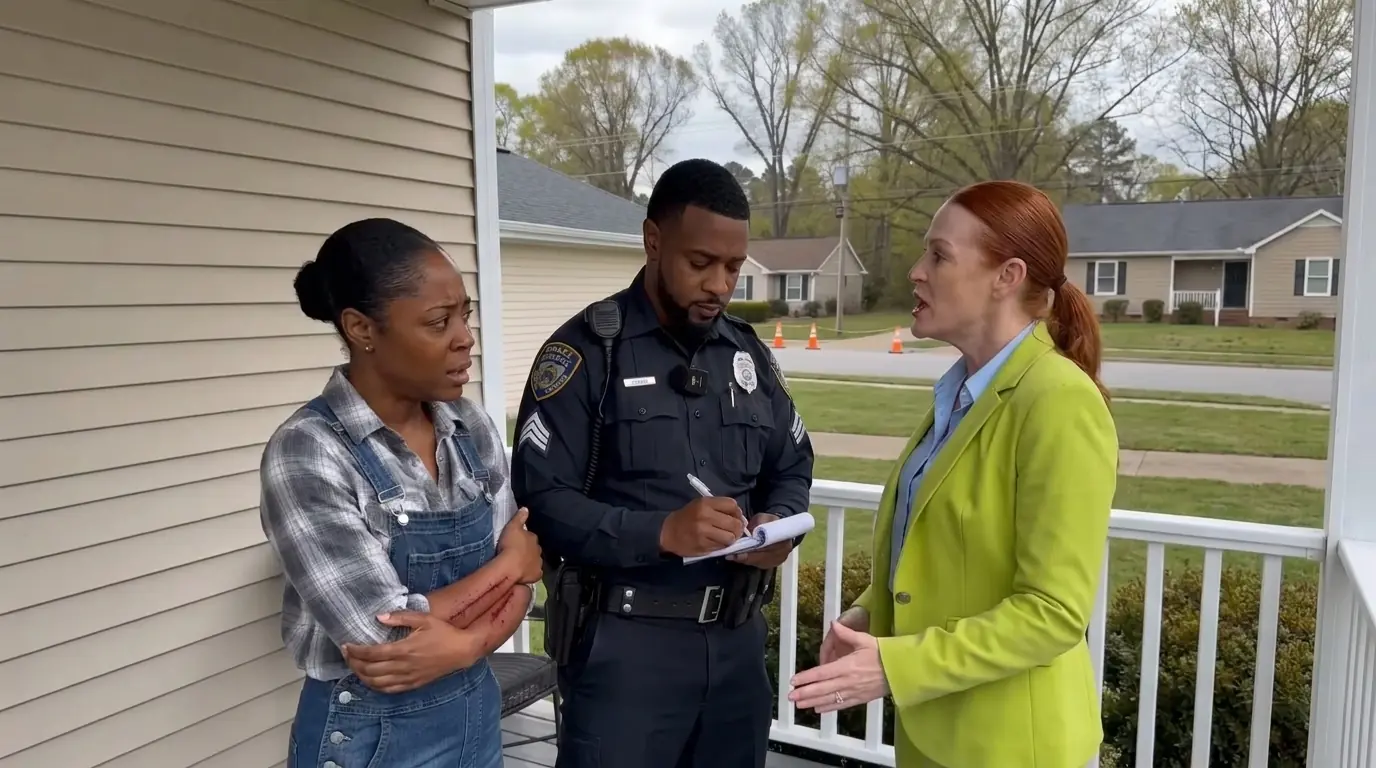
By the time Officer Aaron Mitchell arrived at Pinecrest Commons, the leaf blower had been silent for twenty-three minutes. The orange machine rested on its side near the patio of Unit 41, half covered by wet maple leaves, while forty-six-year-old Carmen Alvarez stood beside the sliding glass door with three angry red scratches above her wrist. Across the shared lawn, sixty-eight-year-old Patricia Langley paced beside the community mailboxes, speaking so quickly into her phone that Aaron could hear her from the patrol car. “She attacked me,” Patricia said. “Maybe not the way you’re thinking, but she absolutely attacked me.”
Aaron stepped from the cruiser and closed the door quietly behind him. His partner, Officer Naomi Brooks, moved toward Carmen while Aaron approached the woman who had called 911. Patricia wore tailored khaki pants, an ivory cardigan, and loafers that had probably cost more than Aaron’s monthly car payment, but the right shoe was soaked from crossing the grass. Her silver hair was cut perfectly at her jaw, and her posture had the rigid precision of somebody accustomed to being taken seriously the first time.
“You’re finally here,” Patricia said. “Good.”
“Aaron Mitchell, Pinecrest Police.”
“I know who I called.”
“I need your name.”
“Patricia Langley.”
“All right, Mrs. Langley. Stay here while we figure out what happened.”
Patricia immediately started toward Unit 39.
“My husband is inside.”
Aaron stepped sideways.
“You can check on him after I understand the scene.”
“I’m the one who called you.”
“I understand.”
“She went after me.”
Aaron looked across the grass at Carmen, who was speaking quietly with Naomi while a teenage girl watched from behind the sliding door. “Calling first doesn’t automatically tell me who the victim is,” he said.
Patricia’s expression changed.
Not much.
Just enough.
Seven months earlier, Patricia would have found that sentence almost insulting. She had spent sixty-eight years believing rules existed to separate order from chaos, and she considered herself very good at knowing which side she belonged on. Before moving to Pinecrest Commons, she and her husband, Henry, had lived thirty-four years in a two-story colonial outside Naperville, Illinois, where Patricia taught English at the same public high school for almost three decades.
She had been respected there. Students knew that essays turned in late lost ten points, hallway passes required signatures, and excuses mattered less than preparation. Other teachers sometimes described her as strict, but Patricia preferred consistent, because strict sounded emotional while consistent sounded fair.
Henry used to joke that Patricia could turn breakfast into a committee meeting. She would give him a look, he would pretend to surrender, and the argument would become one more ordinary ritual inside a long marriage. Then Henry had a stroke.
It happened on a Tuesday morning while he was carrying coffee from the kitchen to his study. The mug broke first, then Henry fell against the cabinets, and for months afterward Patricia remembered the coffee spreading across the tile more clearly than the ambulance. The stroke was considered mild medically, which Patricia learned meant something very different from mild inside a home.
Henry could still speak. He could walk with a cane most days, although his right leg dragged slightly when he was tired, and his right hand never fully regained its old strength. He also became exhausted easily, hated needing help with buttons and shoes, and sometimes lost patience with Patricia precisely because she was the person helping him.
Their daughter Emily lived forty minutes away. She encouraged them to sell the colonial because the stairs had become dangerous, the yard was too large, and Patricia was trying to maintain everything while also managing Henry’s appointments, medication, meals, and physical therapy. Pinecrest Commons looked perfect on paper.
Sixty-two attached townhomes. Exterior maintenance included. Snow removal. Shared landscaping. A homeowners association promising “quiet enjoyment, consistent standards, and respectful community living.”
Patricia read the entire governing packet before signing.
Henry skimmed three pages.
“You’re buying a townhouse,” he told her, “not preparing for the bar exam.”
“Rules matter.”
“People matter too.”
“Rules are how people avoid problems.”
Henry had smiled.
“Sometimes rules are how people turn small problems into official ones.”
Patricia disliked that sentence.
Mostly because she suspected he believed it.
Their first month at Pinecrest went well. Neighbors brought muffins, Henry learned which sidewalk had the shallowest incline, and Patricia arranged the downstairs den into a bedroom so he would not have to climb stairs on difficult days. Then autumn arrived.
The maple tree behind Unit 41 dropped leaves as though it had a personal grievance against the neighborhood. Its branches stretched across Carmen Alvarez’s patio, covering the pavers, garden beds, and narrow walkway her seventy-eight-year-old mother used with a cane. Carmen cleared the leaves several times a week with an electric blower that ran about ten or fifteen minutes.
To most residents, the sound was ordinary.
To Patricia, it became unbearable.
The first time, she closed the patio door. The second time, she turned the television louder. The third time, she walked outside and asked Carmen whether she could use a rake instead.
Carmen apologized for the noise and explained that raking wet leaves took too long before work. She was a physical therapist who reviewed rehabilitation cases remotely for an insurance company, and she usually cleared the patio during her late-afternoon break. Her mother, Rosa, had fallen once on wet leaves the previous year, so Carmen considered the cleanup a safety issue rather than gardening.
Patricia understood the explanation.
She still wanted the blower stopped.
She checked the HOA handbook.
Power tools were permitted between eight in the morning and seven in the evening. Another section prohibited “persistent, excessive, or unreasonable noise that materially interferes with peaceful residential enjoyment.”
Patricia underlined that sentence.
Then she emailed the board.
HOA president Douglas Meyers replied two days later. He was fifty-eight, friendly in the diplomatic way of people who had voluntarily spent years mediating arguments over trash cans and satellite dishes. “Patricia, I understand that the blower is irritating, but Carmen appears to be operating within permitted equipment hours,” he wrote.
Patricia responded with the peaceful-enjoyment clause.
Douglas called her.
“That provision is really intended for ongoing disturbances,” he explained. “Parties, loud music, construction, barking that lasts hours.”
“It says persistent.”
“It does.”
“She uses the blower repeatedly.”
“For ten minutes?”
“Sometimes fifteen.”
Douglas paused.
“Patricia, that isn’t likely to qualify.”
“So the rules mean nothing.”
“That isn’t what I said.”
“What am I supposed to do?”
“Talk to Carmen.”
“I have.”
“Then maybe coordinate a time.”
“She should not get to choose when I have peace in my own home.”
Douglas sighed softly.
“If you believe she violates a municipal noise ordinance, you can call the non-emergency police line, but I don’t think that is where this needs to go.”
Patricia heard something different.
Call the police.
The following Sunday, the blower started at 4:36.
Henry was asleep in his recliner after a difficult morning. His right leg had buckled while dressing, and Patricia had needed nearly twenty minutes to help him from the bathroom floor because he refused to let her call Emily. By late afternoon Patricia had cooked, cleaned, organized medication, answered insurance paperwork, washed bedding, and listened to Henry reject the walker again.
Then the blower started.
The sound entered the house through closed windows.
At least that was how Patricia experienced it.
She walked onto the patio.
“Carmen!”
The blower continued.
“Carmen!”
Carmen finally looked up.
Patricia pointed toward the machine.
“Turn it off.”
Carmen released the trigger.
“What?”
“I’ve asked you repeatedly.”
“And I’ve tried to finish quickly.”
“You used it Tuesday.”
“Yes.”
“And Thursday.”
“Yes.”
“And now again.”
Carmen glanced at the leaves.
“The tree keeps doing that.”
“This isn’t funny.”
“I’m not joking.”
Patricia crossed her arms.
“The HOA has rules.”
“I know.”
“You are disturbing the neighborhood.”
Carmen looked around.
No one else was outside.
“My mother nearly fell here last year.”
“Use a broom.”
“You’re welcome to come sweep wet leaves for me.”
Patricia stared.
“That attitude is exactly the problem.”
Carmen’s expression changed.
“All right.”
She picked up the blower.
“I’m going inside.”
Patricia thought she had won.
Then the blower started again the following Tuesday.
She documented the time.
4:18 to 4:29.
Thursday:
5:02 to 5:15.
Saturday:
3:41 to 3:54.
Patricia created a spreadsheet.
Henry discovered it on the kitchen table.
“What is this?”
“Documentation.”
“Of what?”
“The blower.”
He stared at the printed columns.
“You have a spreadsheet for the leaf blower.”
“I want evidence.”
“Evidence of what?”
“That she is violating peaceful enjoyment.”
Henry sat slowly.
“Patty.”
She disliked that tone.
“What?”
“You have spent more time recording that machine than she has spent using it.”
“That is not the point.”
“It might be.”
She gathered the papers.
“You don’t hear it because you sleep through half of it.”
Henry’s face tightened.
Patricia knew immediately she had gone too far.
His fatigue embarrassed him.
She started to apologize.
He looked away.
“I’m going upstairs.”
“You shouldn’t.”
“I know how stairs work.”
“Henry.”
He reached for the railing.
“Please stop managing me for five minutes.”
Patricia stood at the bottom of the stairs.
The sentence hurt more than she expected.
She blamed Carmen for that too.
By November, Patricia had sent nine emails to the HOA. She submitted two formal noise complaints and one request that Pinecrest ban all power lawn equipment used directly by residents. The board denied the request.
Douglas Meyers visited her personally.
He sat at their dining table while Henry drank coffee and looked increasingly uncomfortable.
“Patricia,” Douglas said carefully, “you have a right to make complaints.”
“I know.”
“But we need to talk about frequency.”
“I complain when there is a violation.”
“The board has determined there is no equipment-hours violation.”
“You refuse to enforce peaceful enjoyment.”
“No.”
Douglas folded his hands.
“We interpret that provision differently than you do.”
“Meaning I’m wrong.”
“Meaning this specific noise is allowed.”
Patricia stared.
Douglas continued.
“There is also another issue.”
Henry looked up.
“What issue?”
“The board received a complaint from Carmen.”
Patricia’s face changed.
“About me?”
“She says you have photographed her patio repeatedly.”
“For documentation.”
“She says you stand near the property line while she works.”
“That is common lawn.”
“She says you knocked on her glass door three times after she stopped answering the front door.”
Patricia’s jaw tightened.
“She was home.”
Douglas remained calm.
“That does not require her to answer.”
Henry closed his eyes.
Patricia noticed.
“You believe her?”
Douglas looked surprised.
“This is not a trial.”
“It feels like one.”
“Then stop treating the neighborhood like evidence.”
Silence.
Henry stared at his coffee.
Douglas softened his voice.
“Patricia, I know you and Henry have had a difficult year.”
“I don’t need sympathy.”
“I’m not offering pity.”
“Good.”
“I’m suggesting this dispute may be carrying more weight than ten minutes of noise.”
Patricia stood.
“The meeting is over.”
Douglas nodded.
“All right.”
Before leaving, he placed an envelope on the table.
Written notice.
No photographing inside another resident’s patio area.
No repeated unwanted contact.
Future noise complaints had to identify actual rule violations rather than simply list equipment use within legal hours.
Patricia read the letter three times.
Then tore it in half.
Henry watched.
“You know that doesn’t cancel it.”
“I know.”
“Patty.”
“Please.”
He became quiet.
That night, Patricia lay awake listening to the furnace cycle.
She thought about her old house.
The cedar fence.
The big kitchen.
Henry mowing the lawn on Saturdays.
Neighbors far enough away that their habits did not cross the property line.
She had not wanted to move.
That was a truth she rarely admitted.
Emily had pushed.
Doctors had pushed.
Henry finally agreed.
Patricia called it practical.
What she felt was loss.
The colonial had contained thirty-four years of evidence that her life worked.
Pinecrest contained shared walls.
Rules she could not control.
A husband she could no longer protect from everything.
A daughter who asked whether she needed help managing bills.
A neighbor whose leaf blower kept reminding Patricia that the world did not reorganize itself simply because she needed quiet.
She hated the machine.
Because hating the machine was easier.
The incident happened four weeks later.
Sunday afternoon.
Cold but dry.
Henry had fallen again that morning.
Not badly.
Still enough that Patricia called Emily despite his objections.
Emily arrived, helped him shower, and asked whether they should hire an aide for three mornings a week.
“No,” Patricia said immediately.
Henry said:
“Maybe.”
Patricia stared at him.
Emily noticed.
“Mom.”
“We can manage.”
Henry looked toward his wife.
“You can manage.”
Patricia’s face burned.
“That is unfair.”
“It is accurate.”
Emily intervened.
“We don’t have to decide today.”
Patricia stood.
“I need air.”
She went outside.
Five minutes later, the blower started.
Carmen stood behind Unit 41 clearing dry leaves from the walkway.
Patricia watched from her patio.
The sound felt personal.
She knew intellectually that it was not.
Emotionally, every burst seemed to arrive directly from Carmen into a part of Patricia already stretched too tight.
She crossed the grass.
Carmen saw her.
Kept working.
Patricia shouted.
No response.
She moved closer.
“Carmen!”
The blower stopped.
Carmen pulled out one earbud.
“What?”
“I need you to turn that off.”
“I’m almost done.”
“No.”
Carmen stared.
“Excuse me?”
“My husband is sick.”
“I’m sorry.”
“He needs rest.”