The dust on the road had a smell to it that day: dry summer earth, horse sweat, and the faint sharp scent of hedgerow flowers growing wild along the lane. Maren Ashcombe walked with a basket on her arm and her bonnet strings loose at her throat, thinking about bread and butter and the small pot of honey her mother had asked her to fetch from the widow down the lane. She was not thinking about dukes. She was not thinking about horses.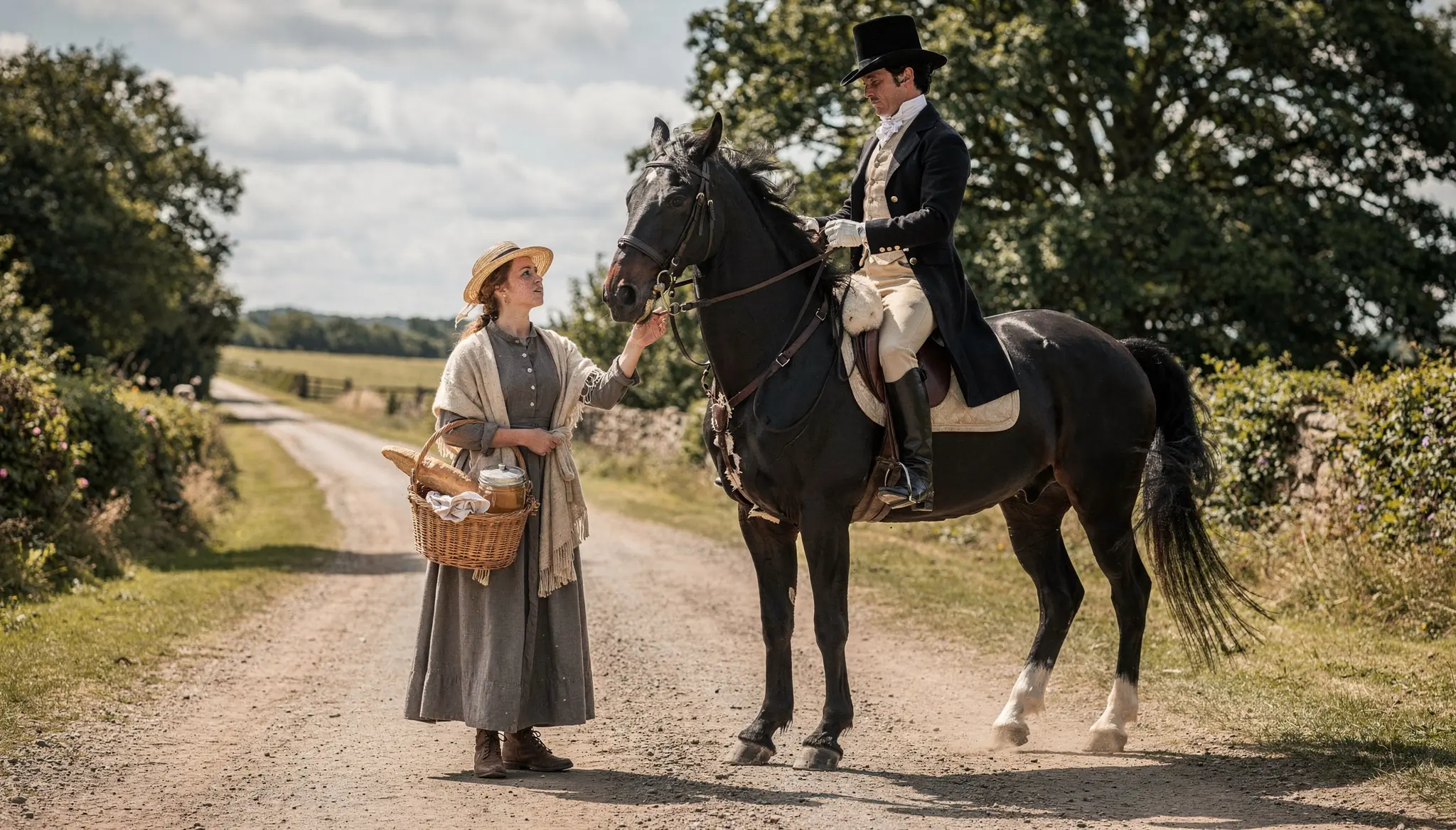
She was thinking about the sun on the back of her neck, the bits of straw clinging to the hem of her plain gray dress from the field she had crossed, and how her father would laugh when he saw her looking more like a farmer's girl than the daughter of a country parson. The lane bent near an old oak, and it was at that bend that she heard hoofbeats. A single horse was moving fast, not at the plodding pace of a farm animal. A hunter, perhaps, or something finer.
Maren stepped to the side of the lane and raised one hand to shade her eyes. The rider came around the bend at a hard canter, and she saw the shine of his boots, the good cut of his dark coat, and the way he sat the horse as if he had been born to it. He was tall, with black hair and a face set in the expression of a man who had somewhere to be and did not much care who saw him getting there. But Maren was not looking at the man. She was looking at the saddle.
She had grown up around horses. Her father kept two, the neighbor kept six, and she had spent half her girlhood in the neighbor's tack room watching an old groom named Barnaby polish leather, mend straps, and mutter that young gentlemen never took proper care of their gear. She knew the sound a good strap made when the buckle was firm. She knew the difference between leather that had been cared for and leather that had been used hard and put away wet.
From twenty paces away, she knew the girth on the rider's saddle was wrong. The leather at the buckle was split, not merely frayed, but split the way old leather splits after being kept too long in a damp place and then dried too near a fire. She could see it moving as the horse ran. She could see daylight through the gap.
"Sir!" she called. Her voice came out clear and firm, which surprised her. "Sir, your girth is going. Your saddle strap is about to break."
The rider did not slow. He glanced at her as he came level, a quick pass of dark eyes, and she saw that he had heard her and chosen not to believe her. The slight tightening at the corner of his mouth told her that he thought she was a village girl trying to stop a gentleman for a coin or a word. He turned his face forward again and touched his heel to the horse's flank.
"Sir!" she called again, sharper now, stepping into the lane. "Please, your girth."
He pulled up, but only because a woman stood in the road and he was not the sort of man to ride her down. The horse tossed its head and blew. The rider looked down at her from a great height, and his eyes were the color of storm water. They were not kind.
"Move aside," he said. His voice was low and clipped. "I am in haste."
"Your girth is split at the buckle," Maren said. She did not move. "If you ride on at that pace, you will be on the ground within the mile."
"I know my own saddle, girl."
"Then look at it." Her chin rose. "Sir, please, look at it."
He did not look at the girth. He looked at her, and there was a flicker in his face that she could not read, something not quite anger and not quite curiosity. Then he touched his heel to the horse again and rode on. The wind of his passing lifted the loose end of her bonnet ribbon.
Maren stood in the lane with her basket on her arm and watched the black shape of him grow smaller against the hot yellow summer road. "Fool of a man," she muttered. Then, because she had been raised by a parson and could not help herself, she added, "God keep him, though."
She had walked perhaps another fifty paces when she heard it. It was not the crack of a whip, which was what a broken girth sounded like at a distance. It was a duller sound, followed by a horse's high, hard cry and the softer, heavier sound of a man hitting the ground. Maren dropped her basket in the lane and ran.
He lay on his back in the grass at the road's edge, half beneath the low bough of a hawthorn. The horse had gone twenty paces farther and now stood with its head down and its sides heaving, the saddle hanging beneath its belly by the one strap that had held. The rider was not moving. His hat was gone, and a thin line of blood ran from his temple to his jaw where a branch had caught him.
Maren dropped to her knees beside him. The grass smelled of crushed clover and hot dust. She could hear a bee somewhere close, the ticking rhythm of the horse's breath, and her own heart pounding loudly in her ears.
"Sir," she said, touching his shoulder. "Sir, can you hear me?"
His eyes opened. They were still the color of storm water, but now they held something that had not been there before. It was not kindness, not yet, but surprise had shaken some of the pride loose from around it. He stared at her for a long moment without speaking.
She watched his chest rise and fall and saw the quick beat of the pulse at the side of his throat. At last he said, "You."
"Yes, me. Lie still. Do not try to sit up. Where does it hurt?"
He drew a breath and winced. "Everywhere. My shoulder mostly, and my pride, though that is my own concern."
"Your pride will mend on its own." Maren tried to sound sharp and matter-of-fact, because if she allowed herself to think about how pale his face was becoming beneath the summer tan, she would begin to shake. Shaking would not help him. "Your shoulder I can look at. Hold still."
She ran her hands lightly along his shoulder through the fine wool of his coat. She had once helped her father set a farmhand's arm, and she had watched Barnaby check fallen boys for broken bones more times than she could count. She knew what to feel for. Nothing was out of place. Bruised, likely, perhaps sprained, but not broken.
She let out a breath she had not known she was holding. "It is not broken, but you will not be riding anywhere today. Can you sit up if I help you?"
"I can sit up on my own."
"Then do it, and stop arguing with me."
He made a sound that might have been a laugh if his ribs had allowed it. He rolled slowly onto one side and pushed himself upright. Maren put a hand under his good elbow anyway, and he did not shake her off. Once he was sitting, he closed his eyes for a moment and breathed carefully while the color slowly returned to his face.
He opened his eyes and looked at her hand. Maren dropped it quickly. "There was a leaf."
"So I see."
"Your horse," she said, trying to cover the sudden heat in her face. "I should see to your horse."
She went to the animal, speaking low and steadily as Barnaby had taught her, and the horse allowed her to approach. She loosened the buckle of the strap that had held and lowered the saddle carefully into the grass. Then she ran a hand down each of the horse's legs, feeling for heat and swelling. There was none.
The horse had not fallen. Only the rider had. The animal was tired and had a small graze on its offside flank where the saddle had swung, but it was sound. Maren led it back and tied the reins loosely to a hawthorn branch.
The rider watched her with a look she could not read. "You know horses."
"I know enough."
"You told me my girth was about to break."
"I did."
"And I did not listen."
"You did not."
He was silent for a long moment. Then he said, "You have my apology."
Maren had not expected that. She looked at him and saw that he meant it. She also saw that he was not a man who offered apologies often, and that he did not enjoy offering this one. She sat back on her heels because it seemed easier than standing over him.
"I accept it," she said, "though the horse would prefer better treatment next time."
"Noted." The faintest lift appeared at the corner of his mouth. "May I know the name of the woman who tried to save me from myself?"
"Maren Ashcombe. My father is the parson at Little Denning, two miles down that road."
"Ashcombe," he repeated, as if tasting the name. "And I am..."
"You are a gentleman who does not check his own tack," Maren interrupted, "and who was in a great hurry to be somewhere. That suggests you were expected, which suggests someone will come looking for you before nightfall. That is fortunate, because I do not think you should walk two miles."
He looked at her for a long moment then. Really looked. Maren had the strange sense that he was seeing her for the first time, not as a woman who had stood in his road, but as a person with a shape and mind of her own. It was not a comfortable feeling. She wanted to look away, but did not.
"You are correct on all counts," he said. "My name is Crispin. I was expected at a house not far from here."
"Then we will get you to that house."
"How?"
"My father's cart. My father is stubborn about his parish rounds, but the cart is not. Wait here."
"Miss Ashcombe."
She had already stood, but turned back. He was looking up at her with that same considering expression.
"Thank you," he said.
Maren nodded once, briskly, and went. She did not look back until she reached the bend in the lane. When she did, he was still watching her, sitting in the grass beside the hawthorn with one hand pressed lightly to his shoulder and his black hair full of summer sun.
That evening, Maren did not tell her father about the storm-eyed rider named Crispin. She told him only that a gentleman had fallen from his horse on the Denning road and that she had helped him. Her father, who was accustomed to his daughter helping people, merely nodded and asked whether the man had been badly hurt.
"Not badly," she said. "Bruised mostly. Bruised in the pride, most of all."
Her father laughed and passed her the bread. Maren thought she would never see the man again. She was wrong.
Three days later, a letter arrived at the parsonage. It came by a groom in green livery, and the groom bowed to her father at the gate, which caused some confusion because country parsons did not generally receive letters delivered by liveried servants. The letter was addressed to Miss Maren Ashcombe. Its handwriting was firm, dark, and slightly slanted, as though the writer had been in a hurry even while being polite.
Miss Ashcombe,
My mother has begged me to write, though I would have written in any case. She would very much like to make the acquaintance of the young woman who prevented her son from breaking his neck upon a country lane. If it would not inconvenience your family, my carriage will call at the parsonage on Thursday next at eleven. You would be doing us both a great kindness by coming to tea.
Yours in gratitude,
Ravensmere
Maren read it twice, then a third time. When she looked up, her father was standing at her elbow and reading over her shoulder, as country parsons will do.
"Ravensmere," he said.
"Yes, Papa."
"Do you know what Ravensmere is?"
"A house, I suppose."
"A house," her father repeated. He gave a small, helpless laugh and sat at the kitchen table with the letter in his hand. "Ravensmere is the seat of the Duke of Ravensmere. His mother is a dowager duchess. His grandmother was cousin to the king."
Maren sat opposite him. The kitchen smelled of the loaf her mother had put in that morning. Outside, her mother was singing to the chickens in the back garden, and a wood pigeon called from the elm at the corner of the house. Maren could hear the blood beating in her ears.
"Papa," she said, "the man I helped in the lane said his name was Crispin."
"Crispin," her father said slowly. "Crispin Ravensmere. That would be the duke."
Maren looked at the letter, then at her father, then at the letter again. "Oh."
The word came out very small.
"Yes," her father said.
She had called a duke a fool, at least under her breath. She had told a duke to lie still and stop arguing with her. She had picked a hawthorn leaf from a duke's hair and informed him plainly that his pride would mend on its own. Maren put her forehead on the kitchen table and made a sound that was not quite laughter and not quite anything else.
Her father patted her shoulder. "Well, you will go to tea, I suppose."
"Papa, I cannot go to tea at Ravensmere."
"You cannot refuse a dowager duchess who wishes to thank you. That is not a thing one does. Also, my child, you will have the sense to wear the blue muslin."
"Papa..."
"The blue muslin," he said firmly. "And your mother's shawl. You will not, under any circumstances, tell the Dowager Duchess that her son is a fool who does not check his own tack."
Maren lifted her head. "I did not call him a fool to his face."
"No. You only implied it. And judging by the way the groom bowed at my gate, His Grace remembers that implication quite clearly."
Maren had never wanted less to attend an appointment. She had also never been more certain that she was going.
Thursday came, as Thursdays do, in its own good time. The carriage sent for her was very fine, dark green with the Ravensmere arms picked out in gold on the door. The groom handed her up. Her mother had cried a little in the kitchen, then laughed at herself for crying, and pressed a small sprig of dried lavender into Maren's palm for luck.
Maren held the lavender in her closed hand throughout the drive. By the time the carriage turned through the gates of Ravensmere, she could smell its crushed sweetness through her glove. She had thought herself prepared for the house. She was not.
The drive ran for nearly a mile between two lines of ancient lime trees. When the trees ended, the house rose ahead of her in gray stone, with countless windows and a great pillared front. Beyond it, she could see the shine of a lake. Maren had grown up in a parsonage of eight rooms. Ravensmere could have swallowed it twenty times over and still had space for a garden shed.
She lifted her chin. She would not make herself small in this place. Her mother had always said that being small in a large place only made the large place larger. Maren would be exactly herself. If that was not enough, then it was not enough.
A butler met her at the door and did not blink when he took her plain shawl. He led her through a hall that smelled of beeswax and old roses, up a pale stone staircase, and into a drawing room that was smaller than she had feared and warmer than she had expected. Sunlight entered through the tall windows in long slanting bars.
A fire had been lit although the day was not cold, because the woman sitting beside it was old, and old bones do not warm easily even in July. She turned her head when Maren entered. Her white hair was coiled at the nape of her neck, and her eyes were the same storm-water gray as her son's, though softened at the edges by years of use.
"Miss Ashcombe," the butler announced, then withdrew.
Maren curtsied. She was proud afterward that her knees did not shake.
"Come here, child," the old woman said. Her voice was thin but firm. "Come where I can see you. My eyes are not what they were."
Maren approached the fire, uncertain whether to sit or remain standing. The old woman gestured toward the chair opposite, and Maren sat.
"So," the Dowager Duchess said, "you are the young woman who told my son his saddle was breaking."
"Yes, Your Grace."
"And he did not listen."
"No, Your Grace."
"And then he fell from his horse."
"Yes, Your Grace."
The Dowager Duchess made a small sound very like the one Maren had made at the kitchen table when she learned who Crispin was. Then, to Maren's astonishment, the old woman began to laugh. Not politely, but truly, until she had to press a lace handkerchief to her eyes.
"Oh," she said when she could speak again. "Oh, my dear, you have no idea how long I have waited for someone to be right and for him to be wrong. Thirty-two years, more or less. Thirty-two years."
"I did not mean to..."
"Do not apologize, child. You saved his life. You may also have saved his character, which was in even greater danger."
The Dowager Duchess put away her handkerchief. "Now, tea. You shall tell me everything, beginning with your father, whom I have not met, and ending with what you thought of my son when you first saw him coming around that bend."
Maren opened her mouth, then closed it. Since there seemed no way out of the room except through honesty, she said, "I thought he sat his horse very well, Your Grace, and that he had the look of a man in a great hurry to reach somewhere he did not much want to go."
The Dowager Duchess stared at her, then laughed again, more quietly this time. "Oh dear. Oh dear. Yes, that is precisely what he was."
Tea arrived on a silver tray. There were small cakes dusted with sugar and a pot of jam the color of dark rubies. The room smelled of bergamot, honey, and the faint dry scent of old books. Maren, who had thought she would be unable to eat, discovered that she could eat quite well.
The Dowager Duchess asked about her father's parish, her mother's chickens, and the school Maren had briefly attended in town. Maren answered honestly because honesty seemed easier than trying to be clever. The Dowager Duchess listened as though the answers mattered. Maren had not expected that.
They had been at tea for perhaps half an hour when the door opened. Crispin entered without ceremony. He was dressed more formally than he had been on the road, in a dark blue coat and a plainly tied white cravat, and he held his shoulder stiffly enough to show that the fall still troubled him.
His hair was brushed. There was no hawthorn leaf in it.
He stopped just inside the door when he saw her. For a moment, his face did the same small, helpless thing his mother's had done, something almost like a laugh and not quite anything else.
"Miss Ashcombe," he said, bowing.
Maren stood and curtsied. "Your Grace."
"Ah," said the Dowager Duchess from her chair. "So it is 'Your Grace' now, is it? Not 'fool'?"
Maren went scarlet. Crispin's mouth twitched.
"Mother, I only observed..."
"Dear, sit down. Both of you. Miss Ashcombe was telling me about the parish school. Do go on, my dear."
Maren sat. Crispin took the sofa at his mother's left, and she became aware of him in the way a person is aware of a fire in a room without needing to look directly at it. He did not speak often. His mother carried most of the conversation.
When Maren mentioned that the schoolmaster kept a lame dog that followed him everywhere, Crispin lifted his head. "A lame dog?"
"Yes, Your Grace. An old spaniel. Its leg was broken by a coal wagon and never set properly."
"Hm," Crispin said.
That was all, but Maren saw him store the fact behind his eyes, just as she had seen him store the memory of her hand beneath his elbow.
When tea was finished, the Dowager Duchess said, "Crispin, show Miss Ashcombe the rose garden before her carriage takes her home. She has come a long way, and it would be a sin to send a young woman back to a parsonage without allowing her to see something worth remembering."
"Mother, the rose garden?"
"The rose garden, Crispin."
He rose and offered Maren his arm. She looked at it for a moment before taking it. The wool of his coat was very fine beneath her gloved hand. She could feel his warmth through it, and the slight stiffness with which he still favored his shoulder.
The rose garden lay south of the house. They walked in silence at first along a pale gravel path that crunched softly beneath their shoes. The roses were at their fullest, with heavy heads of red, pink, and white. Their scent filled the air so thickly that Maren could taste it at the back of her throat.
Bees moved slowly and drunkenly among the flowers, and a blackbird sang somewhere in the yew hedge. The gravel was warm through the thin soles of Maren's shoes, and she could feel each small stone through the leather.
"You are angry with me," she said at last.
Crispin stopped and looked down at her. His eyes were not stormy that day. They were only tired.
"No," he said. "I am ashamed of myself. There is a difference. You told me plainly that my saddle was about to break. I heard you clearly. I ignored you because you were a young woman in a plain dress and I was Crispin Ravensmere, a man who had never been given cause to think that a young woman in a plain dress might know something he did not."
He paused. "I am not proud of the man I was on that road, Miss Ashcombe."
Maren did not know what to say, so she said the true thing. "You apologized, Your Grace."
"In the grass, before you knew who I was and before I knew who you were. That was the apology that counted."
He looked at her for a long moment. Maren heard the blackbird again, the drone of a bee very close, and her own breath moving a little faster than it should have.
"You are a very direct young woman, Miss Ashcombe," he said.
"So my father tells me."
"It is not a common quality."
"It is common enough where I come from, Your Grace. It only seems uncommon here."
He almost smiled. Maren had the sense that he had not smiled properly in a long time and that the muscles required had gone out of practice.
They walked on. Crispin asked about the parsonage, and Maren asked, more carefully, about the estate. He answered, though she saw that he did not much enjoy doing so. Ravensmere sat on his shoulders the way an ill-fitting coat sits, heavy and hot.
He had become duke when his father died, when Crispin was twenty-two. He had managed the estate for eight years and carried a weariness that had nothing to do with falling from a horse. At the far end of the garden, beneath a low stone arch, stood a bench. He gestured for Maren to sit, but remained standing himself.
"Miss Ashcombe, there is a matter of which I must speak."
His voice had changed. It was quieter and more careful. Maren looked up and saw that he was choosing his words as a man chooses stones for a wall.
"I am to be married," he said.
Something in her chest made a small, sharp movement that she had no time to name. She kept her face still. "I congratulate you, Your Grace."
"Do not."
He turned away and looked over the roses. "It is an arrangement. My father made it before he died, and my mother has kept it alive out of respect for him. The lady is the daughter of a marquis. Her name is Lady Portia Wentworth. I have met her four times. She is not unkind. She is not cruel. She and I are, I am told, well suited."
He drew a breath. "I have never chosen anything in my life, Miss Ashcombe. My clothes were chosen for me. My schooling was chosen for me. My title fell upon me. My wife was chosen before I was old enough to know what a wife was, and I have gone along with all of it because that is what a Duke of Ravensmere does. Do you understand?"
"I think so."
"When you stood in the middle of the road three days ago and told me my saddle was breaking, you were the first person in my life who had given me a plain truth without first wondering whether I wanted to hear it. I did not listen because I had never been trained to listen to plain truths, and I paid for that."
Maren remained silent.
"I do not know what to do with the knowledge that such people exist," he continued. "I am telling you this because you asked me a plain question, and I owe you a plain answer. My mother, who is more clever than either of us, guessed the answer before I did and sent us to the rose garden."
Maren looked down at her hands. The sprig of lavender was still there, crushed almost to nothing between her palm and her glove.
"Your Grace," she said, "you are telling me that you are engaged?"
"Yes."
"And that you did not choose it?"
"Yes."
"And that you wish me to know both of those things?"
"Yes."
She lifted her head and met his eyes. "Then I know them. You have done the honorable thing by telling me. I shall go home to my father's parsonage, you shall marry Lady Portia Wentworth, and we shall not speak of this again."
Crispin looked at her. Maren thought later that she had never seen a man look so tired.
"That would be the honorable thing," he said.
"Yes, Your Grace."
"Miss Ashcombe."
"Yes?"
"Thank you for saving my life."
"You are welcome, Your Grace."
He walked her back to the house. The carriage was waiting, and the Dowager Duchess was not at the door to see her off, which Maren understood as a small kindness. Crispin handed her into the carriage. His gloved fingers brushed hers.
It was nothing. It was not nothing.
Maren stared steadily at the seat opposite as the carriage moved away. She did not allow herself to look back until they were well down the drive. Crispin was still standing on the steps with his hands behind his back, watching the carriage go. She turned away.
She did not weep in the carriage. She did not weep at home. She told her mother that the Dowager Duchess had been very kind, that the roses were very fine, and that the Duke had thanked her again for her help. Her mother, who had raised her and therefore knew her, looked at her once with great care and asked no further questions.
Two weeks passed, then three. It was full August now. The wheat in the field beyond the parsonage had been cut and stood in stooks, and the swallows were beginning to gather on the wires.
Maren went about her work. She helped her father with the parish, read her books, and walked to the widow's cottage for honey. She did not think about Ravensmere. She did not think about the rose garden, or about a man's storm-water eyes growing tired when he told her a truth he had never been trained to tell.
She managed not to think about any of it very thoroughly several times a day.
The schoolmaster in Little Denning was a small, tidy man named Mr. Perry. He owned a spaniel called Toby whose left hind leg had been broken by a coal wagon two winters earlier. The dog followed Mr. Perry to school each morning, lay beneath his desk while he taught, and followed him home again afterward.
Toby was good-natured, and the children loved him. Mr. Perry had been unable to afford a proper surgeon when the accident happened. The country bonesetter had done his best, and Toby had survived, but he had survived crooked.
On the last Sunday of August, when Maren came out of church with her mother, Mr. Perry was standing beside the lychgate with Toby on a length of string. The dog was walking. Not perfectly, but walking. His left hind leg was straight.
Maren stopped. Her mother, seeing her stop, stopped beside her.
"Mr. Perry," Maren said. "Toby's leg."
Mr. Perry did not often show emotion in public, but his eyes were shining. "Yes, Miss Ashcombe. A man came from Ravensmere, a surgeon, a proper one from London who was visiting the Duke. He arrived at the school one afternoon three weeks ago and said he had been sent to look at the dog. He would take no fee. He said his fee had already been settled."
Maren said nothing.
"He set the leg again properly," Mr. Perry continued. "He stayed two nights at the inn to watch the healing. Two nights, Miss Ashcombe, for a schoolmaster's dog."
"Oh," Maren said.
The word came out very small, just as it had at the kitchen table.
"I asked who had sent him, but he would not say. He told me only that his instructions had been particular. No one was to know. I was not to write letters of thanks. If anyone asked, I was to say that a traveling surgeon had passed through and been kind."
"Oh," Maren said again.
"But you saved his life, Miss Ashcombe. Everyone knows it, though you have said nothing. When the surgeon came and would give no name, I thought perhaps you should know. Only you, not the parish."
Beside her, Maren's mother made a small sound. Maren knelt in the churchyard grass, and Toby came to her, string and all. She placed her hand on his head. His fur was warm from the sun, and she felt his heartbeat beneath her palm.
"Good dog," she whispered. "Good dog."
She did not weep then either, though it was a near thing.
Maren and her mother walked home in silence. At the parsonage gate, her mother stopped and placed a hand on her arm.
"Maren."
"Yes, Mama?"
"He is a duke."
"I know, Mama. He is engaged."
"I know that too. He fixed the schoolmaster's dog because you mentioned it once at tea."
"Yes, Mama."
Her mother was quiet for a moment. Then she said, "Your father and I did not raise you to be a fool, my love, but we did not raise you to be a coward either."
She went inside, leaving Maren alone at the gate.
That evening, a letter arrived for her father. It came from Ravensmere, but it was not from the Duke. It was from the Dowager Duchess. Her father read it and passed it silently across the table.
Reverend Ashcombe,
Circumstances at the house have altered in a manner I did not anticipate. My son has this morning dissolved his engagement to Lady Portia Wentworth. The lady has, I am told, been very gracious about it, which does her credit. She was, I believe, no more eager for the match than he.
He has made her a settlement from his own funds that will, I hope, allow her to make a better choice in her own time. He has not told me the reasons for his decision. He has told me only that he could not go through with it in good conscience. I know my son. When he says a thing is a matter of conscience, he means it.
I write because I know he will not write to you himself, out of a scruple that is admirable and inconvenient in equal measure. If your daughter would be so good as to come to tea again on Thursday, I should be very glad. I make no promises for my son's behavior, only for my own.
Yours in warmth,
Cordelia Ravensmere
Maren read the letter three times. Her father watched her.
"Well," he said at last. "You will go, of course."
"Papa, he broke off his engagement because of a promise he made me in a rose garden, a promise I told him not to make."
"Maren, my dear child, he did not break off his engagement in a rose garden. He broke it off in a study, alone, three weeks after you left, having thought about it every day of those three weeks. If you imagine the honorable thing is to refuse this invitation, then you have misunderstood what honor is."
He leaned back in his chair. "Honor is not the avoidance of consequences. Honor is the meeting of them."
Maren looked at her father and thought, not for the first time, that in his quiet parsonage way he might be the wisest man in England.
"I will go, Papa."
"Wear the blue muslin," he said, "and your mother's shawl. Do not, this time, imply that the Duke of Ravensmere is a fool. He is not a fool. He is a man who has finally begun to choose."
Maren wore the blue muslin and her mother's shawl, and she went. The carriage came again. The lime trees lined the drive again. The gray stone house rose before her again.
This time, she was less afraid. It is a strange thing about fear: the second time a person enters a great house, the house has already been entered once and cannot frighten in quite the same way.
The Dowager Duchess was in the drawing room beside the fire. She held out her hand. Maren went to her and kissed it, which she had not been taught to do, but which the moment seemed to require.
"My dear," the Dowager Duchess said, "sit. Tea will come. My son will come too, in his own time. He is at the stables. He tells me he is checking the tack of every horse in the house himself, which I gather is a habit he has recently acquired and does not intend to abandon."
Maren laughed. She could not help it. The Dowager Duchess laughed with her.
When they were quiet again, the old woman said, "Before he comes, I wish to say one thing to you, my dear, and only one. You may take it or leave it as you choose. My son is a good man. He was not always easy to see as one because his father raised him to hide it out of some misguided belief that softness is weakness."
She folded her hands in her lap. "But he is a good man, and he is at last becoming a man who is not afraid to be seen being one. If you have any part in that becoming, then you have my thanks. You also have my blessing, whatever comes of it. Do you understand me?"
"Yes, Your Grace."
"Good. Now, tea."
Tea came. Crispin did not.
Half an hour passed. The Dowager Duchess talked about her garden, her old spaniel who had died the previous winter and whom she still missed, and a book she was reading but did not care for. Maren answered, listened, and sipped her tea.
She discovered that she was not nervous. She was something else. She was waiting.
At last the door opened. Crispin entered in plain riding clothes, his hair carrying the untidy look of a man who had been out in the wind. He stopped just inside the door when he saw her. He had done that before. It seemed to be a thing he did.
"Miss Ashcombe."
"Your Grace."
"Crispin, you are late," his mother said.
"There was a girth on the bay mare worn at the buckle. I replaced it."
"I see."
Crispin looked at Maren. "Miss Ashcombe, would you walk with me?"
She stood. She did not look at the Dowager Duchess because she knew the old woman was hiding a smile behind her teacup, and Maren did not think she could bear that smile just then.
They did not go to the rose garden. They walked down through the terrace, past the yew hedge, and along a gravel path that skirted the lake. The water was very still. Swallows skimmed low and fast above it, and a heron stood on the far bank like a gray stone.
The path smelled of cut grass and lake water, with the faint iron scent of the stone balustrades. Crispin did not speak for a long time. Neither did Maren. Gravel crunched under their feet, a woodpecker sounded somewhere in the beeches beyond the lake, and Maren felt the sun upon the crown of her bonnet.
At last he stopped where the path widened beside an old stone bench at the water's edge. He did not sit. He turned to face her.
"Miss Ashcombe."
"Your Grace."
"I did a thing I said I would not do. I broke an engagement. I hurt a woman who did not deserve to be hurt, though I have tried to make what amends I can. I have caused my mother a great deal of trouble, though she pretends otherwise, and I have caused talk in London that will not die for a year."
He held her gaze. "I have done all of this because, on a summer road three months ago, a young woman told me a plain truth and I did not listen. I have been listening ever since."
Maren remained silent.
"I did not ask you to wait," he said. "I did not ask you anything. I told you a truth in a rose garden and sent you home because I believed that was what honor required. I have since discovered that I was mistaken about honor. Honor is not the avoidance of consequences. Honor is the meeting of them."
Maren nearly laughed. Her father and now this man had spoken the same words within the same afternoon of her life.
"So," Crispin continued, "I am here, and I am meeting them. I have no engagement now. I have no arrangement. I have no bride chosen for me by a father who has been dead for eight years. I have only myself, standing before a woman I do not deserve, telling her that if she should ever find it in her to consider me, I would spend the rest of my life listening when she told me plain truths."
His voice grew quieter. "I would check my own tack before riding out. I would try, so far as I am able, to become a man worthy of being told those truths."
The heron on the far bank moved suddenly, rising from the water in a great slow sweep of gray wings. Maren watched it go. She let the moment last as long as it needed to last.
She heard Crispin breathing and heard her own heart. She smelled the lake, the cut grass, and the faint sun-warmed sweetness of roses from the other side of the house. She felt every stitch of her mother's shawl on her shoulders.
In that slow moment, she thought of the road, of the crack she had heard and the softer sound of him striking the ground. She remembered his face when she knelt beside him, the hawthorn leaf in his hair, the schoolmaster's dog walking on a straight leg, the Dowager Duchess laughing, and her father saying that honor was the meeting of consequences.
Maren looked up at him. "Your Grace."
"Please," he said. "Crispin."
"Crispin."
He waited.
"When I told you on the road that your saddle strap was about to break, you did not listen because you thought you knew better than a girl in a plain dress. That is the truth of what happened. Is it not?"
"It is."
"I want you to hear me now."
"I am listening."
"I am not a great lady. I am not the daughter of a marquis. I do not know how to run a house of a hundred rooms. If you take me into that house, I will make mistakes every day. Some of them will embarrass you, and some will embarrass me. The world will talk of us for a year or two, and then it will find something else. Do you understand?"
"I understand."
"I do not want to be a duchess. I have never wanted to be a duchess." She took a breath. "But I would rather be a duchess at your side than be anything at all without you. That is a plain truth. It is the plainest truth I have. Do you hear it?"
"I hear it."
He did not move for a long moment. Then he closed the space between them with a single step, though he still did not touch her. He only looked down, and she looked up.
"Miss Ashcombe."
"Yes?"
"May I?"
"Yes, Crispin."
He took her hand. Only her hand. He lifted it, turned it palm upward in his own, and studied it as though it were a small miracle he had been granted the privilege of examining. Then he raised it to his mouth and pressed his lips to the inside of her wrist, where her pulse beat.
His mouth was warm. Maren felt the light, dry brush of it, the small catch in her breath, and the slow bright turning of everything inside her chest.
"Thank you," he said against her wrist.
"For what?"
"For telling me my saddle was breaking."
She laughed. The sound came out shaky, full, and true. "You did not listen."
"I have not stopped listening since."
They stood there a long moment more. The heron returned and settled again on the far bank. The sun moved a little across the sky, and the gravel remained warm beneath their feet.
Maren knew clearly that this was the moment she would remember when she was old, sitting beside a fire with hands like her mother's and white hair. Not some grand moment still to come. This one. Her wrist beneath his mouth, the heron, and the lake.
They were married in the parish church at Little Denning during the second week of October. Maren's father read the service. Crispin's mother sat in the front pew and cried without shame, which shocked several guests and delighted Maren's mother, who had feared she would be the only one weeping.
Lady Portia Wentworth sent a small wedding gift and a note.
With genuine warmth, I wish you every happiness. If the Duke ever fails to check his tack, please write and tell me, so that I may laugh at him from a distance.
Maren kept the note in a drawer for years.
They lived at Ravensmere, and Maren made mistakes, just as she had promised. During her first month, the housekeeper deliberately told her the wrong thing twice. Maren did not learn until the third month that the old woman, who had served three generations of the family, had been testing her.
Maren called her into the small study one afternoon. In a calm voice, she said, "I do not think we shall need to test one another any further."
For the first time, the housekeeper dropped her a proper curtsy. "No, Your Grace. I do not think we shall."
The Dowager Duchess laughed for a full minute when she heard what had happened.
Crispin checked his own tack every morning. Quietly and without announcement, he also arranged a small pension for Barnaby, the old groom at the neighbor's barn, because Maren had mentioned him once and because Crispin had begun to understand that a man is often only as good as the people who first taught him.
Barnaby never knew who had done it. Maren learned the truth from her father a year later, but she did not tell Crispin that she knew.
There is a moment sometimes in the drawing room at Ravensmere, in the small hour before dinner, when the light through the tall windows turns gold and the servants have not yet come to close the shutters. In that moment, Maren, who is now a duchess and no longer minds it very much, sits beside the fire with a book in her lap that she is not truly reading.
Crispin enters with his shoulder held easily and his eyes no longer tired. He crosses the room and sits beside her without a word. Then he takes her hand, turns it over in his own, and looks at it as though he has never seen it before.
She warned him once, on a summer road, that his saddle strap was about to break. He did not listen then. He has listened ever since.
In the end, that was the whole of it. It was enough. It was more than enough. Together, they came to understand the whole quiet shape of a good life.