The bridge was going to kill someone before the week was out. Marin knew it the way she knew the shape of her own hands. She had seen the cracks grow wider through the winter, felt the shudder of the boards under her boots each time she crossed, watched a stone fall from the north pillar into the black water below, and never come back up. She had told the steward.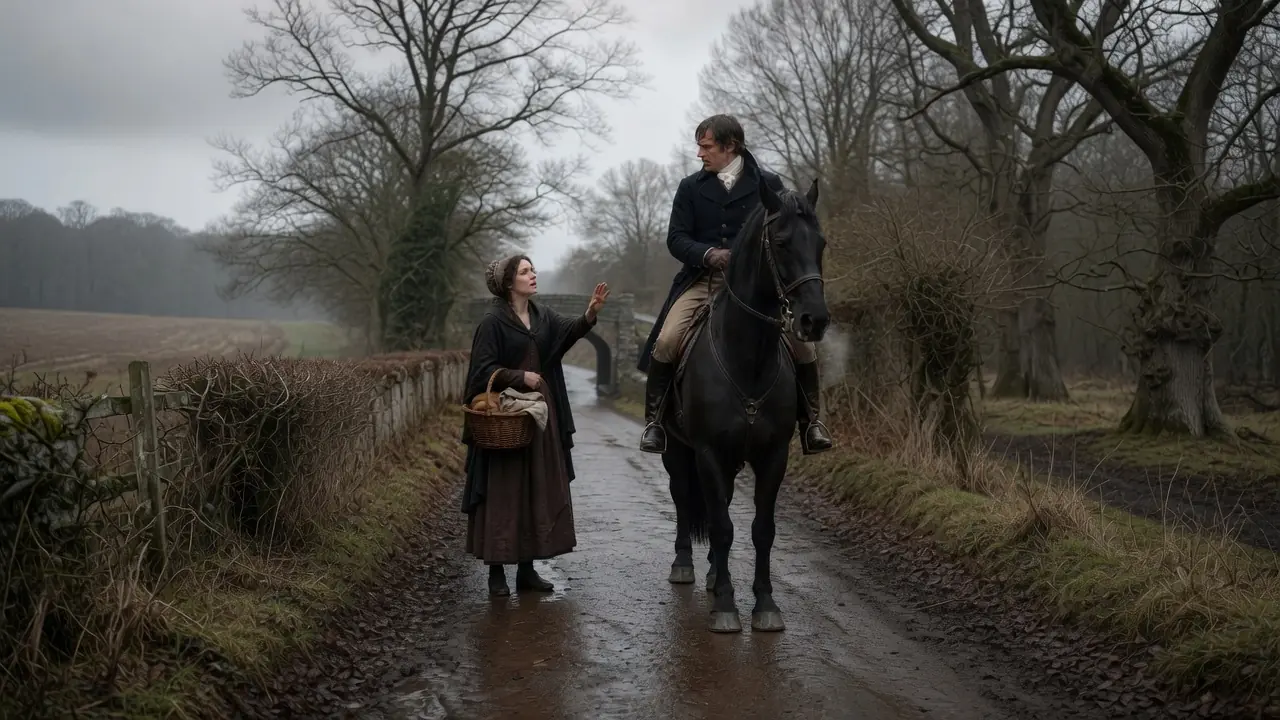
She had told the vicar. She had told the miller, who had only laughed and said the bridge had stood since his grandfather's time and would stand a while longer. None of them had listened because none of them were the sort of people who listened to a woman who lived alone in a small stone cottage at the edge of the wood and mended other people's linens for her bread. So on the morning it happened, she was walking the road herself.
The sky was the color of pewter, low and heavy, and the wind carried the smell of wet leaves and the far-off smoke of a farmer's fire. Her boots made a soft sound on the packed earth. In her basket she carried two loaves, a folded shirt she had finished the night before, and a small tin of salve for the smith's wife, whose hands cracked in the cold. She walked with her head down, and her thoughts folded neat inside her, the way she had learned to keep them.
She heard the horse before she saw it. A heavy sound, not the trot of a farm beast, but the long, easy stride of a hunter, iron ringing against stone at the far bend of the road. She stopped in the middle of the path. She lifted her head.
The wind pulled a loose strand of dark hair across her mouth, and she did not lift her hand to move it. The horse came around the curve. It was black, tall, its breath rising in white columns from its nostrils. On its back sat a man in a dark riding coat.
No valet, no groom, no second horse. He rode alone and he rode fast. The way a man rides when he has been in the saddle since dawn and means to be home by dusk. His head was bare, his hair was the color of wet oak.
He did not see her yet because his eyes were fixed on the far turning where the road bent toward the bridge. She stepped into the middle of the road. She raised one hand, the horse threw its head. The man drew back sharply on the reins, and the animal came down from its long stride into a rough walk, hooves sliding a little on the wet stones.
He was close enough now that she could see his face. It was not a soft face. The bones were hard under the skin. There was mud on the hem of his coat and on the top of one boot.
His mouth was a straight line, and his eyes when they found hers were a strange pale gray, the color of the sky above them. "Sir," she said. Her voice was quiet, but it did not shake. "You cannot ride on." He did not answer at once. He looked down at her from the saddle as if she were a puzzle he had not expected to solve on the road that morning. His gloved hand rested easy on the pommel. The horse stamped, blowing hot breath through its nose, and the smell of the animal, warm and grassy, and iron sharp with sweat, came to her on the wind. "I beg your pardon," he said at last.
His voice was low. It had the shape of an educated man in it, though he did not use more words than he needed. "I am in something of a hurry."
"I know you are," she said. "I could hear you a quarter of a mile back. That is why I stepped out. If you go on the way you are going, you will be in the river inside ten minutes." His brows drew together. He was not used, she saw at once, to being told he could not do a thing. There was a stillness in the way he sat the horse, a kind of quiet weight that told her he was a man who was used to being obeyed. She had known men like that before, and she had learned long ago that the only thing to do with such men was to speak plain and not soften a single word. "The bridge ahead is broken," she said. "The north pillar has been cracked since Michaelmas. The middle beam gave way last Tuesday, and the boards over it are only a plank thick. A horse the weight of yours will go straight through.
If you fall from that height, you will not come up. The current is quick under the stones, and the water is cold enough to stop a heart in a minute." She said it all at a steady pace, without hurry, the way she might have told him the price of eggs. She watched his face while she spoke. She saw the small shift in his jaw when she said the boards were only a plank thick. She saw the slight tightening of the reins in his hand. "You are certain of this?" he asked. "I have crossed it three times this week," she said. "I felt it move under me the last time. I told the steward on Monday. He said he would send men. He has not sent them."
"The steward of what estate?" he asked. There was a new note in his voice, though it was so slight that she almost did not hear it. "Ashenford," she said.
He was quiet for a long moment. The horse blew again. A rook called from somewhere above the road. One long harsh cry, and then another.
The wind moved the tops of the black trees. She waited. She was not going to move out of the road until he had understood her. "You are walking that way yourself." It was not quite a question. "I was going by the mill path," she said. "There is a footpath half a mile back that goes down through the alders and comes up on the far side by the ford. It is shallow enough there for a person on foot. I would not send a horse across." "Show me," he said. She looked at him. She had not expected that.
She had expected him to argue with her, or to thank her without meaning it, and ride on anyway, or to laugh the way the miller had laughed. She had not expected him to speak the one word and swing down from the saddle in a single easy movement, as if his mind had been made up already, and he had only been waiting for her to finish speaking. He was tall. When his boots hit the road, he was a full head above her, and broader across the shoulders than she had thought.
While he was on the horse, he took the reins in one gloved hand and looked at her steadily. "After you, madam," he said. She did not curtsy. She was not sure why.
Water dripped from their bare branches. The smell here was different from the road, sweeter, colder, full of moss and rot, and the mineral breath of the river below. Her boots sank a little into the black leaf mold. She heard him shorten the reins as the horse picked its way behind her. "You know this wood," he said after a time. "I have lived beside it since I was six years old," she said. "And who taught you to look at a bridge and know when it will fall?"
"My father was a carpenter," she said. "Before he died, he used to take me with him when he went to look at things. He used to say, ‘A piece of wood tells you what is wrong with it if you are willing to hear.’" She did not know why she was telling him this. She never told anyone this.
She kept walking and did not look back at him, and the path took them down and down toward the sound of moving water. The ford was where she had said it would be. The river was wider here and less deep, running fast over a bed of pale stones. She stopped at the edge and pointed. "Two feet at the deepest point in the middle," she said. "The horse can walk across without swimming. The bottom is firm. Do not let him drink until you are on the far side, or he will stand and refuse to move." He looked at her for a long moment before he looked at the water. Then he took his glove off and touched the horse's neck once and led it down into the ford. The water rose to the animal's knees, then a little higher. It did not go higher.
He crossed carefully, one hand on the bridle, his boot submerged to the ankle. When he reached the other side, he turned and looked back at her across the running water. "Come across," he said. "I am going the other way," she replied. "The smith's wife is waiting for me." "Then let me pay you for your trouble," he said. He had already put his hand inside his coat. "You do not owe me anything," she said. "I would have told anyone. I am telling you the same thing I told the steward. If you get to Ashenford before nightfall, you might tell him again. He may listen if it comes from a stranger."
He stood very still. His hand was still inside his coat, but he had not taken anything out of it. The water made its steady sound between them. He looked at her across the ford with those pale gray eyes, and something in his face changed, though she could not have said what. "What is your name?" he asked. She hesitated. It seemed a strange question from a man who was not going to see her again. "Marin Ashby," she said. "Miss Ashby," he repeated, and gave a small bow from the far side of the water, and it was a proper bow, the kind a man gives a lady in a drawing room, not the kind he gives a girl on a road. "I am obliged to you." She did not return his bow with a curtsy. She turned and walked away up the alder path and did not look behind her until the sound of the horse and the man was gone. It was only when she was back on the road, walking toward the smith's cottage with her basket bumping against her hip, that she thought about the coat. It had been very good cloth.
She had put her hand on such cloth many times, mending it. The buttons had been bone and silver. The boots under the mud had been made by a boot maker in London, not in any village she knew. She had noticed all this and stored it away without thinking, the way she noticed the strength of a seam.
She thought about it, and she thought about the way he had said the name of the estate, and she stopped in the middle of the road for one long moment, with the wind moving her skirt around her ankles. Then she walked on. At Ashenford, the Duke of Ashenford handed his horse to a groom in the yard, and walked into his own house without speaking. He had been away six months.
In that time his father had died and he had come home to bury him and to take up a thing he had not been ready to take up. He was not a young man but he was younger than the title and he felt the weight of it in his shoulders. He climbed the wide steps and passed through the grate door and stopped in the hall where his housekeeper waited for him with her hands folded in front of her apron. My lord, she said.
Her eyes were red at the edges. Welcome home, Mrs. Pell," he said. His voice was still low. "Send for the steward.
"At once, my lord." He walked past her into the library, where a fire had been kept going for him since dawn. He did not sit down. He stood in front of the fire and put his gloved hand on the mantel.
And he looked at the flame without seeing it, and he thought about a woman standing in the middle of a wet road with her hair blown across her mouth, telling him that if he did not stop, he would be dead inside ten minutes. He thought about it for a long time. When the steward came in, the steward was talking before he was through the door. He was a heavy man, red at the neck, with the smell of the yard on his coat.
My lord, I was not told you would arrive so soon I would have. The bridge on the north road, said the Duke. The steward stopped. My lord, the bridge on the north road is broken.
The north pillar has been cracked since Michaelmas. The middle beam gave way last week. A horse the weight of mine or a carriage with any weight in it will go straight through the boards. You have been told this before.
The steward opened his mouth. He closed it. He opened it again. My lord, I There has been talk, but I was not certain.
You will send four men to the bridge tomorrow at first light. You will close the road at both ends until the work is finished. If any tenant of mine is hurt on that bridge between now and then, you will not be my steward the day after. "Do you understand me?" Yes, my lord.
"Good." The steward waited, but the Duke did not speak again, and after a moment the steward bowed himself out. When the door closed, the Duke stood a long time in front of the fire. Then he sat down at his father's desk, which was his own desk now, and he pulled a piece of paper toward him, and dipped a pen in the inkwell.
He wrote a short note. He folded it. He sealed it with his father's seal, which was his own seal now, and he rang the bell. "Take this to a Miss Marin Ashby," he said to the footman. "Ask in the village. The vicar will know where she lives." The footman took the note and left. The Duke stayed at the desk. He did not open any of the letters that had been waiting for him. He sat with his hands folded and looked out of the window, and he thought about the way she had said, "I would not send a horse across. Not you cannot go, but I would not send a horse across." As if the horse were what mattered. As if she had not once thought of what she was owed for standing there. Marin was mending a sleeve by the window when the footman came to her door. He was very tall and wore a coat with silver buttons and looked at her cottage as if he were not quite sure how to knock at such a door without breaking it.
He gave her the note and stepped back. She turned it over in her hand. The seal was red wax pressed with a shape she did not know, a hawk on a small crest. She broke the seal carefully with her thumb.
The note was three lines. Miss Ashby, I am obliged to you more than I said this morning. If you have need of anything within my power, send to the house. Do not hesitate.
Ashenford, she read it twice. She folded it. She looked up at the footman whose face was very careful and gave nothing away. "Thank you," she said. "There is no reply."
"Very good, madam." He bowed to her as if she were a person in a drawing room and turned and left. She watched him walk down her narrow garden path between her rows of dead winter cabbages, and she stood in her doorway with the note in her hand, and she felt for a moment as if the world had shifted a little sideways under her. She put the note in a drawer under her folded aprons. She did not tell anyone. She sat down again at the window with the sleeve, and she went on mending.
Her hands were steady, but her mind was not. She thought about the man on the black horse, and she thought about the bridge, and she thought about how easily he might have been dead. She thought about how easily she might have been walking home in the evening to the news that a stranger had gone into the river at the North Bend, and no one to blame but the steward, and no one to grieve but a name she had not known. She did not think then of what it might mean that the same stranger was the man who owned the road and the bridge and the wood and the field where her cottage stood and every acre for eight miles in every direction. She kept that thought at arms length because it was too large a thought to hold beside a needle and a piece of linen.
For a week she did not see him again. Men came to the bridge as he had said they would. She walked past on the second morning and saw them, four of them with saws and ropes, and a fifth man on a rope down over the water working at the cracked pillar with a mallet. The road was closed at both ends with wooden barriers. The miller stopped her on her way back and said, sharp and short, "You were right about the bridge, then." She said only, "Yes, I was." He did not thank her.
He did not apologize. He looked at the closed road and shook his head and walked away.
And she thought, "This is why I did not marry anyone from this village." On the eighth day, she was in the churchyard cutting a few sprigs of winter jasmine to put on her mother's grave when a shadow fell over her. She did not look up at once. She finished the sprig she was cutting, and she straightened, and then she turned.
He was standing three steps away on the grass path between the stones. He wore a dark coat, better than the riding coat and no hat. His hair was pushed back from his forehead. His eyes, in the flat winter light, were the same pale gray she remembered. "Miss Ashby," he said.
She curtsied this time. It was very small. "My lord," she said. He looked at her steadily.
She had expected him to be startled that she had worked it out, but he was not. He had known she would. "Then you have heard," he said. "The footman had silver buttons," she replied.
"And the seal on your note was pressed with your family crest."
"Ah," he said. "I did not think of that. I am not yet used to my father's seal." She did not know what to say.
She held the sprigs of jasmine in her hand. The wind moved through the yew tree above them and made a low sound. He looked past her at the stone she had been standing over. "Your mother?" he asked.
"Yes."
"When?"
"Six years ago." He nodded. He did not offer any of the empty words people usually offered. He only stood a little longer looking at the stone. Then he looked back at her.
"I came to say what I did not say properly on the road," he said. "You saved my life. I did not thank you as a man should. I have not been home long, and I was not thinking as I ought to have been. I would like to thank you now."
"My lord, you owe me nothing."
A very small smile touched the corner of his mouth, though the rest of his face remained serious. "Allow me the courtesy of being obliged to you. I have very few people to whom I owe my life. I would like you to be one of them." She looked down at her jasmine. She felt the cold of the stone through her boots and the sharp small smell of the flowers on her fingers. "Very well, my lord," she said. "Thank you," he replied.
He bowed. It was the same bow as at the Ford, only closer now, and she could see the small line at his throat where his shave had caught, and the faint gray at his temples that had not been there in his hair a year ago. "Will you walk with me a moment? There is something I would ask you." She hesitated. She looked around the churchyard. There was no one else there, only the rooks in the yew tree and the wind and the low gray sky. It was not proper. She knew it was not proper. But nothing about this morning had been proper, and there was in the way he stood no threat and no expectation, only the plain request of a man who wished to speak. "Yes, my lord," she said. They walked out through the churchyard gate and along the low wall that ran beside the road. He did not offer her his arm. He seemed to know she would not have taken it. They walked side by side with a proper distance between them, and he did not speak until they had passed the last of the cottages and were on the open path where the fields ran down toward the river. "The steward has been dismissed," he said. She turned her head to look at him. "He should have been dismissed six months ago," he said. "And would have been if my father had been well enough to see what he had become. That is not your concern. It is mine, but I wished you to know because you told me on the road that you had warned him about the bridge, and I did not want you to think you had been ignored a second time." She did not know what to say.
She kept walking. "The bridge will be finished by the end of the week," he said. "You may use it again in safety by Sunday." "Thank you, my lord." He was quiet for a few paces. Then he said, "I have been thinking about what you said about your father."
She looked at him again.
"You said he was a carpenter, that he taught you to see when a piece of wood is failing."
"Yes."
"I have a great many pieces of wood on this estate," he said. His voice was even. "Barns, byres, roof beams, gates, and posts, and half a hundred bridges smaller than the one that nearly took me into the river. My father let a great deal go in his last years and I have inherited it and I do not know one board from another. I need a person who does. I mean to pay a man properly to walk the estate with me and tell me what is falling down before it falls."
He stopped walking. She stopped too. He turned to face her. "I do not know if any such person still lives near enough to hire," he said. "But since I owe you my life, I thought I would ask you first—not to walk the estate; I would not ask that of a woman alone. But if you know of such a man in the villages, someone your father trusted, someone who might still be alive, I would be in your debt again." She stood on the path with the wind pulling her cloak against her legs, and thought about it. She thought a moment longer than he had expected because he did not press her.
He waited. His hands were folded behind his back. He did not lean toward her. He gave her the time.
"There is a man in Ray," she said at last, "two villages east. His name is Tom Hindmarsh. He was my father's apprentice. He is not young, but he is not old either, and he knows every joint my father knew. He works now for the church, but he would take other work if he were asked. If you tell him you were sent by John Ashby's daughter, he will listen." "Then I shall go to him tomorrow," said the Duke. "He drinks his tea very strong, my lord," she said before she could stop herself. "You will offend him if you offer him small beer at midday." The corner of his mouth moved again. "I shall remember," he said. They walked back to the churchyard in silence. At the gate, he stopped and bowed to her again, and she curtsied, and he did not touch her hand or ask if he might call or say any of the things he might have said.
He only wished her good day and turned and walked away down the road toward his horse. She stood at the gate a long time with her jasmine cold in her hand. She told herself, walking home, that this was the whole of it. He had been polite.
He had thanked her. He had asked her advice about a carpenter. Nothing more would come of it, because nothing more could come of it. He was a duke and she was a mender of linen who lived alone in a cottage on his land.
There was a barrier between them so high and so wide and so old that no living person had ever climbed it. She was cleareyed about this. She had always been cleareyed. She would not begin now to be a fool.
It was the barrier that made everything possible in the end. She was so certain of it that she stopped guarding against him. She let him speak to her when he found her on the road. She let him stop at her cottage door once when he was riding by to tell her that Tom Hindmarsh had been hired and had already found four beams in the old tithe barn that needed replacing.
She let him stand in her small garden and admire her winter cabbages of all things and asked what she planted in the spring. She did not ask him inside. He did not ask to be asked. He stood at her gate with the reins of his horse in his hand and spoke to her over the low wall as if that were the most natural thing in the world because it could not go anywhere.
She told herself it did not need to be feared. She could speak plainly with him. She could disagree with him. When he said one afternoon that he did not think much of the vicar's last sermon, she said the vicar had never thought much of anything, and it was a wonder the church did not fall down from the weight of his lack of ideas.
He had laughed at that. He had laughed out loud and she had heard a rook lift out of her apple tree at the sound because he did not, she suspected, laugh often, and the sound was not the sound of a practiced gentleman, but of a man startled into it. He came often after that, never inside the cottage, always at the gate or on the road, or once at the ford where she had shown him how to cross. He was always alone.
He always came on the black horse. He always stayed a little longer than he had meant to. She always sent him away before it grew dark. She thought no one had seen.
She was wrong. In a village where nothing happens, the sight of a duke leaning on the gate of a mender of linen was the only thing anyone had to talk about. It was talked about in the tap room. It was talked about at the well.
It was talked about eventually by a woman who had reason to talk about it, and who came in a black carriage one afternoon in the third week of March, and who did not knock at Marin's door, but stood outside her gate with her gloved hands folded neatly at her waist, and her small hard mouth set in a line. Marin saw her from the window. She knew at once who it was. There is a way a certain kind of woman stands when she has come to see a person she considers beneath her.
Marin dried her hands on her apron. She smoothed her hair. She went out. "Miss Ashby," said the woman.
She did not curtsy. Marin did not either.
"I am Lady Renford. I believe you know my nephew."
"I know a great many people, my lady," said Marin.
"You know the Duke of Ashenford."
"I have met him, my lady."
"You have met him," said Lady Renford, "eleven times by my count since the fifteenth of January. You have spoken with him alone on nine of those occasions. You have received a private note from him under his personal seal. He has been seen at your gate at least three times in the last fortnight."
Marin did not answer. She looked at the woman. Lady Renford was perhaps fifty, thin and elegant, with a face that had once been beautiful and had chosen since to be cold instead. Her eyes were the same pale gray as the Duke's.
"I am here," said Lady Renford, "to save you from yourself, and to save my nephew from his kindness, which is a fault I have watched him develop since he was a small boy and which will ruin him if it is not managed. You are, I am told, an honest woman. I will speak to you as one. My nephew is the Duke of Ashenford."
He is not a village boy who may marry where he likes. He has responsibilities that are older than this cottage of yours and older than your grandmother's grandmother. And he cannot set them aside because a pretty face on a road once told him not to ride onto a broken bridge. "I did not tell him not to ride onto the bridge because I have a pretty face, my lady."
"I do not care why you told him. I care what he does about it. He is a serious man and he does not do things by halves. And if he continues in this course, he will disgrace himself and his name and the memory of his father, who was my brother and who I loved.
I will not permit it."
"My lady—"
"Let me finish," said Lady Renford. Her voice did not rise. It only cut.
"You will not see him again. You will not answer any note he sends you. If he comes to your gate, you will send him away. You may plead illness.
You may plead a change of heart. You may plead whatever you please. I do not care. But you will end it.
And you will end it this week. Or I will make your life in this village so small that you will not be able to draw breath in it. I know your landlord. I know your vicar.
I know the woman who sells you your bread. You have lived here quietly. You may go on living here quietly, but you will not live here and be a stone in my nephew's shoe. Do you understand me, Miss Ashby?"
Marin stood very still. The wind moved a loose curl of her hair. She could hear somewhere over the wall a hen scratching in the yard. She could smell the wet earth of her cabbage rows and the far smoke of a chimney down the lane. She could feel her hands cold at her sides, and she could feel her heart steady and slow, and she thought, So this is what a slap sounds like when it is put into words instead of a hand.
"I understand you, my lady," she said. "Good," said Lady Renford. She turned.
Her carriage waited on the road. Her footman opened the door. She climbed in without looking back, and the carriage drove off, and the horse's hooves made a sound on the road that faded away into the wind. Marin stood at her gate for a long time.
She did not go back inside. She did not move at all. Then she turned and walked into her cottage and closed the door, and she stood in the middle of the small, warm room with her hands pressed flat against her apron, and she did not cry. She did not have room to cry.
She only stood and breathed and waited for the cold thing in her chest to settle enough that she could lift the kettle. She sat by the fire until it grew dark. She did not light a candle. She thought about what Lady Renford had said, and she thought about it clearly without softening any of it.
She thought, "This is true. Every word of it is true. She is a cruel woman and she said it in a cruel way. But she said what any honest person would have to say. He is the Duke of Ashenford. I mend linen. There is no world in which a man like him marries a woman like me. And there is no honorable place for me in his life that is not marriage. Any other place would be shame for me and for him. I have known this since the day I saw the silver buttons on the footman's coat. I have only been pretending not to know it because he made me laugh over the wall." She sat with that thought until it was as steady in her as her own bones. Then she rose in the dark and she wrote a letter. It was very short. She wrote it by the light of the fire because she had still not lit a candle. She wrote, "My lord, I have thought carefully and I find I have taken up too much of your kindness.
Please do not call again. I am well. I want for nothing. M. A." She folded it and sealed it with a lump of plain wax and no crest.
In the morning she gave it to the boy who took the post to Ashenford. And she paid him a penny to put it into the hand of the housekeeper. She did not eat that day. She mended a shirt and a pair of stockings and half a shift.
And she did not eat until it was dark again. And then she ate bread standing at the window with the light of a single candle behind her. He came the next afternoon. She had known he would.
She stood inside the door and did not open it. She let him knock. She let him knock a second time. She heard him say her name once through the wood.
He did not sound angry. He sounded more than anything worried. She pressed her hand flat against the inside of the door and did not answer. After a long time, she heard him step back.
She heard the horse stir on the other side of the wall. She heard him say something low to the animal, and then she heard him mount. She heard the hooves move off at a walk down the lane. She waited until they were quite gone.
Then she slid down the door until she was sitting on the flagstones, and she put her face in her apron, and she cried once, quietly without noise. The way a person cries who has trained herself not to be heard by anyone in the world. She did not answer the next note either. Or the one after that. On the third, she wrote on the back of the folded page in the same pencil she had used to mark linen.
"Please, I am well." She sent it back with the boy. There were no more notes after that. For four weeks she did not see him.
Twice she thought she heard the black horse on the road beyond the far side of the wood, but she did not look. The bridge was mended. She crossed it once on a Friday, and the boards were smooth, and the pillar was new, and the water ran under it as it had done before, and she did not think about the man who had almost fallen into it.
Or she thought about him only for a moment, and then she thought about the smith's wife, and the price of thread, and the mending she had to finish by Sunday, because those were the things her life was made of, and she had lived it well enough before the black horse came around the bend, and she would live it well enough now. She would have gone on that way for the rest of her life, quiet and clear and small, if she had not met the housekeeper in the market on the second Wednesday of April. Mrs. Pell was buying eggs. She saw Marin over a basket of them and she came around the stall and took Marin's arm before Marin could turn away. "Miss Ashby," she said. "A word, if you please." She led Marin aside to a place under the wall of the market cross, where a barrel of apples stood between them and the rest of the square. Mrs. Pell was a small round woman with sharp eyes and a very straight back. She let go of Marin's arm and looked up at her. "He does not know I have come," she said. "He would be angry. But I have watched him for a month, and I cannot stand it any longer. May I speak plainly?"
"Yes, Mrs. Pell."
"You know Tom Hindmarsh has been at the estate."
"Yes."
"Do you know what happened three weeks ago? A ladder broke under him in the tithe barn. He fell twelve feet onto a stone floor. He broke his hip. He is fifty-eight years old, Miss Ashby. He will not walk properly again. His wife has been out of her mind because Tom is the only one of them who earns."
Marin's hand went to her mouth.
"His lordship went to their house the same day it happened," Mrs. Pell continued. "He sat with Tom for two hours. He told Tom he would be paid his full wage for the rest of his life, whether he worked another day or not. He arranged for the doctor from Norwich. He gave Tom's wife a purse of money that would keep them through a winter. He has been there twice a week since, in the evenings, sitting with Tom by the fire. He has told no one at the estate to speak of it. His aunt does not know. He does not want it spoken of. I heard him tell Tom's wife, ‘It is not a matter for talk, madam. It is a matter for doing.’ Those were his words."
Marin said nothing.
"He does not know I know," said Mrs. Pell. "But I know, and I know he has been like a man cut open since your note came. He does not sit in the library. He rides too fast on that horse. He is very careful when he speaks to me to be gentle, and that is how I know something has broken in him, because a man who is not careful does not need to be gentle, and he was not a gentle man before."
She looked up at Marin steadily. "I do not know what you owe him or what you do not owe him. I do not know what has passed between you. I know only what I saw with my own eyes. He is a good man, Miss Ashby. He was not always. He was a hard boy and a colder young man. He has become good, and he has become it lately. I think you have had something to do with it. If you send him away for the sake of someone else, you may be sending away the only person who has ever asked him to be who he is now. That is all I came to say."
She turned and went back to her eggs. Marin stood a long time under the market cross.
The sun had come out, weak and thin. A cart went by. A child laughed somewhere. A woman called to another woman about the price of butter. She did not hear any of it.
She was hearing instead a very small sentence spoken by a housekeeper to a mender of linen over a barrel of apples. It is a matter for doing. She walked home. She did not walk quickly. She thought all the way.
She thought about Lady Renford, and she thought about the eleven times she had spoken with him. And she thought about the ladder in the tithe barn and the twelve feet down onto stone. And she thought about a man who sat by a broken carpenter's fire two evenings a week and told no one. She thought about what she would lose if she did not go. Nothing.
The life she had lived before, quiet and small. She had lived it once, she could live it again. She thought about what he would lose. She did not know how to measure it. She thought perhaps nothing.
Perhaps he would forget her by summer. Perhaps he would marry a woman his aunt approved of and be a good and distant husband and be in his own quiet way a good man to the end. It was possible, she thought. But I do not know. I do not know that.
I only know that Mrs. Pell, who has served him since he was a child, came out from behind a stall of eggs to say what she said. And I know that when I sat on my floor and cried four weeks ago, I did not cry because I had lost a possibility. I cried because I had lost a person. She stopped in the middle of the lane.
She stood a long moment with her basket at her hip. Then she turned around and walked back into the village and she walked past the market cross and up the long road to the north and she did not stop until she came to the gate of Ashenford. The gatekeeper knew her. He had seen her over the last months more times than he would have said aloud.
"Miss Ashby," he said, but he did not open the gate. He looked at her, and she saw in his face that he knew, in the way servants know, that something had gone wrong.
"Is his lordship at home?" she asked.
"He is, miss."
"Will you tell him I am here?"
He looked at her a moment longer. Then he opened the gate. She had never been up the drive before. It was long and lined with lime trees, still bare, their branches making a dark lace against the sky. The house rose at the end of it: gray stone, three stories, with tall narrow windows and a great door beneath a stone arch.
She kept walking. She did not let her steps slow. Her boots crunched on the gravel. She could smell the box hedges and the wet grass. Her heart was steady. She had made her decision under the market cross. She was not going to unmake it because a house was large.
Mrs. Pell met her at the door. Her sharp eyes were bright. She did not say anything. She only stepped aside and let Marin in.
"He is in the library, Miss Ashby," she said. "The second door on the left."
"Thank you, Mrs. Pell."
She walked across the hall.
Her boots made a small sound on the marble. The house smelled of beeswax and old wood, and faintly of the fire in some other room. She reached the door. She stopped for one breath.
Then she opened it. He was standing at the window. He turned. He had a book in his hand, and when he saw her, he set it down on the sill very slowly without looking at where he was setting it, and he did not move any other muscle for a long moment. "Miss Ashby," he said.
His voice was low. He did not come toward her. She was grateful for that. "My lord," she said.
She closed the door behind her. She took two steps into the room. She did not sit down. "I have come to tell you something," she said. "May I speak?"
"You may say anything you wish to me. Always."
She swallowed. Her throat was dry. The room was warm with a good fire, and the smell of the fire was cedar. There was a bowl of hyacinths on a table by the window, and she could smell them too, sweet and cold. She thought absurdly that she would remember the scent of those hyacinths for the rest of her life.
"Four weeks ago," she said, "your aunt came to my cottage."
Something changed in his face. It did not move, but something changed.
"She told me," Marin went on, "that I was not to see you again. She told me plainly that I would ruin you if I did. She said things that were cruel, and she said them cruelly, but I sat with them after she went and decided that most of what she said was true. So I wrote to you, and when you came, I did not open the door. I did not open it because I could not look at you and still do what I had decided to do. I am sorry for that, my lord. It was not brave."
He did not speak. He had gone very still.
"I met Mrs. Pell today in the market. She told me what happened to Tom Hindmarsh. She told me what you did. She told me that you did not want it spoken of. I am not going to speak of it to anyone else. I am only going to say to you here that I heard it and understood it, and that a woman who has heard a thing like that cannot go on pretending she does not know what kind of man she has been sending away from her gate."
She stopped and made herself look at him. His gray eyes had not left her face.
"I do not know what is possible between us," she said. "I know what your aunt believes. She may be right. I am a mender of linen, and my father was a carpenter. I have no fortune, no family, and no name that anyone has heard of outside two villages. I know all of that. I am not asking you for anything. I only came to tell you that the note I sent was not the truth. The truth was that I was afraid. The truth was that I was told I would ruin you, and I believed it and ran. I did not want you to think I had turned away because I did not care. I turned away because I cared and did not know how to care without doing you harm. I have thought about it every day for a month, and I could not go on letting you think I had forgotten you. So I came."
Her hands were folded in front of her. She could feel her pulse in her wrists. She kept her voice steady, but the last words came out lower than she had meant.
He did not move. He looked at her for what felt like a long time. The fire cracked in the grate. Somewhere in the house, a clock struck four times. Then he crossed the room in five long steps and stopped one pace from her without touching her.
"My aunt," he said quietly, "will not speak to you again. I shall see to that this evening. It will not be an easy conversation, but it will be the last one on this subject."
"My lord—"
"Miss Ashby, please let me speak. You have been very brave. Allow me to be brave as well."
She closed her mouth and waited.
"I did not know what my aunt had done. I would have stopped her if I had. I have been a fool this last month for not going to her. I told myself you had changed your mind and that I owed you the courtesy of respecting it. I made myself sit with that. It has been the worst month of my life. I do not say that to press upon you. I say it because you have been honest with me, and I owe you honesty in return."
He drew a breath. His hand at his side opened and closed once.
"You asked me once at the ford why I did not simply pay you and go on. You did not ask it in those words, but I did not answer you properly. I shall answer you now. I did not go on because I have spent my whole life among people who tell me what they think I want to hear. You stood on that road in front of a horse that could have knocked you into the hedge, and you told me something I did not want to hear. You told it plainly. You did not soften a single word, and you would not take a shilling for it. I have not in all my life met another person who did that. I did not fall in love with you, Miss Ashby, because you saved my life. I fell in love with you because you told me the truth."
She could not speak. Her eyes filled, and she did not lift her hand to stop the tears.
"I do not know what is possible either," he continued. "I know only that I would rather stand at your gate for the rest of my life than sit in this house without you. If you tell me now that you cannot, I will accept it, because I will not force any part of my life upon you. But if you can—if you find that you can—then I would like to ask you, before God, my aunt, and every man and woman in this village, to marry me. Not tomorrow and not in a week, but in whatever time you need, and on whatever terms allow you to keep every piece of yourself that I fell in love with."
He waited. He did not touch her. He gave her the time. She looked at him. She thought of her cabbages and her cottage and her narrow life.
She thought of Tom Hindmarsh by his fire. She thought of Lady Renford's small hard mouth. She thought of the bridge she had crossed a thousand times before it was mended and the day she had walked into the middle of the road and lifted her hand. "Yes," she said. It was the only word.
She did not add any others. She did not need to. He lifted his hand very slowly, and he laid it against the side of her face. His glove was off, his palm was warm. His fingers were long and rough at the tips, the hand of a man who rode himself, and did not always let a groom do the work.
He did not kiss her. He only stood a moment with his hand against her cheek, and he closed his eyes, and she heard him let out a breath he had been holding for a month. "Thank you," he said. She put her own hand over his. She held it there.
The clock struck the quarter. Somewhere down the hall, a door closed softly, and she suspected, without being able to prove it, that Mrs. Pell had turned away from a keyhole with tears in her sharp eyes, and was now walking back to her kitchen with a very straight back. The fire cracked. The hyacinths gave off their cold, sweet smell.
Outside, a rook called once from the lime trees. That evening he went to his aunt. Marin was not there for it. He did not tell her what was said, and she did not ask. She knew only that Lady Renford left Ashenford the next morning, and that the letter she wrote to Marin three days later was very short and very stiff, and contained the word welcome, and that it had cost the writer more to write it than it would cost Marin ever to read it.
Marin folded it and put it in a drawer, and she did not answer it in kind. She wrote back in her plain hand that she would be honored to receive Lady Renford at Ashenford whenever her ladieship chose to come. She sealed the note with plain wax. She did not press it with any crest. She did not yet have one.
They were married in the village church at midsummer. It was not a small wedding because he was who he was, but it was a quiet one because she was who she was. She wore a dress of pale gray that a seamstress in Norwich had made for her, and around her neck she wore a chain that had belonged to his mother, which he had asked her to wear, and which she had accepted with a small nod and a hand pressed against her throat. He wore black. When she came up the aisle, she did not look at anyone else in the church, and he did not look away from her once.
Afterwards, when the wedding breakfast was done and the guests were gone, she went by herself down through the garden to the old stone bench under the yew tree where she had asked him to leave her for a quarter of an hour. She wanted the quarter of an hour. He gave it to her. She sat there in the summer evening with the smell of stock and lavender rising from the beds, and she listened to the sound of the wood pigeons in the far trees, and she thought about the road and the bridge, and the woman who had stood in the middle of it with her hand raised. He came for her at the end of the quarter of an hour.
He did not speak. He held out his hand. She took it. They walked back to the house together, and the sun was going down behind the lime trees, and the windows of Ashenford were lit one by one as they walked, and she thought, she had not known that morning on the road, that when she stopped a stranger from riding onto a broken bridge, she had been stopping herself as well. She told him so later when they were sitting together in the library in the two chairs by the fire that she had chosen and moved a little closer than the housekeeper had originally set them.
He listened to her and when she had finished he did not answer at once. He looked at her for a long moment and he lifted her hand from the arm of her chair and he kissed her knuckles once without speaking and then he set her hand back down and covered it with his own. Outside the summer wind moved the lime trees, and somewhere down the road a horse walked easily across a bridge that would hold him.