Oh my. Isn’t that his fiancée? He’ll regret losing you. Evangeline had spent three hours preparing for the Heartwell Winter Gala, the most coveted social event of the season. The night Evangeline Ashford was left standing alone in the center of the Heartwell Grand Ballroom, in front of 400 of England’s most powerful eyes, she swore she would never let another person make her feel small again. Her fiancé had just walked past her with another woman on his arm, not discreetly, not quietly.
He had chosen the moment when the orchestra paused, when the chandeliers blazed their brightest, when every lord and lady turned from their champagne to witness what could only be called a deliberate humiliation. Evangeline didn’t move. She couldn’t. And then, from across the room, a pair of cold gray eyes found hers, steady, unblinking, fierce with something she couldn’t name. And the Duke of Ravenmore began to walk toward her.
The evening had started beautifully. Evangeline had spent three hours preparing for the Heartwell Winter Gala, the most coveted social event of the season. Her gown was deep burgundy silk, fitted at the waist and sweeping to the floor, chosen specifically because Lord Edmund Fairfax had once told her that red made her look like she belonged in a painting. She had believed him then. She believed a great many things about Edmund Fairfax then.
He was the younger son of the Earl of Wrentham, handsome in the polished, practiced way of men who had never been told no. They had been engaged for six months, a formal understanding, documents exchanged, announcements made in the society pages. Evangeline’s mother had cried with joy. Her father had shaken Edmund’s hand like he was receiving a gift he hadn’t dared ask for. And Evangeline, who had always been the sensible one, the steady one, the one who didn’t dream too loudly, she had allowed herself just this once to feel chosen.
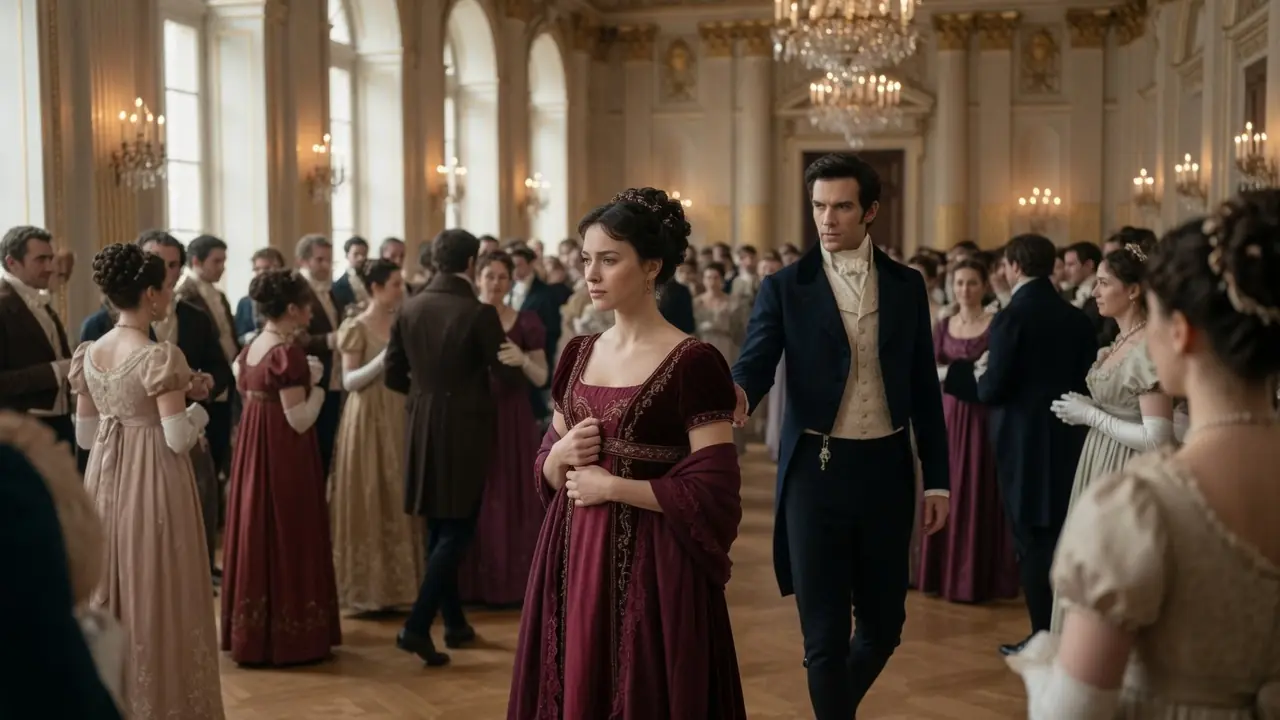
The ballroom of Hartwell Manor was everything the aristocracy built their vanity upon. Thirty-foot ceilings draped in cream and gold, crystal chandeliers burning with a thousand candles, guests in their finest moving between champagne glasses and whispered alliances. Evangeline had arrived on Edmund’s arm, accepted the greetings of people who had barely noticed her existence three years ago, and felt, for exactly forty minutes, like she belonged here.
Then she went to retrieve her wrap from the cloakroom, and Edmund had not waited. She returned to find the center of the ballroom rearranged, not in furniture, but in attention. A ripple of collective awareness had moved through the crowd, that particular social electricity that preceded scandal. Evangeline followed the current of turning heads and found its source, Edmund, standing close, too close, to Lady Cecilia Vane.
His hand at her waist, her laugh rising above the orchestra’s pause, and his eyes, when they briefly crossed Evangeline’s, holding not guilt, not apology, but something far worse, relief. As if she had caught him at something he had been meaning to confess, and was glad the confession was now unnecessary. The room did not go quiet, it merely sharpened. Four hundred people found ways to watch without appearing to watch, which was somehow worse than open staring.
Evangeline stood in the center of it all, her wrap folded in her hands, and felt the precise sensation of her future collapsing in on itself. She did not cry. She would not give them that, but she could not move either. Her feet had simply stopped cooperating, held in place by the weight of being publicly, deliberately, and entirely discarded. It was into this stillness that a voice arrived, low, controlled, the kind of voice that had never once needed to raise itself to command a room.
“You’re holding your wrap incorrectly.” Evangeline turned. The Duke of Ravenmore stood beside her. She hadn’t heard him approach, hadn’t heard anything past the ringing in her own ears, but there he was, tall, dark-coated, with the sharp cheekbones and winter gray eyes that had earned him half his reputation, and the other half had been built on whispered stories she had never entirely believed.
Duke Sebastian Aldridge Voss was thirty-four years old, holder of three estates, a seat in the House of Lords, and a social presence so formidable that men with twice his warmth stepped aside when he entered rooms. The papers called him the Iron Duke. His associates called him, carefully and only in private, simply dangerous. He was looking at her wrap.
“Your knuckles are white,” he continued, his voice carrying only to her. “You’re going to tear the fabric.” Evangeline looked down. Her hands were clenched around the silk so tightly that her fingers had gone bloodless. She forced them to release, smoothed the wrap with deliberate calm, and lifted her chin.
“Thank you for the observation, Your Grace.” “You’re welcome.” He did not move away. “He’ll regret losing you.” The words landed so precisely, so quietly, that for a moment she thought she had imagined them. She looked up at him. Sebastian Voss was not looking at Edmund.
He was looking at her with an expression that was not pity. She would have recognized pity and turned away from it, but something sharper, something that felt almost like recognition. “You don’t know me,” she said. “No,” he agreed. “But I know him.”
A pause so brief it barely existed. “And I know the difference between a man who deserves what he has and one who merely inherited the opportunity.” Then he offered his arm. Not with flourish. Not with performance. Simply extended it. The way one might offer an umbrella in a rainstorm, practical and without ceremony.
“Walk with me,” he said. “Let them wonder what you’re saying to me instead of what he did to you.” Evangeline stared at that arm for three seconds. Then she took it. The shift in the room was immediate, invisible. Four hundred people who had been watching Evangeline absorb humiliation now watched her cross the ballroom on the arm of the most feared, most powerful, and she was beginning to understand, the most deliberately visible man in the room.
Sebastian did not rush. He moved at the pace of someone who owned the floor beneath his feet, which in some technical capacity, given that his family had endowed the Hartwell estate’s east wing, he essentially did. People stepped back. Conversations rearranged themselves. Lady Cecilia Vane’s laugh, which had been carried across the room like a bell, went silent.
“You’re doing that on purpose,” Evangeline said quietly, not looking at him. “Walking?” he said. “Making a statement. I’m always making a statement,” Sebastian replied. “Tonight I simply chose which one.” They reached the far end of the ballroom near the tall glass doors that opened onto the winter terrace.
He did not suggest they step outside. He stopped at the edge of the light, where they could see and be seen. And released her arm with the same measured calm with which he’d offered it. “Better?” he asked. Evangeline assessed herself. Her hands had stopped shaking. The ringing in her ears had quieted.
The crowd had refocused, redistributed its attention, and found other things to examine. She was still in the room. She had not crumbled. That was something. “Marginally,” she said. Something crossed his face. Not a smile. She wasn’t sure yet if Sebastian Voss smiled, but the faint acknowledgement that her answer had been acceptable.
“Evangeline Ashford,” he said. It wasn’t a question. “You know my name.” “Your father is Lord Gerald Ashford. He opposed my land consolidation proposal in the Lords two sessions ago. Quite effectively, as it happens.” A pause. “I made a point of learning about his household after that.”
“That sounds like the beginning of a grudge.” “It was the beginning of respect,” Sebastian said, “which I find is frequently confused for one.” Evangeline looked at him properly for the first time. Up close, Sebastian Voss was not the cold abstraction she had assembled from rumor.
He was present in a way that felt almost disconcerting. The kind of focus that made you feel as though the rest of the room had gone slightly blurry and only this conversation remained in sharp resolution. “Why did you come over?” she asked. “Truly. Not the diplomatic answer.”
He was quiet for a moment. “Because you were standing still,” he said finally. “And you had the look of someone deciding whether to be destroyed or not.” “And you wanted to intervene in that decision.” “I wanted to make it easier to choose correctly.”
She held his gaze. “That’s either very kind or very presumptuous.” “Likely both,” he said. “I’m told I often am.” She didn’t see him again that evening. Edmund attempted to approach her twice before she left and both times she simply turned away.
Which was more devastating to him than any argument could have been. She had learned early that Edmund Fairfax could weather anger but was entirely undone by indifference. Her parents were waiting with the carriage. Her mother took one look at her face and said nothing, which was its own kind of mercy.
Her father squeezed her hand once, firmly, and stared straight ahead. The ride home was silent. That night, Evangeline lay awake in her room and thought not about Edmund, who had behaved exactly as a man like Edmund was always going to behave given enough time and opportunity.
She thought about a pair of gray eyes in a crowded ballroom, about an arm offered without fanfare, about five words spoken so quietly they had bypassed her defenses entirely. He’ll regret losing you. She pressed her fingers to the bridge of her nose and told herself that Sebastian Voss was a man of political calculation and social power and had likely helped her for reasons entirely related to her father’s parliamentary opposition and nothing whatsoever to do with her.
The flowers were from Sebastian. No card, just a small ivory envelope containing a single line of text in sharp, unadorned handwriting. The Lords reconvene Thursday. Your father should bring the Whitmore amendment. It will carry this time. Evangeline read it three times.
Then she went to find her father in his study, gave him the note, and watched his eyebrows rise incrementally as he read it. “The Duke of Ravenmore sent you this,” Lord Ashford said. “Yes. On parliamentary strategy.” “So it appears.” Her father set the note down carefully.
He looked at his daughter, said nothing for a long moment, then picked up his pen and returned to his correspondence, which was as close as Lord Gerald Ashford came to expressing that he was very, very interested in this development. The amendment was carried on Thursday.
The note she sent in response was brief. The amendment was carried. I suspect you already know. Thank you for the intelligence and the flowers. She did not expect a reply. She told herself she had not expected a reply.
The reply arrived the following morning. The flowers were a guess. I wasn’t certain you’d prefer something living. I’m glad I was right. SV Evangeline set the note on her desk. She picked it up, set it down again. Something was happening that she was not entirely prepared for, and she was by nature and by necessity a woman who preferred to be prepared.
She encountered him again at Lord Pemberton’s shooting weekend, an affair she attended out of obligation and planned to survive through strategic use of the library. The library at Pemberton Hall was excellent. Three walls of proper books and a fourth of windows overlooking the frost-gray grounds.
Evangeline had claimed the window seat by nine in the morning and was on her second cup of tea and the third chapter of a thoroughly adequate novel when the door opened. Sebastian paused in the doorway when he saw her. Then, without comment, he came in, selected a book from the shelves with the efficiency of someone who had done it many times before, and settled into the armchair nearest the fire.
They did not speak for forty minutes. It was, Evangeline realized somewhere in the middle of it, the most comfortable forty minutes she had spent in company in longer than she could immediately calculate. “You are not at the shoot,” she said eventually.
“I find shooting animals for sport a poor use of a morning,” Sebastian said, not looking up from his book. “I do it when politics requires it. This weekend does not require it.” “Then why are you here?” “Pemberton owes me three favors. Attending this weekend costs me one. It’s efficient.”
A pause. “You’re here out of obligation to someone.” “My mother,” Evangeline said. “She and Lady Pemberton are old friends, and she worried I’d become a recluse after the Hartwell affair.” “And have you?” “I’ve become selective,” she said, “which I’m choosing to frame as personal growth.”
This time, something did move at the corner of his mouth. Small. Real. “That’s an excellent reframe,” he said. “I’ve had practice.” Over lunch, Evangeline watched Sebastian navigate the social geography of a crowded dining room with the controlled precision of someone who had long since stopped caring what impression he made and began caring only about which impressions were useful.
He was not warm with people. He was not cold, either. He was exact, and there was something almost hypnotic about it, the way he reduced every exchange to its essential elements and discarded the rest. A young viscount named Hartley spent ten minutes attempting to draw Sebastian into an argument about land reform and received three sentences that so efficiently dismantled his position that he spent the rest of the meal in slightly wounded silence.
Evangeline, seated three chairs down, watched and said nothing and thought that Sebastian Voss was one of the most unsettling people she had ever encountered, not because he was frightening, but because he was clear, and she had spent six months in the company of a man who was the opposite of clear, and the contrast was doing something to her perspective that she was not entirely sure she appreciated.
Afterward, in the corridor outside the dining room, he fell into step beside her without announcement. “You were watching me at lunch,” he said. “I was watching the viscount be humbled,” she said. “You were simply in the frame.” He was quiet for a step.
“What did you conclude?” “That you’re efficient in ways that could easily be mistaken for cruelty.” “And are they mistakes?” “Not with Hartley,” she said. “He was arguing in bad faith and you knew it. But I suspect the efficiency isn’t always so precisely aimed.”
Sebastian looked at her then, sidelong, with an expression she was beginning to recognize as the one he wore when something she said had landed somewhere he hadn’t fully expected. “No,” he said quietly, “not always.” On the second evening, there was dancing.
Evangeline had not intended to dance. She had positioned herself near the fireplace with a glass of wine and what she hoped was an expression that communicated her contentment with observation rather than participation. She had been there for fifteen minutes when Hartley appeared, apparently having recovered his confidence, and asked her to dance with the particular brand of cheerful persistence that she found exhausting.
She was trying to construct a polite refusal when Sebastian appeared at her shoulder. “Miss Ashford,” he said, “I believe this was promised to me.” It was not promised to him. They both knew this. Hartley suspected it and looked between them and made the very sensible calculation that disputing the Duke of Ravenmore’s claim to anything was inadvisable. He excused himself.
Sebastian extended his hand. Evangeline looked at it. “That was presumptuous.” “And necessary,” he said. She took his hand. Dancing with Sebastian Voss was nothing like dancing with Edmund Fairfax. Edmund had danced with the performative energy of a man aware of being watched.
Sebastian danced the way he did everything else, with absolute precision and the unsettling sense that his full attention was on precisely one thing, and tonight that thing was her. He didn’t speak immediately. He led, she followed, and the space between them observed all the correct social measurements and still felt somehow intimate in a way she couldn’t account for.
“You’re not going to ask if I’m all right,” she said. “No,” he agreed. “You’re clearly all right. You’ve been all right since the Heartwell ball. I’d find the question condescending.” Something tight in her chest released slightly. “Most people ask.”
“Most people find discomfort easier to manage when they’ve acknowledged it out loud,” he said. “I find discomfort easier to manage when it’s simply survived.” “You speak from experience.” “More than I’d prefer.” The orchestra moved into a slower passage.
His hand at her back adjusted without thinking, a small reflexive steadiness. “What happened to you?” she asked. The question came out more directly than she intended. “Nothing singular,” he said. “Everything is gradual.”
A pause. “My family is known for warmth. I grew up in houses where power was demonstrated rather than expressed and love was not discussed because it was considered a liability.” “That sounds lonely.” “It was extremely efficient,” he said, in a tone that suggested he had told himself this for a very long time and had only recently begun questioning whether it was true.
The dance ended. He held the final position half a beat longer than he needed to. Her hand in his, his eyes on hers. Something in the air between them that she couldn’t name and he apparently wasn’t going to name either. Then he released her, bowed correctly, and stepped back into the crowd.
That night, Evangeline sat at the small writing desk in her guest room and tried to read and could not. She thought about Sebastian’s hand at her back, about the way he said everything gradually like it was something he had only recently allowed himself to say aloud, about gray eyes that paid the kind of attention that felt like being seen, which was a thing she had not realized she had been missing until it happened.
She pressed her palm flat on the desk. This was not the plan. The plan had been to survive the season, let her engagement dissolve quietly, and spend the next twelve months rebuilding the particular kind of dignity that public humiliation tended to erode. The plan had not involved the Duke of Ravenmore and his unsettling exactness and the way he had, without any apparent effort, made himself the fixed point she kept orienting around.
She picked up her pen, set it down, picked it up again. “I’m told you’re dangerous,” she wrote, then stopped, crossed it out. She wrote nothing else that night. The danger arrived, as it often does, from a direction she hadn’t been watching.
Three weeks after the Pemberton weekend, Edmund Fairfax called on her father, not to apologize, not to formally end the engagement, which had been suspended rather than dissolved, a distinction that mattered legally more than either of them had addressed. Edmund had come to renegotiate.
Evangeline learned this from the parlor wall, which in her childhood home was adjacent to her father’s study and had always had the useful property of transmitting conversation with remarkable clarity. Edmund’s argument, delivered in his most reasonable voice, was this: that the incident at Hartwell had been a moment of poor judgment rather than a statement of intention, that Lady Cecilia Vane was an old friend and nothing more, that he understood the optics had been unfortunate, and that here his voice dropped to something Evangeline recognized as calculated vulnerability, he truly did not wish to lose her.
Her father’s response was eleven words. “I’ll discuss it with Evangeline and give you her answer.” Edmund left satisfied apparently that this was progress. Evangeline moved away from the wall and sat in the window of the upstairs sitting room and looked at the street and felt something cold settle through her that had nothing to do with the winter air.
Edmund didn’t want her. He wanted the reacquisition of something he had been careless with and now realized had social and familial value he’d underestimated. She was familiar enough with the workings of men like Edmund Fairfax to read the distinction clearly. The question was what she wanted.
She thought about that for a long time. Then she wrote a letter, not to Edmund. “I find myself in need of advice from someone who prioritizes precision over comfort. If you’re available, I wonder if you might call on me at your convenience.” She sent it to Sebastian.
He came the following morning. Her mother, who had been informed that the Duke of Ravenmore was an acquaintance from the Pemberton weekend, managed to receive him with something approaching normal composure despite the way her eyes kept widening at the fact of him in their sitting room, taking tea, looking at Evangeline with that particular focused attention.
After precisely fifteen minutes of requisite social exchange, her mother discovered an urgent errand in the back of the house that would require her full attention for at least thirty minutes. Subtlety was not her mother’s strongest attribute. The sitting room door remained open. Propriety was observed, but they were effectively alone.
“Edmund came to my father,” Evangeline said without preamble. Sebastian set his teacup down. “I know.” She looked at him. “How?” “Fairfax has a habit of discussing his intentions with his club companions before he acts on them. It’s a form of rehearsal. He was at Whitmore’s last week.” A pause. “I was also there.”
“And you didn’t tell me.” “You hadn’t asked me to keep watch over your affairs,” he said. “I don’t involve myself without invitation.” There was something careful in that sentence. She registered it without entirely parsing it.
“He wants to resume the engagement,” she said. “I’m aware.” “What do you think I should do?” The question cost her something. She felt it leave her. The admission that she was asking him specifically for this particular guidance.
Sebastian was quiet for a moment. When he spoke, his voice was precisely measured. “I think,” he said, “that you should do what you would have done before the Heartwell Ball, before Edmund Fairfax’s opinion became a factor in your assessment of your own worth.” He paused. “Which means deciding what you want, not what resolves the situation most efficiently, not what satisfies your family’s expectations or Fairfax’s convenience.”
His gray eyes held hers. “What do you want, Evangeline?” It was the first time he had used her given name without prefix or formality. She felt it land somewhere deep and quiet. “I don’t want Edmund,” she said. “I haven’t wanted Edmund in quite some time. I think I wanted the idea of him, and he wanted the idea of me, and we were both too comfortable to examine the gap.”
Sebastian nodded once, not surprised, as if she had confirmed something he had already assessed. “Then tell your father,” he said, “and let Fairfax find his own resolution.” “It will cause talk.” “It will cause more talk if you return to an engagement that both parties have already privately abandoned.”
He picked up his teacup. “You’re more resilient than the talk, Evangeline. I’ve watched you be.” The last sentence arrived quietly, without emphasis, and was somehow the most significant thing he had said. She ended the engagement formally that afternoon.
Her father received the information with the expression of a man who had already suspected this conclusion and was relieved to have it confirmed. Her mother sat with her hands folded and said, after a long silence, “Are you certain?” And when Evangeline said yes, nodded once and did not press further, which was its own kind of love.
The letter to Edmund was brief, precise. It said nothing unkind and offered nothing conciliatory and gave him nothing to argue with because it contained no argument, only a decision stated clearly, without apology. She sent it before she could reconsider.
Then she sat at her desk and breathed for a long moment and felt, underneath the anxiety and the uncertainty and the knowledge that the social machinery would begin turning against her, something that might have been freedom. The talk began immediately.
Society had a short memory for most things, but an excellent memory for public spectacle, and the image of Evangeline standing alone at the Heartwell Ball had been stored and indexed in the social consciousness with characteristic efficiency. The news of the engagement’s end revived it, decorated it, and redistributed it at every dinner table in Mayfair within forty-eight hours.
The general conclusion drawn was that Evangeline Ashford had been abandoned twice by the same man, which was both more dramatic and more humiliating than what had actually occurred and considerably easier to discuss. She weathered three days of this in deliberate, quiet dignity.
On the fourth day, she received an invitation to the Countess of Aldermere’s winter supper, an intimate gathering of thirty guests considered among the most influential in London, signed not by the Countess, but in Sebastian’s handwriting, with a single added line. “Come. Disappearing would be a waste of a perfectly good person.”
She almost smiled. She went. The supper was small and exquisitely staged, as everything belonging to the Countess of Aldermere inevitably was. Evangeline arrived alone, which took more resolve than she would have admitted, and found the room already assembled and warm with candlelight and the particular social atmosphere of people who considered themselves important enough not to need to perform their importance.
Sebastian was there. He was across the room when she entered, in conversation with a general and a foreign diplomat, and he did not stop his conversation to look at her, which she recognized as its own form of consideration. He would not mark her arrival in a way that invited observation, but within three minutes, the general and diplomat had been redirected toward each other, and Sebastian was moving through the room.
He stopped beside her with the naturalness of someone completing an interrupted orbit. “You came,” he said. “Your note was persuasive.” “The Countess is a friend. This gathering is safe.” He said it simply, without condescension. “No one here benefits from your discomfort.”
She glanced around. “You selected the guest list.” “I made a suggestion.” “Sebastian.” He looked at her. Steady. Gray. Entirely unrepentant. “Yes,” he said. “I made several suggestions.” Something moved through her, not irritation, though she assembled the expression of it briefly as a matter of principle, but something warmer and more complicated that she set aside for later examination.
“That was presumptuous,” she said. “And necessary,” he said, echoing their own earlier exchange with the particular precision she was beginning to understand was how he expressed things he meant entirely. Dinner was placed, conversation flowed, and Evangeline found herself drawn into an animated discussion with the Countess about the state of women’s property law that she had not expected and thoroughly enjoyed.
When she looked up, Sebastian was watching her from across the table with an expression she could not immediately parse. Not admiration, exactly. Something quieter and more private. She looked away first. Her pulse had done something inconvenient.
After dinner, the company moved to the Countess’s music room where a string quartet played and people gathered in small knots of comfortable conversation. Evangeline was standing near the fireplace, her champagne glass held loosely, when Lord Grantham, forty, widowed, with the hearty confidence of a man who had always found his own company excellent, appeared and began to speak to her.
He was not unpleasant. He was attentive in the careful way of men exploring social territory. He mentioned twice that he had a house in the country. He asked about her interests with what appeared to be genuine curiosity. Evangeline was answering a question about her reading habits when she became aware of Sebastian.
He had not moved. He was across the room, in conversation with someone else, but she could feel his attention shift. Not visibly, not in any way that Grantham would notice, but there, underneath the surface of the room, a kind of heightened stillness that she was beginning to read as his version of emotion made manifest.
She caught his eye. For one second, nothing moved. Then he looked deliberately away, back to his companion, and the conversation continued. But Evangeline had seen it. The jaw, slightly set. The eyes, one shade darker than they had been a moment before. The Duke of Ravenmore was jealous.
The realization sat in her chest like something warm and entirely new. Grantham excused himself eventually. The Countess required him for something, and Evangeline stood alone for the first time that evening, her champagne nearly finished, the quartet playing something quiet and slightly melancholy.
Sebastian arrived beside her within thirty seconds. “Grantham is a good man,” he said, in the tone of someone who found this mildly objectionable. “Yes,” she agreed. “He seems to be.” “He has three estates and adequate political sense, and he’s been looking for a second wife for eight months.”
“That sounds like information you shouldn’t have.” “I make it my business to have information about people who interest me.” A pause. “And people who approach people who interest me.” Evangeline was very careful not to smile.
“Is that what you’re doing? Making a business of me?” He looked at her. Directly, fully, without the sideways caution he sometimes used when they were discussing anything that felt important. “No,” he said quietly. “I stopped being businesslike about you approximately three weeks ago, and I find the transition profoundly inconvenient.”
The string quartet played on. The room moved around them. Evangeline looked at the fireplace and felt something in her chest open, gently and without warning, like a window she had not intended to unlatch. “Sebastian,” she said.
“Yes.” “What do you want?” The question landed between them. He had asked it of her. She was returning it now, deliberately, and they both understood what it meant. He was quiet for a moment that stretched carefully.
“Something I’m not certain I’ve ever allowed myself to want,” he said finally. “Which means I’m approaching the subject with considerably less efficiency than I’d prefer.” “That,” she said, “is the most honest thing you’ve said to me.”
“It may be the most honest thing I’ve said to anyone,” he replied, which wasn’t self-pity, just information. The countess called the room to attention for a toast, and the moment opened into something larger, and Sebastian moved two inches away to observe social propriety, and Evangeline raised her glass and thought that she was very thoroughly in trouble.
The scandal arrived six days later, and it came from a direction she hadn’t expected. Lady Cecilia Vane, who had, it emerged, never been merely a friend to Edmund Fairfax, and had in fact been the reason the engagement unraveled far before the Hartwell Ball, had decided, upon learning that the Duke of Ravenmore had been paying attention to Evangeline Ashford, that this required addressing.
Lady Cecilia was beautiful, strategic, and had been quietly circling Sebastian’s eligibility for two years. She was also, Evangeline was learning, capable of considerable precision when motivated. The story planted in the society papers was careful, nothing actionable, simply an observation attributed to unnamed sources that Evangeline Ashford, twice abandoned by Lord Fairfax and now apparently making a bid for ducal interest, might benefit from understanding that the Duke of Ravenmore’s attention was famously temporary and his intentions historically opaque.
It was, as these things go, perfectly calibrated, not a direct attack, just enough to revive the Heartwell image, add the suggestion of desperation, and remind people that Evangeline was a woman whose engagements did not hold. Evangeline read it on a Tuesday morning and sat very still for a long time.
She had known this was coming in some form. She had expected it. The expectation did not make it painless. By afternoon, she had received three notes of awkward sympathy from acquaintances who were not sure whether they were condoning or gossiping, and one genuinely kind note from the Countess of Aldermere, which she appreciated more than she could express.
Nothing from Sebastian. This was fine. She told herself this was fine. He did not owe her a response to a newspaper item. He had made her no promises. They had had exactly no formal understanding and several significant conversations, and she was not going to sit waiting for a note from a man who was under no obligation to send one.
She was very firm about this for approximately four hours. At five o’clock, there was a knock at the door, not a servant with a note, Sebastian himself in his coat with the expression of someone who had made a decision and was executing it without doubt.
Her mother, to her considerable credit, showed him into the sitting room without a word. He came in and she stood and they looked at each other across the room. “You saw the papers,” she said. “Yes.” “You know who placed it.” “Yes.” “Then you know what people are saying.”
“I know what Cecilia Vane wants people to say.” He moved into the room, stopped at the appropriate distance, then continued past it, stopping close enough that she could see the precise gray of his eyes. “I also know that it requires addressing before it calcifies into accepted social narrative.”
“How?” she asked. “By making my intentions sufficiently clear that there’s nothing left to speculate about,” he said. “Which requires asking you something I should probably have asked more formally several weeks ago.” Evangeline looked at him. Her heart was doing something entirely undignified.
“Evangeline.” He said her name with the same weight he always gave it, like something he was careful with. “I would like to court you, formally, properly, with every attendant visibility that entails. I understand the timing is poor and the circumstances have been unusual and you have recent and legitimate reasons to be cautious of formal arrangements.”
A pause. “I’m asking anyway.” “Because it addresses the narrative,” she said. “No,” he said, and his voice was as clear and direct as she had ever heard it. “Because the alternative is continuing to be in proximity to you without having the right to make my position known and I find I’m no longer willing to do that.”
The room was very quiet. Outside, the winter afternoon pressed gray against the windows. “Your position,” she said carefully. “That you are extraordinary,” he said. “That you have been wrongly underestimated by people who were not paying proper attention. That Edmund Fairfax walking away from you was the worst calculation of his life, which he will come to understand thoroughly and too late.”
He held her gaze. “And that I would very much like the opportunity to demonstrate what a man who is paying attention looks like.” Evangeline breathed. The walls she had built were intact. She had not abandoned them, would not abandon them on the strength of feeling alone, but there was a door in them now, and Sebastian was standing in front of it, waiting, without pressure, with the particular patience of a man who understood that she needed to open it herself.
“If I say yes,” she said, “it will create talk.” “Considerably more talk than a newspaper column,” he agreed. “People will say I pursued you.” “People say whatever is convenient.” “Your father opposed me in Parliament, and I sent you parliamentary strategy in flowers. The narrative writes itself, and it’s considerably more interesting than Cecilia Vane’s version.”
A sound escaped her, not quite a laugh, something lighter than the weight she’d been carrying. “Formal courtship,” she said. “Every correct invisible step,” he confirmed, “no ambiguity.” She looked at him for a long moment, then she said, “Yes.”
The courtship proceeded with exactly the precision Sebastian had promised. He called on her three times a week with the reliability of someone who had decided and was implementing the decision without equivocation. He took her to the theater, front box, the kind of placement that was a statement in itself.
He attended two dinners where her family was present and conducted himself with the controlled warmth of someone who was trying visibly and sincerely to understand a person rather than simply impress them. He asked her father questions about the Lords that were so specific and informed that Lord Ashford began to describe Sebastian as a man of genuine quality, which was high praise from a man who gave no other kind.
And he talked to Evangeline. That was the thing she had not expected, not from him, not from someone whose reputation was built on controlled silence and calibrated distance. He talked to her about his estates and the problems of managing them ethically, about his family in brief, careful increments that told her the landscape of his childhood without requiring her to be devastated by it, about his opinions on land reform, on the future of the peerage, on books he’d read, on a particular kind of silence that existed at Ravenmore in the early morning that he had never described to anyone before.
She gave him equal currency. Her childhood, her studies. That year her family’s finances had been precarious and she had read everything in her father’s library because it was free and she had learned to love learning from necessity. The specific ambition she had privately held to do something of consequence with her mind, something beyond the permitted radius of a well-married lady, that she had been carefully compressing for years in the shape of practical resignation.
Sebastian listened to all of it. He did not look alarmed or politely dismissive. He asked questions. He made connections between things she said. He remembered details and referenced them later in ways that told her he had been paying attention to her specifically, not to a version of her assembled from social expectation.
It was, she realized slowly, the most genuinely seen she had ever felt by another person. The first crisis came six weeks in. Edmund Fairfax, who had watched Sebastian’s courtship of Evangeline with a silence that Evangeline had incorrectly read as acceptance, broke that silence at a parliamentary reception that both families attended.
Edmund was drinking, which reduced his natural facility for strategic restraint. He cornered Sebastian near the entrance of the formal salon and in a voice loud enough to carry to the adjacent cluster of guests said that it was interesting to observe a man of the Duke’s reputation inserting himself into another man’s private affairs.
The room went still. Evangeline, across the salon, felt the air change before she heard the words. Sebastian turned. He did not raise his voice. He did not shift his weight or change his expression in any dramatic fashion. He simply directed his full attention at Edmund Fairfax with the concentrated focus of someone who had spent thirty-four years developing the precise social authority that made grown men step back.
“Lord Fairfax,” he said, “the lady’s affairs cease to be yours at the moment you chose someone else over her in a room full of witnesses.” A pause so brief it barely existed. “I’d suggest that what’s private and what isn’t is not a distinction you’re currently positioned to determine.”
Edmund opened his mouth. Sebastian continued without raising his voice by a single degree. “And I’d further suggest that continuing this line of conversation in its current venue is inadvisable for the reputation of everyone involved, including your own.” Edmund closed his mouth.
The room breathed. Sebastian turned away. Not with triumph, which would have been a performance, but with the simple efficiency of a man who had concluded a matter and returned to his previous occupation. He found Evangeline’s eyes across the salon.
Something passed between them in the four seconds before the room resumed its noise. Something direct and warm. And entirely private in a room full of public observation. She pressed her fingers to her lips briefly. Not distress, something close to its opposite.
That evening, on the steps of the reception house while their carriages were being called, Sebastian stood beside her in the cold air. “That was unnecessary,” she said. Not reproachful. Honest. “It was necessary,” he said.
He was going to continue. “I can manage Edmund Fairfax.” “I know you can.” His breath misted in the winter air. “I wasn’t doing it because I doubted your ability to manage him. I was doing it because I’m in love with you and I find I have a limited tolerance for watching someone speak to you as though you’re something they misplaced.”
The words arrived without preamble. Not a declaration designed for effect, just a fact stated plainly in the manner of a man who had considered the statement and found it accurate. Evangeline stood very still. The cold pressed in around them. The carriages moved in the courtyard below.
“Sebastian,” she said. “Yes.” She turned to face him. He was watching her with that complete steady attention that she had learned to read as everything he didn’t easily say. “I love you, too,” she said, “which I’m aware is either very well timed or six weeks overdue, depending on how one counts.”
For the first time, the first time in all their weeks of conversation and proximity and charged silence, Sebastian smiled fully, without the careful guard that usually lived around the edges of his expressions. It changed his face entirely. She thought briefly and somewhat incoherently that it was the most extraordinary thing she had seen.
He took her gloved hand, lifted it, pressed his lips to her knuckles with the deliberateness of someone choosing an action rather than performing one. “I would like to marry you,” he said against her hand. “Is that a question?” “It can be,” he said, “if you’d prefer the question.”
“I think I would.” He lowered her hand but kept it in both of his. “Evangeline Ashford,” he said, looking at her with that focused gray intensity that she had learned to read as everything he didn’t easily say. “Will you marry me? Not to address a narrative or resolve a situation or meet an expectation, because you are, of all the people I have encountered, the one I am most interested in spending the remainder of my life being surprised by.”
The words landed quietly and completely. The winter air held still. “Yes,” she said, for the second time in this strange and beautiful story they had fallen into together. “Yes, Sebastian.”
They were married in April. Small ceremony. Evangeline had been firm about this, and Sebastian had understood without requiring explanation that there was a difference between the visibility that protected and the spectacle that consumed. Thirty guests. Her family, his few genuine friends, the Countess of Aldermere in the front row with the satisfied expression of someone who had suspected this outcome for months.
Lord Ashford walked his daughter down the aisle with the steady hand of a man who had learned to trust his own judgment after a long time of worrying whether it was adequate. Edmund Fairfax was not invited. Lady Cecilia Vane was not invited.
The society papers printed a brief, dignified announcement and were denied anything more dramatic to work with, which was its own small triumph. Sebastian waited at the end of the aisle with the expression he wore when something mattered precisely as much as he was willing to admit, which was a great deal, held carefully but fully visible to anyone who knew how to read him.
Evangeline had learned how to read him. When she reached him, he took her hand. “Ready?” he said quietly, which was not required by any ceremony but was the kind of thing he said when he meant something specific. “I’ve been ready for some time,” she said.
He didn’t quite smile, but his hand tightened around hers and she felt it. That solid specific warmth of someone who had chosen her entirely without condition or convenience, in full possession of who she was and what she had survived and what she intended to become.
The ceremony was brief and true. When it was finished and they were walking back down the aisle, she leaned close to him. “For the record,” she said, “you were presumptuous and necessary from the beginning.” “I know,” he said. “I’m choosing to frame it as a feature.”
“That,” she said, “is an excellent reframe.” And outside, the April light fell on both of them, clear and new and entirely without shadow. And Evangeline Ashford, the Duchess of Ravenmore, by every title that mattered and every choice that counted, walked into the rest of her life beside the man who had, in a crowded ballroom on the worst night of the year, turned and walked toward her instead of away.
He had been right in the end. Edmund Fairfax did regret it, but that was his story. This one was hers. And that was enough.
The first three months of marriage to Sebastian Aldridge Voss were by every external measure a triumph. The Duchess of Ravenmore, Evangeline was still learning to answer to the title without a fraction of delay that betrayed how recently it had become hers. Occupied one of the finest residences in London and the ancestral seat of Ravenmore in the Northumberland countryside. She had a husband who consulted her on estate decisions, who remembered the names of books she mentioned in passing and had them delivered to her study without announcement. And who looked at her across crowded rooms with the particular focused intensity that she had once found unsettling and now found necessary like oxygen or morning light.
Society had adjusted, not warmly. Society never adjusted warmly to anything that disrupted its preferred narratives, but with the pragmatic efficiency of a system that recognized when the cost of exclusion exceeded the cost of acceptance. The Duke of Ravenmore had married Evangeline Ashford and the Duke of Ravenmore was not a man whose wife could be comfortably ignored. Invitations arrived, doors opened. People who had whispered about the Heartwell Ball now whispered about how well she carried herself. Which was a different kind of scrutiny, but scrutiny nonetheless.
Evangeline navigated all of it with the composure she had spent her entire life developing and the quiet awareness that composure, however effective, was not the same thing as peace. Because underneath the triumph, something was shifting. Not between her and Sebastian. What existed between them was solid and specific and built on the kind of honesty that most marriages in their circle did not even attempt. He was not a man who performed affection. But he was a man who demonstrated it.
In the parliamentary brief left on her breakfast table with a note that read your thoughts before Thursday. In the way he stood slightly closer to her than etiquette required at public events. In the quality of silence they had learned to share in the library at Ravenmore that felt less like absence and more like presence. No. The shift was coming from outside and it wore the face of a woman Evangeline had underestimated.
The letter arrived on a Wednesday morning in October, six months after the wedding. Evangeline was in her study at the London house, a room Sebastian had given her without being asked, cleared of its previous function as a secondary storage room for parliamentary papers and refitted with a writing desk, bookshelves and the particular shade of sage green wallpaper she had once mentioned preferring in a conversation she hadn’t realized he was cataloging.
The letter was addressed to her in handwriting she did not recognize. No return name. Cream envelope, expensive paper sealed with unmarked wax. She opened it with the silver letter knife Sebastian had given her as a wedding gift, practical, elegant, engraved with her new initials and unfolded a single sheet. The words were brief.
Your Grace, I write to you not with malice but with concern. There are aspects of your husband’s history that were not, I believe, shared with you before your marriage. I refer specifically to the matter of Lady Helena Ashworth and the events of the winter of 1811. You deserve to know the full measure of the man you married. A friend.
Evangeline read it twice. Then she set it on the desk, aligned it precisely with the edge and sat back in her chair. She did not know the name Lady Helena Ashworth. She had never heard it spoken in any context. Not by Sebastian, not by the society gossips who had dissected every element of their courtship with forensic enthusiasm. Not by the Countess of Aldermere who knew everything about everyone and shared it with strategic selectivity.
The absence of the name was itself information. People whose histories contain nothing consequential did not generate anonymous letters. Evangeline looked at the letter for a long time. Then she folded it, placed it in the desk drawer she reserved for things that required careful thought and went downstairs to breakfast.
Sebastian was already at the table. He was reading correspondence. Three letters open beside his plate. A cup of coffee growing cold at his elbow. His dark, near black hair still slightly damp from his morning routine. The sharp lines of his face set in the particular concentration he gave to anything that demanded his precise attention.
He looked up when she entered. “Good morning,” he said and something in the way he said it, the brief, involuntary softening of his gray eyes, the way his gaze tracked her as she crossed the room, still had the capacity to rearrange something in her chest that she had thought was permanently settled.
“Good morning,” she said, taking her seat across from him. She poured her tea, buttered her toast, opened the morning paper, read three paragraphs about a debate in the Commons without absorbing a word. “You’re quiet,” Sebastian said.
“I’m reading.” “You’re holding the paper at a 45° angle. You read at 60.” A pause. “Something’s bothering you.” She set the paper down. This was the thing about being married to a man who paid attention with the precision of a military strategist. Nothing went unobserved. Nothing went unanalyzed.
It was, depending on the day, either the most comforting or the most disconcerting element of their partnership. Today it was disconcerting. “Who is Lady Helena Ashworth?” she asked. The silence that followed was not long. Three seconds at most. But Evangeline had learned to read Sebastian’s silences the way other people read sentences and this one contained something she had not encountered before.
Not guilt, exactly. Something adjacent to it. Something that lived in the territory between a thing deliberately concealed and a thing not yet found the right moment to reveal. Sebastian set his coffee cup down. “Where did you hear that name?” he said.
“That’s not an answer.” “No,” he agreed. “It isn’t.” He folded his correspondence, placed his hands flat on the table, looked at her directly. “Helena Ashworth was someone I knew.” “Before you. Before most of the life I currently recognize as mine.” “Knew?” Evangeline repeated.
“Was engaged to,” Sebastian said. “Briefly. Seven years ago.” The information landed in the room like a stone dropped into still water. Evangeline held his gaze. “You were engaged before.” “Yes.” “And you didn’t tell me.”
“I intended to,” his voice was measured but not defensive. “The timing was never.” He stopped, recalibrated. “That’s not accurate. The timing was available. I chose not to use it because the subject is not one I discuss easily and I was aware that introducing it during our courtship would have added a complication I wasn’t certain you needed.”
“You decided what I needed?” “I decided what I was capable of discussing,” he said and there was something raw in the correction that stopped her from pushing further immediately. “Which is not the same thing and I recognize the distinction matters.”
The breakfast room was very quiet. Morning light fell across the white tablecloth and the silver tea service and the space between them that had, for the first time since their wedding, acquired an unfamiliar texture. “What happened?” she asked.
He sat in the leather chair behind his desk. She sat in the chair opposite. The desk between them was, she recognized, not accidental. He needed the structure of it, the slight formality to say what he was about to say. Helena Ashworth had been the daughter of Viscount Ashworth, a family whose estate bordered the southern edge of Ravenmore’s Northumberland holdings.
Sebastian had known her since childhood. She was two years younger, dark-haired, possessed of a particular sharp-edged warmth that he described with the careful precision of someone selecting each word to avoid giving too much or too little. They had become engaged in the autumn of 1811. Sebastian was twenty-seven. Helena was twenty-five.
The engagement was welcomed by both families and regarded by those who knew them as unusually well-matched. Not a strategic alliance but something rarer. A genuine partnership between two people who understood each other. “She was ill,” Sebastian said.
His voice had not changed in volume or tempo, but Evangeline could hear the effort beneath it. The discipline required to keep the words level. A fever that came suddenly and did not respond to treatment. The physicians were optimistic for the first week. By the second week, they had stopped being optimistic and started being present, which is a different thing.
“Sebastian.” “She died on the fourteenth day,” he said. “In December. I was there. Her family was there. It was quiet and terrible and entirely outside anyone’s control, which was, for me, the worst part of it.” He paused. “I am not a man who manages helplessness well,” he said. “I suspect you’ve noticed.”
Evangeline said nothing. She waited. “After Helena died, I spent approximately three years being precisely the kind of man the papers later described me as. Cold, controlled, strategically detached from anything that required emotional investment. I built my political career during that period because politics rewards exactly the qualities that grief produces. Precision, distance, the ability to function without reference to feeling.”
He looked at her across the desk. “I did not tell you about Helena because I was not certain how to explain that the man you married was built, in significant part, on the architecture of a loss he has never fully discussed with anyone. And because I was afraid.” He stopped. The word hung in the air, unfamiliar from his mouth.
“I was afraid that knowing the full scope of my history would make you wonder whether what I feel for you is love or simply the relief of not being alone anymore.” The study was silent. Morning light moved slowly across the carpet. Evangeline looked at the man sitting across from her.
This man who had crossed a ballroom to reach her. Who had offered his arm without ceremony. Who had built a courtship on precision and honesty. And the particular brand of devotion that expressed itself through attention rather than performance. And felt something in her chest crack open. Not with pain, but with the fierce protective tenderness of understanding someone more completely than she had before.
“Sebastian,” she said. “Yes.” “I am not going to wonder that.” He looked at her. His gray eyes held something she had only seen once before. On the steps of the reception house. The night he had told her he loved her. Vulnerability offered without armor.
“You’re certain,” he said. “I’m certain that you love me,” she said. “I’m also certain that you loved Helena. And I’m certain that those two things can exist in the same person without either of them being diminished.” She paused. “I would have appreciated hearing this before our wedding. But I understand why I didn’t. And I’m choosing to be angry about it for approximately twenty minutes and then move forward. Because the alternative is letting a dead woman’s ghost become a wedge between us. And I refuse to do that to her or to us.”
Something crossed his face. Not quite a smile. Something deeper and less composed. “Twenty minutes,” he repeated. “I’m very efficient when I’m angry,” she said. He exhaled. It was the closest thing to a laugh she had heard from him in a context that wasn’t already warm. And it carried relief in a way that told her exactly how long he had been carrying this particular weight.
“The letter,” he said. “Who sent it?” “It was unsigned.” “But you have a suspicion.” Evangeline met his eyes. “I have the same suspicion you do.” Lady Cecilia Vane had not, it appeared, accepted her defeat with the grace that society attributed to well-bred women.
Sebastian confirmed what Evangeline had already deduced. That Cecilia had spent two years cultivating proximity to him before Evangeline entered the picture. Not through direct pursuit, which would have been too visible, but through strategic social placement, mutual acquaintances, and the careful construction of availability that looked like coincidence.
When Sebastian chose Evangeline, Cecilia had responded with the newspaper column. When the newspaper column failed to prevent the courtship, she had stepped back. When the wedding occurred, she had gone quiet. Quiet, Evangeline was learning, was not the same as finished.
“She would have learned about Helena through Edmund,” Sebastian said. They were in the study together. The anonymous letter open on the desk between them. “Fairfax and the Ashworth family share connections through the racing circuit. It wouldn’t have been difficult.”
“And she chose to deploy it now,” Evangeline said. “Six months after the wedding, why?” “Because six months is when the social protection of novelty expires,” Sebastian said. “You’re no longer the interesting new duchess. You’re the established one. The one who can be challenged without it appearing gauche. She wants to destabilize me.”
“She wants to destabilize us,” Sebastian corrected. “You specifically, but the marriage generally. A duchess who doubts her husband is a duchess who can be isolated. And an isolated duchess is a vulnerability in my political position.” Evangeline looked at him. “You’re analyzing this like a parliamentary strategy.”
“Because that’s what it is,” he said. “Cecilia Vane is not operating from emotion. She’s operating from calculated social ambition. And she has chosen the most efficient point of attack.” “The most efficient point of attack,” Evangeline repeated slowly. “Being a dead woman your husband loved before you.”
Sebastian held her gaze without flinching. But she saw the flicker in his gray eyes. The recognition that his analytical framing, however accurate, had landed somewhere it shouldn’t have. “Yes,” he said quietly. “And I’m sorry for reducing it to strategy when it is also fundamentally about you and about Helena and about things that deserve more than tactical assessment.”
It was, she thought, one of the things she loved most about him. Not that he was incapable of error, but that he recognized his errors with the same precision he applied to everything else. And corrected them without requiring her to insist.
“What do we do?” she asked. “We do nothing reactive,” he said. “Cecilia is waiting for a response. If you confront her, she becomes the victim of a jealous duchess. If I confront her, I confirm that Helena is a vulnerability. If we ignore it entirely, she escalates.” “Then what?”
Sebastian looked at the letter on the desk. Then at Evangeline. “We tell the truth,” he said. “Not to Cecilia. Not to society. To the people who matter. On our terms. Before she can shape the narrative for us.” The dinner was held at the London House three weeks later.
Twenty guests carefully selected. The Countess of Aldermere, who arrived with the expression of someone who had been briefed and was fully prepared to be useful. Lord and Lady Ashford, Evangeline’s parents, who had been told about Helena privately by Evangeline and had responded with the quiet steadiness that was, she was realizing, where she had learned her own.
Two parliamentary allies of Sebastian’s whose discretion was verified. Several couples whose gossip networks were, by design, the ones most likely to propagate whatever version of events emerged from this evening. The dinner was exquisite. The conversation was warm. And at the appropriate moment, after the main course, before dessert, when the table had settled into the particular ease that good food and good company produced, Sebastian spoke.
He did not stand. He did not make a speech. He simply turned the conversation, with the skill of someone who had been redirecting rooms for fifteen years, toward the subject of loss. “My first engagement,” he said. In response to a question from the Countess that had been precisely choreographed, “ended with Helena Ashworth’s death in 1811. She was extraordinary. And losing her was the defining event of my adult life until I met my wife.”
He said it plainly. Without drama. Without the theatrical vulnerability that society would have found suspicious. Just a fact stated by a man who had decided that facts, delivered on his own terms, were the most effective defense against whatever distorted version was being assembled elsewhere.
The table received it with the particular silence that indicated genuine feeling rather than performed sympathy. Then the Countess, with the social timing that had made her legendary, said, “Helena would have liked Evangeline enormously.” In a tone that suggested personal knowledge. And the conversation moved forward with the warmth and naturalness of people who understood that grief and love were not competing forces, but coexisting ones.
Evangeline watched her husband from across the table and felt something settle in her chest that had been unsettled since the anonymous letter arrived. Not because the threat had been neutralized. It had. But that was strategy. Because Sebastian had chosen, publicly and without hesitation, to be honest about the most painful chapter of his life rather than let someone else weaponize it.
And he had done it not for political advantage, though it served that purpose, but because Evangeline had shown him, in a breakfast room three weeks ago, that honesty between them was more important than comfort. And he had listened.
After dinner, when the guests had moved to the drawing room and the evening had acquired the loose, comfortable energy of a successful gathering, Sebastian found her near the window. “You’re thinking,” he said.
“I’m thinking that you handled that beautifully.” “I handled it adequately,” he said. “You handled the last three weeks beautifully, which is considerably more difficult.” She looked at him. “Are you all right?”
“I am precisely all right,” he said. And the way he said it, with the faintest emphasis on the word precisely, as if he had measured his emotional state and found it to his own surprise, exactly where it should be, made her reach for his hand. He took it. Held it. Did not let go for the remainder of the evening.
Cecilia Vane’s response came ten days later. And it was not what Evangeline expected. She had anticipated escalation. Another letter, perhaps. Or a more public deployment of whatever additional information Cecilia had gathered. She had prepared for it with the careful composure that she had spent her life perfecting. And the new, harder edge that marriage to Sebastian had given her. Not because he had changed her, but because being fully seen by someone had made her more willing to be fully herself.
Instead, she received a visit. Cecilia arrived at the London House at three o’clock on a Tuesday afternoon without prior notice. Dressed in pale blue silk and carrying the particular expression of a woman who had prepared multiple versions of this conversation and was selecting between them in real time.
Evangeline received her in the drawing room. Alone. She did not summon Sebastian, who was at the Lords. She did not call for her mother. She sat in the armchair by the fire and waited. Cecilia sat opposite her, arranged her skirts, and smiled.
“Your Grace,” she said. “Thank you for seeing me.” “Lady Cecilia,” Evangeline said. “I wasn’t aware we had an appointment.” “We don’t. I came because I thought a direct conversation might be more useful than continued correspondence.”
“Continued correspondence,” Evangeline repeated. “That’s an interesting way to describe an anonymous letter designed to damage my marriage.” Cecilia’s smile did not waver. But something behind it recalculated. “I don’t know what you’re referring to,” she said.
“Of course you don’t.” Evangeline folded her hands in her lap. “Then let me be direct, since you’ve come for directness. What do you want?” The drawing room was quiet. The fire crackled. Outside the London afternoon moved past the windows with its usual gray indifference.
“I—” Cecilia studied her for a moment, then the smile dissolved. Not into hostility, but into something more honest and considerably less attractive. “I want you to understand something,” Cecilia said. “Sebastian Voss was never going to choose me. I knew that. I’ve known it for two years. What I didn’t know, what I couldn’t have predicted, was that he would choose someone like you.”
“Someone like me?” Evangeline said. “Someone without strategic value,” Cecilia said. “Someone whose family holds a minor title and whose social position before the Hartwell ball was precisely unremarkable. I spent two years learning exactly what Sebastian Voss valued in a partner, and you were none of it.”
“And yet,” Evangeline said. “And yet,” Cecilia agreed. The word carried something that might have been respect buried under layers of resentment. “Which means either I misread him entirely or he changed. And Sebastian Voss does not change.”
“He didn’t change,” Evangeline said quietly. “You misread him.” The silence that followed was sharp and clean. Cecilia looked at her, really looked, for perhaps the first time, without the social screening that usually filtered her perception of other women. And Evangeline saw the moment the calculation shifted.
“You’re not afraid of me,” Cecilia said. “No,” Evangeline said. “I’m not. I was humiliated in front of 400 people by a man I trusted and I survived it by standing still and deciding not to be destroyed. You are not more frightening than that moment, Lady Cecilia. Nothing is.”
Cecilia was quiet for a long time. Then she stood. “The letters will stop,” she said. “Yes,” Evangeline said. “They will.” Cecilia moved toward the door, paused, turned. “He chose well,” she said. It cost her something to say it. Evangeline could see the price of it in the set of her jaw, but she said it. Then she left.
Evangeline sat in the drawing room for ten minutes after the door closed. She did not move. She breathed. She felt the particular sensation of a battle won not through force or strategy, but through the simple devastating act of being exactly who she was and refusing to be diminished by someone else’s assessment of her worth.
When Sebastian came home that evening, she told him everything. He listened without interruption. When she finished, he was quiet for a moment. “You handled that alone,” he said. “Yes.” “You didn’t need me.” “No,” she said. “But I wanted to tell you about it. Which I think matters more.”
Something moved across his face. That rare unguarded expression that she had learned to recognize as the one he wore when she surprised him in ways he hadn’t anticipated and couldn’t immediately categorize. “It does,” he said. “It matters considerably more.”
The winter passed. Spring arrived at Ravenmore with a particular gentle insistence that the Northumberland countryside brought to everything, slowly, thoroughly, and without concern for whether anyone was ready for it. Evangeline had established a rhythm at the estate that for the first time in her life genuinely her own.
She rose early and walked the frost-covered grounds while the light was still thin and silver, a habit she had developed after Sebastian mentioned once that the morning silence at Ravenmore was the closest thing he knew to peace. She had wanted to understand what he meant. She had found it immediately.
She wrote in the mornings, not letters, though those continued. Her correspondence with the Countess of Aldermere having evolved into something that resembled genuine friendship, but something else. Something she had not told Sebastian about yet, though she suspected he knew, because Sebastian noticed everything and had the particular tact to not mention the things he noticed until she was ready to discuss them.
She was writing about women’s property law. Not a formal treatise. She had no credentials for that and the legal establishment would have dismissed her on sight, but a careful, documented, accessible argument for reform. Built on the research she had begun during her conversation with the Countess at the Aldermere supper and expanded through months of reading and correspondence with three sympathetic solicitors whose names the Countess had provided with the satisfied expression of a woman whose social network served purposes far beyond social.
Sebastian discovered the manuscript in April. Not by snooping. He was constitutionally incapable of that particular invasion, but because Evangeline left three pages on the breakfast table by accident, mixed in with his parliamentary correspondence. And he read them before realizing they weren’t addressed to him.
He appeared in her study doorway twenty minutes later, the three pages in his hand, and the expression on his face was one she had never seen before and could not immediately categorize. “These are yours?” he said. “Yes.” “These are exceptional.”
She looked at him. His gray eyes were not performing admiration. She would have recognized that and been wary of it. They were expressing genuine startled respect, the kind that came from encountering something unexpected and finding it better than anticipated. “They’re a draft,” she said.
“They’re a draft that argues more clearly and persuasively than anything currently before the Lords on this subject.” He came into the room, set the pages on her desk. “How long have you been working on this?” “Since the Aldermere supper, when the Countess mentioned the married women’s property question. That was eleven months ago. I work slowly when something matters.”
Sebastian looked at the pages, then at her, then at the pages again. “Evangeline,” he said. “This needs to be published.” “I know,” she said. And then, because she had been thinking about this for weeks and had arrived at a conclusion that felt both inevitable and terrifying. “And I need your help to do it without being immediately dismissed as the Duke of Ravenmore’s wife playing at politics.”
“You’re not playing at anything,” he said. “And anyone who reads this will know that within three paragraphs.” “The legal establishment doesn’t read past the author’s name if the name is female.” “Then we address that,” he said with the particular focused energy she recognized as the one he deployed when a problem had been presented and he intended to solve it. “Not by hiding your name. By making it impossible to dismiss.”
She looked at him across the study that he had given her, this room with its sage green wallpaper and its bookshelves and its desk where she had built something entirely her own and felt the full, settled weight of being married to a man who did not see her ambitions as competition to his own, but as an extension of something they were building together.
“I love you,” she said. “I know,” he said. And then, because Sebastian Voss was learning slowly and with characteristic precision to say the things he meant even when they made him vulnerable. “I love you in ways I didn’t know I had capacity for. And watching you become this version of yourself has been the privilege of my life.”
She crossed the room and kissed him. It was not their first kiss. They had been married for a year and the physical dimension of their marriage was as direct and honest as every other dimension, but it carried something particular. Gratitude. Recognition. The specific warmth of two people who had survived separate kinds of damage and found in each other not the absence of damage, but the willingness to build alongside it.
The pamphlet was published in June under her name. Evangeline Ashford Voss, Duchess of Ravenmore. Printed by a press that Sebastian’s parliamentary contacts identified and Evangeline’s arguments convinced. The Countess of Aldermere ensured it reached every drawing room, every parliamentary wife, and every reform-minded lord in London within a fortnight.
The response was not uniform. Some praised it. Several legal scholars wrote responses that engaged with her arguments on their merits, which was, in the landscape of women’s intellectual contributions to legal debate, extraordinary. Three newspapers discussed it, two dismissively, one with genuine interest.
The backlash came from predictable quarters. Evangeline was called presumptuous, which she found ironic given how frequently the word had appeared in her personal life. She was called ambitious, which she accepted as a compliment. She was called the Duke’s political puppet, which annoyed Sebastian considerably more than it annoyed her.
“They’re saying I wrote it,” he said one evening, the offending article open on his desk. “Let them,” Evangeline said. “It undermines your authorship.” “It amplifies the argument,” she said. “If people believe a Duke wrote it, they’ll take it more seriously. If they later learn a Duchess wrote it, they’ll have to reconcile their respect for the argument with their dismissal of its author. That’s a more useful contradiction than any correction I could issue.”
Sebastian looked at her for a long moment. “You’re more strategically sophisticated than I am,” he said. “I’ve had different training,” she said. “Women learn strategy in drawing rooms. Men learn it in the Lords. The drawing room curriculum is considerably more advanced.” He almost smiled. Almost.
“I married the most dangerous person in England,” he said. “You married the most dangerous person you’d met at that particular ball,” she corrected. “The country is larger than one ballroom.”
In August, Lord Ashford fell ill. It came without warning. A cough that didn’t clear. A weariness that didn’t lift. And then a morning when he could not rise from bed and the physician’s face held a particular expression that Evangeline had learned from Sebastian’s story about Helena to recognize as the boundary between optimism and presence.
Evangeline went to her parents’ home immediately. Sebastian came with her. He did not need to come. Parliament was in session. His land reform bill was approaching a critical vote. There were fourteen things on his schedule that week that required his physical presence in London and he canceled all of them with three sentences to his secretary and no explanation beyond “Lady Ashford is ill. I will be at the Ashford residence.”
Evangeline’s mother met them at the door with the composed exterior and devastated eyes of a woman who had spent forty years married to a man she loved and was now being asked to contemplate the arithmetic of his absence. Sebastian did three things in the first hour.
He arranged for the best physician in London, not the most fashionable, the best, a distinction he made with characteristic precision, to attend Lord Ashford by evening. He spoke privately with Lady Margaret Ashford for twenty minutes, during which time Evangeline did not know what was said, but after which her mother’s composure shifted from fragile performance to something more genuinely steady.
And he sat with Lord Ashford for thirty minutes, alone, at the older man’s bedside. When he came out of that room, his face was carefully composed, but his eyes were not. “He’s strong,” Sebastian said to Evangeline. “How strong?” “Strong enough to argue with me about the Whitmore Amendment,” he said, “which I’m choosing to interpret as diagnostic.”
Despite everything, she almost smiled. Lord Ashford recovered, slowly, stubbornly, and with the particular determination of a man who had been told by a duke that his parliamentary opposition was still needed and had apparently taken this as a medical directive.
The three weeks of his illness were, for Evangeline, a crucible, not because of the fear, though the fear was constant and heavy and sat in her chest like something physical, but because of what the fear revealed. She watched Sebastian move through a crisis that was not his own with the same precision and focus he brought to everything, but without the distance.
He was not performing competence. He was not managing the situation. He was present, fully, specifically present, in a way that told her he understood that Lord Ashford was not merely his father-in-law or a parliamentary colleague, but the father of the woman he loved, and that this distinction mattered to him in a way that exceeded strategy.
He brought Evangeline tea at two o’clock in the morning when she couldn’t sleep. He did not say, “It will be fine,” because he did not traffic in reassurances he couldn’t guarantee. Instead, he said, “I’m here,” which was both simpler and more useful, and he said it every time she needed to hear it, which was often, and which she was learning not to be ashamed of.
One night at three o’clock in the morning, sitting in the hallway outside her father’s room because the bedroom was too far away and the chair by his bed was occupied by her mother, Evangeline leaned against Sebastian’s shoulder and said, “I don’t know how to do this.”
“You’re already doing it,” he said. “Badly. There is no version of this that feels adequate,” he said. “That’s not a failure of yours. It’s a feature of loving someone.” She pressed her face against his coat. “Helena,” she said quietly.
He was very still. “When she was ill,” Evangeline said, “did anyone sit with you?” The silence that followed was long enough that she thought he wasn’t going to answer. “No,” he said finally. “I sat alone.” She reached for his hand in the dark hallway. “Not anymore,” she said.
His hand tightened around hers. He said nothing. But she felt it, the thing he couldn’t say, the gratitude and the grief and the love so large it had no adequate container. And she held his hand and stayed exactly where she was.
Autumn brought two things. The first was Lord Ashford’s return to the Lords, thinner but determinately upright, leaning on a cane he claimed was decorative and everyone else recognized as structural. Sebastian walked beside him into the chamber and did not offer his arm, which Lord Ashford appreciated more than any gesture of assistance could have communicated.
They disagreed on three motions that week. Lord Ashford won two of them. Sebastian described the losses as instructive, which was as close as he came to admitting he had been outmaneuvered. The second thing autumn brought was a letter from Cecilia Vane, not anonymous this time, addressed to Evangeline directly, in Cecilia’s own handwriting.
“Your Grace, I have read your pamphlet on women’s property rights. I found it persuasive in ways I did not expect and did not welcome, because agreeing with you requires acknowledging that you possess qualities I spent considerable energy refusing to see. I am not writing to apologize. I suspect you would find an apology from me both late and insufficient, and I would find the act of delivering one insincere, which serves neither of us. I am writing to tell you that I have shared your pamphlet with Lady Ashworth, Helena’s mother, who asked me to convey that she found it extraordinary and that she believes Helena would have been, in her words, fiercely proud to know the woman who came after her. That is all.” Cecilia Vane.
Evangeline read it twice. Then she sat at her desk for a very long time, holding the letter, feeling something she had not anticipated, not forgiveness, which was too simple and too complete for what existed between her and Cecilia Vane, but the complicated, specific recognition that people were capable of growth, even people who had tried to damage you, and that acknowledging their growth did not require diminishing your own experience of the damage.
She showed the letter to Sebastian that evening. He read it in silence, set it down, looked at the fire. “Helena’s mother,” he said. “Yes. I haven’t spoken to her in seven years.” “Would you like to?” He was quiet for a long time. “Yes,” he said. “I think I would.”
They visited Lady Ashworth in November. The Ashworth estate in Northumberland was forty minutes by carriage from Ravenmore, through countryside that Sebastian had ridden as a young man and had not visited since Helena’s funeral. Evangeline watched him from across the carriage as they traveled and saw the particular quality of attention he gave the landscape, not nostalgia, which would have been sentimental, but recognition, which was honest.
Lady Ashworth was sixty-three, silver-haired, and possessed of the same sharp-edged warmth that Sebastian had described in Helena. She received them in a sitting room that contained, among its many portraits and photographs, a small watercolor of a dark-haired young woman with intelligent eyes and a smile that suggested she had just said something witty and was waiting to see if you’d caught it.
Evangeline looked at the portrait and felt no jealousy. What she felt was sadness, clean, uncomplicated sadness for a woman she had never met who had died too young and had been loved by a man who carried that love with the same precision he carried everything else.
Lady Ashworth took both of Sebastian’s hands when he entered and held them for a long moment without speaking. “You look well,” she said finally. “I am well,” he said, and then, with the directness that Evangeline loved most about him, “I should have come before now.”
“You came when you were ready,” Lady Ashworth said. “Helena would have understood that. She always understood your timing, even when it was terrible.” Something crossed his face that was not quite a smile and not quite pain, but existed in the exact space between them.
They stayed for three hours. Lady Ashworth served tea and asked about the estate and discussed Evangeline’s pamphlet with the informed enthusiasm of a woman who had always cared about the world and had never been given an adequate platform to say so. She told Evangeline three stories about Helena that were funny and warm and specific, and Evangeline listened and laughed and understood that these stories were being given to her as a gift, not because she needed to know Helena, but because Helena deserved to be known by the woman who now occupied the spaces she would have filled.
On the carriage ride home, Sebastian was quiet. Evangeline waited. “Thank you,” he said eventually. “For what?” “For not needing me to be a man without a past in order to love the man I am now.”
She looked at him across the carriage, this man with his gray eyes and his sharp cheekbones and his carefully constructed walls that had, over the course of a year, developed doors and windows and the occasional skylight, and she felt the full, complicated, extraordinary weight of loving someone completely, not in spite of their history, but in full possession of it.
“Sebastian,” she said. “Yes.” “Your past is not a liability. It never was. It’s the thing that taught you how to love carefully, and loving carefully is the reason we work.” He looked at her for a long moment. Then he crossed the carriage, sat beside her instead of opposite, took her hand, and held it for the remaining forty minutes without speaking.
It was, she thought, the most eloquent thing he had ever said. December came. The anniversary of Helena’s death passed quietly. Sebastian visited her grave alone in the morning and returned in the afternoon with wind-swept hair and steady eyes and the particular settled quality of a man who had honored something without being consumed by it.
Evangeline was in the library when he came home, curled in the window seat, their window seat, the one from Pemberton that had somehow replicated itself at Ravenmore, as if the house understood what they needed, with a book she was only partially reading.
He came in, sat in the armchair by the fire, their armchair, the one that had been his since before she existed in this house and now existed in relation to her window seat the way certain astronomical bodies exist in relation to each other, fixed, proximate, gravitationally inevitable.
They did not speak for thirty minutes. It was the most comfortable thirty minutes she had spent in company since the last time they had done exactly this. “Evangeline,” he said eventually. “Yes.” “I have something to tell you.”
She looked up from her book. He was looking at her with an expression she had never seen before, not the focused intensity, not the carefully measured honesty, not the rare, unguarded warmth, something new, something that looked, if she was reading him correctly, like wonder.
“What is it?” she said. “I am happy,” he said. The words were simple, two syllables, a statement so ordinary that most people said it without thinking, the way they said good morning or it looks like rain. Sebastian Voss had never said it before, not to her, not, she suspected, to anyone, not in the thirty-five years of his precisely managed, architecturally constructed, strategically defended life.
And he was saying it now, in a library in Northumberland, on the anniversary of the worst day of his personal history, to the woman he had walked toward across a crowded ballroom because she had the look of someone deciding whether to be destroyed or not.
Evangeline set her book down. “Say it again,” she said. “I am happy,” he said. And this time something moved at the corner of his mouth, not quite a smile, not quite anything else, but entirely his. And his gray eyes held hers with the full, focused, devastating attention that she had learned to recognize as the way Sebastian Voss loved.
She crossed the room, sat on the arm of his chair, leaned her head against his shoulder. “Good,” she said. “So am I.” Outside the Northumberland winter pressed against the windows and the fire burned low and the library held them both in the particular silence that was not absence but presence.
And Evangeline Ashford Voss, who had once stood alone in a blazing ballroom while the world collapsed around her, sat beside the man who had chosen her wholly and completely and with every precise, deliberate, carefully honest part of himself and felt for the first time in her life not just chosen but home.