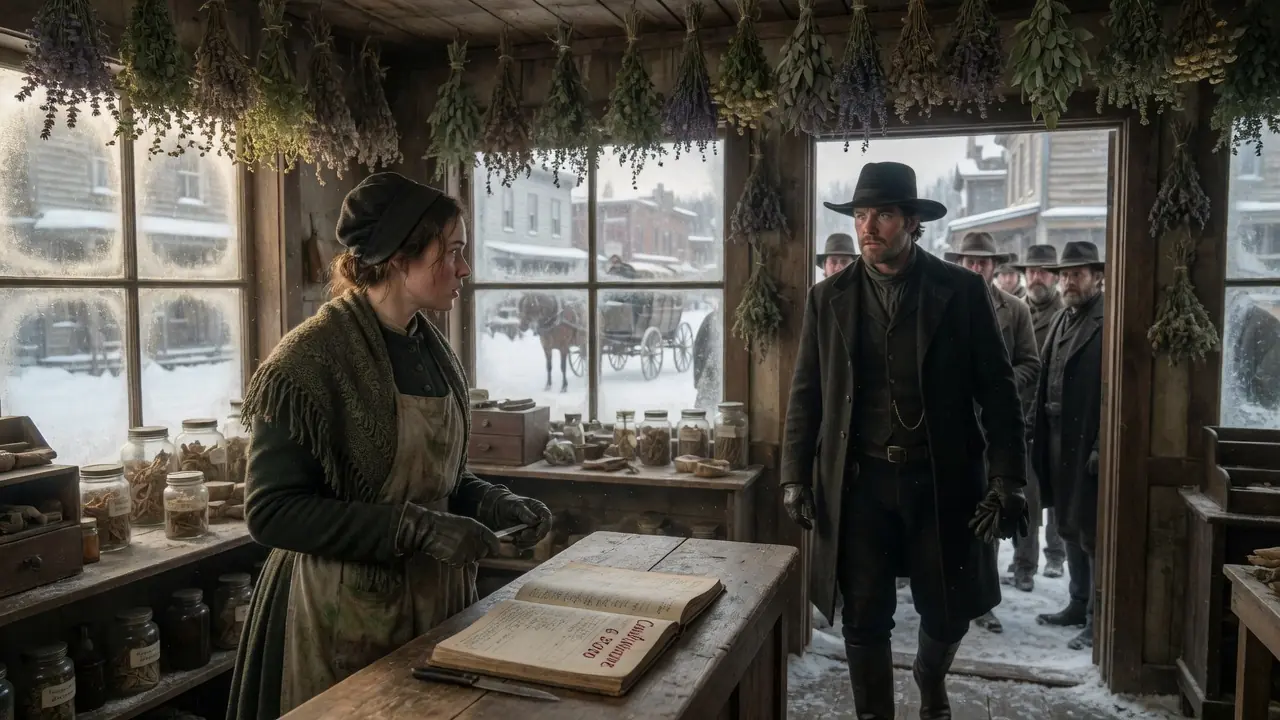
Rosemary Fletcher realized disaster had found her when she saw the name in red ink. Her herb shop in Copper Creek still smelled of mint and wood smoke. Jars lined the shelves, and bundles of herbs hung from the rafters. Outside, wagon wheels rattled past on the frozen street.
Inside, the open ledger showed three hundred dollars of debt. Her partner, Samuel, had vanished before dawn with their savings and best horse. He left only a promissory note with his crooked scrawl and one neat, careful signature. Caleb Hawthorne.
Everyone in the mountains knew that name. Trapper, trader, timber baron. People lowered their voices when they spoke of him. The bell above the shop door clanged hard.
Six men stepped inside, blocking the light. Trail dust coated their boots. Their faces were steady and unreadable. The tallest stopped at the counter.
“Miss Fletcher,” he said. “Mr. Hawthorne would like to speak with you.”
Rosemary’s hand slid toward the knife hidden under the counter. “I am busy with orders,” she replied. “If Mr. Hawthorne needs something, he can send word like everyone else.”
“This is not a request,” the man answered.
Fifteen minutes later, she sat in a straight-backed chair in a cabin high above town. Through wide windows, a bare valley spread below in dark forest and pale rock. A heavy desk divided the room. Behind it stood the man whose name had ruined her morning.
Caleb Hawthorne turned from the glass and faced her. He was tall and broad-shouldered, dressed in plain trail wool and leather. His jaw looked carved, his gray eyes steady and cold. Handsome the way a cliff was handsome, impressive until you stepped too close.
“Your partner borrowed my money,” Caleb said. “Three hundred dollars. He put it into your shop.”
“Samuel told me the loan came from a merchant in Denver,” Rosemary answered. “I did not know it was yours.”
“Not knowing does not erase a debt,” he replied. “The money is gone. The business remains. You are the one who owes me now.”
He watched her for a moment. “Not exactly. You have two choices.”
“Choice one,” he said. “I demand full payment today. I take your building, stock, and equipment. You leave Copper Creek with nothing.”
“And the other choice?” she asked.
The corner of his mouth moved, but there was no real smile. “The other choice is more interesting. My grandmother is ill and will not see another spring. Her last wish is to see me married. She controls a large share of my company. If I remain single, that share goes to the church when she dies.”
Rosemary frowned. “I am sorry for her, but I still do not see how that concerns me.”
“I need a wife,” he said quickly. “For one year. Then we separate quietly. In return, I erase your debt and give you enough to start over wherever you choose.”
The offer sounded like madness. “You want me to marry you? We met less than an hour ago.”
“I want a contract,” he corrected. “A marriage of convenience. No promises beyond what we write. You give me time and a story my grandmother can believe. I give you freedom.”
“That is not what marriage is meant to be,” she whispered.
“Marriage is what the two people in it decide,” he said. “In this case, a trade.”
“You sound very sure I am desperate,” Rosemary said.
His gaze shifted to a leather folder on the desk. “Your sister’s doctors in St. Louis do not work for free. Your father’s farm in Missouri is one bad harvest from foreclosure. Now you carry a three-hundred-dollar note with my name on it. Desperation is not an insult. It is simple counting.”
The weight of that truth settled over her like cold rain.
“Why me?” she asked softly.
“You are not part of my circle,” he said. “No old scandals to crawl out at supper. You are pleasant to look at, which helps the story. And most important, Miss Fletcher, you are out of better choices.”
Anger stirred under the fear. “I may be short on choices,” she said, “but I am not helpless. If I agree, I want more than a purse of coins and a ticket.”
One dark brow lifted. “You are in no position to bargain.”
“If I am going to give a year of my life to your plan, I am,” she replied. “You will also fund the new school in Pine Ridge. Your lumber at fair prices, and the building finished by next fall.”
“A school,” he repeated.
“The children there meet in a drafty church with a broken roof,” Rosemary said. “That school matters more to them than another warehouse to you. That is my price.”
For a heartbeat, surprise flickered in his eyes. Then his expression steadied. “You are bold, Miss Fletcher.”
He stepped closer and held out his hand. Up close, she saw a thin white scar above his right brow and tired lines at the corners of his eyes.
“One year,” he said. “Debt cleared, school funded. We play our parts. When it ends, you walk away free.”
Behind him, ridges and forest stretched to the far horizon. In her mind, Rosemary saw her sister’s pale face, her father’s bent shoulders, and the hopeful children of Pine Ridge. She set her hand in his.
“Deal,” she said. “But I will not pretend to worship you.”
“You will play whatever part we need,” Caleb replied, his grip firm around her fingers. “I can be very persuasive.”
Outside, the wind scraped against the cabin walls while new papers were drawn up in the next room, and Rosemary understood that, with one desperate handshake, she had tied her life to the most dangerous mountain man in the territory.
Four days after agreeing to the bargain, Rosemary sat in Caleb Hawthorne’s mountain study while he pushed a thick folder toward her and told her she must write to her family that they were madly in love, had met at a harvest dance, courted in secret, and that he had proposed by Silver Falls. She said no one who knew her would believe such a story because she spent her evenings grinding roots, not slipping away to waterfalls. Caleb calmly reminded her that her kin lived in Missouri, had not seen her in over a year, and that his men had already prepared every detail. When she opened the folder, she found careful sketches of herself and Caleb dancing and walking beside a river, along with copied letters that described a tender courtship that had never happened.
The whole thing made her skin crawl, and she whispered that it felt wrong in every way. He replied that it felt safe because his grandmother could smell a lie, and if one thread was weak, she would pull until the whole story unraveled. In the last three days, she had signed marriage contracts, property terms, and a neat clause that said they would part quietly after one year once everyone was satisfied. On paper, it all looked tidy, but inside, she felt like she was standing on the edge of a cliff.
When she asked when she had to face this fearsome grandmother, Caleb told her that supper at the Hawthorne homestead was tomorrow night. He then set a small wooden box on the table and said there was one more thing they needed. Inside lay a gold ring with a deep blue stone that looked to Rosemary like enough to clear her debts twice over. She muttered that it could pay off every man she owed.
But Caleb only said it was what people expected him to buy, and that his grandmother would notice if the ring were plain. He took her left hand and slid the ring into place, where it settled with a cool, solid weight that felt more like a lock than a gift. He murmured that it was a perfect fit and did not let her hand go at once. Up close, she smelled pine soap and smoke, and noticed the thin scar above his brow, details she had not wanted to notice at all.
She pulled free and told him his careful plan had one problem. She could not act to save her life and had once knocked the baby Jesus clean off the hay bale during a church play. Caleb’s mouth almost curved. But instead of changing the plan, he said they would practice.
He stepped close, framed her face with his hands, softened his hard features, and in a low, warm voice told her that from the first moment he saw her, he knew she was different, and that she made him want to be better. Her heart stumbled because, for one breath, she almost believed him, even while she knew every word was pretend. Then he dropped his hands, his expression turned cool again, and he asked her to try. All Rosemary managed was to tell him he was very rich and very handsome, which made him sigh and say they had a great deal of work ahead of them.
She suggested they could avoid all this by telling his grandmother the truth, that the marriage was a business bargain with no romance and no lies. He refused at once and said that would break the old woman’s heart. Looking toward the window, he added in a quiet voice that his grandmother had raised him after his father died and that she was the only person who had ever truly stayed. Those simple words shook Rosemary more than his earlier threats about debts and contracts.
A knock from his clerk ended the moment and brought word that the Patterson brothers were waiting and that the circuit preacher needed an answer about the ceremony. When Rosemary repeated the word ceremony and asked how soon everything was meant to happen, Caleb told her they had four weeks to produce a wedding impressive enough to be believed and private enough to keep his rivals away. She called the timing impossible, but he said money and men could do most things. He mentioned that the seamstress already had her measurements and that her shop was closed for repairs he had paid for, with her helper on wages.
She snapped that he had closed her business without asking, and he answered that for the next year, her life was tied to his, and that right now, they had a wedding to plan. “Darling,” he added, the last word dripping with mockery. Yet when their eyes met, a quick, sharp spark passed between them that had nothing to do with contracts.
The next evening, the Hawthorne carriage rolled down from the high ridges into Eagle Ridge and stopped before a broad log house with wide porches and tall windows glowing with lamplight. Caleb helped her down, reminded her to remember their story, and murmured that his grandmother saw everything. Rosemary muttered that there was no pressure at all and smoothed the dark green dress the seamstress had rushed to finish. A stern housekeeper led them into a warm parlor where three people rose to meet them.
Caleb introduced his aunt Margaret, with the same gray eyes as his, her husband Thomas, with the easy smile, and then the small, straight-backed woman in the high chair as his grandmother, Clara Hawthorne. Clara took Rosemary’s hand in a surprisingly firm grip, looked her over with sharp, dark eyes, and said that this was the woman who had captured her grandson’s heart. Then she told Rosemary to sit and say who she was.
For a time, the questions stayed simple as Rosemary spoke about where she had grown up, how she learned herbs, and why she opened her shop, while Clara listened without looking away. Then Clara asked how she and Caleb had met, saying he had told the family almost nothing. Rosemary’s mind jumped to the harvest dance story in the folder, and she began with the words that they first saw each other at the Copper Creek harvest dance. Clara lifted a hand to stop her.
She said she had lived long enough to know when a story had been sanded smooth, that what she had just heard sounded like something her grandson had written, and that she wanted the real version, the argument, because there was always an argument. The room went still, and Rosemary felt Caleb’s gaze from across the parlor like heat on her skin. She thought of the forged letters and neat drawings, and of the rough notes she had heard in Caleb’s voice when he spoke of his grandmother. She chose different words.
She told Clara that the truth was not pretty. Her grandson had tried to buy the building that held her herb shop so he could tear it down for a warehouse. She had refused to sell, gathered the other shopkeepers, and fought him. She might have called him a heartless mountain-man tyrant.
Thomas burst into startled laughter. Margaret covered her mouth, and Caleb’s jaw tightened at the reminder. Rosemary added that after that fight, he had done something she had not expected by asking her to supper. Caleb crossed the room, leaned on the arm of Clara’s chair, and told the family that Rosemary had refused him four times until, on the fifth attempt, he brought her a rare orchid from a passing trader, a plant almost dead that he gave her because he had seen how she tended damaged things and wanted to know if she would give that one a chance.
As he spoke, Caleb looked at Rosemary with a warmth she had never seen in him before. He said that was when he realized she saw something in that broken plant no one else did: its stubborn will to live. And that somehow, she had done the same for him. Silence settled over the parlor, and for a long breath, Rosemary forgot that this story had begun as ink on his desk.
Clara’s sharp gaze moved from her grandson to Rosemary. At last, the old woman said that now this sounded like the truth. Later, under swinging lanterns in the garden, Caleb led Rosemary down a path lined with wild roses and told her that what she had done at supper had been reckless. She replied that his grandmother was never going to swallow the harvest dance tale, that the best lies grew around something real, and that calling him a heartless mountain tyrant had simply given their story roots.
Caleb’s mouth tugged toward a smile as he admitted the orchid part was real. He explained that his father had once brought one home for his mother, and that she had kept it alive longer than anyone believed she could. His face sobered as he looked toward the dark hills and said his grandmother had consumption, that the doctors did not expect her to see another spring, and that this wedding might be the last great joy she would ever have. Rosemary saw no mask at all in that moment, only worry and love.
She told him quietly that they would make it count. Then she reached for his hand and felt his fingers lace through hers and stay there. Up on the porch, Clara sat wrapped in a shawl and watched them through the soft light. She saw their joined hands and the faint lean of two stubborn people toward each other like young plants turning without noticing toward the same patch of sun.
The storm that changed everything rolled over the ridges before dawn and shook Rosemary awake in the guest cabin near the Hawthorne homestead. Thunder walked across the mountains. Rain hammered the roof, and lightning flashed so bright it rattled the glass. She lay still and told herself it was only weather.
By midmorning, hard knocking hit her door. Dorothy Barnes, Denver’s famed seamstress, rushed in with her skirt in her fists and pins sliding from her hair. Dorothy said the church had taken a lightning strike in the night. The roof was burned and soaked, the floor unsafe, and the preacher had said there was no chance of repair before the wedding.
Rosemary, still in her nightgown, said there must be other churches. Dorothy shook her head and said every hall and chapel within three towns was booked for harvest events. The date could not move because the doctor had warned that Clara might not see another spring. Dorothy drew a sharp breath and said they needed a new place to marry, and they needed it now.
An hour later, they sat at a table in the general store with Dorothy’s notebook open between barrels and cloth. Dorothy listed ranches, lodges, and town squares, crossing out each idea almost as soon as she spoke it. At last, she frowned and said there was one more option. Caleb owned an old mountain retreat near Aspen Creek, a cabin with a meadow his parents had once used.
On paper, it sounded perfect. Rosemary sent a short note with one of Caleb’s riders asking if they could use it. His answer came back quickly. He wrote that the Aspen place had been his parents’ getaway, that he had not been there in years, and that it might be in poor shape, but that Rosemary was welcome to see it and decide.
By afternoon, Rosemary and Dorothy rode up a narrow track through pine and aspen. The wagon rolled into a clearing and stopped beside a log house with a sagging porch and weeds in the path. Dust filmed the windows, and the railings leaned. Yet beyond the cabin stretched a wide meadow ringed with trees.
A clear stream cut through the grass, and the sky opened above it like a blessing. Dorothy said they would need an army of workers and called the plan close to madness. Rosemary, for the first time that day, smiled and said madness might be all they had. A slow wagon rattled into the yard while they walked the field.
Clara climbed down with help from her nurse and cane, her breath a little short from the climb. When she looked over the cabin and meadow, her lined face softened. She said her son had built this place for his bride and called it their piece of heaven, and that if they chose it for the wedding, she would feel him close. Then she lifted her chin and said she would stay and help.
Dorothy muttered that they would need every hand they could find. Minutes later, hoofbeats sounded in the trees. Caleb rode in on a black horse, surprised to find his grandmother already in the yard giving orders. The hard set of his shoulders eased as he took in the cabin, the meadow, and the stream.
Old memory and new duty crossed his face as he asked Rosemary what she thought. She told him the place needed work, but that it was beautiful and honest. If they could pull it off, she said the wedding would belong to his family instead of his business. Caleb looked at the cabin once more and agreed.
He said they would make it ready.
The next days passed in a blur of noise and dust. Men repaired the porch and roof. Women scrubbed walls and windows, and carpenters built benches and an arch. Rosemary laid out beds for herbs and flowers along the path and in front of the cabin.
Each cold morning, she planted with her own hands while her breath smoked in the air. Caleb spent his days riding between town and Aspen Creek. He handled trade in his office and walked the grounds at dusk when tools were stacked and lanterns began to glow. One evening, he found Rosemary by the stream, sitting on a fallen log with altar sketches in her lap.
He told her the place looked alive again and said his father would have approved. She answered that the land felt as if it remembered being loved. When she asked about the harsh timber contract in Pine Ridge, he admitted he had cancelled it, said the numbers no longer worked, and did not quite meet her eyes. Rosemary knew her refusal to bend had shifted more than a ledger column.
She went to sleep that night with damp soil still under her nails and a strange warmth under her ribs.
As the wedding drew closer, the meadow changed. Lanterns hung from branches, ribbons marked a path to the arch, and the cabin glowed with fresh polish and firelight. On the night of the rehearsal supper, wagons and riders filled the clearing. Music and low laughter spilled out through the open doors.
Rosemary dressed alone in a small room upstairs, smoothing a copper-colored dress and studying her reflection. A soft knock sounded, and Margaret stepped in, composed as ever. Margaret said Caleb smiled more now, that he laughed at small things and seemed lighter. Then she pressed a tiny velvet pouch into Rosemary’s hand and said Clara hoped she would wear what lay inside.
After she left, Rosemary opened the pouch and found silver earrings that had belonged to Caleb’s mother. She fastened them carefully and felt the weight of the family’s trust settle beside the weight of the secret between her and Caleb. Downstairs, guests gathered under lanterns, talking over music and clinking glasses. When Caleb looked up and saw Rosemary coming down the stairs, talk around them softened for a moment.
He crossed to meet her and told her she looked as if she had always belonged in that house. She answered that, for the length of their bargain, she supposed she did, and something unreadable moved behind his eyes. After food and easy stories came the toasts. Thomas spoke first, loud and warm, telling a story about Caleb as a stubborn boy on his first trading trip.
Margaret followed with quiet words about second chances. Then a tall woman in a deep wine dress rose near the back, and the air tightened as heads turned toward her. Her name was Catherine. She said the Caleb she had known did not believe in marriage, that he had told her he was not made for promises, and now he was suddenly engaged to an herb woman no one had heard of.
She asked what made Rosemary special. Her voice stayed smooth, but the cut beneath it was plain. Caleb stiffened beside Rosemary, ready to stand, but Rosemary laid a hand on his arm and rose instead. She told the crowd she was not special in any grand way, only a woman who had refused to sell when Caleb tried to clear her little street.
She said the man she was marrying was not the cold legend people whispered about, but the one who spent Sunday mornings helping his grandmother in her medicine garden, and who had turned down a rich contract when he understood what it would cost a poor town. She called herself the lucky one because she had been allowed to see the man behind the name. Applause spread through the meadow, rough and honest. Catherine sat down with a stiff smile.
Caleb leaned close and asked in a low voice if Rosemary had meant what she said. The answer stuck in her throat, but her eyes gave him the truth, and the careful mask he wore for the world slipped for a moment. Then Clara rose with her cane, and the noise faded at once. She said that when Caleb first spoke of marriage, she had doubted his heart because she had watched him build walls around himself since his father died.
But then she had watched him with Rosemary. She had seen how Rosemary looked at him, not at his holdings, and how he looked at her when he thought no one else was watching. Real love, Clara told them, seldom arrives like a lightning strike. It grows slowly like roots under stone until one day you find your whole life resting on it.
She lifted her glass and wished them a love that kept growing long after the music and lanterns were gone. Guests echoed the toast, some with damp eyes, some with thoughtful frowns. Later, when the lanterns burned low and most guests had drifted to bed, Rosemary slipped out to the edge of the meadow. She found Caleb by the wild rose hedge, hands in his pockets, face turned toward the dark line of peaks.
He asked again if she had meant every word of her toast. She asked in return if he had really cancelled Pine Ridge only for profit, or if he was finally listening to something softer than pride. For a moment, they stood close with no rehearsed lines to hide behind. Caleb lifted his hand and brushed a loose strand of hair back from her face, his fingers resting for a heartbeat against her cheek.
He said their careful bargain was not going the way he had planned. He had not counted on wanting anything from this year except a clean ending. Rosemary felt her guarded heart answer in a rush that frightened her more than any debt notice ever had. Before she could speak, Dorothy hurried out of the cabin, calling for help with a seating chart and two feuding families.
The fragile moment broke. Caleb let his hand fall and walked beside Rosemary toward the light, both of them keenly aware of how near they stood to a line neither had meant to cross.
Upstairs, in a quiet room lit by one small lamp, Clara sat with her feet up and a tired, pleased smile on her face. She had watched her grandson all evening and had seen the way he looked at Rosemary when others were laughing, and the way Rosemary stepped between him and trouble without even thinking. She reached for pen and paper and began a firm letter to the family lawyer. Certain shares and signatures, she wrote, needed to be changed sooner than anyone had planned.
Dawn on the wedding day washed Aspen Creek in pale light. Rosemary stood at the cabin window, watching mist drift over the meadow where lanterns and benches waited. She had agreed to this match as a cold bargain, but now the thought of walking away from Caleb left her more afraid than the vows themselves. A soft knock sounded.
Clara’s nurse entered first, the old woman following with a cedar chest bound in white ribbon. Inside lay a cream lace gown, delicate and faintly scented with lavender. Clara said her daughter had worn it when she married Caleb’s father, and that the dress had been waiting for one more stubborn love story. When the laces were tied and Rosemary faced the glass, the gown fit as if it had been made for her.
Guilt rose hot in Rosemary’s chest. She stammered that she did not deserve such a gift with how this marriage had begun. Clara only studied her with bright, sharp eyes and said she looked like a woman in love, whether she liked it or not. When Rosemary whispered, asking how much she knew, Clara smiled and said she had guessed from the first Hawthorne supper that the neat courtship tale was partly invention.
She had kept silent because she had also seen how Caleb watched Rosemary and how Rosemary leaned toward him in every room. What began as a bargain, Clara said, had turned into truth, and she was too old to stand in the way. After Clara left, another knock came, sharper and urgent. It was Caleb.
Margaret protested in the hall that the groom could not see the bride, so Rosemary told him to keep his eyes closed while she slipped into a simple dress and stepped into the sitting room. When he opened them, there was no cold mask on his face, only strain and something that looked a lot like fear. He told her the territorial judge had arrived at dawn. Clara had already signed papers, giving him full control of her stake in Hawthorne Trading.
The company no longer needed a wedding to keep the legacy in family hands. For a moment, the room seemed to tilt. Rosemary folded her fingers together so he would not see them shake and said in a careful voice that their bargain was finished, that he had what he wanted, and there was no reason to go through with the vows. Caleb stepped closer and shook his head.
He admitted he had planned a clean year and a clean end: to pay her, free her, and go back to being the man everyone feared. Somewhere between signing the first contract and watching her bring life back to his parents’ meadow, that plan had fallen apart. He wanted mornings with dirt on the kitchen floor, evenings arguing about timber and schools, and a future that stretched far beyond one year on paper. Then he asked the only question that mattered.
Did she still want to walk away?
All the fear she had been holding like a shield slipped. Rosemary said she had entered their bargain with her heart locked tight, ready to endure and escape. Now he was the man she took her worries to, the man she trusted to stand beside her when things turned hard. “No,” she finished, voice shaking. She did not want a clean break at all.
Outside, musicians tuned their instruments, and Dorothy’s sharp voice floated in from the meadow, calling everyone to their places. Caleb reached for Rosemary’s hand and asked if she would meet him at the arch as his wife in truth, not as part of some story. She nodded, and for the first time, there was nothing rehearsed about the way they looked at each other.
The ceremony felt simple and grand at once. Guests filled wooden benches dressed with wild flowers. Mountains rose steady behind the arch Rosemary had sketched by the stream. At Clara’s request, Thomas walked her down the path, saying every bride deserved someone to give her away.
When she reached Caleb, the minister spoke the formal words, then stepped back so they could speak from their own hearts. Caleb said he had once believed strength meant never needing anyone, and that he had treated marriage like a tool to guard his holdings until a stubborn herb woman refused to bow to his money and showed him that real strength meant pulling down his own walls. He promised to use his power to build rather than break and to become the man she already saw under the rough edges.
Rosemary said she had agreed to marry him for debt and duty, certain she knew exactly who he was, but had instead found the man who sat up with his grandmother through coughing nights, who remembered the names of stable boys and shop girls, and who could change when faced with what was right. She promised to argue with him, to steady him, and to keep choosing him, even on days when his pride made her want to smash a flowerpot over his thick head.
When the minister pronounced them husband and wife and told them to seal it, Caleb kissed her with all the careful restraint he had held back finally gone. The cheer that rose from the guests rolled across the meadow like thunder. Behind them, Clara dabbed at her eyes and told Margaret it was about time.
Life after the wedding was not gentle. Months later, a new trading post collapsed because a supervisor had cheated on supplies. Workers were hurt, and people across the territory called for Caleb to step down, saying Hawthorne Trading had grown careless and greedy. He was ready to give up everything his father had built and carry the blame alone.
Rosemary told him that sometimes quitting wore the face of sacrifice, and that real change needed a leader who knew his own failings. She stood beside him at a crowded town meeting while he admitted every mistake and promised to rebuild the company from the ground up. Unsafe projects were torn down and rebuilt. New rules were written.
Part of the profit went into schools, clinics, and fair housing instead of more chandeliers. Clara lived long enough to see the first of those places open, a small settlement with gardens and clean wells that the town insisted on naming Rosemary Commons. On the day they cut the ribbon, Rosemary spoke to gathered families about how fragile things could grow in rocky ground, while Caleb watched with pride clear on his face as children ran between herb beds and water barrels.
That night, back in the quiet meadow at Aspen Creek, they stood under the same arch where they had first promised themselves to each other, lanterns swinging gently in the breeze. Caleb thanked her for seeing the man he could be and for refusing to let him throw himself away when scandal struck. Rosemary told him that being forced to marry the most arrogant and dangerous mountain man in the territory had turned out to be the one reckless choice that saved them both.
They talked about the land in Wyoming they planned to build on. The house would look out over grass and creek, and one day, a child would run between herb beds and fence posts. Rosemary thought back to the day in Copper Creek when six men in worn coats had marched her up a mountain to face a ruthless trader. She had believed she was walking into a year-long sentence.
Instead, she had found a partner who would fight beside her to remake not only a company, but an entire way of life. Sometimes, she decided, the most beautiful futures grew from the wildest, most unwanted beginnings.