At 6:48 on a rainy Monday morning, Nia Brooks had exactly twelve minutes to reach the restaurant before her shift began. She was halfway down Peachtree Street when she noticed an elderly woman standing at the edge of a construction zone, one hand gripping a white cane and the other searching the air where a pedestrian railing should have been. Cars swept through the intersection, sending thin sheets of dirty water onto the sidewalk. The walk signal chirped on the opposite corner, but the temporary crossing had been moved behind a row of orange barriers that nobody had explained to the woman waiting there.
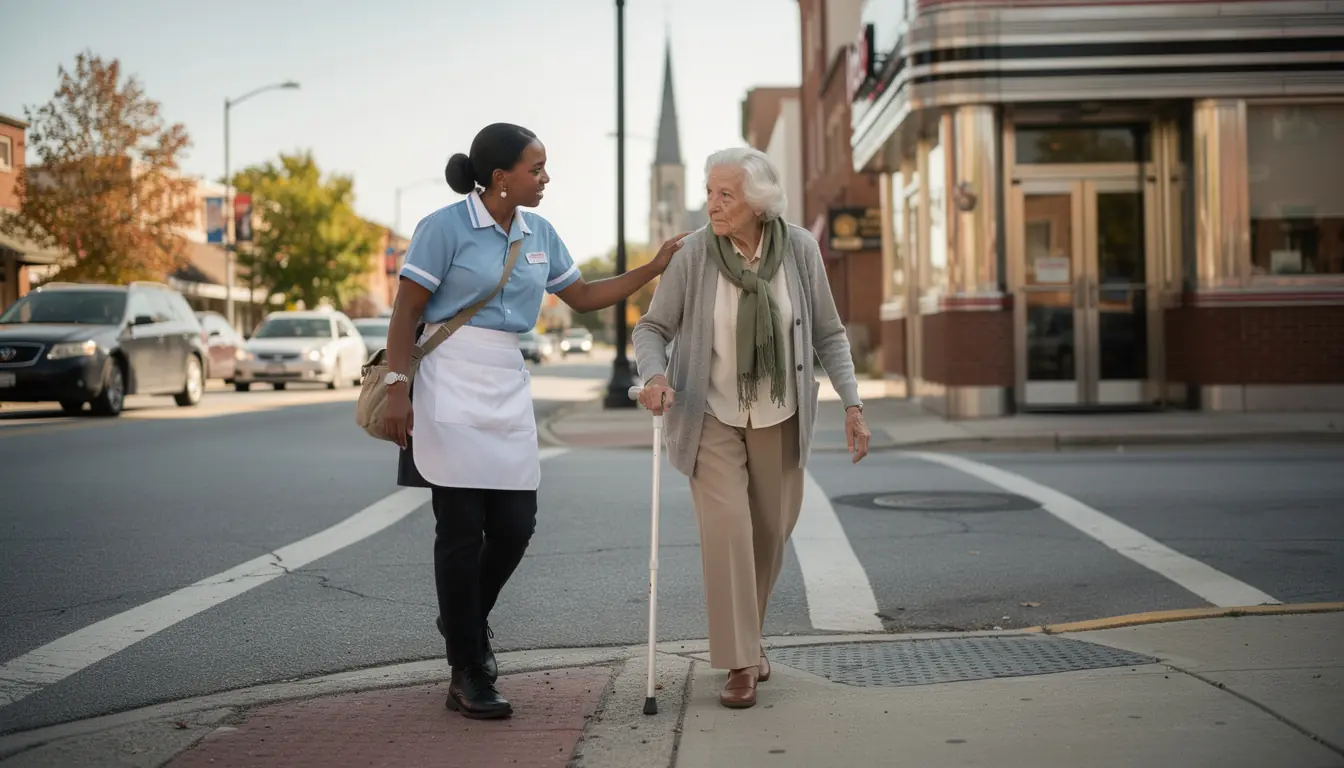
"Excuse me, ma'am," Nia said, slowing beside her. "Are you trying to cross?" The woman's face turned toward her voice. She was Black, perhaps in her seventies, with silver braids tucked beneath a blue rain hat and a canvas bag resting against her hip. "I am," she answered. "The crossing I know has disappeared. Every time I try to find the new one, I hear traffic where the pavement ought to be." She smiled faintly. "I was beginning to think Atlanta had rearranged itself overnight."
Nia looked beyond the barriers. A trench cut through the old sidewalk, and one unsecured metal plate tilted over its edge. A city notice directed pedestrians around the block, but the printed arrow faced away from anyone approaching with a cane. Behind her, a bus hissed to a stop. She could still make her shift if she caught it, and the manager had already warned everyone that late arrivals would be written up. Then the older woman placed her cane forward and its tip struck empty air beyond the pavement.
"Please stop right there," Nia said, sharper than she intended. She explained the trench and asked whether the woman would like to take her elbow to the safe crossing. "Yes, please," the woman replied. "Tell me what's ahead as we go. Don't pull me along." Nia held her arm steady and described the route: a rough patch of sidewalk, three steps around a portable fence, then a curb ramp with standing water. She never grabbed the cane or assumed she knew better than the person using it.
It took longer than it should have. One corner was blocked by a parked delivery truck, and the accessible route marked on the sign ended at a curb without a ramp. Nia called the construction supervisor's number posted on the fence, reached voicemail, and left a precise description of the hazard. Then she guided the woman back to a route that crossed at the next signal. Her phone vibrated twice in her apron pocket. The first message from the diner said, WHERE ARE YOU? The second said, YOU'D BETTER HAVE A GOOD EXCUSE.
"You're late for something," the woman said. Nia glanced at the time: 7:06. "Work. But I'd rather be late than leave you next to that hole." The woman squeezed her arm for half a second. "I don't need someone to rescue me from every street. I do need the city to stop pretending a sign nobody can reach is an accessible crossing." Nia nodded. "That's exactly what I'm going to tell them when I get a chance."