She Was Knee-Deep in the Duke's Pond Chasing a Runaway Duck — He Forgot to Be Cold

She Was Knee-Deep in the Duke's Pond Chasing a Runaway Duck — He Forgot to Be Cold
Theme:
Font Size:
24px

Dioynes had flown the coop before. This was the unanimous view of everyone in the Hullbrook household, delivered with the solemnity of those who'd been proven right repeatedly, and took no joy in it. The first time in August, he'd wandered three gardens south, and wreaked havoc in Mrs. Alcott's vegetable patch, returning at dusk with the serene air of someone who'd simply been out on an errand. The second time in early September, he'd somehow reached the Wiltshire Road and held up the mail coach for eleven minutes. An incident personally witnessed by a young footman dispatched to the village and recounted to the household with the meticulous detail of a witness determined to be believed.
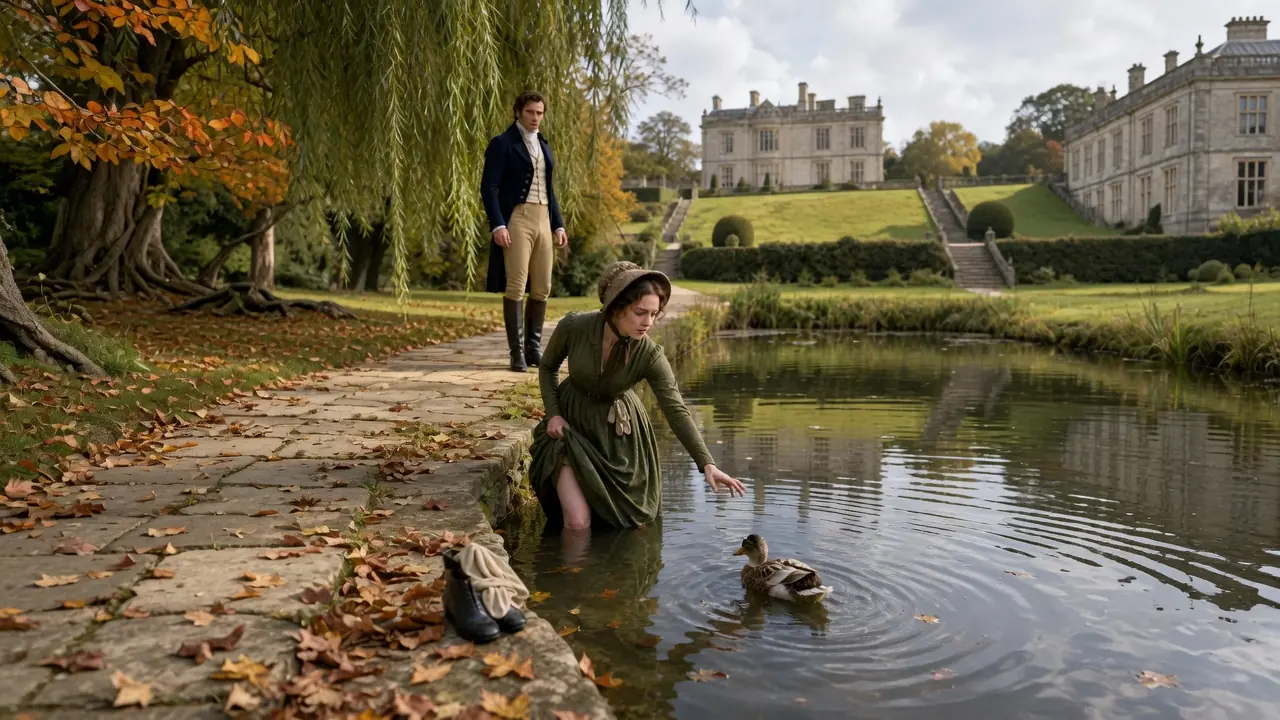


No one had even considered a net after the July net incident, which had ended rather poorly for the net. The third escape, the one that truly matters, occurred on a Thursday morning in October. The weather had settled into that distinct cool clarity particular to Wiltshire autumns. The kitchen garden smelled of damp earth and rosemary, and Felicity Bramwell stepped out at eight with her cousin's umbrella, ostensibly to gather herbs. The umbrella was for the light rain that had ceased six minutes prior.

The herbs were, in hindsight, quite beside the point. Felicity immediately spotted the empty pen. She'd been visiting Hullbrook House for two weeks and had already learned to check the pen, much like one learns to check a door someone keeps leaving unlocked. The gate was open, not forced, not broken, simply open, in the manner of a gate thoroughly considered by a creature with both patience and strong opinions about its desired location. She stood in the kitchen garden, taking stock.

The herb garden was peaceful, fragrant, and utterly duck-free. The meadow beyond the low stone wall to the south was quiet, save for the usual birds. Beyond the meadow ran the stream that marked the boundary between Constance Hullbrook's modest property and the grounds of Alifford Court, the estate of Ambrose Sinclair, Duke of Alifford, who was, as Constance had mentioned three times in two weeks, with increasing emphasis, a man of exceedingly private habits, a well-known aversion to uninvited guests, and a particular coldness that Constance described not as cruelty, but as the careful absence of warmth which was somehow worse. Felicity weighed her options. She could return to the house and inform Constance.

Constance would worry efficiently but not usefully. She could send for the kitchen boy who had on two previous occasions proven incompatible with Dioynes. She could simply wait at the gate and hope. She climbed over the wall. This wasn't strictly speaking trespassing.

Or rather, it was trespassing, but it was trespassing in pursuit of a duck that didn't belong to the property owner, which felt like a distinct and defensible category. The meadow was damp with morning dew, and smelled of freshly turned earth and something sharp and green she'd never encountered in London. The path along the stream was perfectly fine if one kept to the higher bank, which she did, walking swiftly in the direction of water, where Dioynes tended to arrange himself when given choices. She found him at the pond. Alifford's private pond was nothing like Hullbrooks.

Hullbrooks was a cheerful, muddy affair with reeds, three opinionated moorhens, and a general air of having simply evolved rather than been designed. Alifford's pond was deliberate. It had been constructed to precise dimensions, edged with flat limestone, and surrounded by willows that drooped in that particular fashion, suggesting a long acquaintance with sorrow. The water was remarkably still and clear, reflecting the October sky like a painting. Dioynes floated in the middle, arranged with the profound satisfaction of a philosopher who has located the ideal spot for reflection, and sees no reason to reconsider.

Felicity stood at the edge observing him. The pond was roughly five feet deep at its center. Dioynes was sitting in approximately two and a half feet of water, which was navigable but wet. The bank offered no obvious footholds for an approach that might result in retrieving a duck while remaining dry. A long willow branch curved over the water and might, with creative application, serve as a herding tool, but Dioynes had proven specifically resistant to herding since July.

Bread worked. She had no bread. She stood and pondered this for about forty seconds. Then she removed her half boots, placing them neatly on the limestone edge with the resigned tidiness of someone about to do something entirely sensible who desires at least one element of the situation to be organized. She then removed her stockings, tucked them inside the boots, and stepped into the pond.

The cold was immediate and absolute. This was October in Wiltshire, and she had known the water would be cold, much as one knows a plunge will be cold before taking it. That is to say, she knew it perfectly well, and the knowledge helped less than one might hope. The mud at the bottom squelched between her toes, and the water climbed her calves, then her knees. Dioynes watched her approach with the expression of a creature that has lived among humans long enough to find them philosophically interesting, but not particularly surprising.

He paddled two feet further toward the center. Felicity stopped and re-evaluated. The pond floor sloped. She estimated she was about thigh deep in her current position, and moving forward would only make matters considerably worse. She was already holding her skirts up with both hands, which limited her strategic options.

The morning was exquisitely beautiful in the manner of cold October mornings. The willows rustled softly in the slight breeze, and Alifford Court was visible over the ridge of the south bank, its chimneys emitting the thin smoke of a household that had been awake for hours and had things well in hand. And here she was, standing in someone else's pond, barefoot, in pursuit of an uncooperative duck. Some days are simply like that. She was still in the midst of rethinking when she heard footsteps on the gravel path bordering the willow bank.

Measured footsteps, not hurried: the footsteps of a man who is surprised, but has chosen not to betray it in his stride. She turned. The Duke of Alifford stood at the edge of his pond. He was taller than she had expected from Constance's description, which had focused primarily on his coldness, and quite neglected his physique. He possessed the kind of face that was inherently serious, finely sculpted, dark-haired, the face of someone for whom ease had always demanded more effort than seriousness, and who had therefore chosen seriousness as the more economical path.

He wore riding clothes that fit him with the effortless grace of garments worn correctly for years, and he regarded her with the expression of a man who has discovered something utterly unexpected in his pond, and is methodically determining whether it is a problem or merely a phenomenon. His eyes were storm blue, she observed, the precise blue of weather that has weighed its options and made a firm decision. She met his gaze. He looked at her. Behind them both, Dioynes paddled serenely.

"Good morning," Felicity said, because it was either that or sink, and sinking seemed the worst choice. The Duke did not return her good morning. This was either terribly poor manners, or the measured response of a man who needed a moment to update his understanding of the morning, and Felicity charitably assumed the latter. She had been in tricky situations before, the incident with the canal in Bath, the unfortunate afternoon at the Warwickshire Agricultural Fair, and had learned that dignified silence from bystanders usually spoke more to their own recovery than any judgment of hers. He looked at Dioynes.

He looked at her. He looked at her boots, sitting neatly at the limestone edge with the air of abandoned footwear that knew it had made the correct decision. "You," he said, "are on private property." "Yes," she replied. "I followed the duck." That duck, the Duke stated in the tone of a man presenting evidence, has been on my pond every morning for 3 days. Felicity processed this.

This is only the first time he has escaped today from our side. "From your property," the Duke clarified. He appears to have his own arrangements on this side. He said this with the careful neutrality of a man reporting a fact he wasn't quite sure how to categorize. I should have reported it.

I did not. Something in his expression flickered briefly. The slight adjustment of a person who has spoken and is reconsidering their intent. He recovered his composure with the practiced ease of long habit. I should have reported it, he repeated, which was technically a repetition but felt like a correction.

"He has excellent taste," Felicity offered. "Your pond is considerably better than ours." He looked at the pond. She had the distinct impression he hadn't previously considered his pond in terms of its comparative merits. Or perhaps he had, and was surprised someone else had reached the same conclusion. "Be that as it may," he said.

"I'm Felicity Bramwell. I'm visiting my cousin at Hullbrook House. I'd introduce myself more formally, but I'm standing in your pond, and I think the pond has already established the context." He looked at her with those storm blue eyes, and something shifted at their corners. Not quite a smile, more its precursor, the slight softening that comes before the decision to soften, which he clearly thought better of.

"I know who you are." Constance Hullbrook mentioned her cousin from London. "I hope not unfavorably." "The opposite," he said, which seemed to require a small effort, and which he immediately followed by straightening slightly, as if the honesty needed to be counterbalanced by posture. Miss Bramwell, if you would step out of the pond, my housekeeper can find you something dry. I still need the duck. He looked at Dioynes.

Dioynes looked back at him with the composed authority of a creature who has spent three consecutive mornings establishing the terms of a relationship and considers those terms settled. Leave the duck, the Duke instructed. I cannot leave the duck. He belongs to Constance. He appears to belong to this pond.

He has preferences about most things. He is Dioynes. The Duke looked at the duck with the expression of a man filing away new information. You named him Dioynes. Constance did.

He was living in a barrel for a time which she considered appropriate. He outgrew the barrel. We tried a pen but she gestured at the current situation which served as its own explanation. The near smile threatened again. He suppressed it.

His self-containment was quite remarkable. She thought the kind of skill that suggests years of practice, much like certain musicians make the most technically demanding pieces appear effortless, except musicians usually aim to impress someone, and he seemed mostly intent on impressing himself. "Step out of the pond, Miss Bramwell," he said, and this time it was less a command and more a request, the shift in tone quite noticeable. She walked out of the pond. Water streamed from her skirts in a sustained and utterly undignified flow.

She did not look at it. She looked at the Duke, who was looking at her feet, which were wet, bare, and adorned with good Wiltshire pond mud from toe to ankle. He looked away, not dismissively, but quickly, as if the gaze was involuntary. "Mr. Holt," he said. The butler materialized from the path with the seamlessness of a man who had been present all along, which he had been, observing the situation with the expression of someone who has maintained dignity on behalf of others for two decades, and considered this morning a particular test of that vocation.

"Your Grace." "Please see if Mrs. Apprentice can find something suitable for Miss Bramwell." "Of course, Your Grace," Mr. Holt replied in the tone of a man who would certainly do this and also be privately pondering it for some time afterward. The Duke looked at Dioynes. Dioynes looked at the Duke with the placid attention of a creature who had assessed the situation and found it perfectly acceptable. Thomas can come for him with the net.

The Duke suggested, "Thomas can come for him with the net." "He does not respond well to nets," Felicity said. "He responds to bread, ideally stale, offered from the left hand because he approaches from the left when the bread is in the left hand, and from the right when it is in the right hand. He has views about approach-angles." The Duke looked at her. It was the look of a man encountering a level of duck-specific intelligence he had not anticipated at this hour of the morning.

"Is that so?" "I know it sounds particular." "It sounds," he said carefully, "very particular indeed." He paused. "We can find bread." Mrs. Apprentice, Alifford Court's housekeeper for fourteen years, whose organizational prowess was spoken of with the reverence usually reserved for architectural features, produced a dry dress, a towel, a pair of thick wool stockings, and a room to change in, all within seven minutes of Mr. Holt's return to the house.

The dress was several years out of fashion and a trifle short in the hem, having belonged to a housemaid who had left Alifford's service and left the dress behind, which told Felicity something about the rate at which people came and went from this household. Mrs. Apprentice herself had the manner of someone who had already made up her mind, and was simply awaiting the evidence to arrange itself as she expected. She directed Felicity to the small room off the kitchen passage with the firmness of a woman who considered herself the last line between the household and utter catastrophe. "His Grace will see you in the drawing room," Mr. Holt announced when she emerged, which was the most oblique invitation she had ever received.

The drawing room faced south, holding the October light in that unique way of rooms correctly oriented for warmth without being inherently warm. There was a fire and there were chairs and nothing extraneous. No scattered personal items, no embroidery frame left mid-stitch. No sign of anyone having recently occupied the room for any reason other than specific purpose. There were books, though, not decorative books arranged by binding and height for show.

These were books in the specific disorder of genuine reading, removed from shelves and not returned, stacked near chairs, one left face-down in a way that would make a librarian wince, and another with a folded paper marking a page. A horticultural treatise. Tacitus, something in French with a battered spine. Three different books on Wiltshire agriculture at various stages of being read. She was scanning the spines when the Duke entered.

He had changed from his riding coat into a morning coat of dark blue that fit him with the assurance of good tailoring and no hint of vanity. He looked, Felicity thought, like a man who had tidied himself after a disruption and expected the room to cooperate. He paused when he saw her at the shelves. "You read extensively," she commented. "I read," he said. "The horticultural treatise, Tacitus, and something in French are different kinds of reading."

"Tacitus for duty, I would think, or something akin to it. The horticultural treatise for pleasure. The French I cannot quite read from here." He moved further into the room with the measured pace of a man calibrating something. "You read French."

"My governess was very dedicated to it. The French is for the walled garden," she guessed. He stopped. "Yes," he said, which was technically confirmation of a guess, but delivered with the slight defensiveness of someone who has been accurately perceived. "The south wall has the right aspect for certain things."

"What are you growing?" He looked at the book rather than at her, which she was beginning to recognize as a pattern: the displacement of eye contact onto objects when the conversation became something he had not prepared for. "Peonies, among other things."

"They take time. They take years," she said. "My father grew them. He used to say they were the most patient plants in the garden. They ask you to believe in them before they offer any proof." He found that philosophically appealing. There was a pause with its own distinct character. Not the pause of discomfort, but the pause of two people who have said something inadvertently honest and are simultaneously deciding how to proceed. "Milk?" Felicity offered.

Because Mr. Holt had placed the tea things within her reach, the kettle was on, and someone had to. The Duke looked at the teapot with the mild surprise of a man who had just realized a visitor was about to pour his tea, and couldn't immediately pinpoint why this felt unusual. "Yes, thank you." She poured. It was not strictly speaking her drawing room, but the teapot was there, and Dioynes had already done considerably more damage to the morning's protocols than pouring tea could hope to accomplish. The Duke accepted the cup with a look she was coming to catalog, the slight settling of his expression, when something small happened that he hadn't predicted, and found he didn't object to.

"How long are you in Wiltshire?" he inquired. "A month, perhaps through November, unless Constance needs me longer." She looked at him over her cup. "Or unless the duck becomes a genuine diplomatic incident, in which case I may need to remain to manage the situation personally." The corner of his mouth twitched. It was an extraordinarily tiny movement, a fractional adjustment barely perceptible, but she had been watching his face with the keen attention one pays to things that mostly exist in their resistances, and she caught it.

"Has Dioynes been retrieved?" she asked. "Thomas is attempting it." "He has been briefed on the bread method and the approach-angle preference." "Thomas should also know that Dioynes will accept being carried if one approaches from the left, offers bread, and waits for Dioynes to finish the bread completely before attempting any physical contact. If one rushes, he objects strenuously." The Duke looked at her over his teacup.

"You know this duck in considerable depth." We have a complicated relationship built over several months of mutual misunderstanding. She set down her cup. I'm sorry about your pond and your morning. I imagine you had a great deal planned. He was quiet for a moment.

Outside the October garden was going about its quiet business, and the willows at the pond were visible through the south window, their branches moving in the light wind with the meditative patience of things that have been there a long time and expect to remain. "I had things planned," he agreed. However, he did not finish the sentence. He set his own cup down with the deliberateness that she was learning to read as his tell. The small precise action he performed when being very careful about something adjacent to what he was saying.

He looked at her with those storm blue eyes in the October drawing room light and she thought he is not going to say the rest of the sentence but the rest of the sentence exists and that is interesting. "However?" she prompted gently. "They can wait," he said. Dioynes returned on Friday. Thomas, who had retrieved him on Thursday with a considerable expenditure of bread and patience, and a full hour of demonstrating left-handed offering technique to a duck, who regarded him with the evaluating attention of a test examiner, had personally returned Dioynes to Hullbrook House.

He handed him to the kitchen boy with specific instructions and was offered a piece of cake by Miss Bramwell, which he accepted because it seemed ungracious to decline, and because it was, in his considered estimation, an excellent piece of cake. He reported to Mr. Holt that the visiting Miss was, in his considered opinion, a good sort. Mr. Holt received this assessment with the neutrality of a man who had formed his own assessment, and preferred to let it develop privately. On Friday morning, the pen gate was open again. Felicity had checked the latch on Thursday evening, and it was a perfectly functional latch.

The only explanation that accounted for the physical reality of the situation was that Dioynes had spent the night in patient experimentation with the mechanism and had identified the solution, which was the kind of capability she found she could entirely believe in. This time she was ready. She had borrowed Constance's old garden boots, which were approximately her size, and she took the path along the stream rather than cutting across the meadow. She brought bread wrapped in cloth, and she arrived at the Alifford side of the stream at nine, accompanied by better boots and a clearer plan. She found Dioynes in the pond.

She also found the Duke. He wasn't at the pond. He was twenty feet from the pond in the walled kitchen garden, whose gate stood open, engaged in what appeared to be an earnest conversation with Henderson, who was the kind of old gardener that very old gardens produce. A man grown to fit his vocation so precisely that the vocation and the man had become indistinguishable. The Duke had his hands behind his back and was looking at the east wall with the focused attention of someone who genuinely cared about what a wall was doing.

He noticed her at the garden gate. He looked at the pond. He looked at her. She held up the cloth wrapped bread by way of explanation, and he looked at the bread, and something in his expression settled in a way she could not quite name. Not warmer, exactly, but less managed.

A fraction less organized against the possibility of warmth. "Henderson," he said, "we'll continue later." Henderson, who possessed the comfortable equanimity of a man who had watched dukes come and go and found them largely consistent, said, "Very good, Your Grace," in the tone of someone quite content to wait, and who would also be thinking about this later. The Duke came out of the kitchen garden and fell into step beside her as she walked toward the pond. She did not comment on this. He did not explain it.

They walked in the manner of people who have arrived by some mutual and unspoken agreement at a point slightly beyond introductions. They stood at the edge of the pond together. "He has been here every morning since Monday," the Duke said. "I walk the lower garden before breakfast. He is always already in position when I arrive."

"He is a creature of considerable routine," she said. "Within the category of things he cares about, are all ducks alike?"

"I could not say. I have only known Dioynes. He may be specific."

Dioynes regarded them both with the serene superiority of a creature who had arranged things precisely as he wanted them, and saw no reason for anyone to be confused about this. She unwrapped the bread and broke off a piece, holding it in her left hand, low and steady. Dioynes paddled toward the bank with the measured pace of someone with no intention of appearing eager, but strong intentions regarding the bread. He took it from her hand with duck gravity, without particular gratitude, but with absolute intentionality, and stepped onto the bank, standing beside the Duke's boot. The Duke looked down at him.

Dioynes looked up at the Duke. "He sat with you," Felicity stated. It was not a question. The Duke was quiet for a moment. "On Wednesday," he said, with the tone of a man admitting something that didn't entirely fit the narrative he had been maintaining about his mornings. "For perhaps ten minutes, on the bank while I was walking." He sat because he wanted to. Ducks do not sit with people they do not like.

"He may have been cold." "He has feathers," Felicity pointed out. The Duke looked at Dioynes. Dioynes looked at the pond. There was a complicated transaction occurring between the two of them, she thought.

That had been developing over five mornings and had arrived somewhere neither of them was quite willing to name. "He likes you," she said. "He sat on a bank near me." "Yes," she said. "That is how he likes people."

A pause. The October morning was cold and clear and smelled of leaf mold and distance and the faint sweetness of the willows. Somewhere on the estate a horse was being exercised, and the sound drifted across the garden in the intermittent way of sounds the wind carries selectively, as if choosing which pieces of the morning to deliver. She looked at the Duke's profile. He was watching the pond with the expression of someone who spent a great deal of time watching the pond, which she was beginning to think was not actually about the pond.

The lines of his face were older than she would have guessed from his posture. There was something in them that suggested not sorrow exactly, but the aftermath of sorrow carefully organized, the face of a man who had done significant internal housekeeping, and maintained the results with considerable discipline. "I should take him back," she said. "He'll be back tomorrow," the Duke replied. Probably a pause that had its own comfortable character.

"Miss Bramwell," he said. "Yes?" "There is, if you have no fixed engagements this morning, a view from the east terrace. It is worth seeing at this time of year." He said it with the careful precision of a man making an offer he wasn't entirely sure he intended to make and was therefore making very precisely so it could be retracted with minimal difficulty if needed. She looked at him. "I have no fixed engagements," she said. The east terrace offered a view of the valley and the beechwoods beyond.

The beeches had turned entirely to copper and gold, and the light filtered through them at that particular October angle that made the whole scene appear considered not by a painter, but by the day itself, as if the day had arranged its light specifically for this hillside. Felicity stood at the stone balustrade, gazing at it for a long moment without speaking. "Oh," she said eventually. The Duke stood a little to her left, and she had the impression, very clear, the clearest impression she had formed about him, yet that he was watching her reaction rather than the view with the particular attention of someone who has brought another person to something they love and is waiting quietly to see if that love is transferable.

"It is the same in spring," he said. Different quality, the same quality of light. You've been here in every season. "I was born here." He stated it as a fact flatly. But beneath the flatness lay something that was not flat at all.

The specific weight of a person describing something both true and enormous. The way people say, "I grew up here," and means something much larger. Felicity turned from the view and leaned back against the balustrade, a posture not entirely appropriate for a terrace, and looked at the house. Alifford Court was beautiful in a way that was also melancholic, too large for one person, visibly designed for more, with an east wing that from this angle appeared dark in its windows. The particular dark of rooms that have been closed rather than merely empty.

I wasn't born anywhere in particular, she said. My father was good at starting things and less good at finishing them. We moved frequently when I was young. I used to think I'd prefer a fixed point, a place that was always the same. And now she considered the valley.

Now I think it depends less on where you are than on whether you are actually there when you're there, whether you are present to the place or only moving through it. I've known people with fixed points who were never truly in them. He was quiet. The beeches made their copper sound in the wind. He was very close to her, she realized.

Close enough that she could clearly see the lines around his eyes, lines that spoke not of severity, but of something older and more specific. The lines of someone who had at some prior point laughed a great deal, and who had then spent some years on the careful project of forgetting how. "Do you have family nearby?" she asked. "Oh, sister in Dorset. We correspond." A pause.

We are fond of each other at appropriate epistolary distance. And here he looked at the closed east wing. Not currently. She did not press the matter. She had learned from her father's slow dying and the 14 months that followed the shape of a closed subject.

The shape was always the same. A careful flatness, an economy of words, the specific efficiency of someone who has decided that the territory is unavailable and has organized themselves accordingly. She recognized it as one recognizes a language one has spoken and then set aside. My father died 4 years ago, she said. He had a project in Yorkshire.

He always had a project that was his particular gift and I had to wind it up. 14 months of closing things out. I became very precise about endings during that time. He turned from the east wing to look at her. "And beginnings?" She smiled a little. "Beginnings are harder." Endings have a shape.

You can see them coming and you can organize around them. Beginnings have no shape. You don't know what you're beginning until you're already in it. He was very quiet. The October light moved across the terrace in the slow way of light that is not in a hurry.

After a moment, he said carefully, like someone choosing each word for its weight, "I became very good at not beginning, at staying inside things that were already established. There is less risk in things that are already established." She looked at him. He was looking at the valley, and she thought, There it is: the honest sentence, the one that slipped through. He seemed to feel it slip. She saw the slight adjustment of his posture, the return to correctness, but this time the sentence was already out in the October air, and there was nothing to be done about it.

She did not acknowledge it directly. She had found in years of being with guarded people, that acknowledged honesty becomes a pressure, and pressured honesty retreats. So she simply said after a moment, "The peonies won't bloom until June." He blinked. The small recalibration of a man returning from somewhere interior. "June," he agreed.

"On the south wall." "I'll be gone by then." "Yes," he said, and then after a pause that was doing far too much work for a single syllable. "I know." Constance, a perceptive and strategically patient woman, waited until dinner on Saturday to speak. What she said was, "The Duke called this afternoon." Felicity looked up from her soup.

"Here?" she asked. I was not at home. Constance placed the calling card on the table beside the salt cellar with the careful casualness of someone who had been planning this reveal since 3:00. "He left this." Felicity looked at the card.

Ambrose Robert Sinclair, Duke of Alifford. Clean engraving, very little ornamentation. The card of a man who is precisely what the card says and has no interest in additional description. "Shall I suggest he call again on Monday?" Constance offered in the tone of someone who would absolutely arrange this regardless of the answer. "If you like," Felicity said.

Constance returned to her soup with the expression of a woman who had made an excellent decision. He called on Monday. Constance received him with perfect propriety and the minimum present social obligation required, showed him to the morning room, requested tea, mentioned that her cousin was in the library, and then excused herself for a letter that was regrettably urgent and would require her full attention in her sitting room on the other side of the house for as long as proved necessary. The letter was to her cousin in Bath. It was not urgent.

Constance wrote it very slowly. Felicity was in Hullbrook's library working on her reply to her brother, who had asked for her opinion of Wiltshire, and received four crossed-out attempts. She had been trying to explain that Wiltshire in October was a different category of landscape from what she had expected, and that the particular quality of light in the valley below Alifford Court was a thing that could be identified, but not adequately transmitted in a letter, and that she had not yet found language for what she meant, which was unusual for her. She was staring at the fifth attempt when the Duke appeared in the doorway. She stood.

He said there was no need to stand. She stood anyway because she found she wanted to, and because the morning room was warm, and his coat was the same dark blue, and there was something in the quality of his presence in the doorway that made the room slightly more organized than it had been a moment before, as if furniture naturally arranged itself when he entered. "Constance is engaged," she said. "Yes," he said. "I thought she might be." This was so close to an awareness of Constance's maneuver that Felicity nearly smiled.

She managed not to. He came into the library and looked at the shelves with the genuine attention he paid to shelves, reading actual titles, not surveying books as a category of furnishing. "Did you need something specific?" she asked. He turned from the shelves. His hands were clasped behind his back in the way she had come to associate with him, thinking about what he was doing rather than simply doing it.

"I wish to apologize," he said. She blinked. "For what?" "For what I said on the terrace. I—" He stopped. The precision he usually brought to sentences was, she noticed, absent. He tried again.

"I said something unguarded. I should not have—" "You said you were good at not beginning," she said. Yes, I thought it was the most honest thing you'd said since the pond. He looked at her. She held his gaze.

I don't think you need to apologize for honesty, she said. Honesty is the thing people apologize for when they're frightened of it. The thing itself doesn't require the apology. He was quiet for a moment that held weight. The library was very still.

Outside the October garden moved in the wind, and a branch of something tapped against the window in the irregular rhythm of things that have no agenda. "Miss Bramwell," he said. "Yes?" "I find your company..." He stopped. The rest of the sentence was present in the room. She could feel it there, much like feeling a word you cannot quite retrieve at the edge of articulation.

And then he made a decision and said, "Worth considerably more than the inconvenience of a recurring duck." It was clearly not the sentence he had started. It was the sentence he had substituted when the original became too much. She recognized this, too, from her years with her father, who had also been a man of managed honesty. "That," she said, "is the most ducal compliment I have ever received in a library." The lines around his storm blue eyes rearranged themselves into a configuration she had not seen before. It lasted approximately two seconds, and then he brought it back under management, but two seconds was enough to see it clearly.

"I meant—" he said. "I know what you meant," she replied. She leaned forward slightly, her hands folded on the desk. "I find your company worth considerably more than having dry feet, which, given what I went through for the duck, is saying something." He looked at her. She watched the familiar sequence begin, the warming, the awareness of the warming, and then the retreat, the slight straightening, the return to formality, the reestablishment of the careful, correct distance. "You are very generous, Miss Bramwell," he said in the formal voice of a man reassembling himself.

She did not press it. She understood now the precise shape of the thing she was dealing with. It was not coldness. It was the architecture of someone who had been cold for so long that the architecture had become structural, and he could not simply choose to remove it without the whole thing requiring support. "Will you stay for luncheon?" she said instead.

He looked genuinely startled, as if the continuation of a morning into something as ordinary as a meal had not been something he had allowed himself to anticipate. "If it is not inconvenient," he said. "Constance will be finished with her letter by noon," Felicity said, and called for Mrs. Lawson, and went to find her cousin. She was leaving on Saturday. This was not new information. She had always been leaving on Saturday, since the plan had been November at Hullbrook and November was arriving, but by Wednesday it had acquired a different quality, much like a date on a calendar becomes a different object once it is close enough to be felt rather than merely known.

Constance was occupied on Wednesday morning with a letter from Bath that required her complete attention and considerable composure. So Felicity walked to Alifford alone, as she had been doing every morning for a week and a half, in the old garden boots she had quietly adopted as her own. She brought bread. She took the stream path. She arrived to find Dioynes in the pond and the lower garden empty.

This had not happened before. On every other morning she had found either the Duke in the walled garden or on the path or visible from the pond, and the pattern of the mornings had organized itself around that reliable coincidence. She had not until this morning noticed that she had been organizing herself around it. She stood at the pond and offered bread, and Dioynes accepted it. The morning was cold and clear and utterly quiet, except for the willows and the distant work sounds of the estate.

She was thinking about Saturday in the way one thinks about things that are approaching, whether or not one thinks about them. When she heard footsteps on the path behind her, they were slightly faster than usual. Not running, he would not run, she thought. He was not a man who ran toward things. He had spent too many years practicing the opposite, but the walk of a man who has realized he is late for something and has not yet fully committed to being late or being on time.

She turned. He stopped when he saw her. He was wearing a dark gray coat over his morning clothes, and his dark hair was not quite as organized as usual, as if he had come out in haste without completing the organizing, which was the most informal she had ever seen him. "You're here," he said. "I am," she replied.

He looked at Dioynes, who was sitting on the bank near his boot, a spot Dioynes had adopted as a regular position over the course of nine mornings, and which the Duke had stopped pretending not to notice. "I thought," the Duke said, "you might have gone." "I told Constance I was walking." "I meant—" He stopped. He looked at the pond and then at her and she watched the sequence she had watched four times now. The warming, the awareness, the decision point.

She had learned to read it very precisely. She knew exactly where the retreat would begin. It did not begin. "I leave Saturday," she said gently, not to prompt him. Just to say it plainly, because plain things sometimes let the other things pass.

"Yes," he said. "Ambrose," she said, his name in the October air between them. She had not said it before, not once, across all these mornings, and she felt him go very still when she said it, as if she had touched something that did not expect to be touched. He looked at her. "I want to say something," she said, "and I would like you to let me say it without retreating, if you can manage it, and if you cannot, that is all right, but I would like to try." He was very still.

Not the performed stillness of managed distance, but the stillness of a man holding himself carefully, because the alternative was losing the careful hold entirely. "Say it," he said. She took a breath of October air which tasted of cold and frost coming and the clear certainty that precedes winter and she said, "I think you decided at some point to be the coldest version of yourself because the coldest version is the safest version, and you have been so very good at it for so long that you have nearly forgotten that you decided. I think every time something warm happens—on the terrace, in the library, here at the pond—you notice it, and then you put it away because you made a decision, and you are a man who keeps his decisions."

She paused. "I think the decision was a reasonable one when you made it. I think it cost you something real and you were protecting what was left, but I do not think the cost has to be permanent." The morning settled around the sentence. The willows moved.

Dioynes, with the excellent timing of a duck, who had been managing this situation for two weeks, got out of the pond and sat beside the Duke's boot. The Duke looked at the duck. He looked at her, and she saw it. Not the retreat, not the managed face, but the actual face beneath it, which had been there all along in small glimpses, and which was now fully present, looking at her from across two feet of October morning, with the expression of a man who has been found accurately by someone who wasn't hunting him, and who is not sure whether this is the best or most terrifying thing that has happened to him in six years. Both, she thought, both at once.

"My mother had storm-blue eyes," he said. "There is a portrait in the gallery. I find the library considerably easier than the gallery." He said it quietly as if he was setting something down that he had been carrying for a long time and wanted to set it somewhere clean and safe. She died when I was 14.

I was at school. They sent a letter. A pause. "I had been practicing being very correct. It seemed afterward like the most useful skill I had."

"She looked like someone who knew how to laugh," Felicity said. "In the portrait, she was trying not to." Something crossed his face. "She thought seriousness was a choice, and had better be chosen consciously, or it would happen to you anyway and be far less elegant." He paused.

"I chose it less consciously than I would like."

"Ambrose," she said. He went still again when she said his name. She was beginning to understand that his name in her voice was something he had not heard in a long time in the particular register she used: simply his name, without title, deference, or careful management. Simply Ambrose.

"I am not asking you to be different," she said. "I am asking you to be the version of yourself who stands at a pond at eight in October because he might have missed someone. That version exists. I have seen him every morning for nearly two weeks." He took one step toward her. It was not a large step.

They were already close. The closeness of people who have been talking through cold mornings and arriving at the natural proximity of honesty, which is not the same as the proximity of bodies, but tends to produce it. And he said very quietly with the care of a man finding the words rather than deploying them. "I have not known what to do with you." "That seems fair," she said. "I walked into your pond." "You looked at my books." "I look at everyone's books." "You looked at my books," he said again as if he meant something different the second time.

And she thought, "Yes, that is the thing." Actually, she had looked at his books the way she looked at everything with genuine interest, with the assumption that the books would tell her something true about the person who had chosen them, with no performance of appreciation and no strategy of impression. She had simply looked and he had noticed that she looked and it had disarranged something. "I leave Saturday," she said. "My address in London is in Brook Street. Constance has it."

He held her gaze. His storm blue eyes in the October morning with the lines around them that were learning slowly to rearrange themselves. "I am a very poor correspondent," he said. "I write formally, and the formality loses things that were present when I began the letter." "Write it anyway," she said.

"I am very good at reading between formal lines. It is a skill I developed with my father, who also wrote formally and meant considerably more than the formality contained." He reached out and took her hand. Not dramatically, not with any performance. He took her hand the way a man takes a hand when he has decided finally that the retreat has become more expensive than staying. Quietly, carefully, with the deliberateness of a decision that had been forming for nine mornings, and had arrived at its moment.

His hand was warm. Her hand, which had been cold all morning, because she had forgotten her gloves again in the way she forgot gloves in October, with reliable consistency, was immediately less cold. He held it. The morning was very still around them. Dioynes sat on the bank and appeared to find the whole situation entirely expected.

"Felicity," he said quietly, carefully, as if testing what it cost to say her name without the retreat. "Yes," she said. "The peonies bloom in June," he said. "On the south wall." "The light—there is a particular quality to it in June on the south wall." "I have not shown it to anyone." He paused.

"I would like to show it to you." She felt the smile arrive, which it did completely and without asking permission in the way of smiles that are not performing anything. "Then I will come in June," she said. He held her hand in the October morning beside his private pond, and Dioynes sat on his boot, and the beeches on the south ridge were copper and gold against the pale sky, and the thing that had been forming since a woman walked into his pond with bare feet, and no embarrassment about it, stood in the morning air between them, fully assembled at last. He did not say anything else for a long moment.

Neither did she. Some things do not require additional words once the essential ones have been said. He was learning this, she thought, or perhaps he had always known it, and had simply not had occasion to use it in some time. The letter arrived in Brook Street on a Thursday, nine days after she returned to London. It was formal—correctly, predictably formal.

The letter of a man who had warned her it would be formal, and had then written exactly that. The address was precise. The salutation was correct. The first two paragraphs contained information about estate matters in Wiltshire that were entirely accurate and entirely beside the point. Between the formal lines, in the spaces where his actual self was visible through the architecture of proper correspondence, there was something else, a mention that Henderson had expressed a strong opinion about the east wall that she would, he thought, find interesting if she were ever inclined to hear it.

A brief and technically irrelevant observation that the pond had been unusually quiet since Monday. A postscript—the postscript was where he had clearly stopped managing, that said only, "Dioynes, I have been informed by Constance, has been telling fortunes in the Hullbrook kitchen garden." "Henderson considers this unlikely. I have no firm opinion." She wrote back in the space of one afternoon. She sent the letter before Prudence could intervene.

He replied in four days, then three, then two. By the end of November, the formality was losing ground in the second paragraph rather than the fifth, and by December it had retreated almost entirely to the salutation, where it clung with the dignity of things that have been correct for a long time and do not know how to stop. By January, the letters were simply Ambrose, which was more than she had hoped for in October, and meant considerably more for being him. She returned in June. The peonies on the south wall were deep rose and cream, the particular bloom that requires years and delivers everything, and the June light on the wall was exactly as he had described, warm and slanted, and the kind of light that makes you understand why someone looked at an east wall on a cold October morning, and decided to begin.

She stood in front of them with Ambrose beside her and Henderson a respectful distance behind with the expression of a man who considered himself responsible for this on some level and was not wrong. "You were right," she said. "Henderson is usually right," he said. "I implement his conclusions." "I meant about the light," she said. He looked at the peonies in the June morning and then at her, and the lines around his storm blue eyes were doing the thing they did now with increasing frequency, which was what they had always been built for.

They married in September in the church nearest Alifford Court, in the manner of two people who know what they want and have no particular interest in making a theater of knowing it. Constance cried, which surprised her and didn't surprise anyone else. Henderson gave them a cutting from the south-wall peonies with instructions he delivered at length and with the conviction of a man who trusts no one else to follow instructions correctly. Mr. Holt organized the household's response to the occasion with the same professionalism he had organized everything since the pond incident which he never mentioned directly and which could be observed on careful occasions to have made him quietly and permanently fond of the new duchess.

Alifford Court opened its east wing for the first time in seven years. Mrs. Apprentice organized this with her usual genius and an expression that suggested she had been waiting for the opportunity. The portrait gallery, when Felicity passed through it on a morning in October of the following year, looked different from how she remembered it. Not changed, but settled, as if the rooms had remembered what they were for. The woman in the portrait with the storm blue eyes was still trying not to laugh.

Felicity thought she looked rather pleased. Dioynes was given his own pond constructed at Felicity's specific request on the east side of the Alifford grounds in a location Henderson selected for optimal appeal to a philosophically inclined duck. Dioynes visited it occasionally with the polite acknowledgement of something that has received a gift and recognizes the intention. He continued to prefer the original pond which had been his position all along and which everyone had eventually understood was not negotiable. Some things require patience.

Some beginnings require the right kind of interruption. They both happened in the end at the same pond on the same cold October morning because a duck called Dioynes had decided he knew where he wanted to be and had simply gone there with a conviction that turned out to be entirely correct.

News in the same category