The night Edith Voss was publicly humiliated, Lord Crispin Vale stood six feet away and did nothing.
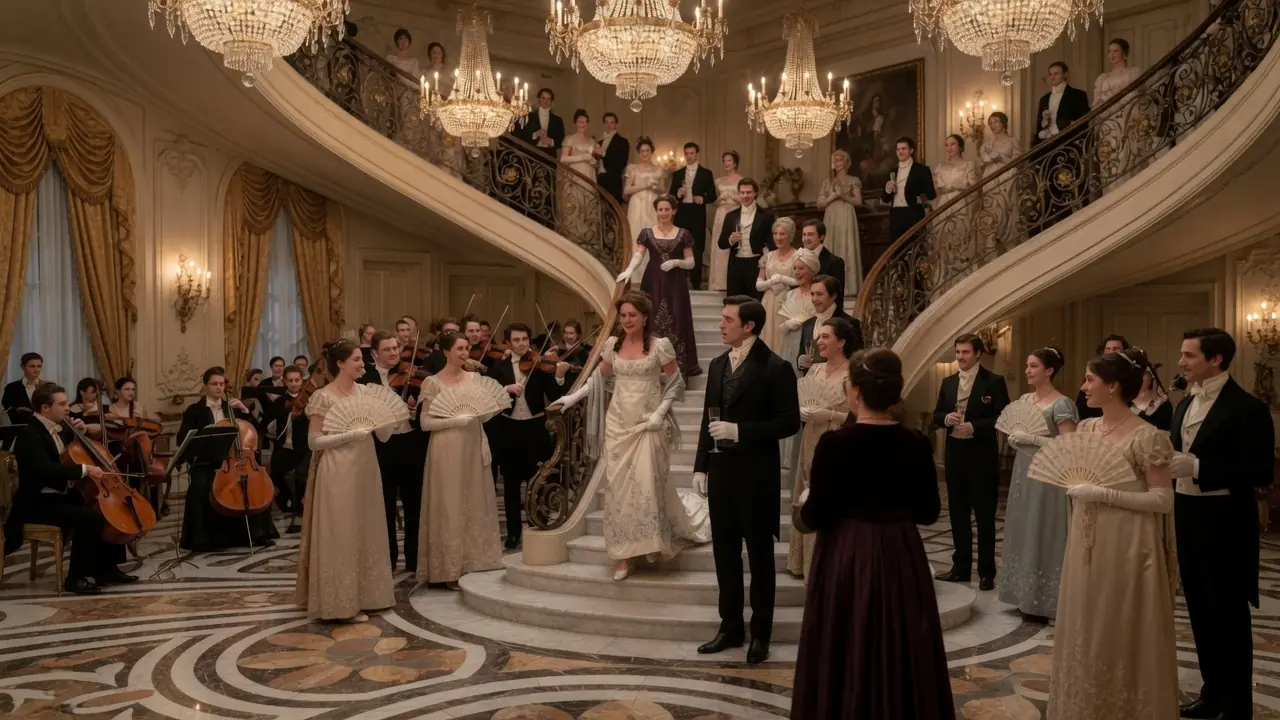
That was the version London told. That was the version that traveled from drawing room to drawing room in the particular efficient way that cruelty travels, gaining detail with each retelling until it had hardened into fact. Edith Voss, the baronet’s daughter with the damaged ears, had misread Lady Pembroke’s question at the Whitmore Winter Ball, had answered something that had not been asked, had smiled at a silence she mistook for conversation, and the room had laughed.
Not all at once. Worse than that. One at a time, like candles catching. And Lord Crispin Vale, the most powerful man in that room and arguably in all of London, had stood six feet away with a glass of champagne he had not touched and had said nothing at all.
What London did not tell, because London had not been paying the right kind of attention, was what happened in the eleven seconds before he turned away. Edith would not have known herself. She had been managing her own face at the time, which required everything she had.
She was twenty-six years old and had been managing her own face in rooms like this one since she was nineteen, when a fever had taken most of the hearing in her left ear and all of it in her right, and the world had rearranged itself around her into a place of moving mouths and careful guesswork and a particular exhausting performance of appearing to follow conversations she was reading rather than hearing.
She was very good at it. Good enough that most people in most rooms had no idea. Good enough that the moment she failed had the specific quality of public nakedness, the shock on others’ faces mirroring back what she was not permitted to show on her own.
She had not cried that night. She had excused herself with composure, retrieved her wrap, and descended the Whitmore steps into the cold with the particular controlled grace of someone who had learned that dignity, once surrendered, is very slow to return. She had not seen Lord Vale follow her out. She did not know yet why he had.
That was the beginning of it, and like all beginnings that matter, it carried inside it something neither of them could have named yet. Something that would, in the months ahead, cost them both considerably more than one ruined evening.
A word about Edith Voss before the rest of it.
She was the eldest daughter of the late Sir Edmund Voss of Wiltshire, whose modest estate and considerable charm had sustained the family through his lifetime and neither survived his death by much. He had died when Edith was twenty-two, four years after the fever, leaving behind a younger sister, Clara, a pleasant house increasingly resistant to repair, and debts that had taken eighteen months and most of Edith’s inheritance to settle cleanly.
She had become a governess not from lack of options, but from a clear-eyed assessment of them, a quality that had always characterized her thinking and had served her well in every context except the social ones, where clarity of thought was rarely the attribute most rewarded.
She taught the daughters of Lord and Lady Merrow on Harley Street. Mathematics, French, Italian, and the kind of quiet competence that could not be listed on a curriculum, but was perhaps the most useful thing she gave them. She had been doing it for three years. She was good at it. She found, most days, that it was enough.
She attended the Whitmore ball because Lady Merrow was generous and because Edith had once, before the fever and the debts and the long education in managing silently, been precisely the sort of young woman for whom such evenings were designed.
She still had the dresses. She had let out their seams twice and taken in their waists once, and kept them with the particular practicality of someone who understands that beauty is not a luxury but a tool, and tools are maintained. She had not expected the evening to go as it did. She rarely expected the bad evenings in advance.
If she had, she would have stayed home more often and attended the world less. And she had made a private decision after the fever that she would not permit her ears to make her smaller than she was. She kept the decision firmly in place.
She kept it in place on the Whitmore steps that night, with the cold finding the gap at her collar and her hands steady at her sides, and London’s laughter still faintly audible through the tall lit windows above her.
She did not hear him come out. She saw his reflection caught briefly in the dark glass panel of the door before it closed, and she turned, and there was Lord Crispin Vale on the step above her with his hat in his hand and an expression she did not yet have the vocabulary to read.
He was thirty-two. She knew this the way one knew facts about powerful men without having sought them, by absorption, by the particular social osmosis of a world in which such men occupied every room, whether present or not. He was unmarried. He was said to be brilliant and said to be cold.
And she had learned through experience that those two things were what people said about men whose intelligence made them efficient in ways that left no room for performance. He had dark eyes and a jaw that looked like it had been designed for disagreement.
And he was standing on the step above her, looking at her as though he had followed her out here for a reason he was still in the process of determining.
“Miss Voss,” he said.
She had turned before he finished the first word, reading his lips in the lamplight with the ease of long practice. His face was well lit and facing her, and she caught all of it.
“Lord Vale,” she said.
Her voice was even. She was rather proud of that.
He said it without preamble, without the softening that would have made it condescension. Simply a fact delivered to another adult, which she found she preferred to the alternative.
“Several evenings are,” she said.
“Not like this one.”
Something in his expression shifted. Brief and controlled, but she was good at brief and controlled.
“Lady Pembroke is not usually so deliberate.”
Edith looked at him carefully. “You say deliberate as though you mean something specific by it.”
He met her gaze. “I do, though I do not yet have the full account.”
She absorbed this. The cold moved between them. Upstairs, the music had started again, bright and indifferent.
“Then I suggest you acquire it,” she said pleasantly, “before you offer conclusions.”
She drew her wrap a degree tighter. “My carriage, Lord Vale, if you would be so kind.”
He called for it himself. She did not thank him. He did not appear to expect it.
She thought about the word deliberate for the entirety of the drive home.
He had his full account by the following morning.
His secretary, Deverell, was a man of thin frame, impeccable discretion, and the particular gift of assembling unpleasant pictures from individually unremarkable pieces. He laid the picture out on Crispin’s desk by ten o’clock with the expression of someone who finds the canvas distasteful, but the craftsmanship undeniable.
Lady Pembroke had known about Edith’s deafness in advance of the Whitmore ball. Not fully, not the precise medical history, but enough. She had been told by someone close enough to the Merrow household to know Edith’s situation, that Miss Voss sometimes missed the shape of conversations, that she read lips with considerable skill, but could be wrong-footed by a room in motion, by a question posed at the wrong angle, by a silence held precisely long enough to become a trap.
Lady Pembroke had held the silence precisely long enough.
It had not been spontaneous social cruelty. It had been a prepared one, which was, Crispin found, considerably worse.
He sat with this for a long time. He sat with a second thing as well, one that Deverell had delivered with particular care, embedded in the middle of the account where it might be absorbed rather than confronted.
Several weeks prior, Crispin had concluded a political negotiation that had quietly and necessarily dismantled a financial arrangement Lord Pembroke had relied upon for the better part of a decade. Crispin had not targeted Pembroke specifically. The man had simply been attached to a larger problem that required solving, but the effect on Pembroke’s position had been significant.
Lady Pembroke was not a woman who absorbed significant effects quietly. She had not come at Crispin directly. She had found instead the thing he could not easily defend without drawing more attention to it: his reputation for conscience, his known instinct for involving himself in cases of injustice, which was genuine, though he would not have called it that himself.
She had manufactured a case of injustice in his direct eye line and waited to see what he would do.
He had done nothing for eleven seconds and then walked away.
And she had gotten exactly what she wanted.
Crispin stood from his desk and went to the window and looked at the street below with the controlled stillness of a man very angry and long practiced at not appearing so.
He was angry at Lady Pembroke. He was angry at the person who had given her the information about Edith. And he was angry at himself, which was the sharpest of the three because it was the only anger with nowhere to direct itself but inward.
He wrote two letters.
The first to Lady Pembroke was five sentences. It was perfectly courteous, and it would, he knew, be understood completely.
The second was to Miss Edith Voss, care of Lord and Lady Merrow, Harley Street, and it said only that he believed she was owed an honest account of what had been done, and that he would provide it if she wished, and that the choice was entirely hers.
He sent it and did not allow himself to speculate about the reply.
She replied in two days. She would receive him on Thursday at two o’clock. She had thirty minutes before her afternoon obligations resumed. The note was precise and offered nothing beyond its content, and he found, reading it, that he respected her the more for it.
He arrived at Harley Street at five minutes to two and was shown to the Merrow drawing room, where Edith Voss was already standing at the window. She turned when he entered, having caught his reflection in the glass, and he filed this away alongside the other things he had been filing since the Whitmore steps.
The quality of her attention. The way she positioned herself in the light. The fact that she had placed her chair, when she sat, at an angle that kept his face visible and readable at all times. A small, practiced adjustment that she made without appearing to make it.
He told her what Lady Pembroke had done. He told her without softening it because he had spent thirty minutes on the drive over considering whether to soften it and had concluded that she would find the unvarnished version more respectful than the managed one.
He was right.
He watched her face absorb it.
“She knew,” Edith said. “She was told by someone in this household.”
It was not quite a question.
“By someone with access to information about your situation. I am still determining who.”
She was quiet, not the performed quiet of someone pretending, but the genuine quiet of a person thinking.
“It doesn’t excuse what I did,” she said then. “I still answered the wrong question.”
“You were given no reasonable opportunity to answer the right one.”
“That is a generous reading.”
“It is an accurate one. There is a difference.”
He held her gaze. “Miss Voss, why did you become a governess rather than return to Wiltshire after your father’s death?”
The shift in subject was deliberate. He watched her register it.
“Because the estate required selling,” she said. “And my sister was sixteen and needed the fees that a position in London could provide. And I was good with children. And the alternative was to become a dependent in someone else’s house and call it a situation.”
She paused. “Why do you ask?”
“Because I wanted to understand the shape of the last four years before I said what I am about to say.”
He met her eyes directly. “You have been navigating a world that arranged itself against you quietly and without acknowledgement. And you have done it with a competence that most people in that room would be incapable of in their best circumstances. What Lady Pembroke did was not a social misstep. It was a prepared cruelty aimed first at me and second at you. And I was present and silent, and I should not have been.”
His voice was even.
“I am not offering that as absolution. I am offering it as honesty, which I should have offered sooner.”
Edith looked at him for a long moment. Something moved in her expression, brief and real, before it settled back into composure.
“You were there to manage a political situation,” she said carefully. “Not to manage mine.”
“They became the same situation,” he said. “Yours was made in order to damage mine. I think you deserve to know that.”
“I do know that,” she said quietly now, a beat. “Thank you for telling me.”
He left at two-thirty.
On the front step, she said, without particular inflection, that she supposed they might speak again if he found himself with more of the account.
He said he expected he would.
They parted with the formal correctness of two people maintaining appropriate distances around something that was not yet named.
He thought about her on the drive home. He was aware that he was thinking about her. He noted this with the same methodical attention he gave to everything significant and did not draw any premature conclusions.
She thought about him until Thursday, when he came again.
He came again the Thursday after that and the one following. By the fourth visit, he had moved his chair without comment so that the light from the window fell across his face rather than behind it. She had not remarked upon this, and neither had he, and the silence on the subject was its own kind of conversation.
They spoke about mathematics, where he knew less than he assumed, and parliamentary land reform, where she knew considerably more, and about Voltaire, about whom they disagreed precisely and at length, with the mutual satisfaction of two people unaccustomed to being genuinely contested.
It was the most consistently comfortable Edith had felt in conversation since before the fever.
She told herself this was because he spoke clearly, that it was the quality of the content, not the quality of the man. She told herself this with great conviction through the fourth visit and the fifth, and was somewhat less convinced by the sixth, when she noticed that she had begun watching for his carriage from the schoolroom window twenty minutes before he was due.
The seventh visit did not come.
She received a note on Wednesday evening, brief and without explanation, saying only that he regretted he would be unable to call Thursday and hoped she would accept his apologies.
Nothing further.
No offered rescheduling.
The tone was correct and revealed nothing.
She told herself this was fine.
She was annoyed to discover how much effort that required.
What had actually happened on Thursday was something Crispin had not anticipated, which was unusual, because anticipation was among his primary professional skills.
Lord Aldous Pembroke had called on him Wednesday evening. Not Lady Pembroke, Lord Pembroke himself, which was a different matter, and which Crispin had received with the careful neutrality he reserved for things that arrived without warning and needed assessing before being engaged.
Lord Pembroke was not a clever man, but he was a proud one, which in Crispin’s experience was the more dangerous combination. He was also, it emerged within the first five minutes of the conversation, aware that his wife had done something at the Whitmore ball and was considerably less comfortable with it than she had anticipated he would be.
“I did not authorize it,” Pembroke said, and the way he said it told Crispin this was true. “What she did to that young woman, I want to be clear about that.”
“I believe you,” Crispin said, because he did.
“She told me your visits to the Merrow household were that you were—” Pembroke stopped, rearranged. “She has now told several people that your interest in Miss Voss is a matter of political management. That you were seen there in order to redeem the appearance of your conscience.”
The room was very quiet.
“She is wrong,” Crispin said.
Pembroke looked at him. “I thought she might be,” he said. “I wanted to hear you say it.”
After Pembroke left, Crispin sat alone in his study for a long time. The fire had burned low by the time he accepted what the evening’s conversation had clarified.
Lady Pembroke had not finished.
She had shifted her strategy, having failed with the first, and her new line was more dangerous than the old one because it used the truth as its architecture and built a lie on top of it.
Yes, he had begun his visits to Edith as a form of restitution. Yes, they had begun as something he might have called, in his most honest private accounting, conscience management. This was true.
And so, when Lady Pembroke said they still were, she was standing close enough to something real that the lie was difficult to distinguish.
He needed to tell Edith before someone else did.
He came on Friday instead of Thursday.
He arrived unannounced. He was shown to the drawing room to find it empty. Then the schoolroom door opened and Edith came out with chalk dust on her sleeve and her hair slightly escaping its arrangement. She stopped when she saw him.
“You changed the day,” she said.
“Something required addressing.”
He stood hat in hand, and for the second time since the Whitmore steps, he had the specific experience of a prepared speech failing him at the moment of delivery.
He looked at her, chalk dust and loosened hair, and the direct watchful attention of someone who had been reading the world by its visible surfaces for seven years.
And he said, “Lady Pembroke has told several people that my visits here are political management, that I came to repair my conscience, not because the visits themselves had become something else.”
Edith went very still.
“She is partly right,” he said. “I will not pretend otherwise. I came the first time for the reason she describes. I continued because—”
He stopped, navigated.
“Because the visits became something I looked forward to in a way that had nothing to do with politics. And I am not in the habit of looking forward to things for no reason. And I thought you deserved the honest account before the dishonest one reached you first.”
She was quiet for a long moment.
He watched her absorb it the way she absorbed everything, with her whole precise attention. Nothing discarded, nothing softened.
“Who told her about me?” she said finally. “About my situation at the Whitmore ball?”
“I believe I now know,” he said. “It was not someone in the Merrow household.”
He paused.
“It was someone in mine.”
She stared at him.
“Deverell gave me the final piece yesterday evening,” he said. “I had a junior correspondent, a man named Greaves, who was connected to the Pembroke household through a family association that predated his employment with me. He had access to my correspondence, including letters in which I had discussed, last autumn, a charitable case involving a young deaf woman in Cheapside that I had assisted in resolving through a legal connection. I had mentioned, incidentally, that I had encountered a similar situation in society, without naming you. It was apparently enough for Lady Pembroke to begin looking.”
He kept his voice even.
“Greaves has been dismissed. I wanted you to know where it came from.”
“Someone in your household,” Edith said slowly, “gave her just enough to find me.”
“Yes.”
“And she used it.”
“Yes.”
She turned away from him and moved to the window. The window where she stood when she needed to look at something that made no demands.
He waited.
He had learned over six weeks of Thursdays how Edith Voss processed the things that cost her, and he knew better than to fill the silence.
“I would like to ask you something,” she said, still facing the glass.
“Yes.”
“And I would like you to answer it with the same honesty you brought here today. Not the managed version, the real one.”
“Always,” he said.
She turned.
“If Lady Pembroke had not created the Whitmore scene,” she said carefully, “would you ever have known my name?”
It was a fair question.
It was a brutal one.
He stayed with it for the full length of time it deserved.
“I don’t know,” he said. “I would like to say yes, because I knew of you before that evening, but I cannot tell you that proximity would have become conversation without a catalyst. What I can tell you is that the catalyst is not what kept me coming back.”
He met her gaze.
“You are. The person who sat across from me and argued Voltaire with the focus of someone who genuinely cares about being right for the correct reasons. And who moved her chair two degrees every visit so that my face stayed readable. And who has never once asked me to accommodate her and never once pretended accommodation wasn’t necessary.”
His voice dropped slightly.
“That is what kept me coming back. And I do not think Lady Pembroke manufactured any of that.”
Edith looked at him.
The afternoon light was long and thin through the window, and the schoolroom was quiet. The world outside the house continued its indifferent business.
“You noticed,” she said, “the chair.”
“The second visit,” he said.
She was quiet for a moment.
“Then there is something you have not told me.”
He looked at her steadily.
“Yes.”
“You do something before certain sentences.”
Her voice was careful, precise.
“A half second of preparation. It is not hesitation. It is navigation. I have been watching it for six weeks, and I believe I understand what it is. But I would rather you tell me than have me be wrong about it.”
Thirty-two years old and fifteen years without a stutter, and he had somehow not accounted for the possibility of a woman who read faces for survival noticing the one thing he had hidden from every room he had ever occupied.
He told her.
About his father’s study. About the word embarrassment used by a man who should not have used it. About the fifteen years of methodical private correction, of building a public self from the material the private self had almost been made to feel was insufficient.
He told her plainly, without drama, in the same register she had told him nothing yet but had shown him everything in the careful adjustments of a chair and the steady watchfulness of a woman who had learned to make a life from what was visible when sound was not available.
She listened without expression.
When he finished, she said, “The night on the Whitmore steps. The sentence about the carriage. I thought the cold made you pause. It was the other thing. I know that now.”
She looked at him with an expression he was finally beginning to have the vocabulary for. Not warmth, not precisely, but something beneath warmth, the thing that warmth sits on top of.
Recognition.
The specific rare relief of being seen accurately by someone who had every reason to look away.
“I have spent seven years in rooms full of people who believe I am less than I am because I cannot hear them,” she said quietly. “I want you to understand that nothing you have just told me makes you less than anything. It makes you someone who rebuilt himself when a person who should have known better tried to reduce him.”
She paused.
“I know something about that project.”
He looked at her across the quiet room.
“Edith,” he said.
It was the first time he had used her given name, and the precision of it, the weight he gave it, landed in the room like something that had been waiting a long time to be set down.
“Yes,” she said, because she had heard what was beneath the name, and she meant the answer before he had finished asking.
What followed was not simple, because the things worth having are not.
There was the matter of Lady Pembroke, who received a second letter from Crispin that was shorter than the first and required no interpretation.
There was the matter of his family, who had opinions about governess-born baronets’ daughters with imperfect hearing. Opinions that Crispin addressed with the same flat, final authority he brought to parliamentary obstruction, which is to say he addressed them once, precisely, and they did not resurface.
There was the matter of Edith’s sister, Clara, who was now eighteen, and whose fees at her school in Bath had been quietly absorbed into a larger household arrangement that Clara herself was informed of only after the fact, when objecting was less logistically practical.
Clara objected anyway.
Edith had expected nothing less. She found she loved her sister rather more for it.
There was Lord Aldous Pembroke, who appeared unexpectedly at a parliamentary dinner three months after the Whitmore Ball and approached Crispin to say, without ceremony, that his wife would not trouble Miss Voss again.
He did not apologize on her behalf. Crispin did not require him to. Some reckonings were settled in rooms that history did not record, and this was one of them.
And there was a particular evening in March, in the drawing room of Crispin’s house on Grosvenor Street, where Edith was by then resident, and to which she had brought very little because she had always traveled light.
She had positioned the chairs near the fire at the angle that kept his face visible. He had positioned the lamp at the angle that kept hers in the light. They had settled into the quiet of two people who have stopped performing composure for each other.
He said, without particular preamble, that he had been thinking about what she had told him once, that she had not cried on the Whitmore steps.
She looked up at him and said she had not.
He said he wanted her to know that she was allowed to cry here if she ever needed to. That this was a room where such things were permitted.
She looked at him for a long time.
She said she would bear that in mind.
She did not cry that evening.
But three weeks later, on a Tuesday night, when the season had turned and the drawing room windows were opened onto the first warm air of spring, and something about the quality of the evening light was the specific shade of a Wiltshire afternoon from a year before her father died, she sat down in the chair by the window and she cried with the particular wholeness of someone who has been waiting a long time for a room safe enough to do it in.
He sat on the footstool beside her chair.
He did not say anything.
He did not perform comfort.
He was simply there in the way he was always there once he had decided to be steady and present and requiring nothing of her in return.
She told him later that this was the moment.
Not the drawing-room conversation, not the letters, not the Thursday visits with their accumulating vocabulary of small adjustments.
This.
He said he had suspected.
She said he would.
They were married in April.
The ceremony was small, attended by the people who had earned the occasion. Lady Merrow, who wept productively. Clara, who did not weep but gripped Edith’s hand during the vows with a pressure that said everything her composure would not. Deverell, who stood at the back with the expression of a man who has seen his employer make many decisions and considers this one the most efficient.
And Lord Aldous Pembroke, who had not been invited but sent flowers of such precise and appropriate arrangement that Crispin decided to find it graceful rather than presumptuous.
Edith wore ivory. She had let out the seams, and she wore it anyway, and she looked, by every account that reached her afterward, exactly like herself.
At the reception, a woman she did not know well leaned across the table and said something at an angle that caught the room noise wrong, and Edith did not catch it.
And for half a second, she felt the familiar preparation, the gathering of composure before the managed smile.
Then Crispin’s hand found hers under the table, brief and certain. Not rescuing, not redirecting the conversation on her behalf, simply present, one inch from her side, and she felt herself breathe.
She turned to him afterward and said quietly, “You didn’t say anything.”
“You didn’t need me to,” he said.
“No,” she agreed. “But you were there.”
He looked at her with the expression she had spent almost a year accumulating the vocabulary for, exact and unguarded and entirely without performance.
“I intend,” he said, “to keep being there.”
She believed him.
She continued to believe him on every subsequent evening that the drawing room windows were open to the warm air, in every room that required managing and everyone that did not, through all the ordinary accumulation of a life built by two people who had each rebuilt themselves once already and understood, better than most, the value of what they had made.
Lord Crispin Vale had walked out of the Whitmore ball into the cold and followed a woman he did not know down a dark step because of eleven seconds in which he had recognized something in her he had spent fifteen years hiding in himself.
Edith Voss had turned on that step and seen a man whose face in the lamplight was asking a question he did not yet know he was asking.
Neither of them had expected this.
Both of them, by the end, were grateful for the things they had not expected.
Some loves begin in grand ballrooms with music and declarations.
This one began on a cold step in February with a sentence about a carriage and a woman who caught the hesitation in it and said nothing.
And a man who called for her conveyance and watched her go and thought, with the beginning of something he could not yet name, that the evening had not ended the way he had expected.
He had been right about that.
It had ended considerably better.