Ravenwood Hall, Yorkshire, November 1819.
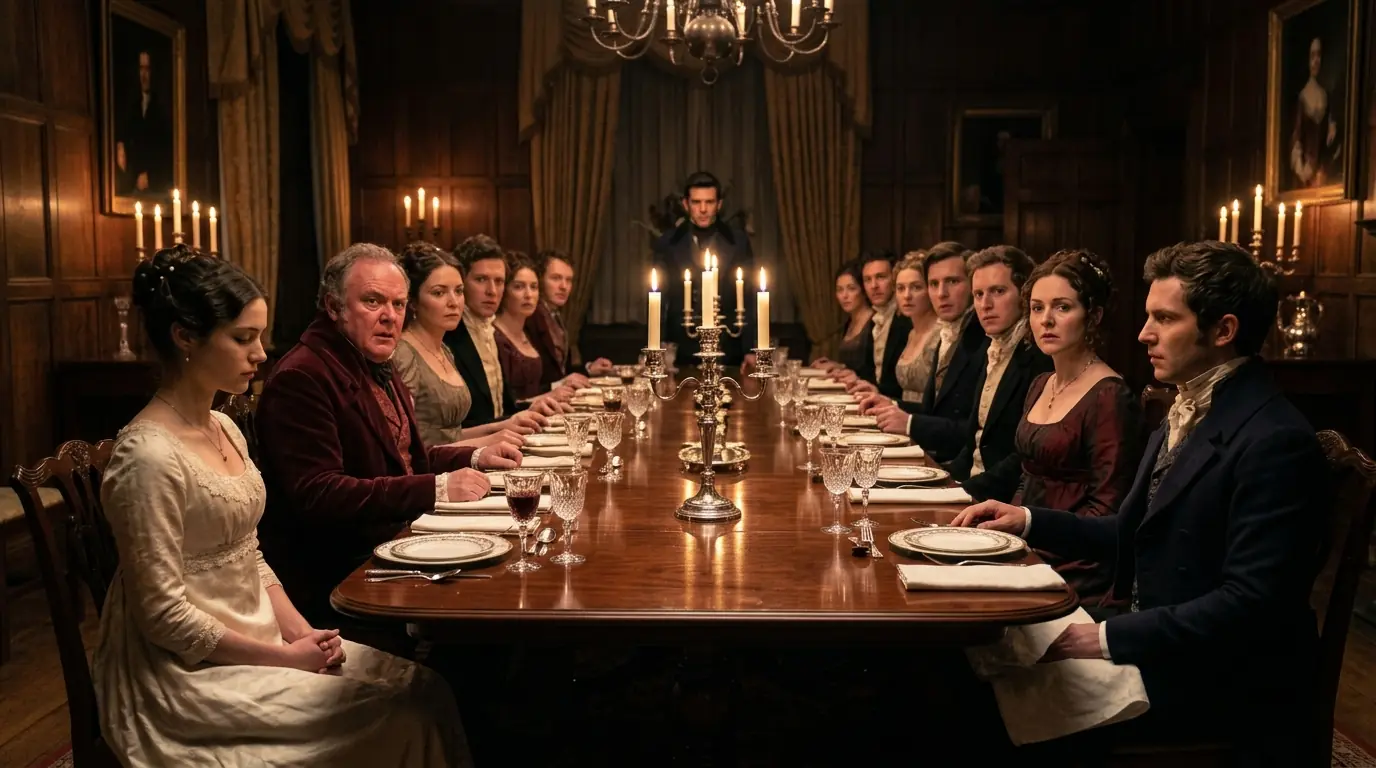
The gathering that evening was the worst kind of social disaster. Not the dramatic kind that ends with broken china and raised voices, but the quiet kind — the one where every person in the room knows exactly what is happening and no one says a word about it. That, dear friends, is the most particular form of cruelty: the kind delivered with a smile and received in perfect silence.
I have been sitting with this story for some time, turning it over the way you turn a stone in your hand, feeling for its true shape. I think it is finally ready to be told. Pull your chair a little closer to the fire. This one deserves your full attention.
Miss Linnea Ashworth had come to Ravenwood Hall with her father's careful planning, her mother's careful prayers, and a traveling trunk that contained, among other things, three evening gowns chosen for a house considerably grander than the one she had grown up in, and one small notebook filled with columns of precise figures that she had not told anyone about.
She had come with a clear understanding. She had always insisted on clear understandings — it was a quality her father had cultivated in her, and one her mother occasionally found inconvenient: that she was being considered as a suitable match for Mr. Sebastian Standish, younger brother of the Earl of Ravenwood. The families had spoken. The correspondence had been exchanged over the summer. The autumn visit had been arranged so that the parties might confirm what had already been decided.
She had also come with her own private assessment of the situation, which she had not shared with anyone: that she was not in love with Mr. Sebastian Standish and was not certain she could become so, but that love was not the only measure of a good marriage — that security and genuine respect were not nothing — and that she was prepared to give the matter a fair opportunity.
The fair opportunity had been quietly undermined within the first three days.
Mr. Sebastian Standish was, and I want to be precise here, because precision matters in this story above all things, a genuinely pleasant man. He had easy manners, a ready laugh, and a quality of warmth that fell on every person in a room with the effortless generosity of firelight. He was the kind of man who made you feel, for the duration of a conversation, that you were the most interesting person he had ever met.
Miss Ashworth had recognized this quality within the first hour, and understood by the second day that it was not directed at her with any particular intention. It went to Miss Celia Penford.
Miss Penford was the daughter of the neighboring estate, a frequent guest at Ravenwood Hall, and a woman who carried the specific silent misery of someone watching the man she loves being arranged toward another. She was self-contained and sweet-natured and clearly suffering. Miss Ashworth had felt a steady and thoroughly inconvenient sympathy for her since the second afternoon of the visit, and sympathy had not improved the situation for anyone.
None of which changed the fact that the dinner on the fourth evening was proceeding with a noticeable awkwardness, one the assembled county families were performing the careful courtesy of ignoring.
Lord Ferrersby, two seats from the head of the table, had been drinking since the fish course. He was a man of considerable Yorkshire property and considerably more self-regard, and he made a remark in that particular register — not loud enough to be a declaration, not soft enough to be private — about the interesting question of what a surveyor's daughter brought to a table like this, beyond her father's instruments.
He smiled when he said it. He looked at Miss Ashworth when he said it, then he looked away.
Miss Ashworth had been the daughter of a surveyor for twenty-six years. She had developed over that time a particular fluency in remarks of this kind. She received it with the same expression she had maintained through the soup course — composed, attentive, without a single visible fracture.
At the far end of the table, the Earl of Ravenwood set down his wine glass.
I should tell you about Lord Ravenwood — about Piers Standish, Earl of Ravenwood — because he is at the center of this story, though you would not have guessed it from watching him at a dinner table. He sat at the head and said very little. He had, in fact, said very little in all four days of Miss Ashworth's visit. Not the silence of a man absent or indifferent, but the silence of someone paying complete attention to everything, who has concluded that adding words would contribute less than continuing to observe.
Miss Ashworth had noticed this about him on the second morning. The county families seemed to find it forbidding. She had found it, privately, a relief. There was something steadying about a presence that did not require her to perform for it.
"Lord Ferrersby," said the Earl of Ravenwood.
The table stilled. In four days she had heard him speak at any length perhaps twice, and never at dinner.
"You are wrong," he said.
Three words. Not a speech, not a rebuke accompanied by argument or explanation — three words delivered with the quiet finality of a man who has decided a thing has gone far enough and sees no need to elaborate on that decision. He picked up his glass again as though the matter were entirely concluded, which, in the particular register of his authority, it was.
The room held its breath. Lord Ferrersby's smile thinned considerably. Lady Standish, at the far end of the table, looked at her elder son with an expression that contained several things at once, none of them displeasure. The Penfords exchanged a glance. Sebastian looked at his plate.
Miss Ashworth looked at the candles. She did not look at the Earl. She did not trust herself, in that particular moment, to look at the Earl of Ravenwood with an expression that did not reveal something she had not yet decided to reveal.
What she felt — the specific, uncomplicated quality of being defended without theater, without requiring her thanks or her attention, by someone who had apparently already arrived at a conclusion about the matter and was acting on that conclusion rather than performing a principle — was not something she had expected to feel at a county dinner in Yorkshire, beside a man she had come to the house to consider marrying.
She looked at the candles and held her composure, and was, beneath all of it, profoundly and unexpectedly grateful.
Ravenwood Hall had a greenhouse attached to the eastern wing. It was large, old, improbably warm, and grew, among other things, a quantity of medicinal plants supplied to the local apothecary and two village practitioners. Miss Ashworth had found it on the second morning, following a frost-gray garden path, and had immediately understood it to be the one place on the estate that was quiet in an uncomplicated way.
She had her notebook with her. She always had her notebook. She was working, in spare moments, on the drainage calculations for a system her father had left half-finished when a commission had redirected his attention. She found mathematics clarifying when social arrangements were neither clarifying nor pleasant.
She had been in the greenhouse for perhaps forty minutes on the third morning when she understood she was not alone. The Earl of Ravenwood was at the far workbench. He had a grafting knife and a length of rootstock and the focused attention of a man who has been doing this particular work for many years and finds it neither tedious nor remarkable.
He had not spoken when she came in. He did not speak now.
Miss Ashworth looked at him for a moment. Then she went back to her drainage figures.
They were in the greenhouse together for an hour, in complete silence. When she finally rose to leave, he looked up once and gave a single nod — the nod of two people who have shared a space without inconveniencing each other, and found the arrangement, on the whole, satisfactory.
She thought about that nod for the rest of the day.
The morning after the dinner, Mr. Sebastian Standish came to find her on the stone garden steps. She was sitting with her notebook, which was where she went when she needed to think clearly, and she heard him coming from some distance. Sebastian Standish was not, in any sense, a man who moved quietly through the world. He arrived with the expression of someone who had been working up to something since before dawn and was not entirely certain he had managed it.
"Miss Ashworth," he said, "I owe you an apology."