Miss Dorothia Mills had never mistaken eagerness for wisdom. She had seen eagerness falter too often, had watched it bloom brightly and wither just as quickly when confronted by the realities of household management, illness, disappointment, or financial uncertainty. In her father’s home, enthusiasm had been permitted, but never indulged. Her father, a solicitor of modest means and firm principles, believed deeply in preparation and restraint. Her mother, gentler in temperament but no less practical, taught that affection was best proven through constancy rather than declaration.
Dorothia had absorbed these lessons so completely that they shaped not only her conduct but her expectations. At six and twenty, she occupied a respectable but unremarkable place in society. She was neither young enough to inspire indulgent hope, nor unfortunate enough to prompt pity. Her appearance was pleasing without being striking: composed features, clear gray eyes, dark hair worn simply. She did not draw attention. Rather, she invited confidence.
People spoke freely in her presence, trusting her judgment, relying upon her discretion. It was not a quality celebrated in ballrooms. Suitors had appeared over the years, men of acceptable fortune and courteous intentions, but Dorothia had listened to each proposal with calm consideration, and declined without regret. She had no desire to be admired at the expense of being understood. Marriage, she believed, ought to be useful. If affection followed, it would be welcome, but it must never be demanded.
Thus, when her aunt, Mrs. Fielding, summoned her to the parlor on an October morning with an air of unmistakable gravity, Dorothia approached with composure rather than anticipation. Mrs. Fielding stood by the window, a letter held carefully between gloved fingers. This arrived yesterday, she said. I have read it twice. Dorothia accepted the letter and seated herself.
The paper was thick, the handwriting precise, every line carefully measured. From the first paragraph, its tone was unmistakable. Mr. Edward Langley of Langley House, Sussex, wrote with deliberate clarity. His father’s recent death had revealed years of neglect and mismanagement: accounts left unattended, repairs deferred, obligations postponed. Though the estate remained structurally sound and socially respectable, its finances were strained to a dangerous degree.
Edward, as heir, felt honor-bound to restore it, not through speculation or advantage, but through discipline and careful stewardship. He sought a wife of modest fortune, sufficient to stabilize the estate. In return, he offered respect, protection, and independence within marriage. There was no mention of love. Dorothia read the letter again, more slowly this time, absorbing not only the words but the intention behind them.
Well, Mrs. Fielding prompted at last. I find it honest, Dorothia replied. Her aunt sighed. Honesty is admirable, but one might hope for a little warmth. Warmth fades, Dorothia said gently. Stability endures. Her own circumstances were not desperate, but they were precarious. Her father’s death had left her with a modest inheritance, enough to assist another household, but not enough to guarantee lifelong independence.
She had no desire to remain indefinitely under her aunt’s roof, nor any inclination to accept a marriage founded upon promises she suspected neither party could fulfill. This proposal offered clarity, boundaries, truth. Two weeks later, Dorothia stood in her aunt’s parlor as Edward Langley was announced. He entered without flourish, bowing properly. He was taller than she had expected, broad-shouldered without heaviness, his movements controlled.
There was a gravity to him that suggested habit rather than performance, a man accustomed to responsibility rather than admiration. They spoke first of inconsequential matters: the weather, the journey from Sussex, the changing season. Edward’s manner was reserved, but courteous. Dorothia noted that he neither hurried nor avoided conversation. When Mrs. Fielding and Edward’s cousin withdrew with deliberate discretion, Edward turned fully toward her.
I will not waste your time, he said quietly. I believe frankness will serve us both. I agree. He spoke plainly of his circumstances, his voice steady and unembellished. Dorothia listened attentively, noting not only his words, but the restraint with which they were offered. And you, he said at last, are you prepared for a marriage founded on necessity rather than affection?
Dorothia met his gaze without hesitation. I am prepared for a marriage founded on honesty. They discussed expectations carefully and at length: separate pursuits, mutual respect, shared responsibility. Appearances would be preserved, but neither would be asked to perform affection they did not feel. I will not ask you to pretend, Edward said. Nor will I offer what I do not possess.
Dorothia inclined her head. Then neither of us need fear disappointment. They signed the agreement in silence. When Edward rose to take his leave and bowed over Dorothia’s hand, their fingers brushed: brief, accidental, and unexpectedly warm. Dorothia withdrew her hand at once. So did he. Neither spoke of it. Yet both carried the sensation away with them.
Their wedding was conducted quietly, without display or excess. Dorothia wore a gown of soft cream chosen for propriety rather than ornament. Edward stood beside her with composed dignity. Their vows were spoken clearly, without tremor or flourish. When the clergyman pronounced them husband and wife, Dorothia felt neither joy nor fear, only a firm resolve to fulfill her role honorably.
You approach everything as though it matters, he remarked one evening as they reviewed tenant accounts. Everything does matter, Dorothia replied simply. Their partnership formed through cooperation rather than intimacy. Dorothia had expected the first weeks of marriage to feel like a new lodging: unfamiliar rooms, unfamiliar rhythms, a polite distance maintained with care.
What she had not expected was how quickly the house itself would begin to speak to her. Langley House was not grand in the manner of the most celebrated estates, but it carried the quiet dignity of age: stone warmed by seasons, windows that looked over long fields, and a line of oaks whose roots had held fast through generations. Yet beneath that dignity lay strain.
Dorothia saw it in the frayed edges of curtains that had once been fine, in the faint damp along an upper hallway, in the way servants watched their master with a cautious weariness that suggested uncertainty about the household’s future. On her second morning, she requested the keys to the storeroom, the linen closet, and the household accounts. Mrs. Fipps, the housekeeper, hesitated, only a moment, but long enough to reveal how rarely such requests had come from the former mistress of the house.
You will find them not as orderly as one might wish, ma’am. Dorothia’s tone remained gentle. Then we shall make them orderly. If Mrs. Fipps had feared a new mistress who would arrive with sharpness and pride, she found instead a woman who asked questions before she judged, who listened more than she spoke, and who addressed even correction with calm.
When Dorothia reviewed the accounts, she did not gasp or exclaim. She simply traced the pattern of expenditure and neglect with the same steady attention she might give a list of household repairs. She saw what Edward had meant by discipline. The estate had not been ruined by a single catastrophe, but by a thousand small indulgences and delays: a roof not mended one year, then another, wages postponed, tenants left to manage without guidance until resentment took root.
Dorothia did not speak of her discoveries at once. She understood that Edward had lived with the weight of these realities long before he had written to her. She would not add to his burden through dramatics. Instead she began. She met with Mrs. Fipps and the steward, Mr. Denton, and asked them not what they wished to defend, but what they believed must be done.
She visited the cottages with her maid and a basket of small remedies, not as a performance of charity, but as a means of understanding. She spoke with mothers about what they lacked. She asked the schoolmistress about attendance and books. She listened to grievances that had long been spoken only in whispers. There were moments in those early days when Dorothia felt the sharp edge of her own position.
She was mistress here. She had a name, a place, authority, and yet she was also the wife chosen for her fortune, and she could not entirely forget it. The knowledge sat quietly in her mind, neither bitter nor resentful, but present: a fact she would not allow to turn her foolish. Edward never alluded to it. If anything, his restraint seemed to include the deliberate refusal to remind her of the transaction between them.
He treated her as though she had always belonged here. It should have been a comfort, yet at times it unsettled her, because it made him too easy to admire. One afternoon, while Dorothia was speaking with the schoolmistress about the need for slates and an additional bench, Edward arrived unexpectedly at the small parish schoolhouse. He removed his hat, listened without interruption, and then without flourish promised the repairs the schoolroom needed before winter returned.
Dorothia watched him as he spoke. His tone remained even, but his eyes held a seriousness that suggested he meant precisely what he said: no empty pledges, no show, simply a man who would carry responsibility until it bent his shoulders. When the schoolmistress curtsied and thanked them, Edward turned toward Dorothia. You were right to come, he said quietly as they walked back along the lane.
It is my duty, Dorothia replied, then hesitated. But I confess I find it easier to do what is needed when I see it plainly. His gaze lingered on her a fraction longer than necessary. You make it easier for others as well. Dorothia lowered her eyes, unsettled by the warmth that rose unexpectedly in her chest.
Praise, she reminded herself, could be offered without affection. Yet the tone of his voice had not been purely formal. That evening, after supper, Edward brought a bundle of correspondence into the library and placed it on the table with a quiet, almost reluctant precision. I should like your advice, he said. Dorothia glanced at the seal on one letter and felt her stomach tighten.
It bore the mark of a London firm she recognized from her father’s old documents. Is this a creditor? Edward confirmed, his voice controlled. And not a patient one. Dorothia’s pulse steadied. Anxiety would not serve. Then we shall respond with clarity. Edward watched her as she sat and opened the letter.
The language was pointed, threatening legal measures if payment was not made within the quarter. Dorothia read it twice, then set it down neatly. They want to frighten you into haste, she said. If you answer in haste, they will assume you are desperate. Edward’s mouth tightened faintly. Am I not?
Dorothia lifted her gaze. You are honorable. There is a difference. It seemed to strike him. He sat opposite her, his hands clasped loosely, his posture rigid with restraint. I do not like this, he said after a moment. The sense of being cornered. Dorothia chose her words carefully. I suspect you have felt cornered for some time, Edward.
His eyes sharpened. Edward. Dorothia blinked. It was not the request itself that startled her, but the quiet intimacy of it. Edward, she repeated. He exhaled as though the sound of his own name on her lips cost him something. They worked together on the reply. Dorothia suggested firmness without hostility, a promise of partial payment now, and a fixed schedule for the remainder.
Edward provided the exact figures. Their minds moved in tandem, practical and focused, until the letter lay complete. When Edward sealed it, his fingers brushed Dorothia’s as he passed the sealing wax. This time the contact was not wholly accidental. Dorothia withdrew her hand more slowly than she had intended. Edward’s eyes flickered to her face, then away.
Silence expanded between them, not awkward, but laden. At last, Dorothia stood. Shall I ring for it to be sent at once? Yes, Edward said, his voice slightly rougher than before. Thank you. Dorothia left the library with the sensation of having stepped too near a fire. She had not violated their agreement. She had not asked for more than practicality.
And yet she felt as though something subtle had shifted, like the first crack in ice: small, but decisive. In the days that followed, their routine continued, outwardly unchanged. They ate together at the same hour, spoke of repairs and tenants, visited the village. Yet Dorothia began to notice the way Edward’s attention lingered. She would look up from an account ledger and find him watching her, not sharply, but with a quiet intensity that unsettled her.
She told herself it meant nothing beyond gratitude. And yet one evening, when she returned to the drawing room and found him alone, standing by the window with a letter in his hand, she knew at once something had happened. His shoulders were tense, his jaw set in restraint. Is it from London? Dorothia asked. Edward nodded once, then held out the letter. Read it.
Dorothia took it, her fingers steady. It was from Edward’s cousin, Robert, written in a hand too casual to match its content. You must be cautious, Edward. Rumors circulate already. They say your marriage is a rescue, not a match. Some insinuate she bought your name. Others suggest you married to hide your failure. Do not give them cause to sharpen their tongues.
Dorothia’s face remained calm as she finished reading. Inside, something cold settled in her chest: not surprise, but a quiet sting of recognition. She had known, of course, that society would measure their marriage by its own shallow standards. Yet to see it written so plainly — “Bought your name” — made the words feel less like idle gossip, and more like a mark branded upon her.
Edward watched her closely. I should not have shown you. Dorothia folded the letter. It is better I know. You do not deserve it, he said, his voice low. Dorothia looked up at him. Deserve has little to do with it. Edward’s hands clenched briefly, then relaxed. I will not allow anyone to speak of you with disrespect. Dorothia held his gaze. You cannot fight every whisper.
No, Edward admitted. But I can choose what I permit in my own house. The statement was simple, but it carried something beneath it: something like possession, not in the crude sense of ownership, but in the deeper sense of loyalty. Dorothia felt her breath catch. She steadied herself with practicality. Then we proceed as we have done. We manage what we can control and ignore what we cannot.
Edward’s gaze softened slightly. Always sensible. Dorothia’s mouth curved faintly. It is my chief fault. No, Edward said quietly. It is your strength. The words hung between them, more intimate than a compliment had any right to be. Dorothia turned away first because she did not trust her own expression.
Not long after, Robert Langley arrived in person. He came with laughter, conversation, and the air of a man who believed charm could smooth any difficulty. Dorothia met him with civility, but she watched him carefully. Edward had warned her his cousin was observant. Robert proved it at once.
At supper he spoke amiably of Sussex politics, of London gatherings, of new carriage designs. He praised Dorothia’s improvements to the household in a manner that suggested he had already heard reports. You have quite transformed the place, he said. Even the servants look as though they have recovered their confidence. Dorothia smiled politely. We are fortunate to have capable people.
Robert’s gaze flicked toward Edward, then back. And you, cousin, do you feel fortunate as well? Edward’s expression remained composed. Yes. The single word should have been sufficient. Yet Robert’s smile widened. How very concise, he murmured. I always forget how you ration language as though it were coin.
Edward’s eyes narrowed slightly, and Dorothia felt a small, unexpected impulse to shield him from the teasing. Mr. Langley prefers substance to display, she said calmly. Robert turned, surprised. And you, Mrs. Langley, prefer order to excitement? Dorothia met his gaze evenly. Perhaps. But order can be comforting.
Robert’s eyes sharpened a fraction, as if he had found something interesting beneath her composure. Later, when Edward and Robert retired to the library for brandy, Dorothia remained in the drawing room with her needlework, more to preserve appearances than from interest in embroidery. Yet she could not entirely ignore the murmur of voices through the partially closed door.
Robert’s tone was lighter than Edward’s, but there was steel beneath it. She is admirable, Edward, Robert said. But you are still holding yourself apart. A pause. Edward’s voice, lower: We agreed to boundaries. And are you content with them? Silence stretched. Dorothia’s fingers tightened on her needle.
Edward spoke at last. Contentment is not the point. Robert’s voice softened, less teasing. Is it not? Dorothia rose quietly and moved farther from the door, heart beating too quickly. She told herself she had no right to listen. She told herself she had no right to feel anything at all. Yet she could not dismiss the echo of Robert’s question.
Are you content with them? Dorothia’s mind supplied its own answer, unwanted and persistent: no. The next day brought an incident that changed the rhythm of the house entirely. A tenant’s child fell ill, fevered and weak, with a cough that sounded too harsh for spring. Dorothia went at once, carrying broth and cloths, and found the mother frantic with fear.
The cottage was cold, the hearth poorly tended, and the air carried the sourness of damp. Dorothia did not hesitate. She sent for the physician, ordered coal delivered, and stayed until the child’s breathing eased. Edward arrived before the physician did. He entered the cottage with controlled urgency, his presence filling the small space.
Dorothia looked up, startled. I was told, he began, then stopped as he saw her kneeling beside the child. Dorothia’s hands were gentle as she pressed a cool cloth to the boy’s forehead. He is burning with fever. Edward’s gaze fixed on the child, then on the mother’s trembling hands. He spoke quietly, firmly, giving instructions with the authority of a man accustomed to being obeyed.
Within minutes, the mother’s panic softened into something like hope. When the physician arrived, Edward stayed, listening closely to the diagnosis and the treatment required. Only when the doctor assured them the child would likely recover did Edward exhale, as though he had been holding his breath for longer than anyone had noticed.
Outside, as they walked back toward the house beneath a sky turning pale with evening, Dorothia realized Edward was silent in a different way than usual: not guarded, but weighed. You are troubled, she said softly. Edward’s gaze remained fixed on the path. I should have known. I should have seen the signs sooner.
You are not omniscient. I am responsible, he replied. Dorothia slowed slightly, forcing him to slow with her. Responsibility does not mean you are permitted no limits. Edward’s jaw tightened. If I accept limits, I accept failure. Dorothia looked at him steadily. If you accept limits, you accept humanity.
Edward’s expression shifted, something raw flashing beneath his restraint. For a moment Dorothia saw not the composed gentleman, but a man terrified of losing control, terrified of being dependent on anyone, even emotionally. She understood then why he had written such a proposal: not merely because of debt, but because affection, for Edward, was a risk.
They reached the house and Edward paused at the door. You stayed, he said, his voice quiet. You did not send someone else. You stayed yourself. Dorothia’s chest tightened. It seemed necessary. Edward’s gaze held hers. You make necessary things feel like mercy.
Dorothia’s breath caught. The words were too intimate, too weighted. She turned away first. Good night, Edward. He did not speak again until she had gone inside. By the time spring deepened into early summer, Langley House began to change. Repairs were underway. Roofs were mended. Cottages strengthened. Accounts steadied.
The servants’ weariness softened into pride. Even the tenants spoke of Edward with less suspicion, because they saw his efforts not as distant promises, but as tangible improvements. Yet success brought its own attention. Neighbors began to visit, drawn by curiosity as much as courtesy. Invitations arrived. Calls were made.
Dorothia’s presence, quiet, composed, and newly titled, became a subject of conversation. Edward continued to escort her with proper attention, always correct, always respectful. If he felt any strain beneath the surface, he did not reveal it. Dorothia, however, began to feel the weight of scrutiny more sharply than she expected.
At first, she had believed she could endure gossip as she endured poor weather: unpleasant, but inevitable. Yet there was a difference between enduring it in theory and hearing it in practice. At a small luncheon hosted by a neighboring lady, Dorothia stood near a window, listening politely as two women spoke of local improvements.
Their voices were soft, but Dorothia had learned long ago that soft voices could still carry. It is fortunate, one said, that Langley found a wife with funds. Fortunate indeed, the other replied, lips curving. One might call it strategic. Dorothia did not turn. She did not react. She simply held her cup steady, her expression unchanged.
But something tightened inside her chest, quiet and stubborn. Not because the words were untrue — they were, in part — but because of the implication that she had no worth beyond her fortune. Later, as Edward escorted her to the carriage, Dorothia’s composure remained intact, yet her silence was heavier. Edward noticed. He always noticed, she realized. Perhaps not immediately, but always.
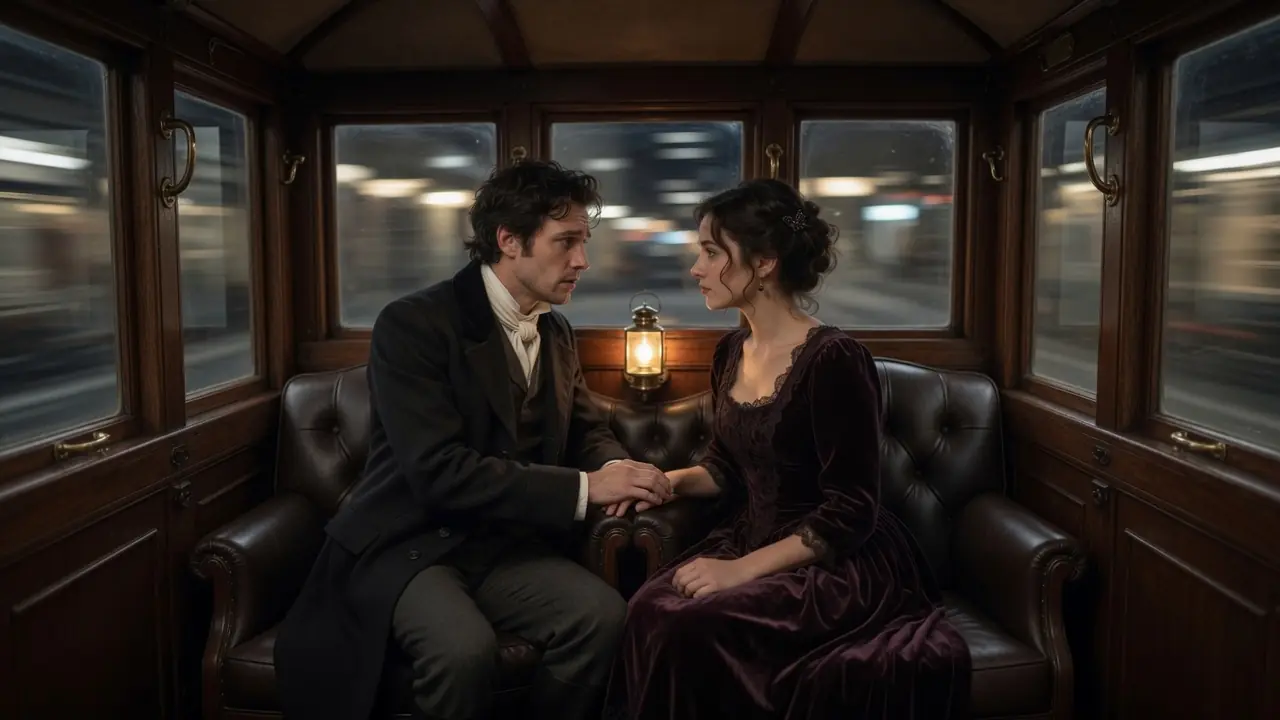
What was said? he asked once they were seated inside the carriage. Dorothia kept her gaze forward. Nothing unusual. Edward’s tone was quiet, but firm. Dorothia. Her name on his lips — no longer Miss Mills, no longer Mrs. Langley — carried a closeness that made her feel too visible. They said the marriage was strategic, she admitted. That you were fortunate to find my fortune.
Edward’s jaw tightened. And what did you say? Nothing. Edward’s gaze sharpened. You should not have to bear it alone. Dorothia turned toward him, her composure cracking just enough to reveal the truth beneath it. It is not the bearing, Edward. It is the certainty with which they assume that is all I am.
Edward’s expression shifted, something fierce flickering beneath restraint. They are wrong. Dorothia’s voice was soft. Are they? The question hung between them like a blade. Edward’s breathing slowed, his voice lowered. You were not purchased. Dorothia’s fingers tightened in her lap. No. I chose.
Edward’s gaze held hers. Yes, he said, as if the word cost him. You chose. The carriage rolled onward, but Dorothia’s heart beat too quickly. She realized with a sudden, uncomfortable clarity that she wanted something she had forbidden herself from wanting. She wanted Edward to defend her not only in public, but in private, in the quiet ways that mattered.
She wanted him to look at her not as a solution, but as what? A wife, yes, but more than that: a woman. That night, Dorothia went to the library after supper to return a book Edward had lent her. She expected to find him alone, reading or writing. Instead, he stood by the desk with letters scattered before him, his expression tight with controlled irritation.
He looked up as she entered. Dorothia. She set the book down. Is something wrong? Edward hesitated, then held up a letter. This arrived today. Dorothia stepped closer and recognized the seal: the same London firm, the same creditor. Her stomach tightened. Edward’s voice was controlled. They demand payment sooner. They believe we have new resources.
Dorothia read quickly, her mind already calculating. They assume desperation. Edward’s mouth tightened. They assume weakness. Dorothia folded the letter neatly. Then we must give them no reason to believe either. Edward’s gaze fixed on her. How do you remain so calm?
Dorothia lifted her eyes. Because panic does not alter figures. Edward’s expression shifted: admiration, then something deeper. His voice lowered. You make me calmer. Dorothia’s breath caught. Edward seemed to realize what he had said; his posture stiffened, his face closing slightly as if he had exposed something he meant to keep hidden.
Dorothia steadied herself with practicality. Let us respond tonight, and let us send a partial payment at once. It shows goodwill without surrender. Edward nodded, grateful for the return to business. Yet Dorothia could not ignore the moment that had just passed: the brief glimpse of warmth beneath his restraint.
As they worked, their hands occasionally brushed over paper, quills, sealing wax. Each contact felt more charged than it ought. Dorothia told herself to remain sensible, but sense, she discovered, was not armor against feeling. The following week, Robert Langley proposed a visit to Brighton.
It will be beneficial, Robert insisted, cheerful as always. Edward has been buried in ledgers and repairs. Dorothia deserves society. Besides, Brighton is where people go when they wish to be seen improving. Edward’s expression tightened. Dorothia knew at once he disliked the notion.
We are not obliged, Dorothia said quietly later when they were alone. Edward’s gaze flickered toward her. Do you wish to go? Dorothia hesitated. She wanted to say no, to preserve the quiet rhythm they had built. Yet she knew the estate required alliances and goodwill. She knew society’s approval could soften creditors’ suspicions.
It may be useful, she said finally. Edward’s mouth tightened faintly, but he nodded. Then we will go. Brighton was brighter and louder than Dorothia preferred. The sea air carried salt and noise, and the promenade teemed with fashionable people pretending not to observe one another.
Dorothia moved through it with composure, but the attention pressed upon her more heavily than she had expected. At the assembly, Dorothia was approached by gentlemen with polite interest. She conversed with courtesy, never encouraging, never cold. She danced when invited, because it was expected. Edward watched.
At first Dorothia assumed his reserve was simply his usual restraint, but as the evening progressed, she began to sense a difference. His stillness was sharper, his gaze more fixed. When a young gentleman — Edward’s distant cousin, Mr. Steven Harrow — asked Dorothia to dance a second time, Edward’s expression tightened almost imperceptibly.
Dorothia accepted the dance, because refusing too pointedly would invite speculation. Yet as she moved through the figures, she felt Edward’s gaze upon her like a hand. It unsettled her more than Harrow’s attentions. When the music ended, Mr. Harrow escorted Dorothia back to her seat, speaking in a tone that suggested admiration.
Dorothia replied with calm politeness. She did not look toward Edward until Harrow had gone. Edward stood a short distance away, his expression composed — too composed. Later, when they returned to their lodging and the carriage door closed behind them, Dorothia spoke first. You were displeased tonight.
Edward’s shoulders stiffened. I beg your pardon. With me, Dorothia said softly. Or perhaps not with me. With the attention. Edward stared ahead. You have done nothing improper. No, Dorothia agreed. But you were distant. Edward’s voice was controlled, but there was roughness beneath it. I have no right to feel otherwise.
Dorothia’s heartbeat quickened. No, she whispered. You do not. A silence stretched, tense, intimate. Then Dorothia spoke the truth that had been circling her mind since the luncheon, since the whispers, since his quiet loyalty in the carriage. And yet, she said, voice barely above breath, I find myself wishing you had one.
The carriage jolted over a rough patch of road. Dorothia reached out instinctively to brace herself, and Edward’s hand covered hers: warm, steady, deliberate. Neither moved away. Dorothia’s breath caught. She looked down at their hands, then up at Edward’s face. His expression was strained with restraint, as if he were holding back words that threatened to undo everything they had agreed.
I did not expect this, Edward admitted hoarsely. Feeling more. Dorothia’s throat tightened. Nor I. Edward’s fingers tightened slightly over hers, not possessive, but as if he needed the contact to steady himself. Dorothia whispered, But denying it feels dishonest. Edward’s gaze held hers, intense and conflicted. It was meant to be simple.
Dorothia gave a small, almost helpless smile. Life rarely is. The carriage continued through the night. Their hands remained together for a long moment longer than propriety required. When Edward finally released her, he did it slowly, as though he were afraid of what the absence would mean.
When they arrived and the footmen opened the door, Edward stepped out first, offering his hand to assist Dorothia. It was a perfectly proper gesture. Yet when Dorothia placed her gloved hand in his, the contact felt like a vow not written on paper. From that night onward, something shifted between them.
Not outwardly — no sudden declarations, no reckless intimacy — but the agreement that had once felt protective now felt like a thin screen between them and a truth they could no longer ignore. Dorothia found herself noticing Edward in ways she had not allowed before: the steadiness of his hands, the quiet strain at the corners of his mouth when he fought emotion, the way his gaze lingered too long when he thought she was not looking.
Edward, in turn, began to look at Dorothia with an intensity he could not entirely disguise. He spoke her name more often. He asked her opinions not only on the estate, but on smaller matters: books, music, the village, the future. They were, Dorothia realized, beginning to court one another slowly, carefully, within the marriage that had been meant to require no courtship at all.
And the most unsettling truth of all was this: Dorothia did not fear it. She wanted it. If the weeks following Brighton had been marked by subtle change, the weeks that followed were defined by strain: not the strain of discord, nor of open disagreement, but the quieter, more dangerous strain of feeling carefully restrained.
Dorothia and Edward moved through their days with the same outward composure. Yet the air between them felt charged, as though one careless word might unravel the careful balance they had maintained since their marriage. Dorothia was acutely aware of Edward’s presence now in a way she had not been before.
She noticed when he entered a room, when he left it, when his attention rested upon her even as he spoke to others. His restraint, once reassuring, now seemed a barrier she longed to see lowered. Yet she feared the consequences of that wish. For Edward the struggle was sharper still.
He had built his life upon control: control of finances, of duty, of emotion. The arrangement he had proposed to Dorothia had been, in part, a defense against vulnerability. Affection, he believed, invited dependency, and dependency risked failure. Yet Dorothia had undone that certainty not through demand, but through presence.
Her steadiness had become something he relied upon without realizing it: her calm counsel, her quiet loyalty, her willingness to stand beside him rather than behind him. All of it had woven itself into his sense of stability, and now that he recognized it, the dependence frightened him. He did not wish to want her. He wanted her nonetheless.
The tension came to a head on an afternoon marked by rain and unwelcome news. Edward returned from the village later than expected, his coat damp, his expression rigid. Dorothia was in the morning room reviewing accounts when he entered without announcing himself. Edward, she said at once, rising. What has happened?
He did not answer immediately. Instead, he crossed the room, set his gloves carefully upon the table, and stood with his hands clasped behind his back, as though bracing himself. The creditor has sent a representative, he said at last. He arrived unannounced. He wished to inspect the estate.
Dorothia’s pulse quickened, though her voice remained steady. And did you permit it? I had little choice. Dorothia nodded once. What was his impression? Edward’s jaw tightened. That we are improving, but not quickly enough. Dorothia absorbed this. Then he seeks to press you further.
Yes. He turned toward her then, and Dorothia saw the strain plainly etched upon his face. He implied, Edward continued, that should we fail to meet his revised terms, he will pursue legal remedies. Public ones. Dorothia felt the familiar cold clarity settle over her thoughts. Panic would not help. What terms?
Edward named a sum that made Dorothia’s breath catch: not because it was impossible, but because it would require sacrifice. We could meet it, Dorothia said slowly, but only by drawing deeply upon my inheritance. Edward stiffened at once. No.
Dorothia met his gaze. Edward. No, he repeated more sharply. That is precisely what I will not do. Dorothia took a breath. It is not a matter of pride. It is a matter of practicality. Edward’s expression hardened. It is a matter of principle. Dorothia’s composure cracked just enough for feeling to enter her voice.
What principle forbids partnership? The principle that I will not reduce you to a remedy, Edward replied. You have already given enough. Dorothia stared at him. I chose this marriage, and I will not allow it to consume you. The words struck her more deeply than he seemed to realize.
Dorothia’s voice softened but gained weight. Edward, you speak as though I am already diminished. He flinched. That is not — You fear taking what I offer freely, she continued, because you believe it makes me less. Edward’s voice lowered. Because I fear it makes you necessary.
Dorothia’s chest tightened painfully. And am I not? The question hung between them, heavy and unguarded. Edward turned away, pacing once, then stopping abruptly. That is precisely what I fear. Dorothia’s hands curled into fists at her sides, not in anger, but in hurt.
You fear needing me, she said quietly. Yet I have needed you since the day we married. Edward’s head snapped up. You have never been dependent. Dorothia interrupted him, her voice steady but firm. Dependence is not weakness. It is trust. Edward stared at her as though she had struck him.
Dorothia took a step closer. You trust me with accounts, with tenants, with decisions that affect lives. Yet you will not trust me with your fear. Edward’s voice was strained. Because if I allow myself to depend upon you, you might lose me. Dorothia finished softly.
Silence followed. Edward did not deny it. The truth settled between them, heavy and undeniable. Dorothia felt a sharp ache behind her ribs: not because Edward feared loss, but because he believed affection to be something that weakened rather than strengthened. She straightened, drawing upon the composure that had long been her refuge.
Then we are at an impasse, she said quietly. Edward turned toward her, alarm flickering across his features. Dorothia, I will not be useful without being valued, she continued. Nor will I offer myself only to be refused when it matters. Edward took a step toward her, then stopped as though uncertain of his right.
I value you, he said urgently. Dorothia met his gaze. Then trust me. Edward opened his mouth, then closed it again. Dorothia inclined her head. I will give you time. She left the room before either of them could say more.
The days that followed were some of the most difficult Dorothia had known. Edward remained courteous, attentive, careful, but distant. He avoided prolonged conversation, immersed himself in repairs and negotiations, and spoke of the creditor only in general terms. Dorothia in turn carried on her duties with the same efficiency as ever, yet felt each interaction sharpened by unspoken tension.
She realized with painful clarity that she was no longer content with being merely capable. She wanted to be chosen. The turning point came not through argument, but through humiliation. It occurred at a gathering hosted by a prominent neighboring family: a dinner Edward felt obliged to attend, despite his reluctance.
Dorothia accompanied him, her composure restored, her manner impeccable. The evening progressed tolerably until a gentleman — one of Edward’s less discreet acquaintances — raised his glass with a smile too knowing to be kind. To prosperity, he said, and to wise marriages that secure it.
A ripple of polite laughter followed. Dorothia felt Edward stiffen beside her. The gentleman continued, emboldened. Langley House is fortunate indeed. It seems practicality has its rewards. Silence fell, brief but heavy. Dorothia set her fork down calmly and turned toward the speaker.
Indeed, it does, she said evenly, particularly when accompanied by effort, discipline, and integrity. The gentleman flushed slightly, but attempted to recover. Of course, Mrs. Langley, I merely meant — I am certain you meant nothing unkind, Dorothia replied, her voice composed, but unmistakably firm.
Nevertheless, I find that implying a marriage’s worth rests solely upon advantage diminishes both parties. The room was silent now. Edward stared at her, something fierce and unguarded flickering in his eyes. Dorothia turned toward him then, addressing him alone, though others listened.
My husband has restored this estate through labor and restraint, she said. If prosperity returns, it will be due to his character, not my fortune. Edward’s breath caught audibly. Dorothia rose, offering a polite inclination of her head to their hosts. If you will excuse us.
Edward followed her without hesitation. They did not speak until they were alone in the carriage. Edward turned toward her, his restraint finally fractured. You should not have had to do that. Dorothia met his gaze steadily. Nor should you have remained silent.
Edward’s voice was thick with emotion he no longer attempted to disguise. I was wrong. Dorothia’s heart pounded. About what? About protecting you by refusing you, he said. About believing affection makes one weaker. Dorothia searched his face. And now?
Edward exhaled, the sound unsteady. Now I see that what I feared losing is what gives me strength. He reached for her hand, not cautiously, but deliberately. I do not wish to be spared dependence, he said. I wish to choose it with you.
Dorothia’s breath caught, tears stinging her eyes, though her smile was unguarded. I have already chosen, she said softly. Edward’s thumb brushed her knuckles, reverent. Then so have I. The carriage rolled onward through the night, carrying not a bargain, but a bond freely claimed.
Their marriage did not change overnight. They did not become effusive, nor did Edward shed his restraint entirely. Dorothia did not abandon her composure. Yet something fundamental shifted. Affection was no longer forbidden, nor feared. They faced the creditor together, presenting a united front: firm, measured, unyielding.
The terms were renegotiated. The pressure eased. Edward accepted Dorothia’s contribution not as rescue, but as partnership. Dorothia accepted Edward’s affection not as repayment, but as choice. In time, the whispers faded. Langley House prospered, not because of convenience alone, but because two sensible people had allowed love to grow where it was least expected.
And the courtship that had been denied at the beginning was discovered, at last, where it mattered most: within a marriage freely chosen, not required.