Everyone knows London society is merely a well-dressed meat market. Young women parade in silk, eyeing coronets, while lords coldly calculate dowries. Yet at the most anticipated ball of the season, Theodore Ashdown, Duke of Westford, ignored the beauties circling his ballroom floor. He stood shrouded in the shadows of the mezzanine balcony, captivated by the single woman who wanted absolutely nothing from him. Instead, she reached out for the hand of his brother.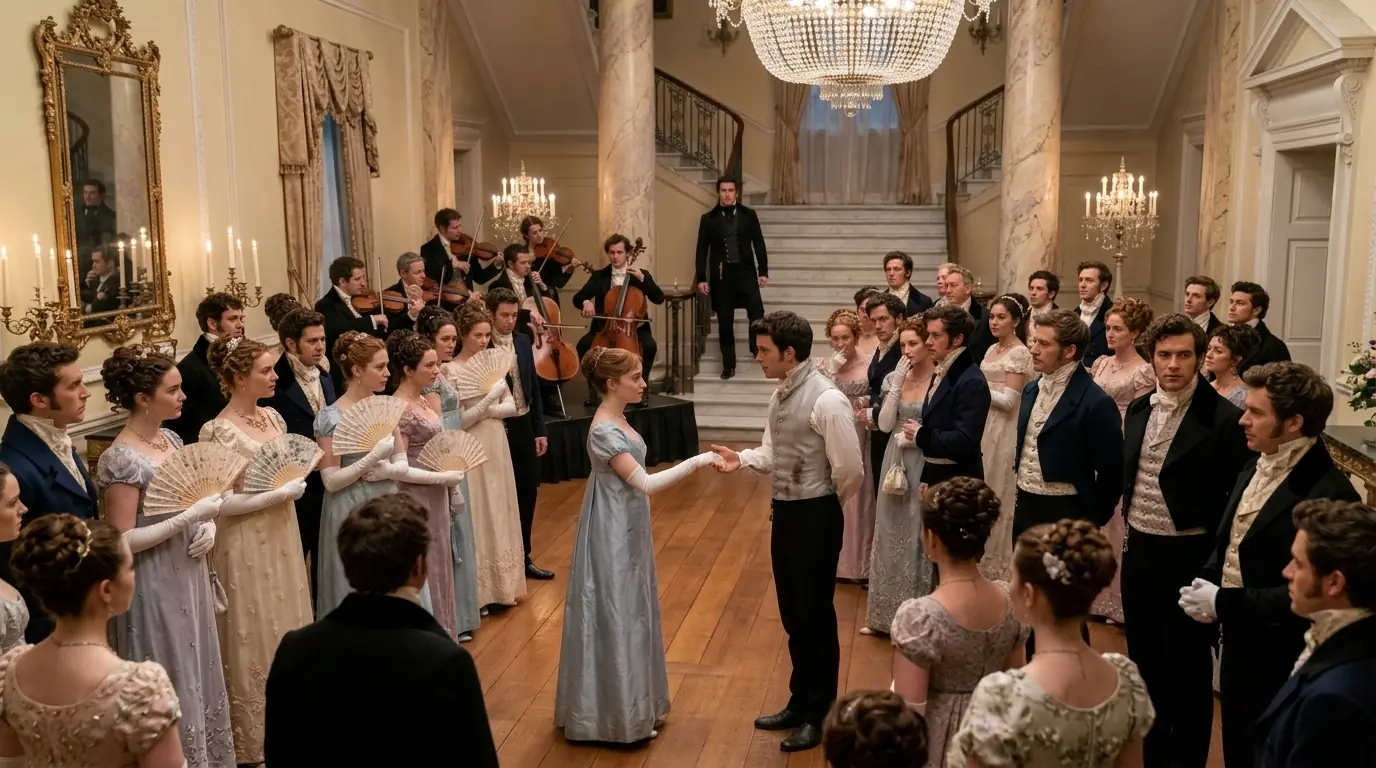
The brother society mocked, the brother she treated like a king. The Ashdown house ballroom smelled of melting beeswax, crushed lilies, and desperation. Diana Croft stood near a towering marble pillar, pressing her shoulder against the cool stone to anchor herself against the dizzying swirl of the room. Her corset was laced a fraction too tight, a silent reprimand from her aunt Josephine, that she was 22, possessing a mediocre dowry, and rapidly running out of time. The heat of 500 bodies pressed together under the light of three massive chandeliers was suffocating.
Silk rustled against silk. Fans snapped open with the sharp rhythmic crack of musket fire. Diana watched the endless rotation of the waltz, her face arranged in the pleasant vacant mask required of unmarried women. She despised it. She despised the painted smiles, the practiced titters, the men with their eyes darting to necklines and weighing bank accounts.
Stand up straight, Diana, Aunt Josephine hissed, not looking away from the dance floor. Lord Harrington is looking in this direction. Diana didn't adjust her posture. She knew exactly what Lord Harrington was looking at, and it wasn't her slightly outdated pale blue gown.
Harrington's gaze, sharp and cruel, was fixed on the far side of the room near the orchestra. Above them all, shrouded in the dim light of the second floor mezzanine, stood Theodore Ashdown, the Duke of Westford. Theo was the architect of this menagerie, though he looked as though he would rather burn the house down than host another dance. He leaned heavily against the marble balustrade, a half empty glass of amber liquid dangling from long, tense fingers. He wore stark black evening clothes devoid of the flashy waistcoats the younger lords favored.
His face was a study in hard lines, a sharp jaw, a straight nose, eyes so dark they looked like bruised iron. He watched his guests with the detached clinical interest of a coroner. They drank his wine. They whispered about his temper. They threw their daughters in his path like sacrificial offerings.
He knew the game. He played it by refusing to participate, remaining above them, untouchable, but his gaze wasn't sweeping the room for a bride. His eyes, fixed and unwavering, were tracking a single figure standing dangerously close to the cellists. Oliver. Oliver was twenty years old.
He possessed the broad shoulders and towering height of the Ashdown men, but his posture was all wrong. He slouched, his weight shifting from foot to foot in an anxious, restless rhythm. His cravat was already crooked, his thick, dark hair fell into his eyes, and his mind, as the ton so delicately whispered behind their fans, was broken. He had the intellectual understanding of a seven-year-old child. Loud noises frightened him.
Complex sentences confused him. He loved the vibrations of the cello, the taste of lemon ice, and the intricate gears of pocket watches. Society tolerated him because of his brother's immense wealth and power. But tolerance was a thin, brittle veneer. Theo gripped the cold marble of the railing.
He hated bringing Oliver to these things. He hated the way the crowd parted around his brother like water around a diseased rock. But Oliver had begged. He had heard the musicians tuning their instruments that afternoon and wept because he wanted to feel the music. Theo couldn't deny him.
He never could. Just stay near the wall. Ollie, Theo thought, his jaw clenched so tight a muscle ticked in his cheek. Stay quiet. Let them ignore you.
But society is rarely content to merely ignore weakness. It prefers to pick at it. Down on the floor, Lord Harrington leaned in to whisper something to a group of young bucks. They snickered, their eyes darting toward Oliver. Harrington adjusted his cuffs, a sly, ugly smile pulling at his mouth, and began to weave his way through the crowd toward the orchestra.
Diana saw it happen. She saw the trajectory. She felt a cold, hard knot form in her stomach. The ton was a meat market, yes, but it was also a wolf pack, and the wolves had just found the straggler. Oliver was swaying.
He didn't notice the people giving him a five-foot radius of empty floor. He was entirely consumed by the low, mournful drag of the bow across the cello's thickest string. His eyes were closed, his large hands tapping an erratic, joyful rhythm against his thighs. Harrington approached the vacuum. He held a glass of dark red punch.
He didn't walk directly up to Oliver. That would be too obvious. Instead, he stepped backward, pretending to be engrossed in conversation with his companions, moving closer and closer to the swaying, oblivious young man. Diana pushed off the marble pillar. Diana, where are you going?
Aunt Josephine snapped, catching a fistful of pale blue silk. I need some air, Aunt. Diana slipped her skirt from the older woman's grasp. She didn't run. Running was forbidden, but her strides were long, purposeful, and entirely unladylike.
She didn't know the Duke's brother. She had heard the rumors, the cruel jokes passed in drawing rooms, the Westford simpleton, the Duke's heavy cross. But looking at Oliver now, she didn't see an idiot. She saw a boy trapped in a man's body, entirely exposed. On the balcony, Theo set his glass down on the stone ledge with a dull clink.
He didn't care about the scandal. He would shatter the man's teeth. Before Theo reached the first step, Harrington bumped hard into Oliver. Oliver stumbled forward, his eyes flying open in shock. He caught his balance, but Harrington let out an exaggerated shout.
The red punch splashed violently over Oliver's pale gray waistcoat, blooming like a massive, ugly blood stain. The music faltered for a fraction of a second before the cellist hastily picked up the tempo. Silence rippled outward from the epicenter of the collision. Heads turned. Fans stopped waving. Good God, man! Harrington declared loudly, brushing perfectly dry sleeves. Watch where you throw yourself! You've nearly ruined my coat! Oliver stared at the red stain on his own chest. His breath hitched.
His large hands came up, hovering over the wet fabric, trembling. He hated feeling sticky. He hated sudden, loud voices. He looked around wildly, his chest heaving, the beginnings of panic tightening his throat. He was searching for the stairs.
He was searching for Theo. The group of young men behind Harrington muffled their laughter behind gloved hands. Perhaps the nursery is missing its favorite pupil, someone muttered. Theo's boot hit the top step of the sweeping staircase. Blood roared in his ears.
Then a flash of pale blue cut through the crowd. Diana stepped directly into the vacuum. She didn't look at Harrington. She didn't look at the whispering crowd. She stepped squarely in front of Oliver, blocking his view of the laughing men, forcing him to look down at her. It is entirely my fault, Diana said. Her voice was not loud, but it possessed a clear, sharp cadence that carried perfectly over the hushed whispers. She pulled a pristine white lace handkerchief from her reticule. Oliver blinked at her, his breathing ragged. So sticky, he stammered, his voice a deep, gravelly baritone that contrasted sharply with his frightened tone. It's sticky. I know, Diana said. She did not use the high-pitched, condescending tone people reserved for children and dogs. She spoke to him evenly, firmly. Punch is terribly sticky, but it hasn't stained your shirt, my lord.
Only the waistcoat. Harrington stepped forward, his face flushing with irritation at the interruption. Miss Croft, I assure you, the fault lies with him—Diana turned her head. She didn't raise her voice. She simply looked at Harrington with eyes so cold and profoundly unimpressed that the man actually closed his mouth. Lord Harrington, she said flatly. You appear to have lost your spatial awareness. Perhaps you should visit the terrace. The heat seems to be affecting your balance. A few sharp gasps echoed from the nearby matrons.
To speak to a titled gentleman in such a manner was social suicide for an undowered girl. Diana didn't care. Her marriage prospects could burn. She turned her back on Harrington, a deliberate, brutal dismissal, and focused entirely on Oliver. She reached out slowly, ensuring he saw her hand coming, and gently pressed the handkerchief against the worst of the stain on his chest.
Oliver flinched at first, but she didn't retreat. She kept her touch light, predictable. Halfway down the staircase, frozen in the shadows, Theo stopped. His hand hovered over the banister. He watched the girl in the outdated blue dress.
He knew her name, Miss Croft, a nobody, a wallflower. Opportunists threw themselves at his feet daily, but they avoided Oliver like a plague. If they did acknowledge him, it was with thinly veiled disgust or exaggerated, sickening pity. But this girl wasn't looking at the balcony to see if the Duke was watching her charity. She wasn't looking at anyone.
She was looking at Oliver's waistcoat, folding the sticky handkerchief into a neat square. Better? she asked Oliver. Oliver looked down. The wetness was still there, but the dripping had stopped.
He looked back at Diana. His panic was receding, replaced by a cautious curiosity. Yes. Thank you. It is cold.
It is, she agreed. But the cellos are warm. I was watching you from across the room. You feel the music quite deeply, don't you? Oliver's eyes lit up.
The transformation was instantaneous. The fear melted away, revealing a boyish, unguarded joy that made him suddenly strikingly handsome. The big wooden one. It rumbles here. He tapped his chest just above the red stain.
It vibrates the floor. It does. Diana smiled. It was the first real smile she had worn all evening. It transformed her face from plain to something arresting.
I have always thought the cello is the only instrument that truly understands melancholy. Oliver frowned slightly, passing the word. Melancholy? Sadness? Yes, but a beautiful sadness.
The orchestra, having recovered from the disruption, shifted into the opening chords of a waltz. It was a slower piece, sweeping and deliberate. The crowd around them, deprived of their disaster, began to murmur and drift back toward the dance floor. Diana knew she should walk away. She had caused a scene.
Aunt Josephine was likely having heart palpitations near the punch bowl. She had insulted an earl's son. Her night and possibly her season was ruined. She looked at Oliver. He was watching the dancers forming their lines, his shoulders slumping slightly as he realized he was once again relegated to the role of an invisible spectator.
Damn them, Diana thought. Damn every single one of them. She looked up into Oliver's eyes. My lord, Diana said, her voice steady. I find myself without a partner for this waltz, and I abhor standing still when the cellos are playing so beautifully.
Oliver blinked, confused. He looked left, then right, as if searching for the person she was speaking to. Diana took a half step closer. She offered her bare, gloveless hand. Would you do me the honor of dancing with me?
The silence that fell over the immediate vicinity this time was absolute. A dropped pin on the polished oak floorboards would have sounded like a gunshot. Even the cellist seemed to hesitate, his bow lingering a fraction too long on a low C. Oliver stared at her hand. He had large hands, calloused from working in the gardens at the country estate, the only place he was truly allowed to roam free. He looked from her small pale hand to her face.
Panic flared again in his eyes. I I do not know the steps, he whispered. Theo says I step on toes. I am clumsy. I am entirely indifferent to my toes, Diana replied, keeping her hand extended.
And a waltz is only walking in circles, my lord. One, two, three; One, two, three. If you can count to three, you can waltz. On the staircase, Theo felt his lungs seize. Don't do this, he thought.
A dark, cynical panic rising in his chest. Don't build him up just to let him fall. When he stumbles, they will laugh and it will break him. He wanted to stride down and intervene. He wanted to shield Oliver from the inevitable humiliation.
But something rooted him to the spot. It was the way Miss Croft held her hand out, not as a demand, but as an offering, unwavering. Patient, Oliver looked at the floor. He swallowed hard. Then, with an agonizing slowness, he reached out.
His massive, warm hand enveloped hers. His grip was entirely too tight, lacking the refined gentleness of a practiced gentleman. But Diana didn't wince. She stepped into him, forcing him to take the traditional frame. She placed his right hand firmly on her waist. Hold me here, she instructed softly. Do not let go. I will guide you. People are looking, Oliver whispered. He was trembling violently now. Let them look, Diana said fiercely, her eyes locking onto his. They are looking because they are bored, miserable creatures who do not know how to feel the music. Focus on the cello. Focus on me. One, two, three.
The music swelled. Diana took the definitive backward step, pulling Oliver with her. He stumbled. His heavy boot landed squarely on the hem of her gown. There was a sickening rip of silk.
A collective gasp echoed from the nearest onlookers. Harrington smirked. Theo gripped the banister so hard the wood groaned. Diana didn't miss a beat. She didn't look down at her ruined hem.
She tightened her grip on Oliver's shoulder, her nails digging slightly into his jacket to ground him. Perfect. She lied smoothly. Now the left foot. One, two, three.
She pushed him, her frame surprisingly strong, forcing him to shift his weight. He stepped. He didn't step on her this time. Good. Again.
One, two, three. They began to turn. It was not a graceful waltz. It lacked the smooth, gliding, effortless quality of the ton's most celebrated dancers. Oliver moved like a draft horse forced into a dress arena.
Stiff, heavy, and terrified. He stared down at his feet, his brow furrowed in intense concentration, his mouth silently forming the numbers. One, two, three. But they were turning. Diana kept her head high.
She refused to look at the crowd. She kept her gaze fixed on Oliver's chin, speaking in a low, constant stream of encouragement. You are doing wonderfully. Feel the turn. Let the music push you.
That's it. One, two, three. Slowly, the violent trembling in Oliver's arm began to ease. The rigid terror in his shoulders softened. He stopped staring at his feet.
He looked up past Diana's head toward the orchestra. He heard the cello, his steps, previously disjointed and harsh, began to find the rhythm. He was still heavy, still utterly lacking in finesse. But he was no longer fighting the music. He was moving with it.
A breathless, tentative smile broke across his face. I am dancing, he whispered, or coloring his deep voice. You are dancing, Lord Oliver, Diana confirmed, a genuine warmth flooding her chest. They rotated past the center of the room. The sea of silk and broadcloth parted for them, not out of respect, but out of shock.
It was unprecedented. The Duke's mocked brother, the great embarrassment of the Ashdown line, was waltzing with a woman who had a ruined dress and the bearing of a queen. From the shadows of the staircase, Theo watched, his cynical shell, hardened by years of defending his brother against the veiled cruelty of the world fractured. He watched Oliver smile, a real unrestrained smile in the middle of a London ballroom. He watched the woman in the pale blue gown take the brunt of the ton's judgment without flinching, absorbing Oliver's awkwardness and transmuting it into dignity.
Theo realized he had stopped breathing. The bitter taste of brandy on his tongue faded, replaced by something entirely unfamiliar. Hope. A sharp, terrifying spike of gratitude. As the waltz reached its final soaring crescendo, Diana guided Oliver into a slow, deliberate halt.
She didn't drop her arms immediately. She let the music fade completely before stepping back. Oliver was flushed, his chest heaving, his eyes wide and bright. He looked down at her. I did not step on your toes again. No, Diana smiled, executing a perfect deep curtsy. You are a flawless partner, my lord. Oliver gave a clumsy, overly deep bow. When Diana rose from her curtsy, her eyes drifted upward.
She didn't mean to. It was instinct, a sudden pull of awareness through the massive crystal droplets of the chandeliers, past the staring eyes of the crowd. Her gaze caught the shadows of the staircase. Theo stood there fully visible now, having descended half the steps. He wasn't looking at the crowd.
He wasn't wearing his customary mask of deadened apathy. He was looking directly at her. The distance between them was immense, filled with the noise of polite applause and vicious whispers. But Diana felt the weight of his stare like a physical touch. There was no anger in his dark eyes.
There was only a burning intense focus that made the breath catch in her throat. For a single suspended second, the Duke of Westford and the ruined wallflower held each other's gaze. Then the orchestra struck up a lively country dance. The spell broke, and the meat market resumed its chaotic swirl.
The carriage ride back to Mayfair was suffocating. Aunt Josephine did not speak for the first 20 minutes. She sat rigidly on the worn velvet squabs, her profile illuminated in harsh flashes by the passing street lamps. The silence was heavier than a physical blow. It was the silence of a ledger being closed, a bankruptcy finalized.
Diana stared at her lap. Her hands rested over the jagged tear in her pale blue silk skirt. The edges were frayed, a tangible symbol of her ruined prospects. The adrenaline that had propelled her across the ballroom floor had evaporated, leaving behind a cold, hollow exhaustion. Do you have any conception? Aunt Josephine finally said, her voice a thin, vibrating wire of contained fury. Of what you have done, Diana didn't look up. I prevented a cruelty, aunt. You committed social suicide. Josephine snapped, abandoning her rigid posture to lean forward, her eyes wide and manic.
You insulted the Earl of Danbury's heir. You made a spectacle of yourself with with that cravature. You are 22, Diana. We do not have the funds to weather a scandal. We do not have the family name to force people to forget.
By tomorrow afternoon, the patronesses of Almack's will cross your name from their books. We are finished. Diana turned her head to look out the window. The cobblestones were slick with a fine London drizzle. She knew Josephine was right.
The mechanics of their society were ruthless. You either possessed capital or you possessed reputation. Diana had just spent the last of her reputation on a boy who couldn't tie his own cravat. And yet, in the dark of the carriage, she could still feel the phantom weight of Oliver's trembling hand. She could see the unguarded joy in his eyes when he realized he was actually dancing. I am sorry for the embarrassment I have caused you, Aunt, Diana said quietly. But I am not sorry for the dance. Josephine let out a sharp, breathless sound of disbelief and sank back against the cushions. She did not speak again for the rest of the journey.
Back at Ashdown House, the ball raged on, a glittering machine running on champagne and gossip, but the atmosphere near the terrace doors had plummeted in temperature. Lord Harrington stood with his circle of sycophants, laughing loudly, holding court over the incident. He was holding a fresh glass of punch, recounting the clumsy footwork of the Duke's idiot brother, inflating his own wit with every telling. He did not see Theo approach. Theo did not stride.
He stalked. He moved with the quiet, lethal economy of a man who had spent his life containing violence. The crowd parted for him instinctively, the laughter dying on their lips as they saw the expression on the Duke's face. Harrington realized his audience had gone silent. He turned, a smirk still half-formed on his mouth, and found Theo standing less than a foot away.
Theo was taller, broader. The sheer physical mass of the man was intimidating, but it was his eyes that made Harrington take a sudden, involuntary step backward. They were entirely blank, devoid of anger, devoid of anything human. Your grace, Harrington stammered, the smirk vanishing. Theo didn't acknowledge the greeting.
He reached out, his movement smooth and deliberate, and plucked the crystal glass of punch from Harrington's hand. He held the glass between them. A clumsy thing, a spilled drink, Theo said. His voice was barely a whisper. It didn't carry over the music.
It was meant only for Harrington and the terrified men standing immediately behind him. I It was an accident, your grace, Harrington said, a cold sweat breaking out across his forehead. The fellow stumbled into me. He is entirely unpredictable, Theo tilted his head slightly. My brother is exactly as predictable as I am, Harrington.
He simply lacks my restraint. Theo opened his hand. The crystal glass dropped. It hit the polished oak floorboards between Harrington's expensive shoes and shattered with a sharp, violent crack. Red punch splattered across Harrington's white silk stockings and the hem of his velvet trousers.
Harrington flinched badly, sucking in a sharp breath. The men behind him scattered a few steps back. Theo didn't look down at the mess. He kept his eyes locked on Harrington's pale face. Your father's shipping contracts in the West Indies require renewal next month, Theo said softly. They require my signature in the House of Lords. I will not sign them. Harrington's mouth dropped open. The color drained from his face entirely. Your grace, please.
You cannot penalize my family's estate for a trivial ballroom misunderstanding. It is not a misunderstanding. It is a lesson in spatial awareness, Theo replied, his voice flat. Consider your season over, Harrington. If I see your face at another event my family attends, I will not stop at your father's ships.
I will bankrupt your entire line. Now get out of my house. Harrington swallowed hard. He looked at the shattered glass, then at the Duke's immovable face. He didn't argue.
He turned and walked quickly toward the exit, his ruined stockings leaving faint red footprints on the floorboards. Theo watched him go. He felt no satisfaction. The rage inside him was a cold, deep lake, and sinking one insignificant lord did nothing to drain it. He turned his gaze toward the grand entrance, tracing the path the girl in the blue dress had taken an hour ago.
Diana Croft. He needed to find out exactly who she was.
Morning light was merciless to the Croft drawing room. It highlighted the faded patches on the Persian rug and the layer of dust on the mantelpiece that the single maid hadn't the time to address. Diana sat by the window, a sewing basket on her lap. She was methodically unpicking the stitches of the ruined silk hem. The dress could not be saved as a ball gown, but if she was careful, there was enough fabric to salvage it into a daydress.
She worked in silence. Aunt Josephine had taken to her bed with a migraine, declaring they were ruined, and she wished to be dead, or at least asleep, until next Tuesday. The heavy brass knocker on the front door sounded with three sharp authoritative strikes. Diana paused, her needle hovering over a thread. They were not expecting callers.
Callers did not arrive at 10 in the morning, and certainly not the morning after a social disaster. She heard the maid's hurried footsteps in the hall, the squeak of the front door hinges, and then a low, masculine murmur that made the floorboards vibrate. A moment later, the maid appeared in the doorway of the drawing room. Her eyes were round as saucers, her cap slightly askew. She held a silver tray as if it were a live grenade.
Resting on the tray was a single heavy card stock with an embossed crest. Ma'am, the maid squeaked. The Duke of Westford. Diana stared at the card. Her pulse spiked, a sudden erratic flutter against her ribs.
She set the sewing basket down on the floor. Show him in, Mary. Diana stood. She smoothed the front of her simple muslin day dress. She checked her hair, knowing full well several strands had escaped their pins.
She didn't care. If he was here to deliver a reprimand on behalf of his family's honor, she would face him on her feet. Theo stepped into the drawing room. He seemed too large for the space. His broad shoulders blocked the doorway, and his head narrowly cleared the hanging chandelier.
He was dressed for riding, wearing a dark coat and immaculate boots that smelled faintly of leather and cold morning air. He held a riding crop in one hand. He looked dangerous. He stopped a few feet from her, his dark eyes sweeping over the faded room, the sewing basket, and finally settling on her face. Diana didn't curtsy.
It felt absurd in her own house. She simply held his gaze. Your grace, she said. Her voice was steady, though her hands were cold. This is a highly irregular hour for a call.
I am not interested in regular hours, Miss Croft, Theo replied. His voice was the same gravelly baritone as his brothers, but it was hardened, stripped of all vulnerability. I am interested in answers. Answers to what? to what you were attempting to achieve last night.
Diana stiffened, her chin tipped up a fraction of an inch. I was attempting to prevent an Earl's son from making a sport out of a man who could not defend himself. Nothing more. Theo slowly walked toward the fireplace, his boots loud on the hardwood floor. He turned to face her.
People do not risk their reputations for nothing. In my experience, charity is always a transaction. What did you hope to gain by latching yourself onto Oliver? Did you think to draw my attention? To play the martyr?
The sheer arrogance of the accusation knocked the breath out of her for a second. Then a hot searing anger flared in her chest. You flatter yourself, your grace, Diana said, her voice dropping a register, cold and sharp as cracked ice. Your attention was the absolute furthest thing from my mind. I saw a boy panicking because a vicious coward spilled a drink on him.
I intervened because everyone else in that Godforsaken ballroom was too busy staring to offer a handkerchief. She stepped closer to him, entirely forgetting the social gulf between them. Do not project the cynical calculations of your peers onto me. I danced with your brother because he heard the cello and he wanted to dance. If you cannot understand a motive simpler than social climbing, that is a failure of your imagination.
Not a flaw in my character. Silence stretched between them, thick and electric. Theo stared at her. He studied the flush of anger high on her cheeks, the fierce, unapologetic set of her jaw. No one spoke to him this way.
Men cowered; women flattered. This girl in a faded dress, holding a ruined hem, was taking him to task in her own dusty drawing room. The cold lake of rage inside him shifted. I ruined Harrington, Theo said quietly. Diana blinked, caught off guard by the non sequitur.
What? Last night I made it clear that if he remains in London, I will financially dismantle his family. He left town this morning. Diana absorbed this. She looked at the heavy riding crop in his hand, the tension in his shoulders.
She realized suddenly that this formidable, terrifying man was fundamentally exhausted. He was carrying a shield so heavy it was breaking his own back. That was unnecessary, she said softly. It was entirely necessary, Theo countered, his jaw tightening. But it does not solve your problem.
I am aware of how the ton operates. You publicly humiliated a wealthy heir and danced with the social pariah. You are currently the subject of fifty different morning calls and none of them are complimentary. You will be ostracized. I am aware I will not allow Oliver's joy to be the instrument of your ruin.
Theo stepped forward. The sheer proximity of him made Diana's breath catch. He smelled of horsehair, expensive soap, and raw power. Tomorrow afternoon at three o’clock, I will send my carriage for you and your aunt. Theo said, his tone turning to pure command.
You will drive with me in Hyde Park in the open barouche at the height of the promenade. Diana stared at him. Driving in Hyde Park with the Duke of Westford was the highest social elevation a woman could achieve. It was a public declaration of his favor. It would instantly obliterate any gossip Harrington had seeded.
It would make her untouchable. You do not need to pay me for my kindness, your grace, Diana said, her pride stiffening her spine. I am not a mercenary. It is not payment, Theo said. His eyes darkened, fixing on her mouth for a fraction of a second before snapping back to her eyes.
It is a consequence. You wanted to drag my brother into the light. Now you must deal with the glare. Be ready at three. He didn't wait for her to agree.
He turned on his heel and strode out of the drawing room. The front door closed with a decisive heavy thud. Diana stood alone in the quiet room, her heart hammering against her ribs, realizing she had just collided with something entirely out of her control. The open bar in Hyde Park had been a calculated spectacle. Theo had sat beside her, rigid and imposing, speaking only in low, polite murmurs for the benefit of the staring crowds.
The ton had gaped. Aunt Josephine, miraculously cured of her migraine, had nearly wept with triumph, but the true revelation came a week later. not in a carriage, but in the sprawling glass conservatory attached to the rear of Ashdown House. Theo had invited Diana and ostensibly her aunt, who was currently asleep on a settee in the main house, overwhelmed by the Duke's sherry, to see Oliver's domain. The conservatory was massive, a jungle of imported ferns and towering palms.
But the air did not smell of flowers. It smelled of oil, brass polish, and damp earth. Spread across three long oak tables were clocks. Dozens of them, mantle clocks, carriage clocks, delicate gold pocket watches, and heavy iron maritime timepieces. Some were fully assembled, ticking in a chaotic, unsynchronized chorus.
Others were completely dismantled, their intricate gears and springs laid out on velvet cloths with surgical precision. Oliver sat on a high stool at the center table, wearing a leather apron over his shirt sleeves. He held a jeweler's loop to his eye, wielding a pair of tiny tweezers with a stillness and focus that completely contradicted his usual restless energy. Diana stood beside the table, leaning in close. She wore a simple yellow dress, the sunlight filtering through the glass ceiling, catching the gold tones in her hair.
Theo stood several feet away, leaning his shoulder against a cast iron support pillar, watching them. This one, Oliver said, his deep voice hushed with reverence. He carefully lifted a small, intricately carved brass gear with his tweezers. This is the escape wheel. It makes the ticking sound.
It stops the spring from unwinding all at once. It's so small, Diana marveled. She didn't reach out to touch it, respecting his workspace. How do you know where it goes? I hear it, Oliver said simply.
He removed the loop from his eye and looked at her. When a clock is broken, it sounds wrong. The rhythm is sick. I look at the gears until I see the sick part. Then I make it healthy. You are a doctor for timepieces. Diana smiled. Oliver liked that. A wide bright grin broke across his face. Yes, a doctor.
He returned the loop to his eye and bent over the pocket watch. Theo broke this one. He dropped it on a rock. He is very clumsy. Diana let out a sudden bright laugh.
It was a beautiful sound, entirely unpracticed and genuine. Theo felt a strange tight pulling sensation in his chest. He pushed off the pillar and walked slowly toward the table. I was thrown from a horse, Oliver, Theo corrected, his voice dry, though the corner of his mouth twitched. The watch was collateral damage.
Oliver didn't look up. Clumsy, Diana looked at Theo, her eyes dancing with amusement. The harsh, intimidating Duke she had met in her drawing room seemed entirely absent here in the humid air of the greenhouse. He looked relaxed, almost entirely human. I didn't realize you had such a destructive streak, your grace, Diana teased gently.
Theo stopped beside her. He was close enough that she could feel the heat radiating from his body. I break many things, Miss Croft. My brother is the only one who can put them back together. The words were spoken lightly, but there was a profound, heavy truth beneath them.
Diana looked up at him. His dark eyes were fixed on Oliver's bowed head, his expression unguarded for the first time. The fierce, terrifying protector was gone, replaced by a man looking at the only thing in the world he truly loved. He is brilliant, Diana said quietly, ensuring Oliver, deeply engrossed in his task, couldn't hear. They call him simple, but there is nothing simple about this. She gestured to the hundreds of tiny, perfectly organized gears. He understands systems, Theo murmured, his gaze dropping to Diana's face. He understands machines because they have rules. They follow a logic. People frighten him because they are entirely illogical.
They smile while they insult you. They offer a hand while holding a knife. He cannot parse the deception. Can you? Diana asked, holding his gaze. I assume everyone is holding a knife, Theo said bluntly. It saves time. Diana felt a pang of deep, unexpected sorrow for him. To live in a state of constant war, forever anticipating the next strike. That must be an exhausting way to live.
It keeps him safe, Theo replied, his jaw hardening slightly. But who keeps you safe? The question slipped out before Diana could stop it. It was too intimate, too direct. She saw Theo's breath hitch.
His eyes snapped to hers, the intensity in them suddenly burning hot. He didn't answer immediately. He stared at her, dissecting her expression, searching for the pity he despised, or the calculation he expected. He found neither. He only saw a quiet, steady understanding.
I do not require safety, Theo finally said, his voice dropping to a rough whisper. Everyone requires safety. Your grace, Diana countered softly. Even if it is only a quiet room where they can drop the armor for an hour. Theo reached out.
The movement was slow, deliberate. His large hand hovered over the table, entirely avoiding the clock parts, and his knuckles gently brushed against the back of Diana's hand where it rested on the oak wood. The touch was electric. A jolt of heat shot up Diana's arm. She didn't pull away.
Perhaps, Theo murmured, his thumb lightly tracing the ridge of her knuckles, his eyes never leaving hers. I have just found one. The chaotic ticking of 50 different clocks filled the silence in the greenhouse. But for Diana, the only sound in the world was the sudden, deafening rush of her own pulse.
The social season was a machine, and machines detested friction. By late June, Diana Croft was no longer a ruined Wallflower. She was an anomaly. The Duke of Westford had driven her through Hyde Park twice more. He had sent her aunt a basket of hot house peaches.
He had stood beside Diana at the opera, his massive frame effectively blocking the stairs of the stalls, his attention entirely focused on the stage and on the woman beside him. But elevation breeds resentment. The aristocracy could tolerate a sudden rise in fortune if it was transactional. A young, beautiful girl traded to an old, wealthy lord made sense. The mathematics were sound, but Theo was young, terrifyingly powerful, and widely considered entirely immune to sentiment.
Diana was plain, impoverished, and entirely too blunt. It didn't add up, and society despises what it cannot calculate.
The boiling point arrived at the Earl of Chatham's summer fête. It was an outdoor affair, sprawled across the manicured lawns of his Richmond estate. The afternoon sun was vicious, beating down on the striped silk marquees and the agonizingly tight cravats of the gentleman. Diana stood near the edge of the rose garden, a glass of warm lemonade sweating through her silk glove. Aunt Josephine had abandoned her to ruthlessly pursue a newly widowed baron near the archery targets.
Theo was temporarily delayed in the house. caught in a political conversation he couldn't simply walk away from without offending a key parliamentary ally. Oliver, however, was in the garden. He was kneeling in the dirt near a massive ancient oak tree, entirely ignoring the hundreds of aristocrats drinking champagne 50 yards away. He had found a colony of stag beetles.
He was entranced by their mandibles, gently shifting leaves with a twig to observe their slow, armored movements. Diana kept her eyes on him, a steady, protective vigilance she had adopted over the last month without even realizing it. An inspiring sight, is it not? The voice was thin, coated in a sugary veneer that barely concealed the venom underneath. Diana turned.
Lady Mercer stood a few feet away. She was a woman in her late 40s whose sharp predatory features were heavily powdered to hide the creeping lines of age. She was Harrington's godmother. The roses, Lady Mercer, Diana asked mildly. Yes, the blooms are quite robust this year.
I was not referring to the foliage, Miss Croft. Lady Mercer snapped her fan open. It sounded like a dry bone breaking. She looked directly at Oliver. I was referring to the spectacle, the Duke's heavy burden, playing in the mud like a feral child.
Diana's grip on her lemonade glass tightened until her knuckles turned white. Lord Oliver is observing the beetles. He possesses a remarkably keen mind for the natural world. He is simple-minded, Lady Mercer said, dropping the pretense entirely. She stepped closer.
her perfume, a cloying heavy lavender, suffocating the smell of the roses. And you are a remarkably clever little opportunist. Do you think we do not see what you are doing? I am standing in a garden, madam. I am not aware of doing anything at all.
You are playing the nursemaid to snare a duchy. Lady Mercer hissed, her eyes gleaming with malice. It is a bold strategy. Harrington told me how you publicly humiliated him to defend that cravature. Theo was grateful.
Naturally, he protects his blood. But do not confuse a bodyguard's gratitude with a man's desire. Diana felt a cold, hard not form in her chest, but she kept her face entirely blank. If you have a point, Lady Mercer, I suggest you reach it. The sun is quite hot and your powder is beginning to run.
The older woman's eyes flashed with pure unadulterated hatred. My point, Miss Croft, is that the Duke of Westford will never marry you. He uses you to pacify his brother. You are a human pacifier. A toy to keep the boy quiet so the Duke can finally have some peace.
Once Oliver tires of you or breaks you as he breaks everything, Theo will cast you aside with a moderate pension and a ruined name. You are a temporary convenience. The words hit their mark. They struck the very center of Diana's own secret, darkest fears. Theo was attentive.
He was protective. But he had never spoken of the future. He had never crossed the line from terrifying protector to suitor. He merely placed her in his brother's orbit and guarded the perimeter. Before Diana could formulate a response, a sharp, deafening crack split the humid air.
Down by the river, the Earl of Chatham had ordered the early testing of the evening's fireworks display. A rogue mortar had misfired in its tube, detonating on the ground with the concussive force of a cannon shot. The aristocrats on the lawn gasped, a few women dropping their glasses. But from the oak tree, a roar, terrifying sound tore through the garden. Oliver screamed.
It wasn't a shout of surprise. It was a guttural, primal sound of absolute terror. He scrambled backward, his large frame thrashing against the roots of the tree. The sudden, violent noise had shattered his delicate sensory equilibrium. Diana dropped her glass.
It shattered on the gravel path. She shoved past Lady Mercer, ignoring the woman's indignant squawk, and ran toward the oak. Ol, she yelled. But Oliver didn't hear her. His hands were clamped brutally hard over his ears.
His eyes were wide, unseeing, completely consumed by the panic that was drowning his mind. He scrambled to his feet, slipping on the damp grass, and bolted. He didn't run toward the safety of the house. He ran away from the crowd, away from the open lawn, plunging blindly into the earl's massive, towering hedge maze. The entrance to the maze swallowed Oliver whole.
Diana didn't hesitate. She grabbed the heavy silk skirts of her dress, hauling them up to her knees, and sprinted after him. The gravel tore at the thin soles of her slippers. The meticulously trimmed U hedges loomed ten feet high on either side, instantly blocking out the sun and plunging the path into a suffocating green gloom. Oliver, she called again, her voice cracking. Only the crunch of her own footsteps answered her. The maze was designed to disorient. The paths branched wildly, twisting back on themselves in tight, claustrophobic angles. She took a left, then a right. She stopped, straining to listen over the ragged sound of her own breathing.
A heavy thud echoed from somewhere to her right, the sound of a large body hitting the tightly woven branches. Diana ran. She tore through the paths, ignoring the sharp twigs that snagged her sleeves and scratched her forearms. She didn't care about the mud ruining her hem. She didn't care about the scandal of a woman running unaccompanied through a labyrinth.
She only cared about the terrified boy trapped in his own mind. She rounded a sharp corner and stopped dead. It was a dead end. Pressed into the darkest corner, huddled against the unyielding wall of thorns, was Oliver. He had made himself as small as possible, his knees pulled tight to his chest, his arms wrapped around his head.
He was rocking back and forth in a frantic, jerky rhythm. He was muttering something, a rapid, unbroken stream of syllables that made no sense. He was entirely lost to the panic. Diana approached slowly. She knew better than to touch him now.
A sudden touch would feel like an attack. She dropped to her knees in the dirt, her silk skirts pulled in the mud. She ignored it. She placed her hands flat on the ground in front of her, making herself small, unthreatening. Oliver, she said.
She kept her voice low, steady. The exact tone she had used on the ballroom floor. He didn't stop rocking. He didn't open his eyes. Loud.
Too loud. It broke. The sky broke. The sky didn't break. Oliver, Diana said softly.
It was only powder. Fire powder. It is gone now. Broken. Broken.
Theo. Theo. His voice hitched into a sob. He was a grown man, massive and strong, weeping with the unadulterated terror of an abandoned child. Diana felt a physical ache in her chest.
She reached into the pocket of her ruined dress. her fingers brushed against the small cool metal object she had carried with her every day since their afternoon in the greenhouse. It was a cheap brass pocket watch. She had bought it from a street vendor for three shillings. It didn't keep perfect time, but it ticked loudly.
She pulled it out. She held it by its short chain, letting it dangle a few inches from her knee. She didn't speak. She just let the heavy rhythmic tick tick tick cut through the damp silence of the dead end. Ten seconds passed, then twenty.
Slowly, agonizingly, the frantic rocking began to slow. Oliver's muttering quieted. His broad shoulders hitched one last time. He cracked open one eye, peering through the tangled mess of his dark hair. His gaze locked onto the swinging brass watch.
The brass caught the faint light filtering through the hedges. Tick, tick, tick. Is it broken? Oliver whispered, his voice and roar. No, Diana said, her voice a calm anchoring tether. It is working perfectly. The escape wheel is healthy. Listen to the rhythm. Oliver lowered his arms. He leaned forward, his entire focus narrowing to the cheap brass casing.
The logic of the machine, the predictable mathematical certainty of the gears pushed back the chaotic terror of the sudden noise. It is a cheap watch, he said, his breathing finally beginning to even out. The gears are rough. They drag. They do, Diana agreed. But they keep moving. They do not stop. Oliver reached out. His hand was trembling slightly. He didn't take the watch from her.
He simply placed his large hand over hers, holding her fingers steady so he could press his ear closer to the casing. He closed his eyes. The tension melted out of his massive frame. He exhaled a long, shuddering breath. Healthy, he murmured.
At the entrance to the dead end, a shadow fell across the gravel. Diana looked up. Theo stood there. He looked as though he had run all the way from the main house. His pristine cravat was torn open.
His chest was heaving. The sheer panic etched into the hard lines of his face was startling. He looked like a man who had stared into the abyss. He had heard the explosion. He had torn through the crowd, demanding to know where his brother was.
Someone had pointed to the maze. He had systematically ripped through the hedges, fear a cold blade against his throat. He expected to find Oliver broken. He expected to find a disaster. Instead, he found his brother sitting quietly in the dirt, anchored by a cheap brass watch, his hand resting gently over Diana's.
Theo stared at the woman, kneeling in the mud. Her hair was falling out of its pins. Her face was smudged with dirt. Her expensive silk dress was ruined beyond repair, and she was the most beautiful, devastating thing he had ever seen in his life. Lady Mercer's poisonous words echoed in Diana's mind as she looked up at the Duke.
You are a human pacifier, a temporary convenience. But looking at Theo now, Diana didn't see a man using her. She saw a man whose walls had just entirely collapsed. Theo didn't speak. He stepped into the clearing, dropped to his knees in the mud beside them, and pulled his brother into a crushing embrace.
Oliver stiffened for a second before wrapping his massive arms around Theo, burying his face in his brother's shoulder. I have you, Olly, Theo whispered fiercely, his voice cracking. I have you. Diana quietly let go of the watch, leaving it in Oliver's palm. She stood up, brushing the worst of the mud from her skirt.
She felt intrusive suddenly, witnessing an intimacy born of decades of survival. She turned to walk away, to give them the privacy of the dead end. Before she took two steps, a hand clamped around her wrist. The grip was iron-tight, entirely unrelenting. Diana looked back.
Theo was still on his knees, one arm around his brother. But his other hand was wrapped around her wrist, anchoring her to the spot. He looked up at her, his dark eyes burning with an intensity that made the air in the maze feel thin. He didn't say a word. He didn't need to.
The desperate bruising grip on her wrist communicated everything. Do not walk away from me. Do not ever walk away.
The Croft drawing room was cloaked in the heavy shadows of late evening. Aunt Josephine was mercifully absent, having retired upstairs with a glass of brandy after the exhausting, scandalous events of the afternoon. Diana sat in the worn armchair by the unlit fireplace. She had bathed. She had changed into a simple, faded cotton wrapper.
She felt hollowed out, entirely drained of adrenaline. When the knock came at the front door, it wasn't the authoritative booming strike of a duke. It was quiet. Two firm, deliberate taps, Mary, the maid, had already gone to bed. Diana stood up, her bare feet silent on the floorboards and walked into the narrow hallway.
She unlocked the heavy oak door and pulled it open. Theo stood on the stoop. The carriage wasn't waiting in the street. He had walked. He had discarded his formal coat and cravat.
He wore only a white linen shirt open at the collar and dark trousers. He looked stripped down, divested of the title and the terrifying armor that came with it. He didn't ask for permission. He stepped over the threshold, closing the door quietly behind him. The small hallway suddenly felt suffocatingly intimate. Ol is asleep, Theo said. His voice was low, rough with exhaustion. I sat with him until the watch you gave him lulled him down. He placed it under his pillow. I am glad, Diana said, crossing her arms over her chest.
She suddenly felt very exposed in her thin cotton wrapper. He recovers quickly when the noise stops. Theo didn't look at the faded wallpaper or the worn rug. He looked only at her. He stepped closer. I spoke with Lady Mercer before I left the fête, Theo said, his tone turning dangerously soft. Diana stiffened. Did you? Yes. She was quite eager to tell me that she had warned you about my intentions.
She informed me that you were visibly upset when she explained that I was merely using you to manage my brother. Theo stopped a foot away from her. The heat radiating off his large body chased away the chill of the evening. And what did you say to her? Diana asked, her voice tight. Nothing, Theo replied. I simply informed the Earl of Chatham that if Lady Mercer was ever invited to another event in London, I would purchase the debt on his estate and evict him by morning. Diana's breath hitched. You cannot keep ruining people who insult me. There will be no one left in London. I do not give a damn about London, he growled, closing the remaining distance between them. He didn't touch her. But he was so close she had to tilt her head back to look at his face. I give a damn about what you believed. Did you believe her? Diana looked into his eyes. She saw the fear there. The raw, bleeding fear of a man who had never trusted another human being in his life. He was offering his throat to a blade. I was afraid she was right, Diana admitted, her voice dropping to a whisper. I am nothing, Theo. I have no name, no money. I am entirely illogical to a man like you, and you guard Oliver so fiercely. It made sense that you would hire a guard dog. Theo closed his eyes.
A sharp, ragged breath escaped his lips. When he opened them again, the cynical Duke of Westford was entirely gone. I am a selfish, ruthless bastard, Diana, he said, his voice shaking with a terrifying vulnerability. I have spent my entire life building walls thick enough to keep the wolves away from my brother. I assumed everyone was a wolf.
Then you stepped onto that ballroom floor, ruined your dress, and walked right through the stone. He finally raised his hands. He didn't grab her. He reached out with excruciating slowness, his large, calloused palms cupping her face, his thumbs gently stroking her cheekbones. I am not using you to pacify him, Theo whispered, leaning down until his forehead rested against hers.
I am terrified of you because before you, if I fell, only Oliver suffered. Now if I fall, I lose everything. You are the only thing in my life that I didn't calculate. You are the only thing I want. The cold knot in Diana's chest dissolved, replaced by a sudden, overwhelming rush of heat.
The logic of the ton, the whispers, the lack of a dowry, all of it burned away under the desperate honesty in his voice. Then stop calculating, Diana whispered. She reached up, tangling her hands in his thick, dark hair, and pulled him down. The kiss was not polite. It was not the chaste, practiced press of lips the ton approved of.
It was a collision. Theo groaned, a deep primal sound in the back of his throat, wrapping his massive arms around her waist and hauling her flush against his chest. He kissed her with a starving, desperate intensity, pouring years of contained isolation into the slide of his mouth against hers. Diana met him entirely, kissing him back with a fierce, grounding certainty. She anchored him just as she anchored Oliver, not with pity, but with an unyielding strength that finally allowed him to stop fighting when they finally broke apart, breathing heavily.
Theo kept his arms locked around her. He rested his chin on the top of her head, his eyes closed. Marry me, he murmured into her hair. It wasn't a request. It was a surrender. On one condition, Diana replied, her voice muffled against his chest. Theo pulled back slightly, looking down at her with a raised brow. Name it. Oliver builds the clocks for Ashdown House, she said, a small genuine smile curving her lips. All of them.
I want to hear the ticking. Theo stared at her for a long moment. Then, for the first time since she had met him, the Duke of Westford threw his head back and laughed freely. It was a rich, deep sound that shook the dust in the narrow hallway. Done, Theo said, pulling her back into his arms. The house will be deafening. No, Diana corrected softly, resting her hand over his heart. Beneath her palm, the erratic hammering rhythm of his pulse finally began to settle into a slow, steady, healthy beat. It will just be entirely on time.