The Duke of Ashworth had been on his knees in the dirt for three hours straight. His back burned. His hands, soft from a lifetime of riding gloves and fine leather, were starting to split at the palms. Sweat ran down his neck and soaked into a shirt so old his valet had tried to throw it away twice. And not a single person had spoken to him.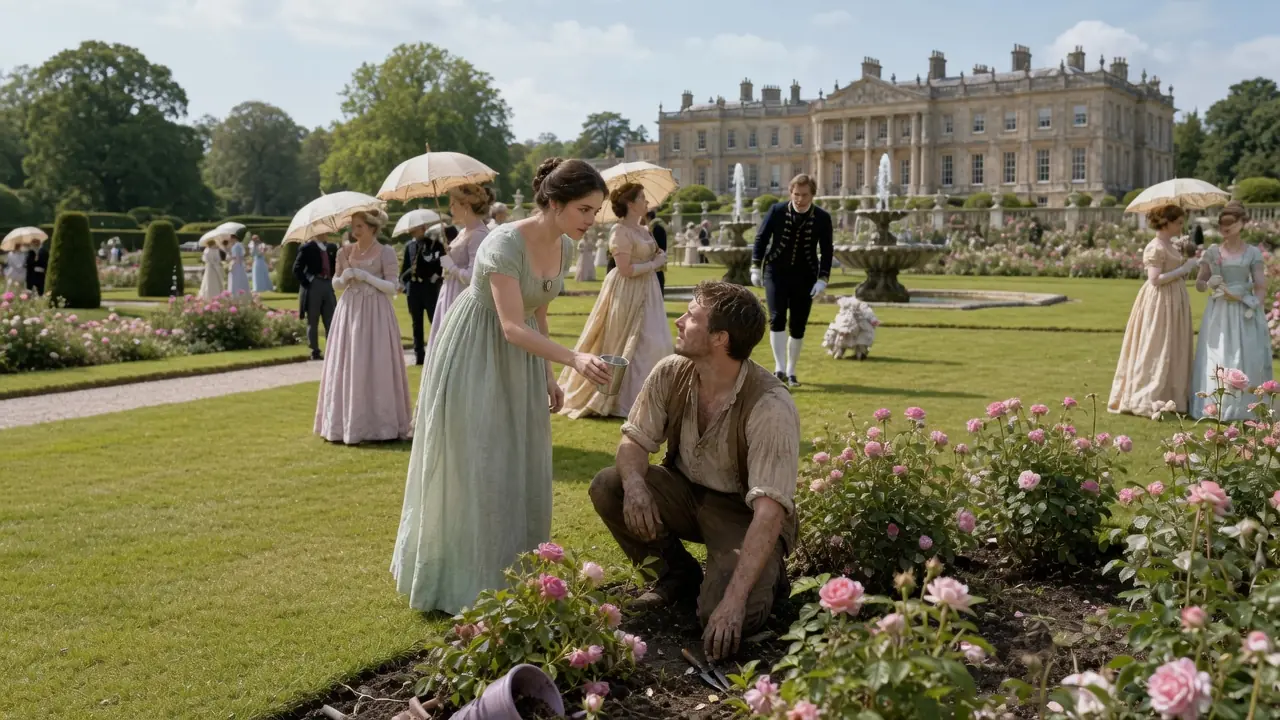
Not one. Because what Marcus Hadley did that summer afternoon would change two lives forever and nearly destroy one of them. Marcus pressed a fist into his lower spine and straightened slowly. Across the wide lawn of Belmore House, a group of women drifted past in silk and lace. Their parasols cast moving circles of shade on the grass.
Their laughter floated on the warm air, bright and careless. It was the sound of people who had never worked a single day. None of them looked at him. He was invisible. A man on his knees beside a rose bush.
Just another servant. Just another pair of hands. Exactly what he wanted. He had planned this for weeks. The borrowed trousers from the head groundskeeper were still damp at the knees, and the frayed collar and patch of stubble along his jaw were deliberate.
He had even rubbed actual soil into his forearms before leaving his chambers at dawn. The disguise was perfect. An hour ago, Lady Peyton had nearly ordered him to carry her trunk inside, mistaking him for staff without a second glance. But Marcus was no servant. He was the Duke of Ashworth, one of the wealthiest men in England, and he was hiding in plain sight because of a question that had kept him awake for months.
Was there a single woman in the country who would show kindness to a gardener? His sister Catherine had called him mad. Three nights earlier, she had sat across from him in his study, while rain hammered the tall windows of Ashworth Hall. Her teacup sat untouched. Her mouth was set in that thin line he knew too well.
"You will find nothing but disappointment," she had said. "People are people, Marcus. They respond to power and title because that is what the world teaches them. You cannot fault them for it." But he could, and he did, because the solicitors had made it perfectly clear. The estate needed an heir.
Marcus needed a wife. And if he was going to stand beside someone for the rest of his life, he wanted that person to be real, not a performance, not a curtsy and a rehearsed smile, someone who saw human beings, not positions. So he had arranged the garden party through careful channels. Lord Belmore owed him a favor from a financial matter the previous year, and the Belmores had been happy to host their annual summer gathering without asking too many questions. Every eligible lady within three counties had received an invitation.
Now Marcus moved among the hedges with pruning shears in hand, watching and listening. Lady Caroline Blythe dropped her handkerchief near the fountain. It landed less than two feet from where Marcus knelt. She waited, her chin lifted, her posture stiff with expectation. When he did not leap to retrieve it, she made a small clicking sound with her tongue and snapped her fingers at a passing footman.
The Ashford twins walked by, discussing their trip to Bath. One of them gestured too wide and knocked over a potted lavender. Soil spilled across the stone path. They stepped around it without breaking conversation and kept walking. Miss Victoria Winters was slightly better.
"Mind yourself," she said when Marcus had to move a wheelbarrow out of her way, but her eyes never quite landed on him. She looked through him the way a person looks through a window. The glass is there, but nobody notices it. The sun climbed higher. His shirt stuck to his back.
His blisters were getting worse. Marcus drove the shears into a thick branch with more force than necessary. Catherine had been right. This was foolish. People were simply people, and expecting more was its own kind of madness.
No jewels except a small cameo pinned at her throat. Her dark hair was pinned up in a plain sensible style. No elaborate curls, no ribbons. She was not beautiful in the way those other women were beautiful. Her nose was a touch too strong.
Her mouth was a little too wide, but her eyes stopped him cold—brown, direct, and so clear that it was like looking into still water on a bright morning. "Yes, miss?" Marcus straightened, suddenly aware of the sweat on his face, the dirt streaked across his arms, the state of himself. "You have been working since morning," she said. "It is simply a fact, not a question. I noticed you when I arrived. You have not stopped once." She had noticed him hours ago. While every other woman on that lawn had looked straight through him, this one had seen him, had watched, had remembered. "It is my work, miss." "Yes, but it is nearly eighty degrees, and I have not seen you take any water." She held out a tin cup. Condensation ran down the sides in small, slow drops. "The punch table is just over there, but I thought you seemed rather occupied."
Marcus stared at the cup, at her hand, extended without hesitation. No gloves. Her nails were trimmed short and practical. A small ink stain marked her index finger. "That is very kind," he said.
His voice came out rougher than he meant it to. "It is basic decency," she said, stepping closer while holding the cup steady, "which seems to be in rather short supply today." There was something in her tone, not bitterness, something drier, an observation from someone who had been watching the same things he had been watching, the carelessness, the casual cruelty of people who never thought about the hands that served them. He took the cup, their fingers brushed for just a moment, and he felt calluses on her palm. This woman did her own work. Whatever that work was, she did it with her hands.
The water was cool. It tasted faintly of lemon. He drank it in three long swallows and did not realize until that moment how thirsty he had actually been. "Thank you," he said, handing the cup back. "You are truly welcome." She smiled, and her whole face changed.
The strong features softened, her eyes warmed. It was the kind of smile that made a person want to say something worth hearing. "I am Rosalind. Rosalind Thorne." Not a name he recognized. Not from any of the great families.
Not on his mother's long, careful list of acceptable brides. "I am—" He hesitated. He had prepared a false name, something common and forgettable. But standing there looking into those clear and honest eyes, the lie caught somewhere between his chest and his throat. "Thomas," he said at last, using his middle name.
"I am Thomas." "Well, Thomas, you are doing a lovely job with the roses. They will be wonderful next week." Rosalind glanced back toward the main party where the other women had gathered near the refreshment tables. Something shifted in her expression, a quiet separateness. She was here, but not part of it. "I should return before my cousin notices I have wandered off. She tends to worry."
"Your cousin brought you?"
"Yes. Margaret Belmore. She is Lord Belmore's niece." Rosalind's mouth pulled slightly to one side. "She means well, dragging me to these things. She thinks I should get out more and meet people, though I suspect I am rather hopeless at it."
"You seem to be managing well enough."
"Do I?" She gave a quiet laugh. "I spent the last hour hiding in the library. I only came outside because I felt guilty about Margaret going to all this trouble." She paused. "And then I saw you, and I thought—" She stopped herself as color rose in her cheeks. "Well, I should go."
"Wait." Marcus set down his shears. "Will you be at the dinner tomorrow night?" Rosalind shook her head.
"Oh, no. That is only for the principal guests. I am just here for the day." She glanced at the grand house behind her. "Margaret tried to insist I stay, but I do not really belong at something so formal." No self-pity in her voice, just a plain, honest reading of the world as she understood it.
Marcus found himself wanting to tear those lines apart. Every invisible wall between the woman standing before him and the table where she believed she did not belong. Perhaps he started then caught himself. He could not ask to see her again. Not as a gardener.
And he could not tell her the truth. Not yet. "Perhaps we will meet again."
"Perhaps." That warm smile appeared once more. "Goodbye, Thomas. Stay in the shade when you can." She walked back toward the party. Her simple dress moved easily in the breeze. He watched her rejoin her cousin, saw Margaret reach over and squeeze Rosalind's hand.
They stood together slightly apart from the others. Two people on the edge of a world that was not quite theirs. Marcus picked up his shears. His hands were shaking. He had found her.
After three hours of watching woman after woman walk past him like he was made of stone, he had found exactly what he had been searching for. A woman who saw people, who noticed a man working in the heat and brought him water without being asked, and he had lied to her. He had called himself Thomas. He had let her believe he was no one. Marcus looked down at his dirt-covered hands.
The weight of what he had done pressed down on him, heavy as a winter coat in full sun and impossible to shake off, because now he had a choice. He could appear at tomorrow's dinner as the Duke of Ashworth and hope she would understand, or he could find another way to meet her, start fresh, pretend the garden had never happened. Both paths led through a lie. And neither one answered the question that was already growing in the back of his mind, sharp and unavoidable. What happens when she finds out?
Would she see the test for what it was? A desperate man searching for something genuine, or would she see what it really looked like from the outside? A rich man playing games with ordinary people because he had the power to do so. Marcus did not know. He only knew that he had spent three hours looking for someone real.
And now that he had found her, everything had become far more dangerous than he had planned. Rosalind had not slept. She had been lying in her narrow bed for hours, watching moonlight crawl across the low ceiling of her room above the bookshop. The sheets were thin and warm against her skin. The air smelled of old paper and lamp oil, the same smell that had greeted her every night for three years, familiar as her own breathing.
But tonight it was not enough to settle her. Her mind kept pulling her back to the garden, to the man with the pruning shears. To the way he had looked up at her with those startled, uncertain eyes when she had spoken to him, Thomas. She turned onto her side and pressed her face into the pillow. It was not his face she kept seeing.
It was that flicker of confusion when she had held out the cup. That half second where his whole expression had shifted as though no one had spoken to him like a person in a very long time. That flicker had made something tighten behind her ribs, something close to anger, but quieter, aimed not just at those women on the lawn, but at herself. Because she had almost done the same thing, she had almost stayed in the library, almost kept her nose in her book and her back to the window. It was only the heat that had driven her outside, and only the sight of him working without pause that had moved her feet toward the punch table and then toward him.
What did that say about her? That kindness was not instinct, but accident, that she only acted because the circumstances had lined up. Rosalind pulled the blanket to her chin and stared at the dark wall. She had lived above the bookshop since her father died. He had left behind nothing but debts and a collection of volumes no one wanted to buy.
Margaret had offered to take her in. Sweet Margaret with her comfortable house and her genuine concern for her poor cousin living alone in two small rooms. Rosalind had refused. She liked her independence. She liked the quiet rhythm of the shop, opening the shutters each morning, cataloging new arrivals, wrapping parcels in brown paper for the few loyal customers who still came through her door.
She liked eating her simple meals at the counter with a book propped open beside her plate. It was a small life, but it was hers. Tomorrow, Margaret would try again. She always did after these social occasions. As if one garden party might suddenly show Rosalind everything she was missing.
But Rosalind knew exactly what she was missing. She had watched it all afternoon. Those women with their practiced laughs and their careful conversations. Every single one of them performing a part they had rehearsed since childhood. Rosalind had tried that once years ago when her father was still alive and still pretending the money was not gone.
She had been terrible at it. Too direct, too honest, too willing to say what she actually thought instead of what people wanted to hear. You would be prettier if you smiled more. Her aunt had told her once, "You would be more popular if you agreed with people instead of arguing." Rosalind had smiled less after that. Just to prove a point.
But Thomas had not seemed to mind her directness. He had looked at her as though she were saying something that mattered. And when their hands had touched, just for that brief moment over the tin cup, she sat up sharply in the dark. This was ridiculous. He was a gardener, and she was a shopkeeper.
They had spoken for five minutes at most. And here she was lying awake at three in the morning, building something out of nothing. Rosalind crossed the room and stood at the window. The street below was empty. Pools of lamplight, long stretches of shadow.
Somewhere a dog barked twice and went quiet. A night watchman's voice drifted from two streets over, calling the hour. She pressed her forehead against the cool glass and forced herself to be honest. She wanted to see him again. Not at a garden party, not as Margaret's awkward cousin hovering at the edges.
She wanted to see him somewhere real, somewhere she could talk to him properly and find out whether that moment of connection had been genuine or just her own loneliness playing tricks on her tired mind. But she did not even know his surname, did not know if he lived on the Belmore estate or traveled between houses with the seasons. The world of servants was as invisible to her as her world was to Lady Caroline Blythe. Rosalind let out a quiet breath that fogged the glass. She climbed back into bed, closed her eyes.
Sleep did not come. Fourteen miles away, Marcus stood in front of his wardrobe and hated everything inside it. The formal dinner was in four hours, he should have been choosing between the blue coat and the black, deciding which waist coat projected the right balance of wealth and approachability. Instead, he stood motionless, staring at rows of perfectly tailored clothes that suddenly felt like costumes. All of them.
Every jacket, every cravat, every pair of polished boots, costumes for a character he had been playing his entire life. "Your Grace, the carriage will be ready at six." His valet, Harding, appeared in the doorway, pressed and spotless as always. "Shall I lay out the blue?"
"No." Marcus turned away from the wardrobe. "I am not going." A pause followed. The particular kind of silence that Harding had perfected over 15 years of service. The silence that said everything without saying a word. "Send my regrets to Lord Belmore. Tell him I have been called back to Ashworth on urgent estate business." "But, Your Grace, this dinner is partially in your honor. Lord Belmore will be expecting you."
"I know what he will be expecting." Marcus moved to his desk and pulled out a sheet of writing paper. That is precisely why I am not going. He could not do it. Could not sit at that long table, surrounded by the same women who had walked past him in the garden as though he were stone. Could not watch them perform their charm and their wit and their carefully arranged laughter.
Knowing what he now knew about every single one of them. And he especially could not do it, knowing that Rosalind would not be there. She was somewhere in the nearby town, some modest room, some ordinary evening, believing he was Thomas the Gardener, probably not thinking about him at all. The thought sat in his chest like a stone dropped in deep water. "I need information," Marcus said, writing quickly.
A woman named Rosalind Thorne. She is cousin to Margaret Belmore. "I need to know where she lives and what she does." He looked up. "No one can know I am asking." Harding's expression did not change, but Marcus could feel the weight of his judgment as clearly as heat from a fire. Dukes did not chase after unknown women.
Dukes did not skip important dinners. Dukes certainly did not send their valet on quiet investigations about shopkeepers. "It is not what you are thinking," Marcus said.
"Of course not, Your Grace."
"I met her yesterday at the garden party." He set down his pen. "She was kind." The words sounded small and thin, nowhere near large enough to hold what he actually meant. "She brought me water," he added.
"How thoughtful, sir." Marcus looked up sharply, but Harding's face was perfectly smooth, not a crack in the surface. "Just find out where she is, please."
"Yes, Your Grace." When Harding left, Marcus sat alone at his desk and stared at the half-written letter of regret. He should explain himself properly to Belmore, should keep up the polite fictions that held the world of the aristocracy together. Instead, he crumpled the paper and threw it across the room. He had spent his whole life being the Duke of Ashworth, following the rules, meeting every expectation, playing the part he had been born into before he could even speak. And what had it brought him?
A parade of women who saw a title and an estate. The growing certainty that he would marry someone he could never truly know until Saturday. until a woman in a faded green dress had looked at him like he was a person and acted on what she saw. Marcus walked to the window, his estate stretched out below, every field and fence line perfectly maintained, profitable, orderly, exactly as a duke's holdings should be. It felt like standing inside a locked room. Harding returned the following morning with a small folded note.
Three lines, an address, a profession, a name painted on a shop sign in faded gold letters. Thorne and Daughter, Booksellers, High Street in Hartwell. Marcus read the note twice. Then he sat down and did something he had not done since he was a boy. He planned what to say to someone who frightened him.
Not frightened in the way creditors or political rivals frightened a man. Frightened in the way that mattered. The deep gut-level understanding that the next words out of his mouth could either open a door or close it forever. He could not go as Thomas. The lie would only grow.
Every additional day he spent pretending to be someone else was another brick in a wall that would eventually stand between them. He had to go as himself. He had to tell her the truth. And he had absolutely no idea how she would respond. Tuesday morning, Marcus dressed carefully, not in his finest clothes, not the full weight of the Duke, but well enough that there would be no mistaking what he was.
He told Harding he would be taking the small carriage. He told the driver to stop at the end of High Street. He walked the last two hundred yards on foot because he wanted time to think and because his legs needed the movement to burn off the tightness in his chest. The shop was smaller than he had expected. A narrow storefront with a bow window full of leather-bound volumes arranged on faded velvet.
The gold lettering on the sign above the door had worn thin in places. A bell hung on a bracket just inside. Marcus stood on the pavement for a full minute. A woman walked past with a market basket and gave him an odd look. A duke standing frozen outside a bookshop on a Tuesday afternoon was not a common sight in Hartwell.
He pushed open the door. The bell chimed sharp and clear in the quiet. Rosalind sat behind a counter near the back, bent over a ledger. She looked up at the sound and her pen slipped from her fingers and rolled across the page, leaving a thin trail of ink. Her lips parted.
Her hand gripped the edge of the counter. She recognized him, even in these clothes, even cleaned and shaved and polished. She knew his face. Those eyes that had looked up at her from beside the roses. "You are not a gardener," she said quietly.
"No." Marcus stopped a few feet from the counter. His hat was in his hands. He was turning it slowly without realizing. "I am not." The shop was warm and close. Books everywhere, stacked on tables, piled in corners, lining the walls from floor to ceiling.
Dust moved slowly through a shaft of afternoon light from the bow window. It smelled of paper and binding glue and something faintly sweet. Old wood perhaps, or the lavender she kept between the pages. "My name is Marcus Hadley." He made himself hold her gaze. "I am the Duke of Ashworth." Rosalind did not move, did not blink.
The color left her face slowly, like water draining from a basin. Then it came back, a flush that started at her throat and climbed to her cheeks. "Of course you are," she said. Her voice was steady, but her knuckles on the counter edge had gone white. Marcus waited.
He owed her that. Owed her whatever came next. Whether it was anger or silence or the door. "Why?" she asked. One word.
Clean and sharp as a blade. "I wanted to see them as they really were," Marcus said. "The women at the party." "I needed to know who they were when they believed no one important was watching."
"So you tested them?"
"Yes. And they failed. Every one of them." He set his hat on a stack of books, then picked it up again. His hands would not stay still. "They walked past me like I was made of stone, like I was not there at all." He paused.
"Until you." Rosalind shook her head slowly. A strand of dark hair had come loose from its pins and brushed her jaw. "I am not special for bringing someone water. That is just being a decent person."
"Exactly." Marcus took one step closer. "That is exactly my point. It should be ordinary. It should be common, but it was not. You were the only one who saw me." "I saw Thomas." Her chin lifted. "A gardener working in the heat. I did not see you."
"But you did." His voice dropped. "You saw the most honest version of me that has existed in years." The clock by the door ticked into the silence between them. Dust turned slowly in the light. Rosalind's jaw tightened. Her eyes were bright and hard and very, very clear.
"You lied to me," she said. And in that moment, Marcus understood that the next words he spoke would determine everything. Not just whether she would listen, not just whether she would forgive, but whether the only real thing he had ever found would survive the truth that had brought him to her door. The clock ticked. Dust turned in the light.
Rosalind's knuckles were still white on the counter edge. Marcus did not look away from her. He owed her that much. He owed her his full face while she decided what to do with the truth he had just handed her. "I know," he said.
"I lied, and I have no excuse that makes it clean." Rosalind released the counter slowly. She stepped back, putting distance between them, and folded her arms across her chest. Her breathing was careful, measured, the breathing of someone keeping themselves very still on purpose. "You could have told me in the garden."
"I could have."
"You could have said your real name when I gave you mine."
"Yes."
"But you did not."
"No." She turned away from him and moved toward the bow window. Afternoon light fell across her shoulders, catching the loose strand of hair at her jaw. She stood with her back to him, looking out at the street. And Marcus felt the distance between them like a physical weight pressing against his ribs. "When I handed you that cup," she said quietly, still facing the glass, "I was not performing. I was not trying to impress anyone. I saw a man who needed water, and I brought him some."
"I know."
"And the whole time, you were performing." She turned around. Her eyes were bright. Not with tears, with something harder. "You were running a test, watching us all like insects under glass, deciding who passed and who failed." The words hit him square in the chest because they were true. "Yes," Marcus said. "That is what I was doing."
"And I passed."
"You were the only one." Rosalind let out a short breath. "Do you understand how that sounds? You dressed as a servant and waited to see which woman was good enough. That is not honesty, Marcus. That is a game—a rich man's game." Her voice did not rise. It stayed low and level, which was worse. Anger he could have met. This quiet, clear dismay cut deeper than shouting. Marcus set his hat down on the counter.
He stopped trying to find the right words and let the wrong ones come instead. "You are right." Rosalind blinked. "It was a game," he continued. "I told myself it was something noble—a search for truth, a way to find someone real. But you are right. I had the power to play it, so I played it, and the people I was testing never had a choice in the matter." He took a breath. The shop was so quiet he could hear the creak of the old floorboards beneath his weight. "I cannot undo Saturday. I cannot go back and introduce myself properly and let you decide whether to bring water to a duke instead of a gardener. That moment is gone." Rosalind watched him.
Her arms were still folded, but her grip on her own elbows had loosened slightly. "All I can offer you," Marcus said, "is this: the truth, my real name, my real face, and the admission that what I did was wrong, even if it led me to the only honest person I have ever met." The street outside was quiet. A cart rolled past slowly, its wheels grinding on the cobblestones. Somewhere nearby, a church bell rang the half hour. Three soft notes hanging in the warm air.
"Why did you come here?" Rosalind asked. "You could have left it, gone to the dinner, and found some other woman who curtsied nicely and laughed at the right moments."
"Because I have not stopped thinking about you since Saturday." He said it simply, with no decoration or flourish. "I skipped the dinner, sent my regrets, and spent two days trying to find you. My valet thinks I have gone completely mad."
"Perhaps you have."
"Probably." The ghost of something moved across her face.
Not a smile, not yet, but the faintest softening around her mouth. The smallest shift in the set of her shoulders. "I live in two rooms above this shop," she said. "I eat plain meals. I have ink on my fingers more days than not. I say exactly what I think, even when it costs me. I know your mother would be horrified."
"My mother is horrified by most things. It is her natural state." This time her mouth did move, just barely. A twitch at the corner that she fought to keep down. "I am not asking you to fit into my world, Rosalind." Marcus took a careful step closer. "I am asking whether I might be allowed into yours." "That is not how this works. Dukes do not—"
"Dukes do whatever they choose," he said gently. "That is rather the point of being one. And I choose this. I choose someone who sees people instead of positions." He held out his hand. Palm up.
Open. An offer she was free to refuse. Rosalind looked at his hand for a long time. She looked at his face. She looked at the shop around her, the stacked books and the worn counter, and the simple life she had built out of nothing after her father left her with nothing.
Then she looked back at his hand. "I am still angry about the lying," she said.
"That is fair."
"And I do not know how any of this works."
"Neither do I." Marcus kept his hand steady. "I have never done anything honestly before. Not like this." Rosalind unfolded her arms. She reached out and took his hand. His fingers closed around hers. Warm, steady. The calluses she had felt on Saturday were gone now, smoothed away with the disguise, but the grip was the same. The person behind the grip was the same. "People will talk," she said.
"Let them."
"They will say I trapped you, that I schemed my way into a title."
"And they will be wrong. I came to you. I found you. I am the one standing in your shop with my hat on your books, asking for a chance." Rosalind looked down at their joined hands. Her thumb moved once across his knuckle.
A small involuntary gesture that said more than any words she could have chosen. "If you ever lie to me again about anything," she said, raising her eyes to his, "I will not forgive it a second time." "I understand."
"I mean it, Marcus."
"I know you do." He squeezed her hand gently. "That is one of the reasons I am here." The shop bell chimed. An older woman with silver hair and sharp eyes poked her head through the door, saw them standing there, hand in hand across the counter and paused. "Mrs. Callaway," Rosalind said, her cheeks coloring.
"Your order of medical texts arrived this morning. They are on the shelf behind the register." Mrs. Callaway looked at Marcus, looked at Rosalind, looked at their hands. Then she smiled, a small, knowing, deeply satisfied smile, collected her parcel from the shelf, and left without a word. The bell chimed again as the door closed behind her.
"Well," Rosalind said, "the gossip starts now."
"Let it." Marcus moved around the counter. She did not step back. "We will give them something worth discussing."
"And what is that?"
"A duke who found his duchess in a bookshop." He lifted her hand and pressed his lips to her knuckles. It was old-fashioned and proper, and it made her pulse jump visibly at her wrist. "A woman who offered water to a stranger because it was the decent thing to do." Rosalind looked up at him at this impossible man standing in her cramped little shop with afternoon light on his face and her hand in his. "That is quite a story," she said softly.
"It is our story." His free hand rose and touched her cheek. Careful, gentle, like he was afraid she might disappear. "If you want it to be." She thought about Saturday. A tin cup, cool water, the brush of rough fingers, the choice to walk toward someone instead of past them. She thought about right now, honesty laid bare in a dusty bookshop.
Risk and truth and the terrifying wide-open possibility of something she had stopped believing in years ago. "Yes," Rosalind said. "I want it to be." Marcus smiled. That same uncertain real smile from the garden, the one that had nothing to do with titles or estates or the weight of a name. And when he kissed her there among the books and the dust and the slow turning light, it was the most honest thing either of them had ever done.
Outside the town would talk. His mother would object. Society would whisper behind gloved hands and painted fans. But inside the little shop on High Street, none of that reached them. A duke had dressed as a gardener and found the one woman who saw him when he was invisible.
She had offered him water and everything else had followed from there.