There are some humiliations that happen so quickly the body feels them before the mind can name them.
A voice hardens.
A room turns.
A hand reaches.
Something is taken from you in public—not money, not property, not blood, but the fragile human right to stand somewhere without being questioned like a stain.
For Clara Jefferson, it happened beneath a chandelier the size of a carriage wheel, in the marble lobby of the Magnolia Grand Hotel in Charleston, South Carolina, where the floors gleamed like they had never known honest dust and the air smelled faintly of lilies, lemon polish, and old money trying to perfume its own history.
She stepped through the revolving door just after four in the afternoon, carrying a cream leather overnight bag in one hand and a folded reservation printout in the other.
She wore a cream silk blouse beneath a tailored jacket the color of winter sand, pearl earrings no larger than raindrops, and low heels sensible enough for a woman who had learned long ago that elegance and discomfort did not have to be synonyms.
She was fifty-two years old, dark-skinned, poised, and quiet in a way that made careless people assume she was either timid or easy to dismiss.
The Magnolia Grand was hosting the South Atlantic Philanthropy Weekend, the sort of event where families with old surnames and newer foundations congratulated one another over shrimp canapés and strategic generosity.
There would be speeches about heritage, panels about community, and checks handed over beneath the approving gaze of photographers.
Clara had been invited to attend a historical preservation roundtable the next morning.
She was no stranger to such spaces.
In the past fifteen years she had built a national reputation as a preservation strategist, a donor adviser, and a relentless advocate for underfunded Black historical archives across the South.
She knew how to move through institutions that loved Black history in theory while distrusting Black authority in practice.
Still, she had come alone.
She preferred it that way.
Traveling alone meant fewer explanations.
No husband to be greeted before her.
No assistant mistaken for the principal or vice versa.
No need to watch a room decide who mattered by where a white man stood in relation to her.
She crossed the lobby toward the front desk, where the check-in line separated itself neatly with brass stanchions and velvet ropes.
A wedding party occupied one side of the room.
Two older women in linen held tiny dogs like accessories.
A bellman pushed a trolley of monogrammed luggage past an oil portrait of some dead benefactor whose face suggested he had never once been denied a room in his own name.
Clara took her place in line.
That should have been the whole story.
But the front desk manager, Rebecca Harlan, looked up from her screen, saw Clara, and made the kind of quick judgment that reveals a lifetime more honestly than any sermon ever could.
“Ma’am,” Rebecca said sharply, loud enough for the nearest guests to hear, “this line is for guests only.”
The words landed with surgical precision.
Not screamed.
Not whispered.
Positioned.
Clara felt it first in the spine—the cold sting of being singled out before she had even spoken.
Then in the chest.
Then in the room around her, where conversation dimmed just enough for people to enjoy being witnesses.
She kept her face still.
“I am a guest,” she said politely. “I have a reservation.”
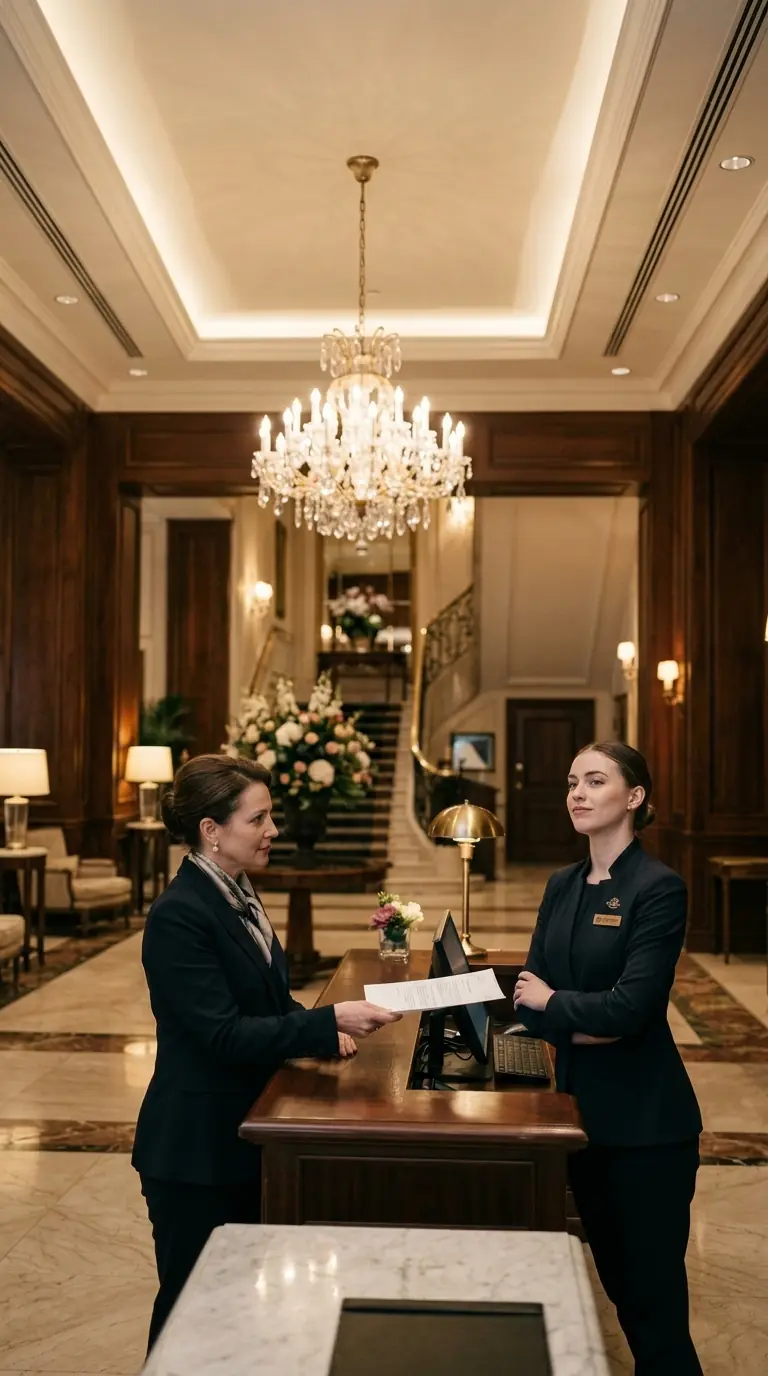
Rebecca was in her early forties, blonde in the polished Southern style that required regular upkeep and no apparent effort, with a navy blazer, a hotel pin at the lapel, and the stiff posture of someone who mistook authority for refinement.
Her smile did not appear.
Instead, she looked Clara up and down the way some people inspect a chair before deciding whether it belongs in the room.
“Let me see that,” she said.
Clara handed over the folded reservation.
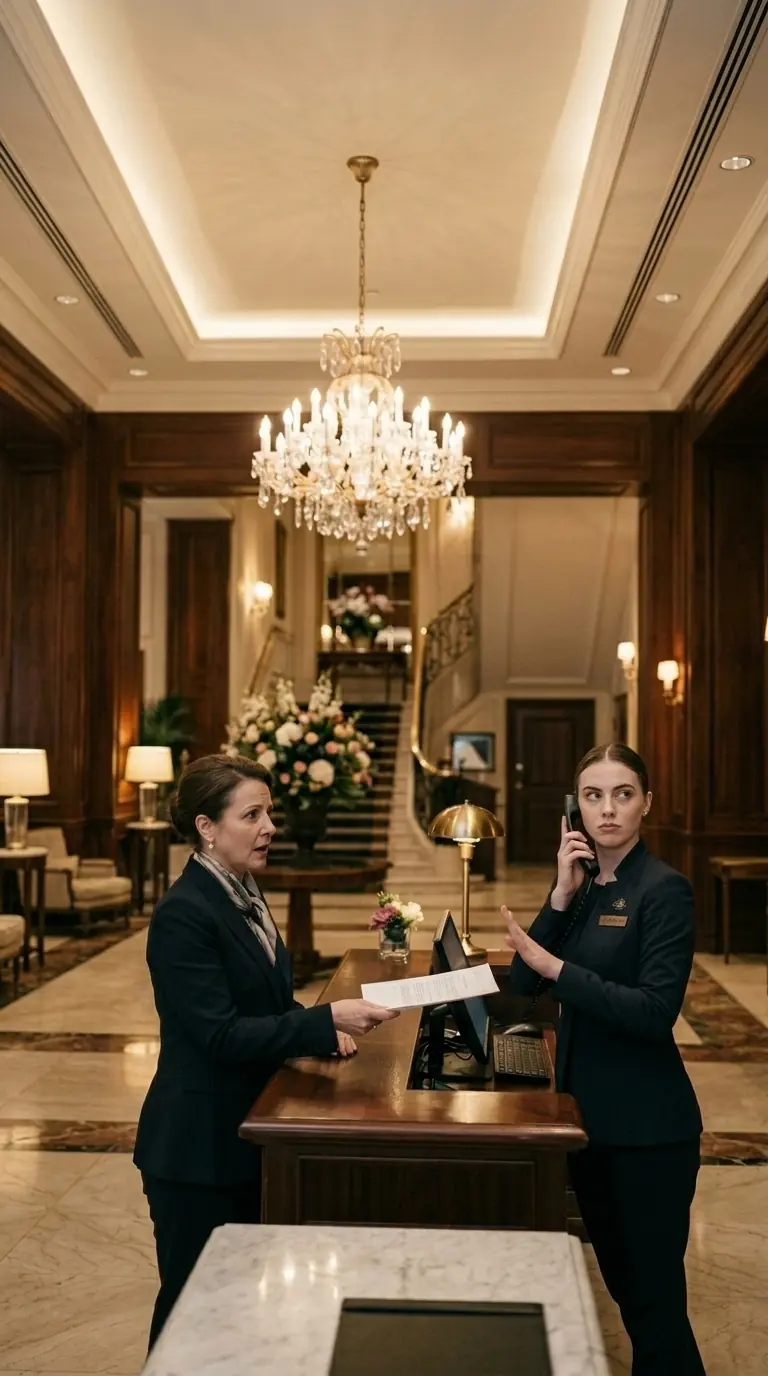
Rebecca glanced at it once, frowned with theatrical suspicion, then looked up again as if Clara had personally insulted her by existing at the counter.
“We don’t take fake bookings here.”
And then, before anyone could breathe, she tore the paper clean in half.
The sound was small, but in the lobby it seemed enormous.
A woman near the fountain gasped.
Someone murmured, “Oh my goodness.”
A man in seersucker took one half step backward, not because he wanted to help, but because white discomfort has always preferred distance to intervention.
Rebecca dropped the torn pieces onto the counter.
“Security.”
For one brief second Clara could not move.
Not because she was weak.
Because she was trying not to split open.
There are moments when humiliation feels physical, as though the skin itself has been stripped back for public inspection.
Her scalp prickled.
Her throat tightened.
Every old memory rose at once.
Department stores where clerks shadowed her mother.
University receptions where she was handed serving trays by mistake.
Boardrooms where people addressed her assistant instead.
The long, exhausting education of being seen as suspect before being seen as human.
A young security guard approached from the side of the lobby, uncertain, embarrassed, and already compromised by the uniform on his body.
Clara bent slowly, picked up the torn halves of the reservation, smoothed them together with careful fingers, and looked at Rebecca with a steadiness more dangerous than shouting.
“You’ll regret that,” she said softly.
Then she turned and walked out.
Head high.
Shoulders straight.
Past the revolving door, into the thick Charleston heat, where the humidity hit her face and the city moved around her as if nothing had happened.
That is how some of the worst moments of your life behave.
They wound you.
Then the world continues.
Clara stood on the sidewalk for thirty seconds, maybe less.
She could hear her pulse in her ears.
A valet glanced at her, then away.
Across the street, tourists took pictures beneath hanging balconies and ironwork, documenting a beauty built atop histories most of them would never ask hard questions about.
Her hands shook only once she reached the car.
She had booked a town car from the airport and asked the driver to wait while she checked in.
When she climbed back into the rear seat, he turned halfway around.
“Everything alright, ma’am?”
Clara’s answer surprised even her.
“No,” she said. “But it will be.”
She did not cry until later, in the privacy of a smaller hotel across town where the lobby furniture was less impressive but the desk clerk had smiled and said, “Welcome, Ms. Jefferson. We’re glad you’re here.”
That was what broke her.
Not cruelty.
Kindness.
Because sometimes one clean act of decency reveals how hard you have been bracing.
By midnight, the video was online.
Clara herself had not filmed it.
She never learned who did.
A college student from Atlanta, maybe.
A bridesmaid waiting near the elevators.
A hotel employee with more conscience than silence.
The footage was shaky but clear enough: Clara at the desk, Rebecca taking the paper, ripping it, calling security, Clara picking up the halves and saying, “You’ll regret that.”
By morning it had spread far beyond Charleston.
The internet, for all its pettiness and speed, still possessed the occasional ability to point its chaos toward truth.
The clip struck a nerve because there was no ambiguity left to hide behind.
No one could credibly describe it as misunderstanding.
It was racism stripped of euphemism.
Meanness in uniform.
Institutional contempt in a navy blazer.
By ten a.m., the Magnolia Grand had issued a statement describing the incident as “regrettable” and “under internal review.”
By noon, local activists were organizing outside the hotel.
By one, national commentators were replaying the clip.
By dusk, Clara Jefferson’s face was everywhere the Magnolia Grand had once hoped its ballroom photos would be.
Charleston, a city fluent in both charm and avoidance, did what it always did when old systems were dragged into daylight: it split.
Some defended the hotel by saying there had to be “more to the story.”
Some blamed training.
Some blamed individual prejudice.
Some blamed “cancel culture.”
A few elderly donors insisted the whole thing had been overblown.
Others, especially Black Charlestonians who had their own archives of similar moments, recognized it instantly for what it was: a polished institution acting exactly as polished institutions often do when they believe no one important is watching.
What the Magnolia Grand had not realized was that Clara Jefferson was precisely the sort of person whose humiliation would not stay local.
For twenty years, she had helped direct philanthropic capital into neglected Black historical sites, legal defense funds, educational trusts, and regional archives throughout the South.
Museum directors knew her.
University presidents knew her.
State preservation councils knew her.
Wealthy families with tarnished consciences knew her.
She was not flashy.
She was not on magazine covers.
She was not the sort of donor who loved microphones.
But she moved millions quietly and understood institutions as both moral systems and legal machines.
Her phone began ringing before sunrise.
Old friends.
Board members.
Former classmates.
Three journalists she trusted.
A pastor in Savannah.
A state senator in Virginia.
An elderly librarian in Mississippi who said, “Baby, I saw it. Hold steady.”
A museum director in Atlanta who asked, “Are you lawyering up?”
And finally, near noon, Evelyn Brooks.
Evelyn was fifty-eight, sharp as cut glass, and one of the most feared civil rights attorneys in the Carolinas.
She wore impeccable suits, spoke with surgical restraint, and had the unsettling gift of making rich men feel legally naked before she had even sat down.
Clara knew her from preservation litigation.
They had worked together twice before, once on a cemetery access dispute and once on a museum board discrimination case that ended in three resignations and one extremely expensive settlement.
Evelyn did not waste words.
“Come downtown,” she said. “Bring everything.”
A week later, Clara sat in Evelyn’s office above a law firm on Broad Street, telling the story from the beginning while traffic moved below the tall windows and framed degrees lined the walls like quiet weapons.
Evelyn listened with a yellow legal pad in front of her, writing almost nothing.
When Clara finished, the room held still for a moment.
Evelyn folded her hands.
“What do you want?” she asked.
Not “What can we get?”
Not “How badly were you harmed?”
Not “Do you want to sue?”
What do you want?
That question matters because it assumes personhood before strategy.
Clara looked out the window.
What did she want?
An apology?
No.
Public apologies from institutions often arrive too late and too carefully edited to mean anything.
Money?
She understood money.
Respected it.
Needed it for causes that mattered.
But money alone would not repair what had been revealed.
Rebecca fired?
Perhaps.
But firing one woman could let the rest of the system walk away congratulating itself for removing “a bad apple” from a barrel built to ferment that very behavior.
No.
What Clara wanted was harder.
She wanted the lie exposed.
She wanted the Magnolia Grand forced to confront the difference between its public values and its private reflexes.
She wanted the donors who hosted “heritage” weekends in a city layered with Black labor and Black grief to answer for what their hospitality actually looked like.
She wanted structures changed, not merely faces replaced.
When she said this, Evelyn nodded once.
“Good,” she said. “That’s more expensive.”
The weeks that followed were a storm.
The Magnolia Grand’s ownership group scrambled through three separate public relations firms.
Rebecca was suspended pending investigation.
The hotel’s general manager did a local television interview in which he described the incident as “deeply unfortunate,” then worsened matters by calling the video “painful for everyone involved.”
Activists held nightly vigils outside the hotel steps carrying signs that read WELCOME FOR WHOM? and HISTORY IS WATCHING.
Ministers spoke.
College students marched.
Weddings cancelled bookings.
A corporate retreat pulled out.
A regional donor forum relocated to Savannah.
Every attempt the Magnolia Grand made to move on only revived the footage.
What finally broke the institution was not outrage alone.
It was discovery.
Under Evelyn’s direction, Clara’s legal team began pulling threads.
Complaint records.
HR turnover.
Customer incident logs.
Hush settlements.
One torn reservation became an opening into years of buried policy and selective enforcement.
Rebecca had not invented the culture; she had simply embodied it too publicly.
Black guests had been questioned at higher rates.
Staff training materials were thin, inconsistent, and legally anemic.
Complaints from employees of color had been documented and neutralized rather than addressed.
The hotel, which marketed itself as the crown jewel of Charleston hospitality, had operated for years on a system of coded discretion that just happened to produce racially predictable outcomes.
Once those patterns emerged, even some of the Magnolia’s own investors recoiled.
There are many things wealthy people will tolerate in private.
Embarrassing documentation is not one of them.
Within two months, ownership began to fracture.
One group wanted aggressive defense.
Another wanted settlement.
A third—more practical, more frightened—wanted out.
The hotel bled bookings and reputation at the same time.
City officials who had once enjoyed cocktail receptions beneath its chandeliers began speaking publicly about accountability.
National press picked up the story.
A glossy travel magazine ran an article titled The Hotel That Forgot Hospitality.
Business schools discussed the case in seminars on brand collapse.
Through it all, Clara remained mostly quiet.
She gave one measured statement.
“What happened to me is not unique. That is precisely the problem.”
Then she went back to work.
That unnerved people more than fury would have.
Because Clara was not performing injury for public consumption.
She was doing something institutions fear more: she was thinking.
In the third month, one of the Magnolia’s minority stakeholders contacted Evelyn privately.
He represented a trust that no longer wished to remain associated with the hotel.
Quietly, and then less quietly, pieces began to move.
Additional investors withdrew.
Debt terms tightened.
Insurance scrutiny increased.
A sale—once unthinkable—became possible.
That is when Clara did the one thing no one saw coming.
She made an offer.
Not under her own everyday name, at first.
Through a development and preservation entity she controlled.
With financing assembled through a coalition of Black investors, a hospitality reform fund, and two quiet allies in Atlanta and D.C. who understood the symbolic and strategic value of the property.
Evelyn structured the deal with ruthless elegance.
Every liability examined.
Every pending claim priced.
Every governance term rewritten.
By the time the old owners understood who was ultimately behind the purchase, they had no leverage left but bitterness.
Three months after tearing up Clara Jefferson’s reservation, the Magnolia Grand closed “temporarily for restructuring.”
Three months after that, it reopened.
Only now everything had changed.
The cameras came first.
By then the story had become national enough that the reopening drew press from Atlanta, New York, D.C., and beyond.
Satellite trucks lined the street.
Reporters clustered beneath magnolia branches.
The protest signs were gone, replaced by curious onlookers, local families, hospitality workers from across the city, ministers, students, preservationists, and a few old donors who had come not from support but from disbelief.
A black SUV pulled up to the curb.
The rear door opened.
And Clara Jefferson stepped out.
The same city.
The same hotel.
The same doors.
Only now she owned them.
She paused for a fraction of a second and looked up at the restored sign above the entrance.
MAGNOLIA GRAND.
The name had been retained deliberately.
Erasure, she believed, was too easy.
Better to transform a place visibly than rename it into innocence.
Clara wore ivory again that morning, though in a different cut—an understated suit with a silk blouse and a narrow gold brooch shaped like a magnolia leaf.
Her hair was swept back.
Her expression was composed.
Cameras flashed like summer heat.
A reporter called, “Ms. Jefferson, what are you feeling?”
Clara smiled faintly.
“On time,” she said, and kept walking.
Inside, the lobby had been renovated but not sanitized.
That was important to her.
Too many institutions use redesign as a form of forgetting.
The marble remained.
The chandeliers remained.
The portraits were gone.
In their place hung commissioned works by Southern artists of color—landscapes, family scenes, abstractions rooted in memory and survival.
A new wall installation near the entrance documented the city’s Black labor history, including the enslaved and free Black artisans whose work had once shaped Charleston’s most admired architecture without being named within it.
At the front desk stood Rebecca.
That had surprised almost everyone when it leaked to the press.
She was not suspended anymore.
Not fired.
Not disappeared.
She was still in a uniform, though a different one now: charcoal instead of navy, no management pin, no elevated posture.
She looked older than she had three months earlier, which is what shame and scrutiny sometimes do.
Public disgrace had stripped something from her, but not enough on its own to make her better.
Clara knew that.
Shame rarely educates by itself.
It often only hardens.
Rebecca’s hands trembled slightly as Clara approached.
“Miss Jefferson,” she said. “I’m sorry.”
Her voice shook.
Clara stopped in front of the desk.
Flashbulbs bounced off the marble.
Somewhere behind them, the new general manager and two city officials held their breath.
Everyone in the lobby seemed to be waiting for the script they understood: the redeemed offender forgiven by the noble victim, both smiling beneath the healing language of transformation.
Clara did not offer them that.
“I don’t want your sorry,” she said calmly.
Rebecca looked as though she had been struck.
Clara continued.
“I want you to learn.”
Those four words changed the room.
Because forgiveness, offered too quickly, often functions as absolution for the person least burdened by the incident.
Learning is harder.
Learning costs labor, discomfort, time, and the surrender of flattering self-mythology.
Learning requires staying in the story after cameras leave.
And that was exactly what Clara intended.
She had decided, after many conversations and much prayer, that what happened at the Magnolia would either become another public morality tale with a clean villain and a clean ending, or it would become something rarer and more useful: a living correction.
Rebecca Harlan, whose instincts had once been protected by the institution around her, was given a choice.
Resign quietly and preserve whatever remained of her career elsewhere.
Or stay.
Stay under the new structure.
Stay in a lower-ranking role.
Stay inside a yearlong inclusion and accountability initiative designed not as decorative corporate training but as grueling institutional reeducation.
Stay and listen to guests she once might have dismissed.
Stay through seminars on bias, local Black history, employment disparities, guest profiling law, and the economics of exclusion.
Stay while the hotel’s archives were opened and its staffing patterns examined and its entire culture reordered.
Stay while being accountable, not theatrically, but daily.
To the shock of almost everyone, Rebecca chose to stay.
Clara was not naïve about why.
Part guilt.
Part fear.
Part unemployment.
Part the simple human instinct to remain close to the place where your story imploded, perhaps hoping proximity might someday make sense of it.
But something else too.
During the legal process, Rebecca had been deposed twice.
And in one of those depositions, beneath defensive language and weeping and repeated legal cautions, a truth emerged: she had spent most of her career in service environments where whiteness, wealth, and correctness had been braided so tightly together that suspicion had come to feel like professionalism.
She had called it standards.
Protocol.
Protecting the brand.
What she had actually been trained into, reinforced by managers and donors and unwritten expectations, was a hierarchy of welcome.
That did not excuse her.
It implicated more than her.
Clara understood this better than many activists who wanted easy punishment and many conservatives who wanted easy absolution.
Real change would require naming the system and forcing its beneficiaries to inhabit the work of undoing it.
So Rebecca stayed.
The new Magnolia Grand did not relaunch as some shallow luxury redemption arc.
Clara refused every branding proposal that made inclusion sound like a seasonal menu change.
No “celebrating diversity” banners.
No soft-focus commercials set to piano music.
No prepackaged language about moving forward.
Instead, she built policy.
Guest profiling safeguards with external auditing.
Anonymous employee reporting with independent review.
Mandatory historical and anti-bias education tied to employment retention.
Community investment agreements.
Supplier diversification requirements.
Scholarship pipelines for Black hospitality students.
Paid apprenticeships.
A public annual accountability report.
And perhaps most radically, she changed what welcome meant.
At the old Magnolia, welcome had been performed upward and denied downward.
At the new Magnolia, welcome became operational.
The valet greeted Black families with the same warmth once reserved for donors and honeymooners.
Front desk protocols were rewritten so suspicion could no longer hide inside discretion.
Concierge recommendations included Black-owned restaurants, tours, galleries, and neighborhoods the old hotel had treated as peripheral to “Charleston culture.”
The event calendar shifted too: preservation symposiums, oral history evenings, youth arts showcases, civil rights lectures, small weddings from families once priced or profiled out of the property.
The first six months were not graceful.
Transformation never is.
Some longtime patrons withdrew in offended silence.
A few left public reviews complaining that the hotel had become “political,” as though fairness were a partisan mood rather than a basic moral requirement.
There were staffing tensions, training resentment, donor tantrums, boardroom discomfort, and one especially absurd op-ed in a regional paper claiming Clara was “weaponizing hospitality.”
Clara kept going.
Rebecca stayed in the middle of it.
At first she seemed perpetually braced—too formal, too careful, speaking in rehearsed humility.
But the work wore past her performance.
That was the point.
She sat through testimonies from former employees of color who described being overruled, demeaned, or disciplined for challenging discriminatory treatment.
She attended historical tours of Charleston led by Black scholars who described the city beneath the postcards.
She listened to hospitality workers explain how coded language—“looks off,” “check again,” “not our usual profile”—functioned as racial sorting with plausible deniability.
Several times she cried.
Several times Clara remained unimpressed.
Because tears are easy.
Reconstruction is harder.
Months passed.
Something shifted.
Not suddenly.
Not enough to make the story sentimental.
But genuinely.
Rebecca began asking better questions.
Then fewer self-protective ones.
She stopped framing her actions as mistakes and began naming them as choices shaped by bias and rewarded by institutional culture.
She volunteered for the most uncomfortable sessions rather than the easiest.
She spent time at the community welcome desk Clara had installed in the lobby, helping local families navigate rates, event access, and scholarship applications.
She read.
She listened.
She stopped needing to be seen as one of the good ones and began doing the less glamorous work of becoming less dangerous.
One afternoon nearly nine months after the reopening, Clara passed through the lobby and saw Rebecca at the desk speaking with an older Black couple from Alabama.
Their reservation had been mishandled by a third-party booking site.
Under the old system, the interaction might have turned suspicious, rigid, humiliating.
Instead Rebecca said, “I’m sorry this happened. Give me five minutes. You’re our guests, and we’ll make it right.”
Her tone was not performative.
It was simply correct.
Clara paused.
Not out of triumph.
Out of recognition.
People can learn.
Not all do.
Some never will.
But some, when denied the comfort of easy redemption, can be remade by sustained accountability.
A year after Clara was first turned away, the Magnolia Grand received a national award for equitable hospitality reform.
Clara disliked awards but understood symbolism.
Photographs from the ceremony showed her standing in the reimagined lobby while families of every color moved around her—checking in, asking directions, laughing, corralling tired children, carrying garment bags, camera cases, diaper totes, and all the ordinary evidence of belonging.
That was what mattered most to her: ordinariness.
The absence of spectacle.
The quiet functioning of dignity.
One Saturday morning, exactly thirteen months after Rebecca tore her reservation, Clara stood near the front windows watching a multigenerational Black family check in for a reunion weekend.
Two little girls in braids pressed their hands to the marble counter and argued over who got to sleep with Grandma.
A Latino couple in linen asked for restaurant suggestions.
A white veteran from Ohio complimented the local history display and actually read it.
A young Black bride crossed the lobby in sneakers carrying a wedding gown in a garment bag while her father tried not to cry.
A same-sex couple took selfies beneath the new art wall.
Staff moved smoothly through it all, not because bias had disappeared from the earth, but because culture had been rebuilt with standards that no longer protected it.
Clara felt someone come to stand beside her.
Rebecca.
They watched the lobby together for a moment.
“I used to think hospitality meant making certain people comfortable,” Rebecca said quietly.
Clara did not look at her yet.
“And now?” she asked.
Rebecca swallowed.
“Now I think it means refusing to make anyone pay for entry with their dignity.”
That was the first apology Clara had ever believed.
Not because it was emotional.
Because it was informed.
Clara turned then.
Rebecca looked older still, but less brittle.
Less certain of herself in the dangerous ways.
More human.
Clara nodded once.
“Good,” she said. “Hold on to that.”
Later that evening, there was a small gathering in the lobby to mark the hotel’s first anniversary under new ownership.
Not a gala.
Clara had banned galas for at least three years on principle.
Instead there were local musicians, food from Black-owned Charleston kitchens, remarks from scholarship recipients, and a wall of photographs documenting the building’s transformation—not merely architectural, but moral.
When Clara was finally persuaded to speak, she stood where the old front desk once functioned as a checkpoint for belonging.
The room quieted.
Reporters had come, though fewer than before.
Most of the cameras now belonged to local families and employees and students.
The applause when she stepped forward was warm, not strategic.
Clara looked around the lobby.
At the staff.
At the guests.
At the children weaving between adults.
At the new art.
At the desk where she had once stood with a torn reservation in her hand.
Her voice, when it came, was soft enough to require listening.
“A year ago,” she said, “this lobby taught the country a painful lesson about what happens when people are judged before they are welcomed.”
She paused.
“And today it teaches a different one.”
A little girl laughed somewhere near the piano.
Someone shifted a glass onto a tray.
The city hummed faintly beyond the doors.
Clara continued.
“Sometimes the doors that close on us are the same ones we were meant to own.”
The line settled over the room not as slogan, but as testimony.
Because ownership, she had learned, was never only about deeds or titles.
It was about narrative.
About refusing to let your humiliation be the final architecture of a place.
About returning not simply to reclaim what was denied, but to rebuild the conditions under which denial can no longer function so easily.
Afterward, as guests mingled and music resumed, Clara remained in the lobby a little longer.
She watched families of every color check in freely.
She watched employees move with purpose rather than fear.
She watched Charleston—at least in this building, on this evening—practice a version of itself better than the one history had too often rewarded.
The Magnolia Grand would never be innocent.
No old institution ever is.
But innocence had never been the goal.
Truth was.
And beneath the chandeliers, under new policies and old scars, inside a hotel that once mistook exclusion for refinement, truth had finally been made operational.
That was rarer than forgiveness.
Harder than apology.
More useful than revenge.
And Clara Jefferson, who had once walked out holding two torn halves of a reservation, now stood exactly where she was supposed to be.