There are rooms in America that decide who belongs before a single name is spoken.
They decide by fabric.
By posture.
By who arrives with an arm hooked through someone important.
By whether your confidence looks expensive enough to make them comfortable.
And if you walk in alone—quiet, composed, dressed with more restraint than spectacle—those rooms often assume one of two things.
That you are staff.
Or that you are a mistake.
The Dominion Grand Hall in Richmond, Virginia, had been built for exactly that kind of judgment.
It was the sort of place old Southern money loved to call “historic,” as though age alone could cleanse a building of the assumptions it had sheltered. The chandeliers looked as if they had been designed less for light than for intimidation. Gilded mirrors climbed the walls. Oil portraits of men with stern jaws and inherited certainty watched from heavy gold frames. The floors gleamed with the kind of polish that came from generations of people being paid to keep surfaces beautiful for other people’s comfort.
The air itself felt curated.
Perfume.
Aged wine.
Beeswax.
Fresh flowers flown in from somewhere nobody in the room would ever have to think about.
And underneath all of it, something older and harder to name.
Entitlement.
That night, the hall was hosting the annual Dominion Heritage Fund Gala, a charitable event that claimed to support preservation, education, scholarships, and the protection of “shared Southern history.” On paper, it was noble. In practice, it was one of those evenings where wealthy donors congratulated themselves for caring while wearing enough jewels to fund a public library.
Men in tuxedos stood in circles discussing land, politics, and legacy in low tones calibrated to sound important. Women in silk and satin shimmered beneath chandelier light, their laughter practiced, their smiles selective. At the center of the room, just ahead of the stage, sat the front tables—those round islands of polished status where the people who mattered most were arranged like living centerpieces.
Everyone there understood the rules.
Who to greet first.
Who to flatter longer.
Who to pretend not to know.
Who to look at once and forget.
That was why the room noticed her immediately.
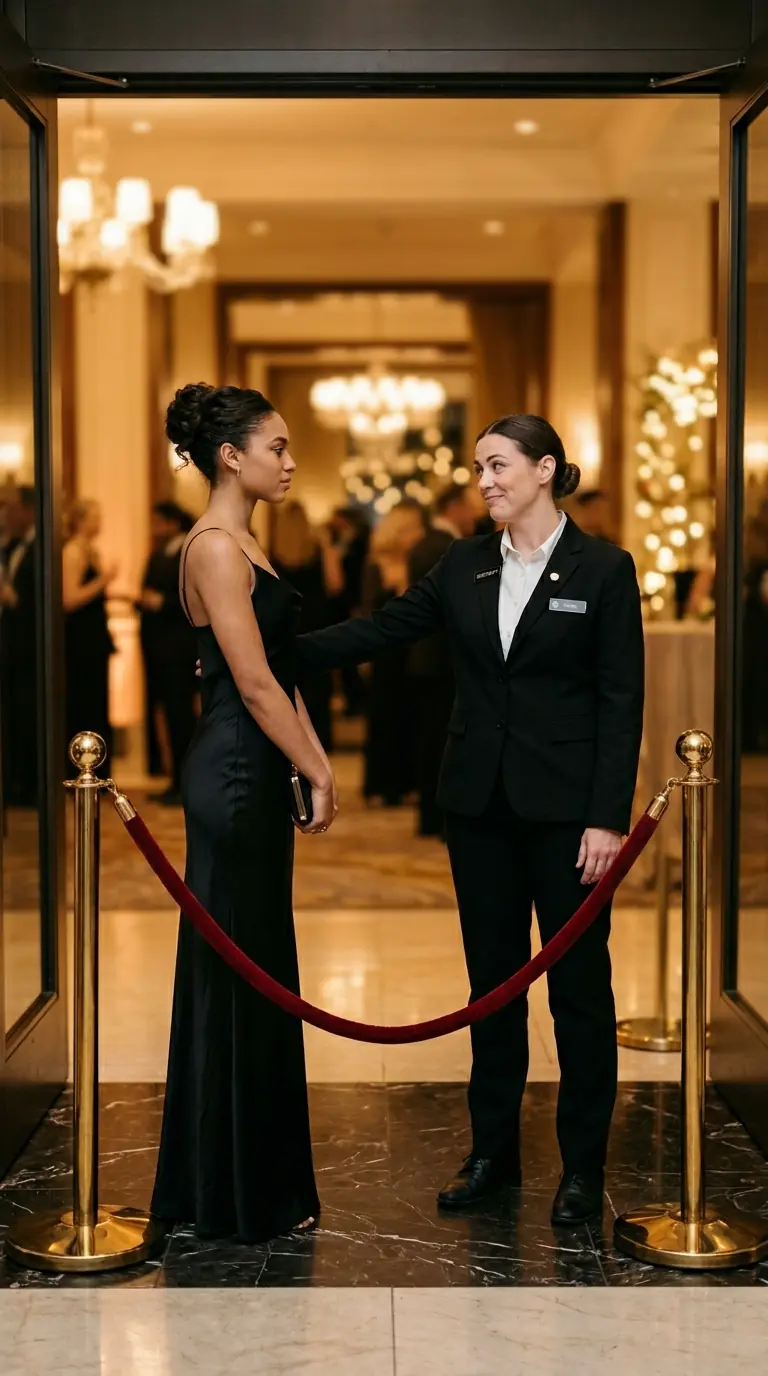
Nova Carter stepped through the entrance alone.
No entourage.
No husband at her arm.
No showy jewelry announcing value in a language the room respected.
Just a simple black dress.
Clean lines.
No sparkle.
No ornament beyond a pair of understated earrings and a watch that looked practical rather than performative.
She was tall, though not in a way that demanded attention. She carried herself with a stillness that did something far more unsettling.
It refused to ask for it.
Her skin caught the light with quiet warmth. Her curls were pinned back loosely, elegant without trying too hard. She held a black leather folder in one hand and a small purse in the other. Nothing about her said uncertainty. Nothing about her invited conversation either.
And that, in rooms like this, was often enough to provoke it.
“Look at her.”
The words came from the left side of the foyer, whispered loudly enough to be heard, soft enough to preserve deniability.
“Must have wandered in from the discount entrance.”
A few low laughs followed.
Another voice, male this time, answered with the lazy confidence of a man who had never once mistaken cruelty for anything but wit.
“Y’all know these people never belong here.”
Nova heard that too.
She heard the little shift in the air that follows a sentence like that—the subtle tightening of attention, the collective instinct people have when they think something mildly ugly is about to become entertainment.
She did not stop walking.
One donor, broad-bellied and silver-haired, glanced openly at her and said to the woman beside him, “Security should’ve stopped her at the door.”
The woman gave a tiny smile into her champagne.
Nova kept moving.
It was not that she did not feel it.
She did.
Of course she did.
There are humiliations some people imagine Black women eventually become immune to, as if repetition numbs the wound. But it does not work that way. It simply trains you to bleed internally with better posture.
What Nova felt was familiar.
That hot rise from stomach to chest.
That tightening beneath the ribs.
That split second where memory rushes in before thought can organize itself.
At twelve, in a boutique where a saleswoman followed her mother from rack to rack while pretending to fold sweaters.
At sixteen, during a debate competition where a judge praised her for being “shockingly polished.”
At twenty-three, at a donor luncheon where she was handed an empty tray because someone assumed she was catering staff.
At twenty-eight, during a board interview, when a man had complimented her résumé by asking who had coached her.
Different cities.
Different rooms.
Different words.
Same message.
Explain yourself.
Prove yourself.
Be better dressed, louder, safer, softer, less threatening, more grateful, more entertaining, more legible.
Be anything except what you are without permission.
Nova Carter had spent most of her life learning how to survive rooms before she ever learned how to command them.
She did not come from Richmond money.
She did not come from old blood or inherited hallways or family portraits in state museums.
She came from a row house in Petersburg where winters were cold enough to make the pipes groan and summers pressed heat into the walls until sleep became negotiation. Her father had taught history in a public high school long enough to stop believing passion alone could save a system, but not long enough to stop trying. Her mother ran a beauty salon out of a converted front room and knew more local truth than most city archives. Between them they raised Nova on books, caution, and the unglamorous discipline of excellence.
“Not because excellence protects you,” her father used to say while grading papers at the kitchen table.
“But because when the lie comes, you should never be helping it.”
Her mother’s lessons were different.
“Never let the room see you reaching,” she’d say while pressing Nova’s school uniform the night before honors ceremonies.
“If you belong, walk like it. If you don’t belong, walk like it anyway until the room has to question itself.”
Nova had taken both lessons seriously.
At Howard, she studied history and finance because she understood early what too many idealists learn too late: memory without money gets curated by strangers. She went on to law, then philanthropy, then preservation work, not the decorative kind that saves silver for estates, but the harder kind that funds public archives, Black schools, cemetery restoration, oral histories, and scholarship pipelines nobody glamorous wanted to sponsor because the names attached were too honest and the returns too invisible.
Over the years she built quiet influence.
Not social media influence.
Not magazine influence.
Not gala-circuit influence.
Real influence.
The kind rooted in contracts, endowments, real estate transfers, title disputes, historical trust law, and the slow, difficult work of making sure history did not get preserved only in the image of those who had benefited most from it.
She learned to sit through endless meetings with men who called her “impressive” when they meant inconvenient. She learned to let donors underestimate her just long enough to sign things they no longer controlled. She learned that many institutions loved diversity in brochures but hated it in power structures. Most of all, she learned to move without noise.
Which was why so many people in that room did not recognize her.
The Dominion Heritage Fund depended on that mistake.
For the last six years, Nova had been the chief architect of its survival. Publicly, the fund was associated with old Richmond families, historic preservation societies, and a handful of loud philanthropic personalities who loved seeing their names on plaques. Privately, it had been bleeding. Endowments had been mishandled. Scholarship money had been diverted. Restoration budgets padded. Certain board members treated the fund as both tax strategy and social theater. When Nova first came in as a legal consultant, she found enough rot beneath the polished wood to sink half the institution if it were exposed correctly.
Instead of walking away, she did what she always did.
She learned the structure.
Found the leaks.
Built the rescue.
Quietly replaced vanity with solvency.
Then, when the previous funder died without heirs, Nova did something no one in the room tonight would ever have expected of a woman they mistook for an intruder: she bought enough influence, through a trust and a donor vehicle deliberately obscured from public gossip, to keep the entire organization alive. Scholarships continued because of her. Properties were saved because of her. The gala itself glittered tonight because of her.
Only a handful of people knew it.
And even they did not know the full scope.
Nova had chosen to keep it that way.
Not because she feared visibility, but because visibility often made mediocre people feel entitled to your labor while still resenting your power. Let them think the money came from somewhere blander. Let them perform their rituals. Let the work endure longer than their approval.
That was why she had come alone tonight.
Not for applause.
For audit.
The board had been sent notice earlier that week that a restructuring vote would occur after the keynote. Several members assumed it was procedural. A few suspected budget tightening. Only Nova and two attorneys knew how deep the cuts would go. She intended to stand up that night, reveal herself formally, announce the findings, suspend those tied to fraud or discriminatory allocation practices, and redirect the future of the fund before the room had time to perfume the truth.
She had expected resistance.
She had not expected wine.
Not yet.
She moved through the foyer and into the main hall while whispers traveled in clusters around her like gnats. No one said anything directly again, but she could feel the eyes. They always came in layers.
Curiosity first.
Then dismissal.
Then a second look when dismissal does not produce the shrinking they anticipated.
At the far side of the room, she approached the front tables. Her seat was at table one, directly beside the stage. A place card waited there with her name embossed in restrained gold lettering: Ms. Nova Carter.
She had not yet reached it when a uniformed guard stepped into her path.
He was broad-shouldered, young enough to still think the uniform created wisdom, and he wore the expression of a man who had been permitted just enough authority to enjoy exercising it badly.
“Public seating’s in the back,” he said.
He smirked when he said it, the way men smirk when they imagine condescension has the shape of helpfulness.
Nova stopped.
She met his eyes.
“I’m seated at table one.”
He laughed outright.
Not a short exhale.
Not surprise.
Laughter.
Behind him, two women in silver gowns turned to watch. A man with a donor ribbon pinned to his lapel leaned back in his chair and grinned like he had been handed unexpected dinner theater.
“Ma’am,” the guard said, drawing out the word until it became insult, “table one is for principals, board officers, and major benefactors.”
Nova’s voice remained even.
“Yes.”
Something in that answer unsettled him—not enough to make him back down, only enough to make him more performative.
“Let me save you some embarrassment,” he said. “The open tables are toward the rear.”
A few people laughed again.
Nova did not move.
She understood something many of them did not: the most powerful pause in a room is often the one that refuses to react on schedule.
Before she could answer, a new voice floated in.
“Well, sweetheart.”
Heads turned.
Camila Rhodess had arrived.
Camila was one of those women whose money entered a room before she did, not because she was truly powerful, but because she cultivated attention with the desperation of someone who mistook visibility for significance. She was in her late fifties, beautifully maintained, wrapped in a deep burgundy gown with enough structure and shine to suggest that comfort had lost the argument to display hours earlier. Diamonds at her throat. Rings like punctuation. Perfume so aggressive it announced a full biography of self-regard from six feet away.
She was a donor, or rather, she liked being called one.
In truth, Camila specialized in using philanthropy as public costume. She chaired committees she barely understood, attached her name to things she did not read, and spoke often of legacy in the bright, brittle tone of a person more concerned with how she would be remembered than what she had ever actually preserved.
Tonight she stepped directly into Nova’s path and smiled the way expensive women sometimes do when they are about to say something ugly enough to impress their own friends.
“You must be lost,” Camila said. “This section is for real contributors.”
The crowd nearest them leaned in.
It was astonishing, Nova thought not for the first time, how quickly wealthy rooms reverted to adolescence when humiliation became available.
Nova smiled.
Not warmly.
Not coldly.
Just enough to suggest balance.
“I’m exactly where I’m supposed to be.”
Camila’s eyes narrowed.
The answer was too calm.
Too unbothered.
People like Camila depended on immediate discomfort. If the target did not flinch correctly, the script had to escalate.
She reached toward a passing tray, not for champagne this time but for a half-filled glass of aged red wine carried from the private tasting bar near the donors’ lounge. She turned it in her hand once, watching the light move through the burgundy liquid.
Then, with the brightness of someone performing charm for a crowd she believes belongs to her, she lifted the glass.
“Oh dear,” she sang.
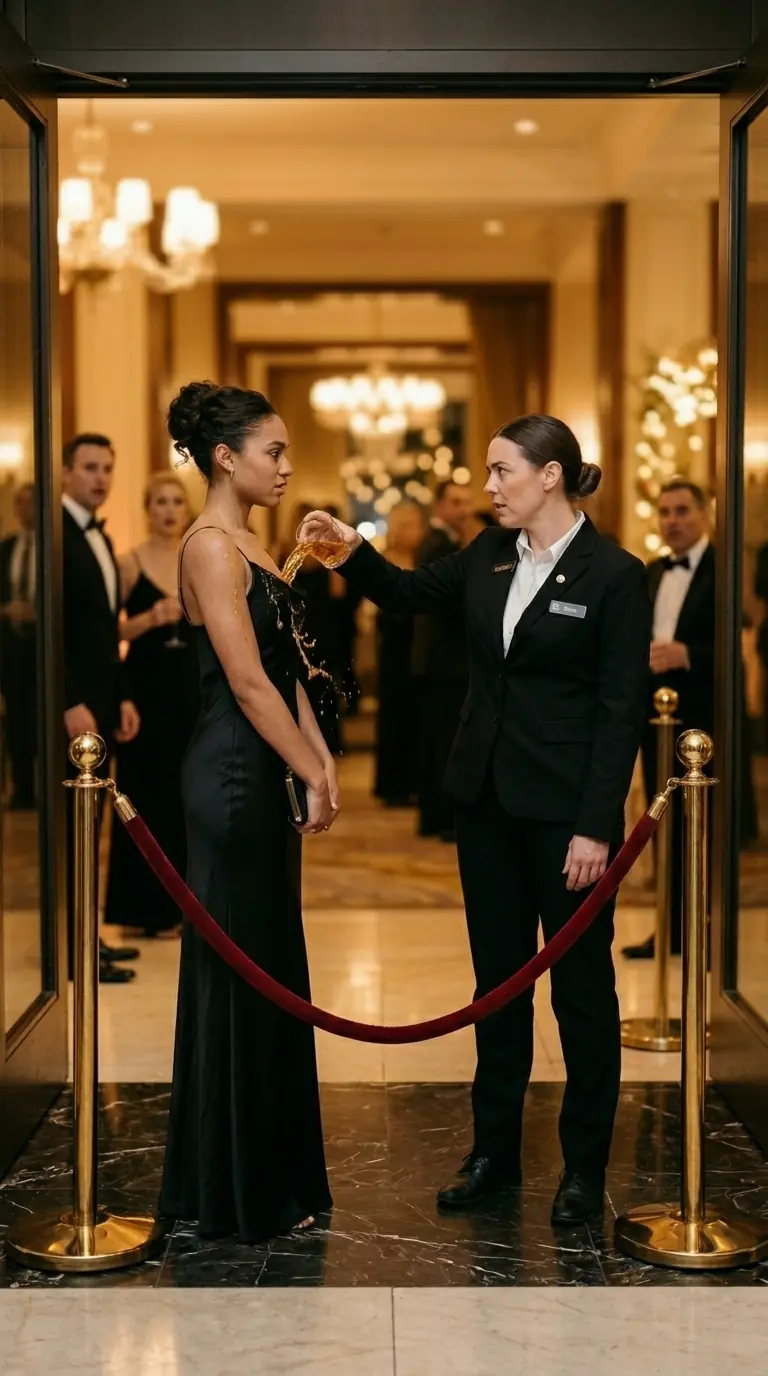
And threw it.
The splash was violent in a way liquid can be.
Gasps burst across the room.
A few shrieks.
Then phones.
Always the phones.
Wine darkened Nova’s black dress into deeper black. It ran through her curls, streaked her shoulder, dotted the folder in her hand, and slid to the polished floor in slow red threads. The smell of tannin rose sharp and immediate. Someone laughed too loudly. Someone else said, “Oh my God,” with the unmistakable thrill of a person who had just been given a story to retell before dessert.
Camila looked delighted with herself.
“That bottle costs more than her car.”
Laughter again.
Wider now.
Ugly as fireworks.
Nova stood completely still.
That was what many of them would remember later—not the splash, not the cruelty, but the fact that she did not break shape.
No tears.
No shouting.
No frantic wiping at her face.
Nothing.
She set her purse down carefully on the edge of table one.
Placed the leather folder beside it.
Then lifted one hand and pushed a wet curl back from her cheek with a slowness that returned the room, all at once, to the reality of what it had done.
When she spoke, her voice was low enough that people had to quiet themselves to hear it.
“Before anyone touches me,” she said, “verify who funds this event.”
Camila rolled her eyes so hard it was almost theatrical.
“Girl, please.”
But there was a shift now.
Small.
Important.
Because Nova had not begged.
Had not defended herself.
Had not asked for apology.
She had issued instruction.
The event coordinator, a thin woman with a tablet and a permanent look of professional panic, glanced uncertainly toward the director near the stage. He frowned, confused, then signaled for the donor ledger. A younger assistant hurried off and returned carrying a black binder so thick it looked ceremonial. The coordinator flipped through pages, scanning names, contributions, trust titles, silent fund entities, and governance notes.
At first her face showed only annoyance at the interruption.
Then confusion.
Then stillness.
Her eyes stopped on one line and did not move.
Color left her face so quickly that even the guard noticed.
“What is it?” the director hissed under his breath.
She leaned toward him and whispered something.
He recoiled as though the words themselves had struck him.
The microphone in his hand tilted. He caught it awkwardly. For a moment he looked less like an elegant host than a man realizing his evening had wandered into history without his consent.
Camila, sensing but not yet understanding danger, laughed again.
“Well? Tell her to clean up and go.”
The director did not answer.
Instead he stepped toward the center of the room, lifted the microphone with trembling fingers, and spoke into the silence that now felt thick enough to climb.
“Ladies and gentlemen,” he said, voice breaking on the first two words, “we have made… a major oversight.”
Every eye turned.
Nova remained where she was, wine soaking into her dress, one hand resting lightly on the folder as if she had all the time in the world.
The director swallowed.
“Ms. Nova Carter,” he said, “is the primary financier of the Dominion Heritage Fund.”
Silence did not fall.
It slammed.
You could feel it physically, the way a room empties of one kind of energy and is forced to stand bare in another. The phones lowered first. Then the smiles vanished. Then came the quick, involuntary recalculations across every face—the donors, the board wives, the self-appointed historians, the men who sat on committees and loved phrases like stewardship while never stewarding anything that did not already resemble themselves.
Camila stared at Nova as if she had suddenly changed species.
The guard took a full step back.
The coordinator stood with the ledger pressed to her chest like a shield.
Nova lifted her chin slightly.
There are moments a person spends a lifetime preparing for without knowing it. Not because they crave confrontation, but because they understand that if the moment ever comes, posture matters more than vindication. What you say after being humiliated tells the truth not only about the room but about your own lineage.
Nova thought, briefly, of her father.
He had died three years earlier, just before seeing the Fund become financially secure. In his last months, even with treatment hollowing him out, he remained precise in his convictions. When she told him once that she was tired—tired of rooms full of polished people who loved Black history but distrusted Black authority—he gave her the sort of smile old Black men sometimes reserve for truths they have known too long to dramatize.
“Then don’t go in there to be liked,” he said from his hospital chair. “Go in there to be clear.”
Clear.
That was the word she carried now.
She stepped forward, wine-dark and composed, and the room made space without realizing it was doing so.
“You poured wine on the woman keeping your scholarships alive,” she said.
Her voice was not raised, but it carried cleanly.
“You mocked the person preserving the history you pretend to care about.”
No one interrupted.
Because no one could.
Nova opened the folder and withdrew several documents clipped with colored tabs. Not theatrical. Not rushed. Prepared.
“For the last eighteen months,” she said, “my office has been reviewing the Fund’s internal financial activity, donor restrictions, scholarship disbursement patterns, and board-level expenditures.”
Several people at the front tables went pale before she even continued.
“We found diversion of educational funds into private entertainment accounts. Inflated restoration invoices attached to shell contractors. Selective exclusion of Black community archives from preservation priorities while publicly advertising equity initiatives. We found discrimination dressed up as governance, and theft disguised as tradition.”
A woman at table three whispered, “Oh my God,” but this time it held no delight.
Nova turned a page.
“Effective tonight,” she said, “every board member linked to fraud, discriminatory allocation, or breach of fiduciary duty is suspended pending legal review.”
The words moved like a blade.
Not fast.
Not loud.
Precise.
A man near the stage stood up halfway, then sat back down when he realized standing changed nothing. Another board member reached for water and missed the glass entirely. One elderly donor simply removed his spectacles and stared at the tablecloth, as if perhaps he had always suspected some version of this and was ashamed at how little that suspicion had cost him.
Nova took one more step.
Her dress clung darkly at the waist now, but her voice remained immaculate.
“And Camila Rhodess,” she said, turning at last toward the woman still frozen in burgundy and diamonds, “consider yourself permanently banned from any event, property, committee, or board associated with the Dominion Heritage Fund.”
Camila found her voice only because disbelief forced it back into her throat.
“You can’t do that.”
It came out shriller than she intended.
The room heard fear now beneath the polish.
Camila looked wildly around for reinforcement—from the director, the donors, the guard, anyone still foolish enough to mistake her social volume for power.
No one moved.
That was the thing about rooms like this. Their courage rarely survived a clear hierarchy.
Nova’s answer was simple.
“You did it to yourself.”
Security approached, but differently this time. No smirk. No swagger. Just the tense professionalism of people suddenly desperate to align themselves with the correct side of history before the night finished hardening around them.
Camila recoiled. “Do not touch me.”
No one in the room came to her defense.
Her friends in silver gowns looked away.
The guard who had blocked Nova stared straight ahead.
The director kept his mouth shut and his microphone lowered, understanding at last that some evenings are not saved, only survived.
As security escorted Camila toward the doors, she continued speaking in fragments—outrage, disbelief, a few threats, a promise to ruin everyone involved. But the effect was gone. She sounded now not powerful but unmasked. Behind every big public personality there is often a smaller private person terrified of irrelevance. Once the room sees that, the spell breaks quickly.
The doors closed behind her.
No one laughed.
No one even breathed loudly.
Nova stood before them, wine still drying on her dress, and looked at the tables one by one. She did not rush. She wanted them to feel seen—not in the flattering way donors enjoy, but in the harder, moral sense. She wanted the room to understand that silence had implicated them too. Not equally. But undeniably.
“When people like you speak about heritage,” she said, “you often mean architecture, portraits, silver, gardens, family names, and buildings with columns. But heritage is not wallpaper. It is memory. And memory without truth is propaganda.”
An older woman in emerald satin lowered her eyes.
Nova continued.
“You cannot claim to honor history while humiliating the people doing the work to save it. You cannot sponsor scholarships for Black children and then laugh when a Black woman enters the room in a dress that doesn’t reassure you.”
That landed deep because it was exact.
There is always one sentence in a confrontation that tells the whole story. That was it.
Nova closed the folder.
“I did not come here for your approval,” she said. “I came here because too many institutions survive on the labor, expertise, and restraint of people they still do not know how to respect.”
The director, finding a trace of his voice, managed: “Ms. Carter, on behalf of—”
“No.”
She did not say it harshly.
She said it with the firmness of a woman refusing the cheap anesthesia of formal apology.
“This is not fixed by a statement.”
He fell silent.
Outside, somewhere beyond the heavy curtains and cut-glass windows, Richmond continued as Richmond always had—streets layered with history and erasure, grace and brutality, monuments raised and removed, neighborhoods rebuilt for some and stripped from others. The city knew something about performance. It knew something about selective memory. It knew, perhaps better than most places, how elegantly power could dress itself while insisting it had become harmless.
Nova had spent years trying to build something better inside that contradiction.
As a girl, she used to sit on the front steps of her parents’ row house while her father told her stories about Virginia that textbooks barely acknowledged. He told her about Black schools built from church basements and rationed chalk. About freedmen who bought land with money earned washing white families’ clothes. About women who kept records in Bibles because courthouses would not. About teachers, masons, cooks, farmers, porters, musicians, and mothers who made civilization while history wrote down someone else’s name. He believed archives mattered, but he believed living memory mattered more. “If they control the telling,” he would say, “they control who gets to sound human.”
Nova never forgot that.
That was why the scholarships mattered so much to her. Why preservation mattered. Why she chose to funnel her wealth into records and schools and burial grounds and trust structures instead of yachts or foundations named after herself. Because she had seen what happened when Black history was curated only by people who liked its tragedy but distrusted its authority. It became decorative. Safe. Consumable. Stripped of the living hands that carried it.
Tonight had proven how little some of them had learned.
She glanced at the front table where her untouched place card still stood beside a folded napkin and crystal stemware. Table one. The table the guard had laughed at. The table from which she had intended to announce reforms elegantly after dessert and speeches. There was something almost funny about it now—not because the night was humorous, but because power, when truly held, rarely looked the way rooms like this expected.
It did not always sparkle.
Sometimes it arrived in a simple black dress and stood still long enough for everyone else to expose themselves.
Nova picked up her purse.
Then the folder.
The room watched every motion.
One donor, a younger Black surgeon who had been invited for credibility more than inclusion, slowly rose to his feet. He was followed by an elderly woman from the historical society, then another guest, then another. Applause did not begin all at once. It started uncertainly, almost awkwardly, the way moral courage often does in public after cowardice has already had its turn. But it spread. Not universal. Not clean. Some remained seated, too ashamed or too proud. Yet enough stood that the sound filled the hall.
Nova did not smile for them.
She inclined her head once in acknowledgment, no more.
Because this was not triumph in the shallow sense. She took no pleasure in humiliation, even deserved humiliation. What she felt instead was something more sober. Relief, perhaps. Clarity. The end of one arrangement and the difficult beginning of another.
There would be calls tomorrow.
Lawyers.
Press.
Accusations.
Attempts to reframe.
Attempts to smooth.
Attempts to reduce the evening to misunderstanding instead of what it had plainly been.
Let them try.
She had documents.
She had authority.
Most of all, she had patience.
And patience, in the hands of someone principled, is often more dangerous than fury.
As she turned toward the exit, the same guard who had blocked her stepped aside before she reached him. He looked as if he wanted to speak. To apologize, maybe. To explain that he was just doing what rooms like this trained certain men to do—mistake access control for wisdom. But Nova kept walking. Not because forgiveness was impossible, but because tonight was not for easing the conscience of people who had not bothered to see her.
At the entrance, the cool night air met her like truth.
She stepped out onto the stone terrace overlooking the city. Her dress was still damp in places. Her hair smelled faintly of red wine and expensive contempt. Somewhere behind her, inside the hall, voices had already risen in frantic clusters. Damage control had begun.
She looked up.
The Virginia sky was clear.
A hard, deep black with only a few visible stars beyond the city haze.
For one quiet moment, she let herself feel it all.
The insult.
The splash.
Her father’s voice.
Her mother’s hands braiding her hair before debate tournaments.
The first grant she ever negotiated.
The first archive she saved from mold and neglect.
The countless meetings where she had been asked to make herself more palatable.
The millions moved quietly so young people could study in buildings whose names would never honor her.
The generations before her who entered rooms with less protection and greater risk.
The women who had not had the option of composure because the consequences were too immediate.
The men whose labor built halls like this without ever being welcomed into them.
She felt all of them.
And then the doors behind her opened again.
The director stepped out, coat unbuttoned, face lined with panic and sincerity fighting for control.
“Ms. Carter,” he said, breathless, “please. We can discuss—”
Nova turned.
He stopped.
Because he saw, perhaps for the first time that evening, not a donor, not a financier, not an inconvenience, but a woman who had long ago stopped needing rooms like his to certify her value.
“Tomorrow,” she said. “In writing.”
He nodded quickly.
“Yes. Of course.”
She held his gaze for one beat longer.
“Make sure the scholarship students hear the truth before the board does.”
That struck him too. Because once again, she had gone straight to the people who actually mattered rather than the people most accustomed to hearing first.
He nodded again.
“Yes, ma’am.”
Nova turned and walked down the stone steps into the night.
This time no one laughed.
No one whispered.
And inside that grand Richmond hall, beneath portraits and chandeliers and all the inherited confidence money could buy, a room full of people had been forced to learn something they should have known before she ever entered.
Dignity does not come from diamonds.
It does not need silk to make itself legible.
It does not announce itself with noise, because it does not fear being missed.
All it needs is courage.
Courage to walk in.
Courage to remain still.
Courage to let cruelty reveal itself fully before answering it with truth.
And that night, in a hall that had mistaken elegance for worth and whiteness for ownership, Nova Carter did not just endure humiliation.
She redefined the room.
Because real power is not the ability to embarrass someone in public.
It is the ability to stand there, soaked in someone else’s ugliness, and still speak clearly enough to change the future.