Winter arrived in Briar Creek without warning.
One day, the prairie still showed patches of brown grass beneath the frost.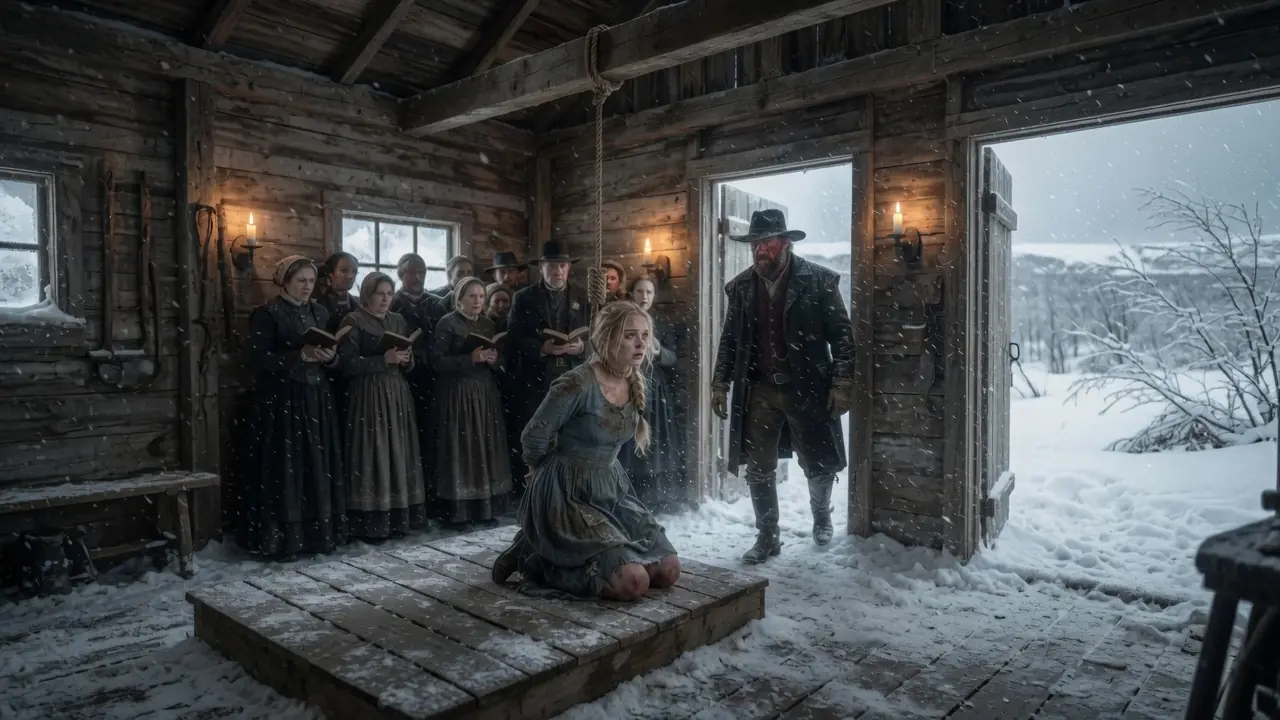
The next morning, the whole valley lay under hard white silence, and every fence post looked like it had been nailed into a grave.
The cold came down from the northern hills with a cruel patience. It slid under doors, froze water in buckets, stiffened blankets, and made men speak less because words wasted warmth. In a town like Briar Creek, where kindness had always been thinner than hunger, winter did not soften people.
It sharpened them.
They tied her to the whipping post just after sunrise.
No sermon.
No court worth naming.
No one asked whether a girl could truly be a criminal for taking bread when her stomach had been empty for two days.
Her name was Clara Vane.
She was twenty-one, though hunger and cold had made her look younger in the face and older in the eyes. Her boots had split at the soles. Her coat hung loose and gray around her thin shoulders. Someone had taken her wool scarf before they dragged her into the square, because punishment in Briar Creek always seemed to attract thieves dressed as decent citizens.
The post stood beside the trading office, a thick upright beam scarred by old notices, tax warnings, missing-horse sketches, and years of weather.
They looped rope over the crossbar and hauled Clara’s wrists high above her head until her toes barely touched the snow.
Her shoulders screamed.
Her breath caught.
The broken loaf lay near the sheriff’s boots.
That was the evidence.
A loaf of rye bread from Harlan’s Store, split open when Clara dropped it in the struggle. Steam no longer rose from it. The warmth was gone. The smell remained, and that somehow made the cruelty worse.
Sheriff Tobias Rusk read the charge like he was reciting a grocery list.
“Theft. Second offense. Public disorder. Failure to pay restitution.”
He did not say starving.
He did not say orphaned.
He did not say she had spent the last month sleeping behind the livery stable after her mother died of fever.
He did not say that Harlan had owed her mother wages for laundry and refused to pay because dead women were poor at arguing.
The rope creaked when the wind pushed her.
Clara did not scream.
That was what people remembered later.
Not the snow.
Not the bread.
Not even the rope.
The silence.
She swallowed every sound before it could leave her mouth, biting down so hard that blood touched her tongue. Her wrists burned where the rope dug into skin. Her shoulders felt as if they were being pulled from their sockets one inch at a time.
Snow fell slowly into her dark hair.
It melted against her cheeks.
It slid down her neck.
Somebody near the store muttered, “Should have learned the first time.”
Another voice answered, “Rules keep a town alive.”
No one moved.
Not the women with baskets.
Not the men gathered near the blacksmith shop.
Not even the boys who had watched her get dragged through the square with wide eyes and open mouths.
Briar Creek had decided to make an example of her.
Examples, Clara thought through the pain, were just people no one planned to save.
Then a rider came in from the west road.
He came slow enough that it did not look like a rescue.
Fast enough that every head turned.
His horse was a tall bay with a winter coat thick as brush, the kind of animal bred for hard miles and worse weather. The man on its back sat heavy in the saddle, shoulders hunched under a dark coat patched at one sleeve. His hat was pulled low, and snow clung to the brim.
Nathaniel Boone had not planned to stop in Briar Creek that morning.
He had planned to buy salt, coffee, lamp oil, and horseshoe nails, then ride back to Red Lantern Ranch before the storm worsened. Plans had become small things after his wife died. He did not trust them much anymore.
Two winters earlier, fever took Lydia Boone in less than a week.
One day she was standing by the stove, laughing because the biscuits burned on one side.
By Sunday, he was digging a grave in frozen ground with his hands split open and the pastor too frightened of sickness to come closer than the fence.
Since then, Nathaniel had lived mostly among cattle, fence posts, and ghosts.
He came to town only when supplies forced him.
That morning, he saw the crowd before he saw the girl.
Then he saw the rope.
His horse slowed without being told.
Nathaniel knew the shape of public cruelty.
A circle of people standing far enough back to feel innocent.
A sheriff pretending punishment was duty.
A victim made smaller so everyone else could feel taller.
He dismounted in the square.
Did not tie the reins.
Did not speak at first.
The sheriff noticed him and frowned.
“This is town business, Boone.”
Nathaniel looked at Clara.
Her head hung forward. Her lips were blue at the edges. Her hands were swollen around the rope, fingers curled uselessly from the cold.
“How long?” he asked.
Sheriff Rusk tilted his chin.
“Until she learns.”
Nathaniel nodded once.
Like he had expected the answer and found it as rotten as the man giving it.
“She won’t learn hanging there.”
“She stole.”
Nathaniel turned toward the voice.
It belonged to Mr. Harlan, the storekeeper, a broad man with clean gloves and a belly that had never known fasting.
Nathaniel looked at the broken loaf in the snow.
“So did I once.”
That quieted the square.
Sheriff Rusk narrowed his eyes.
Nathaniel kept his gaze on Harlan.
“Stole two potatoes from a freight wagon when I was fifteen. Ate one raw before I reached the creek. Saved the other for my sister.”
Nobody laughed.
The wind moved through the square, rattling the sign over the barber’s door.
Harlan’s face reddened.
“That’s not the same.”
“No,” Nathaniel said. “I was lucky enough not to get caught.”
A murmur passed through the crowd.
Clara lifted her head slightly.
For one brief moment, her eyes met Nathaniel’s.
They were gray.
Not soft.
Not pleading.
Alive, but only just.
Something moved in Nathaniel’s chest.
Not pity.
Pity was too weak for this.
Recognition.
He stepped toward the post.
Sheriff Rusk moved with him.
“You cut that rope, you’ll answer for it.”
Nathaniel stopped.
Looked at the sheriff.
“Everything is answered for sooner or later.”
Then he pulled his knife.
No flourish.
No grand speech.
Just a blade worn smooth from years of practical use, catching dull winter light.
The sheriff’s hand dropped toward his pistol.
“Last warning.”
Nathaniel moved closer to Clara.
Close enough to see the blood at her wrists.
Close enough to smell cold skin, fear, and bread dying in the snow.
He cut the rope in one clean motion.
The sound was soft.
Final.
Clara dropped.
Nathaniel caught her before she hit the ground.
Her weight startled him.
Not because she was heavy.
Because she was not.
She folded against him like a bundle of sticks beneath cloth, every tremor running straight into his arms. Her breath came fast, panicked, then slowed when his coat closed around her.
For a moment, the town forgot how to make noise.
Then everyone found their voices at once.
The sheriff shouted.
Harlan cursed.
Someone cried out that the law had been insulted.
Nathaniel did not argue.
He wrapped his coat tighter around Clara, lifted her fully, and carried her to his horse.
No one stepped in front of him.
That was the truth of crowds.
They were powerful until one person moved with purpose.
Then they remembered they were made of individuals.
Nathaniel mounted with Clara held against him and turned the bay toward the west road.
The sheriff called after him, “This isn’t over, Boone!”
Nathaniel did not look back.
“It never is,” he said.
Snow swallowed the horse’s tracks almost as soon as they left the square.
Behind them, Briar Creek stood smaller than before.
As if something had been taken from it besides a girl.
As if mercy, once witnessed, had made cruelty look foolish.
The ride to Red Lantern Ranch was slow.
The ranch lay six miles west, tucked into a bend of low hills where cottonwoods grew along a narrow creek. The land was not pretty in winter, but it had a hard honesty to it. Fence lines vanished under snow. The barn leaned a little east. Smoke rose from the cabin chimney because Nathaniel never left without banking the fire.
Habits kept men alive when hope did not.
Clara did not speak during the ride.
She drifted between waking and something near fainting, her head against Nathaniel’s chest, her hands useless beneath his coat. Once, when the horse stumbled slightly over buried rock, she made a small sound and grabbed the front of his shirt with both bound hands.
“It’s all right,” Nathaniel said.
His voice sounded strange to him.
He had not used that kind of softness in a long time.
Inside the cabin, warmth met them slowly.
The place smelled of woodsmoke, iron, coffee grounds, and old sorrow. One room. A sleeping loft above. A scarred table. Two chairs, though only one had been used for years. A quilt folded over the bed near the stove.
Nathaniel laid Clara down carefully.
When he pulled back his coat, she flinched so hard it made him stop.
“I won’t hurt you,” he said.
She stared at him.
Not believing.
Not disbelieving.
Measuring.
He held up both hands.
“I need to see your wrists.”
After a long moment, she nodded.
The rope burns were bad.
Skin broken, swelling already, raw in deep purple lines. Her fingers were stiff and pale from cold. Nathaniel warmed water, tore strips from a clean shirt, and worked in silence.
Clara watched every movement.
Not like a woman admiring kindness.
Like a woman memorizing his habits in case she needed to survive him too.
“What’s your name?” he asked.
She swallowed.
“Clara.”
“Nathaniel.”
She did not repeat it.
When he finished wrapping her wrists, he poured coffee into a tin cup and added the last spoonful of molasses.
“Drink.”
“I can’t pay you.”
“I didn’t ask.”
“I won’t stay.”
“I didn’t ask that either.”
She looked at him sharply.
He stepped back, giving her space.
“Drink while it’s hot.”
Her hands shook too badly to hold the cup, so he set it on a crate beside the bed and turned away while she struggled with it.
That was mercy too.
Not watching someone fail at a small thing.
She slept before sunset.
Nathaniel sat at the table long after dark, the rifle across his knees, listening to her breathe and to the wind pressing hard against the cabin walls.
He thought of Lydia.
Not the way he usually thought of her, as absence.
But as a voice.
She would have cut the rope before he did.
She would have scolded him for waiting even that long.
Near midnight, horses came.
Nathaniel saw the torches first, bobbing along the lower pasture like angry stars. Six riders. Maybe seven. Too many for neighbors. Too few for soldiers.
He stood, took the rifle, and crossed to the door.
Clara woke when the first shout came from outside.
Her eyes opened wide.
“They came?”
“Stay inside.”
“They’ll kill you.”
“They’ll have to be warm enough to aim first.”
She tried to sit up and winced hard.
Nathaniel helped her to the corner behind the wood box and gave her a blanket.
“No matter what you hear, you keep still.”
“You already did enough.”
He looked at her then.
At the raw bandages around her wrists.
At the fear she was trying to turn into anger because anger felt less helpless.
“No,” he said quietly. “I didn’t.”
Outside, Sheriff Rusk sat on horseback near the porch, flanked by Harlan and several men who liked law best when it was used on someone weaker.
“Bring the girl out,” the sheriff called. “You made your point.”
Nathaniel stepped onto the porch with the rifle low in his hands.
“She isn’t yours.”
“She belongs to county justice.”
“County justice left her hanging in the snow.”
“She stole bread.”
Nathaniel looked at Harlan.
“Then put the bread on trial.”
One of the men snorted before he could stop himself.
The sheriff’s face tightened.
“You’re harboring a criminal.”
“I’m tending a wounded woman.”
“She’s trouble.”
“So is winter,” Nathaniel said. “Don’t see you arresting the sky.”
A murmur moved through the riders.
Not agreement.
Doubt.
Doubt was enough to make men less brave.
Sheriff Rusk lowered his voice.
“You lost your wife, Boone. You know what happens when people start taking what isn’t theirs. Towns fall apart.”
Nathaniel stepped down from the porch.
Snow crunched beneath his boots.
“I know what loss does to a man,” he said. “And I know what happens when he mistakes hardness for strength.”
The sheriff’s eyes narrowed.
Harlan spat into the snow.
“She’ll steal again.”
Nathaniel looked toward the cabin window.
Maybe Clara was listening.
Maybe she could hear him.
“She was hungry.”
“So is everyone.”
“No,” Nathaniel said. “Some people are hungry. Some people are afraid hunger might come for them next. Those ain’t the same.”
Silence stretched.
The wind pushed between them.
At last, one rider turned his horse.
“I’m freezing for a loaf of bread,” he muttered. “I got cattle to check.”
Another followed.
Then a third.
The sheriff sat a moment longer, pride fighting common sense.
Common sense won, but badly.
“This will come back on you.”
Nathaniel nodded.
“Most things do.”
The riders left, torches shrinking into the storm.
Nathaniel stayed outside until the darkness swallowed them.
When he came back in, Clara stood near the stove, pale but upright, one hand braced on the table.
“You shouldn’t have done that.”
“I know.”
“Why did you?”
He hung the rifle by the door.
For a moment, he said nothing.
Then he looked at the second chair at the table, unused for two winters.
“Because no one cut the rope for my wife when fever took her.”
Clara’s face changed.
“That’s not the same.”
“No,” he said. “But grief makes a man tired of standing by.”
Winter settled hard after that.
Briar Creek did not come again for a while, but its threat lingered at the edges of the ranch. Nathaniel saw smoke from riders once along the ridge. Found boot tracks near the lower fence. Heard shots far off one morning, too far to matter and close enough to warn.
Clara healed slowly.
Her wrists remained stiff. Cold made the wounds ache. She never complained. She learned the cabin’s work like someone learning a song by ear: how to feed the fire without smoking the room, how to break ice in the water barrel, how to grind coffee beans, how to check the hens, how to warm the bedding stones before nightfall.
Nathaniel did not ask her history.
She gave pieces when she chose.
Her mother had baked bread for Harlan’s Store. Not as charity. For wages.
When fever came, her mother kept baking because debt does not pause for illness. After she died, Harlan refused to pay what he owed.
“Said there was no proof,” Clara told Nathaniel one night, sitting near the stove with her bandaged wrists in her lap. “Said a woman on her deathbed remembers things wrong.”
Nathaniel looked at the fire.
“And the bread?”
“My mother baked that loaf the morning before she died. He put it on his shelf and sold it like his wife made it.”
Her voice stayed calm.
That made the story worse.
“I took it back.”
Nathaniel nodded.
“You regret it?”
She looked at him.
“Only that I dropped it.”
Something like a smile touched his mouth.
Brief.
Gone almost before it lived.
A storm came three nights later.
Not loud at first.
Worse than loud.
The kind that erased the world inch by inch until fence, road, and sky became the same white blindness. Near dawn, a crack split the air outside, followed by the scream of a horse.
Nathaniel was out of bed before thought.
The barn door had torn partly loose, slamming in the wind. Snow poured inside. The mare in the far stall panicked, eyes rolling, hooves striking the boards.
Clara followed with a lantern.
“You stay inside!” he shouted over the storm.
She ignored him.
The wind nearly took the lantern from her hands, but she held it steady while Nathaniel fought the broken door back into place. He braced his shoulder against wood, cursed, drove nails with half-frozen fingers, and felt Clara at his side before he could tell her not to be.
She wedged a loose board where he needed it.
He hammered.
She held.
The wind screamed.
They won.
When it was over, they stood in the barn, breathing hard, snow in their hair and lashes, the mare calming slowly behind them.
“You didn’t have to come out,” Nathaniel said.
Clara’s mouth curved faintly.
“Neither did you.”
A laugh escaped him.
Short.
Surprised.
It sounded strange in the barn, like an old room remembering music.
After that, the silence between them changed.
It was no longer empty.
It was full of things waiting patiently.
A week later, the notice appeared.
Nailed to the fence post at the edge of Red Lantern land.
WANTED: CLARA VANE. THEFT. EVASION OF JUSTICE.
Beneath that, in Sheriff Rusk’s hand:
HARBORING WILL BE TREATED AS COMPLICITY.
Clara read it without speaking.
Nathaniel watched her face.
“I should go,” she said finally.
“No.”
“They’ll come again.”
“Let them.”
“You can’t fight a whole town.”
“I don’t intend to.”
She looked at him.
“You have a plan?”
“Not yet.”
“That inspires confidence.”
He almost smiled.
That night, he found her packing.
Not much.
Bread wrapped in cloth.
A small knife.
The scarf he had pulled from Lydia’s old trunk and given her two mornings before. Clara wore it now, though he had never told her whose it had been.
Nathaniel stood in the doorway.
“You leave, they’ll catch you before morning.”
“Maybe.”
“And if they don’t?”
“Then I keep going.”
“Where?”
She tied the pack too tightly.
“Somewhere that doesn’t know my name.”
He crossed the room and took the pack from her hands.
She stiffened.
He set it on the table.
“Then we go together.”
Clara stared.
“No.”
“Yes.”
“You don’t owe me your life.”
“I’m not paying a debt.”
“What are you doing?”
He looked at her for a long moment.
Then answered honestly.
“Choosing.”
The word landed softly between them.
She lowered her eyes first.
Not in surrender.
Because something in her had been touched where no one had been gentle for a long time.
They left before dawn.
The ranch stood quiet behind them, smoke thinning from the chimney, fences half-buried, Lydia’s chair still by the table. Nathaniel locked the door, though he did not know if he would return.
They rode south first, then cut through the low ravine west of Briar Creek. Nathaniel knew the land better than the sheriff ever had. Clara knew it too, in a different way. She knew where blackberry canes snagged. Where old creek beds hid under snow. Where a person could disappear if they moved like hunger had trained them.
By midday, they heard riders behind them.
Clara did not panic.
That impressed him.
She pulled the scarf tighter, checked the knife at her belt, and looked toward the ravine ahead.
“There’s a cut through the rock if we reach the bend.”
Nathaniel glanced at her.
“You know this trail?”
“I grew up here before it stopped being home.”
They rode hard.
Shots came once they crossed the ridge.
Not close enough to hit.
Close enough to mean fear.
One bullet struck stone near Nathaniel’s horse, sending sparks through the white air. Clara leaned low, her hair whipping loose beneath her hat.
They reached the ravine as the storm returned.
Snow thickened fast.
Wind swallowed sound.
Nathaniel dismounted and led the horses through a narrow cut between rock walls. Clara followed close, one hand on his saddle strap. Behind them, riders overshot the entrance and vanished into the white.
The ravine bent sharply, then widened near a frozen creek.
They stopped only when the sounds of pursuit faded.
Clara leaned against a rock wall, chest heaving.
Then she laughed.
A real laugh.
Bright.
Disbelieving.
“I’ve never been chased for stealing my own bread before.”
Nathaniel smiled fully for the first time since she had known him.
“Winter gives a person new experiences.”
The storm softened around them, snow falling gently now, as if the land itself had decided they had earned the silence.
Clara looked at him.
“You know running doesn’t end this.”
“I know.”
“And you’re still here?”
“I am.”
She reached out slowly and took his hand.
Not because she was afraid.
Because she chose to.
They followed the frozen creek south for two days.
It was a narrow, stubborn stream half-covered in ice, slipping between cottonwoods and broken stone as if it had learned long ago how to survive without permission.
Nathaniel had trapped along it years before.
Back when Lydia was alive.
Back when life still looked forward instead of inward.
They found an old trapper’s cabin near a bend in the creek, nearly hidden under snow and pine boughs. The roof sagged but held. The chimney smoked poorly but worked after Nathaniel cleared it. There was one cracked window, one table, one bunk, and carvings in the doorframe from people long gone.
Clara ran her fingers over the names.
“People lived here.”
“People live everywhere,” Nathaniel said. “Then they leave marks and call it proof.”
The storm trapped them there.
For three days, the world outside disappeared.
They patched the walls with canvas. Melted snow. Counted food. Fed the fire like it was a living thing.
And in that forced closeness, something changed.
Not suddenly.
Not like a novel printed in cheap paper.
Slowly.
Carefully.
The way ice thins before breaking.
On the third night, Clara told him about her brother.
“He tried to stop them when they took me after my mother died,” she said, sitting beside the low fire. “He was sixteen. Thought being tall made him strong.”
Nathaniel set down the strip of leather he had been mending.
“What happened?”
“Harlan’s men beat him bad. He left town after. Maybe died. Maybe didn’t.”
Her voice did not break.
That made him want to reach for her more than tears would have.
“I’m sorry.”
She looked at him.
“So am I.”
The fire popped.
Then Clara said, “I don’t want to be saved like a thing someone carries off a post.”
Nathaniel listened.
“I want to be chosen.”
He felt the words settle deep.
He thought of the rope.
The square.
The way she had dropped into his arms without knowing if he would hold her.
Then he thought of the way she had held the lantern in the storm.
How she had stayed when the barn door tried to tear loose.
How she had chosen him too, in a dozen small ways, without asking to be thanked.
“I am choosing,” he said.
Clara looked at him for a long time.
Then she moved closer.
Their kiss was not desperate.
It was not clean or pretty.
It tasted of smoke, cold, and things neither of them knew how to say.
Nathaniel touched her like a man afraid of breaking something already cracked. Clara touched him like someone learning that wanting did not always come with danger attached.
Outside, winter howled.
Inside, the fire held.
They did not pretend the future had become simple.
It had not.
But for the first time in years, Nathaniel slept without dreaming of a grave.
When the storm broke, they packed.
The cabin had been shelter, not destination.
They were crossing a narrow bend in the creek when the riders found them.
Four men this time.
No sheriff.
That worried Nathaniel more than if Rusk had come himself.
Men without law beside them often became honest about what they wanted.
The first shot cracked across the creek.
Nathaniel returned fire from behind a fallen cottonwood.
Clara crouched beside him, passing cartridges with steady hands. Her fear was there. He could see it. But she did not let it steer.
A bullet tore through Nathaniel’s shoulder and spun him backward into the snow.
Clara shouted his name.
He gritted his teeth and tried to sit up.
“I’m fine.”
“You’re bleeding through your lie.”
The riders pushed closer.
Then the ice gave way under one horse.
The animal screamed. Another reared. The line broke into panic.
“Now,” Nathaniel gasped.
Clara hauled him up with strength that came from somewhere beyond her small body. They ran into the trees, half-falling, half-dragging each other until the creek, the riders, and the broken ice disappeared behind snow-heavy pines.
Nathaniel collapsed near a stand of cedar.
Clara pressed both hands against his wound.
Her face was pale, but her eyes burned.
“You are not dying after making me run this far.”
He managed a weak smile.
“That an order?”
“Yes.”
She built a shelter with shaking hands and no hesitation. She stopped the bleeding. Fed him melted snow. Kept him awake through the night by telling him every insult she had ever wanted to say to Sheriff Rusk, Harlan, and half of Briar Creek.
Somewhere near dawn, Nathaniel laughed so hard the wound hurt.
“That’s enough,” he rasped.
“No,” she said. “You looked sleepy.”
He survived.
Three days passed before he woke fully.
Clara sat beside him, wrapped in Lydia’s scarf, hair tangled, face smudged with smoke, eyes swollen from refusing rest.
“You stayed,” he whispered.
She gave a laugh that was almost a sob.
“You didn’t give me a choice.”
He reached for her hand.
She took it.
After that, they went south for good.
Past Briar Creek’s reach.
Past the last towns where Sheriff Rusk’s notices might matter.
Past the names that had been used against them.
They found land where winter softened earlier, a river bend with dark soil and cottonwoods bent by wind but still standing. There was an abandoned cabin, better built than the trapper’s place, and enough grass for horses once spring returned.
They built slowly.
Fence first.
Then a smokehouse.
Then a garden.
Then a life.
Clara planted seeds she had carried from her mother’s old flour tin: beans, squash, onions, and two rows of rye because she said bread should grow where no one could steal it back from the hungry.
Nathaniel’s shoulder ached when rain came.
Clara’s wrists ached when the wind turned cold.
They learned each other’s pains by season.
That summer, they married under open sky.
No preacher.
No town clerk.
No witnesses except two horses, a river, and the God who had seen them both at their worst and somehow kept watching.
Nathaniel took her hands carefully.
The rope scars had faded but not vanished.
“I choose you,” he said.
Clara’s eyes filled.
“I choose you too.”
Years later, travelers began speaking of a ranch near the southern river bend where bread was always warm and nobody was turned from the door hungry.
A place where men looking for work could sleep in the barn without being asked too many questions.
A place where widows received flour.
Where children were fed first.
Where a woman with rope scars on her wrists taught her daughters to bake and her sons to never confuse law with justice.
If anyone asked Nathaniel why he had cut the rope that winter morning, he gave different answers depending on his mood.
Sometimes he said, “The bread looked lonely.”
Sometimes he said, “Rope offends me.”
Sometimes he said nothing at all.
But once, when his oldest daughter asked him in front of the fire, he told the truth.
“Because winter already takes enough,” he said.
Clara sat across from him, kneading dough with strong hands.
The scars on her wrists caught the firelight.
She looked at him and smiled.
Not the smile of a woman rescued.
The smile of a woman who had survived, chosen, planted, and become more than the town that tried to make an example of her.
Outside, snow began to fall again.
Soft this time.
Harmless against the warm windows.
Inside, bread rose beneath a clean cloth, children laughed from the loft, and the door remained unlocked.
Winter could come.
It no longer owned them.