The mist had not yet lifted from the river when Eleanor Hale knelt at the water's edge, her sleeves rolled past her elbows, her knuckles raw from the cold. Dawn was the only hour that belonged to her. No one watched her at dawn. No one whispered about her mother, or measured her against her sister's beauty, or reminded her with a sigh dressed up as kindness that she ought to be grateful for a roof over her head.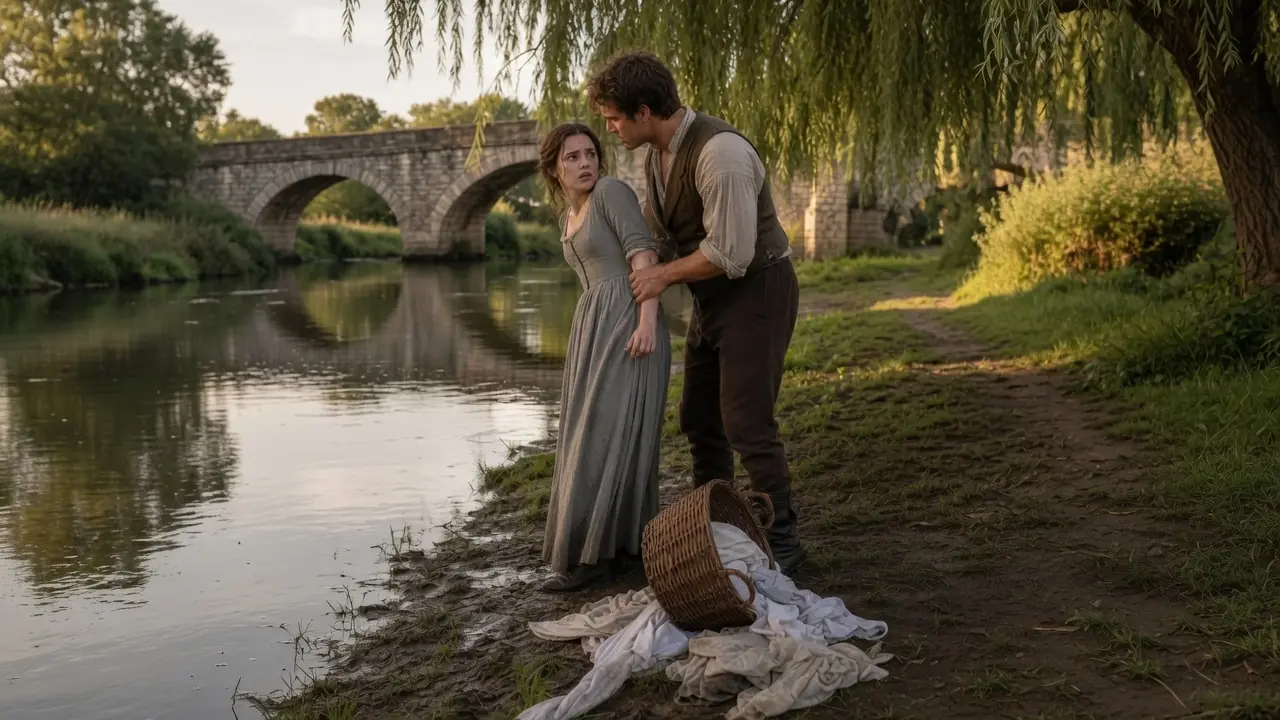
At dawn, there was only the river, the linen, and the silence she had learned to love because it never judged her. She did not know that she was being watched. On the old stone bridge above the water, half hidden by the willow that had grown wild and unpruned for a decade, a man on horseback had stopped without meaning to stop at all. He had ridden out before first light to escape a house full of relations who wanted things from him, and he had not expected to find anything worth looking at in this forgotten corner of the county.
But there she was. A young woman in a plain gray dress, her dark hair coming loose from its pins, working with a quiet, unhurried competence that told him she had done this every morning of her life, and had made a kind of peace with it. There was no self-pity in the line of her shoulders. There was only work and the steady rhythm of hands that had long since stopped waiting for anyone to notice them.
He should have ridden on. A gentleman did not linger over a servant at her labor. But something in the way she paused, lifting her face to the pale gold light breaking over the fields, closing her eyes for one unguarded moment as though she were drinking in a freedom no one had given her permission to want, held him there longer than was proper. He did not know her name.
He did not know that she was not a servant at all, but a gentleman's daughter reduced to a servant's life by an aunt who resented her, or that the dress she wore had once belonged to a cousin who had outgrown it years before Eleanor had. He knew only that he could not look away and that this in itself unsettled him, for Julian Ashbourne, ninth Duke of Rochmere, had trained himself for a decade not to want the things he could not have without consequence. He turned his horse before she could see him, but he did not forget her. Eleanor finished her washing as the sun climbed fully over the hedgerows, wrung the linen into the wicker basket balanced on her hip, and began the long walk back to Hartwell Grange, the house that had been her father's before it became, in every way that mattered, her aunt's.
She walked slowly, savoring the last minutes of quiet before the day's demands began. She did not think of the bridge or the shadow of a rider she had half sensed and dismissed as a trick of the mist. She had learned not to notice men who looked at her because in her experience they were either looking through her toward her sister or looking at her the way one looks at furniture, useful, unremarkable, easily overlooked. At 19, Eleanor had made her peace with being overlooked.
It was, she told herself, a kind of safety. She was wrong about that, though she would not learn how wrong for some time yet. The Grange was already stirring when she came through the kitchen door, her basket dripping a trail across the flagstones. Mrs. Dunmore, the housekeeper, glanced up from the bread she was kneading and gave Eleanor the small sympathetic nod that had become their private language over the years.
A nod that said, "I see you even when no one else does." It was the only kindness Eleanor received most days, and she treasured it more than she would ever admit.
"Your aunt's asking for you," Mrs. Dunmore said.
"Something about Georgiana's blue silk needing the hem let down before Thursday."
Eleanor did not sigh, though she wanted to. Thursday was the assembly at Millbrook, the first real gathering of the season for families of their modest standing, and Georgiana had talked of nothing else for a fortnight. Eleanor had not been invited to think of it at all. It had simply been assumed, in the way so many things about her life were assumed, that she would not attend, or that if she did, it would be to fetch and carry, and stand quietly against the wall while her cousin danced.
She climbed the back stairs, the front stairs were not for her, not since her aunt had decided three years ago that Eleanor's presence in the main rooms unsettled the household's dignity, and found her aunt, Mrs. Prudence Faircliff, seated at her writing desk with the particular expression she wore when she was about to be unkind and wanted credit for restraint instead.
"There you are," Aunt Prudence said, not looking up.
"I trust the washing is done."
"Yes, Aunt."
"Good. Georgiana's blue silk wants letting down at the hem, and mind you do it properly this time, not the crooked business you made of her white muslin. I won't have my daughter looking as though she dresses herself in the dark." Eleanor said nothing. There was nothing to say that would not be turned somehow into further evidence of her ingratitude.
She had learned that lesson at 16, the year her aunt had first begun to speak of her as a burden gently borne, a phrase that had lodged itself under Eleanor's ribs like a splinter that never fully worked its way out.
"You have your mother's hands, you know," her aunt added, almost idly, as she sealed a letter.
It was not the first time Aunt Prudence had mentioned Eleanor's mother in that particular tone, soft, almost wistful, and utterly without warmth. Eleanor had grown up on fragments of a story she was never allowed to hear whole, that her mother had been beautiful, that she had been foolish, that she had brought disgrace upon the family in some manner no one would name outright, and that she had died when Eleanor was six, leaving behind a daughter who was, in her aunt's estimation, a living reminder of a shame better forgotten. Eleanor had stopped asking questions about her mother years ago. The answers only ever came in insults.
She took the blue silk gown from her aunt's dressing room and carried it to the small sewing room at the top of the house, a converted attic space with a single narrow window, cold in winter and stifling in summer, but hers in the sense that no one else wanted it. She worked through the morning with careful, even stitches, and if her thoughts occasionally drifted to the strange, brief sensation she had felt at the river that morning, the feeling of being watched by something other than the willow trees, she told herself it was fancy and nothing more. She was wrong about that, too.
Georgiana found her at midday, sweeping into the sewing room in a cloud of rosewater and self-importance. Her golden curls already dressed for an outing that would not occur for two more days. Where Eleanor was dark-haired and quiet, all watchful stillness, Georgiana was bright and restless and entirely certain of her own charm. And to be fair to her, she was not unkind in the way her mother was unkind.
She was simply thoughtless in the manner of someone who had never once in her life had to wonder whether she would be noticed.
"Is it done?"
Georgiana asked, examining the hem with a critical eye.
"Nearly."
"Mama says there's to be a new gentleman at the assembly on Thursday, a friend of the Whitfields, staying at the Rose and Crown in the village. No one knows quite who he is, but Mrs. Whitfield says he has the bearing of a man of consequence." Georgiana's eyes sparkled with the particular delight she reserved for gossip and gowns in roughly equal measure. "Wouldn't it be something, Eleanor, if he turned out to be someone truly grand?"
"I dare say it would," Eleanor murmured, biting off a thread.
"You never seem excited about anything," Georgiana said, not unkindly, but with the faint puzzlement of someone examining a creature whose habits she did not fully understand. Don't you ever wish for something more than this? She gestured vaguely at the sewing room, the mended gowns, and the narrow window. Eleanor looked up.
For one unguarded moment, something honest moved behind her eyes. Not bitterness exactly, but a tiredness so old it had become part of her, the way a scar becomes part of a hand. "Wishing has never done me much good, Georgiana. I find it easier not to."
Georgiana had no answer for that, and after a moment she left, humming to herself, already imagining Thursday. Eleanor finished the hem alone, and if a tear slipped free before she caught it, she told herself it was only the strain of close needlework and nothing more. The gentleman staying at the Rose and Crown was, of course, not a gentleman of ordinary consequence at all. He was Julian Ashbourne, Duke of Rochmere, and he had come to the district under the name of Mr. Ashworth for reasons that had made perfect sense to him a week ago and now felt increasingly difficult to justify even to himself.
His steward had written to inform him of irregularities on the smaller Rochmere holdings, some thirty miles from his principal seat. Tenants ill-used, rents mismanaged by an agent who had grown too comfortable in his post, and Julian had decided, in a fit of restlessness he did not fully examine, to see the matter for himself, rather than send another letter that would be answered with reassurances he no longer trusted. But there was more to it than land management, if he were honest, and Julian was a man who prided himself on honesty, at least with himself. He was tired of being looked at as a title before he was seen as a man.
He was five-and-thirty, unmarried, and had spent the better part of the last decade fending off mothers who paraded their daughters before him like prize mares at a fair, each one coached to laugh at his jests and admire his horses and agree with everything he said. He had begun, in recent years, to wonder whether there existed a single woman in England who might speak to him honestly, without calculating first what such honesty would cost her. He had come here, in part, to find out. He had not expected to find her at a riverbank at dawn, unaware that she was observed, radiating a dignity that owed nothing to rank or fortune.
He inquired, discreetly, about the household near the old stone bridge, and learned that it belonged to a widow, Mrs. Faircliff, who had two young women in her charge, her own daughter and a niece, the orphaned daughter of her late husband's brother. The niece did the household's rougher work, he was told, though no one seemed entirely certain why a gentleman's daughter should be set to such labor, and no one seemed inclined to ask. Julian filed the information away and told himself it was mere curiosity, the idle interest of a man with too little to occupy his mind. He did not examine too closely why the thought of her, the line of her bent shoulders, the stillness of her face, turned up to the sun, had followed him back to his rooms at the inn and refused to leave him in peace.
He met her properly three days later and it was, in the way of such things, entirely by accident. He had ridden out to inspect a boundary fence at the edge of the Hartwell land, dressed plainly, his horse an unremarkable bay rather than the blooded gray he rode at home, and he came upon Eleanor gathering herbs along the hedgerow, a basket over her arm, her bonnet slipping back from hair the sun had turned the color of dark honey at the edges. She startled at the sound of hooves, straightened, and regarded him with the frank, assessing look of someone accustomed to sizing up strangers quickly for her own protection.
"Good morning," Julian said, dismounting because it seemed discourteous to address her from horseback, and something in him did not want to be discourteous to her, though he could not have said why it mattered.
"I wonder if you might tell me whether I've strayed onto Hartwell land. I confess I've lost my bearings rather badly."
"You have," Eleanor said.
"This hedgerow marks the boundary. Rochmere land lies beyond it, though I understand the Duke himself is rarely troubled to know where his own boundaries run." There was the faintest dryness in her tone, not quite a joke, not quite a complaint, the observation of someone who had heard the great absent landlord discussed at length by tenants who resented him without ever having met him. Julian felt an unexpected flicker of amusement followed swiftly by something more uncomfortable, the recognition that this was precisely the kind of honesty he had come here hoping, without quite admitting it, to find.
"You're not fond of the Duke, then."
"I've never met him," Eleanor said.
"I've only heard him discussed, which is a different thing entirely and rather less flattering."
"Mr. Cobb says the rents have been raised twice this year, though the roof of his barn leaks worse than a sieve, and no one from the estate has troubled to inspect it in three years." She caught herself coloring slightly. "Forgive me. I don't know why I should burden a stranger with our local grievances."
"Not at all," Julian said, and meant it more than she could have known. "I find local grievances a good deal more interesting than most drawing-room conversation." She looked at him properly then, as though reassessing him, and something in her expression, not warmth precisely, but a loosening of guard, told him she had decided he was, at least, not a fool, and possibly not dangerous. It was not much.
It felt to Julian like a great deal.
"I don't believe I caught your name," she said.
"Ashworth," he said, the lie coming easier than he liked. "Mr. Ashworth. I'm looking into some matters of business for a friend with land in the district."
"Eleanor Hale," she said, and did not curtsy or defer or do any of the small performances he had come to expect from young women upon learning a gentleman's name, because she had no reason to think his name meant anything at all. It was, he thought, possibly the most honest introduction he had received in ten years. They spoke for perhaps a quarter of an hour about nothing of consequence, the weather, the state of the roads, a dispute between two farmers over a stray goat that Eleanor recounted with a dry humor that made Julian laugh aloud, an unguarded sound that surprised him as much as it seemed to surprise her.
When at last he took his leave, riding back toward the village with his mind considerably more occupied than it had been that morning, he understood that he had made a decision without quite deciding to make it. He would not correct the misunderstanding, not yet. He told himself it was only prudence, that a woman who believed him a man of modest means would speak to him as she truly was, and that this honesty was worth the small deception it required. He did not examine too closely the possibility that he simply wanted, for once in his life, to be liked for himself rather than his title, and feared what he would learn if he tested that wish too soon.
It was, he would later admit to himself, the first real mistake of many. Over the following fortnight, Mr. Ashworth found a great many reasons to be in the vicinity of Hartwell Grange. He inquired after the leaking barn roof, and quietly arranged, through a local builder, for it to be repaired, giving no name and taking no credit. He learned, through careful and unhurried conversation, that Eleanor had once loved to read, but rarely had leisure for it now.
That she had a gift for herbal remedies, taught to her by an old woman in the village before the woman's death. That she never spoke of her mother, and that her face closed like a shutter whenever the subject arose, which told him more than any direct answer could have. He learned, too, that she laughed rarely, but that when she did, it transformed her entirely, the weariness dropping away all at once, revealing someone quick and warm and startlingly alive, someone who had simply never been given much occasion to let that self be seen. He began, against every instinct of self-preservation he had cultivated over a decade of guarded bachelorhood, to look forward to these small stolen meetings more than he looked forward to anything else in his carefully managed life.
Eleanor, for her part, told herself that Mr. Ashworth was merely a pleasant acquaintance, a stranger passing through who happened to share her dry sense of humor and her fondness for early mornings. She told herself this even as she began, without quite noticing she had begun, to walk the hedgerow path a little more often than her herb gathering strictly required, and to take a little more care with her hair on the mornings she thought she might encounter him. She told herself a great many things in those weeks that were not entirely true. The first small crack in her defenses came on an afternoon when she had gone to the river to wash linens later than her usual hour, having been kept back by one of her aunt's endless small demands.
She had not expected company, and so she was entirely unguarded when the village blacksmith's son, a large coarse young man named Tobias Merrick, who had made a habit of pestering her whenever he found her alone, came upon her at the water's edge and pressed closer than propriety allowed. His intentions clear and unwelcome in the set of his shoulders.
"Come now, Miss Hale," he said, his voice thick with a confidence he had no right to.
"No need to play the fine lady with me. Everyone knows what your mother was, and no one's like to think the worse of you for taking after her a little." Eleanor went very still, the way she always did when her mother was invoked. A stillness that was not calm, but its opposite. A bracing against a blow she could not deflect.
She stepped back. He stepped forward. The basket of linen fell forgotten into the mud. It was at that moment that Julian arrived, having come to the hedgerow path in the vague hope of encountering her, and found instead a scene that turned something cold and dangerous over in his chest.
He crossed the distance between them faster than he had moved in years, and the look he turned on Tobias Merrick was not the look of a gentleman of modest means at all. It carried, for one unguarded instant, the full weight of a man accustomed to absolute authority, and Tobias, sensing something he could not name but understood instinctively to fear, released Eleanor's wrist and backed away, muttering an apology that satisfied no one.
"If I find you troubling this lady again," Julian said very quietly, "you will regret it considerably more than you regret it now."
Tobias fled. Eleanor stood shaking, not from fear alone, but from the strange, disorienting force of having been defended, a thing that had not happened to her in longer than she could remember.
"Are you hurt?" Julian asked, and his voice had gentled entirely, all trace of that cold authority gone as quickly as it had come.
"No," Eleanor said, though her voice was unsteady. "No, only thank you. I don't... No one has ever..."
She stopped, unable to finish, and looked away, mortified by the tears that had risen without her permission.
"You need not thank me," Julian said. "No one should have to endure what you've endured, and I am only sorry I was not here sooner to prevent it."
She looked up at him then, searching his face for something. Pity, perhaps, or the calculating interest men sometimes showed toward women they believed already compromised, and found instead only a quiet, steady concern that asked nothing of her in return. It undid her more thoroughly than kindness ever had before, because kindness that asked for nothing was a language she had almost forgotten how to trust.
"What did he mean?" she asked before she could stop herself.
"About my mother."
Julian hesitated. He did not know the answer, not truly, only the fragments he had gathered from careful village inquiry. That there had been some old scandal, a runaway match, a family divided.
"I don't know the particulars," he said honestly, "only that whatever happened, it was your mother's choice to make, and no shame of hers, if shame there was, belongs to you."
It was, Eleanor thought later, the first time anyone had ever said such a thing to her plainly, without qualification, without the soft cruelty her aunt wrapped around every mention of her mother's name. She carried the words with her for days afterward, turning them over like a stone worn smooth by handling. She did not yet understand that she was falling in love. She only understood that for the first time in years she felt seen, and that the feeling frightened her almost as much as it comforted her, because she had learned, long ago, that things seen too clearly were things that could be taken away.
The assembly at Millbrook arrived, as such occasions do, faster than anyone quite expected, and Hartwell Grange spent the preceding days in a state of controlled chaos, entirely orchestrated around Georgiana's preparations. Eleanor pressed gowns, dressed hair, and fetched ribbons without complaint, having long since accepted that the assembly was not an event she was meant to attend, only one she was meant to serve. It was Mrs. Dunmore, in the end, who intervened.
"It isn't right," the housekeeper said, two evenings before the assembly, finding Eleanor alone in the sewing room, mending yet another of Georgiana's ribbons.
"You're a gentleman's daughter, same as your cousin, whatever your aunt likes to pretend, and there's no earthly reason you shouldn't go to Millbrook, same as she does."
"Aunt Prudence hasn't asked me," Eleanor said, not looking up.
"Aunt Prudence hasn't asked you a great many things she ought to have asked you these ten years," Mrs. Dunmore said tartly.
"I've a length of gray silk left over from Mrs. Faircliff's own gown, put away in the linen press these three years and never missed."
It would make you something respectable if you'd let me help you cut it before Thursday. Eleanor's first instinct was to refuse, to say that it did not matter, that she had no wish to attend a gathering where she would only stand at the edges and watch her cousin be admired. But some new and unfamiliar stubbornness had taken root in her since the afternoon at the river. Some quiet insistence that perhaps she deserved, once, to be seen as more than a pair of useful hands, and she found herself agreeing before she had entirely decided to.
Aunt Prudence, informed the following morning that Eleanor intended to attend the assembly, received the news with an expression of such profound displeasure that Georgiana, watching from the breakfast table, actually laughed before catching herself. I hardly think it wise, Aunt Prudence said, in the tone of someone delivering an unwelcome truth for the recipient's own good. You've no notion of how to conduct yourself in company, Eleanor, and I should hate for you to be embarrassed. I shall try not to embarrass anyone, Aunt, Eleanor said, with a steadiness that surprised even her, and did not back down.
Her aunt's eyes narrowed, calculating something Eleanor could not read, and after a moment, she waved a dismissive hand. Very well, but you'll wear something suitable and you'll not put yourself forward. I won't have you drawing attention away from your cousin at her first proper assembly of the season. Eleanor did not point out that she had never in her life put herself forward for anything.
She simply nodded and went to find Mrs. Dunmore and spent the following evening's stolen hours helping to cut and stitch the gray silk into something that fit her properly for the first time in years. When Thursday came, Eleanor descended the front stairs. She used them that evening deliberately, though her heart hammered at the small defiance. Dressed in silver-gray silk that caught the candlelight and made her look, Mrs. Dunmore declared with tears in her eyes, "Exactly like her mother on the night she had first been presented twenty years before."
Georgiana, resplendent in blue, looked at her cousin with an expression of genuine surprise.
"Why, Eleanor," she said slowly, "you look quite lovely."
It was not unkindly meant, but it carried the particular sting of astonishment, the assumption, unspoken but unmistakable, that loveliness was not a quality anyone had thought to expect from her. Eleanor absorbed the sting quietly, as she absorbed most things, and said only, "Thank you, Georgiana. Shall we go?" The assembly rooms at Millbrook were modest by the standards of London, but to the assembled families of the district, they represented the height of the season's excitement, and the rooms were already crowded and bright with candlelight when the Faircliff party arrived.
Eleanor had not attended such a gathering in three years, and she felt, for the first several minutes, entirely out of her depth, hovering near the wall in the manner she had perfected, watching Georgiana be swept immediately into a circle of admirers. She did not expect to be noticed. She had trained herself over years not to expect it. And then, across the room, she saw him.
Julian, Mr. Ashworth as she still believed him to be, stood near the entrance, dressed with a quiet elegance she had not seen on him before, and for one disorienting moment, their eyes met across the crowded room, and something in his expression, some unguarded warmth, quickly and deliberately schooled into politeness, told her that he had been looking for her before he found her. He crossed the room. He asked her to dance, and Eleanor, who had not danced in three years, who had told herself she did not care for dancing, discovered that she had been wrong about that, too. They said little as they moved through the steps of the dance, but the silence between them was not the strained silence of strangers.
It was something else, something warmer, full of the small accumulated understanding of a fortnight's stolen conversations. When the dance ended, he did not release her hand immediately, and she did not immediately withdraw it, and around the room, several pairs of eyes noted this small suspended moment with considerably more interest than either of them realized. Among those watching was Mrs. Whitfield, whose husband had first hosted Mr. Ashworth at the Rose and Crown, and who had spent the better part of the fortnight attempting, without success, to discover more about their mysterious guest. She had written, three days prior, to a cousin in London with connections to fashionable circles, describing the stranger's bearing, his manner of speech, the fine quality of his boots beneath his plain coat, and had that very afternoon received a reply that had sent her into transports of speculation she had not yet shared with anyone.
She shared it now, leaning close to Aunt Prudence's ear during a lull in the music.
"My dear Mrs. Faircliff, I do believe our Mr. Ashworth is very much more than he appears. My cousin writes that a gentleman answering precisely his description has been seen at Rochmere these past weeks, and that the Duke himself is known to travel sometimes under an assumed name when he wishes to go unrecognized." Aunt Prudence went very still, her gaze fixing on Eleanor and Julian with new and sharpened attention.
"The Duke," she repeated slowly, "the Duke of Rochmere?"
"I cannot say for certain," Mrs. Whitfield said, though her tone suggested she was in fact quite certain.
"But it would explain a great deal, would it not? A man of his consequence would hardly wish to be pursued by every ambitious mother in three counties the moment his name were known." Aunt Prudence said nothing further, but the calculation that moved behind her eyes was swift and merciless. And by the time the assembly's supper was announced, she had already begun to reshape her plans entirely around a single glittering possibility. That the Duke of Rochmere, unmarried and enormously wealthy, was standing in the Millbrook assembly rooms at that very moment, and that her own daughter, beautiful and unattached, might yet be maneuvered into his path before the truth of his identity became more widely known.
She did not for one moment consider that he had already found the woman he wanted, and that it was not her daughter. The remainder of the evening passed for Eleanor in a haze of happiness so unfamiliar it felt almost like fear. She danced twice more with Mr. Ashworth, spoke with him at supper of books and music and the small particular pleasures of country mornings, and found herself, for the first time in longer than she could remember, entirely unguarded. Laughing without catching herself, speaking without weighing every word for its risk of drawing unwanted attention.
She did not notice, in her happiness, the way her aunt's gaze followed her with new and unwelcome interest. She did not notice Georgiana, seated nearby, watching the easy warmth between her cousin and the mysterious gentleman with an expression that was not yet unkind, but was beginning, unmistakably, to curdle into something closer to jealousy. Not because Georgiana particularly wanted Mr. Ashworth for herself, but because she had never once in 19 years seen her plain, quiet cousin looked at the way Mr. Ashworth was looking at Eleanor now. It was Aunt Prudence who cornered Eleanor near the cloakroom as the evening drew to its close.
Her grip on Eleanor's arm firm enough to bruise.
"What do you know of that man?" she demanded, low and urgent.
"Only that his name is Ashworth and that he is looking into some matters of business in the district."
Eleanor said, startled by the intensity of the question.
"His business," Aunt Prudence repeated with a thin, unpleasant smile, "is very likely a great deal grander than you imagine. I will tell you plainly, Eleanor, since I doubt you have the wit to have guessed it yourself, there is very good reason to believe that man is the Duke of Rochmere traveling incognito." Eleanor felt the floor tilt beneath her.
"That cannot be."
"Can it not? And if it is true, as I have every reason to believe it is, then you will do well to remember your place and not embarrass this family further by making yourself conspicuous with a man so far above your station that the very idea is laughable. Whatever small attentions he has paid you these past weeks were paid, I am quite certain, to a woman he believed no more than a farmer's daughter or a servant's kin. A duke does not marry where he flirts, Eleanor. He flirts precisely because he need not marry there at all."
The words landed with surgical precision, striking every old wound Eleanor carried. Every whispered insinuation about her worth. Every reminder that she was tolerated rather than valued. Every lesson her aunt had spent a decade teaching her about the limits of what she was permitted to want.
She said nothing because there was nothing to say that would not confirm in her aunt's eyes exactly the presumption she was being accused of. But something colder and more painful than her aunt's cruelty had lodged itself beneath her ribs, the fear that her aunt might be right. That the ease of Mr. Ashworth's company, the warmth she had allowed herself to trust, might have been nothing more than the idle diversion of a powerful man passing an idle season offered to a woman who did not know enough to guard herself against it. She said very little on the carriage ride home, and when Georgiana, in a rare moment of genuine curiosity rather than vanity, asked whether she had enjoyed herself, Eleanor said only, "It was a pleasant evening."
In a voice so carefully flat that even Georgiana, self-absorbed as she was, glanced at her cousin with something like concern. Eleanor did not sleep well that night. She lay awake turning her aunt's words over and over, testing them against every memory of the past fortnight, and found, to her despair, that she could not entirely disprove them. He had never told her his true name.
He had never once corrected her assumption that he was a man of modest means. Every tender word, every careful kindness, might have been offered in the comfortable knowledge that none of it would ever cost him anything. That he could return whenever he wished to a world she could never follow him into, leaving her with nothing but the wreckage of a hope she had been foolish enough to allow herself. By morning, she had resolved to guard herself completely and to see him no more if she could help it.
She did not yet know that within three days the truth of his identity would be confirmed beyond doubt in circumstances that would make guarding her heart very much harder than she supposed. The confirmation came, as such things often do, through the carelessness of servants rather than the design of anyone involved. A footman from Rochmere Hall, sent to the village on an errand, let slip to the innkeeper's wife that his grace had been residing at the Rose and Crown under an assumed name these six weeks past, and had only that morning returned to the hall to receive urgent correspondence from London.
Within hours, the news had traveled the length of the village and reached Hartwell Grange with the particular speed reserved for gossip, too delicious to sit quietly. Aunt Prudence received the confirmation with something close to triumph and immediately set about revising her strategy with the ruthless efficiency of a general redeploying troops. An invitation, she reasoned, would surely follow. The duke, having been discovered, could hardly avoid some gesture of acknowledgement toward the families who had entertained him unknowingly.
And she intended to ensure that when that invitation came, Georgiana would be positioned to receive every advantage it offered. The invitation did come three days later, delivered by a liveried footman to Hartwell Grange along with several dozen others distributed throughout the district. A card requesting the pleasure of the family's company at a ball to be held at Rochmere Hall the following week. The duke's first formal entertainment of the season, hosted, the card explained with careful vagueness, in recognition of the district's hospitality during his recent stay.
Aunt Prudence read the card twice, then set immediately to planning Georgiana's gown, Georgiana's hair, Georgiana's every possible advantage with a single-minded intensity that left no room in her calculations for Eleanor at all, except, as it happened, in one particular.
"You will attend, of course," Aunt Prudence informed Eleanor two days before the ball in a tone that made clear this was not kindness, but strategy.
"It would look strange were you not to, given how publicly you danced with him at Millbrook, and strangeness invites questions I've no wish to answer."
"But you will wear the gray silk again. Nothing new, mind. I have no funds to waste on you this season. And you will keep well to the edges of the room. I trust you understand me."
Eleanor understood her perfectly. She was to be present, but invisible. Attended, but unadorned.
Permitted into the grand rooms of Rochmere Hall only as a kind of camouflage. A familiar face that would prevent gossip while her cousin was positioned, gown and jewels and practiced smiles all deployed with military precision to catch the Duke's eye and hold it. She did not protest. She had learned long ago that protest changed nothing and only cost her the small dignity of appearing to have expected better.
But something had shifted in her since the night of the Millbrook Assembly. Some new and stubborn refusal to disappear entirely. And she resolved, privately, that whatever happened at Rochmere Hall, she would not spend the evening pretending to be smaller than she was. She did not yet know how severely that resolve would be tested.
Julian, for his part, had spent the days since his identity's discovery in a state of considerable turmoil. He had returned to Rochmere Hall to find his household already alive with the news. His staff treating him with the particular deference that had always, in the past, felt like simple respect. And now felt, for the first time, like a wall going up between himself and something he had only just begun to want.
He thought of Eleanor constantly, of the honesty in her face when she had not known who he was, of the way she had spoken of the Duke of Rochmere as an absent, careless landlord without the faintest suspicion that she addressed the man himself. He thought, too, with a growing unease of how she might receive the truth when she learned it, and whether the deception, however gently intended, would read to her as precisely the kind of cruelty she had spent her life defending herself against. He resolved to tell her himself before the ball, rather than let her learn it from gossip or from the cold formality of an invitation card.
He rode to Hartwell Grange the very next morning, hoping to find her at the hedgerow or the river as he had so many times before. He found her at the river, as it happened, though not alone. Georgiana was with her, the two cousins having been sent together to gather watercress for the kitchen, and the presence of a third party made the private conversation he had planned impossible.
"Your Grace," Georgiana said, dropping into a curtsy so deep and sudden that she nearly overbalanced into the mud, her eyes wide with a mixture of delighted shock and calculation that Julian recognized immediately, having encountered its like in countless London drawing rooms.
Eleanor went very still. Her eyes met his, and in them he saw, with a stab of guilt sharper than he had anticipated, not delight, not even surprise, but a kind of wounded confirmation, as though some small, treacherous hope she had been nursing had just been extinguished by the plain fact of the title her cousin had just spoken aloud.
"Miss Hale," he said quietly, ignoring Georgiana's continued curtsying with an impatience he could not entirely disguise.
"I had hoped to speak with you before this news reached you secondhand."
"There is nothing to speak of, Your Grace," Eleanor said, and her voice, though perfectly courteous, had gone cool and distant in a way he had never heard from her before.
"I quite understand. A gentleman of your consequence must have found the district's ignorance of his true position rather amusing."
"It was never amusement," Julian said. "Eleanor—"
"You will forgive me," she said, cutting him off with a precision that cost her more than he could see, "if I do not linger to discuss it further. My aunt is expecting the watercress."
She dropped a curtsy considerably shallower than her cousin's and turned back toward the Grange without another word, leaving Julian standing at the riverbank with the distinct and unfamiliar sensation of having lost something before he had ever properly claimed it. Georgiana, recovering from her own curtsy, favored the Duke with a bright and hopeful smile.
"You must forgive my cousin, Your Grace. She has always been rather shy in company. I do hope we shall see you at the ball. I understand it is to be quite the grandest event the district has seen in years."
Julian answered her with the practiced, distant courtesy of a man whose thoughts were entirely elsewhere and rode back to Rochmere Hall in a mood considerably darker than the one in which he had set out.
He had wanted, more than he had wanted anything in years, to explain himself to Eleanor, to tell her that the deception had never been about her, that it had been about a decade of guarded loneliness he had not known how to escape until he met a woman washing linen at a riverbank who spoke to him as though his name meant nothing at all. He had lost his chance, and he did not yet know how to win it back. The days before the ball passed for Eleanor in a fog of misery she was careful to hide from everyone but Mrs. Dunmore, who watched her with growing concern and said little, understanding, as only she did, that some wounds were better tended in silence than in questions.
Eleanor told herself, over and over, that she had known all along it could come to nothing. That a duke did not marry a penniless niece reduced to washing linen, whatever tenderness had passed between them under false pretenses. She told herself that the ache in her chest was foolishness, a punishment for having allowed herself, against every hard lesson of her life, to hope. But telling herself these things did not make them easier to bear, and she found herself in the privacy of the sewing room weeping more than once over a wound she could not entirely name.
Grief, perhaps, for a version of her life that had never truly existed, or shame at having believed, however briefly, that she deserved it. The night of the ball arrived with a cold, clear sky, and a great blazing of candlelight from every window of Rochmere Hall as the Faircliff carriage made its way up the long drive. Eleanor, dressed once more in the gray silk, felt the familiar tightening of dread as she stepped down onto the gravel. Not dread of the grandeur before her, but dread of enduring an evening in the same rooms as a man she had allowed herself, foolishly, to love, while her aunt maneuvered her cousin into his path with the single-minded determination of a woman closing in on a fortune.
The ballroom, when they entered it, was more splendid than anything Eleanor had seen in her life. Chandeliers blazing overhead, mirrors doubling the light, a small orchestra tuning in the gallery above. She kept, as instructed, to the edges of the room, watching as Georgiana was introduced, admired, and swiftly claimed for the first dance by a young gentleman of the neighborhood, her aunt hovering nearby with the watchful satisfaction of a woman who believed her plans were proceeding exactly as designed. It was during the second dance that things began to go wrong for Aunt Prudence's careful arrangements, though not in any manner she could have anticipated.
Mrs. Winterbourne, an elderly and formidable widow whose family had known the Hales for two generations and whose memory for old scandal was matched only by her willingness to discuss it, had positioned herself near the refreshment table and was holding forth in the carrying voice slightly deaf, to a circle of interested listeners.
"That is the Faircliff girl," she was saying, nodding toward Georgiana, "and I understand there's a cousin somewhere about as well, the daughter of the brother who married so disastrously. You'll recall the business, surely. Ran off with a penniless painter against her family's wishes, and though I'll grant the marriage seemed happy enough while it lasted, she died in wretched circumstances not five years later, and the family never did forgive the shame of it. I always did think it a hard thing, myself, to visit the sins of the mother on the child, but there it is. People will talk, and the poor girl's never quite escaped it."
Eleanor, standing near enough to hear every word with painful clarity, felt her face burn. This was the whole of the scandal, then, not vice, not disgrace of the kind her aunt's insinuations had always implied, but simply love chosen against family wishes and a life cut short by hardship rather than sin. Twenty years of shame heaped upon her for nothing more than her mother's courage to marry where she loved. She might have slipped away entirely had Mrs. Winterbourne's sharp old eyes not chosen that precise moment to find her standing at the edge of the crowd, clearly having overheard everything.
"Why, there she is now," the old woman said, without a shred of embarrassment.
"Come here, child, and let me look at you properly."
You've your mother's eyes, God rest her. She was a lovely creature, whatever else people said of her. The circle of listeners turned as one to examine Eleanor, and she felt with sickening clarity every eye in the vicinity assessing her. The gray silk gown, several years out of fashion, the plainness of her hair, the flush of humiliation she could not suppress, and understood in that moment precisely what her aunt had intended when she insisted Eleanor attend the ball only to remain unadorned and unnoticed at its margins.
She was meant to be seen exactly like this, reduced, exposed, a living illustration of the family's old shame, so that Georgiana's polish might shine the brighter by comparison. It was at this precise, unbearable moment that Julian, crossing the ballroom to greet arriving guests, caught sight of the small cluster gathered around Eleanor, and understood from the rigid set of her shoulders and the particular quality of the silence that had fallen that something had gone badly wrong. He crossed the room without hesitation, and the crowd parted before him with the automatic deference his rank commanded, whether he wished it or not.
"Mrs. Winterbourne," he said, with perfect courtesy that did not entirely disguise the steel beneath it, "I hope I find you well. I could not help but overhear you discussing Miss Hale's family. I wonder if you are aware that her mother's story is one I have taken a particular interest in of late. A woman of considerable courage by every account I have gathered, who chose love over convenience at real personal cost, and whose daughter has borne an unjust burden for it far too long." The old woman blinked, entirely unprepared for a duke's direct intervention in what she had considered idle gossip.
"I meant no harm, your grace. I assure you."
"I am certain you did not," Julian said, "and I trust, now that the matter has been properly aired, that it need not be raised again."
He turned then to Eleanor and offered his arm with a formality that carried, beneath its correctness, an unmistakable warmth.
"Miss Hale, I believe the next dance is about to begin. Would you do me the honor?" The entire circle of onlookers watched, transfixed, as Eleanor, flushed, uncertain, her eyes searching his face for some sign of the mockery she had half convinced herself must be there, placed her hand upon his arm and allowed him to lead her onto the floor. Aunt Prudence, watching from across the room with an expression of undisguised horror, moved to intervene, but the music had already begun and there was nothing to be done but watch as the Duke of Rochmere danced, not with the beautiful, carefully polished Georgiana Faircliff, but with the plain, overlooked niece the family had spent years teaching everyone to disregard.
"You did not have to do that," Eleanor said quietly, as they moved through the steps of the dance, acutely aware of the eyes following them.
"I wish to," Julian said.
"I have wished, this past week, that I had told you the truth of my name the moment I understood how much it mattered to you. Not because a title changes who I am, but because I understand now that deception, however gently meant, cost you something I had no right to take. I am sorry for it, Eleanor. I should have trusted you with the truth from the beginning. You believed I might value the title over the man," Eleanor said, unable to keep the hurt entirely from her voice.
"That is what my aunt says, at least."
That whatever kindness passed between us was offered to a woman you believed beneath your notice and would never have been offered had you thought I might mistake it for something more. Your aunt is wrong, Julian said with a quiet intensity that made her look up at him properly for the first time that evening. I did not conceal my name because I thought you beneath my notice. I concealed it because for the first time in a decade I had found someone who spoke to me as a man rather than a title and I was selfish enough and lonely enough to want to keep that a little longer than I should have.
It was not fair to you. I understand that now. But it was never contempt, Eleanor. It was very nearly the opposite.
She said nothing for several moments absorbing this and when she spoke again her voice was unsteady. I do not know how to trust it. I have spent so long being told what I am worth by people who had every reason to lie to me about it and I find I no longer know how to believe a kindness when it is offered. Then let me earn your trust properly.
Julian said. Not tonight and not through a single dance but in whatever time you will allow me. I do not ask you to believe me yet. I ask only that you allow me to try.
The dance ended before she could answer and propriety demanded he release her hand but something had shifted between them nonetheless. Not full trust, not yet but the first fragile beginning of it. And it was more than either of them had dared to hope for only an hour before. Aunt Prudence, however, had not spent the intervening minutes idle.
Watching her carefully laid plans dissolve before her eyes, she had retreated to a quiet corner of the room with Georgiana and begun in a low urgent voice to construct a new strategy from the wreckage of the old one. This will not stand, she said. I will not have that girl, of all people, elevated above your claim through nothing but a chance meeting and a moment's misplaced gallantry. There are matters I have kept from you both, matters concerning Eleanor's mother, that go a good deal beyond old gossip.
"And if the Duke's interest cannot be discouraged by honest means, I shall find other means."
"Mama," Georgiana said, with an unfamiliar note of discomfort, "surely it does no harm to let him choose as he wishes."
"I confess, I begin to think it rather touching, the way he looks at her."
"You will think as I instruct you to think," Aunt Prudence snapped, "or you will find yourself with neither the Duke's notice nor mine to depend upon. Do you understand me?" Georgiana, unused to having her mother's sharpness turned so fully upon her, subsided into uneasy silence, and did not protest again, though the seed of doubt her mother's cruelty had planted would not, in time, remain entirely dormant. What Aunt Prudence had hinted at, matters concerning Eleanor's mother, was this: some fifteen years before, Eleanor's mother, in the final desperate months of her illness and poverty, had written a letter to her husband's family begging for assistance. A letter in which she had, in her distress, made certain unguarded statements about her marriage that Aunt Prudence had kept ever since, not out of any legal necessity, but as a weapon held in reserve against precisely such a day as this.
The letter, carefully edited and presented out of context, could be made to suggest that Eleanor's parents' marriage had been irregular in some manner, hastily conducted, perhaps invalidly witnessed. A suggestion that, if pressed hard enough in the right ears, could cast doubt, not merely on Eleanor's respectability, but on her very legitimacy. It was a cruel and desperate weapon, and Aunt Prudence, cornered by the collapse of her ambitions for Georgiana, did not hesitate to consider using it. She began her campaign quietly in the days following the ball, dropping careful hints among her acquaintance about irregularities in her late brother-in-law's marriage, hints designed to reach the ears of Rochmere Hall through the same efficient channels of gossip that had first revealed Julian's identity.
She did not act directly against Julian, understanding that a duke's interest, once engaged, was not easily discouraged by rumor alone. But she understood, too, that scandal, properly seeded, could make a match socially difficult even for a man of his consequence. And difficulty, she reasoned, might yet be enough to make him reconsider. She had, however, badly misjudged her opponent.
Julian, hearing the first murmurs of the rumor within a week, did not retreat from Eleanor. He rode to Hartwell Grange directly, found Eleanor in the garden attempting, with visible distress, to make sense of a letter her aunt had at last shown her, the very letter Aunt Prudence had kept concealed for years. Now produced not out of any genuine desire to inform Eleanor of her own history, but as a final, desperate attempt to poison the match before it could be formalized. Believing that if Eleanor herself lost confidence in her own legitimacy, she would withdraw from the courtship out of pride and shame, exactly as she had so many times before.
"She showed me this only this morning," Eleanor said, her voice unsteady, holding the worn pages out to him with trembling hands.
"She says it proves my parents' marriage was never properly solemnized, that I am not, in the eyes of the law, entirely who I have always believed myself to be. She says she has kept it hidden all these years to spare me the shame of it, but I think now she kept it only because it gave her power over me, to be used whenever it might serve her." Julian read the letter carefully, and as he read, his expression darkened with a controlled fury Eleanor had not seen in him before.
"Eleanor," he said at last, "this letter proves nothing of the kind. It is your mother's own distressed account of financial hardship, nothing more. She speaks here of the difficulty of proving her marriage lines after the parish register was damaged in a fire, a common enough misfortune, and one easily resolved through the bishop's transcript, which any competent solicitor could locate within a fortnight. Your aunt has read into this letter a scandal that does not exist, either through malice or through willful misunderstanding, and I suspect, knowing what I now know of her, that it is rather more the former than the latter." Relief and fresh anger warred in Eleanor's face.
"She has held this over me for years, then, not out of any care for my reputation, but only ever as a means of controlling me."
"I believe so, yes," Julian said gently, "and I intend to see the matter resolved beyond any possibility of further doubt. I will have my own solicitor locate the bishop's transcript this very week, and I will see your parents' marriage confirmed publicly and beyond question, so that this weapon can never be raised against you again." He paused, and something in his manner shifted, grew more careful, more searching.
"But, Eleanor, I must ask you something first, and I ask it not as the Duke of Rochmere, but simply as Julian, the man who watched you at the riverbank one morning and could not make himself ride away."
Whatever the truth of your parentage, whatever gossip or scandal has attached itself to your name through no fault of your own, none of it changes what I have come to feel for you these past weeks. I love you, Eleanor, not despite the burdens you carry, but because of the grace and courage with which you have carried them. I should like, very much, to spend the rest of my life helping you set them down. Eleanor stood very still, the letter forgotten in her hand, searching his face for the doubt or hesitation she had spent so long expecting from anyone who claimed to care for her, and found none.
"You would marry me?" she said slowly, "knowing what my aunt would say of it, knowing the whispers that would follow us both?"
"I would marry you," Julian said, "because I have spent ten years surrounded by people who valued my title above every other part of me, and you are the first woman I have ever met who valued nothing about me but the man himself, before you knew there was a title attached to him at all. That is not a thing I intend to let slip away for fear of gossip, Eleanor. I have had quite enough of caring what gossip thinks." It took Eleanor a moment to find her voice, and when she did, it was thick with tears she no longer troubled to hide.
"Then, yes," she said, "yes, I will marry you, Julian, not the duke, but the man who defended me at a river when he had every reason to ride on, and who never once, in all these weeks, made me feel small for wanting more than I had been taught to expect." What followed, in the days after, unfolded with a swiftness that left Aunt Prudence entirely without recourse. Julian's solicitor confirmed within the week exactly what he had promised. The bishop's transcript recording Eleanor's parents' marriage in full and unimpeachable order, dated a full year before Eleanor's birth, extinguishing every whisper of scandal Aunt Prudence had hoped to raise.
The Duke's public and unequivocal announcement of his engagement, delivered personally to the assembled families of the district at a dinner held expressly for the purpose, left no room for further gossip to take root. And Aunt Prudence, her schemes exposed and her power over her niece permanently broken, found herself, for the first time in a decade, entirely without leverage. It was Georgiana, in the end, who offered the one grace note of reconciliation the story afforded. She came to Eleanor privately the evening before the engagement dinner and confessed, with genuine and unpracticed humility, that she had allowed her mother's ambitions to blind her to her cousin's suffering for far too long.
"I did not see it," she said, twisting her hands together.
"Or I saw it and did not let myself understand what I was seeing because it was easier not to. I am sorry, Eleanor, truly. Whatever comes of this, I hope you will believe that I never wished you the unhappiness my mother's schemes might have caused you."
"I believe you," Eleanor said, and found, to her own quiet surprise, that she meant it.
"You were taught, same as I was, only different lessons."
I do not think either of us chose the family we were given. It was not full forgiveness, not yet, but it was a beginning. And in the years that followed, it would grow slowly and imperfectly into something like real affection between the cousins, a friendship neither of them could have predicted on the night of the Millbrook Assembly, when one had been dressed in silk and admired by all, and the other had stood quietly at the edges of the room, unremarked and unremarkable, or so everyone had believed. The wedding, when it came, was held not in the grand fashionable churches of London that Julian's rank might have commanded, but at the small parish church nearest Rochmere Hall, at Eleanor's own quiet request, with the fields and hedgerows of the district she had always called home standing witness through the open windows.
She wore, at her own insistence, a gown of simple gray silk edged in the finest lace Mrs. Dunmore could procure, a deliberate echo, worn with pride rather than shame, of the woman she had been at the riverbank, unremarked and unremarkable, when a duke had first stopped his horse upon a bridge and found himself unable to ride on. Julian watched her walk toward him down the narrow aisle with an expression his household had never once seen upon their reserved and guarded master, and those gathered to witness the match would say for years afterward that they had never seen a man look so entirely undone by happiness, nor a bride carry herself with such quiet, hard-won dignity.
"I used to think," Eleanor whispered to him as they exchanged their final vows, "that being overlooked was a kind of safety. I am glad now that you never let me hide in it."
"I could not have looked away from you," Julian answered, "even had I wished to. I have spent my whole life being seen for what I have. You are the first person who ever made me feel truly seen for what I am." Outside the church, the same river that ran past Hartwell Grange wound its slow, familiar way through the fields toward Rochmere land, indifferent as ever to the small dramas played out along its banks, carrying the morning mist away as it had every dawn of Eleanor's life. She would return there often in the years that followed, no longer to labor at its edge before the household woke, but simply to walk its banks in the quiet hours she had always loved best.
Her husband's hand often in hers, both of them remembering with a tenderness that never entirely faded, the morning a duke had lingered too long upon an old stone bridge, and a woman washing linen in the mist had, without ever meaning to, changed the whole shape of his life. She had believed, once, that no one watched her at dawn, and that this was its own quiet mercy. She understood now that she had simply not yet met the one person for whom watching her, in all her ordinary, unadorned dignity, would become the truest happiness he had ever known, and that some mercies, however long delayed, arrive at last exactly when they are most deserved.