The first thing Lydia Fenwick learned about Gideon Rourke was that silence could have weight.
It sat beside him on the freight wagon as they climbed into the mountains. It occupied the empty space between his enormous gloved hands on the reins. It followed them through miles of dark pine while snow gathered on the brim of his hat and the settlement disappeared behind the ridge.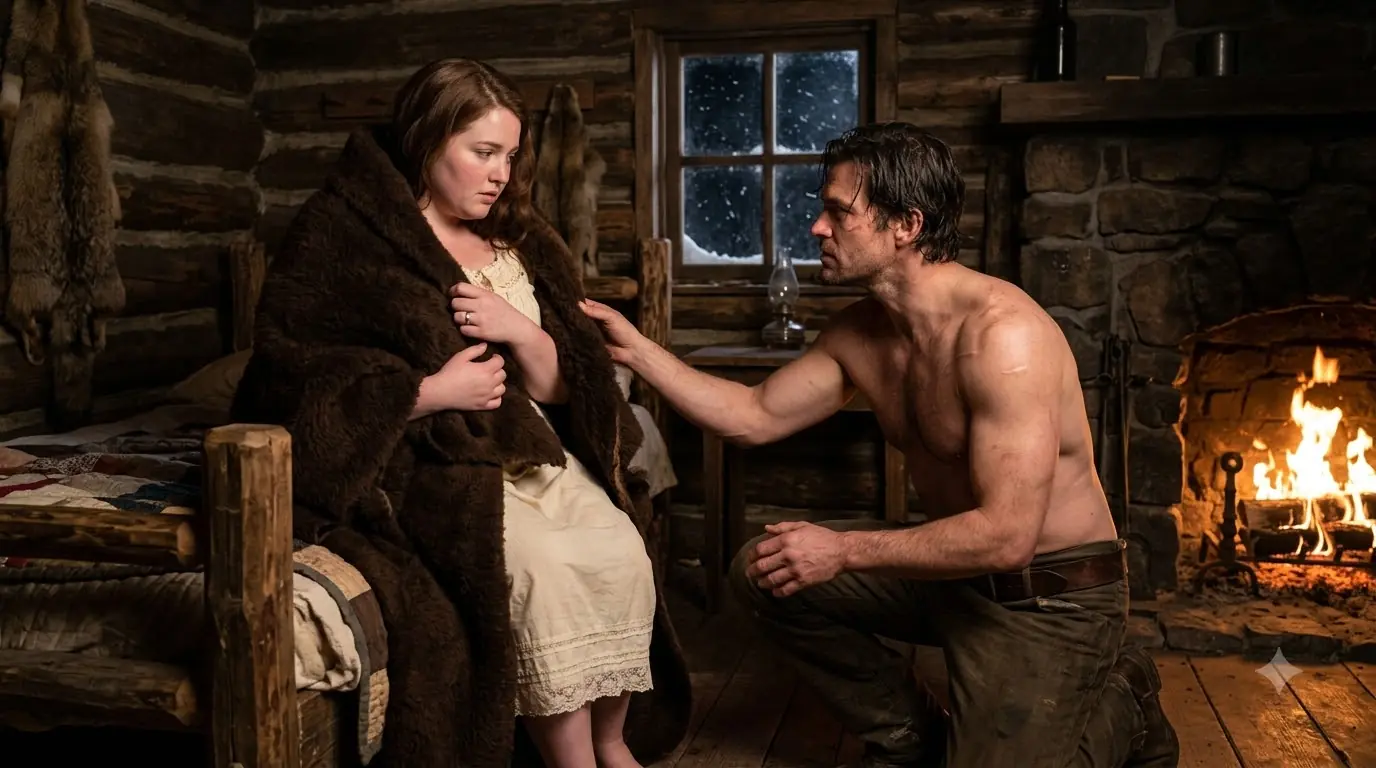
Lydia had spent most of her life around noise.
Factories were noise.
Looms striking wood and iron hour after hour until workers learned to read lips instead of speaking. Foremen shouting over machinery. Women coughing into sleeves. Steam pipes knocking inside walls. Streetcars rattling through Philadelphia before sunrise.
Gideon’s silence frightened her more.
She sat beside him wrapped in the borrowed wool blanket he had brought to the railway platform and watched the wilderness swallow the road behind them.
The plain silver ring on her finger felt impossibly heavy.
They had been married for less than six hours.
She knew almost nothing about the man beside her.
Thirty-seven.
Homesteader.
Livestock.
Timber.
One hundred forty acres.
No drinking.
No gambling.
Those were the facts contained in the letter.
The photograph had provided the rest.
A huge man beside a black horse.
Shoulders broad enough to make the animal appear small.
Dark beard.
Broken nose.
Eyes that looked straight into the photographer’s lens without any apparent interest in pleasing whoever might later examine the picture.
Lydia had expected harshness.
She had almost welcomed it.
Harshness was easier to recognize than charm.
Mr. Briggs had been charming.
He polished his boots every morning.
He smelled of lavender shaving soap.
He spoke softly when other supervisors shouted.
He opened doors for female workers in front of factory owners.
And when nobody important could see him, he stood close enough behind Lydia that she could feel his breath against her neck.
A woman who wants to keep her position should learn to be agreeable.
She heard the sentence again as Gideon guided the wagon around a bend.
He looked toward her.
“Cold?”
Lydia blinked.
“A little.”
Without a word, he stopped the horses.
He climbed down.
Opened the supply box behind the bench.
Removed another buffalo robe.
Then spread it across her lap.
She stared at him.
“You’ll freeze.”
“I have a coat.”
“So do I.”
“Yours is useless.”
Lydia looked down at the thin wool garment she had owned since she was nineteen.
“That is insulting.”
“It is accurate.”
He climbed back onto the wagon.
The corners of Lydia’s mouth almost moved.
Almost.
They continued.
An hour later she saw the cabin.
It stood in a narrow valley beneath Black Elk Pass, where mountains rose like walls on both sides.
The building was larger than Gideon’s letter had suggested.
Two stories.
Thick log walls.
Stone chimney.
Stable attached by a covered walkway.
Wood stacked beneath a long shed roof.
A fenced paddock disappeared beneath snow.
Lydia stared.
“You built this?”
“Most.”
“Alone?”
“Some hired help.”
The wagon stopped.
Gideon climbed down.
Then walked around to Lydia’s side.
She gathered her skirts.
Before she could move, he offered one hand.
Lydia looked at it.
His palm was enormous.
Scarred.
Callused.
She placed her hand inside.
He helped her down without pulling.
The distinction registered immediately.
Men often used strength as performance.
Gideon used it as leverage and then released her.
Inside, the cabin surprised her again.
Clean.
Not elegant.
But orderly.
A stone hearth occupied one wall.
Iron stove.
Heavy timber table.
Shelves of preserved vegetables, flour, dried meat, coffee, and beans.
A narrow staircase rose beside the pantry.
The cabin smelled of woodsmoke and pine resin.
Not whiskey.
Lydia noticed that first.
Gideon carried her canvas bag upstairs.
She followed.
Three doors.
He opened the first.
“Your room.”
Lydia stopped.
“My room?”
He looked back.
“Yes.”
“There are separate rooms?”
“Yes.”
Her cheeks warmed.
“I assumed—”
“I know what you assumed.”
His voice was not mocking.
That somehow embarrassed her more.
Gideon set her bag beside the bed.
“You'll sleep here unless you decide otherwise.”
Lydia stared.
“Decide?”
He nodded toward the second door.
“Mine.”
Then toward the final door.
“That one stays shut.”
His tone changed.
Lydia noticed.
She said nothing.
Gideon looked toward her.
“Hungry?”
She was starving.
“Yes.”
He made stew.
Badly.
Lydia ate two bowls.
The potatoes were undercooked.
The meat had been boiled until it lost every reason for once having been alive.
She said none of this.
Gideon watched her finish.
“Terrible?”
Lydia looked up.
“No.”
“You're lying.”
“Yes.”
The answer escaped before she could stop it.
Gideon stared.
Then laughed once.
A rough, unexpected sound.
Lydia nearly smiled.
The next morning he took her to the stable.
Two horses.
Three milk cows.
Four oxen.
Chickens.
A goat that disliked everyone equally.
Gideon showed her the smokehouse, springhouse, root cellar, tool shed, and wood lot.
He explained winter routines.
Lydia listened.
At the end he asked:
“Too much?”
“No.”
“You've never worked a homestead.”
“No.”
“You can say if something is beyond you.”
Lydia looked toward the barn.
“Can you repair a broken Jacquard loom drive belt?”
Gideon frowned.
“No.”
“I can.”
“What does that have to do with cattle?”
“Nothing.”
She met his eyes.
“But being unfamiliar with work and being incapable of work are different things.”
Gideon's expression shifted.
“Fair.”
That was all.
No argument.
No insult.
No explanation about women.
Just fair.
Lydia began to suspect Gideon Rourke was dangerous in a different way.
He made her question rules she had spent years accepting.
The wedding night came three days later.
Not because Gideon demanded it.
Because Lydia decided delay would make fear worse.
She knocked on his bedroom door after supper.
Gideon opened it.
He had removed his shirt.
Lydia stopped.
The photograph had failed completely.
Gideon was larger without clothing.
Not fat.
Not graceful.
Built by hauling logs, breaking horses, chopping wood, and surviving winters that killed weaker men.
Old scars crossed his chest and shoulders.
One narrow white line ran beneath his collarbone.
Another cut along his ribs.
His dark hair was wet from washing.
He looked at Lydia.
Her mouth had gone dry.
“You need something?”
She hated that he made her say it.
“Our marriage.”
His brows drew together.
“What about it?”
Lydia looked toward his bed.
Understanding came slowly.
Gideon stepped aside.
She entered.
The room was simple.
Bed.
Chair.
Washstand.
Chest.
One rifle near the wall.
No decorations.
Lydia stood near the fire.
Gideon closed the door but did not lock it.
She noticed.
He noticed her noticing.
“You can leave whenever you want.”
“I know.”
“Do you?”
The question irritated her.
“Yes.”
Gideon walked closer.
Not touching.
Lydia forced herself not to step back.
He waited.
Finally she raised one hand and touched his chest.
His muscles tightened beneath her palm.
The reaction startled her.
She had expected confidence.
Instead Gideon looked almost wary.
“You sure?”
Lydia nodded.
He kissed her.
Very carefully.
At first she felt nothing except surprise.
Then warmth.
Then fear.
Old fear.
Not memory exactly.
Expectation.
A hand trapping her wrist beside a loom.
Mr. Briggs saying:
You should be grateful I'm patient.
Lydia stiffened.
Gideon stopped instantly.
“You all right?”
“Yes.”
“Lydia.”
“Yes.”
His eyes searched hers.