She arrived at Stonefield Park on a Tuesday in March with a worn book, no connections, and enough education to be dangerous. He took one look at her and told his butler she wouldn’t last a week. She was sharp where he expected deference, warm where he had forgotten warmth existed, and quietly, without permission, she began to reach the one person in that house he hadn’t been able to reach himself. He had a suitable match waiting, a correct future nearly arranged. Then spring came, and everything he thought he’d decided started to cost him something.
Stonefield Park received its new governess on a Tuesday in March, which was, by general consensus among the staff, the worst possible day for anything to begin. The roads from Norwich had been passable but unpleasant. The sky was the particular shade of gray that Norfolk specialized in during early spring, not storming, not clearing, simply refusing to commit. The elm trees along the drive were budding with the tentative optimism of things that had been wrong before and were not yet certain they weren’t wrong again.
The house itself rose from the flat landscape with the confidence of a building that had never needed to justify itself to anyone. Marian Hale noticed all of this from the window of the hired coach. She noticed it because she had learned in twenty-seven years of living at the margins of comfort to read a house before it read her. Stonefield was large. Stonefield was orderly. The gravel had been raked. The windows were clean to a degree that suggested someone cared very much about appearances and had the staff to enforce that care.
There was a fountain in the circular drive that had not yet been uncovered from its winter housing, a careful canvas wrap around its basin, like something the household was not yet ready to show the world. Marian thought, “This is a house that keeps itself defended.” Then the coach stopped and she got out, and Mr. Norris opened the front door. He was a tall man of sixty or thereabouts with the particular stillness of a butler who has seen a great deal and elected to have opinions about none of it.
He looked at Marian with eyes that were neither welcoming nor hostile, merely assessing in the way of a man whose job was to assess things accurately. “Miss Hale,” he said, “welcome to Stonefield.” “Thank you, Mr. Norris.” She had been given his name in the letter of appointment. She had memorized everything in that letter. “I trust my trunk has arrived?” “Yesterday evening, miss. Mrs. Alderton has had your rooms prepared.”
The rooms, she discovered, were on the third floor, neither servants’ quarters nor family rooms, but the precise social middle ground that a governess occupied in every house she had ever heard of, close enough to the child to be useful, far enough from the family to be invisible. The window looked over the kitchen garden, where the first green things were just beginning to assert themselves through the dark soil. She stood at it for a moment after Mrs. Alderton left and permitted herself one complete breath. Then she unpacked.
She did not meet the Duke that first day. She met Thomas. He was brought to the schoolroom at nine o’clock the following morning by a nursemaid who looked relieved to deliver him and alarmed to be leaving. He was nine years old, small for his age, with dark eyes that had the quality of watching without appearing to watch, a skill, Marian thought, that children developed when they had learned that the adults around them behaved differently when observed.
He stood in the doorway and looked at her. She was arranging books on the schoolroom shelves, which the previous governess had left in a disorder that offended her. She did not stop arranging them. “Good morning,” she said to the shelf. A pause. “Good morning.” “You may come in. I haven’t set anything on fire yet.” Another pause, shorter. He came in. He did not sit down. He stood in the middle of the room with his hands at his sides and examined her with the thoroughness of a natural scientist encountering an unfamiliar specimen.
“You’re not old,” he said. “No, I’m twenty-seven. Is that a problem?” “Miss Cartwright was fifty-three.” “Was she the one before me or the one before her?” He blinked. “Before you.” “Miss Penrose was before her. She was thirty-one.” “And what happened to them?” The question seemed to surprise him. He considered it with the gravity of a much older person. “Miss Penrose cried. Miss Cartwright complained to my uncle every day until he asked her to leave.”
Marian put the last book on the shelf and turned to look at him properly. He held her gaze, not defiantly, just steadily, in the manner of someone who was used to making that effort. “I don’t intend to cry,” she said. “And I prefer to manage my own difficulties rather than present them to other people. So we are already off to a more promising start than either of my predecessors.” Thomas said nothing, but he sat down.
She met the Duke at half past eleven. She had not expected to meet him so soon. In her experience, the employers of governesses treated the nursery wing as a separate establishment to be visited on formal occasions and otherwise left to run itself. She had been in the middle of establishing what Thomas could and could not do in Latin, considerably more than he was willing to admit and considerably less than she had been told, when footsteps in the corridor announced someone of purpose.
The door opened without a knock. William Harcourt, Duke of Stonefield, was thirty-three years old and built with the kind of physical authority that had probably been inconvenient for him since the age of sixteen. He was not, Marian noted in the two seconds before he noticed her, the sort of man who looked like a duke in any theatrical sense. He didn’t look decorative. He looked like a man who made decisions and lived with the results of them, which was a different thing entirely.
He stopped when he saw her. She rose from her chair. “Your Grace.” He looked at her. He looked at Thomas. Something passed across his face that she could not immediately read. “I was not aware the lesson had begun,” he said. “We started at nine o’clock, Your Grace, as specified in Mrs. Alderton’s letter.” A brief pause. “Indeed.” He looked at Thomas again. “How are you getting on?”
Thomas, who had been studying his Latin grammar with the expression of someone trapped in a burning building, looked up. “Miss Hale says my Latin is better than I told her.” “Does she?” “I had not finished,” Marian said. “I said it was better than he had told me and worse than someone should have required of him by now.” “He is nine, Your Grace, and reads Virgil passably. Someone taught him well initially and then stopped expecting progress.”
The Duke looked at her. It was a long look, the kind that in a drawing room would have constituted a social event. “You have been here,” he said, “one day.” “One day and two hours,” she said. “I found it instructive.” She held his gaze. She did not know precisely why she held it. Only that looking away felt like a concession she had not agreed to make.
He said nothing further. He nodded at Thomas, some private abbreviated communication between them, and left. Marian sat back down. Thomas was watching her with an expression she was beginning to recognize, the look of someone recalibrating. “He doesn’t like it,” Thomas said, “when people speak to him like that.” “Like what?” “Like they’re not frightened.” Marian looked at her notes. “I’ll bear it in mind.”
At four o’clock, Mr. Norris brought the Duke his afternoon correspondence in the library. This was the established ritual. The correspondence on a silver tray, the Duke at his desk, the exchange of information about the day’s domestic business before Norris withdrew. “The new governess,” the Duke said without looking up from the letter he was reading, “your assessment?”
Norris considered his answer with his usual economy. “Capable, Your Grace. The boy came down for his luncheon willingly, which is more than could be said of the past four months. She is proud.” “Yes, Your Grace.” “Too proud for the position.” Norris said nothing. “She corrected me,” the Duke said, “in front of the child. She had been in the house for a day.” “One day and two hours, I believe, Your Grace.”
She lasted the week. She lasted it without complaint, without tears, and without presenting a single difficulty to anyone above the rank of housekeeper. She organized the schoolroom with a thoroughness that suggested she found disorder personally offensive. She established Thomas on a schedule that he accepted with less resistance than anyone had anticipated. She ate her meals in the correct rooms at the correct times and gave the housemaids no trouble at all.
On Thursday, she took Thomas out to the kitchen garden in the afternoon because the sky had cleared and he had been indoors since Monday, and she decided, without consulting anyone, that Latin could wait for a finer day. On Friday, the Duke, who had been returning from the eastern fields on horseback, saw them through the iron gate of the kitchen garden. The governess crouched in the mud beside his ward, pointing at something in the soil. And Thomas, who had not, in the Duke’s memory, initiated conversation with any adult since his mother died, leaned forward to look and asked what appeared to be a question.
The Duke stopped his horse. He could not hear what they were saying. He watched for perhaps thirty seconds, not long enough to constitute observation, he told himself, just long enough to verify that nothing was wrong. The boy’s face was open in a way he hadn’t seen in eight months. The governess said something and Thomas laughed. Not loudly, not the laughter of a happy child, carelessly happy, but the smaller rusty sound of a child who had forgotten it was possible. The Duke rode on.
That evening at the end of the week, he passed Norris in the corridor outside the library. Neither of them said anything about the week. Neither of them needed to. The library at Stonefield occupied the entire eastern end of the ground floor, which meant that in the mornings it caught the light first. This had been true for as long as anyone could remember, and the room had arranged itself around the fact with the unhurried confidence of a room that knew its own value.
Shelves from floor to ceiling on three walls, a pair of deep windows on the fourth, a writing desk positioned to catch the morning light without being blinded by it, and two armchairs flanking the fireplace that had absorbed, over three generations, the particular quality of chairs that had been sat in by people thinking seriously. The Duke used the library every morning between eight and eleven. This was not a secret. The entire household knew it. The household also knew that during those hours the library was, functionally, inaccessible. Not because any prohibition had been issued, but because the quality of his presence in it made entry feel like an interruption of something important.
Marian had been told this by Mrs. Alderton on her first full day. “His Grace works mornings in the library,” Mrs. Alderton had said, in the tone of someone communicating a fact of natural law. “The schoolroom has its own shelves for the boys’ lessons.” “Of course,” Marian had said. The schoolroom shelves, she had discovered, contained two grammars, a child’s atlas published in 1793, and a religious text that Thomas regarded with the particular weariness children reserved for books that had been given to them by people hoping they would become better.
The library, she had noted from the doorway, contained everything. She waited until the fourth week. She chose a morning when Thomas had a music lesson with the visiting master, which freed her from nine until eleven. She went to the library at half past nine, when she had reason to believe the Duke was out inspecting the home farm. She had heard him give that instruction to his steward at breakfast, voices carrying in the corridor, and she intended to take what she needed and leave before he returned.
The library was not empty. He was at the desk. He had not gone to the home farm. He looked up when she entered with the expression of a man who had been interrupted by precisely the kind of interruption he had not anticipated. “I beg your pardon, Your Grace.” She did not retreat. “I was given to understand you were at the home farm.” “I was. I returned.” He looked at her steadily. “What is it you need?”
There was, she noted, no version of this sentence that wasn’t an assertion of ownership. What do you need, and I will judge whether you are entitled to it. “I was looking for something on natural history,” she said. “Thomas has developed an interest in the kitchen garden. I thought if he had a proper text, he might read voluntarily, which would accomplish more in a week than compulsory Latin in a month.” A pause. “The natural history texts are on the second shelf from the top east wall, the third section.”
She crossed to the east wall without thanking him. There was nothing in his tone that had invited thanks. She found the section. It was good. Better than good. Three volumes of Banks, a copy of Gilbert White’s Selborne that had been read enough to be soft at the spine, and a newer text she didn’t recognize. She took down the White and opened it.
“That one,” the Duke said from his desk, “was my father’s.” She looked up. “He read it every spring,” he said, and then, as though he hadn’t said it, “there is a copy in better condition on the left shelf.” “The worn one will interest Thomas more,” she said. “He’ll know someone loved it.” The Duke looked at her. Not the long judicial look of their first meeting, something shorter and less certain of its own conclusions.
She took the White and the Banks and left him to his correspondence. It became, without either of them deciding it, a pattern. Not a daily one, nothing so regular as to require acknowledgement. But twice in the following week she came to the library in the late mornings for texts she needed, and twice he was there, and twice they spoke briefly about nothing of consequence, and twice she left with what she came for.
On the third occasion he spoke first. “How does the boy progress?” She was at the east wall, her back to him. “In Latin, slowly and resentfully. In natural history, with a degree of enthusiasm that suggests he has been waiting for someone to give him permission.” “He never showed interest in the gardens before.” “He may not have been asked.” A pause. “Miss Cartwright considered outdoor time a disruption to the curriculum.” “Miss Cartwright,” Marian said, taking down a volume, “would have been correct if the goal were Latin. If the goal is a child who reads willingly, mud is underrated.”
She heard what she thought might have been something. Not quite a laugh, not quite a dismissal. She turned. He was looking at his correspondence. His expression was composed. “Do you disagree?” she said. “I didn’t say anything.” “You made a sound.” He looked up. “I was considering,” he said, “whether you hold any opinion with less than complete conviction.” “I find incomplete convictions uncomfortable,” she said, “like a coat that doesn’t fasten.”
He studied her for a moment. “Where were you educated?” “At my father’s library.” She said it without apology. “He was rector of Holston in Suffolk. He had opinions about education that the village did not entirely share, and more books than the village living warranted.” “And yet you’re here.” The sentence had more edges than he perhaps intended. She received them without flinching.
“My father died two years ago,” she said. “The rectory and the library went to his successor. I retained the education,” she paused, “which has proved more portable.” He said nothing. She had the impression, not certain, but present, that he regretted the sentence, not from softness, but from the particular discomfort of a man who had said more than he meant to and could not unsay it.
She put the book under her arm. “Good morning, Your Grace.” She left. The fourth visit was different because Thomas came with her. She had not planned this. Thomas had followed her from the schoolroom on a morning when he had finished his work ahead of schedule, and she had not, in time, invented a reason for him to stay. He arrived at the library door behind her with his natural history journal, a composition book she had given him for recording observations, tucked under his arm.
The Duke was reading by the fire. Thomas stopped in the doorway. The Duke looked at him. There was between them the specific quality of silence that exists between two people who love each other and are not certain how to be in the same room. Marian had seen it before in the brief overlaps between the Duke and his ward, the ward’s face going still and careful, the Duke’s going formal in a way that seemed to cost him something.
“Come in, Thomas,” the Duke said. Thomas came in and sat in the second armchair, not the one closest to the fire, which was the Duke’s, but the one opposite, which left the footstool between them as a kind of neutral territory. He opened his journal. He did not speak. Marian went to the shelves.
For twenty minutes, no one said anything of consequence. The fire settled, the Duke read, Thomas wrote in his journal with the focused silence of a child doing something he genuinely wanted to do. Marian found what she needed and didn’t leave immediately, which she examined later and chose not to explain.
Then Thomas said, without looking up, “Uncle, have you read this one?” He was holding up the Selborne, Marian’s copy, the soft-spined one. The Duke looked at it. “Yes.” “Miss Hale says it’s good because someone loved it.” A brief pause. “Miss Hale is right.” Thomas turned a page. “Did you love it?” “My father did.” “Do you know which parts he liked?”
The Duke was quiet for a moment. Then, “The letters about swallows. He said White understood that you could study something without reducing it.” Thomas absorbed this. He looked at the book. He turned it over in his hands with the consideration of someone handling an object that had become more significant. Marian at the shelf did not turn around.
“I could read it,” Thomas said, “if Miss Hale says I can borrow it.” “It lives here,” the Duke said. “You may read it here whenever you like.” Marian turned and looked at him then because she couldn’t help it. He was not looking at her. He was looking at Thomas with an expression she recognized now, the expression of a man who knew he was watching something he had nearly missed.
“Thank you, Your Grace,” she said quietly. He glanced at her, looked away. “I’ll have Norris bring another chair,” he said. There was an afternoon in the third week of April when the rain came suddenly and she and Thomas were caught in the kitchen garden and arrived back at the house through the servants’ entrance looking, as Mrs. Alderton put it, as though they’d been arguing with a river.
Thomas, to Marian’s private relief, appeared to find this funny. He was mud-covered from the knee down and his hair was stuck to his forehead and he was laughing. Properly, carelessly, the way children were supposed to laugh. She was not in much better condition. She was also, despite everything, laughing.
They came through the kitchen passage and directly into the Duke, who was returning from somewhere dry and purposeful and who stopped in the doorway to take in the scene with an expression that moved through surprise and arrived somewhere she couldn’t classify. Thomas said, “We got caught in the rain.” “I see that,” the Duke said. “Miss Hale said the earthworms come up in the rain and that’s why the robins look pleased.”
The Duke looked at Marian. She was attempting to wring water from her cuff in a manner she hoped suggested competence rather than disaster. “That is,” she said, “an accurate summary.” “Are you well?” he asked. The question was directed at her, not Thomas. It surprised her, not its content, but its quality. Simple, without ceremony, as if he’d asked it before he remembered to be careful.
“Quite well, Your Grace. Wet, but well.” He stepped aside to let them pass. As she went by him in the narrow passage, she was aware of him looking at her with that unclassifiable expression still in place. And then Thomas pulled her sleeve toward the stairs, and she went. And the moment closed.
Later, she sat by her window with dry clothes and her father’s copy of Cowper, the one book she had kept, and tried with limited success to read. The kitchen garden was visible below, steaming slightly in the aftermath of the rain. The dark soil turned up and rich-looking. Three robins, vindicated, hopped among the rows.
She was thinking about the way he had said, “Are you well?” without the title, without the distance. She was thinking about how it had felt like a mistake on his part, and how she had filed it away before she could decide what to do with it. She opened Cowper to a page she didn’t read.
Lady Sophia Vane’s name first appeared on a Thursday, delivered by Mrs. Alderton, with the domestic gravity that attached to impending guests. “Lady Sophia will be arriving the second week of May,” Mrs. Alderton told Marian over the household schedule. “With her mother, Lady Vane, and a lady’s maid. We’ll be putting them in the blue rooms.”
“I’ll ensure the schoolroom schedule allows for Thomas to be available at appropriate hours,” Marian said. “Yes, miss. His Grace will want him presentable for dinner on the first evening.” Marian made a note. She did not ask who Lady Sophia was. She had a reasonable suspicion she already knew. And she found she did not want the information confirmed in a housekeeper’s corridor.
She got it anyway that afternoon from Thomas. They were in the library. She had acquired a chair of her own by this point. An unremarkable wooden one that Norris had installed without ceremony near the shelves, at enough distance from the fireside chairs to be appropriate and enough proximity to the room to matter.
Thomas was reading the Selborne. She was correcting his Latin exercises. The Duke was at his desk. “Lady Sophia is coming,” Thomas said to no one in particular. Neither adult responded immediately. “She came last year,” he said, still to no one. “She brought me a book about knights.” “Did you like it?” Marian asked. “It was all right.” He turned a page. “Uncle, are you going to marry her?”
The Duke did not look up from his correspondence. The pause before he answered was brief. Professionally brief, the pause of a man who had considered the question in advance. “That is not determined,” he said. “But you might?” “It is a possibility that has been discussed.” Thomas considered this. “She’s nice,” he said in the tone of someone doing their best to be fair. “She doesn’t talk to me like I’m sad.”
Marian kept her eyes on the Latin exercises. “That,” the Duke said, “is a considerable quality.” Marian turned a page. She corrected a verb. She did not look up. Beside the fireplace she heard the Duke’s pen resume its movement across the paper. And she concentrated on the Latin with a focus that had nothing to do with Latin.
She returned the Selborne on a Friday morning in late April. She had borrowed it two weeks earlier. The worn one. For a lesson on seasonal observation that had led Thomas to spend an afternoon at the library window with the book open and a pencil making small careful notes. She had been pleased with the lesson. She had been less pleased with herself for keeping the book longer than necessary.
She left it on the corner of the Duke’s desk with a folded note, a single line written in her clearest hand. “Thomas found the Swallow letters. He sends them back to you better than he found them.” She left before he arrived. He read it three times that morning and did not mention it. He said nothing about it at luncheon, nothing in the library that afternoon, nothing over the next three days.
On the fourth day, she arrived at the library to find a book on her chair. The new natural history text she had noticed on her first visit and not taken. There was no note. She picked it up and turned it over and opened the front cover. His name was written there in a hand she didn’t know yet. William Harcourt, March 1809. Three years old, read.
She put it under her arm. “Thank you, Your Grace,” she said. He was at his desk. “It’s more current than the Banks,” he said without looking up. “The taxonomy is better. So I’m sure Thomas will find the taxonomy very gripping.” He looked up then, the sharp look assessing, and she kept her expression entirely neutral, and after a moment something at the corner of his mouth moved in a direction that was not quite a smile, but was in the same neighborhood.
She left. She thought about the not-quite smile for the rest of the day and was annoyed with herself and did it anyway. The morning Thomas told her about his mother, they were in the schoolroom and the lesson had gone sideways. It was a geography lesson, straightforward, intended to be short. She had produced a map of England and asked him to trace the route from Norfolk to London, and he had done it competently, and then she had asked him, as an extension, where else he’d been, and he’d said Suffolk without thinking and then his face had changed.
She waited. “My mother was from Suffolk,” he said. “Was she?” He looked at the map. He traced a line with his finger that had nothing to do with the exercise. “She liked the sea. She said Norfolk was flat enough to see forever, but Suffolk had better cliffs.” “She was right,” Marian said. “I grew up in Suffolk.” He looked at her. “You did?” “Holston, near the coast. My father used to walk us to the cliff path on Sunday mornings after church.” She paused. “The view from the top is worth the climb.”
Thomas was quiet for a moment. “She died in September,” he said, “before the autumn was over. Uncle William, he went very quiet. He’s been quiet since.” Marian said nothing. She kept her pen still. “He was different before,” Thomas said. “I don’t remember all of it, but I remember he used to come to the nursery in the evening sometimes, and we’d look at the maps together. Those ones.” He nodded toward the atlas on the shelf. “He’d tell me the names of the places.” A pause. “He doesn’t come to the nursery anymore.”
“He comes to the library,” Marian said carefully. “That’s different,” Thomas said. He folded the map along its original creases. “In the library, he’s the duke. In the nursery, he was just—” He stopped. He thought about it. “Just himself, I think.” Marian looked at the map. She was thinking about a man who had gone quiet in September and had been performing himself ever since, and about a nine-year-old who had noticed the difference and filed it away because there was nowhere useful to put it.
“Shall we continue?” she said. “Yes,” said Thomas. And then, “Miss Hale, were you sad when your father died?” “Very,” she said. He nodded as if this confirmed something. “Does it get better?” She looked at him directly. “It changes,” she said. “It doesn’t disappear, but it stops being the only thing.” He thought about this. Then he opened his exercise book and picked up his pencil, and she resumed the lesson, and neither of them said anything more about it.
But she carried it with her for the rest of the day. She understood the Duke differently after that. She did not want to. It was significantly more convenient to find him difficult and leave it at that, but understanding was not a process she could halt once begun. It was a professional failing perhaps, or a personal one. She could not be told a true thing about a person and continue to see them through the distortion of her first impression.
He had loved someone and driven them away. That was the wound Thomas hadn’t named but had described. The man who used to come to the nursery and tell the child the names of places, who had gone quiet when the child’s mother died, and had not come back to himself since. The performing of the dukedom, the control that looked like composure. She knew something about performing composure. She had been doing it since she was twenty-two and the living was taken, and she had understood with the clarity of someone who has just lost their net that the world would not be gentle about her education and her poverty occupying the same body.
She did not, however, intend to tell him any of this. The scene in the grounds happened on a Wednesday, in the second week of May, three days before Lady Sophia was expected. Marian had taken Thomas out to the walled garden after lessons, the kitchen garden proper, not the ornamental grounds, where things were actually growing and could be observed. He had been transcribing his earthworm observations into the natural history journal with a dedication that had moved her, and she wanted him to have something new to record.
She did not know the Duke was in the walled garden. He was not usually in the walled garden. He was, she would discover later, there because his steward had raised a concern about one of the espalier apple trees along the south wall, and he had come to look at it and had stayed because the afternoon was fine and the work on his desk was the kind that could wait, and the walled garden was one of the few places on the estate where no one brought him correspondence.
She saw him when they came through the gate. He saw her at the same moment. There was the standard pause, the brief recalibration of two people who had been expecting to be alone and had arrived at the same space. Then Thomas saw him and went still in the specific way he went still when he wanted to approach someone and wasn’t certain of his welcome.
“Come to inspect the espalier,” the Duke said. Thomas looked at the apple tree against the south wall. It was an old tree trained flat against the brick in a fan of branches just beginning to blossom. “What’s wrong with it?” “Nothing serious. A canker on the lower left branch.” Thomas went to look at it. He crouched down and peered at the branch with professional interest. He had, Marian reflected, the natural scientist’s complete unselfconsciousness about proximity to things other people might find unpleasant.
“Can it be saved?” Thomas asked. “Pruned back, it should recover.” “Miss Hale says plants are more resilient than they look.” The Duke glanced at Marian. “Does she?” “She says most things are.” A pause. The afternoon light lay flat and pale across the garden, the kind of spring light that has not yet committed to warmth but is making a reasonable effort. The apple blossoms were white against the old brick and the smell of the turned earth was present and specific.
And Marian stood by the gate with her hands quiet at her sides while Thomas interrogated the apple tree. “Will you stay?” the Duke said. She looked up. He was looking at her in the direct way he had, not unkind, simply undecorated, the way people looked when they had stopped managing the impression they made. “I don’t wish to intrude,” she said. “Then you’re not intruding,” he said, and then more carefully, “I’d rather you stayed.”
The sentence was a small one. It didn’t announce itself. She thought he might have surprised himself with it. “Then I’ll stay,” she said. Thomas, who had been crouching by the apple tree and was therefore facing away from both of them, said nothing. But she thought, she was fairly certain, that his shoulders settled very slightly as if something he had been holding had been put down.
They walked the garden for the better part of an hour. It was not the kind of walk that required description, no dramatic turns, no charged speeches. Thomas moved ahead of them through the rows, collecting observations in his journal, asking questions about this plant and that one, receiving answers from the Duke that were precise and occasionally surprised her with their knowledge. She had not expected him to know the Latin names of the kitchen herbs.
He delivered them without self-consciousness, and she revised something. Somewhere in the middle of the walk they began to talk. Not Thomas-adjacent conversation, not exchange of necessary information, but actual conversation, the kind that requires both people to be attending. He asked her about Suffolk. She told him about the cliff path and the view, and her father’s habit of stopping to identify every bird by call before they’d taken twenty steps, which made the walks both long and, she had eventually decided, valuable.
He listened with the quality she had noticed in him in the library, full attention without performance of it. “He sounds like a man who thought carefully,” the Duke said. “He thought about everything carefully. It was occasionally exhausting.” A pause. “I miss it considerably.” He was quiet for a moment. Thomas had found a toad behind a planter and was introducing himself to it.
“My father was the opposite,” the Duke said. “He made decisions quickly and adjusted later. He said deliberation was the enemy of momentum.” A brief pause. “I spent a long time believing him. And now—” He looked at the garden. “Now I think momentum without deliberation is how you arrive in places you didn’t intend.”
She thought about that. She did not say what she was thinking, which was, “Yes, I know something about that.” “Is that why you deliberate now?” she asked instead. He looked at her sideways. “Is that what you think I do?” “I think you are extremely careful,” she said, “about everything.” The sentence sat between them with more weight than she had intended to give it. She was aware she had said something true and that true things had a way of changing the quality of the air.
“That is,” he said after a moment, “not always a compliment.” “No,” she agreed, “not always.” Thomas, having concluded his introduction to the toad, returned to them with his journal and announced that he thought toads deserved more credit than they received and the conversation shifted and Marian breathed again.
That evening she wrote in the margins of her lesson notes, not proper notes, just the shape of things she was thinking, and then turned the page over and looked at the blank side and wrote nothing on it and put the notebook in the drawer. She had been in this house six weeks. She was doing the work well. Thomas was progressing. The household had accepted her. These were the relevant facts.
She took the natural history book, his book, still with his name in the front, from her bedside table and held it for a moment without opening it. Then she opened it to a page about migration patterns and read it until the candle guttered. She did not think about his voice saying “I’d rather you stayed.” She thought about it anyway.
Four days later she returned the book to the library. She left it on her chair, not his desk, her chair, the distinction mattered, with a folded note inside the front cover. She had written it three times and this was the shortest version. “The chapter on swifts is wrong in one particular. I’ve left a note on the page. You may disagree.” And then below it, “Thank you for the afternoon in the garden. Thomas has been drawing the apple tree from memory. He has it almost right.”
She was in the schoolroom when she heard him in the corridor below. Not his words, just the rhythm of his walk, which she had learned to identify without meaning to. She heard him go into the library. She heard nothing after that, which was appropriate because the walls were too thick and the distance too great. But she thought about him reading the note. She thought about whether he would disagree about the swifts and how he would do it. In person with the dry precision she was beginning to recognize as the register he used when something interested him.
She thought about this with the focused attention of a woman who has decided not to think about something and is therefore thinking about it constantly. She set Thomas his afternoon exercise and concentrated on his conjugations. He came to the schoolroom. She had not expected this. In six weeks he had come to the schoolroom twice. Once on her first full day, once to collect Thomas for a formal visit from the estate solicitor.
He did not come to the schoolroom. The schoolroom was her territory. He knocked. That was the first difference. “Come in,” she said. And he did. And Thomas looked up from his conjugations with uncomplicated pleasure. “Uncle William, have you come to do Latin?” “I’ve come to speak with Miss Hale.” He said. “Can you occupy yourself for ten minutes?”
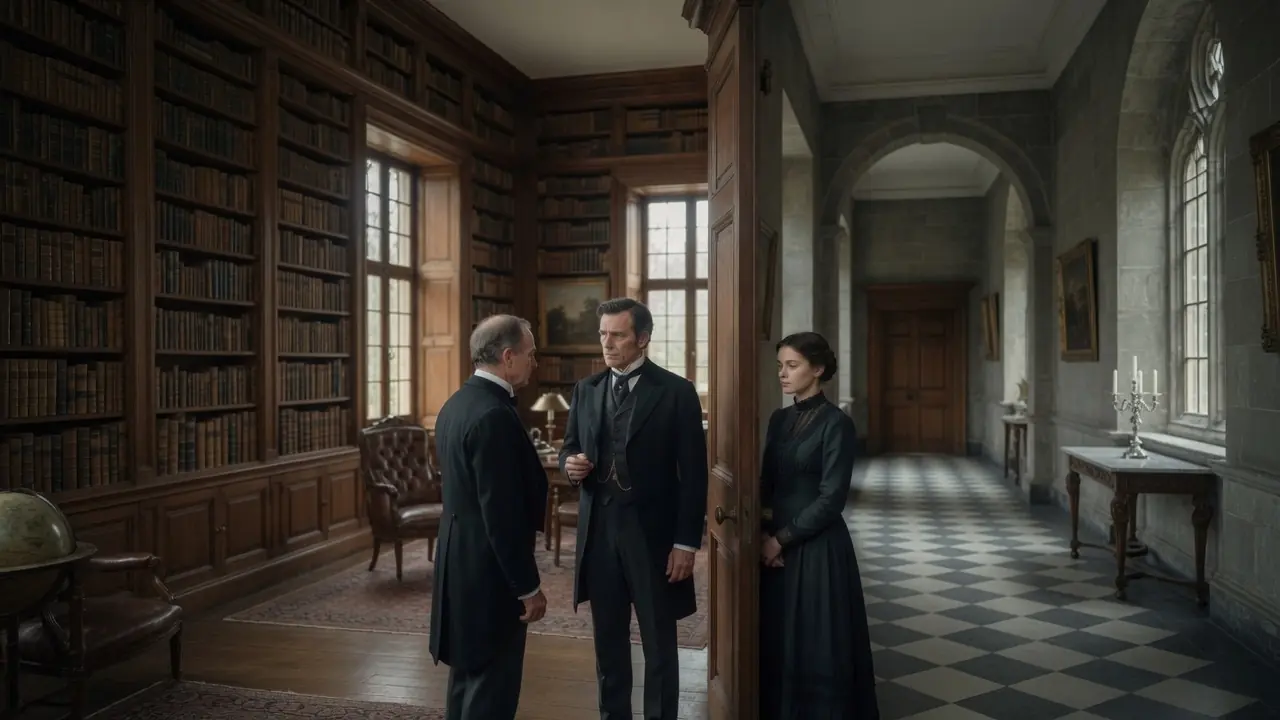
Thomas considered this. “I could finish the apple tree drawing.” He said. “Do that.” Thomas extracted his drawing materials from the desk with the efficiency of someone who had been waiting for an excuse. And the Duke looked at Marian and she looked back at him. “The chapter on swifts.” He said. “Yes.” “You’re correct about the nesting altitude.” He said it without preamble, without ceremony. “The author visited only the southern populations. The error is in the generalization.” “I thought so.” She said.
“You might have written more than a note in the margin.” “I didn’t think you’d want more than a note in the margin.” He looked at her with that assessing look. And then past her at the window where the afternoon light was doing its unremarkable Norfolk thing. “My father’s copy.” He said. “He wouldn’t have minded the annotation.” She said nothing. He looked back at her.
“I have a question.” He said. “Yes, Your Grace.” “Why the wrong copy when you first borrowed it, you said Thomas would know someone loved it, but you could have told him that about the clean copy.” She thought about this. She had thought about it before without fully admitting she’d thought about it. “The worn copy was more honest,” she said. “Honest about what?” “That things can be used and be better for it.” She paused. “That wear is not the same as damage.”
He was quiet for a moment. Thomas was drawing at the window, his pen making small deliberate marks, paying them no attention at all. “Lady Sophia arrives in three days,” the Duke said. “I know.” “She is—” He stopped. He appeared to be selecting his words with the care of a man who had learned to be careful. “She is a good person. I want you to know that.” Marian looked at him. She did not know what he wanted from this sentence, and she did not trust herself to interpret it. “I’m sure she is, Your Grace,” she said.
He nodded. He looked at Thomas who had finished his apple tree and was adding with great concentration a small bird in the upper corner. “Thomas,” he said, “that bird is a swift.” Thomas looked at it. “Is it?” “Apparently, they’re nesting at the wrong altitude.” He glanced at Marian, one swift unguarded look that held something she didn’t have a name for, and then he said, “Good afternoon, Miss Hale,” and left.
She stood in the schoolroom with the afternoon light coming through the window and Thomas asking whether swifts nested in apple trees, and she said no, they preferred the eaves of old buildings, and he asked why. And she gave him an answer, and the lesson continued. She said “Your Grace” to the closed door silently after he’d gone. Out of habit, out of practice, out of something she was not yet calling anything else.
Lady Sophia Vane arrived on a Thursday afternoon in the second week of May in a carriage that was neither ostentatious nor modest, the carriage of a family that had nothing to prove and knew it. She stepped down onto the gravel of Stonefield’s drive with the ease of someone who had been arriving at houses like this one her entire life, looked up at the facade with polite appreciation rather than awe, and said something to her mother that made Lady Vane laugh.
Marian watched from the schoolroom window. She had not intended to watch. She had been correcting Thomas’s essay on the migration habits of swallows, which owed a great deal to Gilbert White and a small but genuine amount to his own observation, when the sound of wheels on gravel had been apparently enough. Lady Sophia was handsome. There was no useful purpose in denying it.
She was perhaps twenty-four, slender, dressed in a pale traveling costume that had been chosen by someone with taste, and she moved with the particular confidence of a woman who had been told consistently and since childhood that she was an asset to any room. It was not vanity. It was the settled quality of a person who had never had cause to doubt their own welcome.
The Duke came down the front steps to greet her. Marian turned from the window. “Miss Hale,” said Thomas without looking up from his essay, “you’ve corrected the same line three times.” She looked at the page. He was right. She put the pen down. “Finish the paragraph,” she said, “then we’re done for the afternoon.”
She met Lady Sophia at dinner. The dinner was formal, small, only the family and guests, but conducted with the full complement of courses, and the silverware that came out only when the Duke wished to signal, without saying so, that he considered the occasion significant. Marian’s place was the precise social position of a governess at such a table, present, included in the conversation when directly addressed, not expected to initiate.
She had dressed carefully and permitted herself nothing more than that. Lady Sophia, seated to the Duke’s right, was precisely what Marian had expected and rather worse because she was not only handsome and composed, but also genuinely, observably kind. She asked Thomas, who had been placed beside her at his uncle’s instruction, about his studies and listened to the answer with real attention and said something about swifts. She had heard swifts mentioned, she said, and had always found them remarkable that made Thomas’s face open like a window.
Marian watched this and recognized the quality of what she felt. It was not dislike. It was something considerably more uncomfortable than dislike. “Miss Hale,” said Lady Vane from her left, “I understand you are from Suffolk originally.” “Yes, my lady, near Holston.” “A pretty county. My late husband had a connection there, the Fenwick family. Do you know them?” “By name only, I’m afraid. We were not in that circle.” “No, of course.” Lady Vane said it without unkindness, but it was a sentence that knew its own geography. “You were educated privately, by your father?” “Yes, my lady.” “How unusual. And useful, I’m sure, in your current position.” “Quite,” said Marian. She picked up her glass.
Across the table, the Duke was listening to something Lady Sophia had said. He was not performing attention. He was simply attending. He looked like a man in a situation that fit him. The right house, the right table, the right woman beside him. The situation was correct in every particular.
She concentrated on Lady Vane’s account of the Fenwick family’s considerable estates and contributed appropriate responses at appropriate intervals and did not look at the other end of the table again. The following morning, she went to the library early, before eight, before the Duke’s usual hour, to return a text she had borrowed for Thomas’s lesson. She did not intend to be there when he arrived. She intended to be gone well before.
Lady Sophia was in the library. She was at the window with a book open on her lap, not reading it, looking out over the grounds in the early morning light with an expression that was thoughtful and slightly tired. She looked up when Marian came in. “Miss Hale,” she said with immediate warmth, “come in, please. I’ve been intruding in your territory.” “It isn’t mine,” Marian said. “It’s the Duke’s library.” “And yet the chair by the shelves has a quality of belonging to someone.” Lady Sophia smiled. “Thomas told me about the lessons here. He clearly thinks very highly of you.”
“He is an exceptional child.” “He is.” Lady Sophia looked at the window. “He was so withdrawn when I visited last autumn. I hardly knew how to speak to him.” “You’ve done something remarkable with him.” “I’ve done very little,” Marian said. “He needed someone to expect something of him.” “And someone to put earthworms in his education.” She said it without condescension, genuinely amused, genuinely warm. “William told me about the kitchen garden.”
The use of his name, simple and thought, landed somewhere. Marian went to the shelves. She found what she needed with more focus than the task required. “May I ask you something?” Lady Sophia said. “Of course, my lady.” A pause. Marian turned to find Lady Sophia looking at her with an expression that was candid and careful in equal measure.
“He is different,” she said, “since the autumn. I noticed it last night.” She paused. “William is—he has always been contained. It is one of the things about him. But last autumn he was contained in the way of something sealed. Now it is different.” She looked at Marian directly. “You have been here since March.”
The silence in the room was specific. “Thomas has improved considerably,” Marian said. “His Grace has observed that improvement. I imagine it has been relieving.” Lady Sophia looked at her for a moment longer. “Yes,” she said. “I imagine it has.” She looked back out the window. The morning light was strengthening, moving across the grounds, and the elm trees along the drive were fully leafed now, the tentative buds of March having arrived at their conclusion.
“He is a good man,” Lady Sophia said quietly. “He carries too much and he does it too quietly, and I have always thought that a person who does that needs someone who insists on being heard.” She said it to the window. Marian said nothing. “Good morning, Miss Hale,” Lady Sophia said. “Good morning, my lady.” Marian took her books and left the library and walked up the stairs to the schoolroom and sat down at her desk and looked at the wall for approximately two minutes before Thomas arrived and required her to be a person with a plan for the day.
The visit lasted four days. On the second day, there was a walk in the grounds. The Duke, Lady Sophia, Lady Vane, and Marian at the appropriate distance behind with Thomas. The day was fine. The conversation ahead of her was unhurried and companionable. She watched Lady Sophia take the Duke’s arm on the uneven path, a natural gesture unremarked. Thomas beside her said quietly, “Do you think you’ll ask her?”
“That is not a question for me,” Marian said. “You could have an opinion anyway.” “I could. I choose not to.” Thomas considered this. “Norris says they’ve been expected to marry for two years.” “Mr. Norris says a great deal to you.” “Mr. Norris says almost nothing,” Thomas said. “That’s why I remember it.” Ahead, the Duke said something to Lady Sophia and she laughed, genuine, unguarded. They looked like a painting. They looked, Marian thought, like a future.
“She’s nice,” Thomas said. “I said that before.” “You did.” “But,” he stopped. “But what?” He looked ahead. He didn’t finish the sentence. He wrote something in the margin of his journal instead. She caught a glimpse of it later when he left it open on the schoolroom desk, a small, careful drawing of the walled garden, two figures at the gate, a third figure with a notebook in the middle distance. It took her a moment to understand what she was looking at.
She closed the journal and left it where it was. On the third day, the Duke looked for her. She had not known this immediately. She had learned it afterward from Norris, who had arrived in the doorway of the schoolroom with a message about Thomas’s riding lesson and had paused in a way that invited question.
“His Grace was looking for you this afternoon,” Norris said. “In the library and then the garden. You were at the Henderson’s farm with Master Thomas.” She had taken Thomas to see the lambs at the neighboring farm. An educational errand entirely justified, scheduled that morning with no particular urgency. The timing had been her own choice.
“I was.” She said. Norris looked at nothing in particular. “He didn’t leave a message. I thought you should know.” She thought about several things she might say to Norris. She chose none of them. “Thank you.” She said. “Is there anything further about the riding lesson?” “No, miss.” Said Norris. “He left.”
She sat for a long moment with the afternoon quiet around her. He had looked for her. While Lady Sophia was here, while the visit was proceeding correctly, while the future arranged itself in the grounds and the drawing rooms of his own house, he had looked for her. She opened the drawer of her desk and took out the sheet of paper she had started that morning. She read what she had written.
“Dear Mrs. Alderton, I write to give notice of my intention to leave my position at Stonefield Park at the end of the current quarter. I have greatly valued the opportunity to serve in this household and I trust that my work with Master Thomas—” She had stopped there. She read it through twice. She put it back in the drawer without adding to it. Then she took it out again and put it on top of the desk where she could see it and went to find Thomas for supper and told herself she would finish it in the morning.
On the fourth day, Lady Sophia came to find her. Not in the library, in the kitchen garden where Marian had taken herself in the early evening after Thomas was in bed. She had brought no book. She was sitting on the low stone wall near the apple tree, looking at the espalier with its new growth where the canker had been pruned away.
Lady Sophia came through the gate and stopped. “I thought you might be here,” she said. “I’m sorry to have been predictable,” Marian said. Lady Sophia sat on the wall at a distance that was companionable rather than intrusive. She looked at the apple tree. “I wanted to speak with you before I leave tomorrow.” “My lady—” “Please.” She said it without sharpness. “I’m not going to say anything injurious. I want to say something true.”
She paused. “I have been considering this match for two years. My mother considers it settled. William considers it probable.” A pause. “I am not certain he would use that word now.” Marian said nothing. “I am not angry,” Lady Sophia said. “What I have observed this week has not made me angry. It has made me honest, with myself at least, which is the harder direction.”
She looked at the apple tree. “He has always been guarded. I thought I could be patient with that. I thought it was sufficient.” A pause. “But I have watched him in his own house this week and he is not guarded with you. He is something else entirely. And I believe that is the thing that matters.” Marian looked at the new growth on the pruned branch, green and small and certain of itself.
“Lady Sophia,” she said carefully, “I am a governess. I have no connections, no fortune, and no claim on anything in this house.” “I know what you are,” Lady Sophia said without unkindness. “I also know what I saw.” She stood. “I am not withdrawing from anything formal. There is nothing formal to withdraw from. But I’m clarifying my own position.” She smoothed her skirt. “I wanted you to know because I think you are the kind of person who makes decisions based on what is possible rather than what is true. And I think those are sometimes different things.”
She went back through the gate. Her footsteps diminished across the lawn. Marian sat on the stone wall until the evening light was gone and the robins had stopped and the kitchen garden was nothing but shapes in the dark. Lady Sophia and Lady Vane departed the following morning at ten o’clock. The farewell on the front steps was gracious. Lady Vane with her composed authority, Lady Sophia with her easy warmth, the Duke with the correct attentiveness of a host fulfilling a role.
Marian was in the schoolroom with Thomas. This was the appropriate place for her to be and she was there. From the window she heard the carriage on the gravel. She heard it diminish down the drive. She did not watch. Thomas, who had been watching, said, “She’s nice.” “You’ve mentioned it,” Marian said. “I think she knew.” “Knew what?” He looked at her with the calm certainty of a child who has arrived at a conclusion by a different route than the adults around him. “I don’t know exactly,” he said. “But she said goodbye to me like she wasn’t sure she was coming back. That’s different from last autumn.”
Marian put down her pen. “You notice a great deal, Thomas.” “I had a lot of practice,” he said, “being quiet.” She had no answer for that. She picked up her pen again. “Miss Hale,” he said. “Yes.” “Are you going to leave?” She looked at him. His face was careful. The face he wore when he wanted to know something and was braced for an answer he didn’t want.
“Whatever gave you that idea?” she said. He looked at her desk, at the drawer. She had left it slightly open that morning. The letter was visible. Not its contents, just its existence, the corner of the page. She closed the drawer. “I haven’t finished it,” she said. Thomas looked at the drawer. He looked at her. He said nothing else. He opened his grammar and began to conjugate verbs with the focused misery of someone trying not to show that something had frightened him and Marian corrected his work and said nothing about the drawer. And neither of them spoke of the letter again that morning.
Norris came to her in the afternoon. He knocked in the way of someone who considered it a formality rather than a request. He looked at her desk, at the closed drawer. “His Grace would like a word,” he said. She straightened her papers. “I’ll come down directly.” Norris looked at her for a moment with his usual expression of having assessed everything and committed to nothing. “He is in the library,” he said. “Of course he is,” she said. Norris withdrew. She sat for one moment more. She opened the drawer, looked at the letter, and closed it again without taking it. Then she went downstairs.
He was standing at the window when she came in. Not at his desk, not in his chair, but at the east window with his back to the door. He turned when she entered. She stopped a correct distance inside the room and waited. “Norris told me,” he said. She had several possible responses. She chose the straightforward one. “It isn’t finished.” “No.” He looked at her steadily. “It isn’t sent, but it exists. I have been thinking about my position.”
“Your position,” he said, “is governess to my ward.” “Yes.” “And you wish to leave it.” “I was considering whether it would be appropriate to remain.” The word appropriate landed in the room with a weight she hadn’t intended, or perhaps had. He heard it. “Appropriate,” he said. “Your Grace.” “You’ve been here eleven weeks,” he said. “In that time Thomas has learned to read for pleasure, to observe, to ask questions he expects to be taken seriously. He has laughed. I have not heard him laugh since September.” He paused. “You did that.”
“He did it himself,” she said. “Children do if you give them the conditions.” “You gave him the conditions.” “That is my job.” He looked at her. The afternoon light was behind him, and she couldn’t read his expression with full precision, but she could read the quality of his stillness, the stillness of a man holding something in that he hadn’t decided yet to put down.
“Is that all it is?” he said. “A job?” She said nothing. “Because I have employed three governesses,” he said, “and none of them brought a worn book to a nine-year-old and explained why the wear mattered. None of them disagreed with me about swifts. None of them stayed in this room because the room was better with them in it.” The fire was quiet. Outside the first evening birds were starting.
“But you said Lady Sophia was a good person,” Marian said. “You were going to marry her.” “It was expected,” he said. “It was logical. She is a good person and I know her family and it would have been a correct arrangement.” A pause. “It would have been the kind of arrangement a man makes when he has decided that wanting something is less reliable than choosing something sensible.”
“That is not an unreasonable conclusion,” she said. Her voice was level. “It’s the conclusion a man reaches after he has driven someone away with his coldness and decided the safest response is more coldness.” He said it without self-pity, flatly, as people stated facts they had already finished being wounded by. “I was twenty-six, she was—It doesn’t matter who she was. It doesn’t matter who. What matters is that I spent two years being careful and controlled, and I looked up one day and she was gone, and I had not once told her anything true.”
Marian looked at him. “I decided,” he said, “that wanting was the problem, that if I wanted less, I would lose less.” “And?” “And then you came to this house and told me Thomas’s Latin was worse than it should be and borrowed a worn book on principle and disagreed with a published naturalist in the margins and made my ward laugh, and I discovered that wanting had not gone anywhere at all.” A pause. “It had merely been waiting for something worth the risk.”
The room was very quiet. “Your Grace,” she said. “William,” he said, “please.” She looked at him. The word was there, simple and present, waiting for her to pick it up. “I am a rector’s daughter with no connections and no fortune,” she said. “I am employed in your house. The social logic of this—” “I know the social logic.” “It would be talked about.” “Yes.” “Your family—” “My family is your family. My family is Thomas,” he said, “and a handful of cousins who have their own concerns.” “The county—” “The county,” he said, “can occupy itself.”
She almost smiled. She pressed it back. “I have never,” she said carefully, “allowed myself to want something I could not keep.” “I know.” “It is not a small habit to change.” “No,” he said, “it isn’t.” He looked at her with the unguarded look, the one she had been cataloging without admitting it, appearing first in the kitchen passage after the rain, recurring since in smaller, briefer instances, each one slightly less defended than the last. “But I am asking you to try.”
She stood in the library of Stonefield Park on a Thursday evening in May with the light failing and the letter unfinished upstairs and eleven weeks of careful distance behind her. And she thought about her father’s library and the cliff path and the view from the top that was worth the climb. “William,” she said. The word was new in her mouth, plain and entirely different from anything she had said in this room before.
He crossed to her, not hurried, not theatrical, simply direct in the manner of a man who had been deliberating long enough. He took her hand. It was a formal gesture that wasn’t formal at all. “Don’t send the letter,” he said. “I hadn’t finished it,” she said. “I know. I’m asking you not to finish it.” She looked at their hands. She looked at him. “You’ll have to speak to Mrs. Alderton,” she said. “There are arrangements.”
“Marian,” he said. She stopped. “Yes,” she said. “All right. Yes.” He looked at her with something she could finally name, relief and certainty, and the specific quality of a man who has put down something heavy and found the world still standing. “Good,” he said. And then with the dry restraint she had come to recognize as his version of warmth, “I’ll speak to Norris.”
She laughed, short and surprised, and his face moved into something she hadn’t seen on it before, an uncomplicated smile without the management, without the performance. He looked for a moment like the man who had used to come to the nursery and tell a small boy the names of places. “Norris already knows,” she said. “Norris always knows,” he said. “He simply waits for everyone else to catch up.”
Norris, at that moment, was in the corridor outside the library door, having arrived with the evening correspondence three minutes earlier and made the professional assessment that the correspondence could wait. He stood for a moment in the passage. He looked at the closed door. He took the correspondence back to the silver tray. He was not, he told himself, sentimental about this. He was simply accurate.
Stonefield Park in the following March was much the same house it had always been. The gravel was raked, the windows were clean. The fountain in the circular drive had been uncovered from its winter housing. It was running again, which it had not done the previous spring, because the Duchess had asked about it in November and the Duke had seen to it by February. Small things changed first in houses. Norris had observed this across four decades of service.
He carried the morning correspondence to the breakfast room. The library was still the library, the books, the chairs, the morning light, but breakfast was taken together now and the correspondence had migrated accordingly. He knocked. “Come in,” said the Duchess. She was at the table with a cup of tea and a letter of her own, which meant she had been up for some time. This was usual. Marian Harcourt, Duchess of Stonefield, had the habits of a woman who had spent years responsible for her own mornings and had not relinquished them upon acquiring a household that could have managed everything for her.
She was up before the housemaids. She had opinions about the kitchen garden that the gardeners had learned to take seriously. She had reorganized the schoolroom library in the first month and the main library in the second and the Duke had permitted both with the expression of a man who found being reorganized considerably less objectionable than he had anticipated.
Norris placed the correspondence beside her. “The Duke?” he said. “Still upstairs,” she said without looking up, “with Edward.” Norris went to the sideboard and adjusted the breakfast things which were perfectly arranged and required no adjustment. The nursery was on the third floor. It had always been on the third floor where the governess’s rooms had been, where Thomas still slept. When Edward was born, three weeks prior, Marian had decided without consultation that the baby would go where the children were rather than to the family floor and had said as much to Mrs. Alderton with the calm certainty of a woman who had been running households in practice for some time and was now simply permitted to say so aloud.
Mrs. Alderton had agreed immediately. The Duke had not been consulted because he had not needed to be. From above, directly above the third floor, carrying sound down through the old bones of the house, came a small noise. Indistinct, new, the particular sound of an infant awake and considering the world. Then the Duke’s voice, low and unhurried, in response.
Marian turned a page of her letter. Norris straightened a fork. He had worked at Stonefield for twenty-two years under three members of the Harcourt family and had developed precise standards for what constituted a well-ordered house. The current arrangement met those standards and exceeded several of them.
There was, naturally, the matter of succession. The county had talked, the county always talked, about the implications of a direct heir for Thomas’s position. Thomas himself had been told by the Duke in the library on a Tuesday afternoon in January. Norris had not been present for the conversation. He had, however, observed Thomas leaving the library afterward and had noted that the boy’s expression was not the expression of someone who had received difficult news. It was rather the expression of someone who had received news he had already privately processed and was relieved to have confirmed.
Thomas had told Marian, and later, Norris had heard this in the passage, not by design, that he had never particularly wanted to be a duke, that he had, in fact, found the prospect somewhat alarming, that what he wanted was to finish his natural history journal and start a new one, and that a cousin who would eventually require explaining to was considerably less alarming than an earldom.
Marian had said, “You are a person of excellent priorities.” Thomas had said, “I learned it from you.” Norris had continued down the passage without pausing. “Norris,” the Duchess said. “Your Grace.” She looked up from her letter. Her expression had the dry precision he had come to read with some fluency. “Lady Castleton is coming next week. She’ll want the blue rooms.” “I had anticipated it.” “She’ll also want to have an opinion about the fountain.” “I expect she will, Your Grace.” “Tell Jenkins not to be drawn.” “Very good.”
She returned to her letter. He moved toward the door. “Norris.” He stopped. “How long have you known?” she asked, simply, without looking up, as if the question were entirely ordinary. “I beg your pardon, Your Grace.” “He told me what he said to you on my first day.” She turned the page. “That I wouldn’t last a week.” During a pause, “His Grace made an observation on your arrival.” “He told me two weeks ago he thought it was funny by now.” She put down the letter. “I thought it was funny immediately. I simply didn’t know it had been said.”
“You lasted considerably longer than a week, Your Grace.” “Ten months before he came to his senses.” She looked at him with the directness that had not softened at all since March of last year. “You were pleased even then. When I arrived.” Norris considered his answer. “I had formed an opinion,” he said. “I was waiting for everyone else to arrive at it.” She held his gaze for a moment. Then she smiled. Not the careful professional smile she had worn through her early weeks at Stonefield, but the real one which she had been showing more freely since approximately November and which transformed the Duke’s expression when he saw it in a manner Norris considered entirely satisfactory.
“Thank you,” she said, “for all of it.” He withdrew without comment. It was answer enough. The Duke was in the old chair by the nursery window when she came up. Not the formal chair, the low comfortable one that had lived in this room since the previous generation, worn at the arms, reliable. Edward was in his arms. Three weeks old, born in the last days of February in a snowstorm that had kept the doctor on the road for two hours and given William Harcourt, Duke of Stonefield, the most frightening evening of his adult life. A fact he had disclosed to Marian afterward quietly when everything was well and which she had received without comment and filed in the same place she kept all the true things he had learned to say.
Edward was awake. He was examining the world with the focused seriousness of a very new person encountering it fresh. The morning light from the east window lay across the floor of the nursery in the same way it lay across the library below. This eastern aspect had been, Norris suspected, part of Marian’s calculation when she chose to keep the nursery on the third floor rather than move it down.
She stood in the doorway for a moment. The Duke looked up. He looked entirely himself. No performance, no management, simply a man in an old chair with his son and three weeks of practiced ease at this particular arrangement. “He’s been awake since six,” he said. “I know. I heard him.” She came in and sat on the edge of the bed, which was not dignified, but was comfortable. “How is he?” “Certain about his opinions, unclear what they are.”
He looked at Edward with the expression of a man surprised repeatedly by how much room a very small person occupies. “Lady Castleton next week.” “Norris told me.” She glanced at him. “Are you concerned?” “About Lady Castleton?” “About all of it, the county, the talk.” He considered this with genuine thought, which was, she had found, his actual mode of considering things when he was not performing consideration. “No,” he said. “I find I’m not.” “She’ll have opinions.” “She may keep them.”
He looked at Edward. “I’ve discovered that the opinions of people who have never sat in this room carry less weight than I once gave them.” She looked at him. He glanced at her. “That is almost sentimental,” she said. “I’ve been corrupted,” he said, “by earthworms and worn books.” “Thomas has a theory that you were always like this,” she said. “He says you were different before September, more like yourself.” “Thomas,” he said, “is too perceptive for anyone’s comfort.” “I know. I made him that way.” “Oh, you did,” he said. “I intend to keep thanking you for it.” “Do you?” She reached over and adjusted Edward’s blanket, small automatic already habitual. “At what point does gratitude become something else?”
“I believe,” he said, “it became something else in approximately April of last year.” “April,” she said. “I thought it was March.” “March was when I began to be wrong about you,” he said. “April was when I began to know it.” She looked at him with the expression that was, he had learned over ten months, the one she wore when she was pleased and declining to show it fully. He had become fluent in it. He found it still quietly remarkable that a woman who had spent years making herself unreadable had become to him entirely legible, that she permitted it.
“Marian,” he said. “William.” “Are you all right after—” He meant the birth, the two hours, the snowstorm and the doctor on the road. “I’m well,” she said. “I’ve been well for three weeks.” “I know. I’m still asking.” She looked at him. She said, “Yes, I am well.” In the tone of someone answering more than the question. He nodded. He looked back at Edward.
Thomas came up at half past nine. He knocked. He always knocked. And came in with his natural history journal under his arm and the composed energy of a boy trying to seem less eager than he was. He looked at Edward in the way he had been looking at him for three weeks, with a proprietary attention that had arrived unannounced and shown no sign of leaving.
“He’s bigger,” he said. “He is three weeks old,” the Duke said. “He is supposed to be bigger. That’s what growing is.” Thomas said it in the tone of someone explaining something obvious. He came to look at Edward more closely, not intrusively, but with the focused interest of a natural scientist encountering a subject he considered worthy of study.
“He started looking at things properly.” “He has,” Marian said. “He looked at the window for twenty minutes this morning.” “I’ll put it in the journal,” Thomas said. He sat down on the floor, not on the bed, not in a chair, on the floor, with his back against the wall and his journal open on his knee, which was where he sat when he was most comfortable and least self-conscious. He had been sitting on the floor in this way since she’d known him.
“Miss Hale,” he said. “Marian.” He looked briefly conflicted. It still cost him something. She was patient about it. “Marian,” he said, “I’ve nearly finished it.” He held up the journal. She took it. She opened it. First page, earliest entries, the careful, tentative handwriting of a child who had not yet believed anyone would read it seriously. An earthworm, a toad, the apple tree in the walled garden, the swift drawing from the schoolroom reproduced more accurately now that he’d had a year to observe the real thing.
She turned to the last page. He had drawn the nursery, small, careful, the particular accuracy of a child who looks at things with full attention. The old chair by the window, two figures, one of them holding something small, the third-floor window with the east light. In the margin, in his careful hand, “Stonefield, March 1840.” She looked at it for a long moment. “Thomas,” she said, “this is very good.” He looked at the floor in the manner of someone receiving a compliment they believed and had not yet learned to hold.
“I need a new journal.” “I know. There’s one on your desk in the schoolroom. I left it yesterday.” He looked up. “You knew I was nearly finished?” “Eleven pages ago,” she said. He looked at her with the open expression, the one she had first seen in the kitchen garden, the one that arrived now without effort. Then he looked at Edward, who received his scrutiny with the sublime indifference of a very new person. “He should go in the new journal,” Thomas said. “He should,” she agreed.
Thomas showed Edward the open page of the old journal with the grave seriousness of someone introducing a very small person to something important. “This is the nursery,” he said. “You live here, and this—” he pointed at the swift drawing “—is a swift. They come back in summer. Marian says if you look up at the right time, you can see them from this window.” “Every year,” Marian said, “without fail.”
Thomas looked at the window. The March sky was pale and high, and the elm trees along the drive were just beginning the first tentative green of things working their way back. “The fountain’s running,” he said. “It is,” she said. “It wasn’t last year.” “No.” He nodded, filing it away in the manner she recognized. The manner of a child who keeps accounts of what changes and what stays the same, who understands that the two categories tell different stories.
He turned to the first empty page of the old journal and began, with great concentration, to draw the fountain. Below in the corridor outside the breakfast room, Norris was attending to the midmorning duties that attended a household of this size. The silver was being polished, the blue rooms were being prepared for Lady Castleton. Jenkins had a question about the kitchen garden that would require a decision before the end of the week.
He stood for a moment at the foot of the stairs. From the third floor, the nursery carrying down through the old house, came voices. Not the words, the quality. Unhurried, the particular warmth of a room with four people in it who were glad to be there. He adjusted the correspondence tray. He thought, not for the first time, about the morning in March of the previous year. The hired coach on the gravel, the woman at the window, the assessment he had made before she had spoken a word. He had made it accurately. He generally did.
The Duke had said, “She won’t last a week here.” Norris had written it in his internal ledger under a heading he had not at the time named. He had a name for it now. He had had it since approximately the third week of April, when he had observed the Duke returning from the walled garden with a quality about him. Not happiness precisely, not yet, but the look of a man who had remembered there was something to be happy about.
That was, Norris had thought, the most significant thing to happen at Stonefield in three years. He had been right. He was generally right. From the third floor, through the floor and the beams and the two staircases between, the Duchess of Stonefield laughed. The real laugh, the unguarded one that had become, over ten months, the most reliable indicator of the household’s condition he had encountered in twenty-two years of service.
Then the Duke said something and she laughed again. Norris collected his tray and went about his morning. He was not sentimental, he was accurate. He was, if the distinction required acknowledgement, satisfied.
Later, after Thomas had taken his finished journal downstairs, after the Duke had gone to meet his steward, after Mrs. Alderton had come and gone with the week’s domestic business, Marian sat in the old chair by the nursery window with Edward. He was awake and quiet. She held him in the way she had arrived at over three weeks, which was not the way any book described it, but which worked for him.
Outside the March sky was doing what Norfolk skies did in early spring, refusing to commit to anything, maintaining a pale considered quality of light that was not warm yet, but was no longer cold. She was not thinking about anything in particular. The fountain was running in the drive. The kitchen garden was being turned for spring. The elm trees were putting out their first leaves with the unhurried confidence of trees that have been doing this for a long time and expect to do it for a long time more.
Somewhere in the eaves of the east wing the swifts would come back in June. Thomas had said, “They always come back.” She looked at her son. He was looking at the window with the complete attention of someone for whom everything is still the first time. She thought about the cliff path in Suffolk and the view from the top. She thought about her father’s library, every book of which she knew by heart and none of which she had to carry anymore, because the thing the books had given her was already hers and had been for years.
She thought about a library on a Thursday evening in May and a word she had been asked to say. “Edward William Harcourt,” she said to the top of his head. He made a sound of comprehensive satisfaction. Outside the fountain ran. The light moved across the floor of the nursery. The same eastern light that came first to the library below, that had been coming first to this side of the house for as long as anyone could remember and longer. It reached the old chair by the window and lay across them both, warm enough now to feel.
“Your Grace,” she said once to herself, to the room, to the year that had passed and the one now beginning. She said it like a joke because it was a joke now, the armor she had worn for eleven weeks and sat down in a library on a May evening when a man had said, “Please,” and meant it. She held her son in the morning light and let the old sound of it go. It had done its work.