“You’re nobody now.”
Sheriff Clayton Ford said it while the last black edge of Arthur Pendleton’s discharge paper curled into ash inside a dented metal trash can.
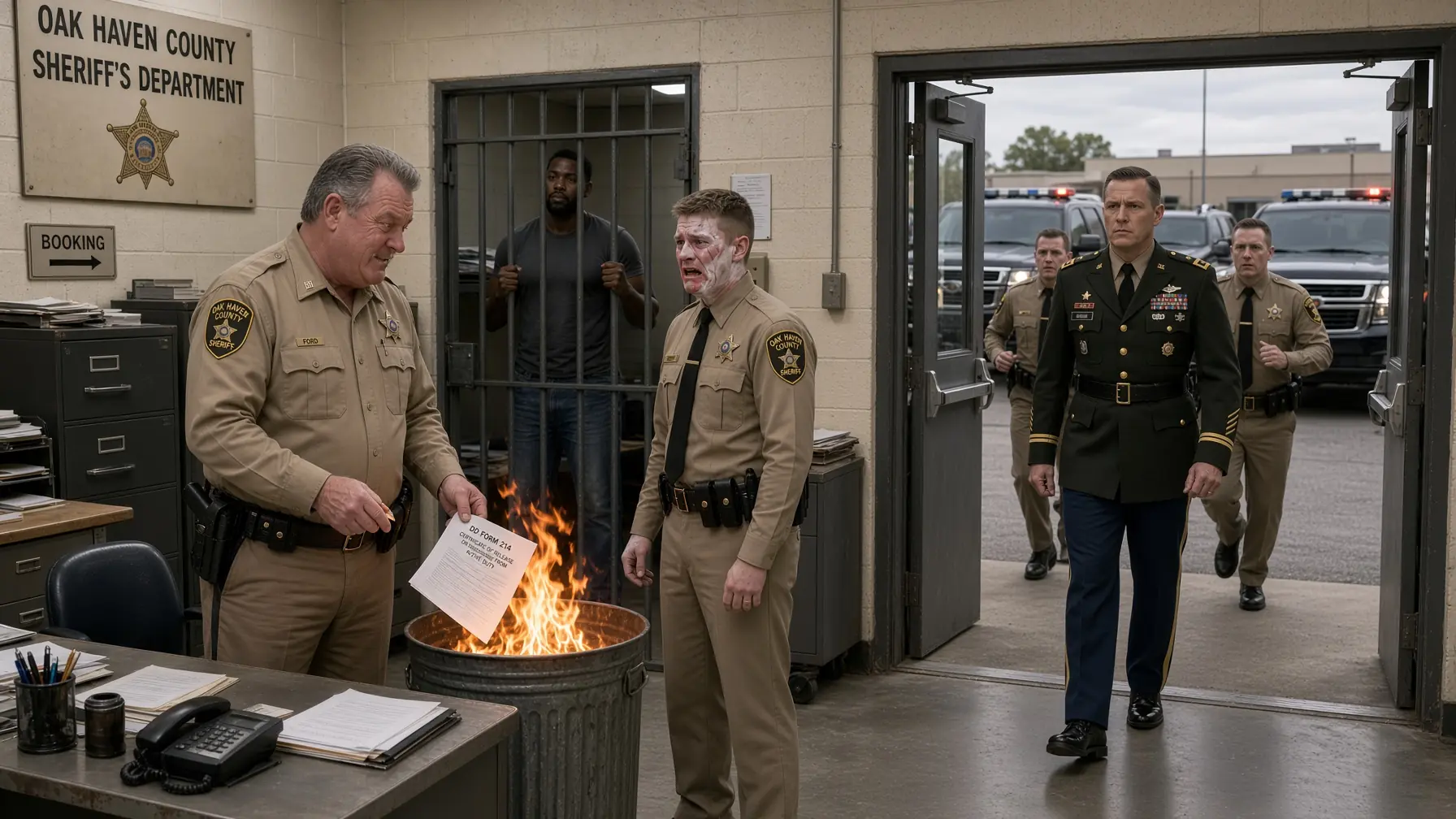
Arthur stood behind the bars of holding cell two and watched the smoke rise toward the fluorescent lights.
He did not shout.
He did not lunge at the door.
He did not beg Ford to save what remained.
At thirty-six, Arthur had spent too many years in places where one emotional movement could turn a bad situation into a fatal one. He had learned to let angry men hear silence and mistake it for weakness.
So he simply looked at the sheriff.
“No, Sheriff.”
Ford’s smile remained.
Arthur nodded toward the burning paper.
“Now they know exactly where I am.”
Deputy Tommy Riggs shifted beside the booking desk.
The twenty-six-year-old deputy had been uncomfortable since the traffic stop. Now he looked genuinely afraid.
Ford laughed.
“You think the Army’s coming to rescue you?”
Arthur glanced at the clock above the booking room door.
3:42 p.m.
He had been scheduled through the outer gate of Black Ridge Technical Annex at 3:25.
The facility was thirty-one minutes from where Ford had stopped him and less than twenty from the sheriff’s station by the county road.
Arthur had checked in electronically before entering Oak Haven County.
He had not checked out.
He had not arrived.
And unlike Ford, the people waiting for him understood exactly what the long silence meant.
Arthur looked back at the sheriff.
“I’m not in the Army anymore.”
Ford spread both hands.
“Then what exactly am I supposed to be afraid of?”
Arthur said nothing.
That bothered Ford more.
It had bothered him from the beginning.
Two hours earlier, Arthur had been driving a clean Ford F-150 through the pine country of southern Georgia with the air conditioner humming low and both hands relaxed on the wheel.
State Route 119 was almost empty.
Pine trunks flashed past in straight dark columns. Red clay shoulders baked under the August sun. Every few miles there was a church, a feed store, or a faded political sign left standing long after whatever election it advertised had ended.
Arthur was not sightseeing.
He was working.
Not military work exactly.
He had left active duty fourteen months earlier after twelve years in Army special operations. His discharge was honorable. His awards were real. The scars on his left thigh and right shoulder were real too, though none of that made him more entitled to constitutional protection than anyone driving the same road.
Now Arthur worked for Meridian Defense Systems, a private contractor supporting secure communications and survivability testing for the Department of Defense.
The assignment that afternoon was unusual enough that he carried physical backup documentation.
Passport.
Military retiree identification.
Commercial contractor credential.
A certified copy of his DD-214.
And a packet of heavily redacted travel and access documents connected to Black Ridge Technical Annex.
The packet contained no operational plans.
No classified target information.
No secret weapons specifications.
It was mostly the kind of material security officers needed when moving between controlled facilities.
Names.
Authorization numbers.
Contract references.
Access windows.
Distribution codes.
Numbers that meant almost nothing to civilians.
Arthur kept them inside a brown leather portfolio on the passenger seat.
He did not think of the papers as powerful.
They were paperwork.
Necessary.
Boring.
Proof that bureaucracies love almost as much as signatures.
At 3:02, red-and-blue lights appeared in the rearview mirror.
Arthur checked his speed.
Fifty-three in a fifty-five.
He glanced at the mirrors.
No equipment problem visible.
He signaled.
Pulled onto the shoulder.
Put the truck in park.
Turned off the engine.
Rolled down the window.
Hands on the wheel.
No sudden movements.
No attitude.
No gift to fear.
The marked Oak Haven County cruiser stopped twenty feet behind him.
Sheriff Clayton Ford stepped out.
Arthur recognized the rank before the man.
Most sheriffs in counties this small did not personally work routine traffic unless they wanted to.
Ford was fifty-eight, heavy through the middle, with mirrored aviators and a tan uniform pulled tight across his stomach. His campaign hat remained on the passenger seat. He walked toward the pickup with one hand hanging near his pistol.
Deputy Tommy Riggs came behind him.
Young.
Thin.
Careful.
He did not mirror Ford’s posture.
Arthur noticed that.
He noticed everything.
Ford leaned toward the open window.
“You’re a long way from the interstate, boy.”
The word was soft.
Deliberate.
Arthur looked at him.
“Afternoon, Sheriff.”
“License. Registration. Insurance.”
“May I ask the reason for the stop?”
Ford’s mouth shifted.
“I just gave you three things to do.”
Arthur did not argue.
He reached slowly toward the glove compartment.
“My registration is in here.”
Ford watched his hands.
Arthur removed the documents.
The insurance card was digital, but he carried a printed copy.
Then Ford looked through the window.
The brown portfolio sat on the passenger seat.
“What’s that?”
“Work documents.”
“What kind of work?”
“Government contracting.”
Ford took Arthur’s driver’s license.
“Government.”
“Yes.”
“What government?”
Arthur looked at him.
“Federal.”
Ford laughed once.
“Of course.”
Riggs looked toward the back of the truck.
Nothing unusual.
No cargo.
No broken light.
No damaged plate.
Ford tapped Arthur’s license against his palm.
“Where you headed?”
“Work site.”
“Where?”
Arthur hesitated.
Black Ridge did not appear under that name on ordinary public maps.
The access instruction specifically told contractors not to identify the facility casually.
“An authorized facility north of here.”
Ford leaned closer.
“You getting smart with me?”
“No.”
“Sounds like it.”
Arthur remained still.
“You asked where I’m going. I’m telling you I’m headed to a restricted work site.”
“What’s the address?”
“I can provide a verification contact if necessary.”
Ford straightened.
“Step out.”
Riggs looked toward him.
“Sheriff?”
Ford did not take his eyes off Arthur.
“Out of the vehicle.”
Arthur said, “Am I being cited for something?”
“Step out.”
Arthur opened the door slowly.
Ford moved backward.
“Hands where I can see them.”
“They’re visible.”
Arthur stepped down.
Ford looked at him fully for the first time.
Arthur was six feet one, lean, broad through the shoulders, dressed in khaki work pants, a gray polo, and hiking boots.
Ford’s eyes moved to a faint scar near Arthur’s wrist.
Then to the truck.
Then back to the portfolio.
“What’re you hiding in the bag?”
“Nothing illegal.”
“Then give it to me.”
“No.”
That answer changed the afternoon.
Ford took off his sunglasses.
“What did you say?”
“With respect, Sheriff, you have my license, registration, and insurance. I don’t consent to a search of private federal work documents.”
Riggs inhaled.
Very quietly.
Ford heard him anyway.
“You got something to say, Deputy?”
“No, sir.”
Ford looked back at Arthur.
“You people watch too many lawyer videos.”
Arthur remained calm.
“What people?”
Ford’s jaw shifted.
“Smartasses.”
Arthur nodded once.
“If I’m being detained, please tell me why.”
Ford pointed toward the hood.
“Turn around.”
“For what?”
“Now.”
Arthur understood something then.
This was no longer about discovering what had happened.
Ford had decided that being questioned was itself suspicious.
Arthur turned.
Placed his hands where instructed.
Ford frisked him aggressively.
Wallet.
Phone.
Belt.
Ankles.
Nothing.
Ford pulled the phone from Arthur’s pocket.
Arthur looked over his shoulder.
“I do not consent to you searching that.”
Ford smiled.
“You planning on suing me?”
“No.”
“Everybody says that before they find out lawyers cost money.”
Riggs came closer.
“Sheriff, his license is probably enough to run him.”
Ford snapped, “Run it.”
Riggs returned to the cruiser.
Ford walked toward the pickup.
Arthur straightened slightly.
“Sheriff, I’m stating clearly that you do not have consent to enter the vehicle.”
Ford opened the passenger door.
“I heard you.”
“That portfolio contains controlled work material.”
“Then maybe you should’ve been more cooperative.”
He picked it up.
Arthur’s voice hardened.
Not louder.
“Put it down.”
Ford looked back.
There was a new quality in Arthur’s voice now.
Not fear.
Not pleading.
Command without performance.
Ford hated it.
“What exactly are you going to do?”
“Document that I told you not to open it.”
Ford unfastened the portfolio.
Riggs returned.
“Sheriff.”
“What?”
“License is valid. Truck’s registered to him. Insurance current. No warrants. No criminal wants.”
Ford did not stop opening the portfolio.
Riggs continued.
“Nothing comes back.”
Arthur looked at Ford.
“That should matter.”
Ford pulled out the first document.
Passport.
Then military identification.
Then the certified discharge record.
His expression changed.
He looked from the paper to Arthur.
“You were Army?”
“Yes.”
Ford read.
The form contained years of service, separation status, decorations, occupational codes, and other records.
His eyebrows lifted.
“Silver Star.”
Arthur said nothing.
“Bronze Star with Valor.”
Still nothing.
“Special operations.”
Ford gave a slow smile.
“You expect me to believe all this?”
Arthur stared at him.
“You can verify it.”
Ford looked at Riggs.
“You buy this?”
Riggs said carefully, “The military ID looks real.”
Ford flipped to the transit packet.
The top page bore Department of Defense markings, a contract reference, routing information, and a clear warning:
FEDERAL CONTRACT TRANSIT DOCUMENT — CONTROLLED DISTRIBUTION
The sensitive portions were redacted.
Ford stared at the page as though the unfamiliarity itself made it fake.
“What is Black Ridge?”
Arthur did not answer.