She picked her wages up from the mud, coin by coin, while the richest man in Willow Creek watched from across the street and said nothing. Every woman in town had dressed their finest to make Ethan Callahan look their way. But he could not take his eyes off the one on her knees in the dirt, the one nobody else bothered to see. That was the summer everything in Willow Creek changed. And it all started the night he saved his first dance for the woman they all looked past.
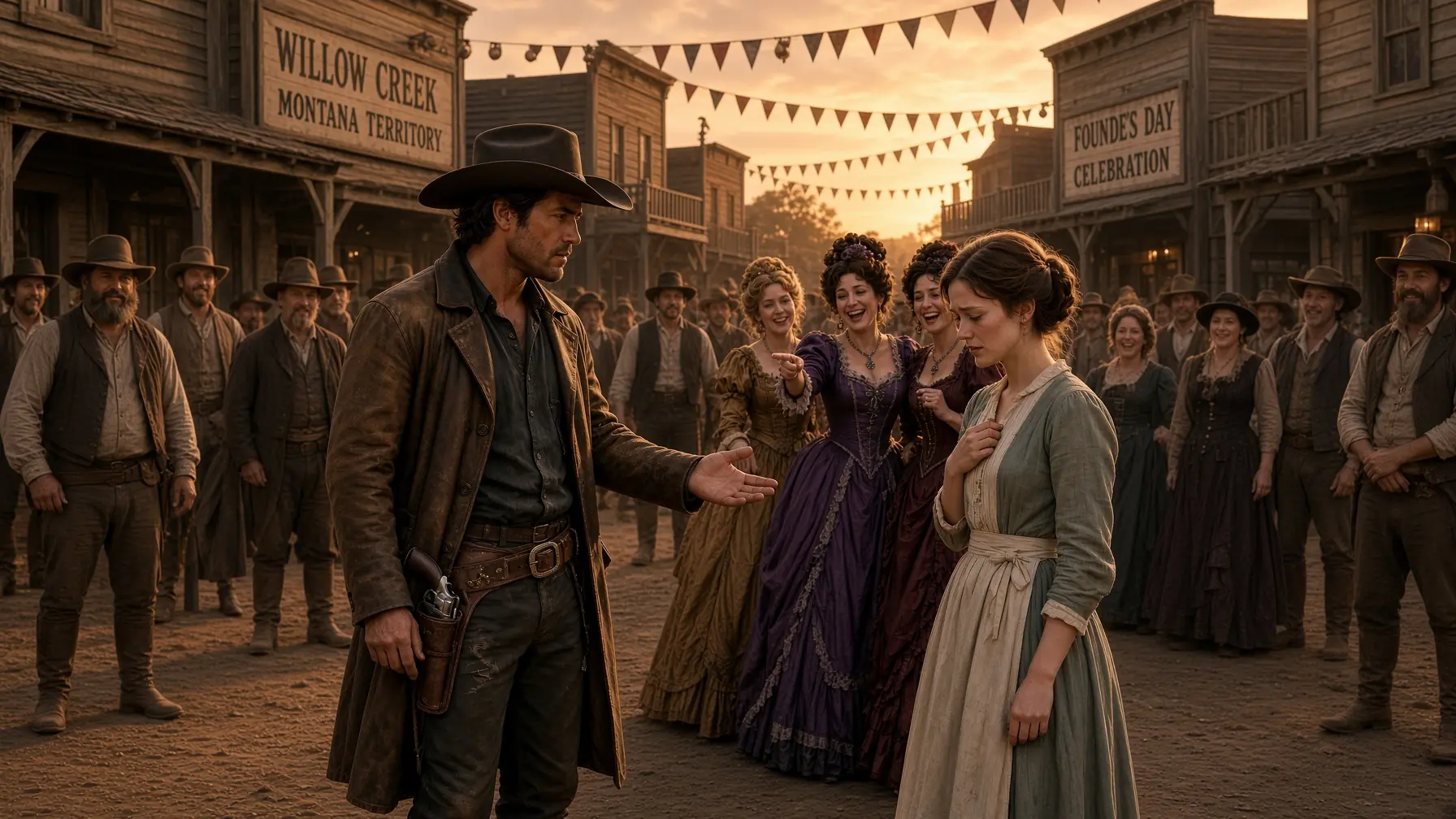
The summer of 1882 came to Willow Creek, Montana territory like it always did. Hot, loud, and full of people pretending to be something they weren't. The annual Founders Day Festival had transformed the main street into a carnival of ambition. Ribbons hung from every post. The smell of roasted corn and fresh pie drifted through the air.
Fiddle music spilled out of the saloon doors before noon, which meant the whiskey was already doing its job on the men who had nothing better to do than stand around and watch other people work. And in Willow Creek, the most watched man of the entire summer was Ethan Callahan. He was 35 years old, tall in the way that filled a door frame without trying with dark brown hair that curled slightly at the collar, and deep brown eyes that didn't miss much. His hands were rough from real work, not the decorative kind of rough that men performed for appearances, but the genuine kind that came from repairing fence lines at first light, and pulling cattle out of creek mud in the cold. He had inherited the Callahan ranch from his father two years prior, and what his father had built into something respectable, Ethan had quietly doubled.
I was not a man who announced himself, which was precisely why everyone in Willow Creek could not stop watching him. The Beaumont sisters had stationed themselves near the lemonade stand by 9 in the morning. Margaret Holloway, whose father owned the grain mill, had worn her best ivory dress with the pearl buttons, the one she saved for church and funerals. Even old Reverend Tate's niece, who had arrived only two weeks ago from St. Louis, with a trunk full of fashionable hats, had managed to position herself directly in the path Ethan would most likely walk.
They all wanted the same thing. Not Ethan exactly, or at least not the man behind the name. They wanted the ranch, the land deed, the future that came attached to the Callahan name like a second shadow. Ethan Callahan knew this. He had known it since he was 19 years old.
And a girl named Rebecca Sinclair had kissed him behind the feed store and then the following week asked his father how many acres the family owned. He had learned to read the difference between a woman who looked at his face and a woman who was calculating something behind her eyes. He had stopped looking for warmth in places that only offered transaction. By 10:00, he had exchanged polite words with six women, tipped his hat to four more accepted two slices of pie. He didn't particularly want and maneuvered himself to the far end of the street where the vendor stalls thinned out, and the noise dropped to something manageable.
That was where he saw her, not immediately. Not the way stories were supposed to happen with a shaft of golden light or a sudden stillness in the crowd. He saw her the way a man sees something that doesn't quite fit the picture around it. A detail that pulls at the corner of his attention until he can't pretend it isn't there. She was standing behind a table of ribbon spools and fabric samples at the far edge of the market, arguing quietly with a woman in an expensive green dress.
The woman in green had the particular posture of someone who had never once in her life been told no, and had therefore never developed any tolerance for it. "The work was shoddy," the woman in green was saying, loud enough that the people nearby could hear if they chose to. The hem on the second dress came loose after one wearing Miss Whitfield. I will not pay full price for careless work. The young woman behind the table, Clara Whitfield.
Ethan would learn her name within the hour. Did not raise her voice. She was perhaps 26, with soft brown hair pulled back, practical and plain, beneath a simple calico bonnet, and she wore the kind of clothes that announced poverty without apology. Her eyes were warm and steady the color of creek water in summer. And when she spoke, she spoke with the controlled precision of someone who had learned that anger was a luxury she could not afford.
"Mrs. Aldridge," she said, "I reinforced that hem three times before delivery. I would be glad to repair it again at no charge, but I cannot return payment for work that was completed to the terms we agreed on. " Margaret Aldridge, wife of Willow Creek's most prosperous merchant, made a sound in her throat that suggested she found the response deeply offensive. "You cannot return it," she repeated, as though tasting the words and finding them bitter. "That is remarkable audacity from someone in your position, Miss Whitfield.
Do you have any idea how many women in this town would love to have my business? "Yes, ma'am," Clara said. "I imagine several of them would. You're welcome to take it to them. " The silence that followed that sentence was the kind that had weight. Margaret Aldridge's face went through several colors.
The women standing nearby stopped pretending they weren't watching. Two of them exchanged a look that was equal parts alarm and poorly concealed delight. "You ungrateful little—" Mrs. Aldridge stopped herself, drew a breath, and reached into her purse. She pulled out a handful of coins and dropped them onto the table.
Not placed. Dropped. Several rolled off the edge and fell into the dirt of the street below. "That is half," she said. "For half the quality I received, and you'll be grateful for that much. " She turned and walked away before Clara could respond.
Clara stood there for a moment. She looked at the coins on the table. She looked at the ones in the dirt. Her jaw was set and her eyes were bright with something she was working hard not to let become tears. Then she walked around the table bent down to the dirt street and picked up every single coin with both hands.
She set them on the table beside the others. She counted them. She wrapped them in a piece of cloth. She tucked the cloth into her apron pocket. And then she looked up and she looked directly at Ethan Callahan.
She had no idea who he was. That much was immediately clear. He could see it in her face, the complete absence of the particular calculation that appeared in women's eyes when they recognized his name. She looked at him the way she might look at any stranger who had witnessed something she'd rather he hadn't, with a brief flicker of dignified irritation, and then she looked away. "Something I can help you with? " she asked, already reaching for a bolt of fabric that needed refolding.
"No, ma'am," he said. "Then you're welcome to move along. " He almost smiled. "Yes, ma'am. " He didn't move along. Not immediately. He stood there another moment watching her organize her table with the focused efficiency of someone who had 20 things to do and had just been handed an interruption.
She didn't have time for and he felt something turn over in his chest that he hadn't felt in a very long time. It wasn't attraction exactly. Not yet. It was recognition. The recognition of someone who had also learned at some point to do hard things without asking for applause.