The diner smelled like burnt coffee and old grease that October evening in Ashfield, Iowa. 15 Hells Angels filled the booths, leather jackets, hard faces, the kind of men most folks crossed the street to avoid. And standing in the middle of it all was a waitress, 38 years old, tired eyes, an apron stained from a double shift. Her name tag said Delia. She had a coffee pot in her right hand.
Her left hand was shaking. But her voice, her voice was steady as a church bell. She pointed that finger right at the biggest man in the room, the one everyone called Preacher, the one with the president's patch on his cut, and she said 11 words that changed everything. "Shout at me again, mister, and you're done in this diner."
The whole place went quiet. You could hear the clock tick. You could hear a young biker at the counter swallow hard. 30 men who had ridden across three states, men who had faced down SWAT teams and crooked cops and worse, all of them watching this little waitress with her shaking hand and her steady voice. And then Wade Caldwell, 68 years old, stood up from his booth.
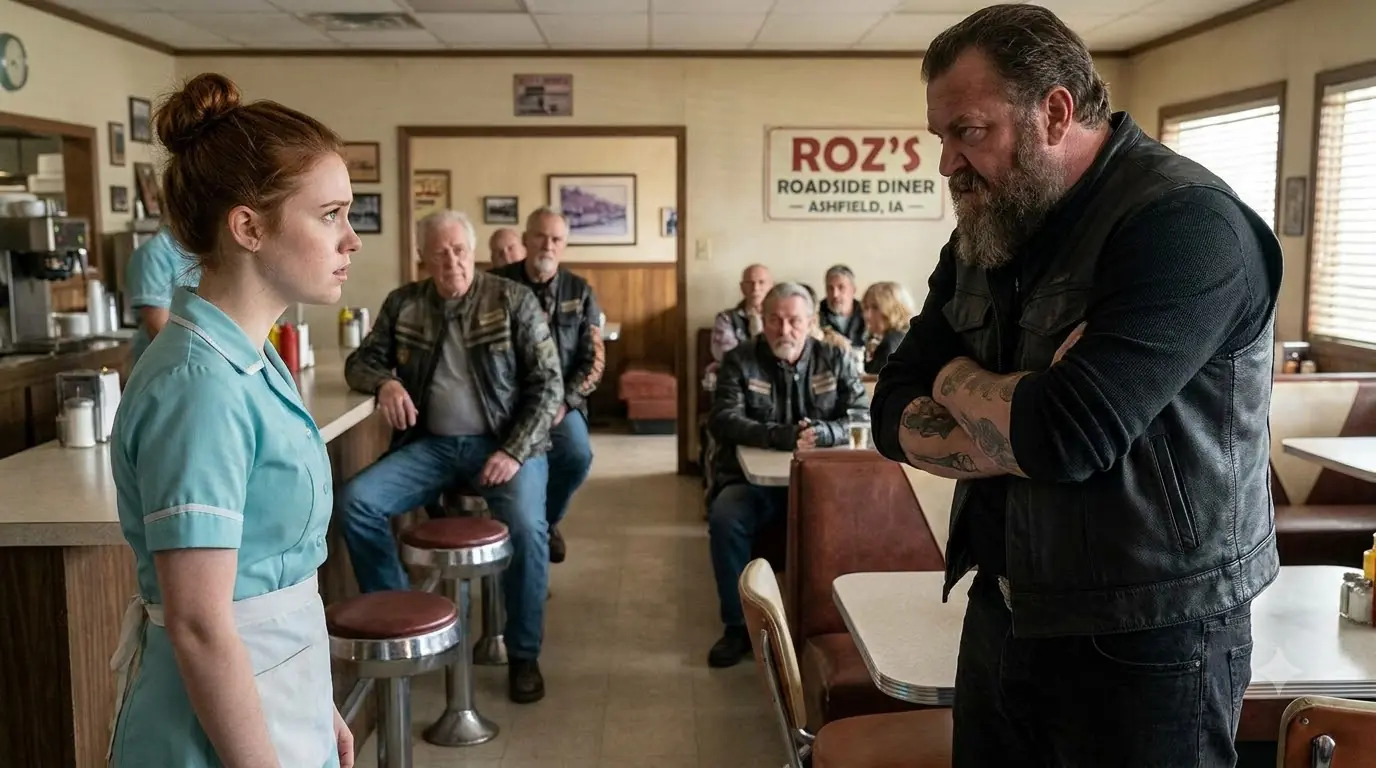
What he did next, nobody in that diner ever forgot. Not the bikers, not the cook, not the old widow Roz Kowalski who owned the place. Because sometimes the toughest man in the room is the one brave enough to bow his head. This is that story.
The alarm clock went off at 4:45. Delia Brennan reached out from under the quilt and slapped it quiet. She lay there a moment, looking at the water stain on the ceiling, counting the days until rent was due. Seven days. She had $83 and some change in the coffee can by the fridge.
Rent was 650. The math didn't work. It hadn't worked for a while now. She swung her feet onto the cold floor.
Her back ached. Both knees popped when she stood. 38 years old and already she felt like her mama had looked at 60. That was what serving plates for 14 hours a day did to a woman. The house was a little two-bedroom on the edge of town.
Peeling blue paint, a porch that sagged on the left side, the kind of house folks drove past and didn't notice. But to Delia it was home, and more important, it was Ezra's home. She tiptoed down the hall past the picture of her father Sean gone 5 years now. Past the old cross her mother had hung by the door before cancer took her in 2003.
Past the bathroom with the leaky faucet she couldn't afford to fix. And she stopped outside Ezra's door. She always stopped there, just to listen. Some mornings she could hear him crying in his sleep. Some mornings he was yelling at men who weren't there.
Men in a country on the other side of the world. Men he had been trying to save when an IED took his leg and most of his mind with it. This morning Ezra was quiet. Delia pressed her palm flat against the door, closed her eyes, whispered the same prayer she whispered every morning. "Lord, give him one good day, just one.
That's all I'm asking." Then she opened the door. Ezra was 34 years old. He had been 26 when he came home from Afghanistan. That was 2011, 8 years ago.
Sometimes Delia felt like it had been yesterday. Sometimes she felt like Ezra had been this way forever and she had just forgotten what he used to be. The wheelchair sat by his bed. His prosthetic leg leaned against the wall. He slept with his back to the door.
He always slept with his back to the door now. Something a counselor had tried to explain to her once about hypervigilance. Delia didn't understand the word, but she understood her brother. "Ezra," she said softly, "Ezra, honey, time for your meds." He didn't move.
"Ezra." His shoulder twitched. Then he rolled over. And for a half second before his eyes focused on her, she saw the man he used to be then, the 20-year-old boy who had kissed her on the forehead before he shipped out, who had told her, "I'll be back, D. I promise."
Then his eyes cleared and that boy was gone. The man who came back was the man she knew now. "Morning, D," he said. His voice was rough. "Morning, soldier."
She set the pill tray on his nightstand. Four pills, two for the pain, one for the nerves, one for the dreams. "You sleep, okay?" "Same as always." "So, no?"
He almost smiled. Almost. She helped him sit up. He didn't like being helped, but he needed it and they both pretended otherwise. "I'm working a double today," she said.
"I'll be home around 11." "You work too much." "Rent's due." He looked down at his hands, those big scarred hands that used to carry a rifle and now couldn't even button his own shirt on the bad days. "I'm sorry, D."
"Hey." She sat on the edge of the bed, took his face in her hands, made him look at her. "Don't you ever. Ezra Brennan, you listen to me. You gave your leg for this country.
I can give you a few shifts at Roz's. That's how it works. That's how family works." He nodded, but she saw the water in his eyes. She pretended not to.
The car had died in August. Delia couldn't afford to fix it. She couldn't afford to replace it. So most mornings she walked, 2 miles from her little blue house to Roz's Roadside Diner out on Highway 20. October in Iowa was a mean month.
The wind came down off the prairie with nothing to slow it. It smelled like cold earth and dying corn. By the time she reached the diner, her ears burned and her fingers were stiff inside her thin gloves. But she walked every morning, 5 days a week, sometimes six, because what else was she going to do? "Stop."
Her mama had a saying. "Feet that stop walking are feet that start giving up." Delia Brennan had never been one to give up. Not when her mama died, not when her daddy died, not when they rolled Ezra off that C-17 at Dover Air Force Base in a wheelchair with a folded flag in his lap and nothing but screaming in his head. Not now.
Not ever. She crossed the gravel lot at Roz's at 10 minutes to 6:00. The neon sign in the window said open in faded red letters. She let herself in the back door. "Morning, Roz."
The old woman at the grill grunted. Roslyn Kowalski was 79 years old and she had been running that diner since 1968. She had buried a husband. She had buried a son. She had buried more friends than she cared to count.
And she had never missed a morning behind that grill, not once. "You walked again," Roz said. Not a question. "Good for the legs." "Good for nothing.
It's 28° out there." "I'm fine." Roz turned around slow. She was a small woman, silver hair in a tight bun, a face like a road map of every hard year she had ever lived. "Child," she said.