The third time Officer Mason Trent demanded her identification, the woman still did not move.
“Ma’am, I said show us your ID.”
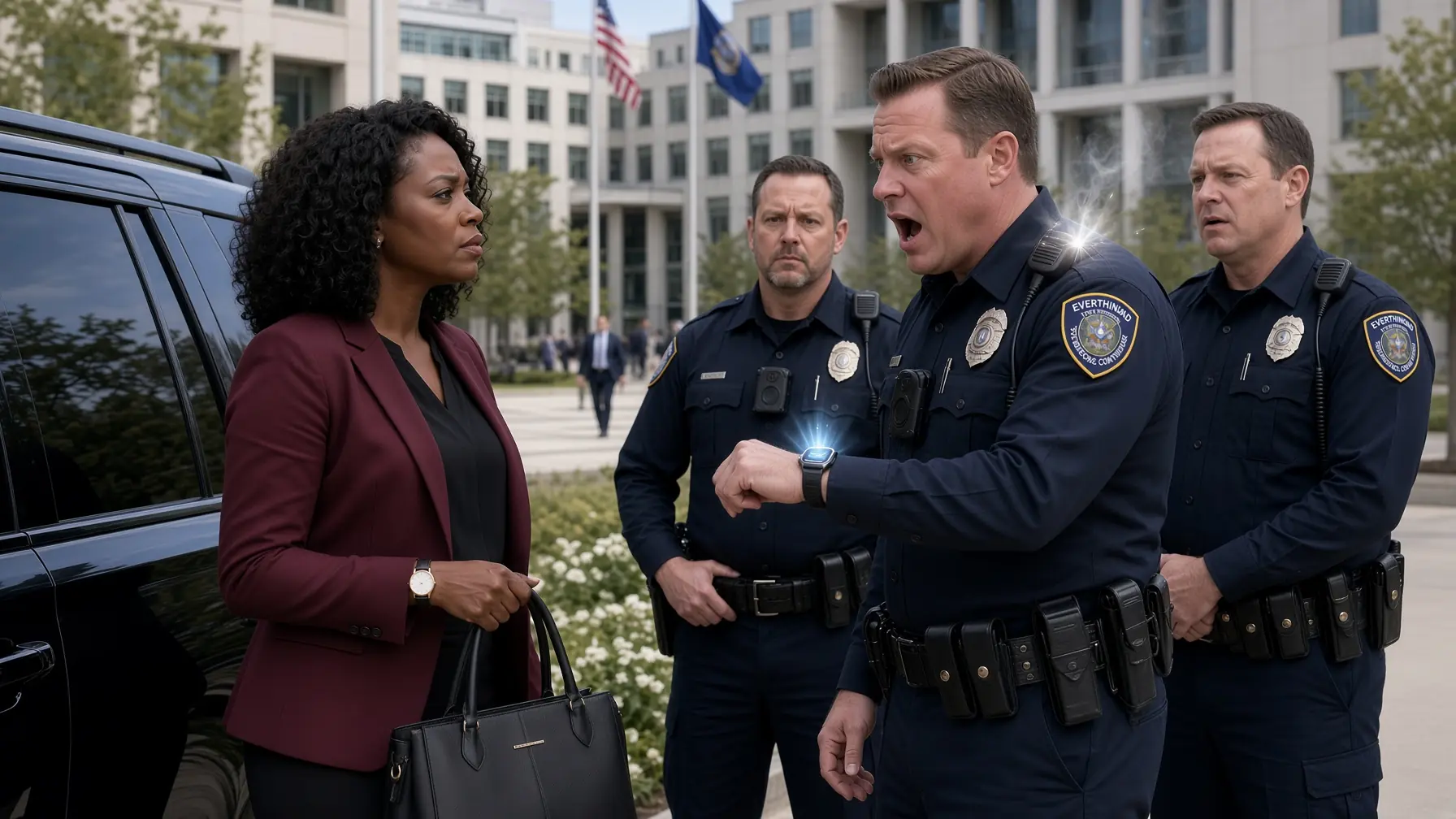
Dr. Renee Marshall stood beside a bus shelter on the corner of Grant Avenue and East Ninth Street with a leather notebook tucked beneath one arm.
She was fifty-one years old.
Black.
Five feet seven.
Gray wool coat.
Flat shoes.
No purse.
No visible badge.
Nothing about her appearance suggested she was dangerous.
Nothing about her behavior suggested she was doing anything at all.
She had been standing there for approximately twenty-three minutes.
Watching.
Writing.
Occasionally checking her watch.
That was enough to bother Mason.
He stepped closer.
“You deaf?”
Renee slowly lifted her eyes from the notebook.
“No.”
“Then give me identification.”
“Why?”
Mason gave a short laugh.
His partner, Officer Luke Barrett, stood several feet behind him near their cruiser.
A third officer, Tyler Nash, had just finished questioning a young man beside the curb.
The young man was Black, perhaps nineteen or twenty, wearing a grocery-store uniform and carrying a backpack.
His identification had already been checked.
His bag had been opened.
His pockets had been emptied onto the hood of a patrol car.
He had done nothing wrong.
Renee knew that because she had watched the entire encounter.
She also knew something the officers did not.
Their stop had been selected for observation that morning.
Not by the media.
Not by Internal Affairs.
By a federal court.
Mason pointed at Renee’s notebook.
“You’ve been standing here writing things down and watching officers conduct enforcement activity.”
“That’s correct.”
“That’s suspicious.”
Renee tilted her head slightly.
“Writing is suspicious?”
“Don’t play games.”
“I asked a question.”
Mason stepped closer again.
“We’ve had complaints about people interfering with traffic enforcement.”
“I have not interfered.”
“You’re monitoring us.”
“Yes.”
The honesty surprised him.
His expression hardened.
“Who are you with?”
Renee said nothing.
Mason looked toward Barrett.
“See?”
Barrett shrugged.
Renee noticed that too.
The shrug.
The look.
The small communication between officers deciding that her refusal to volunteer information had become evidence of something.
Mason turned back.
“Last chance. ID.”
Renee closed the notebook.
“Am I being detained?”
There was a pause.
A small one.
But important.
Mason had heard that question before.
People who asked it usually knew enough law to become inconvenient.
“We’re investigating suspicious behavior.”
“What crime do you suspect me of committing?”
“You don’t get to interrogate me.”
“I’m not.”
Her voice remained calm.
“I’m asking why a police officer is demanding identification from me.”
Mason looked around.
A city bus rolled past.
People stood outside a coffee shop across the intersection.
Several pedestrians had begun watching.
The young grocery worker remained near the cruiser, still waiting for permission to leave.
Mason lowered his voice.
“You need to understand something.”
Renee waited.
“This neighborhood has had problems.”
“With what?”
“People coming in from outside the area.”
Renee looked down Grant Avenue.
Apartment buildings.
A laundromat.
Two small restaurants.
A pharmacy.
A daycare center.
The neighborhood was mostly working-class and heavily Black and Latino.
“What does outside the area look like?”
Mason frowned.
“You know exactly what I mean.”
“No.”
She opened the notebook again.
“I’d like you to explain it.”
That was when his patience disappeared.
“Put the notebook down.”
Renee looked at him.
“Why?”
“Put it down.”
She did not.
Officer Barrett walked closer.
“Mason.”
“What?”
“Maybe just run her name.”
Mason looked back at Renee.
“She won’t give it.”
Barrett sighed.
“Ma’am, this is going to go a lot easier if you just cooperate.”
Renee looked at him.
“I am standing on a public sidewalk.”
“Yes.”
“I have not obstructed an arrest.”
“No.”
“I have not entered a restricted area.”
“No.”
“I have not threatened anyone.”
“No.”
“Then what exactly would cooperation require?”
Barrett had no immediate answer.
Mason did.
“Identification.”
Renee nodded once.
“So we are back where we started.”
Mason took one more step forward.
Now less than three feet separated them.
“Show us your ID.”
His voice was loud enough for several people across the street to hear.
Renee studied his face.
Then glanced toward the red light on his body camera.
“Is that recording?”
Mason looked down instinctively.
“Yes.”
“Good.”
Something about that answer unsettled him.
“You planning to file a complaint?”
Renee’s expression did not change.
“I haven’t decided what I’m planning.”
Mason laughed.
“You people always think saying bodycam means something.”
There it was.
Renee said nothing.
He heard himself too late.
“You people?”
Mason’s jaw tightened.
“You know what I mean.”
“No.”
Her pen moved across the notebook.
“What are you writing?”
Renee looked down.
“Your exact words.”
Mason reached toward the notebook.
Renee moved it backward before he could touch it.
His expression changed instantly.
“Don’t pull away from me.”
“You reached for my property.”
“Put it on the hood.”
“No.”
“That’s a lawful order.”
“Under what authority?”
Mason’s face reddened.
Officer Nash had now joined them.
“What’s happening?”
Mason pointed at Renee.
“She’s been surveilling us and refuses to identify herself.”
Nash looked at her.
“Press?”
“No.”
“Attorney?”
Renee almost smiled.
“Why?”
“You ask questions like one.”
Mason interrupted.
“She could be involved with one of these activist groups.”
Renee looked at him.
“Is membership in an activist group illegal?”
“That’s not what I said.”
“You brought it up as justification for demanding identification.”
Mason stared.
Officer Nash looked uncomfortable.
Across the street, someone raised a phone.
Mason noticed.
His shoulders stiffened.
Then he said the sentence that changed everything.
“Fine. Put your hands behind your back.”
Renee remained still.
“Am I under arrest?”
“You are being detained until we establish who you are.”
“For what suspected offense?”
“Failure to identify.”
Renee’s eyes sharpened.
“To my knowledge, this state does not criminalize a pedestrian’s refusal to identify herself absent a lawful detention based on reasonable suspicion.”
Mason gave a bitter smile.
“There it is.”
“What?”
“The lawyer act.”
Renee said nothing.
Mason reached for her arm.
She stepped backward once.
Not fast.
Not aggressive.
Enough to avoid being grabbed.
Officer Nash said:
“Hold up.”
Mason turned.
“What?”
“She’s not going anywhere.”
“She just pulled away.”
“She stepped back.”
“Same thing.”
“No, it isn’t.”
Renee watched the exchange carefully.
The difference between those two sentences was exactly why she was there.
She stepped back.
He called it pulling away.
A neutral action had already begun transforming into resistance.
Mason turned toward her.
“Hands behind your back.”
Renee looked at Officer Nash.
“Are you participating in this detention?”
Nash hesitated.
Mason snapped: