The woman’s scream hit Marcus before he even touched the door handle. He had heard plenty of strange things in twelve years of running an auto repair shop. Engines that wheezed like dying men, transmissions that screamed like wounded animals, but nothing like this. Nothing human.
Nothing inside his shop at seven o’clock in the morning when the doors were supposed to be locked.
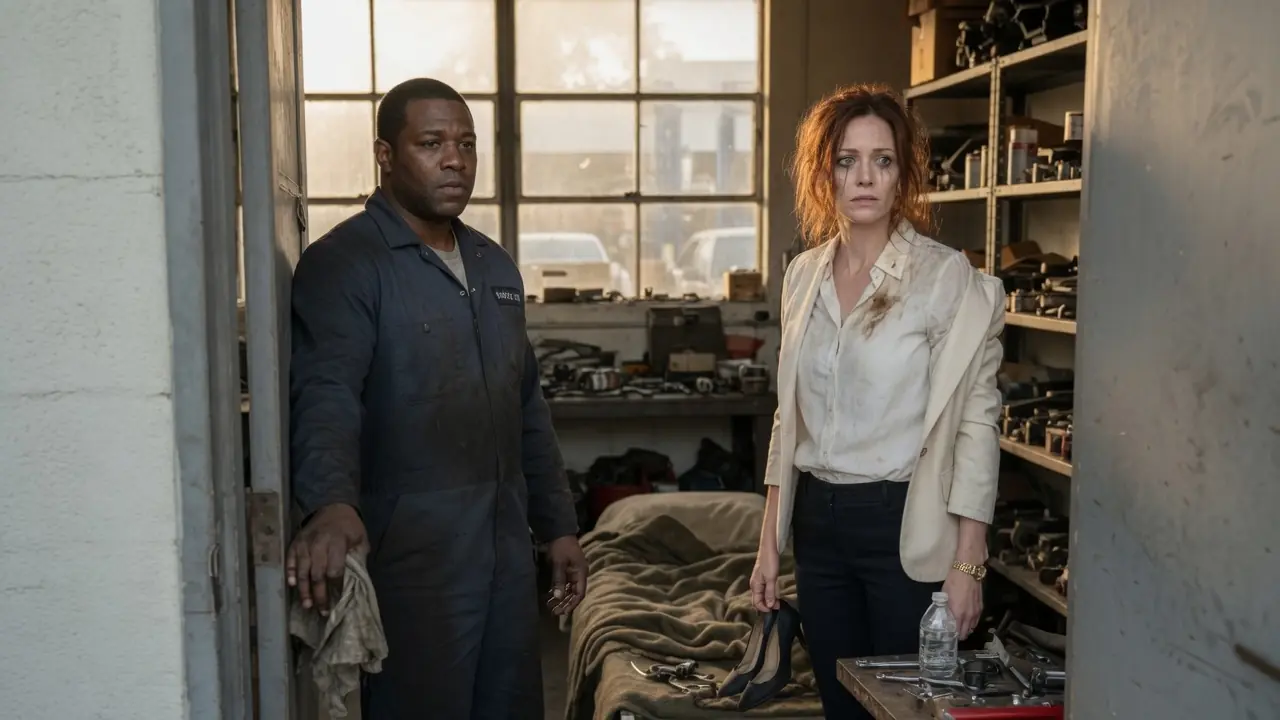
Marcus shoved the door open with his shoulder, grease rag still in his hand, and froze. She was standing behind the parts shelf in the far corner. Tall, fair-skinned, auburn hair undone, blazer half on, one arm threading through the sleeve with the frantic speed of someone caught somewhere they were not supposed to be.
Her pale green eyes locked onto his, and for a full three seconds neither of them moved. She was wearing yesterday’s clothes. He could tell because there was a dried coffee stain on the collar of the white shirt underneath her blazer. Her heels were in her hand, not on her feet.
Her mascara had tracked thin lines down both cheeks, and her expression had gone from shock to fury in the time it took him to blink.
“Who are you?” she demanded, as if he were the one who had broken in.
Marcus looked around. The small cot he kept in the back office, the one his daughter Zoe used when she was too sick for school and he could not close the shop, had been slept in. The wool blanket was bunched at the foot of it. A pair of car keys sat on his workbench next to an empty water bottle.
His water bottle, which had been full the night before.
He looked back at the woman.
“I’m Marcus Webb,” he said slowly. “I own this shop.”
She blinked. Something crossed her face too fast to read, and then the fury came back because that was easier. He could see it happen in real time.
She straightened. She put her heels on the floor, stepped into them with practiced precision, and tucked a loose strand of auburn hair behind her ear.
“The door was unlocked,” she said.
“It wasn’t.”
A pause.
“The side door.”
Marcus almost said something about the side door, about the lock he had been meaning to fix for six weeks, about how that was on his list between replacing the hydraulic seal on bay two and buying Zoe new school shoes, but he stopped himself. Because this woman was standing in his shop at seven o’clock in the morning, fully dressed now except for a dignity she was clearly fighting to reconstruct, and something about the way she was holding herself told him her night had been far worse than his morning.
“Are you hurt?” he asked instead.
That stopped her. She had been about to say something sharp. He could see the words forming, but his question derailed her entirely. She looked at him like he had asked in a foreign language.
“No,” she said, quieter.
“You need coffee.”
Her name was Diana Hartwell. He did not know that yet. What he knew in those first twenty minutes was that she took her coffee black, she sat on the edge of the stool like she was not sure she was allowed to stay, and she did not explain herself. Not even a little.
She sipped the coffee from the spare mug he kept for clients, the one that said World’s Okayest Mechanic, and she looked around his shop with the slow, measuring gaze of someone doing math in their head.
Marcus let her be. He had a Civic to finish before nine, and he was not in the habit of interrogating women who had clearly had a bad night. He had had enough bad nights himself to know that sometimes you just needed someone to not ask.
“How long have you had this place?”
“Twelve years,” he said without looking up.
“Before that?”
“Army, then community college, then this.”
She was quiet for a moment. He heard the stool shift.
“You built it yourself?”
“Me and my wife.”
He pulled a bolt, set it aside.
“Before she passed.”
The shop went very quiet.
“I’m sorry,” Diana said, and it was the first thing she had said that did not have armor around it.
“Three years ago,” Marcus said. “We’re okay, mostly.”
He meant himself and Zoe, though he had not mentioned Zoe yet. He did not know why he said we. Old habit, maybe, or the truth that grief does not halve itself when it has two people carrying it. It just finds a way to be shared.
Diana set the mug down. She picked it back up. She looked like she was deciding something.
“I was supposed to be in London yesterday,” she said finally. “Presentation to our European board. My flight was canceled. I know, small thing. And then my driver didn’t come, and then my hotel reservation was apparently given to someone else, and I couldn’t reach my assistant because she resigned last week.”
“My phone died at forty percent, which means there is something wrong with the battery, and I sat in my car for two hours in the parking lot behind this strip of shops before I saw the side door swinging open.”
She exhaled.
“So, I went in. Moved the car to the lot two blocks over so it wouldn’t get towed, set an alarm on my watch, and slept on your cot for four hours.”
Marcus straightened up and looked at her for the first time since he had started the Civic.
“Four hours isn’t a lot,” he said.
“No,” she agreed. “It isn’t.”
He grabbed his own coffee from the shelf. It was lukewarm. He drank it anyway.
“Your car’s two blocks over.”
“Yes.”
“What kind?”
She told him. He already knew from her keys. He had seen the logo. He did not say that.
“Battery on those models goes soft fast,” he said. “Draws power even when it’s off. You probably lost thirty percent overnight.”
She stared at him.
“I’ve had that car for eight months.”
“I know. It’s a known issue. You can bring it in. I can recalibrate the draw settings. Takes twenty minutes.”
She looked at him for a long moment. He went back to the Civic.
“Why are you being nice to me?” she asked.
Marcus thought about it honestly before answering.
“You didn’t take anything. You cleaned up after yourself. You put the blanket back. My wife used to say that you can tell everything about a person by how they treat a space that isn’t theirs.”
He shrugged.
“You treated it fine.”
Diana did not say anything for a long time. When he finally looked up again, she was staring at the far wall where Zoe had taped up a drawing, a crayon version of the shop, yellow and lopsided, with a small figure holding a wrench that was twice as tall as the figure itself.
“Your daughter?” she asked.
“Zoe. She’s eight.”
“She drew that?”
“Last year. Gave it to me for my birthday.” He paused. “Didn’t let me put it in a frame. Said it had to be taped so it looked casual.”
He did the air quotes with greasy fingers.
Diana laughed. It was sudden and unguarded, the way laughs are when they catch you off guard. And it changed her face completely. Loosened something behind her pale green eyes that had been wound tight since she had screamed at him in his own shop thirty minutes ago.
“She sounds like a person,” Diana said.
“She is. Best one I know.”
She left at 8:15. She took her coffee mug back to the sink, rinsed it, and placed it on the drying rack. She put forty dollars on the workbench.
“For the sleep,” she said, “and the coffee.”
Marcus shook his head. “I’m not taking that.”
“I broke into your shop.”
“You walked through a broken lock. There’s a difference.”
She left the forty dollars anyway. He did not stop her. He watched her walk out the front. She took the front door this time, and he went back to the Civic.
He thought about her for about ten minutes, which was nine minutes longer than he usually spent thinking about strangers. Then Zoe called to ask if he remembered her field trip permission slip was due today, and he spent the next two hours alternating between engine repair and the slow bureaucratic crisis of faxing a school permission form, which apparently still required an actual fax in the year they were living in.
He forgot about Diana Hartwell.
Mostly.
She came back four days later. He was under a pickup truck when he heard heels on the concrete. He rolled out, squinting in the morning light, and there she was. Different blazer, same posture, carrying two coffees from the cafe two blocks down that charged seven dollars for things Marcus could make at home for forty cents.
She held one out without preamble.
“I did some research,” she said. “You’re right about the battery draw. I also looked at reviews for this shop.”
Marcus sat up and took the coffee.
“Four point nine stars, sixty-eight reviews. Every single one mentions that you’re honest.” She said it like the word surprised her. “Nobody says fastest or cheapest or most technically impressive. They all say honest.”
He unscrewed the coffee lid. “That a compliment or an observation?”
“Both.”
She set her own coffee on the edge of the car hood without asking.
“I’d like you to look at my car.”
“Sure. Pull it around.”
She started to turn, then stopped.
“I’m Diana,” she said, like she had realized she had never told him. “Diana Hartwell.”
“Marcus Webb,” he said, which she already knew, but accepted with a slight nod, the kind you do when you are formalizing something informal.
He did not know who she was until after she left that day. He had fixed the battery draw, recalibrated the system, checked her tires while he was at it because the rear passenger was six PSI low, and she would never have noticed. He charged her eighty dollars.
She looked at the number like it offended her in a different way than she had expected.
“This should be more,” she said.
“That’s what it costs,” he said.
She paid, left, and Marcus Googled her on a whim an hour later, because her name was sitting in his head the way songs sometimes did.
He had to sit down.
Diana Hartwell was the CEO of one of the largest logistics and supply chain companies in the country. She had been on the cover of three business magazines in the last two years. She had a net worth the article described as substantial, and when Marcus looked at the actual number, it made him set his phone down and look at the wall for a full minute.
She had slept on his cot.
She had rinsed her mug.
She had left forty dollars for coffee.
She came back the following Tuesday, and the Tuesday after that. Not always for the car. The second visit was for a sound in the undercarriage that turned out to be a loose heat shield. The third was for nothing as far as Marcus could tell.
She sat on the stool, drank coffee, and asked him questions about the shop, about the army, about what it had been like to build something with someone else and then keep building after they were gone.
He answered because she asked like she actually wanted to know, not the way people sometimes asked about his wife with sympathy already stacked behind their eyes, but the way someone asks about architecture, curious about the engineering, respectful of the structure.
In return, she told him things in pieces. About the company, how she had inherited it from her father, who had built it from nothing and nearly dismantled it in the process. About London, which had eventually happened two weeks late and gone badly anyway. About her assistant, whose resignation had turned out to be a quiet catastrophe that was still unraveling.
“She wasn’t just an assistant,” Diana said one Thursday, watching him bleed the brakes on a Jeep. “She was… she was the person who knew everything. How I took my meetings, what I couldn’t stand, which clients needed to be handled delicately. Eight years.”
She paused.
“She didn’t quit. She was recruited by my VP of operations.”
Marcus stopped what he was doing.
“The VP poached your assistant.”
“And three other key staff, all in the same month.” Her voice was absolutely even. “He’s been building something, some kind of… I don’t know yet, a restructuring proposal, a hostile internal narrative. My board meeting is in six weeks, and I have less intelligence about my own company than I had three months ago.”
He looked at her.
She looked back.
“That’s not a car problem,” he said.
“No,” she agreed. “It’s not.”
“So why are you telling me?”
She thought about it for a moment, genuinely, not performing thought, but actually doing it.
“Because you know how to fix things,” she said. “Not for advice. I’m not asking for advice. I just think better when I’m talking, and you listen without trying to take over.”
He almost made a joke. He decided not to.
“Okay,” he said, and went back to the brakes.
She talked for another twenty minutes. He listened. By the end, she had the thing organized in her head. He could hear it shift, the way a diagnosis sometimes clicked into place mid-conversation.
She sat up straighter. She picked up her phone. She said, almost to herself, “He’s using the restructuring proposal as a cover. The real target is the Paris contract.”
She looked at Marcus like she had forgotten he was there.
“Thank you,” she said.
“I did nothing,” he said.
“I know. Thank you.”
She met Zoe for the first time on a Wednesday, when Zoe’s school had an early release day, and Marcus had no other option. Zoe came in at noon wearing her backpack, found Diana on the stool, and stared at her with the specific unfiltered assessment that only eight-year-olds and very tired adults can get away with.
“You’re pretty,” Zoe said. “Dad doesn’t usually have pretty customers.”
“Zoe,” Marcus said from under a car.
“He’s embarrassed,” Zoe told Diana, dropping her backpack next to the stool.
“I can hear you,” Marcus said.
“Good.”
Zoe climbed onto the second stool without being invited.
“I’m Zoe. What’s wrong with your car?”
“Nothing today,” Diana said. “I’m just visiting.”
Zoe looked at her very carefully.
“You’re visiting a car shop.”
“I like it here.”
Zoe seemed to accept this with the pragmatic flexibility of someone who had not yet learned that it was unusual. She pulled out her homework, spread it on the workbench, the clear part Marcus kept clear for exactly this purpose, and began her math.
Diana watched her for a while. Marcus watched Diana watch her from the small angle he had underneath the car.
“She does her homework here?” Diana asked quietly.
“Every day I can’t find a sitter,” Marcus said, “which lately is most days.”
“Is that a…” She stopped, reconsidered. “Does she mind?”
“She says it’s her second office,” he said.
Diana was quiet for a moment.
“Smart kid.”
“She’s me,” he said, “but better.”
The crisis, when it came, came on a Friday. Diana walked in at three in the afternoon, not her usual time, not her usual energy. She looked exactly the way she had that first morning, minus the sleep deprivation and the undone hair. Same tightness around her jaw, same pale green eyes doing math.
She sat down on the stool and said, “My board chair called me this morning. He wants to push the meeting forward, two weeks from now instead of six.”
Marcus set down his wrench. “That’s not good.”
“Tobias, my VP, filed the restructuring proposal yesterday, ahead of schedule, ahead of my preparation.”
She folded her hands in her lap.
“I have two weeks to counter a narrative he’s been building for four months.”
“What does the proposal say?”
“That I’ve been emotionally reactive, strategically unfocused, and that the Paris contract failure is evidence of a leadership gap.” She said it cleanly, no waver. “Two of those things are things he manufactured. One of them…”
She stopped.
Marcus waited.
“One of them I gave him,” she said quietly. “Six months ago, when we lost the Copenhagen deal. I made a decision under pressure that I should have slept on. He documented it. He’s been waiting.”
The shop was quiet. Somewhere outside, a car passed.
“That’s one decision,” Marcus said.
“To a board looking for a reason, one is enough.”
He thought about what his wife used to say when a job seemed too far gone to save, that you did not argue with the damage, you worked with what was still whole. He had fixed cars that everyone else had written off, not by pretending they were not damaged, but by finding what still worked and building out from there.
“What do you have?” he asked.
She looked at him. “What?”
“Not what you lost, not what he built. What do you have?”
She was still for a long moment. Then she started talking, really talking, not organizing, not venting, but pulling inventory. The restructured Eastern Corridor that had increased delivery efficiency by thirty-one percent. The vendor renegotiations she had handled personally. The team she had rebuilt after her father’s era, person by person.
The client relationships that had nothing to do with contracts and everything to do with trust.
She talked for almost an hour. Marcus asked questions, dumb questions. Logistics was not his world, and he said so. But they made her explain things simply, and in the explaining, she kept finding more.
By the end, her back was straight again. Not the defensive straight from that first morning. Something different.
The posture of someone who had taken stock and was no longer afraid of the number.
“I need to ask you something,” she said, “and you can say no. I’ll understand completely.”
“Go ahead.”
“The board meeting is at a hotel downtown. I need someone in my corner, not as an advisor, not as a professional. I have those. I need someone who will sit in that lobby before I go in and remind me that I’m not to buy his version of me.”
She met his eyes.
“You’re the only person in my life right now who sees me like that.”
He should have said no. He knew he should have. He had two cars to finish before the weekend, a daughter whose shoes still had not been replaced, a permission slip that needed signing for another school event.
He was not a man who belonged in hotel lobbies before board meetings for companies that had offices across six states and four countries.
He said yes.
He wore the nicest thing he owned: dark pants, a button-down he had not worn since Keisha’s last work event, three years gone. He had polished his shoes, which had made Zoe stare at him with an expression that was equal parts confusion and solemn respect.
“Are you going somewhere important?” she had asked.
“Helping a friend,” he said.
“The pretty customer.”
He had looked at his daughter for a second.
“How do you know things?”
“I’m observant,” she said, borrowing a word he was almost certain she had gotten from a book. “Also, you cleaned the truck.”
He met Diana in the lobby at 8:45. She was in a dark green blazer and looked exactly like what she was: formidable, prepared, carrying more than she was showing.
When she saw him, she stopped walking, and something in her face loosened just slightly, the way a knot loosens when you find the right thread.
“You came,” she said.
“Said I would.”
They sat in two chairs near the window. Outside, the city was already busy, going about its morning with total indifference. He bought them both coffee from the hotel lobby stand.
She did not say anything about the coffee being worse than the cafe’s.
She drank all of it.
“I keep thinking about what you said,” she told him, “about your wife, about building something and then keeping on building after someone was gone.”
He said nothing. He knew she was not finished.
“I’ve been running this company the way my father would have wanted me to run it,” she said, “not the way I would have built it if I had started from nothing. I’ve been defending something instead of creating something.”
She turned the empty cup in her hands.
“Today, I stop defending.”
Marcus looked at her.
“That’s it,” he said. “That’s the whole thing.”
“I know,” she said. “I just needed someone else to hear it.”
The elevator opened. A man in a gray suit stepped out, caught sight of Diana, and visibly recalibrated his expression. Tobias, Marcus guessed, from the particular quality of the smile, professional, practiced, and aimed about two inches to the left of sincerity.
Diana stood up. She was taller than Tobias in her heels. She did not look at Marcus again, but she did not need to. She walked across that lobby like she owned it, which, in a way Marcus would only fully understand later, she was about to prove that she did.
He waited. He drank a second coffee. He read a business magazine from the rack by the door and learned more about supply chain optimization than he had ever expected to know.
He watched people come and go. He thought about Zoe, who was at school, drawing probably, or terrorizing someone’s math assumptions with her frankly unreasonable logical confidence. He thought about Keisha, about how she would have found all of this deeply, cosmically funny.
Marcus Webb in his polished shoes, sitting in a hotel lobby, reading logistics magazines while a CEO took her board meeting.
“You always did know how to fix things,” she would have said. “Even the things that weren’t cars.”
Diana came out at 11:43.
He knew from her walk before he saw her face.
It was the walk of someone who had done the thing they came to do.
She sat down in the chair across from him.
“Tobias withdrew the proposal,” she said, “mid-meeting, before I had finished presenting. He saw where it was going.”
She paused.
“Two board members asked me afterward about expanding the Eastern Corridor program company-wide.”
Marcus nodded slowly.
“And the Paris contract?”
“Reopened. Different terms. My terms.”
She looked at her hands.
“My board chair told me I was the most prepared he had seen me in two years.”
She looked up.
“I took four pages of notes sitting in your shop.”
He laughed genuinely, from somewhere that had not been exercised enough lately.
She laughed, too.
They sat there in the hotel lobby like two people who had stumbled into something neither one of them had been looking for, which is almost always how the real things happen.
“I want to do something for the shop,” she said after a while.
“You don’t have to.”
“Not for you,” she said. “I know you’d refuse. For Zoe.”
She held his gaze.
“She does her homework on your workbench. She needs a desk and a proper space. Let me do that.”
He thought about arguing. He thought about the forty dollars she had left for coffee that he still had not spent, sitting in the drawer where he had put it like it was something else entirely, something he had not named yet.
“Let me think about it,” he said.
“Okay,” she said. “While you think, can I take you to lunch?”
He looked at her for a long moment. She looked back. Outside, the city kept moving. In a shop two miles away, two cars waited patiently to be fixed. His daughter was in class, working through math problems with the serene ferocity of someone who had never once doubted that the numbers would come out right.
“Yeah,” Marcus said. “You can take me to lunch.”