Snow fell thick and heavy on the quiet street in North Haven, Vermont, when the black motorcycle suddenly died in the bitter winter night. Ethan Walker, a single father making a living fixing old vehicles, stepped out from his small garage, unaware that the woman shivering before him was a billionaire who had just vanished from her glamorous world to find real love. Just one act of kindness on that cold, snowy night would accidentally pull two fates from completely different worlds into collision, opening a story neither of them could have predicted.
Morning light barely broke through heavy clouds when Ethan Walker pushed open the garage door at 6:47 a.m. Snow had accumulated overnight. Another six inches added to what was already coating North Haven, Vermont. The temperature had dropped to 15 degrees, and his breath fogged in the frigid air as he reached for the worn snow shovel leaning against the door frame.
“Daddy, can I have pancakes?”
Seven-year-old Mia’s voice drifted from the small apartment above the garage. She appeared at the top of the stairs in her purple pajamas, clutching the stuffed rabbit she’d had since she was two. Gap-toothed smile, auburn hair tangled from sleep, hazel eyes still heavy with dreams.
“Give me 10 minutes to clear the path, sweetheart,” Ethan called back. “Then I’ll make you the best pancakes in Vermont.”
“That’s what you always say.”
But she was smiling as she said it.
Ethan had said the same thing yesterday and the day before, and every morning since they’d lost Clare three years ago. Pancreatic cancer. Stage four. Six brutal months from diagnosis to goodbye. The doctors had used words like aggressive and unfortunate and nothing more we can do. But none of those clinical phrases had prepared him for the empty side of the bed, the silence where her laugh used to be, the sheer exhausting weight of raising their daughter alone.
He shoveled with mechanical precision, creating a narrow path from the garage to the road. The physical work helped. It always did. When his hands were busy with something concrete, his mind couldn’t wander quite so easily to the photograph on his nightstand, or the wedding ring he still wore on a chain under his shirt, hidden beneath layers of flannel and practical winter clothing.
Inside, the apartment smelled like butter and vanilla extract. Mia sat at their small kitchen table, already dressed for school in jeans and a pink sweater, working through her spelling homework with the kind of fierce concentration that reminded Ethan so much of Clare it sometimes hurt to breathe.
“How do you spell because?” she asked without looking up, pencil poised.
“Sound it out first.”
“Be-cuz?”
“Close. There’s an A before the U, and it ends with S.”
She erased vigorously, the tip of her tongue poking out in concentration. Another gesture inherited directly from her mother.
Ethan flipped the pancakes and tried very hard not to think about how Clare used to help with homework at this same table, in this same morning light, with the same patient tone.
“Mr. Patterson said we need to bring pictures for our family tree project,” Mia announced, finally looking up from her worksheet. “Can I bring the one of Mommy at the beach? The one where she’s wearing the blue dress?”
Ethan’s hand stilled on the spatula for just a moment.
“Of course you can, sweetheart.”
“Will you help me write about her? I want to say she was nice and funny and made really good cookies.”
“Yeah, we’ll do it together this weekend.”
“Okay.”
The school bus arrived at 7:32, punctual as always. Ethan walked Mia to the end of the driveway, made sure she climbed the steps safely, her backpack almost as big as she was. He waved until the bus turned the corner and disappeared from sight. Then he stood alone in the falling snow, hands shoved deep in his pockets, and allowed himself to feel the loneliness for exactly 30 seconds before turning back to work.
That was the rule he’d made for himself. Thirty seconds of honest feeling, then back to the business of living. It was the only way he’d survived the first year.
Walker’s Auto Repair wasn’t much to look at, a two-bay garage with fading paint and a hand-lettered sign that Clare had made in their first year of marriage, back when they were young and poor and so stupidly hopeful about the future. But it was honest work, and the people of North Haven trusted him. Ethan had built a reputation for fair prices and quality repairs, which meant he stayed busy enough to keep food on the table, but never wealthy enough to stop worrying about money.
His first customer arrived at 8:15 a.m. Dorothy Chen, a retired teacher whose Honda was making concerning grinding noises whenever she touched the brakes.
“Brake pads,” Ethan diagnosed after a quick inspection, his hands already dark with the familiar grease. “I can have it done by 3:00. Parts will run you $80. Labor another 60.”
Dorothy winced visibly.
“That much?”
Ethan looked at the worn tires, the rust creeping along the wheel wells, the decade-old inspection sticker that was barely legible. Dorothy lived on a fixed income in a town where winter was expensive and help was scarce. He knew her story. Widowed, pension barely covering heating bills, too proud to ask for assistance, but too poor to afford anything beyond the bare necessities.
“Tell you what,” he said, making a decision he’d probably regret when his own bills came due. “I’ve got some pads left over from another job. Same quality. I can do the whole thing for $90 total if you pay cash.”
“Ethan, you can’t keep undercharging people like this. You’ll put yourself out of business.”
“I’m not undercharging. I’m being flexible with my pricing structure.”
He gave her a small smile.
“It’s different.”
She patted his arm with a grandmother’s affection.
“Clare would be so proud of how you’re raising that little girl and of the man you’ve become.”
After she left, promising to return by three, Ethan worked steadily through the morning. A Subaru needed new wiper blades. A Ford pickup required an oil change and tire rotation. A teenager’s beat-up Civic had a mysterious engine knock that turned out to be nothing more than a loose heat shield. A five-minute fix that he only charged $20 for, mostly because the kid reminded him of himself at 17.
At noon, he climbed the stairs to make lunch. Mia would be eating in the school cafeteria, chicken nuggets on Wednesdays, she had told him that morning with the kind of enthusiasm only a seven-year-old could muster for processed food. But Ethan had leftover soup from Sunday, homemade vegetable that he’d learned to make from a recipe Clare had copied from her grandmother. He heated it on the stove and ate standing at the window, watching snow continue its relentless accumulation.
“I’m doing my best,” he said quietly to the photograph, like he did most days when the apartment was empty and no one could hear him talking to ghosts. “I’m trying to keep my promise to you.”
Clare’s last coherent words had been spoken from a hospital bed with Mia asleep in the uncomfortable chair beside her.
“Promise me you’ll teach her to be kind. Ethan, promise me you’ll show her what good people look like, even when the world feels hard and unfair.”
He’d promised. And he’d meant it with every broken piece of his heart.
The afternoon brought two more repair jobs and a parts delivery from the supplier in Burlington. By the time Ethan picked up Mia from the bus stop at 3:45 p.m., his back ached in the familiar way it always did, and his hands were stained with grease that would take at least three washings to remove completely.
“How was school?” he asked as they walked back to the apartment together.
“Boring! We had a substitute for math, and she didn’t even know how to do long division properly. Tommy had to correct her.”
“Did he do it nicely?”
Mia giggled.
“Not really. That’s why she got mad.”
They made dinner together. Spaghetti with jarred sauce, garlic bread from the freezer, a side of green beans that Mia pushed around her plate without actually eating. Then homework at the kitchen table. Bath time with too much splashing. Thirty minutes of reading time, where they took turns with the voices.
By 8:30 p.m., Mia was asleep, clutching her rabbit, her nightlight casting soft shadows across her peaceful face. Ethan stood in her doorway for a long moment, just watching her breathe.
This was the good part of his day, the part where the loneliness transformed into something else. Not exactly happiness, but purpose. Meaning. The knowledge that at least one person in the world needed him to wake up tomorrow morning and do it all again.
Downstairs, he wiped down his tools with the methodical care his own father had taught him, organizing his workbench the way he did every night. The garage was cold enough to see his breath, but there was something meditative about the repetitive tasks. Wrench in its designated place. Socket set aligned by size, from smallest to largest. Oil drain pan cleaned and stored.
Outside, the wind picked up, rattling the garage door with increasing intensity. The weather forecast had predicted more snow, another six to eight inches overnight. Another winter in a long series of winters, each one blurring into the next with the same routines, the same quiet loneliness, the same careful management of survival.
Ethan didn’t mind winter anymore. In some ways, it suited him. Snow, quiet, contained. A season designed for enduring rather than flourishing. The cold matched his internal landscape, and there was a certain comfort in that alignment.
He locked up at 10:00 p.m., climbed the stairs one last time, checked on Mia sleeping peacefully. Then he lay in his own bed, staring at the ceiling, listening to the old house settle around him with its familiar creaks and groans.
Tomorrow would be the same as today, and the day after that would be the same as tomorrow. The same morning routine, the same work, the same quiet evenings, the same careful navigation of grief and responsibility, and the small joys that made it all worthwhile.
Until it wasn’t.
Isabella Cruz stood on her Manhattan penthouse terrace, 43 stories above the city, and felt absolutely nothing. Below, streets pulsed with life, taxis honking, pedestrians rushing. Above, gray January sky pressed down with oppressive weight. Here, suspended between earth and clouds, Isabella existed in a space that cost $12 million, but couldn’t buy a single moment of genuine peace.
Her phone buzzed for the 17th time in an hour. Gregory Ashford, her former fiancé, calling to discuss their situation as if their broken engagement was a merger gone sideways rather than the death of whatever fragile thing they’d built together.
Three months ago, Gregory had proposed at Le Bernardin in front of 80 of New York’s social elite. The ring was from Cartier. The announcement made Page Six the next morning. Isabella’s mother had cried with joy. Gregory’s father, chairman of Ashford Capital, had toasted to combining two great families.
But 10 days ago, Isabella had walked into Gregory’s office unannounced and overheard him on the phone with his brother.
“Of course, I’m not in love with her, but Cruz Tech’s market cap makes this the smartest move I’ll ever make. Plus, her father’s connections in Silicon Valley are worth their weight in gold.”
She’d set the ring on his desk without a word and walked out.
Now the tabloids were speculating. The investors were nervous, and her assistant had fielded 47 interview requests just this morning. Everyone wanted the story. Everyone wanted to know why Isabella Cruz, 32 years old, CEO of Cruz Technologies, youngest woman on Forbes’ billionaire list, had suddenly called off the society wedding of the year. Nobody wanted to know how she felt. That wasn’t relevant data.
“You can’t hide forever,” said Natalie Park, her chief operating officer, and one of the few people whose calls she actually answered.
“I’m not hiding. I’m on my terrace.”
“You know what I mean. The board wants a statement. Gregory’s camp is spreading rumors. Your mother has called me six times today.”
“I need to disappear for a while.”
“Define disappear.”
“Get on my motorcycle and ride until I can’t anymore.”
“It’s January. There’s a snowstorm hitting the Northeast.”
“I know.”
“Bella.”
Natalie only used the nickname when genuinely worried.
“This isn’t like you.”
“Maybe that’s the problem. Maybe being like me is exactly what led to this mess.”
In the silence that followed, Isabella could hear all the things Natalie wasn’t saying. Be reasonable. Think about the company. Don’t make impulsive decisions. The same advice Isabella would give to anyone else in her position.
But Isabella hadn’t built a billion-dollar company by being reasonable. She’d built it by trusting her instincts, by zigging when conventional wisdom said to zag.
“I’ll have my phone,” Isabella said finally. “For real emergencies.”
“Everything’s an emergency in your world.”
“Then you’ll have to decide what qualifies as real.”
She ended the call before Natalie could argue further.
The preparations took two hours. Isabella packed light. Jeans, sweaters, thermal layers, her leather riding jacket. She transferred a few thousand in cash to her wallet, more than she’d need, but uncertainty demanded cushion. Her credit cards stayed home. They were too easy to trace. And the last thing she wanted was paparazzi tracking her movements through transaction records.
The motorcycle waited in the building’s private garage, a Ducati Multistrada, black as midnight, powerful enough to outrun most of her problems. She’d bought it during business school as a small rebellion against her father’s expectations, and over the years, it had become her favorite escape, the only place where the speed of her thoughts matched the speed of the world rushing past.
At 11:47 p.m., Isabella rode out of Manhattan. She took the George Washington Bridge into New Jersey, then headed north on Route 87, chasing the highway into progressively darker territory. Traffic thinned. Cities gave way to towns. Towns gave way to forests and frozen fields.
Snow began falling somewhere past Albany. Light at first, then heavier, until the world narrowed to the tunnel of her headlight and the hypnotic swirl of flakes. The temperature dropped. Her heated gloves kept her fingers functional, but her face felt raw behind the visor.
She should stop, find a hotel, wait out the storm like a sensible person. But sensible people didn’t throw away perfect engagements. Sensible people didn’t abandon their companies mid-quarter. Sensible people didn’t ride motorcycles into winter storms because the controlled chaos of weather felt more manageable than the controlled chaos of their lives.
Isabella rode on.
Near the Vermont border, exhaustion caught up with her. The adrenaline that had powered her escape began to fade, replaced by the heavy pull of too many sleepless nights. Her reactions slowed. The bike wobbled slightly on a patch of ice.
The town of North Haven materialized out of the snow like something from a half-remembered dream. A single main street lined with dark storefronts, a church with a white steeple, rows of small houses nestled under blankets of white. It was nearly 2:00 a.m., and nothing was open except the streetlights casting orange pools on the empty road.
Then she saw the garage, small, shabby, but with lights still on in one window. And as she slowed down, the Ducati’s engine made a sound it had never made before, a grinding, coughing choke that seized her stomach with dread.
The motorcycle died completely 10 feet from the garage door. Isabella coasted on momentum, came to a stop, tried the ignition. Nothing. Tried again. Still nothing.
The silence was profound. No engine noise, no traffic, just wind and snow, and the terrible realization that she was stranded in a place where nobody knew her name, with no phone signal and no plan beyond getaway.
For the first time in years, Isabella Cruz felt genuinely afraid.
Then a door opened, and a man stepped into the light.
Ethan had been balancing books when he heard the expensive engine die with grinding finality. He stepped outside into biting cold. Through swirling white, he saw a figure in black leather still straddling a motorcycle going nowhere.
“You all right?” Ethan called.
The rider turned.
“My bike died.”
“Let’s get it inside before we freeze.”
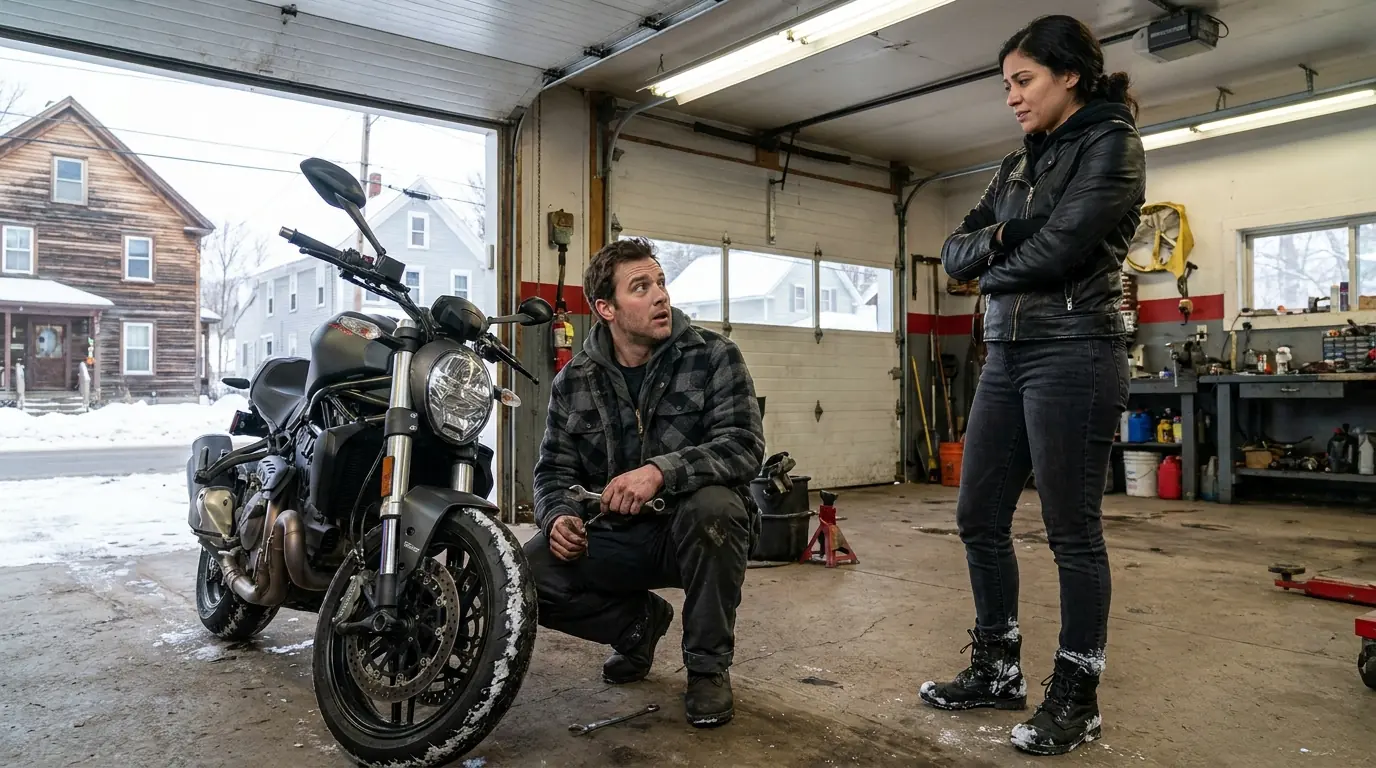
Together, they pushed the Ducati into the garage. Ethan closed the door against weather. Fluorescence buzzed to life. The woman removed her helmet. Sharp cheekbones, dark eyes, black hair in a disheveled ponytail. Expensive everything. Money and privilege radiating from her. Yet her hands shook, and her eyes held something like desperation.
“Are you hurt?”
Ethan’s tone gentled automatically.
“No, just cold and stranded.”
“Let me look at the bike first.”
The problem revealed itself quickly. Faulty fuel pump relay. Simple fix, but he’d need to order the part. With weather, two or three days minimum.
“Bad news,” Ethan said. “Fuel pump relay’s shot. I can fix it, but I need to order from Boston. With snow, you’re looking at a few days.”
The woman’s face flashed panic, then resignation, then something like relief.
“A few days,” she repeated.
“There’s a motel three miles north, but in this storm…”
He hesitated. This was where Clare would have insisted.
“I’ve got a couch upstairs. Warm and free.”
“I’m not…”
She stopped.
“I don’t want to impose.”
“You’re not imposing. You’re stranded. There’s a difference.”
She studied him with X-ray intensity, assessing, calculating odds.
“Why would you help a complete stranger?”
Ethan shrugged.
“Because I’d hope someone would do the same for my daughter if she needed it.”
That decided something. Her shoulders dropped.
“Okay. Thank you. I’m Bella.”
Not her real name, Ethan guessed. But if she wanted privacy, he wouldn’t push.
“Ethan Walker. Welcome to North Haven.”
The apartment was small and lived in. Mia’s backpack by the door. Art projects on the refrigerator. Unfolded laundry.
“Sorry about the mess,” Ethan said.
Bella stood in the doorway uncertainly. In better light, she looked younger, early 30s, exhausted underneath expensive armor.
“Bathroom’s down the hall. I’ll make up the couch.”
“I should pay you.”
“It’s a couch, not a room. You don’t owe me anything except maybe not stealing my silverware.”
The joke landed flat. Bella nodded seriously.
Ethan grabbed sheets, acutely aware how strange this was. No one had been in this apartment except Mia and Dorothy since Clare died. But the storm howled outside. No decent person sent someone back into that darkness.
“Are you hungry?” he asked. “I’ve got soup, or I could make eggs.”
“I’m fine.”
“When’s the last time you ate?”
Bella frowned.
“Yesterday. Lunch. Maybe.”
“Eggs it is.”
He cooked scrambled eggs, toast, cheese. Simple but filling. Bella sat at Mia’s homework table and watched with an expression suggesting she didn’t understand what was happening.
“You do this often?” she asked.
“Take in stranded motorcyclists? First time. Usually, I just fix the bike.”
Ethan slid her a plate.
“But usually it’s not 2:00 a.m. during a blizzard.”
She ate with focused intensity. Someone running on fumes longer than realized. Ethan made his own plate, left space between them.
“You mentioned a daughter,” Bella said.
“Mia. She’s seven. Asleep upstairs.”
“You’re raising her alone.”
“My wife passed three years ago. Cancer.”
“I’m sorry.”
“Thank you.”
They ate in silence. Outside, wind rattled windows. Inside, refrigerator hummed. Radiator clicked.
“Can I ask why you’re riding through Vermont in January?” Ethan said.
Bella’s fork paused.
“Can I not answer?”
“Sure.”
“I needed to get away from my life for a while.”
“Must be some life if you’re willing to freeze to death to escape it.”
“You’d be surprised.”
Bitterness in her voice made Ethan look carefully. This wasn’t vacation. This was flight. Desperate momentum making animals run toward horizons without knowing what they’d find.
He recognized it because he’d felt it himself after Clare died, when grief was so massive, his body kept trying to outrun it through pure motion.
“Well,” Ethan said quietly, “you’re safe here.”
Bella met his eyes. Something passed between them. Recognition, maybe. Two people who’d learned that safety wasn’t a location, but a feeling.
“Thank you,” she said. “Really.”
Ethan cleared plates, showed her everything, said good night. As he climbed stairs, he heard her settling in. Water running. Couch springs creaking. He checked on Mia, then lay in bed, listening to the sounds of a stranger in his home.
It should have felt wrong, uncomfortable, a violation of careful boundaries. Instead, it felt like the house was breathing again after holding its breath for three years.
Ethan fell asleep to snow against windows and didn’t dream at all.
Mia discovered their guest before Ethan could warn her.
“Who are you?”
His daughter stood three feet from the couch at 6:30 a.m.
“This is Bella,” Ethan said quickly. “Her motorcycle broke. She’s staying until I fix it.”
Mia processed this.
“Do you like pancakes?”
“I… yes.”
“Good. Daddy makes the best pancakes in Vermont.”
The morning unfolded surely. Ethan made pancakes while Mia peppered Bella with questions about her motorcycle, and Bella answered with increasing ease, as if the child’s genuine interest was breaking through walls.
At 7:15, Ethan walked Mia to the bus. When he returned, Bella was washing dishes.
“You don’t need to do that.”
“I want to. I’m not good at sitting still.”
“Neither is Mia.”
That earned a small smile.
“She’s wonderful. You’re doing a great job.”
“Thanks. Most days, I’m just hoping not to mess her up too badly.”
“I think that’s what all good parents feel.”
In morning light, Bella looked different. Younger, softer, less armor and more person.
“What do you do?” Ethan asked.
“For work, I run a company. Technology sector.”
“That sounds important.”
“It is. Or it’s supposed to be. Most days, it just feels exhausting.”
“Is that why you left?”
She was quiet, hands stilled in soapy water.
“I left because I realized I’d built this entire life that looked perfect from outside, and none of it made me happy. Not one single piece.”
Ethan knew that feeling. After Clare died, everyone told him how strong he was being. All he could think was that strength was just another word for pretending.
“Well,” he said, “you’re welcome to hide here as long as you need. North Haven’s pretty good at being boring.”
“Boring sounds perfect.”
The part arrived on the third day. Ethan could have installed it immediately. He took his time instead. Not to trap her, but because rushing felt wrong, like waking someone from a good dream before they were ready.
A routine emerged. Ethan worked while Bella read or walked through town. She’d return with observations. Church bells at noon. The elderly man hand-shoveling his driveway. How everyone waved.
“It’s strange,” she said. “Living where people actually see you, as opposed to being invisible in a crowd.”
Afternoons, Mia came home and attached herself to Bella with effortless affection. She showed Bella schoolwork, rock collection, drawings, taught her card games, and didn’t mind when Bella forgot rules.
Ethan watched them together and felt something he’d thought died with Clare. Hope. Not romantic hope, not yet, but simple hope that good things could still happen, that new people could still matter, that life wasn’t just about enduring.
They ate dinner together nightly. Nothing fancy. Pasta, chicken, stir-fry. But the table felt less empty with three people.
On the third night, after Mia slept, Bella helped clean up.
“I should probably leave tomorrow,” she said. “I’ve imposed long enough.”
“You haven’t imposed.”
“Still. I can’t hide forever.”
“Why not? Hiding seems to be working.”
“Because it’s not real. This is your life, not mine. Eventually, I have to go back and figure out how to fix my mess.”
“What if your mess isn’t fixable?”
“Then I’ll build something new. That’s what I’m good at.”
Ethan dried his hands, faced her.
“Can I ask something?”
“Okay.”
“Are you happy in your real life?”
Bella’s expression complicated.
“I thought I was. Or I thought happiness wasn’t the point. Success was the point. But then I realized I couldn’t remember the last time I laughed at something that wasn’t a carefully orchestrated business dinner joke.”
“That sounds lonely.”
“It was. Is.”
She folded the towel with precise creases.
“Your daughter asked me today if I had friends. I started listing people, then realized they were all colleagues, not actual friends.”
“You could stay longer,” Ethan said quietly. “If you wanted.”
“And do what? Play house with a stranger’s family?”
“Mia likes you.”
“I like her, too. But kids get attached easily, and then they get hurt when people leave.”
Bella met his eyes.
“I won’t do that to her.”
She was right. Ethan knew she was right. But the thought of apartment silence returning made his chest ache unexpectedly.
“The part’s installed,” he admitted. “Your bike’s ready whenever you are.”
Bella nodded slowly.
“Tomorrow morning, then. Before Mia wakes. That’ll be easier.”
“Okay.”
They stood in the small kitchen. Two people who’d known each other 72 hours, but had somehow fallen into profound, fragile connection.
“Thank you, Ethan,” Bella said, “for everything. You gave me something I didn’t know I needed.”
“What’s that?”
“A glimpse of what a real life looks like.”
She went to bed shortly after. Ethan stayed up, dreading tomorrow’s empty table.
At 11:00 p.m., he heard her phone ring downstairs. Then her voice, low and tense.
“I told you I needed time. No, I’m not coming back for that because it’s not my responsibility to manage your crisis, Natalie. I don’t care what the board thinks.”
Twenty minutes later, silence returned heavier than before. Ethan lay in bed, wondering what kind of life Bella was returning to. What kind of pressure required escaping on a motorcycle in winter? What kind of success felt like suffocation?
He fell asleep thinking about morning and how much harder it would be than expected.
Ethan woke at 5:30 a.m. to breaking glass. He took stairs two at a time and found Bella surrounded by shards of a coffee mug, staring at her phone with pure devastation.
“Are you hurt?”
He scanned for blood, relieved to see none.
“I’m sorry. I dropped…”
Her voice cracked.
“They know where I am.”
“Who knows?”
She held out her phone. The screen showed: Runaway Billionaire Isabella Cruz Spotted In Vermont Village.
Ethan’s brain stuttered. Isabella Cruz. The name sounded familiar. Something from radio or grocery store checkout.
“You’re…”
He stopped, recalibrating everything.
“You’re a billionaire.”
“CEO of Cruz Technologies. Worth about $4.2 billion on paper. Apparently, someone with a camera recognized me walking through your town.”
Ethan sat down hard. The woman sleeping on his couch, eating his simple meals, playing cards with his daughter. She was one of the richest people in the country.
“Why didn’t you tell me?”
“Because I wanted to be no one.”
Bella’s hands shook.
“For once in my life, I wanted to be just Bella, not Isabella Cruz, not a CEO, not a brand or stock price or headline. I wanted to be normal.”
“So, you lied.”
“Yes.”
She met his eyes, tears fighting to contain themselves.
“I lied, and I’m sorry. But I didn’t lie about anything that mattered. Everything I told you about feeling trapped and exhausted and lonely, that was all true.”
Ethan rubbed his face, processing. Part of him understood. Part sympathized. But another part, the part that had trusted this stranger with his home and daughter, felt betrayed.
“I need you to leave,” he said quietly.
“Ethan, please.”
“Just go.”
Bella nodded. She didn’t argue, just gathered her belongings, put on her leather jacket, walked to the garage.
Ethan heard the Ducati roar to life, heard it fade into distance, heard the silence rush back.
Upstairs, Mia called, “Daddy, is Bella making breakfast?”
And Ethan had to climb those stairs and tell his seven-year-old their guest was gone, watch her face crumple, hold her while she cried and asked, “Why didn’t she say goodbye?”
He had no good answer because the truth, that sometimes people leave even when you wish they wouldn’t, was too painful to put into words.
Five days later, Dorothy appeared at the garage looking worried.
“Ethan, have you seen Mia this morning?”
Cold dread dropped into his stomach.
“She’s in her room. Why?”
“No, she’s not. I saw her walking toward the woods an hour ago.”
Ethan was running before Dorothy finished. The woods stretched for miles, and with recent snow, terrain was dangerous. Hidden drops, frozen streams, heavy branches. He called Mia’s name, crashing through underbrush, chest tight with fear.
He found her 20 minutes later at Miller’s Pond edge, sitting on a fallen log, crying, coat unzipped despite the cold.
“Mia.”
Ethan scooped her up, checking for injuries.
“What were you thinking?”
“I wanted to go where Mommy went,” Mia sobbed. “I thought if I walked far enough, I could find her.”
Ethan’s heart shattered.
“Sweetheart, Mommy isn’t somewhere we can walk to.”
“But Bella left. And Mommy left, and everyone leaves. So I thought maybe they were together somewhere.”
He carried her home, both shaking. Mia from cold, Ethan from adrenaline crash. He wrapped her in blankets, made hot chocolate, called her school. But even after warming up, something was wrong. Mia’s breathing sounded raspy, her skin too hot.
“Does your chest hurt?”
Ethan pressed his palm to her forehead. She nodded miserably.
The emergency room doctor diagnosed pneumonia, moderate to severe, requiring hospitalization and IV antibiotics. Mia was admitted by noon. Insurance covered most, but most still left thousands in co-pays and deductibles. Money Ethan didn’t have. Clare’s medical bills had depleted their cushion.
That night, while Mia slept fitfully, Ethan sat in the uncomfortable hospital chair and stared at the wall. His phone buzzed. Unknown number.
“Ethan Walker.”
“This is Natalie Park. I work with Isabella Cruz. Isabella asked me to monitor news from North Haven, and I saw the report about your daughter’s hospitalization. She wanted you to know all medical expenses have been handled.”
“What?”
“The hospital’s billing department has been notified that Miss Cruz’s charitable foundation is covering the full cost of your daughter’s treatment. You won’t receive any bills.”
“I can’t accept.”
“Mr. Walker, with respect, this isn’t about you. Isabella cares about your daughter. She wants to help. Please let her.”
The call ended. Ethan sat in the dim hospital room, watching his little girl breathe with tubes in her arm and an oxygen monitor on her finger, and felt something crack open inside. All the grief and fear and loneliness he’d been containing for three years, suddenly too big to hold.
He put his face in his hands and cried.
Isabella arrived at the hospital at three. Ethan looked up to find her in the doorway, wearing jeans and a sweater, hair pulled back, face bare of makeup. Not a CEO, just a woman who’d driven through the night because a child she’d known for three days was sick.
“How is she?” Isabella whispered.
“Stable. They say she’ll be okay in a few days.”
“Can I sit with you?”
Ethan nodded.
Isabella pulled up a second chair, close enough their shoulders almost touched. They sat in silence, watching Mia asleep, listening to the steady monitor rhythm.
“I’m sorry,” Isabella said eventually. “For leaving the way I did, for not being honest from the beginning.”
“I was hurt,” Ethan admitted. “Not because you’re rich. I don’t care about that. But because I thought we were being real with each other, and it turned out you were hiding who you are.”
“I was trying to hide from who I am. There’s a difference.”
She turned to look at him.
“Everything I told you was true, Ethan. How I felt. What I was running from. What your family gave me. The only thing I lied about was my name and bank account.”
“Those aren’t small things.”
“No, they’re not.”
Isabella reached out, then stopped, hand hovering in the space between them.
“But they’re not the things that matter either. What matters is that I sat at your table and felt like a person instead of a corporation. What matters is that your daughter made me laugh for the first time in months. What matters is that you showed me what kindness looks like when it’s not transactional.”
“Natalie called about the medical bills.”
“I know you probably hate that I did that, but I couldn’t.”
Her voice caught.
“I couldn’t let Mia suffer because I messed everything up. Please don’t punish her for my mistakes.”
Ethan was quiet, processing. The truth was, he didn’t hate it. He was grateful beyond words, but accepting help meant admitting he couldn’t do everything alone.
“Thank you,” he said finally. “For helping her. For caring.”
“I do care.”
Isabella’s voice was barely above a whisper.
“About both of you. I know I have no right to. And I know I should probably leave you alone, but I can’t stop thinking about those three days in your apartment. How much I didn’t want to leave.”
“Then why did you?”
“Because I was afraid of hurting you. Of hurting Mia. Of bringing my complicated, messy world into your simple, good life.”
“My life isn’t simple,” Ethan said. “It’s hard and lonely, and sometimes I lie awake wondering if I’m completely screwing up this single-parent thing. But it’s mine, and for three days, it was ours, and that was good.”
On the bed, Mia stirred. Her eyes opened, unfocused.
“Bella,” she croaked.
“I’m here, sweetie.”
Isabella moved to the bedside instantly, smoothing Mia’s hair.
“You came back.”
“Of course, I came back.”
“Are you going to leave again?”
Isabella looked at Ethan. He saw the question in her eyes, the hope and fear mixed together.
“Not if you don’t want me to,” Isabella said to Mia.
Then to Ethan, “Not if your dad says it’s okay.”
And there it was, the moment of choice. Ethan could protect himself, protect Mia, send Isabella back to her world. Or he could take a risk, open the door to possibility and all complications that came with it.
He thought about Clare’s last words. Kindness meant vulnerability, meant letting people in even when it might hurt.
“It’s okay,” Ethan said.
Isabella didn’t move back to Manhattan. She didn’t return to being CEO of Cruz Technologies. Instead, she stepped down. The business world erupted. Analysts speculated, tabloids invented scandals, but Isabella appointed Natalie as her replacement, set up a charitable foundation with half her fortune, and bought a small house on North Haven’s edge.
“You’re sure about this?” Ethan asked weeks after Mia came home.
They sat on his couch, the same couch where Isabella had slept that first night, watching Mia arrange her dollhouse.
“I’ve never been more sure of anything.”
Isabella leaned into his shoulder.
“I spent a decade building something that made me successful and miserable. I’d rather spend my life building something that makes me happy.”
“What if you get bored?”
“I’m launching a nonprofit to provide technology education in rural communities. Trust me, I won’t be bored.”
Ethan kissed her temple, marveling at how natural this felt, how quickly his carefully guarded life had expanded, how Mia had bloomed with someone who loved her without expectation.
They took it slow. No rushing. Isabella kept her own house, but ate dinner with them most nights. She helped Mia with homework, learned Ethan’s simple recipes, sat in the garage reading while he worked. The town adjusted with fluid acceptance. Initial buzz faded. Isabella became just another resident, the woman who bought the Henderson place, who volunteered at the library, who was dating Ethan Walker.
Six months after that snowy night, Ethan proposed. Not with an expensive ring or grand gesture, but with a simple question in his kitchen while Mia was at school.
“Do you want to stay?”
“Like permanently?”
Isabella looked up from the sandwich she was making.
“Are you asking me to marry you?”
“I’m asking if you want to build a life here with us.”
She set down the knife carefully.
“Yes. God, yes. I want that more than anything.”
They married in October in the garage, which Mia insisted was where everything started, so it should be where this starts, too. Seventy-five people attended, mostly locals. A few of Isabella’s former colleagues who’d remained genuine friends, and Natalie, who cried through the entire ceremony. No photographers, no press, no society pages, just a family choosing each other in the place where they’d all learned what love actually looked like.
Two years later, Ethan stood in the garage teaching his nine-year-old daughter how to change a tire while Isabella worked at the corner desk, managing her foundation via laptop.
“Like this, Daddy?”
Mia positioned the jack with fierce concentration.
“Perfect. Now remember, safety first.”
“Never get under a car supported only by a jack because it could fall.”
“Exactly.”
Isabella glanced up, caught Ethan’s eye, smiled. The kind of smile that still made his chest feel too full even after two years of marriage.
Outside, snow began falling. The first of the season.
“I love winter now,” Isabella said, closing her laptop.
“Yeah?”
Ethan walked over, pulled her into his arms.
“Winter brought you to me.”
“Actually, winter broke your motorcycle and stranded you here.”
“Same thing.”
She kissed him softly.
“Best breakdown I ever had.”
Mia made a gagging noise across the garage.
“Gross. Stop kissing and help me with this tire.”
They laughed and separated, returning to their tasks. But the warmth lingered, the knowledge that they’d built something real and lasting out of a chance encounter on a snowy night.
Later, after the garage closed, and Mia slept, and the house was quiet, Ethan and Isabella sat on their porch watching snow accumulate.
“Do you ever miss it?” Ethan asked.
“Sometimes,” Isabella admitted. “But then I remember what I was sacrificing for it, and I realize I didn’t lose anything. I gained everything that actually matters.”
She leaned into him, and Ethan wrapped his arm around her shoulders, and they sat together in comfortable silence while winter transformed the world into something clean and new.
In the end, it wasn’t about a billionaire finding love or a single father finding help. It was about two people who’d been moving through their lives on autopilot, surviving instead of living, until a broken motorcycle and a snowstorm forced them to stop long enough to see each other, really see each other, and choose to stay.