The porch light at 47 Lynden Street had been burning since 4 in the morning, the way it always did when Ruth Langford couldn't sleep. Daniel Mercer noticed it as he turned onto the block, the small amber glow cutting through the last of the September dark. He slowed his truck, killed the engine two houses down out of habit, and stepped out into air that smelled of wet leaves and someone's early coffee. It was 6:18 a.m. He knew because he had checked his watch at the corner, the way he always did. Ruth took her heart pill at 6:30, and she took it better when there was warm bread on the counter.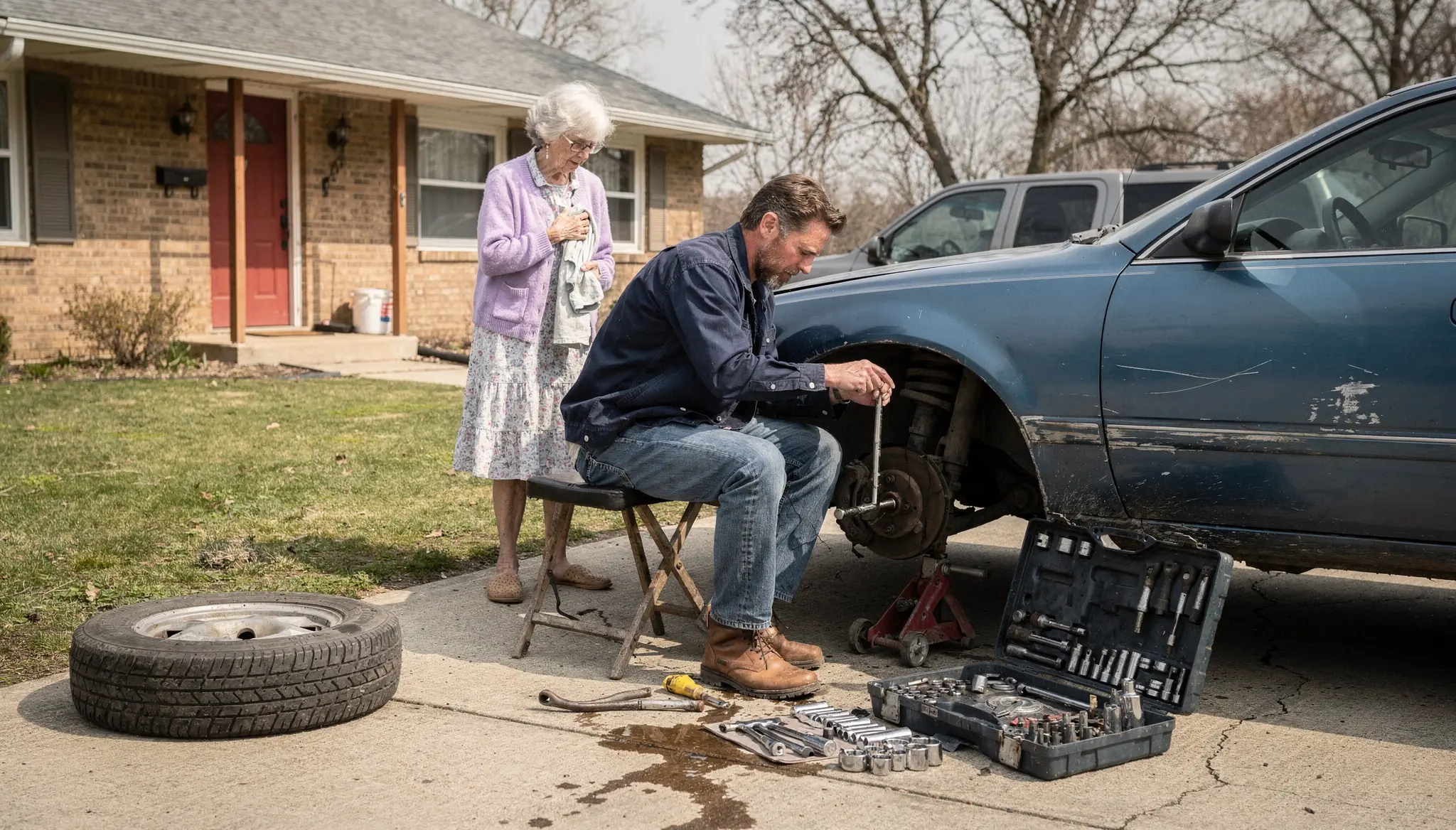
He walked up the path with both hands full: a loaf of sourdough from the bakery on Cedar Street, still warm through the paper; a small white pharmacy bag holding the prescription her cardiologist had switched her to last Tuesday; and the freshly cut spare key to the Buick, because the old one had started sticking in the ignition. Tucked under his arm was a short length of brake line he had pulled from her car the week before—cracked, brittle, its rubber gone the color of old ash. He was going to show it to her over breakfast. He was going to say gently that maybe she shouldn't drive out to the lake this month.
Not yet. Not until he'd had another Saturday under the hood. It was the eighty-third time he had walked up this path. He knew the count because Emma had asked once at the kitchen table why he went to Miss Ruth so much. He had told her the truth because Miss Ruth was alone and alone was a hard thing at seventy-six.
Emma had started keeping tally marks on the inside cover of her notebook after that. Small blue tally marks, four vertical and one across. The last time he'd looked, there were eighty-two. He pressed the bell. He knew Ruth's footsteps by now.
They were slow and slightly uneven, favoring her right hip. And they always paused at the hall mirror because she liked to check her hair before opening the door to anyone, even him. He'd learned to wait through that pause. He'd learned to smile at the peephole so she wouldn't feel silly about looking. The footsteps that came this morning were wrong.
They were fast, clipped, the sound of hard heels on hardwood, moving with the kind of impatience that belonged to a different kind of morning entirely. Daniel's shoulders shifted before his mind caught up. Something in his chest tightened the way it used to on the test floor. The half second before a gauge told him what he already knew. The door opened.
The woman standing on the other side of the threshold was not Ruth. She was tall, forty-something, in a charcoal suit that had been pressed by someone who charged for it. Her hair was pulled back sharply. A phone was held against her ear, and the other hand was still on the doorknob as though she had opened it without ever fully committing to the act. Her eyes flicked over him, the bread, the pharmacy bag, the work jacket, the smear of oil he hadn't quite scrubbed off his knuckles, and then found his face.
He watched her go still. He watched the phone lower until it hung forgotten at her side. He knew her. Of course, he knew her. He had spent three years trying not to think about her face and three years failing.
Victoria Langford, chief executive officer of Langford Automotive Group, the woman whose signature in a looping confident hand sat on the last page of the file that had ended his career. She knew him, too. He could see the exact moment it landed, the tiny inward flinch, the way her mouth opened around a word she didn't say. Whatever call she had been on, whatever quarterly number or crisis had been in her ear a moment ago, it was gone. There was only the porch and the cold and the man on her grandmother's doorstep holding bread and heart medicine.
Neither of them spoke. From somewhere behind her, deep in the house, Ruth's voice came drifting down the hall, bright and unhurried, half scolding and half delighted. "Daniel, is that Daniel out there? Victoria, honey, don't just stand in the doorway. Let him in. My goodness, the two of you finally get to meet each other." Victoria did not move. Her hand stayed on the doorknob. Daniel did not move either. The paper around the bread crinkled softly in the breeze. A single dry leaf skittered across the porch between them, and somewhere a block away, a school bus released its air brakes at a stop sign.
He watched her try to make the arithmetic work. He could almost see it behind her eyes. The man in the file, the man on the porch, the 83rd loaf of bread, the grandmother she called every Sunday and visited almost never. She was CEO of a company built on decisions made in fourteen minutes, and she was learning in real time that some decisions took longer than that to finish arriving. Three years ago, Victoria Langford had signed a single sheet of paper, and without ever quite meaning to, had taken a house, a career, and a daughter's certainty about her father. She had done it in a conference room on the fourteenth floor between a market briefing and a lunch, and she had not thought about the man on the other side of that signature since.
This morning, standing in her grandmother's doorway with a dead phone in her hand, she was beginning to understand that the man she had erased from the company had been quietly holding her family together for longer than she had. Daniel shifted the bread to his other arm. His voice, when it came, was even almost kind. "The bread's getting cold," he said. "She likes it warm." The bread grew warm again in Daniel's memory every time he thought about how all of this had started.
Because none of it, not the porch, not the 83rd loaf, not the woman in the charcoal suit, would have happened without a nine-year-old girl and a bicycle she hadn't quite learned to steer. Six months earlier, on a bright Saturday in March, Emma had been wobbling down the sidewalk on her secondhand bike, pigtails flying, calling over her shoulder for Daniel to watch. Watch, Dad. Watch. And Daniel had watched exactly in time to see her front wheel jerk sideways, her handlebars twist, and her whole small body pitch toward the curb where an old Buick LeSabre sat parked in the sun. The sound was not loud, a soft metallic scrape, the kind a key makes when it slips. Emma landed on her side in the grass, unhurt except for her pride, and stared at the long silver line she had just drawn down the dark blue paint of a stranger's car.
Her lips started to tremble before Daniel reached her. "Dad, Dad, I ruined it." He knelt in the grass and checked her elbow first, the way fathers do, and only then looked at the car. The scratch ran a good eight inches along the rear door. The Buick was old. The paint had that soft, chalky quality that 30 Michigan winters give a car that has been loved, but not garaged, and the line stood out against it like a fresh cut on weathered skin.
He walked her up the path to the house with the brick red door. He rang the bell. He rehearsed an apology in his head, and he made Emma rehearse hers out loud. And when the door opened, he was ready for a stern face and a raised voice and a phone call to somebody's insurance. He was not ready for Ruth Langford.
She was small and silver-haired in a cardigan the color of dried lavender, and she took one look at Emma's wet eyes, and did not look at the car at all. Well, she said, "You must be the young lady who's been racing up and down my sidewalk all morning. Come inside. I was about to burn a batch of cookies, and I need a witness." Daniel tried to explain.
He pointed to the Buick. Ruth waved him off with the back of one hand. The way you wave off a fly. "That car has survived thirty-three years," she said. "It will survive one nine-year-old." He insisted on paying.
She insisted on cookies. They compromised in the way strangers do when they are both trying to be decent. And he came back the next morning with tools. That was when he found the rest of it. The scratch was cosmetic.
The brake line was not. Under the car on his back on her driveway, Daniel found a hairline crack running along the rubber where it met the fitting and a slow dark weep of fluid that had left a small brown stain on the concrete. He lay there for a long moment, staring up at it, thinking about the hill on Cedar Street, where Ruth drove to church every Sunday. Thinking about how she would have described the feeling later if she had lived to describe it, the pedal just went soft, dear, I couldn't understand it. He replaced the line that weekend.
"You're a strange one, Daniel Mercer," she said quietly. "Come inside. The kettle's on." After that, the shape of their weeks changed without anyone deciding it should.
Emma acquired a pair of soft pink slippers that lived by Ruth's back door so she wouldn't track mud on the kitchen tiles. Ruth acquired the habit of making Saturday breakfast for two pancakes with too much butter, bacon slightly too crisp, orange juice in the small glasses her husband had liked. Daniel acquired without ever asking for it, a standing appointment under the hood of the Buick every Sunday afternoon, checking fluids, listening for the little hesitation in the starter that only he seemed to hear. When the Buick spent three days in his garage, waiting on a part, he drove Ruth to the pharmacy himself. When her cardiologist changed her medication, he wrote the new name on a card and taped it inside her kitchen cabinet next to the list of the old ones so she wouldn't mix them up in the dim of an early morning.
When Emma struggled with fractions, Ruth sat beside her at the kitchen table with a plate of cookies and explained them using apple slices, and Emma understood fractions forever after. Ruth talked about her husband sometimes when the light in the kitchen turned amber in the late afternoon. Henry, she called him. Henry had built cars. Henry had believed that a good car didn't just take you somewhere, it brought you home.
Henry had bought her that blue Buick the year their son was born. And thirty-three years later, she still could not bear to sell it because it still smelled faintly of his aftershave in the summer heat. Daniel would listen. He would tighten a hose clamp or wipe his hands on a rag and he would listen. He never mentioned that he too had once worked on cars.
He never mentioned the company he had worked for. He never asked Ruth's last name, and she offered it the way anyone offers a last name, casually in passing, attached to a piece of mail on the counter, and he did not react. Langford, he read it once, on an envelope by the fruit bowl, and something cold moved through his chest, and then Emma laughed at something Ruth had said, and the cold went away. Because whatever the name on the envelope meant elsewhere in the world in this kitchen, it only meant a woman who was kind to his daughter. He decided that afternoon that it did not have to mean anything more. He was wrong about that.
But the wrongness was still six months away, still waiting on a porch at 6:18 in the morning, still folded up inside a charcoal suit that had not yet walked through Ruth's front door. For now, there was only the smell of apple cake and the sound of Emma laughing in the next room, and an old blue car in the driveway that ran a little better every week because a man who had lost everything had decided, without making a thing of it, that it was still worth keeping alive. The apple cake and the laughter in the next room were the kind of things a man could almost mistake for a life if he wasn't careful. Daniel was careful. He knew what a life looked like from the inside, and he knew what its imitation looked like, too. And he knew that the difference was measured in the small hours of the morning when nobody was watching and there was nothing left to fix.
At 5:47 on a Tuesday, his phone rang in the dark, a pipe in unit 3B, water on the floor. Mrs. Alvarez, apologetic and half asleep. Daniel was already sitting up before she finished the sentence, already reaching for the jeans folded on the chair, already whispering, "It's okay. Go back to sleep." to a daughter three rooms away who hadn't actually woken up. Ridge View Apartments paid him $41,000 a year to be the man who answered that phone.
He was grateful for it most days. Owen Price, who owned the building, had hired him without asking too many questions, and Daniel had returned the favor by never giving him a reason to ask any. He fixed the pipes. He replaced the bulbs in the stairwells. He patched the drywall where teenagers punched it and where old men leaned too hard on their canes.
He came when he was called, and he did not complain about the hour. The maintenance office in the basement was eight feet by ten. There was a metal desk, a pegboard of keys, a folding chair, and a small window that showed nothing but the underside of a hedge. There were no diplomas on the walls. There were no photographs of him in a suit at a company event. No framed patents, no plaque from the year he had been named to the industry's Under 40 list.
Those things were in a cardboard box in the back of his closet, and the box had not been opened in three years. What was on the walls was this. A crayon drawing of a man and a small girl standing beside a car with square wheels signed Emma in careful block letters. A dented aluminum lunchbox that had belonged to his father. A pair of leather work gloves stiff with old grease and a spiral notebook, its cover soft with handling in which he still, out of a habit he could not break, wrote down every mechanical anomaly he encountered.
A shutter in a washing machine, a hum in a furnace. The exact RPM at which the boiler on the east side began to whine. Engineers did not stop being engineers because the world stopped paying them to be. The money was thin. He had done the arithmetic often enough to know it by heart.
His old salary had been 142,000 plus bonus plus stock. His current salary was less than a third of that. No bonus, no stock, and no company car. The house he and Sarah had bought the year Emma was born had been sold 18 months after the termination because the mortgage was written for two incomes and only one had survived. And then six months after that Sarah herself hadn't survived either, though that was a different kind of losing and Daniel did not let himself think about it before dawn.
They lived now in a two-bedroom on the third floor of the very building he maintained. Emma had the bedroom with the window. Daniel slept on a pullout in the living room and told her when she asked that he preferred it that way. The rejection letters from the other automakers came in envelopes with embossed logos and he had learned to check the mail before Emma came home from school and to slide the envelopes into the bottom of a drawer in the kitchen where she never looked. There were forty-one of them in that drawer.
He knew because he had counted once on a bad night and then decided never to count again.
The school called it career day. Emma had brought home the flyer in early April, folded into a careful square inside her math folder. Parents are invited to share their profession with the class. She had smoothed it flat on the kitchen table and looked up at him with an expression he could not quite read. You don't have to come, she said too quickly.
I can just write something. He came anyway. He wore his cleanest shirt. He sat on a small plastic chair at the back of Mrs. Delaney's classroom and watched a pediatric nurse show slides and a firefighter pass around a helmet and an accountant explain, with limited success, what a spreadsheet was. When it was Emma's turn to introduce her father, she stood up at her desk and read from an index card in a voice that was steadier than his own.
"My dad fixes everything," she read. "Sinks and heaters and bicycles and the elevator when it gets stuck. He can hear when a car is sick." "He says machines just want to be listened to."
The children clapped. A boy asked whether Daniel could fix a PlayStation. Daniel said he could try. The teacher smiled. He didn't see the woman in the doorway until the parents were filing out.
She was another mother, someone he vaguely recognized from the pickup line. Thin blonde with a lanyard that said she worked in HR for a supplier down in Dearborn. She caught his sleeve in the hallway lightly and lowered her voice with the particular gentleness people use when they are about to be cruel. You're Daniel Mercer, aren't you? From Langford.
He said nothing. I just Her eyes flicked past him toward the classroom toward Emma packing her backpack. I just thought you should know people remember. My husband was in engineering over there. He said what you did.
The whole design theft thing. That was really something. He said they were lucky they caught it. She squeezed his arm as though she were doing him a kindness and walked away. He drove Emma home in silence.
She held her drawing on her lap. A new one of him under the hood of a car with a wrench almost as big as he was. And she looked at him twice in the rearview mirror before she spoke. Dad. Yeah, sweetheart.
A long pause. The kind of pause a nine-year-old takes when she has been building up to a question for a while and is not sure whether asking it will make things better or worse. "Did you take something from them? From the car company?" He kept his hands on the wheel. He kept his eyes on the road. He counted to four because four was the number he counted to when he needed his voice to come out level.
And then he pulled the truck over to the shoulder of Elm Street and turned in his seat to face her. She was so small in the back, her seat belt cut across her drawing. "No," he said. "I didn't take anything." She waited.
"Sometimes," he said, "people believe a piece of paper before they'll look at a person. That doesn't make the paper true. It just makes it easier." She thought about that.
She looked down at her drawing at the small wrench holding version of him and then back up. Okay, she said. That was all. Okay. And she went back to looking out the window. And he pulled the truck back onto the road and somewhere behind his ribs, a thing he had been holding closed for three years slipped just slightly and began to bleed again.
Losing the job had been hard. Losing the house had been harder. Losing Sarah had been a wound he did not have language for. But nothing, nothing in the whole long ledger of what the last three years had cost him, had cut like the sound of his own daughter in the backseat of a truck on a spring afternoon, asking whether her father was a thief. He would remember later that this was the week Ruth had first invited them to stay for dinner.
He would remember that Emma had eaten two helpings of pot roast and fallen asleep on the couch with her head on Ruth's knee. He would remember thinking on the drive home that some kitchens were built to hold more than food. He did not yet know whose kitchen it was. No. But the reason he could not know, the reason the name Langford had to stay a stranger's name on a stranger's envelope, lived three years and 100 m behind him in a windowless room on the fourth floor of a test facility outside Detroit at a moment when a needle on a gauge had begun to fall.
The room had smelled of hot rubber and coffee gone bitter in the pot. Daniel remembered that first before he remembered anything else. Test Cell 4. On a Thursday in June, forty-seven minutes into a simulated descent that was supposed to run a full hour. On the dyno, a prototype Aster X sat with its front wheels locked to the drum, brakes engaged, the whole system heating steadily toward the temperatures a real car would see coming down a long grade in Colorado in July with a family of four and a trailer behind it.
He was director of brake safety engineering. He had thirteen years at Langford Automotive. He was thirty-seven years old and he still on days like that one felt lucky to be paid to do what he did. At minute forty, the numbers were clean. At minute forty-three, the pressure in the electronic boost assist ticked down by two-tenths of a bar.
It was a small movement. On a chart, it looked like nothing. Daniel wrote it down anyway. In the spiral notebook he kept in his shirt pocket because he had learned a long time ago that small movements were how large failures introduced themselves. At minute forty-seven, the boost pressure dropped by a full bar and did not recover.
The stopping distance, calculated live on the screen above the bench, jumped from acceptable to something he did not want to say out loud in a room with other people in it. He said it anyway. He said it quietly to the two technicians running the cell. And then he said it more loudly into the phone to the engineering lead upstairs. "Kill the test.
We have a thermal seal problem in the assist. I need this unit on my bench in an hour." They found it that night. A rubber O-ring inside the boost housing specified for a heat range that turned out to be optimistic by roughly 15°. When the assembly ran hot for more than forty-five minutes, the ring contracted, the seal broke, and the driver, who would not know any of this, would suddenly find the pedal going soft under his foot on a mountain grade at 70 miles an hour. Daniel wrote the report over the weekend. He recommended three things. Halt the pilot production run, revise the seal to a higher grade compound, and delay the Aster X launch by a full quarter to allow revalidation.
On Monday morning, he walked the report into Marcus Vale's office himself. Marcus was the chief operating officer. He was fifty-one then, silver at the temples, the kind of executive who kept a rowing machine in his office and a photograph of his boat on the wall behind his desk. He read the report standing up. He read it twice.
He set it down on the corner of his desk and he smiled at Daniel the way a man smiles when he is about to explain something obvious to a child. Danny, he said, we are eleven weeks from launch. We have a supply contract with an investment group in Singapore that closes the day this car hits dealerships. You know what a one-quarter delay does to that contract? Daniel said he did.
"I need you," Marcus said, still smiling, "to run the test again, but cap it at forty minutes. That's the drive-cycle standard the regulator uses. Forty clean minutes is a pass. Anything beyond that is you being creative, and creative is not what we pay you for this quarter."
Daniel said the drive cycle was a floor, not a ceiling. A real car on a real grade did not stop at forty minutes simply because a regulator said it could. He would not sign a validation letter on a forty-minute test when he had a forty-seven-minute failure on his bench.
Marcus stopped smiling. "Then someone else will sign it," he said, "and you can decide what kind of engineer you want to be remembered as." Daniel left the office. He did not sign.
Two weeks later, on a Tuesday morning at nine minutes past eleven, his badge stopped working at the parking garage gate. He remembered the exact time because he had looked at the dashboard clock twice while a security guard he had known for eight years told him without meeting his eyes that he would need to wait in the lobby. He remembered the walk across the lobby. He remembered the two men in gray suits who met him at the elevator and asked him politely to come with them to a conference room on the second floor. He remembered the folder on the table and the phrase unauthorized transfer of proprietary design data and the printed log showing 311 gigabytes downloaded to an external drive at 2:14 in the morning from his account.
He had been asleep at 2:14 in the morning. Sarah had been beside him. He remembered that too later. In the way you remember irrelevant details from the worst days of your life. He asked to speak to Victoria Langford directly.
He was told that the CEO had already reviewed the file. He was told the meeting had taken fourteen minutes. He was told his employment was terminated for cause, effective immediately, and that legal would be in touch about the non-disclosure and the non-compete and the return of company property. They walked him out through the side entrance, past the loading dock, so he would not be seen crossing the main lobby. His personal box, the framed photograph of Sarah and Emma, the coffee mug that said world's okayest dad, the spiral notebook was already packed.
Someone had done it for him. Someone had touched his things. The industry is small. That is the part civilians never quite understand. There are perhaps 40 companies in the world that hire brake safety engineers at Daniel's level.
And by the following Monday, every one of them had received a quiet phone call or a quiet email or a quiet lunch from someone at Langford. Nobody used the word thief. Nobody had to. They used softer words, fit issues, judgment concerns. Not someone we can recommend.
He interviewed twelve times over the next fourteen months. Eleven of those interviews ended the moment he was asked why he had left Langford. The twelfth ended when the hiring manager, an old colleague, called him three days later and said, "Off the record, Danny, I'm so sorry. It came down from above. There's nothing I can do." Sarah got sick that autumn.
She was gone by spring. The medical bills came for a year after that. He signed on at Ridge View in the fall of the second year because Owen Price did not ask about Langford. And because Emma needed a father who came home at a predictable hour and because a man has to be somewhere. He did not lose because he was wrong.
He lost because the man who lied had more power than he did. And because the woman who signed the paper had not spent one extra minute asking one extra question. Fourteen minutes was all it had taken to end him. Fourteen minutes on a Thursday in a conference room he had never been invited into, decided by a woman whose face he had only ever seen in the annual report.
Three years later, that same woman was standing in his neighbor's doorway, holding a phone she had forgotten she was on, and neither of them, in the long silent second that followed, knew what to do with a face they had only ever met through paper. It was Ruth who moved them. Well, don't just stand there letting all the warm out, she called from the kitchen. Victoria, take the bread from him. Daniel, come in.
Come in. The coffee is about to burn. Victoria stepped back from the door without a word. Daniel stepped forward. The bread changed hands between them without their fingers touching.
An exchange so careful it was almost a negotiation. And then he was inside the house he had walked into eighty-two times before. And the woman who had signed his termination was closing the door behind him. Ruth was at the stove in her lavender cardigan, waving a wooden spoon at nothing in particular. She did not look up. I have been trying to get the two of you in the same room for a month, she said.
More to the eggs than to either of them. Victoria never comes on a weekday, and Daniel is always gone by 7. Sit both of you. Daniel, the mug with the chip is yours. You know that.
Daniel sat. He knew which chair. He knew which mug. He knew that the sugar was in the blue tin on the second shelf and that Ruth took her coffee with too much of it. And he knew that the third floorboard from the sink squeaked because he had meant to fix it twice and Ruth had told him twice not to bother because Henry had made that squeak and she liked hearing it.
Victoria stood in the doorway a moment longer watching him know these things. Then she sat too carefully on the chair opposite him and put her phone face down on the table. Grandma, she said, her voice came out even. Impressive, Daniel thought in spite of himself. You didn't tell me you had someone coming.
I didn't tell you a lot of things, dear. Because you didn't ask. Ruth turned finally, a plate in each hand, and set eggs and toast down in front of both of them as though this were a Tuesday like any other. Daniel keeps my Buick alive and my back porch and me mostly. He and Emma come by most mornings.
Emma's my apple cake girl. You'd like her? I'm sure I would. Victoria's eyes flicked to Daniel. "How long has this—how long have you been coming, Mr. Mercer?" six months, Daniel said.
About that, Ruth said cheerfully. Since March. Since his little one put a very artistic scratch down the side of the Buick and cried her eyes out about it. Do you take cream, Victoria? I forget.
Black Grandma. That's right. Your mother's fault that she never let you have anything sweet. Ruth sat down between them with a small satisfied sigh and looked from one to the other with the mild pleased expression of a woman who has finally arranged a dinner party she has been planning in her head. "So you two, same industry," Daniel said once.
"Cars, was it?" Daniel watched Victoria's throat move. A while ago, he said, for me, different companies, Ruth asked. There was a very small pause. Daniel let it belong to Victoria. He had earned the right, he thought, to let her choose the shape of this one lie.
Adjacent, Victoria said finally. We were adjacent. Well, isn't that funny, Ruth said, and reached for the pepper. The meal that followed was on the surface ordinary. Ruth talked about a squirrel that had been getting into the bird feeder.
She talked about Emma's most recent drawing, which was taped to the refrigerator behind Victoria's head. Daniel and Emma and Ruth standing beside the blue Buick, all three of them stick figured and smiling. The sun a yellow spiral in the corner. She talked about her cardiologist, whom she disliked, and her pharmacist, whom she adored, and the fact that Daniel had rehung her back gate on Sunday because the hinge had been dropping. Victoria listened.
Victoria also watched. She watched Daniel refill Ruth's water glass without being asked. She watched him notice that the salt shaker was almost empty and get up without breaking the conversation to top it off from the box in the pantry, a box he clearly knew the location of. She watched him reach across the table mid-sentence and adjust the angle of Ruth's plate a quarter turn because Ruth's left wrist had been stiff for a year, and cutting was easier when the food came at her from a certain direction. She watched him do a dozen small things that she, the granddaughter, did not know to do.
Halfway through the meal, Emma arrived. She had been at a friend's house down the block, and she came in through the back door without knocking, kicked off her sneakers, put on the pink slippers that lived by the mat, and slid into the chair beside Daniel as though the chair had been reserved for her, which it had. "Hi, Miss Ruth. Hi, Dad." She looked across the table. "Hi, this is Victoria," Ruth said.
My granddaughter, she lives in the city. Oh. Emma studied her frankly, the way 9-year-olds study new adults. You look like the picture on the piano. That was taken a while ago.
You have the same hair. Emma reached for the toast. What do you do at the car company? Victoria's fork paused. I handle a lot of the paperwork, she said.
Oh. Emma nodded, satisfied with this. She turned to Daniel. Dad used to make cars safer. That's what he says.
He listens to them and figures out what's going to go wrong before it does. Emma, Daniel said gently. Eat your eggs. I am eating my eggs with your mouth closed. Fine.
She turned back to Victoria. Do you know about the brakes on cars? Dad says brakes are the most important part because they're the part that decides if you get home. That's what my grandfather used to say too, Victoria said quietly. And she did not look at Daniel when she said it.
After the meal, Ruth took Emma into the living room to show her a book of birds. Daniel carried the plates to the sink. Victoria, after a moment, followed him. She stood at his elbow with a dish towel. He washed.
She dried. They did not speak for almost a full minute, and the running of the water was the loudest thing in the room. "Why didn't you tell her?" she said finally. Her voice was low, meant only for him. He did not look up from the plate in his hands.
Tell her what exactly? That her granddaughter fired me, that I've spent three years explaining to my own daughter that I'm not a thief. She's seventy-six years old, Miss Langford. She was happy tonight. She needed a quiet evening more than I needed a moment of revenge. She was silent for a long time.
You could have humiliated me at that table, she said. In front of her? Yes. Why didn't you? He handed her a wet plate.
She took it. His hands were rough. She noticed grease under one thumbnail. A small scar across the knuckle of the other hand, pale and old. "Because I'm not the person you signed off on," he said. "And this isn't the room to prove it in." Victoria dried the plate slowly.
She said it on the counter. From the living room came the sound of Ruth laughing at something Emma had said, and Emma laughing back, and the small, warm silence of a house that had rearranged itself around two visitors it had not known it was waiting for. For the first time since the door had opened that evening, Victoria looked properly at the man beside her. Not at the file, not at the signature, not at the fourteen-minute meeting three years gone, but at the man himself, standing at her grandmother's sink in a work jacket, drying his hands on a towel that had belonged to a dead grandfather he had never met, and quietly refusing to hate her in front of a woman they both loved. She did not know yet what she was going to do about that.
But she knew standing there that she was going to have to do something. She did not know what she was going to do about it. But she knew driving back into the city that night with the taste of Ruth's coffee still in her mouth that she was going to start by looking at a file she had not looked at in three years. Victoria's apartment was on the twenty-second floor of a building in downtown Detroit, all glass and quiet, the kind of place where a person could work until two in the morning and hear nothing but the hum of the refrigerator. She kicked off her heels in the entryway.
She poured a glass of water she did not drink. She sat down at the kitchen island with her laptop, opened the secure archive, and typed Mercer Daniel J into the search bar. The file that came back was forty-one pages long. She read it slowly this time, slower than she had read it the first time, three years ago, in a conference room between a market briefing and a lunch. She read the termination memo.
She read the security incident report. She read Marcus Vale's cover summary, three tidy paragraphs that concluded with the phrase, "Recommend immediate separation to protect proprietary interests." Then she started reading what wasn't there. There was no original engineering report from Daniel. There was no transcript of any conversation in which he had been asked to explain the download. There was no forensic image of the drive the data had supposedly been copied to and no chain of custody log for the drive itself.
There were no interviews with the two technicians who had run test cell 4 on the night of the alleged transfer. There was in the whole forty-one pages not a single document that had not been generated by or forwarded through an office reporting to Marcus. Her own signature sat on page 41 in a blue ink loop she recognized as her Tuesday afternoon hand. The hand she used when she was signing things between meetings without reading them. She closed the laptop.
She sat in the dark of the kitchen for a long time.
Over the next two weeks, without telling anyone why, she began to change her routine. She drove out to Cedar Ridge on Wednesday evenings now, not just Sundays. She started staying for dinner. She told herself at first that she was making up for the years she had spent calling Ruth instead of visiting her. This was true.
It was also incomplete. The rest of it was Daniel. She watched him without letting him see her watch. She watched him lift the hood of the Buick on a Saturday morning and write the oil change date on a strip of masking tape stuck to the underside of the hood. Because Ruth could not remember dates and Ruth would not check a logbook, but Ruth would sometimes glance up when she was fueling. She watched him adjust the driver's seat two clicks forward so Ruth's knees would clear the wheel without straining.
She watched him lay a rubber mat on the driveway beside the door so that when the frost came in October, Ruth would have somewhere to plant her cane without slipping. She watched him with Emma. She watched him explain long division three different ways patiently at the kitchen table without ever once making the child feel stupid for not getting it on the first pass. She watched him tie the loose lace of her sneaker without breaking a sentence. She watched him say good night to Ruth every visit by touching the back of the woman's hand briefly the way a grown son might.
She watched him never once in front of Ruth say her own name in anger. Does a man like this steal 300 gigabytes of proprietary data at two in the morning? She asked herself. One Wednesday night on the drive home and then walk away without a lawyer, without a leak, without a single word to the press. She already knew the answer.
She had known it, she suspected from the moment she had opened the door on the porch and seen his face. The kitchen one night in the third week emptied itself around the two of them again. Ruth had drifted off in the armchair in the living room with her book on her lap. Emma was cross-legged on the rug in front of her drawing. The dishes were in the sink.
Daniel washed. Victoria dried. "Do you hate me?" she said. Her voice was quieter than she had meant it to be. He did not pretend not to understand.
"I don't have that much time for hating anymore," he said. "I have a nine-year-old who watches how I live." That's not an answer. It's the only one I've got.
She held a plate against the towel for longer than the plate needed. "What do I do?" she said. "To fix it." He set the sponge down.
He turned to face her and he dried his hands on the towel tucked into his belt and he looked at her the way he had once she suspected, looked at gauges with attention and without flattery. "Don't start by asking me to forgive you," he said. "Start by telling the truth in the room where it costs you something." The next morning, she called Elena Brooks into her office and closed the door.
Elena was 38. She had been executive administrator to the C-suite for 9 years. She had two small children, a 5-year-old and a 7-year-old, and a photograph of them in a silver frame on the corner of her desk. Her husband had died of pancreatic cancer 1Six months earlier. Victoria knew all of these things because Victoria had signed the bereavement leave.
"I need the Test Cell 4 logs for the Aster X validation program," Victoria said. Every raw file, every email between Marcus Vale and Brake Safety between January and July of that year, every HR memo referencing Daniel Mercer in the order they were drafted, not the order they were filed. Elena's face did not move. Her hands resting in her lap did. That's a large request, Miss Langford.
Yes. May I ask why? You may not. Elena nodded once. She stood up.
She did not quite meet Victoria's eyes on her way out the door, and Victoria watched that, too, and filed it away. Elena did not come back that day. She did not come back the next day. On the third day at 6:45 in the evening, when the executive floor was empty and the cleaners had not yet started their rounds, she knocked once on Victoria's open door and stepped inside carrying a manila folder and a small black thumb drive. She closed the door behind her.
She sat down in the chair opposite the desk. She placed the folder and the drive on the wood between them and pushed them gently across. "I have had these," she said, "for three years and two months." Victoria did not touch them.
Not yet. Tell me what they are. Elena drew a breath. It came out uneven. The first document is an email from Marcus Vale to the test cell 4 supervisor dated the second week of June, instructing him to cap all Aster X thermal validation runs at forty minutes and to report any longer runs as protocol deviations.
The second is Daniel Mercer's original engineering report with a timestamp showing it was filed at 11:17 in the morning on a Monday. The third is an email from Marcus Vale to human resources dated the following Wednesday, two full days before the alleged data theft on Mercer's account, instructing HR to begin drafting a for-cause termination package for a director of brake safety. Victoria did not move. She was not sure for a moment that she was breathing. You had these?
She said, for three years. Yes. Why? Elena's hands were shaking now. She did not try to hide it.
She looked down at them, then up, and her eyes were wet, but her voice was very steady. Every time I thought about coming forward, I looked at the photograph on my desk. Two children, no father, one income. I told myself that staying quiet was how I protected them. I told myself that for three years and I got very good at telling myself.
But I was not protecting my children. I was letting somebody else's child pay the price for mine. The room was very still. Victoria reached out at last. She did not open the folder.
She placed her palm flat on top of it. The way people place a hand on a Bible in an old courtroom. Elena. Yes. You did a hard thing today.
Thank you. Now we are going to spend a long time being accountable for the three years and two months in which you did not. Elena did not flinch. She only nodded once and it looked somehow like relief.
That night in her apartment on the twenty-second floor, Victoria opened the manila folder for the first time and read every page and read them again and then sat in the dark for an hour with her hands folded on the counter because there was no longer any way to pretend she had been merely the woman who had signed a piece of paper. She had been the piece of paper's power, and there was only one room in which that debt could be paid, and it was not this one. There was only one room in which that debt could be paid. And Marcus Vale, it turned out, understood that as well as she did because by the time Victoria walked into work the following Monday morning, he had already begun trying to make sure she never reached it.
The first sign came from Owen Price. He called Daniel on a Tuesday afternoon while Daniel was in the basement of Ridge View replacing a thermostat. Owen would turn sixty in a week and he had the voice of a man who had smoked for 40 of those years and quit unconvincingly for the last two. Daniel got a minute for you? Sure.
You got anything going on I should know about? Daniel set the screwdriver down. Such as such as I got a phone call this morning from a fellow at Langford Automotive. Didn't leave a name I recognized. Said he was doing what he called a courtesy check-in. Said you'd been spending a lot of time at the home of a senior member of the family.
Suggested and I want you to hear the word suggested, Daniel, because he was slippery about it. That maybe you were positioning yourself. His word, positioning. Daniel closed his eyes for a moment in the dim of the boiler room. Owen, I'm not asking if it's true.
I'm asking if there's something coming down the road that's going to make my building look bad. I'm helping a neighbor, Daniel said. That's all I'm doing. That's what I told him. A pause.
But Daniel, if it turns out to be more complicated than that, I'd rather hear it from you than from him. You understand? I understand.
That night in the Ridge View parking lot, Victoria was waiting by his truck. She had driven out from the city in a gray sedan he did not recognize, and she was standing in the cold in a coat that was too thin for it with her hands in her pockets. He's already moving, she said before he had shut his door. Marcus, he's calling people. He's told your landlord you're running some kind of long con on my grandmother.
He's told two of our board members that I'm being manipulated by a bitter ex employee. He's I know you know. Owen called me at 2. She let out a small breath. It hung white in the air between them.
I'm going to protect you, she said. From him I can shut this down. I can make a statement tonight. No, Daniel. No.
He said it quietly. He was not angry. He was, if anything, tired. "I don't need you to protect me from Marcus. I need you to stop protecting the system that let him do it." She looked at him for a long moment in the sodium light of the parking lot.
That's harder, she said. I know it is. It might cost me the company. I know that, too. She nodded once slowly and got into her car and drove back into the city.
And the following morning, she called an emergency session of the board of directors of Langford Automotive Group for 4:00 on Friday afternoon.
The boardroom was on the fourteenth floor. It had a long walnut table and a view of the river, and Marcus Vale walked into it that Friday with the easy stride of a man who had been in the room longer than most of the people sitting at the table. He took the seat to the right of the chair, as he always did. He smiled at Adrian Cole, the retired safety engineer who held the independent seat and who had been on the board since before Victoria's grandfather had died. He did not smile at Victoria.
He did not need to. He had over the course of the week made sure that every director in the room had heard some version of the same story, that the CEO was in the grip of a personal entanglement, that she had begun visiting a former employee at her grandmother's home, that her judgment could no longer be considered impartial. He believed sitting down that he had already won. Victoria did not open with a speech. She opened instead with paper.
She placed the first document in front of each director, then the second, then the third. She did not narrate. She let them read. Marcus' email to the test cell supervisor, capping the run at forty minutes. Daniel's original engineering report, timestamped and signed.
Marcus' email to HR dated 2 days before the alleged data theft, instructing them to begin drafting a four- cause termination package for a director who had not yet, in the official record, done anything wrong. Adrian Cole read all three twice. He did not look up when he finished. He set his glasses on the table and folded his hands over them. Marcus laughed.
It was a short, dry laugh, and it did not reach his eyes. Victoria, this is theater. Those emails have context. Those emails have explain the HR1. I beg your pardon.
Explain to the board why on a Wednesday morning in June, you instructed human resources to begin drafting termination paperwork for a director of brake safety who, according to the official record, had done nothing wrong until Friday. Marcus opened his mouth. He closed it. He tried again. You are letting a personal matter answer the question, Marcus.
You are letting a personal relationship with a disgraced former employee cloud answer the question. He did not answer it. Instead, he turned slowly to the rest of the room and he spread his hands and he smiled the smile he had spent 30 years perfecting. Ladies and gentlemen, what the board should be asking itself is a much simpler question. How will our shareholders react when they learn that the chief executive officer of this company has been having weekly dinners at her grandmother's home with the man she is now attempting to publicly exonerate?
How is that going to look? How is that going to look in a proxy filing? The door of the boardroom opened. Daniel walked in. He was in a work jacket he had not changed.
There was a smudge of grease along the cuff of his left sleeve because he had come straight from a broken furnace in unit 4C and there had not been time. And he had decided, walking across the lobby downstairs, that it did not matter. In one hand, he carried the spiral notebook with the soft cover. He did not look at Marcus. He did not look at Victoria. He walked to the far end of the table where an empty chair had been left for him and he sat down and he opened the notebook.
"My name is Daniel Mercer," he said. "I was the director of brake safety engineering at this company for six years. I would like to talk to you, if I may, about minute forty-seven." He did not perform.
He did not flourish. He walked them through it the way he had once walked new hires through it. The O-ring, the thermal contraction, the pressure drop, the stopping distance calculation on a seven-percent grade at seventy miles per hour with a family of four inside. He drew on the whiteboard at the end of the room a simple graph. He circled a point on it.
"Any test that stops at forty minutes," Daniel said, "cannot see this point. Any car sold on the strength of that test will eventually find it on a mountain road with a driver who trusted us."
Adrian Cole cleared his throat and asked two technical questions. He asked them the way a man asks when he hopes to be disappointed by the answers, but he was not. "The engineering is sound," he told the room. "The concern was real, it was correctly raised, and it was buried."
Victoria stood. She did not have notes. She looked down the length of the table at the twelve people who had spent the last twenty minutes watching her career walk itself toward a cliff.
"Marcus Vale created the lie," she said. "That is now a matter of documentary record, and it will be handled accordingly. But I am the person who gave the lie its power. I signed a termination for cause after a fourteen-minute meeting. I did not call the man whose life I was ending. I did not examine his engineering. I did not ask a single question that a serious executive should have asked. I trusted a report because it was easier than checking one, and I will not hide behind Marcus Vale's guilt to escape my own."
She let the admission settle before continuing. "This board will decide what to do with me. That is your right. But first, this board will vote to suspend Marcus Vale, freeze his access, and commission an independent audit of every safety validation that has crossed his desk in the last five years."
The vote was called. It carried unanimously.
Marcus did not stay to hear the second half of it. He rose from his chair without a word, walked the length of the table, and left the room by the same door Daniel had come in through, and there was, in the sound of the door closing behind him, something very final. The all-hands meeting was held the following Wednesday in the main atrium of the plant. Fourteen hundred people stood on the floor. Legal had prepared a statement for Victoria.
She read the first two sentences of it, stopped, folded it in half, and set it down on the podium.
"Three years ago, this company terminated a man for refusing to certify a car he believed was unsafe. His name is Daniel Mercer. The engineering concern he raised was valid. The theft he was accused of did not happen. The paperwork was manufactured, and I signed the termination. His record will be corrected today. His back pay and benefits will be restored in full. A written correction will be sent to every partner, supplier, and industry contact that received defamatory information about him from this company. I owed him this three years ago. I am giving it to him today, and I am sorry that today is the day and not that one."
A single pair of hands began to clap somewhere in the middle of the crowd. Then another, then a section, then the whole atrium. Some of the people clapping had once looked at their shoes when Daniel passed them in a fourth-floor hallway. Some of them now could not look at him at all.
That evening at the small kitchen table on the third floor of Ridge View, Victoria sat opposite a nine-year-old girl in a purple hoodie with a juice box in her hand. Daniel was in the hallway out of sight and had not technically given her permission to be there. He had also not technically refused it. Emma studied her over the juice box. "You're the paperwork lady," she said.
"Yes."
"Did you know my dad wasn't a bad person?"
Victoria did not look away. "I didn't know," she said. "But I should have found out before I let other people believe he was."
Emma thought about that and took a small, suspicious sip of juice. "Can you give my dad his three years back?"
Victoria's hands tightened once on the table and then relaxed. "No," she said. "I can't. Nobody can. But I can spend the rest of the years I have making sure this doesn't happen to somebody else's dad."
Emma considered this with the seriousness of a small judge. "Okay," she said finally. In the hallway, out of sight, Daniel closed his eyes and leaned his forehead briefly against the wall. For the first time in three years, he believed that the woman on the other side of the wall was not fixing her reputation.
She was fixing a wrong. But there was still one wrong left standing between them, and it was sitting in a lavender cardigan at a kitchen table in Cedar Ridge, drinking coffee she had not yet been told the truth about.
They drove out together on a Saturday morning. Neither of them spoke much on the way. Victoria had brought a pastry box from a bakery Ruth liked. Daniel had brought Emma because Emma had refused with the calm certainty of a nine-year-old who had lived through too many closed doors to be left behind for this one. She sat in the back seat and drew in her notebook and did not ask what they were going to say.
Ruth met them at the door in her slippers. She looked from one adult face to the other, and she did not smile the way she usually did, and she stepped back to let them in without a word. She had, Daniel realized, been expecting some version of this conversation for weeks. They sat at the kitchen table. Victoria did the talking mostly.
She started at the beginning, the test cell, the forty-minute cap, the report Daniel had refused to soften, the download at two in the morning that had not been his, the fourteen-minute meeting, the signature, the three years. Ruth listened without interrupting. Her hands were folded on the table in front of her, and she did not once look away from her granddaughter's face. When Victoria was finished, there was a long silence. Ruth reached out.
She took Victoria's hand in one of her own and Daniels in the other, and she held them both for a moment on the tabletop over a placemat that had a small coffee stain in one corner that Daniel had weeks ago given up trying to lift. "You two," she said at last. Her voice was quiet. It was not angry. It was not soft either.
You both thought you were protecting me by keeping it quiet. Both of you sitting at my table passing the salt. Grandma, let me finish. Dear Ruth's fingers tightened, just slightly on Victoria's. "Family isn't kept safe by secrets.
Family is kept safe by whether or not you can still sit down together after the truth has been said out loud. That's the only test that matters. Everything else is furniture." She turned to Daniel. You should have told me the first night. I know.
You would have hurt me. I would have gotten over it. I would have been angry with her. She nodded toward Victoria. I would have been very angry with her.
And then eventually I would have made her sit down and eat. And I would have made you sit down and eat, and we would have been where we are now, only sooner. She turned to Victoria. And you? You call me every Sunday, and I love you for it.
But I don't need a longer phone call. I need you to show up. You understand the difference? Victoria's eyes were wet. She nodded.
She did not trust her voice. Good, Ruth said. She let go of their hands and picked up her coffee cup. And the ordinary weight of that gesture, a woman reaching for a cup she had reached for 10,000 times before did more to unclench something in the room than any of the words had. Now, somebody tell me if that bakery box has the almond ones or not.
The offer came four days later in a letter on Langford stationery hand-delivered to Ridge View by a courier who did not understand why the address was a maintenance office director of independent vehicle safety. It was a new title. The role would report not to the COO and not to the CEO, but to an independent safety committee of the board on which Adrian Cole would sit as chair. The letter came with a proposed compensation package and a request for a meeting. Daniel read the letter twice.
He set it down on the small kitchen table. Emma, doing homework across from him, looked up. Is that from the paperwork, lady? Yes. Are you going to take it?
He thought about that for a long moment. He thought about the forty-one envelopes in the drawer. He thought about the maintenance office in the basement and Owen Price and the pipes in unit 3B. At 6:00 in the morning, he thought about the notebook with the soft cover and the graph he had drawn on a whiteboard in a boardroom two weeks earlier and the point on the graph that no forty-minute test could ever see. I'm going to talk to her about it, he said.
There are some things I need first. He drove into the city on a Thursday. He met Victoria in her office. He did not sit down. I'll come back, he said, but not to the old job and not on the old terms.
Tell me. I report to the independent safety committee, not to the COO, not to you. Agreed. Every engineering concern raised by any employee at any level is logged in a system that is not administered by the operations side of the company. It cannot be edited.
It cannot be deleted. It cannot be closed without a written signoff from an engineer and a written signoff from a member of the safety committee. Agreed. Any employee who raises a concern is protected legally in writing. No disciplinary action of any kind can be taken against them within one year of a report without review by outside counsel.
Agreed. No launch date, no quarter-end, no investor call, no board pressure of any kind overrides the safety signoff. If the car isn't ready, the car isn't sold. That is not a guideline. That is the rule.
Victoria did not answer right away. She looked at him for a long moment across the desk. Then she stood up. She walked around the desk. She held out her hand.
Agreed, she said. All of it in writing. This afternoon. He shook her hand.
His first day back at the plant was on a Monday in late October. The engineering floor had not changed much. The coffee pot was still in the same corner. The whiteboards were the same shade of scuffed. When he walked in, a few people looked up from their monitors, and the small movement of their looking rippled outward across the room until every head at every desk had turned.
He set the spiral notebook, still soft with three years of maintenance calls on the corner of the nearest bench. He looked at the room. "We are not," he said, "going to start by proving that the car can be sold. We are going to start by proving that the people inside it can get home." Somebody at the back of the room began to clap. Others joined.
This time, he did not close his eyes against it. He nodded once and he opened the notebook and he went to work.
Winter came in early that year.
On a Tuesday in November, the first hard frost sat on every windshield in Cedar Ridge at dawn. Daniel walked up the path to the house at 47 Lynden Street at 6:18 in the morning, the way he always did, and he carried a loaf of warm sourdough, a small pharmacy bag, and the spare key to the Buick. His hands were rough. His breath was white in the air. Emma was in the truck at the curb, waiting with her seat belt on and a piece of toast in one hand, because school started at 7:40 and she had, at ten, decided that being early was more grown-up than being on time.
He pressed the bell. The footsteps that came to the door this time were quick and clipped and belonged to a woman in a charcoal suit, but her hand was not on a phone. Her hand was around the handle of a mug, and there was a second mug in her other hand. And when the door opened, she was already holding it out to him, steam rising off the coffee, cream, and one sugar, the way he took it. Behind her, in the warm yellow light of the kitchen, Ruth was scolding Emma through the open truck window about the toast, and Emma was laughing, and something on the stove was faintly and unmistakably beginning to burn.
On the refrigerator, held up by a magnet in the shape of a small blue car, was a new drawing. There were four figures in it this time. A man in a work jacket, a small girl with pigtails, an older woman in a lavender cardigan, and a fourth figure taller than the older woman in a charcoal suit with the coffee cups drawn very carefully into both of her hands. In the middle of them, in dark blue crayon, was the Buick, old, scratched, running. Above the four figures in the same careful block letters Emma had used on the first drawing three years ago were four words.
The people who stayed. Victoria did not say anything. She only held out the mug. Daniel took it. Their fingers this time did touch.
He stepped inside. Three years earlier, a woman had signed a single sheet of paper in fourteen minutes and had believed on the strength of that signature that she had ended a man's career. Six months earlier, a small girl had scratched an old blue car with a bicycle and had believed on the strength of that scratch that she had ruined something. Three weeks earlier, a woman with a photograph of two children on her desk had walked into her boss's office with a manila folder and had believed on the strength of that folder that she had done a hard thing at last. And on a September morning at 6:18, on a porch with a brick red door, a man had held a loaf of warm bread in his arms, and had thought for a single wrong second that the wrong person had answered. He had been wrong about that. It turned out to have been all along exactly the right person.
Daniel had thought once that this door led only to the kitchen of a lonely woman. It led in the end back to his name and back to the work he had loved and into a family none of them had known they had been looking for. Behind him the door of the little house with the brick red door swung slowly shut against the November cold. Inside the coffee was warm. Inside the toast was burning.
Inside a small girl was laughing and an old woman was scolding. And a woman in a charcoal suit was setting a second mug down on a table beside a man in a work jacket who had at long last come home. Inside they stayed.