The single father at Terminal 17 had learned long ago that the world could turn cruel in the time it took to look away.
Two five-year-old twins were left on a bench at O’Hare without a kiss, without a goodbye, and without anyone turning back to see if they were crying. Their stepmother thought she could walk onto a plane and disappear, but she did not know the exhausted single dad watching from across the terminal had already decided those children would never be abandoned again. 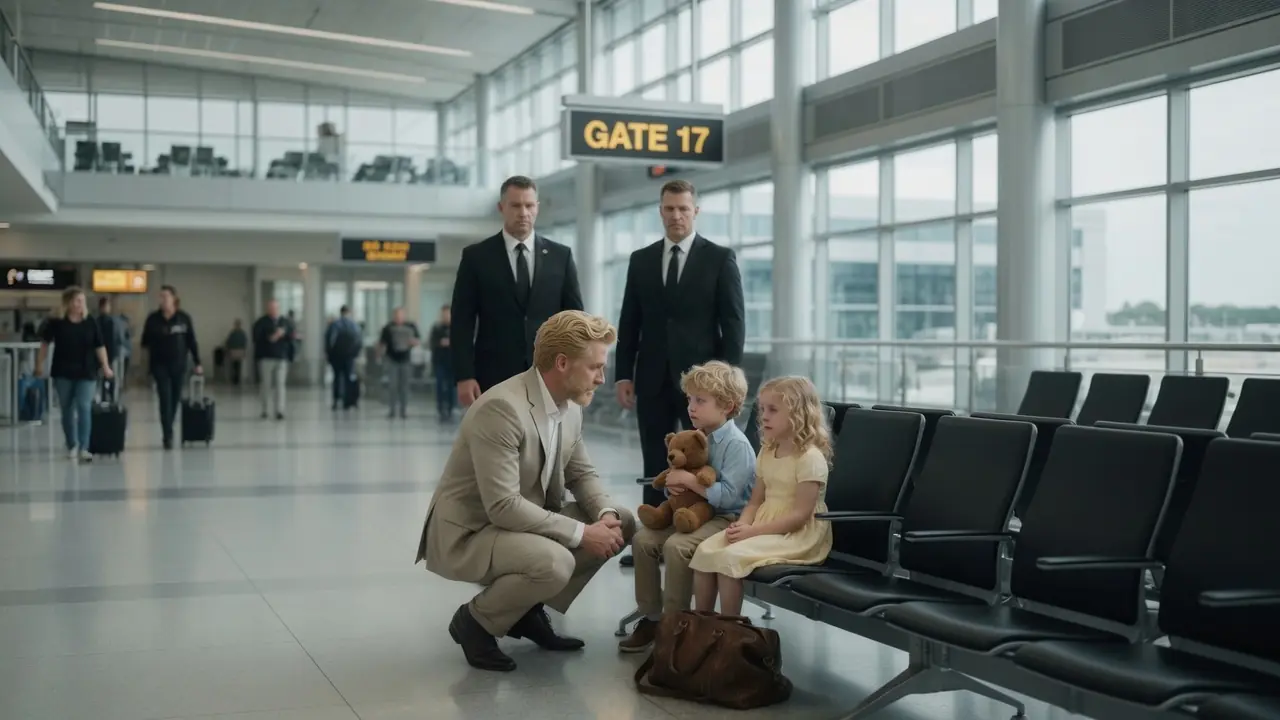
I was hurrying toward the security line with my six-year-old son, Noah, when I saw her.
The woman wore a beige coat and dark glasses, though the afternoon sky beyond the windows was gray and heavy. She dragged a polished suitcase behind her, moving fast toward Gate 17 like someone running from a life she no longer wanted.
Behind her, two small children struggled to keep up. A boy and a girl with the same curly blond hair and wide blue eyes. The boy clutched a worn brown teddy bear. The girl held his hand so tightly her fingers turned white.
They could not have been older than five.
I stopped in the middle of the concourse. Noah nearly walked into my leg.
“Daddy?” he asked, looking up at me.
The woman reached the gate and pointed at a row of black seats.
“Sit,” she ordered.
The children obeyed without question. The boy sat first, still hugging his bear. The girl pressed close to him and folded her hands in her lap. Her yellow dress was wrinkled, and one shoe strap had come loose.
The woman crouched for one second. She did not kiss them. She did not hug them or smooth their hair. She whispered something I could not hear, then stood and walked through the boarding door without looking back.
The terminal kept moving. People rushed past. Wheels rolled. Announcements echoed. Hundreds walked within feet of the twins. Almost no one noticed them.
But I saw the boy tighten his arms around the bear. I saw the girl stare at the closed door until her chin trembled. Neither child cried.
I knew that silence. Noah had worn it in the months after we lost his mom.
I moved before I fully decided what I was doing.
“Stay close, buddy,” I told Noah, taking his hand.
I crossed the concourse and slowed when the little girl noticed me. Her pale blue eyes lifted to my face. She did not shrink away.
I crouched a few feet in front of them so I would not tower over them.
“Where is your mother?” I asked gently.
The boy looked down at his bear.
“She’s not our mother,” he said flatly.
“What is her name?”
“Veronica,” the girl whispered.
“And your names?”
“I’m Lily. He’s Owen. We’re twins.”
I kept my voice soft. “How old are you?”
“Five,” Owen answered.
I glanced at the gate. The boarding door had closed.
“Is someone coming to get you?”
The children looked at each other. Lily finally shook her head.
“What did Veronica tell you?”
Owen buried his face in the bear. Lily’s fingers twisted together.
“She said to wait until someone noticed.”
My chest tightened. As a single dad who had spent countless nights wondering if I was enough for Noah, the thought of any parent walking away from these two made something protective and fierce rise in me.
I sat on the bench beside them, leaving space so they would not feel trapped.
“Where is your father?”
“He died,” Lily said. “Last week, Veronica said.”
Noah squeezed my hand tighter. He knew what it felt like to lose a parent.
I pulled out my phone and called airport security while staying with the children. Within minutes, officers and a social worker arrived. But the twins refused to go anywhere unless Noah and I stayed close.
In the private room, the truth began to unfold.
The officers brought Veronica back from the plane. When she saw me, her face went pale.
She knew exactly who I was — not by name at first, but by the look of a tired single father who would not walk away.
During questioning, a small envelope slipped from the teddy bear. My name was written across it in handwriting I had not seen in twelve years.
The letter was from my younger brother, Caleb.
He had changed his name, built a quiet life, and become a father. He had tried to reach me many times, but our late father had made sure those messages never arrived. Veronica had been paid to keep the children away from the family.
Caleb was not dead. He was dying in a hospice nearby.
The twins were my blood. My niece and nephew.
I sat with Lily and Owen while Noah stayed pressed against my side. As a single dad, I knew how heavy the world felt when you had no one. I promised them we would find their father.
The drive to the hospice was quiet. Noah held Lily’s hand in the back seat. Owen clutched his bear.
At Saint Catherine’s, Caleb lay thin and pale in the hospital bed. When he saw his children, joy broke across his face despite the pain.
He looked at me and whispered my name.
We had lost twelve years because of our father’s control. But in that room, with three small children between us, something began to heal.
Caleb spoke to Lily and Owen with the gentleness only a parent who had fought hard could give. He told them stories about their mother. He made them laugh even as his strength faded.
Noah, my own son, sat quietly beside me, understanding more than a six-year-old should. Being a single father had taught me that love sometimes arrives through the hardest detours.
That night, Caleb passed peacefully with his children’s hands in his and the old bear against his chest.
In the weeks that followed, I brought Lily and Owen home. Our house, once quiet except for Noah’s footsteps, filled with crayons, small shoes, and the sound of three children learning they were safe.
As a single dad who had raised Noah alone, I now had three hearts depending on me. Some nights the weight felt enormous. Other nights, when all three kids piled into my bed after bad dreams, I understood what Caleb had tried to give them.
Family was not perfect. It was showing up when no one else did.
I hung Caleb’s letter on the wall beside a new drawing the children made. Four figures under a crooked sun.
At the bottom, Lily had written in careful letters:
We are home now.
And for the first time in many years, the single father who had almost walked past two scared children at Gate 17 knew that stopping had saved more than just them.
It had finally brought the pieces of his own broken family back together.