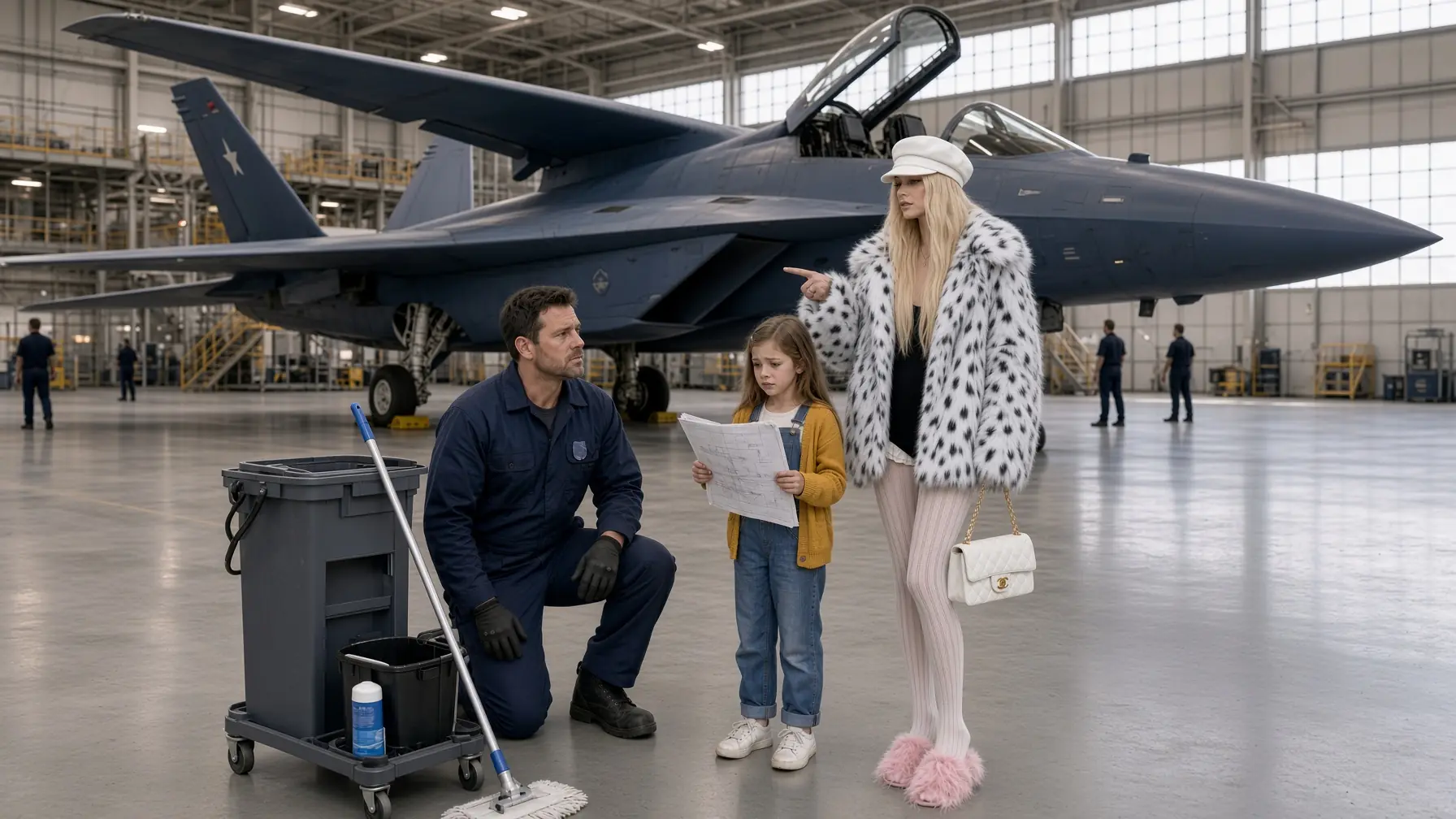
The wind howled through the testing facility of Vanguard Aerospace. Jet engines roared, fuel fumes thick in the air. Ethan Cole knelt on the concrete floor, scrubbing a fuel stain with steady hands. A procession of executives passed overhead on the steel catwalk. Among them, Veronica Pierce, 32, CEO, heels clicking like gunshots.
She glanced down, her voice slicing through the noise. Careful there. Don't let your hands touch something you're not qualified to understand. Jets aren't for people who only know how to mop floors. Laughter erupted around her.
Ethan stayed still, his eyes lifting toward the steel gleam of the fighter jet behind glass, the place where he once belonged. Veronica Pierce had inherited Vanguard Aerospace 6 months ago when her father died of a heart attack in his corner office. She was brilliant, ruthless, and utterly convinced that weakness had no place in the sky. The board of directors watched her every move, waiting for her to stumble, to prove that a woman in her early 30s couldn't fill her father's shoes. So, she became harder, colder.
She fired underperformers without hesitation, cut budgets that didn't show immediate returns, and built walls around herself so high that even her own reflection felt like a stranger. To Veronica, the world was divided into two kinds of people. Those who flew and those who fell. And once you fell, you didn't deserve to look up. She'd grown up watching her father command rooms, negotiate billion-dollar contracts, shake hands with generals and senators.
He taught her that respect was earned through dominance, that sympathy was weakness dressed in pretty words. When he collapsed at his desk, clutching his chest, she wasn't there. She was in Tokyo closing a deal. She flew home to an empty office and a legacy she wasn't sure she could carry. The funeral was private.
The press conference was flawless. And every night since, she stood in front of the mirror practicing her father's expression, the one that said nothing could break her. But something already had. Ethan Cole had fallen a long time ago. He was 35 now, but the scars on his back made him feel older.
He'd been a fighter pilot in the Air Force, flying F-16 seconds with the Valor Squadron, a unit so elite that their missions were still classified. He'd flown over deserts and mountains, pulled maneuvers that defied physics, saved lives that would never know his name. Then came the mission in Nevada. His wingman's engine failed at 20,000 ft. Ethan broke formation, stayed with him, guided him down through a sandstorm that turned the sky into a wall of rage.
They both survived. But Ethan's jet took shrapnel from ground fire on the way out. He ejected over the desert, spent 2 days in the sand before rescue came. The injury to his spine was severe enough to end his flying career. He was honorably discharged, given a medal he never wore, and sent back to a life that no longer fit.
His wife, Sarah, had been his whole world. She died of cancer during his physical therapy, and he couldn't even hold her hand without shaking from the pain in his back. Now, he lived in a small apartment with his 8-year-old daughter, Layla. She had her mother's smile and his love for the sky. Every night, he told her stories about flying, about the clouds that looked like mountains, and the stars that guided pilots home.
But he never told her why he stopped. The medical bills had emptied his savings. The veteran benefits covered some, but not enough. So, he took the only job he could find that didn't require standing for 12 hours, janitorial work at Vanguard Aerospace. It was humiliating at first, working in a place where he'd once been respected, where people like him had walked as legends.
But then he realized something. Layla could come with him after school. She could sit in the corner and draw. She could breathe the same air as the machines that touched the sky. And that was enough.
Layla would sit in the corner of the Vanguard hangar while he worked, sketching airplanes in a notebook she carried everywhere. Her drawings were surprisingly detailed. Engines, fuel lines, wing structures. A young engineer named Marcus noticed her once and spent 20 minutes explaining thrust-to-weight ratios while she nodded, absorbing every word. Ethan watched from a distance, mop in hand, and felt something crack open in his chest.
This was why he stayed. Not for himself. For her. Veronica found Layla in the restricted testing zone on a Tuesday afternoon. The little girl was sitting cross-legged on the floor, holding a faded blueprint she'd found in a recycling bin.
Her small fingers traced the lines carefully, her lips moving as she whispered the labels to herself. Veronica's heels announced her arrival like a judge's gavel. The sound echoed off the steel walls, sharp and final. Who let this child in here? Her voice cut through the hum of machinery.
Layla looked up, startled. Her eyes were wide, dark, innocent. I I was just looking. This is a place for people who know how to fly. Not people who dream.
Veronica's eyes were sharp, her jaw set. She gestured to the prototype fighter behind the glass partition. Do you know how much that costs? More than your house, more than your school, more than anything you'll ever touch in your life. Layla's face flushed.
She stood, clutching the blueprint to her chest. I'm sorry. I didn't mean Where's your parent? Ethan came running, his uniform damp with sweat, his breath short. He'd been two floors down when someone told him his daughter had wandered off.
Panic had gripped his chest the whole way up. I'm sorry, ma'am. She won't. She won't What? Wander into a million-dollar facility again?
Veronica's gaze swept over him, cold and dismissive. She took in his uniform, the mop and bucket he'd left by the door, the calluses on his hands. You think mopping floors in a hangar will get you back into the sky? The words hung in the air like a blade. The room fell silent.
Other workers nearby stopped, pretending not to listen. Someone chuckled. Another cough to hide a laugh. Ethan's jaw tightened, but he said nothing. His hands curled into fists at his sides, then slowly relaxed.
He'd learned a long time ago that some battles weren't worth fighting. Not here. Not in front of Layla. He took his daughter's hand, gently pulling the blueprint from her fingers, and setting it on a nearby table. Come on, kiddo.
Let's go. As they walked toward the exit, Layla whispered, Dad, you used to fly, didn't you? He looked down at her, his throat tight. Yeah, kiddo. But now, I just need you to live in a world that still has skies.
She didn't understand, but she squeezed his hand anyway. That night, Ethan sat on the edge of his bed, staring at the shadow of his right arm in the dim light. The tattoo was still there, hidden beneath his long sleeves, a pair of iron wings with the words Wings of Valor inscribed below. He hadn't looked at it in months. It reminded him of everything he'd lost.
The sky, Sarah, the version of himself that believed he mattered. But it also reminded him of everything he'd saved. His wingman, Sterling Pierce, the rescue team in the sandstorm. He pulled his sleeve down and went to check on Layla. She was asleep, her notebook open on her chest, a half-finished drawing of a jet engine visible in the moonlight.
He kissed her forehead and closed the notebook gently. You'll fly one day, he whispered. With your wings and mine. Marcus Hale was a veteran engineer at Vanguard, 63 years old with a limp from a helicopter crash in the '80s. He'd seen a lot of faces come and go, but something about Ethan Cole stuck with him.