My name is Adrian Cole, and I never imagined a joke would change my entire life. That morning, I was running on 3 hours of sleep and stale coffee. Nora, my 6-year-old, had a fever, and I'd spent half the night with a cool cloth pressed to her forehead instead of resting. I almost called in sick. Instead, I was standing outside the executive elevator, clutching a folder that could make or break the company's biggest deal of the year.
The mailroom supervisor had grabbed me at the last second. "Everyone else is out. Just get it to her office. Don't talk. Don't linger."
I didn't listen. The doors opened, and there she was, Camille Hartwell, CEO, untouchable, terrifying in her composure. She looked exhausted in a way no one else would have noticed. Something reckless in me spoke before I could stop it. "Kiss me for luck, Ms.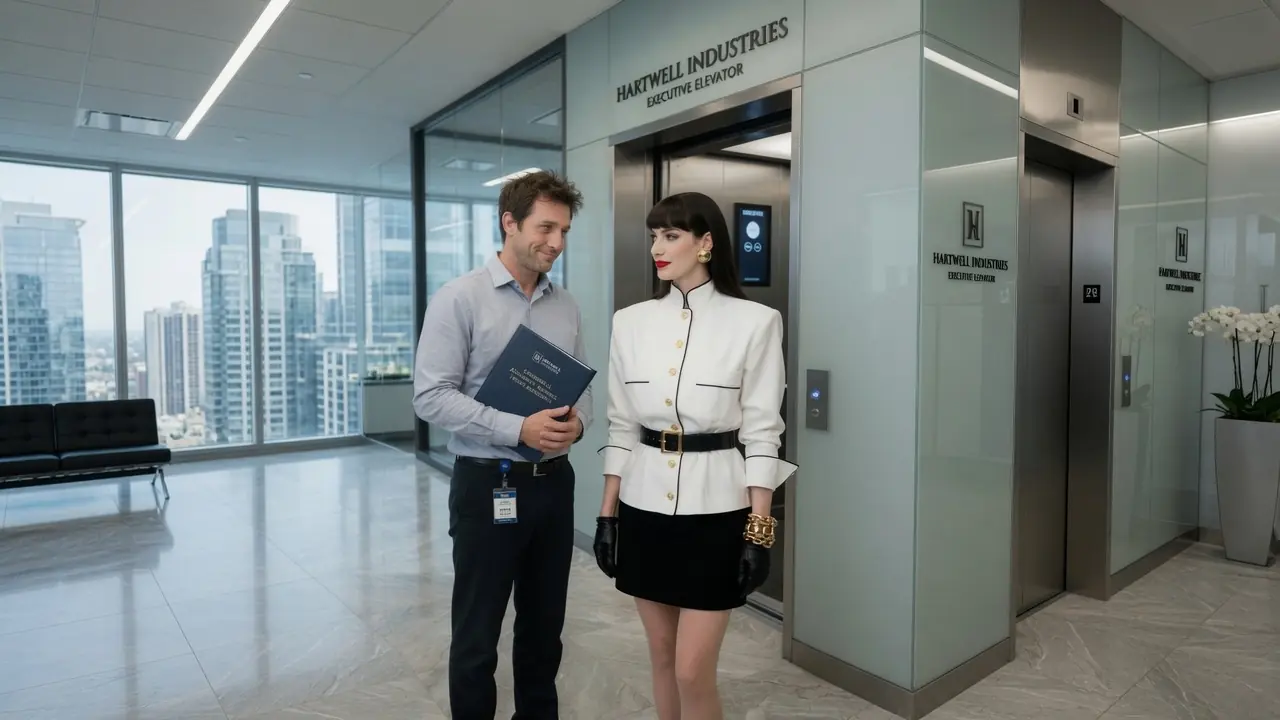
Hartwell." I expected silence, a raised eyebrow, maybe security. Instead, she stepped closer, closer than I'd braced for, her eyes studying mine like she was searching for something. "How much more luck," she whispered, "do you think you need?" Neither of us laughed.
I told myself it meant nothing. CEOs didn't remember mailroom clerks. By the time I got back downstairs, I'd already convinced myself I'd imagined the way her voice had dropped when she said those words. I was wrong. Two days later, she found a reason to walk past the mailroom herself.
She didn't step back. She never did. After that, it became something neither of us named out loud. She'd find reasons to come downstairs. I'd find reasons to be near the executive floor, a delivery that could have waited, a question that could have been an email.
Our conversations were short, clipped, professional on the surface. Underneath, something else was building, brick by brick. She teased me about my socks, mismatched, always, because folding laundry at midnight with a sleeping child on your shoulder doesn't leave room for matching pairs. I teased her about the color-coded calendar her assistant complained about, the one that scheduled her lunch breaks down to the minute. "You should try being spontaneous sometime," I told her once, and she laughed, really laughed, not the practiced kind she gave in meetings.
"Spontaneous got me an elevator joke and questionable luck advice," she shot back. "I'm not sure I can afford more of that." It was during one of those exchanges that I let it slip, Nora's name, her laugh, the drawings she left on my desk shaped like dinosaurs and hearts. Camille went quiet for a moment, and something in her expression softened in a way I hadn't seen before. Not pity.
Something closer to tenderness. "She sounds like she's loved," Camille said softly. "She's everything," I admitted, and for the first time, Camille didn't look away when I said it. The blackout hit without warning. One moment the elevator lights hummed steady above us, the next, everything went dark, and the car jolted to a stop between floors.
Camille's breath caught. "You have got to be kidding me." "I wish I were," I said, feeling along the wall for the emergency panel. The intercom crackled dead. My phone had one bar, enough to text security, not enough to promise a quick rescue.
"Looks like we're here a while," I said. She sank down against the wall, the composed CEO dissolving into someone tired and unguarded. "Of course this happens the one week I have no room in my schedule to be trapped in an elevator." ""Guess spontaneity finally caught up with you."" She laughed, but it faded into something quieter. In the dim emergency light, she started talking, really talking. About her father, the company's founder, and the impossible shoes she'd been handed to fill.
About the loneliness of a corner office, how no one ever spoke to her without an agenda. "You're the first person in years," she said, "who's talked to me like I'm just a person." I told her about Nora's mother, gone before Nora could remember her voice. About raising a daughter alone in a one-bedroom apartment, terrified every day that I wasn't enough. "You are enough," Camille said quietly, and something in her voice made my chest ache.
We talked until our voices grew hoarse, until the space between us on that elevator floor had somehow disappeared. When the lights finally flickered back on, her hand was resting in mine. Neither of us pulled away first. The doors opened. A board member stood there, phone raised, already recording.
The photo hadn't leaked yet—not officially— but I felt the shift in the building immediately. Whispers followed me down hallways that used to ignore me completely. I told myself it would pass. Then came the family day. I almost didn't bring Nora.
The thought of her surrounded by executives in tailored suits judging a mailroom clerk's daughter made my stomach twist. But she'd begged for weeks, clutching the flyer with both hands, and I couldn't say no to her. She wore her favorite dinosaur shirt, the one with the frayed collar I kept meaning to replace. I watched her weave through the crowd of unfamiliar faces, and my chest tightened with something close to dread. Then Camille appeared.
She didn't nod politely and move on the way I expected. She knelt down, right there on the lawn in her expensive dress, until she was eye to eye with my daughter. "I hear you know everything about dinosaurs," Camille said. Nora's whole face lit up. "The spinosaurus was bigger than the T-Rex.
Did you know that?" "I did not know that," Camille said, and she actually listened, nodding along as Nora rattled off facts I'd heard a hundred times but never tired of. Watching them, something inside me broke open quietly, the way ice cracks before it melts completely. No woman had looked at my daughter like she mattered, truly mattered, since her mother left. My throat tightened, and I had to look away before they saw my eyes water.
That night, Camille sat across from her assistant, staring at her wine glass without drinking it. "I think I'm falling for him," she admitted quietly. "And I don't know what to do about it." The photo surfaced three days later. Camille's assistant burst into her office, tablet in hand, face pale.
The image was already circulating. Camille's hand in mine, our fingers laced, captured the second the elevator doors opened. By noon, it had reached every board member's inbox. They called an emergency session. I wasn't in that room, but I heard about it later: how the chairman slid a printed copy across the table and said the word inappropriate like it was a verdict already reached.
How they invoked her father's name, the company he'd spent 30 years building, and threatened to block her re-election unless she distanced herself from entanglements with staff. Camille told me none of this directly. I found out because her voice, when she finally called me to her office, didn't sound like hers at all. "Adrian," she said, and my name in her mouth had never sounded so heavy. "We can't do this anymore.
Whatever this was, it has to stop." I opened my mouth to argue, to ask what this even meant, when my phone buzzed violently against my hip. Nora's school. Emergency contact only calls for one reason. I stood frozen between the woman quietly ending something I'd never had words for, and the phone screaming for my attention about the only person in this world I couldn't lose.
Camille saw it in my face. "Go," she whispered, already turning away, already building the wall back up between us. Nora was fine. A fall on the playground, a scraped knee, tears that dried the moment she saw me running through the school doors. But my hands didn't stop shaking for an hour after I held her.
Camille's silence, though, was a different kind of wound. It didn't scrape. It bled slow. She stopped walking past the mailroom. Stopped finding reasons to be near me.
When I saw her in the hallway, she nodded once, professionally, like I was any other employee, like the elevator, the family day, the way she'd knelt to hear Nora talk about dinosaurs had never happened at all. I told myself she was protecting the company. I told myself she owed her father that much. But late one night, rocking Nora back to sleep after a bad dream, I realized something that made my chest ache with a different kind of ache. Camille never once asked me to change who I was.
She never asked me to be someone else, something more polished, more acceptable to a boardroom of men who'd never scraped together rent or held a feverish child at 3:00 a. m. She'd asked me to disappear. And I understood, finally, that the easiest thing in the world would be to let her have that, to protect her from the mess of loving a mailroom clerk with a daughter and mismatched socks and nothing to offer a company like Hartwell Industries. But easy had never once fixed anything that mattered. I thought of Camille kneeling on that lawn, listening like Nora's words were the most important thing she'd heard all year.
I thought of her hand in mine in the dark, and the way she'd said, "You are enough," like she meant it down to her bones. I wasn't going to let a boardroom decide that a moment like that was something to be ashamed of. I was going to fight for her. The shareholders' meeting was already underway when I walked in, still in my mailroom uniform, folderless for the first time in months. Every head turned.
Camille's face went pale, then something else, something I hadn't seen from her before. Fear, maybe, for me instead of herself. "I know I wasn't invited," I said, my voice steadier than I felt. "But I've spent months delivering files to people who never once looked at me. So today, I'm asking you to look at her instead."
I told them about the elevator, not the scandal version splashed across a stolen photo, but the truth. A woman exhausted from carrying a company alone, finally letting herself be human for two hours. I told them about family day, about a CEO who knelt in the grass in an expensive dress just to listen to a six-year-old talk about dinosaurs like her words mattered more than any quarterly report ever could. "You're not deciding whether she's fit to lead," I said, looking at the chairman now. "You're deciding whether kindness disqualifies her.
And if it does, I don't know what this company's founder built it for." Silence stretched long enough that I thought I'd ruined everything. Then, one by one, hands rose. The vote came back unanimous. Camille found me outside afterward, evening light spilling gold across the courtyard, and for the first time since the photo, she wasn't guarded at all.
"You never asked how much luck I needed," she said, stepping close, closer than that first day. "I think I already know the answer," I said. She kissed me first, right there where anyone could see, and when she finally pulled back, she rested her forehead against mine. "I stopped needing luck," she whispered, "the day you walked into my office."