It was Christmas Eve, and Daniel had spent 5 years convincing himself he'd finally forgotten the woman who once promised to love him forever. Five years of silence, five years of early mornings in an empty kitchen, of coffee mugs set for one, of falling asleep to the sound of wind pressing against the wooden walls of a house that had never quite learned to feel like a home. He had told himself, on more occasions than he could count, that he was fine, that the ache had dulled, that the name he no longer spoke aloud had lost its power over him. He only stopped by the old train station cafe to escape the snow for a few minutes, to warm his hands around a paper cup, and watch strangers pass through the glass.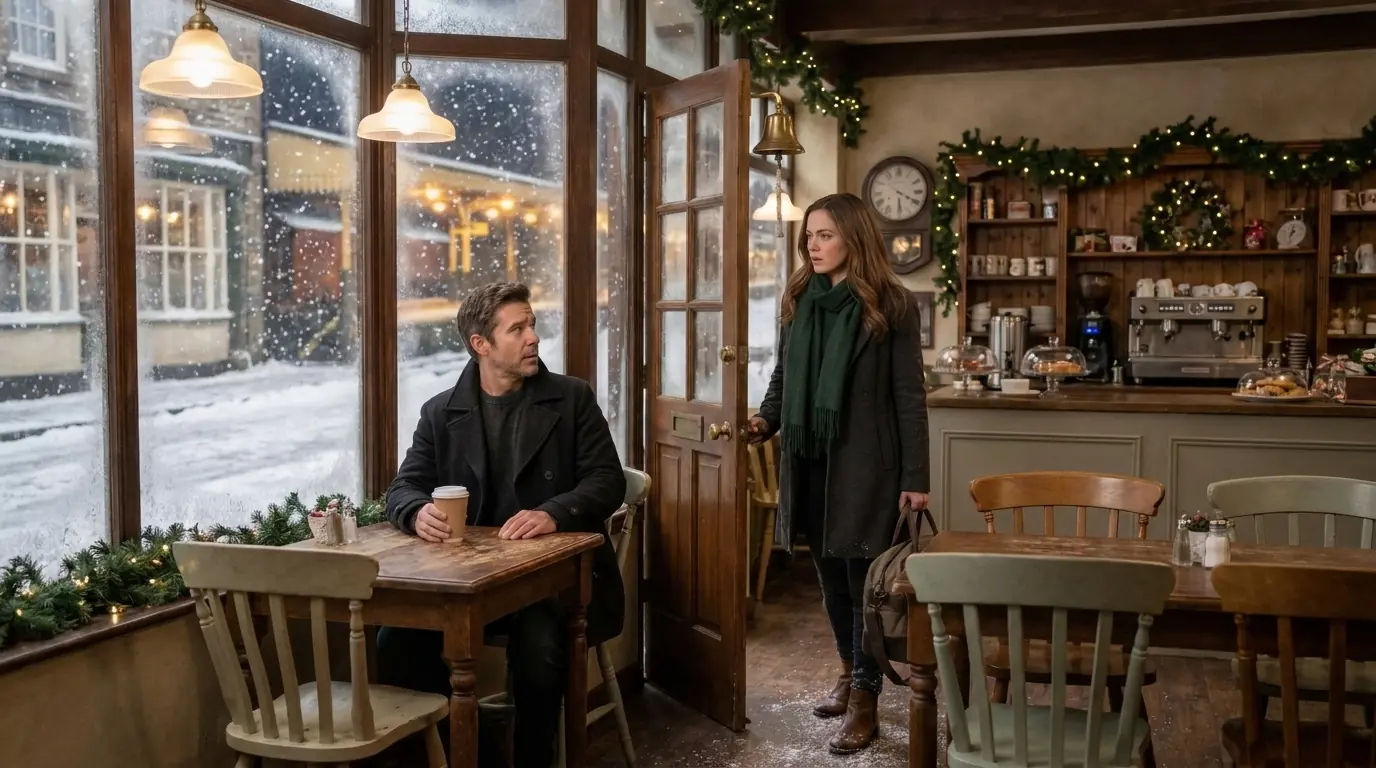
Then the door opened, and Emily walked in. The same eyes, the same dark wool scarf she'd worn the night she left. Neither of them spoke until she looked at him through trembling tears and whispered two words he had waited half a decade to hear. Those two words didn't just reopen old memories, they changed the ending of both their lives forever.
Daniel was 40 years old, and he carried the particular kind of quietness that belongs only to men who have loved deeply and lost without fully understanding why. He was an architectural engineer by trade, a man who spent his days drawing the bones of buildings, calculating load-bearing walls, measuring the precise distances between one thing and another. There was a certain irony in that, though he rarely allowed himself to think about it. He was good at measuring distances.
He was not as good at closing them. He lived alone in a small wood frame house on the edge of town. Set back from the road behind a row of bare-limbed oaks that had been old even when he first moved in, the house was modest, two bedrooms, a kitchen with a window that faced east, a fireplace he used in winter more out of habit than comfort. The neighbors on either side kept their distance, which suited him.
He liked the quiet, or at least he had convinced himself that he did. He had not remarried. He had not even tried to date. There had been a few attempts in the first year after the divorce, a colleague who invited him to dinner, a woman his sister had introduced him to at a backyard gathering, but nothing had taken root.
He would sit across the table from someone perfectly kind and feel nothing but the low hum of absence, the way a house sounds when it has been empty too long. After a while, he stopped trying altogether. Not bitterly, not with anger, simply with the resigned acceptance of a man who had decided that some chapters, once closed, do not deserve to be reopened. On Christmas Eve, with snow falling in heavy, deliberate curtains outside his window, Daniel did what he always did.
He drove his old pickup truck into town. He bought groceries enough for 2 or 3 days, in the practical way of a man who has learned not to over prepare for celebrations. He stopped at the hardware store out of habit. He passed the bakery and did not go in.
He bought a small Christmas tree from the lot outside the grocery store, a modest spruce about 3 ft tall, the kind sold cheaply at the end of the afternoon when the good ones are already gone. He bought it not because he wanted it, not because it would make the house feel any more festive. He bought it because he had bought one every year since the divorce. And stopping now would have felt like admitting to something he was not ready to name.
He drove home. He set the tree on the kitchen table. He stood there for a long moment, hands in his coat pockets, looking at it. Then he turned around, got back in the truck, and drove toward the old part of town, not for any particular reason he could have explained.
Maybe because the streets there were lit with the kind of warm yellow light that made loneliness feel almost picturesque. Maybe because he needed somewhere to sit for a while that wasn't his own four walls, he parked near the train station. He walked toward the cafe on the corner. He pushed open the door and stepped inside, stamping snow from his boots, and felt the familiar warmth of the place settle around him like a coat.
He ordered a coffee. He found a seat near the window. He wrapped both hands around the cup and watched the snowfall. He was not expecting anything.
He was not hoping for anything. He was simply a man taking shelter from the cold on the longest, quietest night of the year. And then the bell above the door rang. He looked up, not deliberately.
Just the reflex of a man in a quiet room when a sound breaks through. The door swung open, letting in a brief rush of cold air, and the muffled sound of Christmas music from somewhere down the street. And she walked in. Emily, his ex-wife.
The woman he had spent five years trying to forget and five years failing to. She was wearing a coat he didn't recognize, charcoal gray, long, practical, but the scarf around her neck was the same dark green wool scarf she had worn the night she left. He would have known it anywhere. He had seen it in his dreams more times than he cared to admit.
Emily stepped fully inside. The door swung shut. The bell rang again, softer this time, like an afterthought. They were no more than 15 ft apart, and it felt like standing on opposite sides of a canyon.
Neither of them smiled. Neither of them cried. Neither of them said a single word. They simply looked at each other across the warm Christmas-lit room for what felt like nearly a full minute, long enough for the song playing softly from the cafe speakers to change, long enough for the woman behind the counter to begin watching them with the politely curious expression of someone witnessing something she cannot quite categorize.
The air between Daniel and Emily was not hostile. It was not angry. It was something rarer and more difficult. It was the particular silence of two people who once knew everything about each other and now do not know where to begin.
Daniel thought about all the things he might say. He thought about standing up. He thought about looking away, back at his coffee, pretending. He did none of those things.
He just sat there. And she just stood there. And the snow fell outside the window. And the cafe was warm and smelled of cinnamon and old wood.
And for one suspended moment, it was as if the last 5 years had not happened at all. There was a time not so long ago, though it felt like another life, when Christmas Eve had been Daniel's favorite night of the year. Not because of the gifts or the traditions, or even the particular beauty of snow falling in the dark. It had been his favorite night because of her.
Because of the way Emily looked in candlelight, because of the way she laughed when she burned the pie crust and the kitchen filled with smoke and they had to open all the windows even though it was freezing outside, because of the way she curled against him on the couch with a mug of cocoa balanced on her knee and the tree lights casting colored shadows across her face. Those Christmases had been the happiest years of his life, though he had not always known it in the moment. He had taken them for granted the way people take for granted the things they believe will always be there. They had met 14 years ago at a city planning conference of all places, not the most romantic of settings, but they had never cared much about settings.
He had been presenting a proposal for an urban renovation project. She had been in the audience representing her firm. She had asked a question during the Q&A that was so precisely the right question that he had laughed out loud right there at the podium in front of 200 people. She had flushed.
He had apologized and then explained that it was the best question he'd been asked all year. They had coffee after. Then dinner. Then, within 6 months, they were inseparable in the way of two people who have found in each other something they had not known they were looking for.
He had proposed 2 years later on a Tuesday night in December, right there at the corner table of that same train station cafe, the same place where they now stood on either side of a silence 5 years wide. Their early married life had been full, full of plans, full of travel, full of the small domestic rituals that make a life feel inhabited. They had spent their first Christmas together decorating the house from top to bottom, strings of lights in every window, a wreath on the door, a tree so large it barely fit in the living room and had to be secured to the wall with picture wire so it wouldn't fall. Emily had made mulled wine and played Christmas albums on the old record player she'd inherited from her mother.
Daniel had assembled furniture in the wrong order and pretended he'd done it correctly. They had driven through the mountains one December and gotten briefly, memorably lost in a snowstorm, which had not been frightening at the time, only funny because they'd had each other and a flask of whiskey and a full tank of gas, and problems feel small when the right person is sitting beside you. Those early years had the particular quality of light that belongs to things seen in retrospect, a little too bright, a little too warm, the way photographs of the past always look as if the sun was kinder then. But time has a way of wearing things down, not through any single dramatic event, but through the patient, invisible accumulation of small things.
The job offer had come during their sixth year of marriage. Emily's company was expanding, opening a new headquarters in a city 400 miles north, and they wanted her to lead the transition. It was an extraordinary opportunity, the kind that comes once, if it comes at all. She had told him with the careful, controlled excitement of someone trying not to seem too eager for fear the other person would feel left behind.
He had smiled. He had said all the right things. He had meant them at first, but then the weeks passed, and the conversations about logistics, about which of them would move, about whether the house would be sold, about schools neither of them needed yet, and distance and timing, those conversations grew heavier each time until they began to avoid them entirely. Daniel had his own projects underway.
He had commitments, partners, a practice he had spent a decade building. Moving north was not impossible, but it was not simple. And he had waited, perhaps too long, for her to say she would turn it down. She had waited, perhaps too long, for him to say he would come.
The gap between them widened slowly, the way ice cracks in spring, not all at once, but in quiet increments, each one almost unnoticeable until the whole surface has given way. She went north for weeks at a time. He stayed. They called every evening at first, and then every other evening, and then whenever they could manage.
The calls grew shorter. The silences grew longer. And the terrible thing, the thing that took Daniel years to understand, was that there had been no betrayal, no dishonesty, no cruelty. There had only been two people who loved each other failing, slowly and quietly, to say the things that most needed saying.
The argument, the one that ended everything, had happened on a Sunday evening in February, 3 years into her new job. It had begun over something trivial and escalated in the way that arguments do when they are not really about the trivial thing at all, but about everything that has been accumulating underneath it for years. He didn't remember now what the original subject had been. What he remembered was the quiet.
The long pause before she spoke, the way she had looked at him not with anger, but with something sadder than anger. And then, she had said it, softly, without looking away. "Maybe we should stop." He had heard those words and understood them, or thought he had understood them as the conclusion of something already decided.
He had heard in them a finality, a door closing. He had not heard what she had actually meant, which was closer to a question than a statement. "Maybe we should stop and really talk about this. Maybe we should stop pretending everything is fine. Maybe we should stop before we lose each other completely." He had said nothing. He had stood in the kitchen of their house, looking at the window above the sink, and he had said nothing.
And she had taken his silence for its own kind of answer. She had packed a bag that night. He had not stopped her. He had stood in the hallway, watching her go, and told himself that she was right, that this was what she wanted, that stopping her would be selfish.
He had not understood until much later that what she had wanted, what she had been waiting for, was for him to stop her. The divorce had been quiet, mutual, almost entirely without lawyers, and without bitterness. They had divided everything fairly and spoken to each other in the carefully polite tones of two people trying very hard not to wound each other any further. On the day it was finalized, Daniel had driven home and sat in the driveway for a long time, engine running, not quite able to go in.
He had thought, "This is the rest of my life now." And he had put the truck in park and gone inside and begun the slow, patient work of rebuilding himself around the absence of her. He had never quite finished that work. He suspected, sitting across a cafe from her on Christmas Eve 5 years later, that he had never really started it.
Emily ordered a tea she didn't need, just to have something to do with her hands. She chose a table near the window, not the table they had always claimed as theirs when they were married, but not far from it either. And after a long suspended moment in which the cafe continued its quiet business around them and the snow continued to fall outside. Daniel picked up his coffee and moved to her table.
She looked up as he sat down. He looked at her and slowly, haltingly, like a door that has been shut too long and doesn't swing easily on its hinges anymore, they began to talk. It was awkward at first, of course it was. They asked each other the questions strangers ask.
"How are you? Where are you living now? Are you still doing the same work?" They were careful, the way people are careful with things they're afraid of dropping, but beneath the careful questions there was something else, the particular ease of two people who once knew each other completely.
A familiarity that does not disappear simply because time has passed. He noticed the way she still held her mug with both hands, thumbs touching at the top. She noticed the way he still rubbed the back of his neck when he was thinking. The small things are what survive.
They always are. Emily told him she was passing through on her way back from her mother's, who lived two towns north. The train connection had been delayed by the weather, the usual December complications. She had stopped for warmth and something hot to drink, not expecting to stay long and certainly not expecting any of this.
She said all of that in a steady voice, matter-of-factly, and then she paused and looked at him with the kind of directness she had always been capable of, the quality that had drawn him to her across a conference room a decade and a half ago. And she said, "Of all the places." He nodded. "Of all the places," he replied, and neither of them said anything for a moment because there was nothing adequate to say, and they both knew it.
She told him about the years. She had done well in her career. The project north had succeeded. And she had moved on to others, each one more complex and demanding than the last.
She spoke of her work with the familiar animation that always came over her when the subject engaged her, the way her hands moved when she described a problem she'd had to solve. He listened the way he had always listened to her fully, with his whole attention, missing nothing. She had not remarried. She said it simply, without drama, as a fact she had long since made peace with.
She had not dated much. There had been someone, briefly, about two years after the divorce, someone kind, someone good, but it had not worked. And she had known early on, if she was honest, that it would not.
"I kept comparing," she said, and then stopped as if she'd said more than she intended. He did not ask her to continue. He understood.
He told her the same in fewer words, because he had always been the less verbal of the two of them. He was still in the same house, same work, same town, same life, more or less. He had gotten a dog for about a year, but the dog had gone to live with his sister when the travel demands of a large project made caring for him impractical. He hadn't replaced the dog.
He had thought about it. He said that last part almost as a joke, and she smiled a real smile, not the careful social one she had been deploying since she sat down, and something in his chest loosened very slightly. Outside, the snow was not stopping. If anything, it was thickening, the kind of heavy, wet Christmas snow that coats everything evenly and makes the world look laundered.
From inside the cafe, it was beautiful. From the parking lot, 20 minutes later, it was a problem. Emily's car, a sensible silver sedan she'd rented at the station, would not start. The battery, most likely killed by the cold.
She stood beside it in the parking lot in her long charcoal coat, trying the key twice, and then putting her phone away with the resigned expression of someone who has calculated the odds and found them unfavorable. The tow service, when she called, informed her that, given the weather, it would be 2 hours at minimum. Daniel, who had followed her out to see if he could help and found that he could not, looked at the falling snow and then at her.
"Walk with me," he said. It wasn't quite a question. They walked.
The town square was lit for Christmas, strings of lights between the lampposts, a large tree in the center surrounded by a low wooden fence, the storefronts glowing warm behind their frosted windows. A group of children in bright coats were throwing snowballs near the fountain. A couple walked by hand in hand, their breath clouding the air. A cart near the square was selling roasted chestnuts, and the smell of them warm and sweet and unmistakably seasonal reached Daniel and Emily at the same moment, and they both stopped walking and looked at each other because they had eaten roasted chestnuts from a cart very much like that one 12 years ago on their second Christmas together, standing in just such a square in a city they had been visiting for the first time.
The memory landed between them like snow soft, without impact, but covering everything. They kept walking. They talked more easily now, something about being outside in the cold, in motion, made conversation simpler. She asked about his work, and he told her about a project he was particularly proud of, a community center he had designed for a small rural town, built mostly from reclaimed materials, that had opened in the spring and was already the heart of the place.
His voice changed when he talked about it, and she recognized the change, it was the voice he used when something mattered to him beyond the professional. She told him about a restoration project she had taken on recently, an old textile factory being converted into affordable housing. "It's slower than new builds," she said.
"Everything costs more, takes longer, and goes wrong in ways you don't anticipate. But when it works..." She stopped, searching for the word. "When it works, it feels like something was saved." The square had a small band playing carols near the tree, and they stopped to listen for a while without discussing whether to stop. A brass quartet working through the standards O Holy Night, then something faster and lighter, then Silent Night in a slow, aching arrangement that made the crowd around them go quiet.
Daniel watched Emily's profile in the glow of the Christmas lights and thought about all the versions of her he had known, the version who asked the perfect question from the back of a conference room. The version who burned the pie crust and laughed about it. The version who stood in the kitchen doorway with a packed bag and eyes that he had read wrong. That he would give anything to have read right.
He thought, "I have missed you every single day." And he said nothing because they were not there yet if they were going anywhere at all. But they were moving towards something. He felt it the way you feel a change in weather before it arrives, a shift in pressure, a charge in the air.
She felt it, too. Though she would not have been able to say when it began exactly. Maybe it had begun the moment she walked through the cafe door and saw him sitting there. Maybe it had never stopped.
They had circled back toward the train station and were standing near the park bench where the tow truck would eventually meet her when Daniel spoke. He had been building toward something for the past half hour. She could see it in his jaw. In the way he kept looking at her and then looking away.
He said, "There's something I never told you." She waited. The snow fell. He looked at the ground for a moment, then back at her.
"The night you left, the night you packed your bag, I let you walk out the door. I stood there for about ten minutes, and then I got in the truck." She was very still. "I was going to come after you," he said.
"I was going to drive to wherever you were going and tell you I'd been an idiot. That you were right. That I should have talked to you instead of going quiet. That I would move north, or we would figure something out. At the very least, I needed to say the thing I'd never said: I didn't want to lose you." He paused. "I didn't make it. There was a crash on the interstate. Three cars, bad ice. I sat in stopped traffic for four hours. By the time the road cleared, it was nearly two in the morning. I kept trying to call you and getting voicemail. And I thought..." He stopped. "I thought you'd made your decision. I thought showing up at two in the morning would only make it worse. So I turned around." Emily had gone very still. Her face in the Christmas light was unreadable for a moment.
And then it was not. It was full of something that looked like grief and wonder in equal measure. "I waited," she said quietly. "I was staying at a hotel two towns over, and I waited for two days for you to come. I kept my phone on all night." The snow fell around them, slow and even. "I thought you'd decided," she said. "I thought your silence was the answer." He looked at her.
"Your silence was the answer I thought I heard, too," he said. He reached into his coat pocket, the inside pocket, the one closest to his chest, and he took out his wallet. From inside it, he unfolded a piece of paper, worn soft at the creases, that turned out to be a train ticket.
The date on it was December 23rd, 5 years ago. A one-way ticket on the northbound line, the route that would have taken him to the city where she had gone. He had bought it 2 days after she left and never used it. He had kept it all this time without fully knowing why, except that throwing it away had always felt like giving up on something he couldn't quite relinquish.
And then he reached into the same pocket and took out something else. A ring, their wedding ring, his, the plain silver band he had worn for 7 years and removed on the day the divorce was finalized and placed in his pocket because he could not think where else to put it and had simply never taken it out again. He held both things out in his open palm. Not as an offer or a gesture, but simply as evidence.
As proof that some things, even unspoken and unanswered, do not go away. Emily looked at his hand. She looked at the ticket and the ring lying there in the snow-lit dark. And then, for the first time since she had walked through the cafe door, she cried, not dramatically, not in the manner of a staged scene, but quietly, the way adults cry when they have held something for too long and finally set it down.
She pressed her hand over her mouth. She looked away. She looked back. And then she said it.
Two words, barely above a whisper, her voice unsteady in the cold air. "I'm sorry." Just that. Just those two words.
But in them was everything she had not said for 5 years. The apology for leaving without making him understand, for reading his silence as rejection, for packing her bag and walking out of the door she had hoped he would follow her through, for all the years of not reaching out, of telling herself it was too late, of living inside the quiet echo of a marriage she had never fully stopped grieving. Two words, and they carried the weight of all of it. Daniel closed his fingers around the ring and the ticket.
He looked at her. And his eyes were bright with something that had been pressed down for a very long time. "So am I," he said.
And that was the thing that finally broke it open. Not with drama, not with noise, but with the particular relief of two people who have been holding their breath for 5 years and have finally, at the same moment, let it out. They stood there in the snow, in the Christmas-lit street, and for the first time since the divorce, they talked, really talked, without the armor of politeness, without the careful distance of strangers. They talked until the tow truck came and the mechanic determined that the car needed a battery that could not be found until morning.
They talked while the mechanic worked and while the town grew quieter around them and the last of the carolers went home. They talked past midnight. It was Daniel who said, eventually, that she should not drive anywhere in a rental car with a temporary fix in weather like this. It was practical and true, though not entirely the only reason he said it.
He had a spare room. The roads north would be impassable by morning if the snow kept up. She hesitated not because she didn't want to, but because she was trying to be sensible about what it meant and what it didn't mean. And what she was allowed to hope.
He did not push. He simply said the offer was there and started walking toward his truck and after a moment she followed. The house was the same as she remembered in the ways that mattered and different in the ways that accumulate over five years of solitary life. Same kitchen with the east-facing window.
Same fireplace. The wood frame walls had darkened a shade with time. The bookshelves were fuller. The furniture had shifted.
The small Christmas tree he'd bought sat on the kitchen table. Still in its plastic wrap, unsupported and slightly listing. She looked at it and then at him and he looked faintly embarrassed in the way of a man caught in a private admission.
"I always get one," he said, by way of an explanation that explained very little. "I know," she replied, because she did know she had always known these things about him. The way he held on to rituals even when they no longer served their original purpose.
The way he was stubborn about the small ceremonies of life. It had frustrated her sometimes. It moved her now. They cooked together.
It was not planned, it simply happened. The way things happen between two people who have cooked in the same kitchen for years and whose bodies remember the choreography even when the minds have tried to forget. He had groceries, she knew where everything was, more or less. They made a simple supper, pasta, a salad, bread from the bakery bag he'd left on the counter.
They opened a bottle of wine he'd been saving for no particular occasion. They sat at the kitchen table with the small undecorated tree between them, and they ate and talked the way they used to talk freely, without agenda, following the thought wherever it went. After supper, without discussion, they decorated the tree. He found the box of ornaments in the closet, the same box, the same ornaments he had packed when he moved out of their old house and into this one.
Glass balls in red and silver, a wooden star he had carved, badly, one December as a gift to her, and which she had declared beautiful anyway. The small brass reindeer she had found at a market years ago. He lifted each one out with the particular care of a man handling things that are more fragile than they look. She hung them, mostly in silence, occasionally saying the name of the memory attached to each one, not with sadness, but with the gentle matter-of-factness of someone sorting through old photographs and finding more good ones than expected.
At the bottom of the box was a smaller box inside a shoebox, taped shut with tape that had yellowed at the edges. He had forgotten it was there, or had pretended to himself that he had. She looked at it. He looked at it.
He said, "That's... I don't know if you want to." She said, "Open it." Inside were photographs. Their wedding photograph, the two of them on the steps of the courthouse, because they had wanted something small and had gotten something small and had been happy about it.
A Christmas card she had made by hand the year she'd been between jobs and taken up a brief, intense interest in calligraphy. A handful of letters, actual handwritten letters, from the early years of their relationship, when they had been apart for a summer internship of hers, and had written to each other on paper because the email felt insufficient. And one more letter, this one sealed in an envelope he recognized as his own handwriting, addressed to her, never mailed. She looked at the envelope.
He took it out and held it. "I wrote it the night I bought the train ticket," he said. "I was going to bring it with me." She held out her hand.
He gave it to her. She broke the seal carefully, unfolded the single page inside, and read. He looked at the fire while she read. He already knew what it said.
He had read it only once, the night he wrote it, and had not read it again. But he knew. It was not a long letter. It said that he had been wrong to go quiet, that the distance between them had not been geography, that he missed her in the specific, irreplaceable way you miss someone who has become part of the architecture of your daily life, not just present, but load-bearing, that he was sorry, that he would spend whatever time was needed making it right, if she would let him, that he loved her.
He had never stopped. Emily folded the letter slowly along its original creases, and held it in both hands for a long moment, her head slightly bowed. Then she looked up. Her eyes were dry now.
She had moved past the crying into something quieter on the other side of it. She reached up and unwound the dark green scarf from her neck, the same scarf, the one from the night she left, the one he had recognized the moment she walked through the door. She laid it on the table between them.
"I wore it on purpose today," she said. He looked at her. "I always wear it," she said.
"Everywhere I go. I couldn't explain exactly why. I just couldn't put it away." She paused. "Now I think I know why." He reached across the table and put his hand over hers. Neither of them spoke for a long time.
Snow fell through the night. The fire burned low and was built back up. They talked until the small hours about everything and nothing. About the years in between.
About the things they wished they had said and the things they were saying now. At some point the conversation gentled into something less urgent and more peaceful. The way a storm settles after it has given everything it had to give. They did not make any declarations that night.
They did not make any promises beyond the immediate. There was too much that needed to be understood slowly, carefully, without rushing. But there was something in the room in the fire-lit kitchen of the small wood frame house with the decorated tree on the table and the letters put carefully back in their box. Something that had not been there before she walked through the door.
It was the tentative, fragile beginning of a thing that had never quite been finished. In the morning, the snow had stopped. It lay thick and still and brilliantly white across everything. The road, the yard, the bare branches of the oaks.
The sky was the particular pale blue of winter mornings after a storm. Clear and cold and vast. Emily woke first in the spare room and stood at the window for a while, looking at the snow. Then she went to the kitchen and, without fully deciding to, began making coffee. Daniel came downstairs to the smell of it, his hair not yet combed, and found her standing at the east-facing window with a mug, looking out at the white yard. He poured himself a cup. He stood beside her. They watched a cardinal land on the fence post outside, a flash of red against all that white, so vivid it looked almost deliberate.
He drove her to the train station. The roads were clear enough. A plow had come through early, as they do in towns that know how to handle winter. The station was quiet in the particular way of holiday mornings.
A few travelers here and there. The air still carrying the faint smell of the previous night's festivities. They stood on the platform while the board showed her train arriving in 11 minutes. The cold was sharp and clean.
Their breath clouded between them. She had her bag over her shoulder and her green scarf around her neck, still wearing it, he noticed, which meant something, though he wasn't sure yet precisely what. He had been thinking all morning about what to say. He had rehearsed several versions of it, some too much, some not enough.
In the end, he said the true thing, which was simpler than any of the rehearsed versions. He looked at her and he said, "If we met again today, for the very first time, if you walked into that cafe and I was sitting there, and neither of us knew anything about the other, would you still choose me?" It was not a casual question. She heard it for what it was, not a plea, not a negotiation, but a genuine inquiry asked by a man who needed to know not what she regretted, but what she wanted.
She looked at him for a moment, and her expression was the expression of someone arriving. Finally, at an answer they had been approaching for a very long time. "Every single time," she said.
He had kept the ring in his coat pocket all morning, had not been sure he would take it out, had told himself it would be too much, too soon, too freighted with the past they were still making sense of. But when she said those words, every single time, he reached into his pocket and closed his fingers around it. And then he took it out and held it in his open palm between them. Not as a proposal, not as a demand or an expectation.
He held it out the way you might hold out a compass as something that had always known north. Regardless of how far from it he had traveled. "This wasn't about the past," he said quietly.
"It never was." She looked at the ring in his hand and she looked at him. And she reached out and took it not to put it on. Not yet.
Not in the way of an immediate answer. But to hold it the way you hold something you are not ready to put down. The train came in on schedule. Which was not something trains often do on the day after Christmas in a heavy snowfall, but which felt on that particular morning like the smallest possible miracle in a day that was already full of them.
Emily stepped toward the platform. She turned back once. She was still holding the ring closed in her right hand. She looked at him the way she had looked at him across a conference room 14 years ago.
Directly, openly, without pretense. "Call me," she said. He nodded.
"Tonight," he replied. She smiled the full smile. The real one.
The one he had been waiting for since she walked through the cafe door the night before. Then she stepped onto the train. He stood on the platform and watched the train until it curved out of sight around the bend north of the station. Then he stood there a moment longer in the cold and the clean white air of Christmas morning.
He was not the same man who had driven into town the night before with a 3-ft spruce tree in his truck bed and no particular hope for the evening. He was not sure yet what he was, but he was not empty in the way he had been for 5 years. That particular hollowness that a man gets used to carrying was not there this morning. In its place was something smaller and more tentative, but real, the way a room feels after a window has been opened.
He walked back to his truck. He sat for a moment with both hands on the wheel, engine running, heater coming up slowly. He thought about all the things that would need to happen, conversations, decisions. The long careful work of two adults rebuilding something complicated after a long absence.
None of it would be simple. None of it would be fast, but it would be honest, which was more than it had been before. And honest was where everything worth anything had to start. He put the truck in drive.
He drove home through the brilliant white morning, past the town square where the Christmas lights still glowed softly in the daylight. Past the cafe on the corner where everything had changed the night before. He pulled into his driveway. He sat for a moment looking at the house.
Then he went inside. Poured the last of the morning coffee. Sat at the kitchen table beside the small decorated tree and picked up his phone. Sometimes the greatest Christmas miracle isn't finding someone new.
It's finding your way back to the person you never truly stopped loving and discovering in the middle of the longest night of the year that they have been waiting in the same place, holding the same things, wondering what you have been wondering all along. Not whether love can survive time and distance and silence and misunderstanding, but whether two people, given one more chance, can finally learn to say the things that have always been true. He called her that evening at 6:30, which was the time they had always called each other when they were young and first in love and living in different cities during that summer internship, a habit so old it lived in his fingers before his mind had consciously decided on. She answered on the second ring.
"Hi," she said. Just that. But the way she said it warm, unhurried, with the particular ease of someone who has put down a weight she has been carrying for years, told him everything he needed to know about where they were.
Not back at the beginning, not in the middle of the story they had told before. Somewhere new, somewhere that had no map yet. Which was frightening and necessary and right. They talked for 2 hours that night, which surprised neither of them.
There was so much still to say. Not the urgent, confessional kind of talking that had happened on the platform of the train station or in the firelit kitchen, that part was done. Or at least the first chapter of it was done. This was quieter.
This was two people beginning to sketch the outlines of something they were not quite ready to name, but which both of them already understood. She told him about the ring, that she had slipped it into the small zippered pocket of her bag, the pocket she never lost things in. He told her he had noticed, which made her laugh, a brief and genuine sound that traveled cleanly through the phone and settled somewhere in the region of his chest. He told her about the cardinal on the fence post.
She said she had seen it, too, from the spare bedroom window, and had taken it as some kind of sign, which she acknowledged was sentimental and probably not rational. He said he had thought the same thing. She laughed again. He asked her when she would come back through.
She said she had no reason to be in that direction for at least a month, maybe 6 weeks. He said he might have a reason to be in her direction sooner than that. He had a colleague he'd been meaning to visit, a former partner who'd relocated to a city that was, he had calculated while she was on her train, approximately 40 miles from where Emily now lived and worked. She was quiet for a moment.
Then she said, "That's a lot of math for a casual visit." He said, "I'm an engineer. Math is how I think." She replied, "Then come." And those two words—"Come"—spoken by her without hesitation, in the voice of someone who meant it entirely, were as significant to him as any two words she had spoken the night before. He drove north 3 weeks later on a Saturday in January when the sky was the flat gray of winter and the roads were clear and dry and the bare trees stood in their rows along the highway like a patient audience.
He had told his colleague he was coming. The colleague had seemed genuinely pleased and they had had a good lunch and Daniel had left mid-afternoon with enough time to reach Emily's neighborhood by 5. She had texted him the address of a restaurant she liked, a small Italian place two blocks from her apartment. He found parking which in that city was its own small miracle and walked the two blocks in the cold, hands in his pockets, his breath clouding the air, feeling the particular anticipation of something about to begin.
She was already there when he arrived. Sitting at a table near the window. Not a corner table. Not the specific geography of their history.
Just a table near the light. She was wearing something he hadn't seen before which struck him as significant in a way that was difficult to articulate. She had a whole wardrobe he didn't know, a whole daily life he had missed 5 years of and they were starting from that truth rather than pretending otherwise. She looked up when he came in.
She smiled the real smile, the full one. He sat down across from her. He thought, "This is where we begin. Not where we left off. Not where we used to be. Here, at this table, in this city, in January, with five years between us that we will spend the rest of our time learning to carry lightly." They ordered. They ate.
They talked about the future carefully but not fearfully about what moving might look like for one or both of them, on a timeline they could not fully see yet but were willing to discover; about what they had learned in the years apart that they hadn't known before about themselves. About what they needed. About the things they had been wrong about. He had been wrong to go quiet.
She had been wrong to interpret his silence as rejection without asking first. They had both been wrong to let distance, physical and otherwise, become the language of the marriage without recognizing what language it was speaking. They said these things not with the pain of accusation, but with the steadiness of two people who had done their reckoning privately and were now doing it together, which was the only way it counted. After dinner, they walked.
Her neighborhood was quiet in the way of residential streets in winter, with most people inside and most lights glowing behind curtains, the cold keeping the city compact and interior. They walked without a particular destination. Hands in their pockets at first and then after a few blocks not. He reached for her hand in the way of someone taking a step he had been considering for a while—not impulsively, but deliberately, as a choice.
She took it. They walked that way for a long time not saying much. It was not the silence of two people who had nothing to say, but the silence of two people comfortable enough to say nothing, which was a different thing entirely and one of the rarest things in a life. Eventually they stopped in front of a small park where a fountain sat dry for winter surrounded by bare-limbed trees strung with white lights someone had not yet taken down after the holidays.
They stood there looking at it for a moment. Then she let go of his hand and reached into the pocket of her coat and took out the ring. She had been carrying it with her, he realized, since the train platform. She looked at it in the light of the Christmas bulbs still strung overhead, and then she looked at him, and she placed it carefully in his palm.
He looked at her. "Not yet," she said gently, as a beginning rather than an ending. "But I want you to hold it." He closed his fingers around it.
He understood. There were things still to be built between them, slowly, correctly, on solid ground. The way he had spent his career building things meant to last. The ring was not a conclusion.
It was a foundation stone. And for now, tonight, in January, in a small park with out-of-season lights strung overhead, and the cold clean air around them, with all of it—the years, the silence, the letters never sent, and the train tickets never used—laid out behind them like a road they had finally agreed to stop walking alone. For now, a foundation stone was enough. It was more than enough.
It was exactly where they needed to start.