The rain hammered downtown Seattle as James Carter ran toward the most important interview of his life. His only suit was already soaked through. A red Mercedes sat crooked against the curb. A woman in a brilliant orange dress stepped out and immediately went down hard. Her ankle twisted as her heel caught in a storm drain.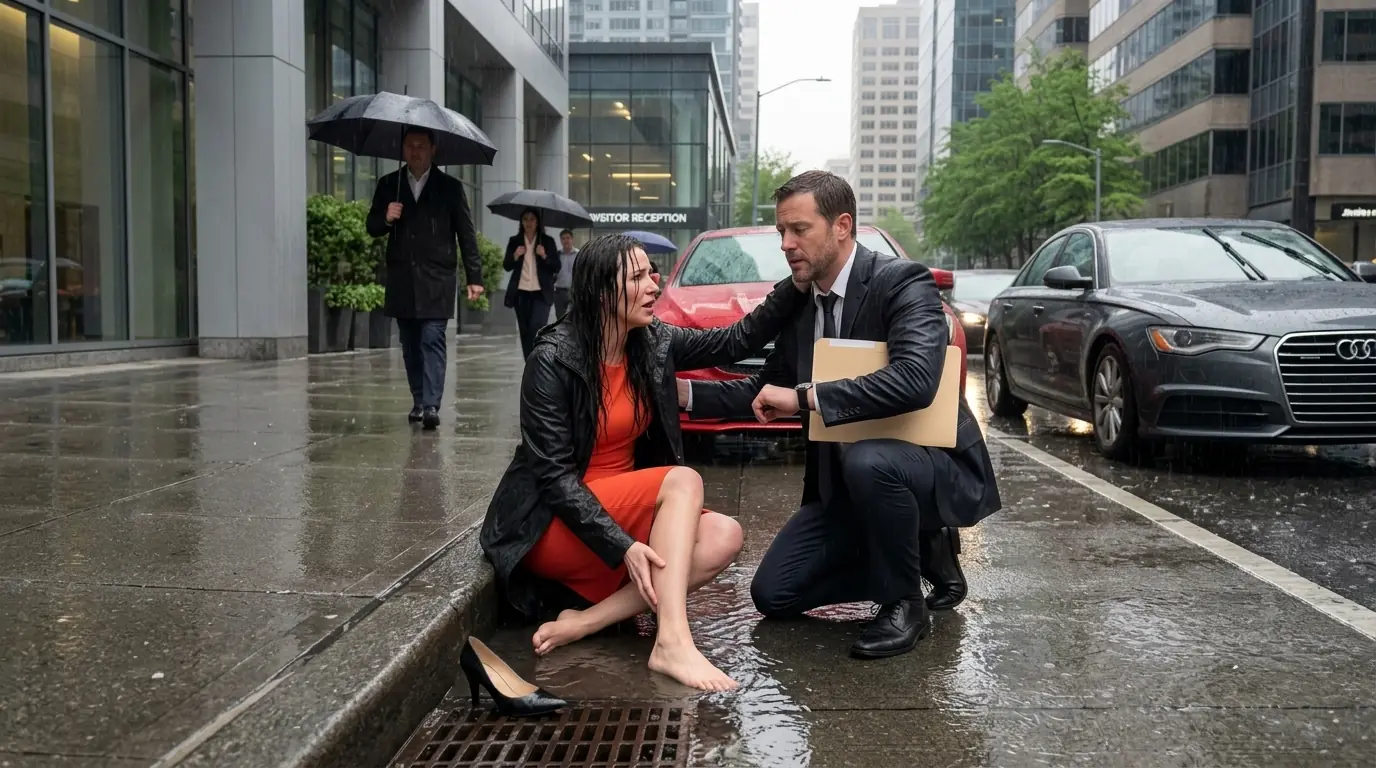
Cars splashed past. Nobody stopped. James checked his watch: 17 minutes until his interview. He looked at the woman struggling to stand in the downpour, closed his eyes, knowing what this would cost him, then ran back. James Carter hadn't always been the kind of man who worked three part-time jobs to keep the lights on.
Five years ago, he'd been lead engineer at Boeing's experimental propulsion division, designing systems that would revolutionize commercial aviation. His corner office had overlooked Mount Rainier on clear days, which in Seattle meant maybe twice a month. But when that mountain appeared through the clouds, James would stop whatever he was doing and stare. It reminded him that some things were worth waiting for, worth working toward, even when they seemed impossibly distant. He'd met Sarah at a conference on sustainable aviation.
She'd been presenting a paper on biofuels, stumbling over her words when the projector failed, her face flushing red as she tried to explain complex molecular structures without her carefully prepared slides. James had stood up from the third row, walked to the front, and fixed the projector in 30 seconds. She'd looked at him with such gratitude that he'd forgotten how to walk back to his seat properly, bumping into two chairs and nearly knocking over someone's coffee. After her presentation, she'd found him at the coffee station. “My hero,” she'd said, and he'd spilled sugar all over his shoes trying to play it cool.
They were married 14 months later in her parents' backyard in Spokane. Sarah wore her grandmother's dress, altered to fit, but still smelling faintly of lavender and age. James had written his own vows, but forgotten them completely the moment he saw her walking toward him, settling instead for promising to love her, fix her projectors, and try not to spill things when she made him nervous. The crowd had laughed. Sarah had cried.
Her father had clapped him on the shoulder afterward and said, “Take care of her.” As if James could imagine doing anything else. Their house in Queen Anne was a 1942 Craftsman that needed everything fixed. James spent weekends learning plumbing from YouTube videos, rewiring outlets with the power off, and Sarah standing nervously in the doorway with a flashlight. She painted every room a different color.
Bold choices that shouldn't have worked but did: forest green in the bedroom, deep purple in the bathroom, and a shade of yellow in the kitchen that she insisted was “Butterscotch Dream” but looked exactly like mustard to James. He loved it all because she loved it. When Sarah got pregnant, she documented everything in a journal that would later become James's most treasured possession: every kick, every craving, every 3 a.m. moment when she'd wake him to put his hand on her belly and feel their son doing gymnastics. She'd written that James thought the baby would be an engineer like him. The way he was always moving, always building something in there.
But she knew better. This little one was going to be an artist. She could feel it in the way he responded to music, to her voice, to the rain on the windows. Liam arrived during a thunderstorm two weeks early and in a hurry. The birth was complicated.
Sarah hemorrhaged badly enough that they rushed her into emergency surgery. James stood in the hallway holding his minutes-old son, watching through a window as doctors worked to save his wife. A nurse found him there an hour later, still standing, still holding Liam, tears streaming down his face. “She's okay,” the nurse said. “She's asking for you both.”
James had never run so fast in his life, even carrying a baby. Those first two years blurred together in James' memory, like watercolors running in the rain. Sarah singing Liam to sleep with made-up songs about elephants who wore fancy hats. James building increasingly elaborate block towers for Liam to demolish with prehistoric glee. Sunday mornings at Pike Place Market.
Liam in a carrier on James's chest. Sarah buying too many flowers because she couldn't choose just one bouquet. She'd been teaching kindergarten, then coming home covered in fingerpaint and glitter, stories about 5-year-olds who thought butterflies were just fancy moths, and that marriage meant someone who'd share their fruit snacks. The day Sarah died, it had also been raining. James remembered that detail with painful clarity: how she'd kissed him goodbye that morning, tasting of coffee and cinnamon toast, and complained that her umbrella had broken and she'd have to make a run for it from the parking lot.
He'd offered her his umbrella, she'd refused, saying he needed it more for his big presentation that afternoon. They'd had a playful argument about it, ending with her pushing him out the door, laughing. “Go change the world, engineer man. I'll just change some five-year-old's pants when they have an accident.” Those were her last words to him.
Instant. Painless. They assured him as if that mattered. As if the fact that she didn't suffer somehow made it better that she was gone. That Liam would grow up without her.
That James would wake up alone for the rest of his life in their mustard yellow kitchen. The funeral was a blur. Sarah's parents took Liam for a week while James sat in his house surrounded by her colors, her flowers dying in vases, her coffee cup still in the sink with lipstick on the rim. He tried to go back to work. But sitting in meetings about profit margins and production schedules felt like betrayal.
His boss gave him extended leave. HR sent flowers. His team lead said to take all the time he needed. But what James needed was to be a father fully and completely without distractions or divided loyalty. The real reason for leaving Boeing was darker than grief.
Three months before Sarah's death, James had discovered critical safety flaws in the new 787 production line, specific stress points in the fuselage that could cause catastrophic failure under certain flight conditions. He'd run the simulations dozens of times, hoping he was wrong. He wasn't. He reported it through proper channels, expecting immediate action. Instead, his supervisor, Thomas Marshall, buried the report.
Production deadlines were more important than hypothetical risks. Marshall said the planes were already sold. The contracts were signed. The stock price couldn't take the hit. James threatened to go to the FAA directly.
That's when things got ugly. Suddenly, there were discrepancies in his expense reports from years ago, small amounts easily explained but made to look like a pattern. There were questions about his mental state after Sarah's death, suggestions that grief had made him paranoid, unstable. Marshall offered him a choice. Resign quietly with a modest severance and keep his reputation or be fired for embezzlement and blacklisted from the entire industry.
With Liam to think about, James took the deal. Six months later, he heard through former colleagues that the safety issues had been quietly fixed after a near disaster during a test flight. No one ever admitted James had been right. His resignation letter was two sentences: “I appreciate the opportunities Boeing has provided. My son needs me more.”
His boss tried to talk him out of it, offering part-time work, consulting, anything to keep his expertise. But James had made up his mind. The corner office was just a room. The six-figure salary was just numbers. Liam was everything.
The house sold quickly in Seattle's hot market. James found a two-bedroom apartment in Northgate. Close to a good elementary school, he drove Uber during school hours, the same streets he used to navigate in his BMW, now driving a 10-year-old Camry that smelled perpetually of other people's coffee. He stocked shelves at Target overnight when Liam stayed with Sarah's parents. He did freelance technical writing at the kitchen table, translating engineering specifications into plain English, while Liam slept down the hall.
Victoria Lane had been groomed for greatness since birth, though she'd never been asked if greatness was what she wanted. Her father, Marcus Lane, had started his defense contracting company in a garage in Tacoma with nothing but a laptop and a security clearance from his Navy days. By the time Victoria was five, Lane Dynamics had its first Pentagon contract. By the time she was 10, they'd moved to a mansion in Medina with gates and guards and a view of Lake Washington that cost more than most people's entire homes. Marcus raised Victoria like he was training a successor, not raising a daughter.
Dinner conversations were about market strategies and hostile takeovers. Bedtime stories were annual reports and acquisition proposals. When other girls were playing with dolls, Victoria was sitting in board meetings, silent but absorbing everything. She learned to read people's faces during negotiations, to spot weakness in a contract clause, to understand that power wasn't about money. It was about information and the will to use it.
Her mother, Evelyn, had left when Victoria was 12. The divorce was quick and quiet, sealed records and non-disclosure agreements. Victoria found out from a gossip blog that her mother had moved to Italy with her art dealer lover. Marcus' only comment was, “She lacked focus.” Victoria learned not to lack focus.
She learned to be perfect, controlled, necessary. She learned to be everything except happy. Wharton at 18 was Marcus' idea, but Victoria threw herself into it with desperate intensity. She graduated in three years. Summa cum laude with a thesis on emerging defense technologies that got attention from the Pentagon.
Her professors said she was brilliant. Her classmates said she was terrifying. Both were true. She returned to Seattle with her MBA at 21, stepping directly into a vice president role at Lane Dynamics that everyone knew had been created specifically for her. The company became her entire world.
She lived in a penthouse apartment 10 minutes from the office, though she often just slept on the couch in her executive suite. She knew every contract, every employee's name, every line item, and every budget. When Marcus had his first heart attack at 62, Victoria took over seamlessly. When he returned 4 months later, he found she'd increased profits by 18% and secured three new government contracts. “Good,” he said.
Nothing more. Victoria had tried relationships in the clinical way she approached everything else. Men from appropriate backgrounds with appropriate portfolios and appropriate ambitions. David, the investment banker who spoke four languages but couldn't hold a conversation about anything except money. Richard, the tech CEO who brought his laptop to bed and checked stock prices during intimate moments.
Thomas, the senator's son, who proposed on their sixth date with a ring worth more than most houses and a prenuptial agreement already drafted. She'd said yes to Thomas because it made sense, because Marcus approved, because it was what she was supposed to do. The engagement lasted four months. She found Thomas with her best friend, her only friend really, in his apartment, in the bed where Victoria had tried so hard to feel something beyond mild satisfaction, and a vague sense of checking off a box marked intimacy. The betrayal should have hurt more than it did.
Instead, Victoria felt relief. She didn't have to pretend anymore. At least not about that. Marcus' death came suddenly. Unlike everything else in his calculated life, the FBI raid on Lane Dynamics headquarters was for charges Victoria hadn't seen coming: 20 years of systematic bribery.
Defense officials bought and sold like commodities. Marcus had built his empire on a foundation of corruption so deep, so systemic that Victoria hadn't even known to look for it. He'd hidden it from her. Or maybe she'd hidden it from herself. All those signs she'd chosen not to see.
When the agents burst into the building, Marcus had been in the lobby coming back from lunch. The stress triggered a massive coronary. Victoria ran from her office, her heels clicking on marble, reaching him as he collapsed. She held him on that cold floor, his blood spreading across her white suit. While federal agents stood around them with their guns and their warrants and their careful expressions, Marcus grabbed her wrist hard enough to leave bruises that lasted weeks.
“Don't let them take it,” he gasped. “Don't let them win.” Those were his last words. Not “I love you,” not “I'm sorry,” just business, even while dying. The aftermath nearly destroyed everything.
The stock price plummeted 60% in three days. The board called emergency meeting after emergency meeting, half of them demanding Victoria's resignation. The media painted her as either complicit or incompetent, neither option leaving room for the truth, that she'd been so desperate for her father's approval, that she'd made herself blind to his methods. Federal investigators combed through everything, looking for evidence of her involvement. They found nothing because there was nothing to find.
Victoria had been many things for her father, but never his confidant. He'd never trusted her that much. She saved the company through sheer force of will and strategic brutality. She fired every executive who'd known about the bribes. She brought in a new compliance team, giving them unprecedented power to investigate and report.
She personally testified before Congress for 12 hours, answering every question with precision and ice-cold composure that made headlines. “The Ice Queen Cometh,” one paper wrote. She cut the article out and framed it as a reminder that survival sometimes meant becoming exactly what they said you were. But at night, in her glass penthouse that felt more like a terrarium for displaying a rare specimen than a home, Victoria fell apart. She'd have panic attacks in her bathroom, sitting on Italian marble that cost more than most annual salaries, sobbing until she couldn't breathe.
She'd stand on her balcony 30 floors up and wonder what it would feel like to step off, to stop fighting for once. She never did it, not because she wanted to live, but because dying felt like letting them win, and Marcus had taught her never to let anyone win. The morning she met James, she'd been driving to another emergency board meeting. Richard Donnelly, her largest individual shareholder and most vocal critic, had called it to discuss leadership concerns. Victoria knew he wanted her gone, replaced with someone he could control.
She'd been strategizing her counterattack when the rain started, sudden and violent, the kind of Seattle storm that made driving feel like swimming. She'd pulled over to wait it out. Too distracted by the conference call, she was managing to raise the convertible's top when she stepped out of the car and her heel caught. When she went down hard on wet concrete, something inside her broke that had nothing to do with her ankle. She lay there for a moment, rain soaking through her designer dress, watching people walk past without stopping, and thought, “This is my life.
I could disappear right here, and the only people who'd care would be the ones afraid of losing their jobs.” The pain in her ankle was almost welcome. At least it was real, immediate, something she could point to and say, “This hurts.” Then James appeared, running the wrong direction and everything changed. The way he helped her up was so gentle, so careful, like she was something precious that might break more.
His suit was cheap, probably off the rack from a decade ago, but he wore it with dignity. His hands were calloused. She could feel them through her dress as he supported her weight, but they were steady, sure. He didn't recognize her. She could tell.
To him, she was just a woman who needed help. The simplicity of that, the purity of it, made her want to cry. He half carried her to the Starbucks, his arm around her waist, taking most of her weight without being asked. He smelled like rain and drugstore shampoo and something else, something warm and safe that reminded her of her grandfather's workshop before he died, before Marcus turned her into this. James found her a chair, knelt in front of her without caring that his knees were getting soaked from the puddle on the floor, and examined her ankle with surprising expertise.
“You've done this before,” she said. “My son's very active,” he replied, not looking up from her ankle. “I've gotten good at first aid.” A son? Of course, he had a family, a life, somewhere to be that wasn't here with her.
“Your meeting,” she said, remembering how he'd been running. “You're going to be late.” He looked at his watch, and she saw him deflate, his shoulders dropping like someone had cut his strings. “Yeah,” he said quietly. “I am.”
“Go,” Victoria said. “I'm fine. Go.” He looked at her then, really looked at her, and she saw him make a decision that would cost him everything. “You're not fine,” he said simply.
“And they won't reschedule. It's their policy, so it doesn't matter anymore.” He stayed until she insisted she could manage and had called her driver, though she actually just pretended to call, too embarrassed to admit she'd been planning to drive herself home in this condition. When he left, she watched him walk back into the rain, his ruined suit clinging to him, his shoulders squared despite what he just lost. She didn't even know his name.
Victoria sat in that Starbucks for an hour, her ankle throbbing, replaying the moment over and over. The way he turned back, the resignation in his voice when he'd said it didn't matter anymore, the careful way he touched her ankle like he was trained to heal things, not hurt them. When was the last time someone had chosen her? Not her money, not her company, not her connections, just her over something that mattered to them. By that evening, she'd had her security team pull the traffic camera footage.
The facial recognition software found him in minutes. James Carter, 35, widowed, one son. The public records told a story that made her chest tight. Brilliant engineer at Boeing. Rising star.
Multiple patents pending. Wife deceased from a brain aneurysm at age 31. Resignation from Boeing immediately following her death. Current employment. Multiple part-time positions.
Current residence. Northgate. Average rent for a two-bedroom in that area, less than what Victoria spent on lunch most days, but it was the Boeing file that made her sit up straight. Her head of security had connections everywhere. It was part of what she paid him for.
The real story wasn't in the official records. James had discovered critical safety flaws in the new 787 production line, the kind that could cause catastrophic failure under specific conditions. He'd reported it through proper channels. His supervisors had buried it, choosing production deadlines over passenger safety. When James threatened to go to the FAA, they destroyed him.
Accusations of embezzlement, mental instability following his wife's death, a complete character assassination that ensured he'd never work in aerospace again. Victoria pulled up the security footage again, watched him turn back in the rain. This man had already sacrificed his career once for doing the right thing. He'd just done it again. For a stranger, she made a decision that went against every professional instinct Marcus had drilled into her.
She was going to find James Carter and make this right. Three days later, Victoria knocked on James's apartment door at 7 in the evening. The building was tired-looking, one of those 1970s complexes that had been renovated just enough to justify raising the rent, but not enough to actually improve anything. The hallway smelled like someone's dinner curry, maybe, or something with too much garlic. Children's voices echoed from somewhere above.
This was so far from her world that Victoria almost turned back, but she knocked. And when James opened the door, the surprise on his face was worth the courage it had taken to come. He looked different in jeans and a t-shirt, younger, less formal. Behind him, she could see a small boy at a kitchen table, his tongue poking out in concentration as he worked on something with crayons. “How did you—” James started.
“I'm very good at finding people,” Victoria said, which sounded more ominous than she'd intended. “May I come in?” The apartment was small but meticulously clean. Toys were organized in labeled bins. Children's artwork displayed on every wall like a gallery.
The furniture was old but well-maintained. Everything arranged to maximize the limited space. It smelled like laundry detergent and apple juice and something indefinable that she'd later recognize as the scent of a happy home. “Liam,” James said to the boy, “this is Miss Lane. She's someone from Daddy's work.”
“You don't have work today,” Liam pointed out with five-year-old logic. “She's from potential work,” James corrected, and Victoria saw him flush slightly. Liam studied her with his father's serious eyes. “Are you the lady with the hurt foot?” Victoria blinked.
“How did you—” “Daddy said he helped a lady with a hurt foot, and that's why he was late to his meeting, and they said he couldn't have the job, but it was okay because helping people is more important than jobs.” Liam delivered this in one breath, then added, “Do you want to see my dinosaur collection?” “Maybe later, buddy,” James said quickly. “Why don't you finish your picture?” Liam returned to his coloring, but Victoria noticed he kept glancing at her with curious eyes. She pulled out the folder she'd prepared, set it on James's coffee table, a piece that had probably been new when Clinton was president.
“I want to hire you,” she said without preamble. “Technical consulting for Lane Dynamics, reviewing our aerospace contracts, ensuring quality control, preventing the kind of disasters Boeing tried to hide.” James's face went carefully neutral. “You looked me up.” “I look everyone up.
But yes, I know what happened at Boeing. I know you were right. I know what it cost you.” She paused. “And I know you deserve better than stocking shelves at Target when you could be saving lives.”
“I'm not in a position to take a traditional job. My son needs stability and routine. I can't do 60-hour weeks or travel.” “I'm not offering you a traditional job,” Victoria interrupted. “Remote work, completely flexible hours.
You work when Liam's at school or asleep. No office requirement. No travel unless you choose it. The salary is in the folder, along with benefits that include dependent coverage.” James opened the folder and she saw his eyes widen at the number.
It was more than generous. It was life-changing, but his face remained troubled. “Why?” he asked. “You don't know me.
One interaction in the rain doesn't—” “You turned back,” Victoria said simply. “In the rain, late for something important, you turned back to help someone you didn't know. That tells me everything I need to know about your character. The fact that you're also brilliant at what you do is just a bonus.” She stood to leave, pulling out her business card.
“Call me when you decide.” At the door, she turned back. “The man who forced you out at Boeing—Thomas Marshall? He works for my biggest competitor now. I just thought you should know that helping me means beating him.”
After she left, James sat at his kitchen table, staring at the contract while Liam colored beside him. The salary would mean he could stop driving Uber, stop stocking shelves, stop worrying about making rent every month. It would mean Liam could have the things other kids had, new clothes that fit properly, birthday parties that weren't just cake from a box, maybe even college savings someday. But more than that, it would mean doing work that mattered again, using his brain for something more than translating technical manuals. The handwritten note at the bottom of the contract decided him.
“Second chances don't come often. Trust me, I know. —V.” James called Victoria two days later to accept the position. He started immediately working from his laptop at the kitchen table while Liam was at school. The first contract he reviewed was for a new drone guidance system.
He found 17 critical flaws in the first hour, issues that could have caused navigation failures in combat situations. His report was thorough, meticulous, and so well written that Victoria forwarded it to the entire board with a note: “This is why we need people who care more about quality than quotas.” The calls started as professional check-ins. Victoria would phone to discuss a contract detail and somehow they'd end up talking for an hour about everything else. She learned that James sang Beatles songs in the shower badly but with enthusiasm.
He learned that she'd never learned to ride a bike because Marcus thought it was a waste of time. She learned that he read Liam three stories every night doing different voices for all the characters even though it made his throat hurt. He learned that she had panic attacks that she hid in bathroom stalls, breathing into paper bags from the sandwich shop downstairs. Six weeks into their working relationship, Victoria showed up at the apartment on a Saturday morning with a box of pastries from the French bakery downtown. “I was in the neighborhood,” she said, which was absurd since her neighborhood and his were separated by several tax brackets and a large body of water.
Liam answered the door in dinosaur pajamas that had seen better days. “The foot lady,” he announced with delight. “Dad, the foot lady brought food.” “Her name is Miss Lane,” James called from the kitchen, where something was burning. “Victoria,” she corrected, entering without invitation.
The kitchen was a disaster: eggs stuck to a pan, and the smoke alarm was threatening to go off. James looked harassed in an apron that said “Dad's Kitchen” in a child's handwriting. “I was trying to make omelets,” he said helplessly. “Step aside,” Victoria said, surprising herself. She hadn't cooked in years.
There'd never been a reason to. But suddenly, she wanted to. She saved the eggs, though they became scrambled rather than an omelette. She found cheese in the fridge, some vegetables that were on the edge of acceptable, and made something that resembled actual food. They ate together at the small table, Liam chattering about school, about his best friend Marcus, who could burp the alphabet, about how his teacher, Mrs. Chen, had a baby in her tummy that was going to come out soon.
Victoria found herself listening with genuine interest, asking questions that made Liam light up with excitement. James watched them both with an expression she couldn't quite read. “Do you have kids?” Liam asked suddenly, his mouth full of egg. “No,” Victoria said.
“Why not?” “Liam,” James warned. “It's okay,” Victoria said, though it wasn't. Not really. “I guess I've been too focused on work to have a family.”
Liam considered this with the seriousness only a 5-year-old could muster. “That's sad,” he pronounced. “Everyone should have family like me and dad. We're small, but we're good.” Victoria's eyes burned with unexpected tears.
“Yes,” she said quietly. “You are.” These visits became a pattern neither of them acknowledged. Victoria would appear with some excuse: contracts to review, educational toys for Liam that she happened to see, or soup when James mentioned feeling under the weather. She learned the rhythm of their life.
Breakfast at 7:00, school drop-off at 8:15. Lunch at noon sharp because Liam got cranky if it was late. Dinner at 6:00, bath at 7, stories at 7:30, lights out by 8:00. She learned smaller things, too. James couldn't sleep without checking on Liam at least twice.
Liam was afraid of the vacuum cleaner, but pretended he wasn't. They had pizza every Friday and watched movies on James's laptop because the television had broken months ago, and fixing it wasn't a priority. James still wore his wedding ring on a chain around his neck, tucked under his shirt where no one could see. Liam had his mother's eyes, but his father's way of tilting his head when thinking hard about something. In return, though she didn't realize she was doing it, Victoria revealed herself.
She told James about the panic attacks that started after Marcus died, how she'd sit in bathroom stalls breathing into paper bags, counting to 10 in different languages to calm herself. She told him about the engagement that ended when she found her fiancé with her best friend, how the betrayal had been less painful than the relief she'd felt at having an excuse to end it. She told him about standing on her balcony at 3:00 in the morning, wondering if anyone would notice if she just disappeared. “They would,” James said quietly when she admitted that. “Liam and I would.”
Four months after that first rainy morning, everything shifted. It was a Thursday evening and Victoria had come over to review quarterly projections, but ended up helping Liam build a pillow fort that took over the entire living room. She was crawling out from under it, laughing at something Liam had said about dragons who wore business suits to trick people when she looked up to find James watching her with an expression that made her forget how to breathe. “What?” she asked, suddenly self-conscious. Her hair was a mess.
Her designer blouse was untucked. Her makeup was probably smeared. “You're different here,” he said softly. “You're yourself.” “Is that bad?”
“No,” James said, his voice rough with something she didn't want to name. “It's perfect.” The moment stretched between them, fragile and terrifying and absolutely right. Then Liam announced he needed to pee right now and it shattered. Victoria left soon after.
But they both knew something had fundamentally changed. They were no longer employer and contractor or even friends. They were something else, something neither had words for yet. The crisis that brought everything to a head came from Richard Donnelly. He'd been maneuvering against Victoria since Marcus died, but she'd always been one step ahead.
This time, he'd found what he thought was a killing blow. The board meeting was scheduled for Tuesday morning. Victoria arrived to find the conference room full. Every board member, several major shareholders, and Donnelly himself, looking like a cat who'd cornered a mouse. He placed a folder on the table containing James's Boeing file with fabricated embezzlement charges, photos of Victoria at James's apartment, and psychological evaluations taken out of context to suggest instability.
“You've hired a disgraced engineer with mental problems and financial crimes,” Donnelly announced. “He has access to classified contracts. This is a security breach, but more than that, you're personally involved with him. Fire him or resign. You have 24 hours.”
Victoria drove straight to James's apartment and told him everything. “I'll resign immediately,” James said. “Distance yourself. Say I misrepresented my qualifications. This isn't your fight.
Donnelly's connected to Marshall at Boeing, isn't he? This is about me.” They argued until midnight. The next morning, James sent his resignation despite Victoria's protests. He ignored her calls and texts.
Didn't answer when she came to the door. Twenty-four hours after Donnelly's ultimatum, Victoria stood before the board. “Mr. Carter has resigned,” she announced. “Smart choice,” Donnelly said, already tasting victory. “I'm not finished.”
Victoria opened her laptop, connected it to the screen. “The charges against James Carter were fabricated by Thomas Marshall, your brother-in-law, Mr. Donnelly—the same Thomas Marshall who's now CEO of Apex Dynamics, our biggest competitor, and the same man who's been feeding you inside information about our contracts.” She showed email after email evidence of $17 million in bribes, corporate espionage, and stock manipulation. “The FBI will be very interested in these communications unless you resign immediately and divest all shares.” Donnelly capitulated in five minutes and fled.
Victoria turned to the remaining board members. “James Carter is the most ethical man I've ever met. He sacrificed everything to prevent disasters. If we can't make room for people like that, what are we protecting?” She paused.
“And yes, I'm in love with him. Anyone have a problem with that?” The board voted unanimously to vindicate James completely. Victoria drove to James's apartment through rush hour traffic. When he opened the door, she said, “It's done.
Donnelly's gone. The truth is out. You're vindicated.” “Dad, why is Victoria crying?” Liam asked from behind James.
“Because your dad is an idiot,” Victoria said. “A beautiful, noble, self-sacrificing idiot who thought I'd let him fall on his sword again.” “If Victoria loves you, you should probably say it back,” Liam advised his father. “I love you, too,” James said to Victoria. “I have since you made those terrible scrambled eggs.”
James pulled her inside into their small apartment that smelled like dinner cooking and home. Six months later, Victoria sold her penthouse and bought a house in Wallingford with a yard perfect for the treehouse Liam had always wanted. The night before moving in together, she found James staring at a photo of Sarah. “She would have liked you,” James said. “She had this way of seeing through to who people really were.”
“Marry me,” James said suddenly. “Not now, but someday. Marry me.” The actual proposal came from Liam months later. He approached Victoria one Saturday with a Ring Pop and a serious expression.
“Will you marry me and Dad? He's too chicken to ask properly, and I really want you to be my mom officially.” Behind him, James held a real ring. “Yes,” Victoria said to both proposals. They married the following spring in their backyard, rain falling soft as a blessing.
They exchanged vows under a small awning built to recreate where James first helped Victoria. Liam served as ring bearer and best man. In his impromptu speech, Liam said, “If dad hadn't stopped in the rain, he would have gotten that job. But we wouldn't have Victoria. So, I'm glad Dad missed his interview.
Sometimes the best things happen when stuff goes wrong.” As evening ended, Victoria stood watching the rain with James beside her, Liam asleep in his arms. “Thank you for stopping,” she whispered. “Thank you for being worth stopping for,” he replied.
The rain continued, soft as a promise. They were complete. They were family. They were home.