He had not opened a door for a woman in eight years. But there he stood, pressed blue shirt, hand hammering on the cold metal handle of a restaurant he had driven past three times before finally pulling in. Ryan didn’t know her face. He didn’t know her voice. He only knew her name, Lena. And that his nine-year-old daughter had shoved a folded piece of paper into his pocket that afternoon, giggling, refusing to let him see it.
He pulled the door open. She stepped through, slightly breathless, a strand of hair out of place. And before he could say a single word, she leaned in close and whispered five words directly into the space between them. Five words that stopped him cold. Five words that could only mean one thing. Someone had been planning this long before tonight.
The morning that changed everything started the way every morning did, with the smell of motor oil that never quite left his hands and the sound of his daughter singing to herself in the bathroom. Ryan hadn’t planned to go on a date. He hadn’t planned a lot of things in the past eight years. He hadn’t planned to be the only person in the house who knew how to braid hair, or the only person who could find Emily’s left shoe in under forty-five seconds, or the only person who remembered that she needed her colored pencils sharpened before Monday.
He hadn’t planned any of it. He had just kept showing up day after day. And somewhere along the way, it had become his whole life. He wasn’t complaining. That was the thing people never quite understood when they looked at him with that particular expression, the slightly tilted head, the soft eyes, the tone that meant they felt sorry for him. He didn’t need their pity. He had a daughter who drew dragons on the backs of grocery receipts and fell asleep every night with a fistful of crayons still clutched in her hand. He had a full life. It was also undeniably a quiet one.
His coworker Marcus had been working on him for months. Not aggressively. Marcus wasn’t that kind of person, but steadily, the way water wears down stone. A comment here, a suggestion there, a name dropped so casually into conversation that Ryan almost didn’t notice it landing. “There’s someone I think you’d like. No pressure, just one dinner.” Ryan had said no a dozen times in a dozen different ways, and Marcus had accepted every refusal with the patience of someone who knew he was eventually going to win.
He eventually won on a Tuesday in the breakroom when Ryan was eating a sandwich and not paying close enough attention. The arrangement was simple. A restaurant downtown. Seven o’clock. A woman named Lena. No photograph, no background details beyond what Marcus had offered, which wasn’t much. “She’s good, man. She’s just really good people.” Ryan had written the address in his phone and spent the next four days trying not to think about it.
Emily, however, had not stopped thinking about it. She found out the way Emily always found out things, by being nine years old and paying attention to everything while appearing to pay attention to nothing. Ryan had mentioned it on the phone to Marcus while she was supposedly absorbed in a drawing at the kitchen table. By the time he hung up, she was watching him from across the room with an expression he recognized as barely contained delight.
“You have a date,” she announced. “It’s not a date,” Ryan said, which was technically a lie. And Emily’s smile told him she knew it. She didn’t bring it up again until the afternoon before, when she appeared in his bedroom doorway while he was standing in front of his open closet with the look of a man trying to diffuse something he didn’t fully understand. His usual clothes, the ones he wore every day, suddenly seemed inadequate in a way he couldn’t quite articulate.
He owned three collared shirts. He was unsure which of them said, “I am a trustworthy person who is not going to be strange about this.” Emily pushed past him, studied the closet for approximately four seconds, and pointed. “The blue one,” she said. “Why the blue one?” “Because it looks warm,” she said. It was the way she said most things, with complete certainty, as though the answer had been obvious all along, and she was simply helping him catch up. “People trust warm colors.”
Ryan put on the blue shirt. She followed him to the bathroom mirror and stood on her tiptoes to reach his collar, smoothing it down with both hands, her small fingers pressing out an invisible wrinkle with a focus that was almost painful to watch. Then she stepped back, tilted her head, and deemed him acceptable. “You need to fix the back of your hair,” she said. “The back of my hair looks fine.” “The back of your hair looks like you slept on it.”
“What did you just put in my pocket?” “Nothing.” “Emily.” “It’s a good thing,” she said. “Don’t take it out until you need it.” Then she added, with the gravity of someone delivering a very important piece of intelligence, “And don’t show her right away. Only if it feels right.” Ryan reached for his pocket. Emily held up one hand like a crossing guard. “Dad.”
He left the paper in his pocket. She walked him to the door the way she did every evening. Shoes lined up neatly by the mat. Arms wrapped briefly around his waist. Chin tipped up to look at him. There was something different in her face tonight, though. Something older than nine. Something that made his chest feel strange in a way he didn’t have words for.
“Don’t be scared,” she said. “Just be kind. That’s all you have to do.” He kissed the top of her head. His neighbor Margaret, who lived three blocks away and never let him forget how much she loved both of them, was already on her way over. He had ten minutes. He used eight of them sitting in his truck in the driveway, engine running, hands on the wheel.
The restaurant was on a block downtown that Ryan rarely had reason to visit, the kind of street with good lighting and restaurants that wrote their menus on chalkboards and charged accordingly. He parked two blocks away, walked the rest, and arrived four minutes early. Then he stood at the entrance and tried to look like a person who did this all the time. He did not look like a person who did this all the time.
The door was cold metal under his palm. The street behind him was the ordinary kind of busy, headlights, voices, the clatter of a city that didn’t know or care that he was standing here doing the most terrifying thing he’d done in almost a decade. He had faced harder things than this. He knew that. But knowing it and feeling it were different countries, and he was standing at the border with no map.
He was checking his watch at 6:58 when he heard footsteps approaching at a pace that was slightly faster than a stroll. He looked up. She was moving the way people move when they’ve been running late and are trying not to look like they’ve been running late. Quick steps, chin up, a strand of dark hair that had escaped whatever she’d done with it, catching in the cold air. Her coat was buttoned unevenly, one button off, though she clearly hadn’t noticed.
She was scanning the entrance, and when her eyes landed on him, something in her posture shifted, not relaxing exactly, but settling. The way a person settles when they realize they found the right place. Ryan pulled the door open. She stepped into the warmth of the restaurant, and he was about to say something, his own name probably, or hi, or some other collection of sounds that would have been perfectly adequate.
When she turned toward him, leaned slightly closer, and spoke in a voice just low enough that only he could hear, “Your daughter helped with this.” Five words. Ryan’s hand was still on the door. He became aware of this because he could no longer feel it. He could not, in that moment, feel very much of anything except a ringing in his chest that was not quite pain and not quite joy and was something he hadn’t felt in so long he’d forgotten it had a name.
She was watching him with an expression that was carefully neutral. No smugness, no performance, just a kind of quiet attention, as though she understood this was a lot to land on a person and she was willing to wait for him to catch up. The door swung shut behind them. Ryan stood in the warmth and the low light and looked at this woman he had never met, hair slightly imperfect, coat slightly wrong, eyes entirely steady, and felt the floor shift an inch beneath his feet.
He had two choices. He could treat this as a strange coincidence, laugh it off, redirect, steer them both onto safer ground. He had spent eight years becoming very good at safer ground. He knew every inch of it. Or he could ask. “How?” he said. “Do you know about my daughter?”
They were seated at a corner table, the kind that restaurants reserve for people who need a little more space than usual. And Ryan was grateful for it without knowing how to say so. Lena had answered his question at the door simply and without drama. She’d noticed the corner of a folded paper sticking out of his breast pocket, the edge of it just barely visible, with handwriting on it that was unmistakably a child’s.
She’d recognized it because, she said, there was a specific way children pressed down on crayons harder than necessary, as if the color needed to be convinced to stay. The letters had that quality. She’d known before she knew anything else about him. “I probably shouldn’t have said anything,” she admitted once they were seated and the menus were open in front of them. “It was a strange thing to lead with.” “It was,” Ryan agreed.
She laughed, short, genuine, a little embarrassed, and something in his chest loosened a fraction. He reached into his pocket. The paper was still there, folded into a small square, the way Emily always folded things, with the precision of someone who took her project seriously. He had been carrying it all evening without opening it, honoring a nine-year-old’s instructions with more obedience than he’d shown most adults.
He unfolded it carefully, flattening it on the table with one hand. It was a crayon drawing. Two stick figures side by side, both seated, their oversized hands joined in the middle. Emily had given the figures round faces with small curved mouths, smiles, but the shy kind, the kind that weren’t quite sure of themselves yet. Beneath the drawing, in the large and slightly uneven lettering that Emily used when she was concentrating hard, were two lines of text.
“Be kind to her. Maybe she’s lonely, too.” Ryan sat with it for a moment. He was aware that his throat had tightened in a way that would be inconvenient in a restaurant. He pressed two fingers against the edge of the paper and breathed through it. “She’s nine,” he said, which was not a complete sentence, but Lena seemed to understand what he meant.
“How long has it been the two of you?” “Eight years,” he said. He folded the drawing again carefully along Emily’s original creases. “Since she was one.” Lena didn’t offer the tilted head. She didn’t do the soft thing. She just nodded once, the way someone nods when they’re filing information away rather than performing sympathy. And Ryan found he appreciated that more than he could have anticipated.
They ordered. The conversation found its footing in the way conversations sometimes do, tentatively at first, then with more confidence, like learning the weight of new ground before committing to it. He learned that she worked in landscape architecture, that she had moved to the city four years ago from a smaller town two states over, that she ordered her coffee without sugar and her food without fuss.
She learned that he had been a mechanic since he was nineteen, that he drove the same truck he’d bought secondhand a decade ago because he liked things that were honest about what they were, that he had recently learned, through necessity and a significant number of YouTube tutorials, how to do a French braid. “How long did that take?” she asked. “Three weeks before I could do it without Emily telling me to start over.” “She has standards.” “She has very specific standards.”
The dinner moved. Ryan had not expected it to move. He had anticipated something stilted, something that required effort to sustain. But it didn’t. It carried itself. It was somewhere between the main course and the moment the waiter came to ask about dessert that Ryan found himself looking at her across the table and remembering her coat, the uneven buttons, the strand of hair she still hadn’t fully fixed.
He had noticed both at the entrance and filed them away without examining them. But now they surfaced again, and he understood something he hadn’t before. She had not arrived effortless. She had arrived the same way he had, slightly braced, slightly imperfect, and that meant the composure she was carrying now had been chosen. It was not her natural state tonight. It was something she was working at.
“Can I ask you something?” he said. “You’ve been asking me things all evening.” “This one’s different.” He turned his water glass once on the table. “When you saw the paper, when you recognized it was a kid’s handwriting, you didn’t hesitate. You just said it. Most people would have kept that to themselves.”
Lena’s eyes dropped to her plate for a moment. Not the kind of look that meant she was hiding something. The kind that meant she was deciding how much of something was appropriate to give. Her hand moved to her bag, which was hanging from the back of her chair. She opened it and took out her wallet, worn leather, the kind that had been carried long enough to soften at the corners. And from inside it, she removed a piece of paper.
Old, by the look of it. The kind of old that meant it had been folded and unfolded so many times the creases had gone white, and the paper itself had taken on a color that wasn’t quite yellow but wasn’t white anymore either. She set it on the table between them. Ryan leaned forward.
The drawing was in pencil, not crayon, but the same essential language. Two stick figures, one sitting down, shoulders slightly curved, one standing beside it, one arm extended, touching the seated figure’s shoulder. Below them, in small, careful letters that must have been young but were steadier than Emily’s, it said, “It’s okay. I’m right here with you, sis.”
“My sister drew that for me,” Lena said. “I was in middle school. I told her I felt invisible, that I went to school every day and it was like no one could actually see me.” She looked at the paper the way you look at something you’ve looked at so many times it’s become a part of how you see. “She was eight. She couldn’t fix any of it, so she drew me a picture instead.”
Ryan didn’t say anything. He understood the instinct, the gap between being unable to fix something and being unable to do nothing, in a way that didn’t need explaining. “I’ve kept it ever since,” Lena said. “It’s been in my wallet for I don’t even know how many years. I stopped counting.” She picked it up and tucked it carefully back into place. “When I saw the paper in your pocket, I just knew it was the same kind of thing. The same reason.”
The waiter came, and they both said no to dessert without consulting each other, which Ryan noticed. He also noticed the thing she hadn’t said yet. It was sitting at the edge of the conversation, and he wasn’t sure whether to reach for it or let it be. But then she said it herself. “I almost didn’t come tonight.”
He looked at her. “I sat in my car in the parking garage for fifteen minutes,” she said. “Keys in my hand. I had a very convincing argument going in my head for why I should just drive home.” A small, rueful shape came to her mouth. “I’m good at that. Convincing myself.” “What changed your mind?”
She glanced briefly at her bag where the wallet was. “I opened my wallet to put my parking ticket in, and I saw the paper, and I thought—” she stopped, started again. “My sister drew that because she didn’t want me to feel like I was alone in something hard. I think coming tonight felt hard. And I thought maybe that still counted.”
Ryan held that for a moment. Across the table, Lena was watching him with that same careful steadiness she’d had at the door, not performing, not waiting for him to respond in any particular way, just present. He thought about his truck and his driveway and eight minutes of sitting with the engine running. “I sat in my driveway before I came,” he said. “Eight minutes?”
Something in her expression shifted, not dramatically, just a small change, the way a room changes when a door opens somewhere else in the house. “We’re both ridiculous,” she said. “We’re both something,” Ryan agreed.
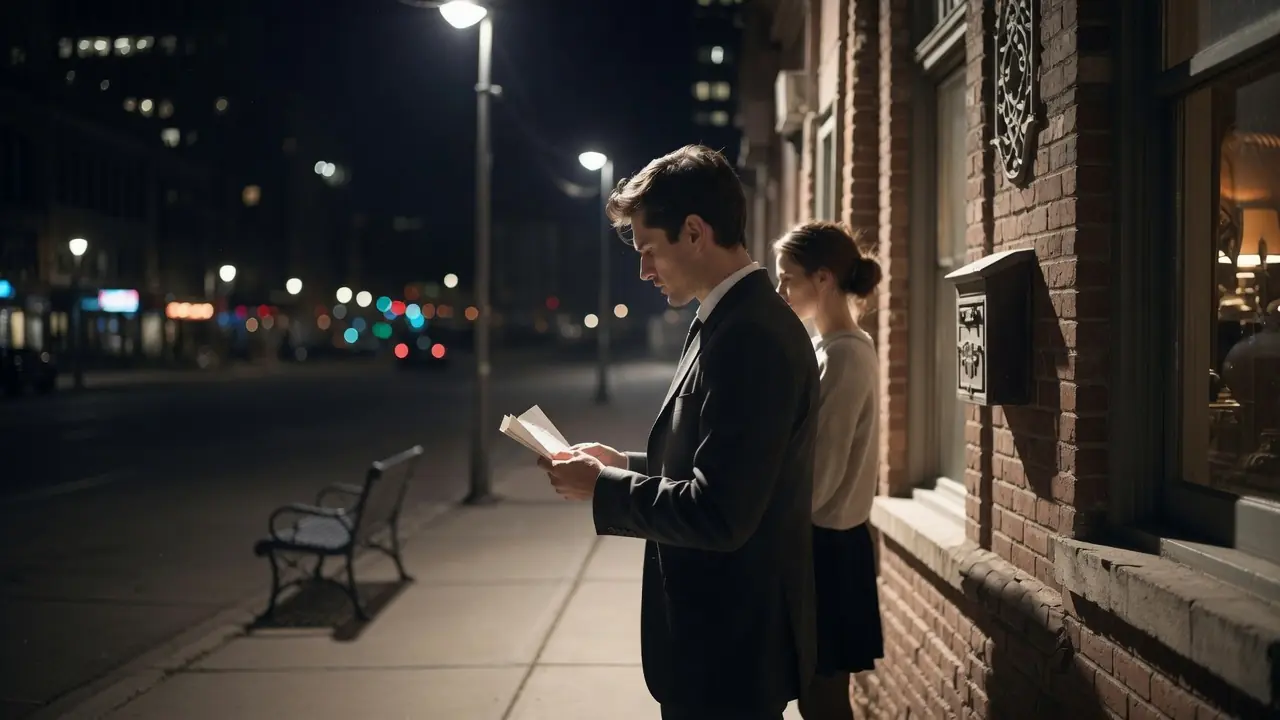
They walked out together at 9:43. The street had quieted since he’d arrived, fewer people, colder air, the city settling into its later mode. Their breath showed faintly in front of them, small clouds that appeared and disappeared before they could become anything. They stood on the sidewalk the way people stand when a thing is ending and neither person is entirely sure how to mark it.
Ryan knew the shape of this moment. He had imagined it in a vague and reluctant way earlier in the week, the end of the evening, the handshake or the nod, the polite conclusion that would allow him to return to the life he understood. Lena reached into her bag. She took out her wallet and from it the folded paper, the old one, the one with pencil lines and her sister’s careful handwriting, and she held it out to him.
“I want you to have this,” she said. Ryan looked at it in her hand. “That’s yours.” “I know.” She kept her hand extended. “I’ve had it for a long time. I think I kept it because I needed to remember that someone saw me when I felt invisible. But I don’t feel invisible the way I used to.” Something moved briefly through her expression. “I think you and your daughter might understand it better than I do right now.”
He took it. The paper was lighter than it looked, which somehow made it heavier to hold. He stood on the sidewalk with a stranger’s most important thing in his hand and felt the full strange weight of having been trusted with it. There was something he wanted to say. He was aware of it the way you’re aware of a word that won’t come, present, real, just out of reach. Something true. Something that matched the significance of what she’d just placed in his hand.
What he said instead was, “Thank you. Tonight was really nice.” Lena smiled, and it was genuine. And that somehow made it worse. “It was,” she said. And then she turned and began walking down the sidewalk toward the parking garage. And Ryan turned in the opposite direction toward where he’d left his truck two blocks away.
He walked, his shoes on the concrete, a car passing somewhere to his left, the sound of the city filling in around him, neutral and indifferent. He counted his steps without meaning to. One. Two. Five. Eight. Ten. He stopped. He stood on the sidewalk with the folded paper in his hand and the footsteps behind him growing quieter, and he understood with complete clarity what was happening.
He had done this before. Not with Lena. He had never met Lena before tonight. But with the version of this moment that had come up in different forms over eight years. The moment where something possible appeared, and he found a reason to let it pass. And then he went home to his routine and his daughter and the life he had built that was good and real and safe and quiet. He was a reliable architect of safer ground.
He knew if he kept walking, he would build something safe out of tonight, too. He would tell himself it had been a nice evening. He would mean it. And in a week, the specificity of it, her uneven buttons, her water glass, the way she had looked at that old piece of paper, would soften into something general, and then into nothing, and that would be the end of it. The footsteps behind him were faint now. His heart was doing something loud and unhelpful.
He turned around. She was twenty feet away, walking with her head slightly down against the cold. “Lena.” One word. The most ordinary word. Her name. He had said it once before at the table in the middle of a sentence, and it had meant nothing in particular. Now it meant everything he hadn’t said on the sidewalk, and the choice he’d nearly made. And Emily’s voice at the door. “Just be kind. That’s all you have to do.” And the piece of paper in his hand that he would carry home tonight to a hallway where his daughter was already asleep.
Lena stopped. She turned. Across the space between them, she looked at him. Ryan took a breath, the cold air sharp in his lungs, and walked back toward her. He didn’t tell her what he’d wanted to say. Not that night, standing twenty feet apart on a cold sidewalk with the city moving quietly around them. But he walked back to her, and they stood together for another few minutes, and he asked if he could call her. She said yes. He said he would. She believed him, which was more than he deserved given the previous ten minutes.
He drove home with both pieces of paper on the passenger seat. Margaret let herself out when he came through the door. She had her own key, had insisted on it years ago, and Ryan had long since stopped pretending that was inconvenient. She gave him a look that asked everything without asking anything. And he gave her a look that said later, and she put on her coat and left him to it.
The house was the way it always was after Emily went to sleep, quiet in a specific way, still carrying the shape of her in it. A cup of water on the coffee table. A drawing left unfinished on the kitchen counter. One shoe in the middle of the hallway, its pair nowhere visible. Ryan picked up the shoe and set it by the door. He turned off the kitchen light.
He sat down on the floor in the hallway outside Emily’s room, his back against the wall, knees up, and he put both pieces of paper on the floor in front of him. He looked at them for a long time. Emily’s drawing on the right. The waxy, saturated crayon colors. The two figures with their shy smiles and their joined hands. The careful instruction she’d pressed into the page with a child’s full certainty. “Be kind to her. Maybe she’s lonely, too.”
The other drawing on the left, older, softer. The pencil lines faded to the color of an old memory. One figure sitting and one standing beside it with a hand on its shoulder. “It’s okay. I’m right here with you, sis.” Two drawings. Two children. Years apart and cities apart and every kind of apart. And somehow they had ended up here side by side on his hallway floor, saying the same thing.
He thought about what Lena had said, that she’d kept the drawing because she needed to remember that someone had seen her when she felt invisible. He thought about the fifteen minutes in the parking garage and the ten steps he’d taken in the wrong direction before he’d managed to turn around. He thought about the question he couldn’t stop circling. Not whether Lena was a good person. She was plainly. Not whether the evening had been what he hoped it had been. More.
The question was the other one. The one that had been living quietly in the floor of his chest for longer than he’d been willing to admit. It wasn’t about Lena at all, really. It was about him. Whether he had anything left in him that was still capable of opening. Whether eight years of building a life that was sufficient and stable and self-contained had left him any room for something that was uncertain and unscheduled and real in the way that things were real when they could also hurt you.
He was thirty-seven years old. He had a daughter who drew pictures for strangers because she believed in kindness as a practical force in the world. He had spent eight years being exactly enough, and he had never once asked himself if he was allowed to want more than enough. The question hung in the hallway like something with weight.
Emily’s door was open two inches the way she liked it. He could hear her breathing, slow and even, deep in whatever world nine-year-olds inhabited when they slept. In a few hours, she would wake up and want pancakes and want to know everything, and he would tell her some of it, and she would fill in the rest with her own imagination, which was frankly more vivid than reality anyway.
He picked up both drawings, held one in each hand. His daughter had put a piece of paper in his pocket and sent him out the door with instructions that were, when he stripped everything else away, very simple. “Just be kind. That’s all you have to do.” He’d been so busy being afraid that he’d almost missed the fact that the answer was already in his pocket.
He didn’t have to wait until morning. A sound from behind Emily’s door. A small rustle, then quiet. Then the soft thump of feet on the floor. And then the door swung open and Emily appeared in the gap, squinting against the hallway light. Her hair was loose and tangled on one side, and she was wearing the pajamas with the small stars on them, and she looked at him sitting on the floor the way children look at adults doing inexplicable things, curious but unsurprised, because adults were frequently inexplicable.
She came and sat beside him without being asked, leaning into his arm. He wrapped it around her automatically. She looked at the two drawings on his knees. She picked up her own, examined it, set it back down. Then she picked up the other one, the old pencil drawing, the one she’d never seen before, and held it carefully the way she held her own drawings, with both hands and the proper amount of respect.
She studied it. Ryan watched her take in the two figures, the standing one with its hand on the shoulder of the sitting one, the careful small letters beneath. Emily set it down with the same care she’d picked it up. “Is she still lonely?” she asked. Her voice was still soft with sleep.
It was such a direct question. No scaffolding. No approach. No cautious framing. Just the thing itself offered plainly, the way Emily offered most things. Ryan looked at the two drawings on his knees for a moment. “No,” he said. “I don’t think so.” Emily nodded once, satisfied, the way she nodded when something confirmed what she’d already believed.
She stayed beside him for a while longer, her weight solid and warm against his side, and then she went back to bed. Ryan sat in the hallway alone for a few more minutes. Then he got up, put both drawings on the kitchen counter, and went to sleep.
He called Lena the next day. They talked for forty minutes. He called her three days after that, and they talked longer. The first time the three of them were in the same place, Ryan was more frightened than he’d been outside the restaurant. That surprised him. He’d faced the restaurant. He’d turned around on the sidewalk. He’d made the calls. He had managed all of that.
And yet, standing in the parking lot of Heron Lake Park on a Saturday afternoon in early November, watching Lena’s car pull in two spots away, he felt something in his chest tighten in a way that had nothing to do with himself. Emily was beside him, wearing her yellow coat and her secondhand sneakers that she refused to replace because she’d drawn small flowers on the toes with a fabric marker in September and considered them improved.
She was not, for once, talking. She was watching the car. Lena got out carrying a tote bag and a folded blanket and the slightly braced expression of someone who was working hard not to appear as though they were working hard. She wore a green jacket Ryan hadn’t seen before. Her hair was fully sorted today, which he noticed the way you notice when something is different from the first time you saw it.
She and Ryan exchanged a look that contained, without words, approximately everything they’d talked about over the past several weeks. Then they both looked at Emily. Emily looked at Lena. Lena did not crouch down to Emily’s level, which Ryan appreciated, because Emily found that particular adult gesture condescending in a way she had once described with precision. Lena also did not speak first.
She just stood there with her tote bag and her blanket and let Emily take the measure of her. Emily was thorough about it. She started at Lena’s face, moved to the tote bag, which had a drawing of a bird on it, which Emily clocked with visible interest, then back to the face. “Hi,” Emily said. “Hi,” Lena said.
That was all for the moment. They walked to the lake. Ryan and Lena talked, easy conversation, the kind they’d built over three weeks of phone calls. And Emily walked slightly ahead of them, kicking through the leaves that had collected along the path, engaged in whatever internal project occupied her when she appeared to be doing nothing.
Ryan kept half his attention on her the whole time, the way he always did, the particular frequency a parent keeps tuned, even when they don’t realize it. They found a spot near the water and spread the blanket and sat down. Lena took a small sketchbook from the tote bag, the kind with a spiral binding and a pencil. Ryan hadn’t known she sketched.
He watched her open it without comment, and she didn’t offer one. She just began to draw, lightly, the pencil moving without urgency. Emily lasted approximately ninety seconds before she migrated closer. She didn’t do it all at once. She moved the way she moved toward things she was interested in but wasn’t ready to claim interest in yet, sideways, incrementally, with pauses in between that were supposed to appear casual.
Ryan watched this happen from his peripheral vision and said nothing. Lena continued drawing. She didn’t look up. She didn’t acknowledge the small presence that had materialized beside her. She just kept the pencil moving, slow and easy, in a way that was clearly not performed. She was actually drawing, actually thinking about what she was putting on the page.
Emily’s chin dropped to see on the sketchbook page. A figure was taking shape. Small, round-faced, pencil lines building up into something that was beginning to look very much like a girl in a coat with flowers on her shoes standing near water. Emily went very still.
Lena finished the figure and considered it. Then, without looking up, she held the sketchbook slightly in Emily’s direction, not pushing it at her, just making it available. “Is that you?” Lena asked. Her voice was the same even, unhurried tone she used for everything.
Emily stared at the drawing for a long time. The figure on the page had her coat silhouette, her shoes, the particular way she stood with her weight shifted to one side. It was unmistakably her, rendered in five minutes by someone who had been paying attention. Emily took the sketchbook. She held it the way she held her own drawings.
She examined it with the full seriousness she brought to art, which was complete and unironic and one of the things Ryan loved most about her. Then she reached into her coat pocket and produced, because she was Emily and therefore never without them, a small set of colored pencils held together with a rubber band.
She picked out a color, the dark teal, which Ryan recognized as her current favorite, and she added to the drawing, not to the figure of herself but beside it, a second figure, slightly taller, with a green jacket, standing close. She gave it hair. She gave it the tote bag with the bird on it. She drew it carefully and with intention, and when she was finished, she held the sketchbook up to look at it from a slight distance, the way she always assessed her own work.
Then she held it out to Lena. Lena took it. The two figures stood side by side on the page, one drawn in pencil, one added in teal, different hands, different pressures, but together on the same piece of paper. Ryan was looking at the lake. He was looking at the lake because if he looked at either of them right now, something was going to happen in his face that he would prefer to manage privately.
Lena’s voice, when it came, was quieter than usual. “She’s not standing alone anymore,” she said. Emily considered this. “That’s what I meant,” she said. They stayed at the lake until the light went flat and the cold settled in with intention. Emily walked between them on the path back, not touching either of them but close, close enough that when the path narrowed she stepped naturally to Lena’s side, and when Lena moved the blanket to her other arm to make room, Emily took her free hand, simply, without asking, the way Emily did things when she’d decided they were already true.
Ryan watched this happen and kept walking. At the edge of the parking lot, where the path widened back out and the cars were visible, Emily looked up at Lena. “Are you still lonely?” she asked. It was the same question she’d asked him in the hallway in the middle of the night, in the same tone, with the same plainness. The question she’d sent out into the world via crayon drawing weeks ago before any of this had happened. “Maybe she’s lonely, too.” Now returned and asked aloud directly to the person it had always been meant for.
Lena looked down at her. She didn’t answer right away. She took in Emily’s face, the serious eyes, the yellow coat, the flower-marked shoes, and something moved through her own expression that was too layered to name. Not sadness. Not quite happiness either. Something that lived in the space where both of those could exist at the same time.
She shook her head. Small. Definite. Real. Emily accepted this the same way she accepted most true things, without needing it to be said again. She squeezed Lena’s hand once, then let go, and ran ahead toward the car, because she had spotted a particularly large pile of leaves near the rear tire, and it would have been irresponsible not to investigate.
Ryan and Lena stood at the edge of the parking lot and watched her go. He thought about a lot of things in that moment and said none of them, because there was nothing he needed to say that the afternoon hadn’t already said more clearly. He thought about a folded piece of paper in a breast pocket. About two strangers with eight minutes and fifteen minutes worth of doubt between them. About a nine-year-old who had understood something that had taken him eight years to get within reach of. That you didn’t have to be certain before you tried. You just had to be kind. And sometimes, if you were very lucky, kindness was the thing that made a door open.
Emily had reached the leaves. She turned and looked back at them both. “Come on,” she called. Ryan looked at Lena. Lena was already walking toward.