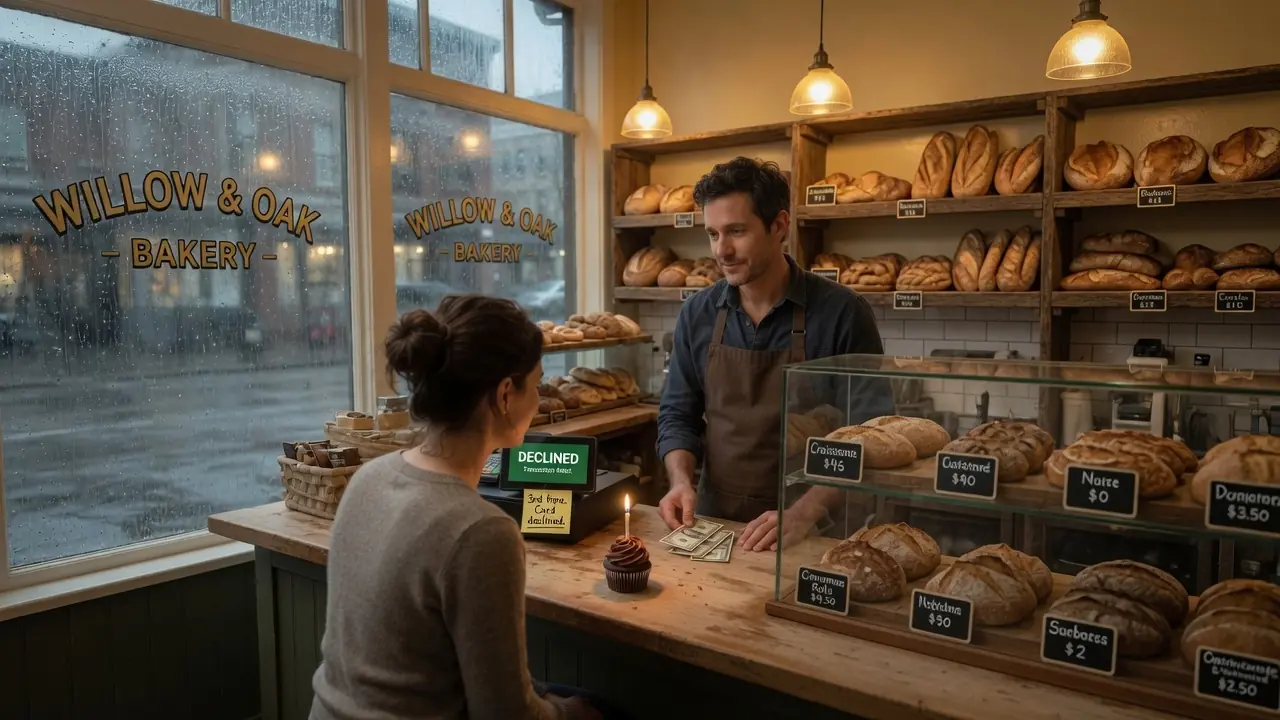
A small bakery in Pittsburgh’s Strip District, Tuesday afternoon. Warm yellow light. Soft rain against the window. A woman stood at the counter with a single chocolate cupcake and one white candle in front of her. Her card declined three times. She smiled faintly, ready to walk away.
Daniel Hayes, behind her in line, placed three bills on the counter without looking at her. He said one sentence. “Everyone deserves a birthday cake.” She thanked him, almost crying, and left.
The next morning, Daniel stood in the Whitmore Capital boardroom. The doors opened. The CEO walked in. It was her.
Two years before, Sarah Hayes died on a Thursday morning at Allegheny General. She had been a social worker at the Hill District Women’s Shelter for eleven years. The breast cancer took ten months, no longer. She wrote Daniel a letter the week before she stopped writing things. The last line read, “Don’t stop building for people who can’t build for themselves.”
Daniel left his principal architect position at Hartwell and Reed that same month. The senior partners offered him a sabbatical, then a part-time arrangement, then a remote role. He thanked them and turned each one down. Lily was six. She needed her father at four o’clock every day.
Now they lived in a two-bedroom apartment in Lawrenceville, above a hardware store on Butler Street. The radiator clanked in the winter and the windows fogged when it rained. Lily had a corner of the living room for her drawings. Daniel had the kitchen table for his work.
Tuesday night, the night before the pitch, the table held pasta and a stack of bound documents two inches thick. Lily was eight now. She was telling him about a girl at school who had said her drawing of a horse looked like a dog. Daniel laughed at the right moments. When she got up to put her plate in the sink, he turned and looked at the pitch deck again.
Sarah’s Place. One hundred units of affordable housing on the corner of Center and Roberts. Ten million dollars. His last shot. If Whitmore Capital said no, the house he had grown up in, the one his mother left him in ’78, would have to go on the market in January.
Wednesday morning, he stopped at the bakery on Smallman Street. He had been going there for two years, since the week after Sarah died, when the owner Mike had given him a coffee on the house and asked no questions. Today, he wanted to buy Lily a cupcake to find in her lunch the next day.
There was a woman at the counter. He saw her from the side. He did not register much. Her card declined. Declined again. The third time the machine made the small sad sound, and she said something quiet to the cashier, and reached for her cupcake to put it back.
Daniel did not think. He put three singles on the counter and said the sentence the way he might have said it to anyone. “Everyone deserves a birthday cake.” He did not look at her face. He had a meeting to get to.
She said, “Thank you.” Her voice broke a little. He nodded toward Mike, picked up the second cupcake Mike was bagging for him, and walked out into the rain.
At Whitmore Capital, the receptionist sent him up to the fourteenth floor. The waiting area smelled like coffee and new carpet. Daniel sat with the pitch deck on his knees. In the breast pocket of his jacket, folded into a small square, was a card Lily had made him at breakfast. Crayon stick figures of him and her holding hands. “Good luck, Daddy,” in green letters. He touched it through the fabric.
Daniel did not move either. Marcus did not notice. He gestured at the chair at the far end of the table. “Mr. Hayes, please.”
The boardroom had twelve chairs and a long walnut table. The blinds were half drawn against the rain. Daniel opened with the slides he had rehearsed for a month. He did not waste time on himself. He spent thirty seconds on the firm, three minutes on the Hill District, two minutes on what the neighborhood had lost since the Civic Arena went up in ’58, and the rest on the design.
He showed them the unit layouts, the east-facing windows, the shared courtyard, the community room on the ground floor with the door that could open onto the street in summer. He showed the financials at the end, not the beginning. Cost per square foot. Projected occupancy. The return on investment was modest but real. Eight percent over fifteen years. Better than the muni bond they were holding.
Claire Whitmore sat at the head of the table. Her hands were folded in her lap beneath the wood where no one could see how tightly the man speaking ten feet from her was the same man who had put three singles on a bakery counter the night before. He had not looked at her then. He was not looking at her now. He was looking at his slides and at the older board members and at the city through the half-drawn blinds.
Marcus took the question and answer. The questions were the kind that sounded reasonable and were not. How many units of this scale had Daniel personally delivered as lead architect in the last sixty months? What was the firm’s bonding capacity? What contingency did he have if the city revised the zoning overlay during construction? Each question was designed to make the answer sound thin.
Daniel answered every one of them without raising his voice. He did not flinch. He did not oversell. Then Harold Pemberton, the oldest man at the table, set down his pen.
“Wait,” Pemberton said. Daniel Hayes. He looked over the top of his reading glasses. “Hartwell and Reed. You designed the Riverside Pavilion in Boston in 2017. AIA Honor Award. The community center in Roxbury the year after.” He paused. “I sit on a jury that almost gave you something for that one, too.”
The room went quiet. Claire looked up. Marcus’s face did one thing for half a second, then it did another thing on purpose. He laughed lightly. “Mr. Hayes is currently working as an independent consultant. The scale of his recent portfolio is the concern here. Not what he did at a firm five years ago.”
Daniel did not contradict him. He looked at Pemberton and nodded once. “That was a long time ago, sir. Thank you for remembering.”
Claire understood three things in the same second. The man at the end of her boardroom was not what Marcus had told her he was. He had spent forty-five minutes in this room without using a single credential, and Marcus had known. She knew none of that mattered yet. The board pack had been circulated five days earlier. Six members had already filled out their opinion sheets. She had no leverage to overturn anything from the chair right now.
She signed the rejection decision the firm’s legal counsel slid across to her. She kept her hands steady. Daniel thanked the board. He gathered his materials. When he reached the door, he passed within two feet of her chair. He paused just long enough for her to hear him. “Happy birthday, ma’am.” He did not look at her face. He stepped out.
The room emptied. Claire stayed in her chair. After a minute, she opened the Manila folder of the rejection paperwork. At the back, behind the last signed page, something thin was wedged in. A folded card. Stick figures. “Good luck, Daddy,” in green crayon. She looked at it for a long time.
The rain came harder on the drive back to Lawrenceville. Daniel parked behind the hardware store and sat with the engine running for ten minutes. The bank had called twice while he was in the boardroom. He did not return the call. He turned the engine off and listened to the rain on the roof of the truck.
Lily was at the apartment door when he came up the stairs. She had been waiting at the window. “Did you get it, Daddy?” He set down his bag and knelt. He had practiced this on the drive. He did not have to practice it long. He pulled her against his shoulder. “Not yet, sweetheart. We’re still trying.”
Lily did not ask anything else. She was eight, not five. She understood the shape of her father’s quiet now. She took his hand and led him inside and showed him the math problem she had finished on her own.
Across the city, on the fourteenth floor of Whitmore Capital, Claire sat at her desk with a different folder open in front of her. Rachel had brought it in within an hour of the rejection vote. It was Daniel Hayes’s full resume, the version that had not been in the board pack. Riverside Pavilion. The Roxbury Center. The AIA Honor Award. A pro bono affordable housing project in Detroit in 2019. Eighty-four units completed under budget. Master of Architecture, MIT, 2008. Wife, Sarah Hayes, deceased 2024. One daughter, Lily, age eight.
She stared at the line about the daughter for longer than she needed to. She called Marcus into her office. She did not stand up. “Why wasn’t his full portfolio in the board pack?”
Marcus arranged his face. He took the seat across from her without being asked. “We standardize submissions to the last five years of active firm work, Claire.” “He hasn’t been at a firm.” “It’s procedural. He uses a sole proprietorship. There’s no rule against listing prior work.” “There’s no rule for it, either. We applied the same standard we apply to every consultant.”
She looked at him for a long beat. She did not trust the answer. She also did not have the leverage to push past it. Eight months into the chair her father had held for thirty years, Marcus’s name was on the founding documents next to Richard Whitmore’s. The board listened to Marcus because the board had known Marcus longer than they had known her.
She nodded. “That’ll be all,” she said. Marcus left. Rachel came in with tea about twenty minutes later. She set the cup down on the coaster. She did not retreat. She stood there until Claire looked up. “Ms. Whitmore,” Rachel said. Her voice was very quiet. “Happy birthday.” Claire blinked. “How?” “HR records,” Rachel said. “I won’t tell anyone.”
Claire opened her mouth, closed it, and just nodded. Rachel walked out and shut the door behind her.
That night, in Lawrenceville, Lily fell asleep on the couch under a blanket Sarah had knitted the year she got engaged. Daniel carried her to bed. He kissed her forehead and stood in the doorway of her room for a minute, watching her breathe. He went out onto the small back balcony with a glass of water. He pulled the letter from his wallet. The paper was soft from being opened and folded. He read the last line. “Don’t stop building for people who can’t build for themselves.”
He looked down at his lap. He had a photocopy of Lily’s card on his phone. The original was somewhere in a Manila folder on the fourteenth floor of a building downtown. He did not know how to get it back. He did not know it was already sitting on a desk inside a folded paper, three inches from a CEO who was no longer sure of anything.
Thursday morning, Daniel was at the bakery before seven. Mike paid him twenty dollars an hour to unload the flour delivery on slow mornings. In a bad month, twenty dollars an hour mattered. Daniel had been having a long string of bad months. He was bent over a fifty-pound sack of bread flour when the door chimed. He straightened up.
Claire Whitmore was standing in the doorway. She wore none of what she had worn in the boardroom. She looked tired in a way that did not have to do with sleep. She walked to the counter. She set something down on the wood. It was Lily’s card, flat in a clear plastic sleeve.
Daniel had not been able to imagine how it would come back to him. This was not the way he would have guessed. “You left this,” she said. “I thought she might want it back.”
Daniel wiped his hands on his apron. He came around the counter and took the card. He held it in both hands for a long moment. Mike, sensing what he did not understand, slipped through the swinging door to the kitchen. Daniel gestured at the small table by the window. They sat.
The rain had not started yet, but the sky over Smallman Street had the look of having decided. “Why did you come?” Daniel said. He said it without any heat. He was a man who had run out of energy for heat. “Because I rejected something I didn’t actually read,” Claire said. She did not say, “I’m sorry.” She did not say, “I made a mistake.” She did not perform anything for him. She had run that sentence in her head on the drive over three times and decided that was the version that was true. “Tell me about it,” she said. “Not the pitch. Just tell me.”
He told her about Sarah, about the shelter on Wylie Avenue, and the women Sarah had spent eleven years trying to find permanent housing for, and how most of them had ended up back at the shelter within a year because there was nothing in the city in their price range that was not unsafe. He told her why every unit faced east. He had read a study once that said morning light was the single strongest predictor of whether a woman in recovery stayed in her apartment past the first six months. He had designed every floor plan around that line in the study.
Claire listened. She did not take notes. She did not interrupt. When he finished, she sat for a moment looking at the empty table between them. “I need to look at the real numbers,” she said, “not the ones I was given.” Daniel nodded. She stood. She did not offer her hand. She walked to the door. She turned around once. “Mr. Hayes,” she said, “yesterday in the bakery, did you know who I was?”
He looked at her, honest about it. “No, ma’am. I still don’t really.” For a fraction of a second, something moved across her face. It was the first time in seven months that she had smiled and meant it. She walked out into the gray morning.
Daniel stood at the window and watched her cross Smallman Street and get into a black sedan. The driver pulled away. The bakery was very quiet. He looked down at Lily’s card in his hand. Mike pushed back through the swinging door. “Friend of yours?” he asked. Daniel did not answer for a moment. “I’m not sure yet,” he said.
Saturday afternoon, the sky over Lawrenceville was the bright low gray that meant snow was a possibility by Monday. Daniel was making grilled cheese for Lily and reading the Post-Gazette when the buzzer rang. He went to the intercom. It was Claire. He held the buzzer down. “Fourteen,” he said. “Apartment B.”
She came up the stairs with a folder under her arm and her hair damp from the walk from her car. The folder was an inch thick. He took her coat. The apartment was small enough that there was nowhere for her to look without seeing something personal. A photograph of Sarah on the mantel. A row of architecture monographs along the floor against the wall. A wooden box of Lily’s colored pencils on the coffee table.
He cleared the kitchen table. He brought her water. They sat. She opened the folder. The first page was Marcus’s financial model for Sarah’s Place. The margins were red with her own handwriting. “The materials cost is from 2019,” Daniel said before she had asked. He had not even looked at the page yet. He was looking at her notes. “Steel was a different number then. He used it because steel was at a low. If you run it with current numbers, it changes the internal rate of return by about seventy basis points. In your favor, by the way.”
She turned the page. “Occupancy assumption, sixty-five percent,” he said. “Detroit ran at ninety-one. Cleveland ran at eighty-eight. The Cincinnati equivalent ran at eighty-six. There is no project comparable to this one anywhere in the Midwest that ran below eighty,” she wrote.
He gave her his sketchbook, the hand-drawn one. Marcus had never seen this version. She turned the pages slowly. The east-facing windows. The placement of the laundry rooms on the second and fifth floors, so they doubled as informal gathering spaces. The retaining wall along the back lot that doubled as bench seating for the playground.
They worked for two hours. He did not flirt with her. She did not flirt with her. Two people moved through a document together the way two surgeons might move through a chart, deliberate and impersonal, and the impersonality was its own kind of intimacy.
The door opened. Lily came in from her Saturday painting class, smelling of acrylic and rain. She stopped when she saw the woman at the table. “Daddy, who is she?” Daniel looked up. “Her name is Claire,” he said. “She’s a friend.”
Lily considered this. Then she walked over and put down the picture she had made that afternoon in front of Claire. It was a house with a heart-shaped window. “For you,” Lily said, “because friends.” Claire did not say anything. She picked it up. She folded it carefully along a single seam. She slid it into the inner pocket of her coat.
Around six o’clock, her phone vibrated against the table. She glanced at it. Her face did not move, but her shoulders set. She stood. She put on her coat. At the door, she said, “I’ll see you Monday morning.” Daniel did not ask what the message was. He walked her down the stairs. She drove away into the wet dark, and he stood on the sidewalk in front of the hardware store until the taillights were gone.
The text on her phone had been from Rachel. “Marcus is filing an emergency motion to remove you Monday. He has the votes lined up.” She had not let it show.
Sunday morning was cold and clear, and the bakery was empty. Mike opened at seven on Sundays and got maybe four customers before nine. Daniel was at the back table with a coffee when Rachel Bennett walked in. He had never met her. He knew her because Claire had said her name twice. He knew it was her because she was the kind of woman who, when she walked into a room, checked the windows before she sat down.
He set a laptop on the table. She did not order anything. “I have about twenty minutes,” she said. “I told my husband I was getting bagels. I’m sorry to do this here. I can’t go to her office, and I can’t go to her apartment, and you live above a hardware store on Butler that has one entrance in the alley and one in the front. So this is the only place I could think of.”
Daniel did not interrupt. She opened the laptop. She turned it to face him. “Three things,” she said. The first was an email chain between Marcus Cole and a man named David Cole. The dates ran from June through the week before Daniel’s pitch. The subject line was about the Hill District parcel. The body of the messages discussed a luxury condominium project to be built on the same lot. There was a sentence in one of David Cole’s replies: “As soon as the Hayes thing dies, we move on it.”
The second was a side-by-side scan. Daniel’s original pitch financials with his signature on the cover sheet. Marcus’s edited version, the one the board had received. The numbers Daniel had given on materials, on occupancy, on absorption rate had been changed in eleven places. None of the changes were small.
The third was an internal email Marcus had sent in 2020 to a senior partner who had since retired. There was a single line about Daniel in it. “Hayes turned me down on the Riverdeck Casino five years ago. Sent a holier-than-thou rejection letter. I haven’t forgotten.”
“David Cole is his cousin,” Rachel said. “He didn’t disclose it on the conflict of interest form. I pulled the form last night. It’s blank.”
Daniel did not speak for a while. He read each of the documents a second time. Then he looked up. “Why are you bringing this to me?” he said. “Why not to her?”
Rachel had the answer already prepared. “Because if I bring it to her, Marcus has the security badge logs of me walking into her office. He’ll say I leaked it under her instruction. It poisons her in front of the board. If I bring it to you, and you bring it to her with your name on the chain of custody, it’s a whistleblower tip from an external party. That’s a different legal posture.”
Daniel understood. He understood also that this woman had spent her week thinking about chains of custody. “Your mother,” he said. Rachel nodded once. “He’d hinted he had friends on the board at her facility. I moved her Tuesday. My brother’s paying. I don’t have anything left for him to use against me.”
She closed the laptop. She did not ask Daniel what he would do. She stood up. She walked out into the cold sun on Smallman. Daniel sat for ten minutes. Then he picked up his phone and called Claire.
They met that afternoon at a coffee shop in Squirrel Hill, three miles from anywhere either of them usually went. He handed her the laptop. She read for twenty minutes. Her face did not change. When she finally closed it, her eyes were dry. Whatever was in them was not grief.
“Monday,” she said. “Board meeting. Be there. I’m not on the agenda. You will be.”
Monday morning at nine o’clock, the boardroom of Whitmore Capital was already full. Marcus had spent the weekend on the phone. He had six votes pinned down to remove Claire as CEO, with the formal motion to be raised under new business at the bottom of the agenda. He was not nervous. He was annoyed at having to do this.
The double doors opened at nine sharp. Claire walked in. Behind her, two steps back, came Daniel Hayes. Behind Daniel, also two steps back, came Harold Pemberton.
Marcus stood. “This is a closed session,” he said. “Claire, what is this?” “Mr. Hayes is here as a material witness,” Claire said. By law 7.3, she set three bound documents on the table and slid one to each side. The board members opened them.
For the next twenty-five minutes, Claire spoke. She did not raise her voice. She did not perform. She walked the board through the financial model that had been altered before it reached them. She showed the original signature page next to the doctored second version. She showed the eleven changes one by one. She read three of the emails between Marcus and David Cole aloud, slowly, including the sentence about how the Hayes thing dies. She showed the blank conflict of interest form. She read the 2020 email about the casino.
Marcus did not interrupt for the first eight minutes. He did interrupt at the ninth. “These documents are stolen,” he said. “This is a coup by a CEO who is about to be removed for incompetence. You all know what’s on the agenda. You all know what we’re here to do.” He looked at the men he had counted. He named two of them. “Tom. Bill. You know my record.” He named a third. “James, your father and I built half of this firm.”
Two of the three did not meet his eyes. The third, Tom, looked down at the documents in front of him and did not look up.
Daniel had not spoken. He waited until the room was quiet. And then he spoke once. “Sir,” he said, looking at Pemberton, not at Marcus. “I did not bring these to you to be vindicated. The project is the project. It either gets built or it doesn’t. I brought these because there are sixty-eight women on the waiting list at the shelter on Wylie Avenue, and they deserve to know the truth about why a project meant to house them was killed. That’s all I came here for. I’ll step out now if that’s appropriate.”
He did not step out. No one asked him to.
Pemberton set both his palms flat on the table. He addressed the room. “I move that Mr. Cole be suspended from his position pending an independent forensic audit conducted by a firm not on our existing list of vendors. I further move that the Sarah’s Place review be reopened immediately under Ms. Whitmore’s direct oversight with the original financials restored.”
The motion was seconded. The vote was seven to four with one abstention. Marcus’s six had become four.
Marcus stood. He took his time. He buttoned his jacket. When he walked past Daniel on his way to the door, he stopped for half a second and spoke to him alone. “You don’t know what you’ve done,” he said. He walked out.
The board did not adjourn for almost an hour. When they finally did, the room emptied in twos and threes. Claire stayed in her chair. Her hands under the table were shaking. She let them shake for one second, then she made them stop.
Daniel went down the hall to the small kitchen and came back with a glass of water and set it in front of her. He did not say anything. She did not thank him with words. They sat next to each other in the empty room for about three minutes. Outside, the rain had started again.
Two weeks later, on a Friday afternoon, an independent forensic accounting firm out of Cleveland delivered a 140-page report to the Whitmore Capital Board. The report confirmed every allegation in the documents Daniel had brought to the Monday meeting. Marcus Cole’s stock options were voided. His severance was withheld pending the outcome of the SEC inquiry that had been opened the previous Wednesday. David Cole’s firm, Crestmont Development, withdrew its bid for the Hill District parcel on the same Friday afternoon, four hours before the report was made public.
The Sarah’s Place project was formally approved by the board the following Monday at ten million dollars with the original financials restored and a development timeline of twenty-six months.
Claire did not hold a press conference. She signed the papers in her office alone with Rachel as the witness.
The next afternoon, Daniel sat across from her at the long walnut desk on the fourteenth floor. He was not pitching. He was not in an emergency. He was reading a contract. The terms were clean. Architect of record. Full design authority. No clawback. No morality clause. Payment schedule front-weighted. Because she knew what kind of cash flow a sole proprietor lived on. She had thought about every line.
He signed it. He set the pen down.
Claire spoke without looking up from the document on her own side of the desk. “We have a principal architect position opening,” she said. “The salary is good. There’s a benefits package that would cover Lily. I’d like you to consider it.”
Daniel picked up the pen again. He turned it between his fingers. He set it down. “Ms. Whitmore.” “Claire.” He let the name sit in the room. “I appreciate that more than I can say, but I left a firm to be home for her at four o’clock every day. I’m not ready to leave that again. Not yet.”
She nodded. She did not push. She had not expected him to say yes. She had needed to make the offer because anything less would have been a kind of dishonesty.
He stood up. He picked up his coat from the back of the chair. He walked to the door. His hand was on the knob. “The Sarah’s Place groundbreaking is October seventeenth,” she said. She was looking at the papers on her desk. She was not looking at him. “I’d like Lily to turn the first shovel of dirt if that’s all right with you.”
Daniel’s hand stayed on the knob. He did not turn around. He understood that she had not looked up on purpose. She had given him the room to answer in whatever shape his face would make without having to perform. “She’d love that,” he said.
He opened the door and stepped through it and closed it quietly behind him.
Claire did not look up for another full minute after the door had closed. Then she did. The folder on her desk was the original board pack from the day of the rejection. She had been keeping it. She did not know why exactly. She slid it across her desk and dropped it into the recycling under her credenza.
She walked over to the window. The fourteenth floor looked north across the Allegheny. The water was the color of slate. A barge moved slowly downstream. She did not smile. She did not need to. There was nobody in the room.
October seventeenth was a Saturday. The Hill District morning was cold enough for breath to show. The trees on Centre Avenue had not turned all the way yet, but the maples by the school across the street had gone red at the tips. About eighty people came. Future residents from the Wylie shelter waiting list. The City Council member for District 6. A reporter from the Post-Gazette. Mike from the bakery in a coat Daniel had never seen him wear. Pemberton in a gray scarf leaning on a cane he had not been using two months earlier.
Daniel wore his black wool coat, the same one he had worn to the boardroom in September. Lily was at his side in a red parka holding a child-sized ceremonial shovel that Mike had carved a handle for the night before. She had been practicing what to do with it for three days.
Claire stood at the front of the small gathered crowd. She had no podium. She had a single sheet of paper she did not look at. She spoke for less than thirty seconds. “This project was almost lost,” she said, “because someone forgot what we’re supposed to build. Daniel Hayes never forgot. That’s why we’re standing here.”
She did not look at him while she spoke. He did not look at her while he listened.
She gestured to Lily. Lily walked to the bare patch of soil that had been marked with stakes. She put her small boot on the lip of the shovel the way her father had practiced with her on the apartment balcony all week. She pushed. The dirt turned. She lifted it out, set it carefully on the tarp beside the hole, and turned around with her entire face open in a grin.
The crowd clapped. Daniel went to her and crouched and pulled her against his coat for a moment.
The crowd thinned slowly over the next half hour. People shook his hand. People who had not known him three months earlier shook his hand. Pemberton clapped him on the shoulder and told him to do this again somewhere else soon. The reporter asked for a quote, and Daniel gave her the same line he had given Claire in the bakery in September. “We’re trying to make sure the morning light hits the right side of the building.”
Claire walked over after most of the others had gone. She was holding a small white bakery box. She crouched in front of Lily and held the box out. Lily took it and looked up at her father for permission. He nodded. She opened it. A chocolate cupcake. One white candle.
Lily looked up at Claire. “Is it your birthday?” “It was,” Claire said, “a while ago.” Lily thought about that with the serious expression an eight-year-old uses for important matters. Then she lifted her finger to the candle. She tapped the tip of it like she was lighting it with her own hand. “Make a wish,” she said.
Claire closed her eyes for two seconds. She was not pretending for the child. She was making one. When she opened them, her gaze went, by accident, across the cupcake and met Daniel’s. They both looked away in the same instant. Lily did not notice.
The wind moved through the lot. Somewhere a hammer hit something on the roof three blocks over.
Six months later, on a Saturday morning in April, the framing on the first building of Sarah’s Place stood thirty feet above the sidewalk on Center Avenue. The bones of three more buildings were laid. The neighborhood had started to expect them. A coffee cart had begun to set up across the street on weekends because the construction crew tipped well.
Daniel was still freelance. He had not changed his arrangement, but the Post-Gazette had run a long piece on the project and on the boardroom story behind it, and his phone had not stopped since. Three other affordable housing developments in Cleveland and Akron, and one back in Detroit, were waiting for him to give them dates. He had not given them dates yet. He liked having Saturday mornings free.
That Saturday morning, he took Lily down to the Strip District. They parked behind the produce terminal and walked the four blocks to Smallman. The bakery had a new awning. Mike had had a good year.
Lily ran ahead to the counter. She pointed at the case. A chocolate cupcake with one white candle. Mike, who had been waiting, slid it onto a small plate without ringing it up first. Daniel laid three singles on the counter and pushed them across. Mike picked them up without comment and went to the register.
The bell over the door rang. Claire stepped in. She stopped in the doorway when she saw them. Lily was already running. Claire bent down to meet her hug. Daniel had not turned around yet. He picked up the plate with the cupcake and walked over and held it out.
“Happy birthday, Miss Whitmore.” She looked at the cupcake. She looked at him. “It’s not my birthday.” “I know,” he said, “but I never got to celebrate the last one with you properly.”
She took the plate. Lily tugged her sleeve. “Sit with us.”
The three of them went to the table by the window, the same table as in September. The rain was light and warm, and the April light had begun to lengthen the way April light does. They did not talk much. Lily ate half of the cupcake. Daniel drank a coffee. Claire looked out the window for a long time at the corner of Smallman and Twenty-first, at nothing in particular, at the way the wet asphalt threw back the gray of the sky.
She set her hand on the table. Daniel’s was already there. Their little fingers touched. Not held. Not gripped. Just touched, the way two pieces of paper rest against each other. Neither of them moved.
Lily was telling them something about a girl in her class. Neither of them was tracking the words. Both of them were nodding at the right places. The pinky of Claire’s right hand and the pinky of Daniel’s left hand stayed where they were, outside the window. The April rain was very soft.
In the boardroom on the fourteenth floor, on the back wall, somewhere in a stack of approved project files marked Sarah’s Place, there was a folded crayon card with stick figures and the words “Good luck, Daddy” in green. It had been put there by hand, not Marcus’s hand.
Neither of them had been looking for this. That was the only reason they could trust that it was real.