“Did I cross a line with you?”
She was standing in his kitchen, wearing borrowed clothes. His boss, the woman who decided his future at the company, stood there while, across the table, his young daughter quietly ate her breakfast, unaware that her father’s career, reputation, and place in her life were suddenly at risk. Nothing inappropriate had happened. No flirting. No lines crossed.
He had only done one thing the night before: he refused to leave a drunk woman alone and unsafe. But one question was enough. Enough to turn kindness into suspicion. Enough to make a good man doubt everything he thought protected him.
In that moment, he realized something terrifying. Sometimes doing the right thing does not defend you. It puts you on trial. And the answer to that question would change his life forever.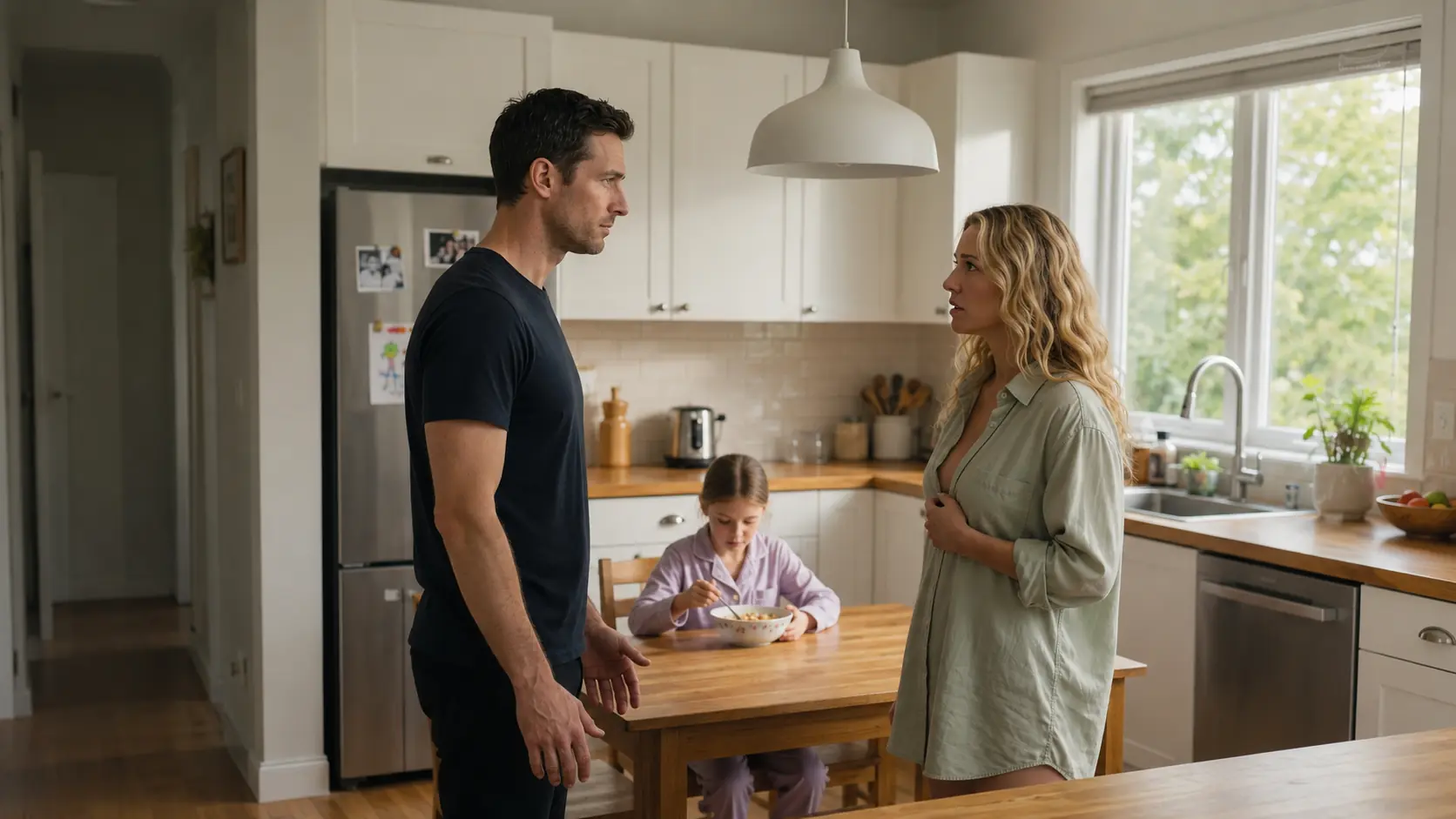
The question did not come with anger. That was what made it dangerous. She stood in the doorway of his kitchen, one hand resting on the back of a chair, the other gripping a mug she had not touched. Her voice was steady, almost careful, as if she were afraid of breaking something fragile.
He did not answer right away, not because he did not know what to say, but because every possible answer felt like a trap. Across the room, his daughter sat at the table, legs swinging beneath the chair, cereal slowly turning soggy as she watched her cartoon. The normalcy of it all made his chest tighten. Breakfast, morning light, the quiet hum of a house that had no idea it was standing on the edge of something irreversible.
He cleared his throat. Nothing happened. Finally, he said, “You were drunk. I made sure you were safe. That’s it.”
She exhaled, shoulders dropping just slightly. Relief. Not suspicion. Not accusation. Relief.
And somehow, that hurt more than anything else. Twenty-four hours earlier, his only concern had been time. Deadlines at work. A school performance he could not miss.
The usual tired routine of being both provider and parent with no room for mistakes. He had not planned on staying late at the company event. He had shown up for exactly one reason: respect. She had been the one who signed off on his flexible hours after his wife passed, the one who never questioned why he left early or turned down late-night meetings.
“One drink,” she had said. “You earned it.” One drink had turned into too many. He had noticed the change in her before anyone else did.
The way her words slowed. The way she leaned too heavily against the bar. The way she laughed a second too late when he suggested calling her a ride. She had shaken her head too quickly.
“I can’t,” she had said. “Not like this.” That was the moment the night stopped being simple. Leaving her there felt wrong. Dragging her back into the room felt worse.
And walking away felt like the kind of choice he would not be able to explain to himself later. So he had done the only thing that made sense in the moment. He had helped her. He had missed part of his daughter’s performance.
He had missed the smile she had been saving just for him. He had missed the moment he had promised he would not miss. And now, standing in his kitchen, he realized how quickly one sacrifice could turn into a reckoning. She set the mug down slowly.
“I didn’t remember much when I woke up,” she said. “Different house. Different clothes. I panicked.”
“I understand,” he replied.
But understanding did not protect him from what came next. Because panic did not need facts. It needed distance. And distance, once it existed, had a way of spreading.
At work, things looked the same. The same nod in the hallway. The same professional tone in meetings. But something had shifted.
He noticed it in the pauses, in the way people looked up when he entered a room, in the quiet recalculation happening behind eyes that used to see him as invisible. He had not done anything wrong. But that did not mean nothing had happened. At home, his daughter asked why he had been so quiet lately.
He had chosen kindness. And now, for the first time, he wondered what it was going to cost him.
Nothing happened out loud. That was the problem. No accusations. No meetings behind closed doors.
No sudden HR email waiting in his inbox. Just silence. And silence, he learned quickly, could be worse than blame. At work, people were still polite.
Too polite. Conversations ended a second earlier when he walked into the room. Laughter dropped just a notch, not enough to call out, enough to feel. He told himself he was imagining it until he was not.
A meeting he had always been part of went on without him. His calendar invite never came. When he asked about it later, the answer was smooth. “Oh, we figured you were busy.”
Busy. That word again. He nodded, said nothing, and did what he always did. He swallowed it.
From her office, his boss kept things strictly professional. Emails were shorter. Conversations stayed in doorways instead of desks. She avoided eye contact just enough to make it noticeable.
Not cold. Careful. That was worse, because careful meant she was thinking. And thinking meant she was replaying the night the same way he was, over and over.
He tried to tell himself it did not matter. That he had done nothing wrong. That truth would hold if it needed to. But truth does not announce itself.
It waits. At home, the wait followed him. He caught himself snapping at small things: a spill at the table, a toy left on the floor. His daughter noticed immediately.
“Did I do something bad?” she asked one night, voice small.
The question hit him harder than anything at work. “No,” he said too quickly. Then softer, “No. This isn’t about you.”
But it was. Everything was. Because every choice he made now felt like it was being measured against a standard no one had explained to him. One wrong look, one misunderstood moment, one story told from the wrong angle, and he would not just lose his job.
He could lose her. That fear crept in quietly. Not panic. Not dread.
Just a steady awareness that he was no longer standing on solid ground. The call came three days later. Not from HR. Not from his boss.
From a senior manager he barely knew.
“Just wanted to check in,” the voice said casually. “How are things going?”
“Fine. Busy.”
All the usual lies. There was a pause on the line. A recalibration.
“We’re reviewing team structures,” the manager said. “Nothing formal. Just taking a look at dynamics.”
Dynamics. That word sat heavy. After the call ended, he stayed at his desk long after everyone else had gone home. The office lights dimmed automatically around him.
His reflection stared back from the dark screen, tired, guarded, older than he felt. He thought about the night again. Not the drive. Not the house.
The moment he had hesitated. The moment he could have walked away and chosen the easier wrong. Would that have been safer? The question bothered him more than he wanted to admit.
Because if the answer was yes, if selfishness protected you better than kindness, then what did that say about the life he had been trying to live?
The tension finally broke at home late one night, when the house was quiet and his daughter asleep. He sat at the kitchen table, paperwork spread out, bills half sorted, not really seeing any of it. His phone buzzed. A message from her.
Not work-related.
“I’ve been meaning to ask you something,” it read.
His chest tightened. He stared at the screen for a long time before responding.
“Okay.”
Dots appeared, disappeared, appeared again.
“I’m worried,” she wrote. “And I don’t know if I’m allowed to be.”
Allowed. The word hit him harder than any accusation. He typed, deleted, then typed again.
“About what?”
Another pause.
“About whether I put you in a position you didn’t deserve to be in.”
That was it. Not blame. Not denial. Fear.
And suddenly, everything felt more dangerous than if she had accused him outright. Because fear spreads, and fear looks for distance. They met the next evening, not at work, not at his place. A neutral space.
A quiet park bench where no one could overhear and no one had power over the other. She did not sit too close. “I keep replaying it,” she said. “Not because I think something happened, but because I realized how much was at stake.”
“For me?” he said.
She nodded. “For you.”
The words hung there. He wanted to tell her he was fine, that it would pass, that he could handle it. But he was tired of handling things alone. “I did what I thought was right,” he said. “And now I don’t know if that makes me reckless or stupid.”
She looked at him then, really looked. “It makes you human,” she said quietly.
He almost laughed, because human did not feel like enough anymore. Not in a world that punished ambiguity. Not in a world where context came second to perception. They sat there longer than necessary, neither offering solutions, neither pretending this was over.
Because it was not. This was the part no one warned him about, the part where doing the right thing did not end the story. It complicated it. And as he walked home that night, keys heavy in his pocket, he understood something he had not before.
The danger was not what had happened. It was what might be believed. At this point, nothing had been proven. Nothing had been said out loud.
But his life was already starting to shift.
They did not sit down right away. That alone told him this was not a casual conversation. She stood near the window of the small conference room, arms folded, eyes fixed on the parking lot below. He stayed by the door, not sure whether closing it would feel like privacy or a mistake.
“This isn’t an HR meeting,” she said first. “I want to be clear about that.”
He nodded once. “I appreciate you saying it.”
There was a pause. Not awkward. Measured.
“I’ve been asked to document the events of that night,” she said.
His stomach dropped. “Document?” he repeated. “By who?”
“By people who don’t know you,” she replied, “and don’t know me.”
The words landed exactly where she did not intend them to.
“So this is becoming something,” he said.
She turned then, finally facing him. “It already has. Not because of what happened, but because of how easily it could be misunderstood.”
He leaned back against the wall, arms crossing now as a reflex, a shield. “I did nothing wrong,” he said. Not defensively, just flat.
“I know,” she answered immediately, too quickly.
That did not help. “Then why does it feel like I’m the one being examined?” he asked.
She opened her mouth, then closed it again. When she spoke, her voice was quieter. “Because you’re the one with more to lose.”
That was the first honest sentence of the meeting. He exhaled slowly. “So say it.”
“Say what?”
“What they’re asking.”
She hesitated. “They want to know whether there was any moment where consent could be questioned,” she said carefully. “Not because they think something happened. Because they have to prove it didn’t.”
There it was. The false peak. No accusation. No charge.
Just the implication that his integrity was now a variable. He felt heat rise in his chest. Not anger. Something colder.
“You’re asking me to defend myself against something that never occurred,” he said.
“I’m asking you to help me close a door before someone else opens it,” she replied.
He shook his head slowly. “That door shouldn’t exist.”
“I agree,” she said. “But it does.”
Silence filled the room again, thicker this time. He thought of his daughter, her backpack by the door, the way she always asked if he would be home for dinner. The trust in her eyes, simple and unguarded. “This goes on paper,” he said. “Then what?”
She did not answer right away. “Then it becomes part of a file,” she said finally. “And files don’t care about intent.”
He laughed once, short and humorless. “So this is it,” he said. “I do the right thing, and now I’m explaining my character to people who’ve never met me.”
She looked down. “I never wanted this,” she said.
“I know,” he replied. “That’s what makes it worse.”
Because if she had been malicious, he could have fought it. If she had accused him, he could have defended himself. But this was bureaucracy wrapped around fear.
“Can I ask you something?” she said suddenly.
He nodded.
“When I asked you that question in your kitchen,” she said, “what did you feel?”
He did not answer immediately. He was not sure how honest he was allowed to be. “I felt like I was standing on a trapdoor,” he said at last, “and someone else had their hand on the lever.”
Her throat tightened. “That wasn’t my intention,” she said.
“I know,” he replied again. “But intention doesn’t undo impact.”
She took a breath. “I need to know something else.”
He tensed.
“Do you regret helping me?” she asked.
The question cut deeper than the first one had. He looked at the table between them, the grain of the wood, the small scratch near the edge. If he said yes, he protected himself. If he said no, he risked everything continuing exactly like this.
“I regret that kindness needs paperwork,” he said carefully, “not that I showed it.”
She nodded slowly. “That’s not the answer I expected.”
“It’s the only honest one I have,” he replied.
Another pause. Then she said it, the line that changed the temperature in the room. “There’s a chance,” she said, “that for this to fully go away, you may need to step back from certain projects. Temporarily.”
“Step back?” He straightened. “Step back,” he repeated, “as in punished?”
“As in protected,” she countered.
“Protected from what?” he asked.
She did not answer. She did not have to. The answer was clear. Protected from perception.
From rumor. From discomfort. Protected at his expense. “I built my reputation by being invisible,” he said quietly.
“By never crossing lines. By never needing explanations. And now invisibility isn’t enough.”
Her eyes filled, but she did not look away. “I’m trying to keep this from becoming something worse,” she said.
“And I’m trying to keep my life intact,” he replied.
They stared at each other, both understanding something they had not before. This was not about truth anymore. Truth had already been established. This was about containment.
And containment always demands a sacrifice. He picked up his bag. “I’ll write whatever statement you need,” he said, “because I don’t have the luxury not to.”
She flinched. “But don’t mistake cooperation for consent,” he added. “I’m doing this because I have a child who needs stability, not because I believe this is right.”
She nodded slowly. “I won’t forget that.”
He paused at the door. “Neither will I,” he said.
As he walked out, the hallway felt longer than it ever had. Each step echoed. Each door he passed felt like another witness. The worst part was not that his name might be questioned.
It was that the truth, whole, unbroken, undeniable, still was not enough to set him free. And that realization stayed with him long after the door closed behind him.
The statement went on file. That part was quick. A few paragraphs. Neutral language.
Dates. Times. No emotions allowed. Just enough detail to prove nothing happened without explaining who he was.
He signed it without argument because arguments only mattered when you had room to make them. After that, things did not explode. They thinned. Projects he used to lead quietly shifted to someone else.
Meetings happened without his name attached. No one said it was permanent. No one said it was temporary either. He was still employed.
Still paid. Still trusted. But trust, he learned, could exist without presence. At home, the weight settled in ways he had not expected.
Not anger. Not bitterness. Fatigue. The kind that came from carrying yourself carefully all day and realizing no one noticed the effort.
The kind that made you quieter without meaning to be. His daughter noticed. “You don’t sing anymore,” she said one night as he tucked her in. He smiled, forced.
“Just tired.”
She studied him the way kids do, without filters. “You were tired before, too.”
That stayed with him. He had always believed doing the right thing was enough. That if you kept your head down, showed respect, followed rules, life would meet you halfway. Now he knew better.
Life did not reward restraint. It tolerated it. A week passed, then another. His boss kept her distance.
Not out of cruelty. Out of caution. He recognized it for what it was: containment. She was not protecting herself from him.
She was protecting the situation from complexity. They spoke once, briefly, in the hallway. “I hope you know I never doubted you,” she said.
He nodded. “I know.”
And he did. But that was not the point. That was not the problem. Exposure was.
That night, after his daughter fell asleep, he sat alone at the kitchen table and did something he had not done in years. He let himself feel angry. Not loud anger. Focused anger.
Anger at a system that demanded perfection from men who chose restraint. Anger at the idea that silence was safer than truth. Anger at himself for believing that being harmless was the same as being protected. He realized something then.
He had not lost his dignity that morning in the kitchen. He had almost lost it by staying silent afterward. By shrinking. By stepping aside.
By accepting temporary as a favor instead of what it really was: a slow erasure. The shift did not come with an announcement. It came the next time someone reassigned a project without explanation. He asked why.
Not aggressively. Not defensively. Just clearly. The room went still.
“Because we thought you’d prefer less visibility,” someone said.
“I don’t,” he replied.
The words surprised even him. “I didn’t ask to be invisible,” he continued. “And I didn’t do anything that requires it.”
No raised voice. No accusations. Just presence. Later that week, he requested a meeting.
Not to demand. Not to threaten. To state boundaries. He explained what he would accept, what he would not, and what stepping back had cost him.
Quietly. Concretely. The meeting ended without resolution. But when he left the room, something had shifted.
Not in them. In him. He stopped apologizing for existing in the space. He stopped overexplaining.
He stopped shrinking. He did not regain everything, but he regained something more important: the knowledge that his worth did not depend on being unchallenging. At home, his daughter noticed the difference too. “You’re singing again,” she said, smiling.
He smiled back, real this time. He had not fixed the system. He had not won. But he had refused to disappear.
And that, he realized, was the first honest victory he had had in a long time.
Nothing dramatic followed. No apology email. No sudden promotion. No announcement that made things feel resolved.
Life did not circle back to reward him for holding his ground. It just adjusted. The distance at work softened. Not erased.
Softened. He was added back to meetings slowly, not as a favor, but as a necessity. People stopped recalculating when he spoke. Conversations resumed without that half-second pause.
It was not justice. It was equilibrium. And he understood the difference now. His boss spoke to him again.
Properly this time. Not as someone managing risk, but as someone acknowledging presence. “I should have handled parts of this differently,” she said. No excuses.
No long explanations. He nodded. “So should the system.”
She did not argue. They did not become close. They did not rewrite the past. But the line between them became clean again.
At home, things mattered more. His daughter watched him the way she always had, not for words, but for posture, for tone, for whether he shrank when the world pressed in. She noticed he did not anymore. One evening, as they walked back from the corner store, she reached for his hand without looking up.
“You didn’t disappear,” she said suddenly.
He stopped. “What do you mean?”
“From yourself,” she replied, matter-of-fact, as if that was something everyone knew how to name.
He laughed softly. Kids had a way of cutting straight through. “No,” he said. “I didn’t.”
That night, after she fell asleep, he sat alone in the quiet and let the whole arc settle. The fear. The silence. The way his life had almost narrowed into something smaller than it deserved to be.
He realized something then. The question that morning had not changed his life because it threatened him. It changed his life because it forced him to see the cost of being endlessly accommodating. He had not been wrong to help.
He had not been foolish to care. But he had been mistaken about one thing. Kindness does not protect you by itself. It needs a spine.
The real shift was not in how others saw him. It was in how he stopped negotiating his own presence. Weeks later, nothing about his life looked impressive from the outside. Same job.
Same apartment. Same routine. But it felt different because he no longer lived as if one misunderstanding could erase him. He had learned where to stand.
And more importantly, when not to move. If anyone asked him whether he would make the same choice again, he did not answer right away. Then he said yes. Not because it was safe.
Not because it was rewarded. But because abandoning who you are is always more expensive than any consequence that comes from staying true. The morning had tried to take his voice. It had not succeeded.
And that, quietly, was enough.
I used to believe that doing the right thing was enough. That if you stayed quiet, respectful, and careful, life would meet you halfway. That kindness would protect you. I was wrong.
What I learned is this: kindness without boundaries does not make you noble. It makes you invisible. The morning everything changed, I realized how fragile a good reputation really is. How easily silence can be mistaken for guilt.
How quickly a life built on restraint can be questioned. I did not lose my dignity because someone asked the wrong question. I almost lost it because I was ready to shrink in response. Doing the right thing still matters.
But so does standing your ground afterward. Because being a good person is not about disappearing to keep the peace. It is about staying present, even when it is uncomfortable. And that lesson stayed with me longer than the fear ever did.