On a gray Tuesday morning in late November, Caleb Mercer was fired in front of three dozen co-workers.
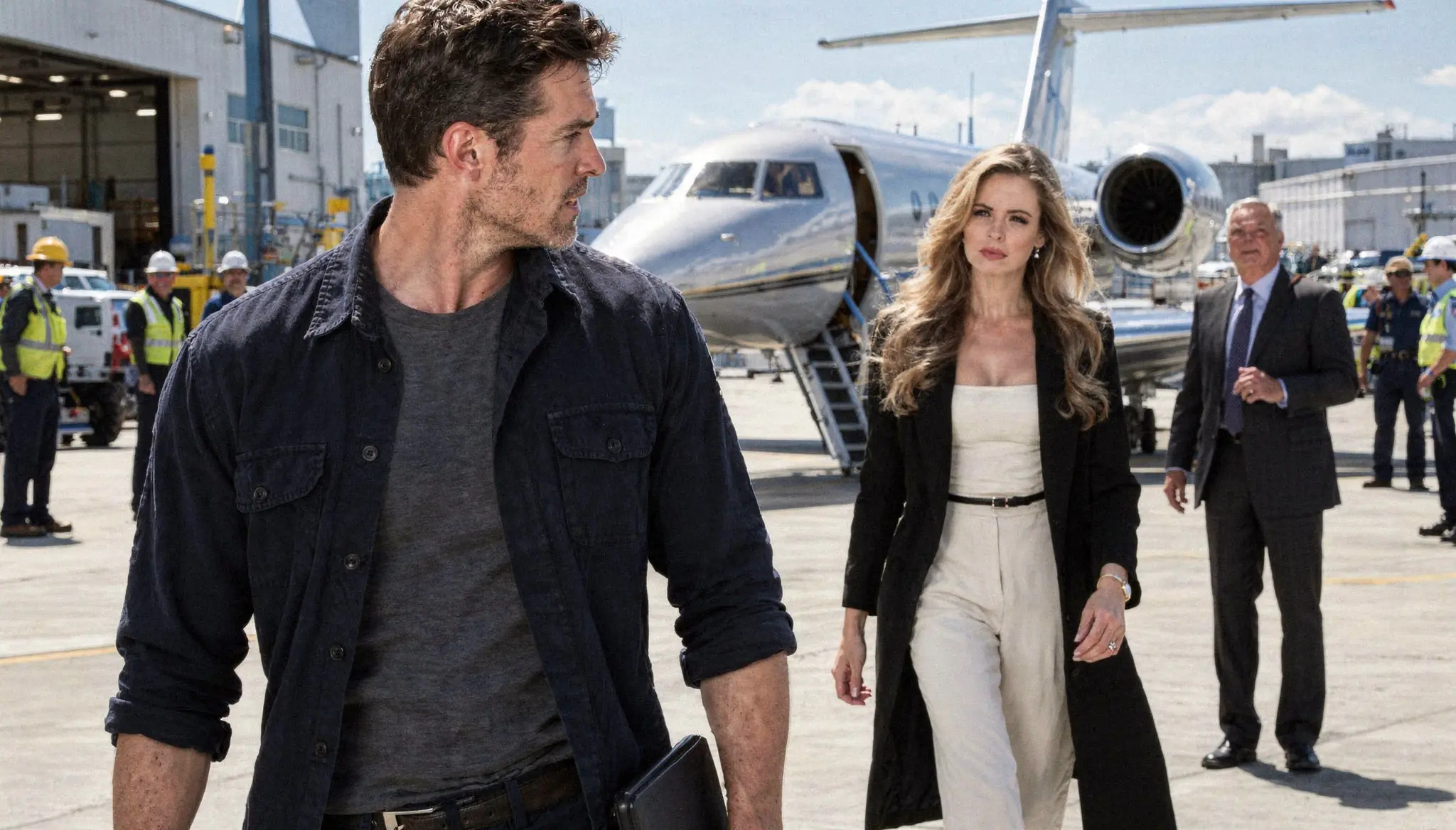
He was 42 years old, a single father. A maintenance technician who had never been late, never raised his voice, and never once asked anyone for a favor.
His offense was simple. He had walked away from his post to help a stranger who collapsed outside the company gates.
Nobody knew who she was. Nobody believed a man like Caleb would drop everything for a stranger without some kind of angle.
They watched him carry a cardboard box across the hangar floor, and most of them looked away.
3 days later, he came back for the last of his things. That was when the sound of jet engines tore across the Kansas sky.
A silver private jet dropped out of the clouds and settled onto the private runway beside the industrial park.
Men in hard hats stopped working. Office doors swung open.
The cabin door lowered, and a woman in a tailored black suit stepped down onto the tarmac. She walked straight past the executives who rushed to greet her.
She stopped in front of Caleb and looked him in the eye.
"You were fired," she said quietly. "For saving me?"
* * *
To understand how a quiet man with a toolbox ended up at the center of a storm that would shake an entire aviation empire, you have to go back to that cold morning.
Back to the frost on the hangar doors. Back to the moment Caleb Mercer set down his wrench and decided that a stranger's life mattered more than his job.
The Ashford Aeronautics Complex at Harland Field sat 20 miles outside Wichita. A sprawl of steel hangars and glass offices, rising out of flat brown prairie.
At 6:45 in the morning, the wind came hard across the runway and bit through every jacket on the line.
Caleb Mercer was already there. He was always already there.
He had clocked in 15 minutes early, the way he had every single day for 6 years. And he was working his way down the ground power units outside Hangar 4, with a flashlight clamped between his teeth.
He was a tall man, with gray at his temples and hands that knew their way around a machine.
He didn't talk much. The younger techs called him the librarian, because he logged everything. Every bolt, every reading, every part number.
"Mercer, you know nobody reads those logs, right?" said Troy Hadley, leaning against a tug with a coffee in his hand.
"Somebody might," Caleb said, and kept writing.