Don't open that door, Mama, seven-year-old Zoe Thompson whispered from behind Maya's hip, her little fingers gripping the sleeve of her mother's damp hospital scrubs. Outside their apartment, beneath a flickering porch light in the cold Milwaukee rain, an old man sat under the narrow awning like a shadow the world had forgotten. His coat was soaked, his gray beard dripped water onto his collar.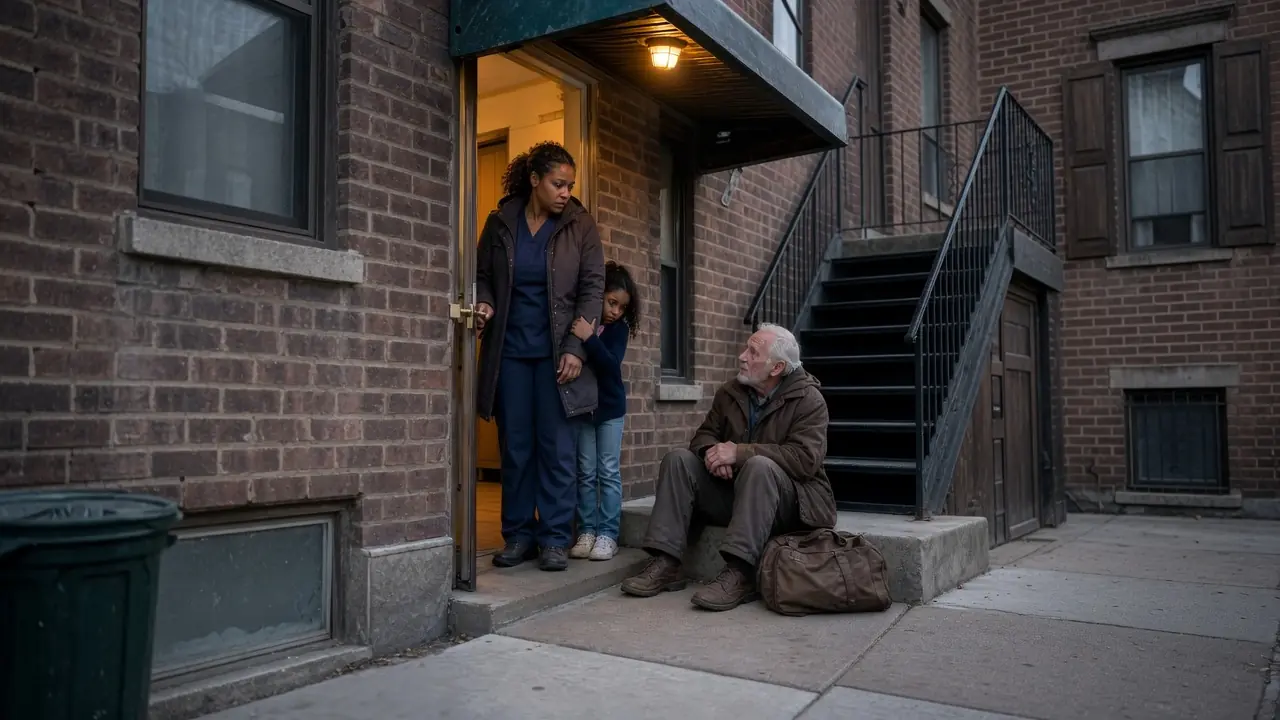
His hands were folded neatly in his lap. He was not begging, he was not knocking. He was just sitting there, shivering quietly as if even asking for help would be too much. Maya Thompson stood frozen with one hand on the deadbolt.
She had every reason not to open that door. She was 35 years old, a black single mother, and she knew the price of one wrong decision. She had worked 12 hours at St. Anne's Hospital cleaning rooms, changing linens, helping nurses lift patients who never learned her name. Her feet ached, her back burned, her paycheck was already gone before it arrived.
Rent, electric bill, Zoe's school lunch account, gas for the old Honda, and $11 in her purse until Friday. Still, the old man outside did not look dangerous. He looked tired, not drunk, not angry, not wild-eyed. Just tired in a way Maya understood too well.
The kind of tired that did not sit on the face, but lived deep in the bones. Maya leaned toward the door but kept the chain fastened. Sir, she called, are you all right? The old man lifted his head slowly.
His eyes were dark, gentle, and painfully alert. I'm sorry to bother you, ma'am, he said. I tried to get to the shelter on Vine, but they locked the doors before I made it. Maya said nothing. Zoe pressed closer. Rain hammered against the metal stair rail.
Somewhere downstairs, a dog barked once and went silent. I'm not asking for money, the old man added. I just need somewhere dry until morning. A hallway, a basement corner.
Anything. The answer should have been no. Every rule inside Maya said no. She thought of Zoe's bedroom, the pink backpack by the door, the little sneakers drying near the radiator.
She thought of every warning she had ever heard. A woman alone could not afford to be careless. A mother could not afford to be soft. I have a daughter, Maya said.
The old man nodded immediately and lowered his eyes. Then you do what keeps her safe, he replied. No shame in that. He began to stand slowly, painfully, one hand pressed against the brick wall.
His left knee nearly failed beneath him, and for one brief second his face twisted with a pain he was too proud to show. Maya saw it, and without warning she thought of her mother. Lillian Thompson had died 8 years ago with a hospital bracelet on her wrist and apologies on her lips, still trying to be gentle with a world that had never been gentle with her. Maya felt something old and tender break open in her chest.
Mama, Zoe whispered again. Maya looked down. Her daughter's eyes were still frightened, but there was something else there, too. Compassion. The dangerous, beautiful beginning of mercy.
Maya closed her eyes for half a second, then she opened the door only as far as the chain allowed. I need to see an ID, she said. The old man blinked, then reached slowly into his coat pocket with two fingers, careful not to frighten her. He pulled out an old state identification card, worn at the edges but readable.
Raymond Hale, age 69. Maya took a photo of it with her phone and sent it to Mrs. Alvarez next door. Then she looked at him again. You can sleep on the couch, she said. One night only.
My neighbor knows your name. Zoe's bedroom door stays locked. And if I tell you to leave, you leave. The old man stared at her as if she had given him something far greater than shelter.
No trouble, he said softly. I promise. Maya unhooked the chain. The apartment was small, warm, and worn down by survival. The sofa had a tear hidden beneath a crocheted blanket.
The carpet held stains no amount of scrubbing could erase. On the refrigerator, Zoe's drawings hung under mismatched magnets, a yellow sun, a crooked yellow house, and a stick figure family with only two people. Raymond looked at that little yellow house a moment too long, then he looked away. I'll get you a towel, Maya said.
No need to dirty one. It's already laundry day. she replied, though it wasn't. When she handed him the faded blue towel, he accepted it with both hands. Thank you, miss. Thompson, she said. Maya Thompson.
At the sound of her name, something shifted in Raymond's face, a flicker, a wound remembering itself. Maya noticed. Do I know you? she asked. Raymond lowered the towel to his chest. No, ma'am, he said quietly. I don't believe you do.
But his voice had gone thin at the edges. That night, after Zoe was asleep, Maya sat at the kitchen table with her phone beside her and a knife within reach. She watched Raymond sleeping on the couch beneath the crocheted blanket, his breathing slow and uneven. Near 2:00 in the morning, he stirred.
Maya sat up straight. But he only turned his face toward the wall and whispered one name, Lillian. Maya's blood went cold. That was her mother's name.
For a long moment, she did not move. She listened to the rain. She watched the old stranger on her couch. Then she told herself it was only coincidence.
Milwaukee had plenty of women named Lillian. The world was full of ghosts wearing ordinary names. But 21 days after that rainy night, when a lawyer stood at this same door holding a rusted tin box and a letter written in her mother's hand, Maya would remember everything. She would remember the rain, the old man's hesitation, the way his eyes had stopped on Zoe's drawing of the yellow house, and she would understand that Raymond Hale had not come to her door by accident.
Water dripped from the fire escape. The heater clicked in the corner, coughing out more noise than warmth. Raymond Hale was awake, too. That was the first thing Maya noticed.
He had folded the crocheted blanket into a neat square and placed it on the arm of the sofa. The faded blue towel hung carefully over the back of a kitchen chair. His shoes were lined up near the door, toes facing outward, as if he had prepared himself to leave before anyone asked. You didn't have to do all that, Maya said. Raymond turned slowly.
In the morning light, he looked older than he had the night before. His face was lined, his shoulders stiff, and his wet coat hung over him like something heavier than cloth. I don't leave a place worse than I found it, he said. Maya said nothing. It was a simple sentence, but it touched a tired place inside her.
Most people who entered her life left something behind. A bill, a broken promise, a wound too small to explain and too deep to forget. Raymond Hale had slept on her couch and left the blanket folded. From the hallway, Zoe appeared in her pajamas, curls wild from sleep, her stuffed rabbit tucked beneath one arm.
Is Mr. Raymond still here? she asked. Only long enough to say thank you, Raymond said gently. Zoe studied him. Did you sleep okay? Better than I deserve. Maya frowned. Don't say that.
Raymond lowered his eyes. Yes, ma'am. The apartment fell quiet. Maya opened the refrigerator. Two eggs, half a carton of milk, one heel of bread, and a jar of peanut butter stared back at her.
Payday was still 2 days away. She closed the door before Zoe could look too long. Raymond noticed. Then he politely looked away. That small act meant more than Maya wanted to admit.
A man with nowhere to sleep still had enough grace not to stare at her poverty. Zoe, Maya said, go brush your teeth. We have to leave soon. Raymond reached for his coat.
I'll head to the shelter now. But when he stood, his left hand trembled. He tried to hide it by pressing his palm against the wall, but Maya had worked too many hospital shifts not to recognize pain. You sick? she asked. Raymond paused. No more than most men my age.
That's not an answer. He gave a tired smile. Just tired. He took one step toward the door and his knee nearly gave out. Mama. Zoe whispered. Maya's jaw tightened. Sit down, she said. Miss Thompson, I won't be a burden.
I didn't ask what you'd be. I told you to sit down. Raymond obeyed. Maya made the two eggs stretch into three small portions, adding milk and cutting the toast into triangles because Zoe believed triangles tasted better than squares. She gave Raymond the chipped blue plate and kept the smallest portion for herself.
Raymond looked down at the food as if accepting it hurt him. Eat, Maya said. He did slowly, almost reverently. After breakfast, Maya asked, Where exactly are you going? There's a church near Walnut, Raymond said.
Sometimes they let folks sit inside if the pastor is there. And if he isn't? Raymond gave a small shrug. Maya hated that shrug.
It was the shrug of people who had practiced having no answer. She thought of every warning she had ever heard. She thought of Zoe's bedroom door. Then she thought of Raymond whispering one name in his sleep, Lillian, her mother's name. Two nights, Maya said. Raymond looked up. No, ma'am.
That wasn't a negotiation. Same rules. You sleep on the couch. You stay away from Zoe's room. I already sent your ID to Mrs. Alvarez.
Raymond's eyes softened, not with victory, but with something close to grief. I don't know how to repay you. Start by not making me regret it. That night Maya came home from another hospital shift with rain in her shoes and pain in her back. She expected disorder.
Instead, Zoe was asleep at the kitchen table with her cheek resting on an open picture book. The floor had been swept. The sink was empty. A small pot of soup simmered on the stove, made from a potato, half an onion, and things Maya thought were too little to become dinner.
Raymond stood near the counter wiping it clean. If you don't mind, he said. Little one said she was hungry. Maya looked at the soup, then at Zoe, then at the old man.
For the first time in years, someone had noticed she was tired without making her ask for help. Raymond reached for his coat. I can leave in the morning. Maya looked at her sleeping daughter.
Then she looked back at him. Morning, she said. But deep inside Maya knew one night had already become two. And two nights were beginning to feel like the edge of a story her mother had started long before Maya opened the door. The next morning Maya woke to a sound she had not heard in months, silence. Not complete silence.
Milwaukee still breathed outside her window. Cars hissed over wet pavement. Pipes knocked somewhere in the old building. A child cried faintly in the apartment below, but inside Maya Thompson's kitchen, the faucet was no longer dripping.
For 3 months that faucet had leaked through every night of her life, one silver drop at a time. Drip, drip, drip. It had followed her into sleep, into bills, into worry, into the heavy hours before dawn when she lay awake counting everything she could not fix. Now it was quiet. Maya stood in the doorway, still in her faded T-shirt, staring at the sink as if it had performed a miracle.
Raymond Hale was sitting at the kitchen table with a small screwdriver, an old rag, and a cracked rubber washer beside his elbow. He looked up carefully. I hope I didn't overstep, he said. That faucet was wasting water. Maya blinked. You fixed it. It wasn't much.
Washer was worn out. I found an old one in the drawer. Maya stepped closer and turned the handle. Nothing leaked, not one drop.
For some reason that almost made her cry, she swallowed it back. You didn't have to do that. Raymond folded the rag neatly. No, ma'am, but I knew how.
That answer stayed with her. Not I wanted praise, not you owe me, just I knew how. Zoe came bouncing into the kitchen wearing her school uniform in one crooked ponytail. Mama, listen, she said.
She pointed at the sink. Maya tried not to smile. I hear it. Zoe grinned. Nothing. Raymond's mouth lifted at the corner. At breakfast, Maya watched him more closely than before.
He ate little, too little. He pushed food around the plate when he thought nobody was looking. His hands were strong, but sometimes they trembled. And whenever Zoe laughed, something passed through his face like sunlight crossing a closed room. Not happiness, exactly. Memory.
After Zoe left for school, Maya found Raymond kneeling in front of the refrigerator. The old fridge had been making a grinding noise for weeks, a sound like a tired animal trapped behind metal. Maya had learned to ignore it, because ignoring broken things was sometimes the only way to survive them. What are you doing? she asked.
Raymond did not turn around. Trying to convince this refrigerator it isn't dying yet. Despite herself, Maya laughed. The sound surprised them both.
Raymond smiled without looking up. It's just a loose fan cover, he said, not the motor. You know appliances, too? I know a little about things people throw away too soon.
Maya leaned against the counter. There was something in the way he said it that made the room feel smaller, softer, as if he had not only been talking about refrigerators. By noon, the grinding stopped. By evening, the loose cabinet door no longer banged every time Zoe reached for a cup.
By the third day, the apartment seemed to exhale. The faucet held, the fridge hummed gently. The cabinet closed straight. Raymond never announced what he had done.
Maya simply came home from work and found one less small misery waiting for her. That was the part that unsettled her most. She was used to people helping loudly. People who reminded you what they had done.
People who handed kindness like a receipt. Raymond did the opposite. He repaired things and stepped away from them, as if goodness was meant to be left quietly behind. On the fourth night, Maya returned late from the hospital and found Zoe sitting on the sofa beside him, holding a picture book open across both their laps, Raymond was reading slowly.
His voice was deep, rough at the edges, but gentle enough to make each word feel safe. And the little house waited through the winter, he read, because it knew spring would come. Zoe leaned against the arm of the sofa, listening with her whole heart. Maya stopped in the doorway.
No man had read to Zoe before, not her father, not an uncle, not anyone who stayed. Raymond looked up and immediately closed the book halfway. I'm sorry, he said. Maya frowned, but Zoe turned toward her.
Mama, he does the voices. Maya wanted to be strict. She wanted to remind Zoe not to get attached. She wanted to remind herself, too.
Instead, she set down her bag. One story, Maya said. Zoe beamed. Raymond nodded, but his eyes held that same old sadness. He opened the book again.
While he read, Maya stood in the kitchen pretending to wash a mug that was already clean. The words floated through the apartment, gentle and slow. Zoe laughed once. Raymond chuckled softly. The fridge hummed without groaning. The faucet did not drip.
For the first time in a long time, Maya's home did not sound like survival. It sounded like shelter. Then, near the end of the story, Raymond paused on a sentence and looked at Zoe's face. You have her eyes, he whispered.
Maya turned off the water. What did you say? Raymond closed the book. His hand trembled slightly on the cover.
I said she has kind eyes, he answered. But Maya knew what she had heard. You have her eyes, not kind eyes. Her eyes. And somewhere deep inside Maya, the name Lillian began to rise again, quiet as a ghost and impossible to ignore.
That night, Maya could not stop hearing Raymond's words. You have her eyes. He had corrected himself quickly, too quickly. He said he meant Zoe had kind eyes, but Maya had lived long enough to know when a person was covering a wound with a bandage made of silence.
Still, she said nothing, not in front of Zoe, not while her daughter sat cross-legged on the sofa asking Mr. Raymond to read one more page, then one more, then just one more after that. Maya stood by the kitchen sink rinsing the same cup twice watching them from the corner of her eye. Raymond read slowly as if every sentence deserved a safe place to land. He did not rush through words the way tired adults often did.
He gave the little bear in the story a clumsy deep voice. He gave the old grandmother a soft southern lilt. Zoe covered her mouth to keep from laughing too loudly. Maya felt her heart tighten.
It was dangerous this warmth. Dangerous because it looked too much like something they had needed for years. When the story ended Zoe leaned back against the sofa cushion sleepy and smiling. Did you read stories to your kids? She asked.
Raymond's hand froze on the book. Maya turned fully toward him. No, Raymond said at last. I never had children. Zoe blinked.
Then who did you read to? Raymond looked at the book in his lap. His thumb moved along the worn edge of the cover. A friend, he said, a long time ago.
What was her name? Zoe asked. Maya said gently, That's enough questions. But Raymond answered before the silence could close around him. Lillian. The name fell into the room like a key dropped on a wooden floor. Maya went still.
Zoe did not notice. She was too young to understand how a name could stop the blood inside a grown woman's body. My grandma's name was Lillian, Zoe said. Raymond looked at her.
Something bright and painful moved through his eyes. I know, he whispered. Maya's hand tightened around the cup. You know? Raymond's face changed. The softness disappeared, replaced by fear.
Not fear of Maya, but fear of having stepped into a truth too soon. I mean—he cleared his throat—you mentioned her before, didn't you? No, Maya said. The word was quiet, but it struck hard.
Raymond lowered his eyes. Zoe looked between the two adults. Mama? Maya set the cup down carefully. Go brush your teeth, baby. Now, Zoe.
Zoe slid off the sofa her smile gone and walked toward the bathroom with her stuffed rabbit tucked under her arm. The moment the bathroom door closed, Maya turned back to Raymond. How do you know my mother's name? Raymond did not answer.
Outside, wind pressed rain against the window. The refrigerator hummed softly. The repaired faucet stayed silent as if even the apartment was waiting. Mr. Hale, Maya said, her voice tighter now, I asked you a question.
Raymond closed the book and placed it gently on the coffee table. I knew a woman named Lillian once. Maya stared at him. There are many women named Lillian, yes.
Did you know my mother? He looked toward the hallway where Zoe's toothbrush water ran, then back at Maya. I knew someone kind, he said. Someone who loved her daughter more than she loved breathing.
Maya felt the words hit a place she had tried to keep protected. My mother has been dead eight years. Raymond nodded slowly. I'm sorry. The apology was too heavy, too personal. Maya stepped closer. That is not an answer.
Raymond's hands rested on his knees. They were trembling again. I don't want to bring pain into your house, he said. You already brought questions. His eyes lifted.
There was a sadness in them so old it seemed almost patient. Some questions need the right time. Maya gave a bitter little laugh. I let you sleep on my couch.
I let you eat at my table. You read bedtime stories to my child. Don't stand in my living room and tell me the truth needs better timing. Raymond bowed his head.
For the first time, he looked smaller than his age. You're right, he said. You have every right to ask. Then tell me. He opened his mouth, but before he could speak, Zoe's small voice came from the hallway.
Mama, my nightlight won't turn on. Maya looked toward her daughter. That single interruption saved Raymond from answering. Or maybe it saved Maya from hearing too much.
She turned back to him. This conversation is not over. No, ma'am, Raymond said softly. It isn't. Later, after Zoe was tucked in bed, Maya checked the nightlight, kissed her daughter's forehead, and stood for a moment in the dark doorway.
Mama, Zoe whispered half asleep, yes, baby? Raymond looks sad when he says Grandma's name. Maya's throat tightened. I know. Did Grandma know him? Maya looked back toward the living room where Raymond sat alone beneath the weak lamp, his hands folded over the storybook like he was guarding a grave.
I don't know yet, she said, but that was no longer true. Deep down, Maya knew Raymond Hale had not entered their lives by chance. And tomorrow she would begin looking for proof. The next morning, Maya Thompson woke with a question sitting heavy in her chest.
Did Raymond Hale know her mother? She tried to move through the day like usual. She packed Zoe's lunch, she brushed lint from her school sweater, checked the old Honda's gas gauge, and drove through Milwaukee's gray morning streets toward school. But Raymond's voice followed her everywhere.
Lillian, I knew someone kind. Someone who loved her daughter more than she loved breathing. Those were not the words of a stranger. At the hospital, Maya made beds, emptied trash, wiped down counters, and nodded when nurses hurried past her with tired smiles.
But her mind kept returning to the old man on her couch, the way his face had changed when he heard her name, the way his eyes had stopped on Zoe's drawing of the yellow house. By the time her shift ended, Maya had decided one thing: she was done waiting. When she came home that evening, the apartment smelled like warm rice and stewed tomatoes. Zoe was at the kitchen table coloring, her tongue pressed between her teeth in deep concentration.
Raymond stood at the stove stirring carefully with one hand. I used what was left, he said before Maya could ask. I hope that's all right. Maya looked at the pot.
You keep making something out of almost nothing. Raymond gave a small smile. That's what poor folks learn first. The sentence was gentle, but it cut deeper than he knew.
After dinner, Zoe begged for another story. Maya almost said no. She needed answers, not bedtime sweetness. But Zoe's eyes were bright, and Raymond was already reaching for the picture book like a man reaching for the only prayer he still remembered.
One story, Maya said. Zoe cheered softly. Halfway through, Raymond coughed. It was not loud, but it bent him forward. The book slipped from his hand.
Zoe sat up fast. Mama. Maya crossed the room. Mr. Hale. I'm all right, Raymond whispered, though his face had gone pale. You're not. She helped him sit back.
His coat had been folded over the chair nearby. When she reached for it to get his handkerchief, his old wallet fell from the pocket and opened on the floor. A photograph slid out. Maya froze. The picture was old, its edges worn soft by years of being touched.
In it stood a young black woman with bright eyes and a wide tired smile. Her hair was pulled back with a blue scarf. Beside her stood a younger Raymond Hale, taller, stronger, one hand resting on the hood of an old pickup truck. Maya knew the woman before her mind could accept it.
Her mother, Lillian Thompson, not sick, not fading in a hospital bed, not apologizing through pain, young, alive, smiling like the world had not broken its promises yet. Maya bent slowly and picked up the photograph. Her hand trembled. Zoe leaned over the sofa. Is that Grandma? Raymond closed his eyes.
Maya looked at him. You lied to me. Raymond opened his eyes, and the pain in them was no longer hidden. I didn't want to.
But you did, yes. Her voice dropped. How long have you had this? Raymond looked at the photograph as if it carried both heaven and punishment. More than 30 years.
Maya could barely breathe. 30 years. Long before Zoe, long before the hospital bills, long before the funeral home handed Maya a box with her mother's earrings and a folded church program. How did you know her? Raymond swallowed. We were friends, he said.
When we were young, before life separated people the way it does. Friends? His eyes lowered. Family, almost. Maya gave a sharp wounded laugh. Almost family doesn't sleep on my couch for 5 days without telling me who he is. I know. Almost family doesn't whisper my dead mother's name and pretend it means nothing. I know. Then why? Raymond's mouth tightened.
For a moment he looked towards Zoe, then away again. Because your mother asked me for something before she died, he said. Maya's anger went still. What? Raymond did not answer quickly.
That frightened her more than if he had. What did my mother ask you? His hand moved toward the photograph, but Maya held it back. No, she said. You don't get to touch this until you tell me the truth.
Raymond bowed his head. She asked me to find you. he said quietly, if I ever could. Maya felt the floor shift beneath her.
She knew where I was. No. Raymond said, not at the end. Maya shook her head. What does that mean?
You had moved after the rent increase. he said softly. Your phone number changed. Some records had your married name. Some still had Thompson.
Your mother was sick by then, sicker than she let you see. She was ashamed she had lost track of so much paperwork while trying to stay alive. Maya looked away. She remembered those years in pieces, packing boxes in a hurry, changing numbers after collection calls, signing forms with a name she no longer used, trying to keep Zoe fed while her mother's health slipped faster than anyone admitted. She never told me about you, Maya whispered. She had reasons. What reasons?
Raymond looked older with every question. Some stories belong to your mother. he said, and some are not mine to open without care. Maya's eyes filled, but her voice hardened.
My mother is gone. If she left a story, I'm the only one still here to hear it. Raymond looked at her then, really looked. And for the first time Maya saw not a stranger, not a burden, not a man sheltering secrets under a wet coat.
She saw someone who had carried grief for a very long time. I have something for you. he said, not here, not with me. What? A box. Maya's fingers tightened around the photograph.
What kind of box? Raymond's voice broke softly. The kind your mother made me promise I would give you when I found you. Zoe climbed down from the sofa and slipped her hand into Maya's. Nobody moved.
Outside the city lights trembled in the wet street. Inside Maya stared at the photograph of her mother smiling beside Raymond Hale and every wall she had built around the past began to crack. But Raymond still had not told her everything. And the truth, Maya could feel it now, was much larger than one photograph.
After the photograph, nothing in the apartment felt ordinary anymore. The sofa was still torn the crocheted blanket. The refrigerator still hummed in the corner. Zoe's drawings still hung on the door with mismatched magnets.
But every small thing seemed to carry a question now. Who was Raymond Hale and what had Lillian Thompson trusted him to keep? Maya did not sleep well that night. She lay awake listening to the quiet apartment, one hand resting near Zoe's bedroom door.
In the living room, Raymond slept on the couch like a man who had been forgiven nothing. Even in sleep his face looked burdened. By morning Maya expected him to explain everything. He did not. Instead he made oatmeal with sliced apples from the bottom drawer of the refrigerator and served Zoe first, the way he always did.
Maya watched him from the counter. You said there was a box, she said. Raymond's hand paused over the pot. There is. Where? With a lawyer. What lawyer? Daniel Price. Your mother knew him. Maya's jaw tightened.
And you just decided not to tell me. Raymond looked down. I came to make sure I had found the right person first. You had my name. I had your name, he said.
But I also had fear. Maya said nothing. Raymond placed the spoon beside the pot. I spent more than two years looking for you. Library computers, old addresses, churches, county records, shelter bulletin boards.
I had very little money and when my illness got worse, I lost most of what little stability I still had. By the time I found this building, I had already spent the night in three bus stations and two church basements. Maya's face changed. Raymond continued, voice low, That night in the rain, I wasn't pretending to be a man with nowhere to go. I had nowhere to go, but I saw your name on the mailbox downstairs and I couldn't make myself knock, not at first.
I was afraid you would look at me and see danger before I could explain the promise. Maya looked toward Zoe's yellow house drawing on the refrigerator. So, you sat outside my door? Yes, in the rain.
I was trying to gather courage. For the first time, Maya had no reply. Raymond's eyes lifted to hers. I did not come to test your kindness.
You owed me nothing. If you had closed the door, you still would have been right to protect your child. The anger in Maya did not disappear, but it softened around the edges. For the next several days, Raymond did not push.
He stayed quiet, helpful, almost invisible. He fixed the loose kitchen drawer. He repaired the chain on the front door, so it slid cleanly for the first time in years. He carried groceries up the stairs when Mrs. Alvarez from next door left a small bag outside, pretending it was extra food when everyone knew it was kindness.
He never entered Zoe's room, never raised his voice, never asked for money, never made himself larger than the space Maya allowed him. And somehow, in that small apartment, 12 days passed. 12 days of quiet repairs, 12 days of soup, rice, oatmeal, and toast cut into triangles. 12 days of Zoe sitting beside him after dinner, asking for the bear story, the train story, the story about the little house waiting for spring.
By the ninth night, Zoe stopped calling him Mr. Raymond only when Maya reminded her. By the tenth, Maya stopped checking the knife drawer every hour. By the eleventh, she came home from the hospital and found a folded note on the counter. Ms. Thompson, Zoe finished her reading homework.
The faucet still holds. Soup is on low. Please eat before it gets cold. R. H. Maya stood there with the note in her hand for a long time.
No one had written her something that gentle in years. On the 12th morning, Raymond was already dressed when Maya entered the living room. His coat was buttoned. His old wallet was in his hand.
The photograph of Lillian was no longer inside it. Instead, he placed the photograph carefully on the kitchen table. Maya stared at it. What are you doing? Leaving, he said.
Zoe, who had been tying her shoes by the door, looked up sharply. Leaving where? Raymond smiled at her, but his mouth trembled. Just somewhere I need to go, little one. No, Zoe said. You didn't finish the spring story.
I think your mama can finish that one. Maya folded her arms, trying to hide the sudden tightness in her chest. You said the box was with a lawyer. It is. Then why leave before I get answers?
Raymond looked at her with an exhaustion that seemed deeper than age. Because I didn't come here to become something you had to lose twice. The words struck the room silent. Maya could not answer.
Raymond turned to Zoe and knelt slowly, his knees stiff with pain. He did not touch her without permission. He simply held out one hand. Zoe stepped forward and hugged him. Maya's breath caught.
Raymond closed his eyes as if that small embrace had given him both comfort and punishment. When Zoe stepped back, he looked at her face for a long moment. You are a very brave girl, he said. And you have eyes like someone I loved very much.
This time he did not correct himself. Maya felt tears sting her eyes. At the door, Raymond paused. He looked once around the apartment, the repaired sink, the clean counter, Zoe's drawings, the couch where he had slept for 12 nights.
Then he looked at Maya. Your mother was proud of you before you ever knew how hard life would be, he said. Maya's voice cracked. How do you know? Raymond's eyes filled. Because she told me.
Then he opened the door. Cold air slipped into the apartment. Before he stepped out, he turned back one last time. Your daughter. he said quietly, is very much like someone I once knew.
Maya did not ask who. She already knew. Raymond Hale walked down the stairs without looking back. And for the first time since he had arrived, the apartment felt too quiet. Nine days later, Raymond Hale passed away.
21 days after the rainy night, the lawyer came. Maya Thompson still found traces of Raymond in the apartment. Not things he had forgotten, things he had fixed. The faucet no longer dripped through the night.
The refrigerator hummed softly instead of growling. The cabinet door closed without a bang. Even the chain lock slid smoother beneath Maya's fingers, as if the old man had repaired not only metal, but the small daily irritations that had worn her down for years. Zoe missed him in a way children do not know how to hide.
At bedtime, she would pause beside the sofa and ask, Do you think Mr. Raymond finished the spring story somewhere else? Maya always gave the same answer. I hope so, baby. But hope had started to feel uneasy.
Raymond had not called. He had not returned. He had not sent a message through Mrs. Alvarez. Some nights, Maya told herself that was for the best.
He had been a stranger, even if he carried her mother's name like a wound. Other nights, she sat at the kitchen table after Zoe fell asleep and stared at the old photograph he had left behind. Lillian Thompson and Raymond Hale, young, smiling, alive in a time Maya had never been invited to know. Then on a Tuesday afternoon, there was a knock at the door.
Not a neighbor's knock, not the quick tap of Mrs. Alvarez. This was firm, careful, official. Maya looked through the peephole and saw a white man in a dark overcoat standing in the hallway holding a leather folder beneath one arm and a small rusted tin box in both hands. Her stomach tightened. Who is it? she called. Miss Maya Thompson? the man asked. My name is Daniel Price. I'm an attorney.
Maya's fingers went cold. Attorney. That word never arrived carrying simple news in the neighborhoods Maya knew. Zoe appeared from the kitchen doorway with a half-eaten apple in her hand. Mama.
Maya held up one finger for silence. What do you want? she asked through the door. I'm here on behalf of Mr. Raymond Hale, he said.
At Raymond's name, Maya unfastened the chain before fear could talk her out of it. The lawyer stood very still as if he understood the danger of surprising a woman who had learned to protect herself. I'm sorry to come without warning, he said, Mr. Hale asked me to wait until today before contacting you. Is he alive? The question escaped before Maya could soften it.
Daniel Price lowered his eyes. For one terrible second, the hallway seemed to tilt. He passed away nine days ago, the lawyer said gently. Zoe dropped the apple.
It hit the floor with a small, helpless sound. Maya gripped the doorframe. No, she whispered. I'm very sorry. Zoe began to cry first, not loudly, just a small, broken sound as if a storybook had closed before the last page. Maya wanted to comfort her daughter, but she could not move.
She saw Raymond folding the blanket. Raymond fixing the faucet, Raymond kneeling slowly so Zoe could hug him. Raymond saying, I didn't come here to become something you had to lose twice. He had known. He had known he was leaving them twice.
Daniel Price held out the tin box. This belonged to your mother, he said. Maya looked at it. The box was old and rusted at the corners, the kind cookies might have come in years ago.
Across the lid, written in faded black marker, were three words: For My Maya. Her knees nearly failed. Zoe came to her side and slipped one trembling hand into hers. My grandma wrote that, Zoe whispered.
Maya could not answer her. Daniel opened his folder and removed an envelope, yellowed with age but sealed carefully. There is also a letter, he said, from Lillian Thompson, Mr. Hale kept it safe until he found you. Maya stared at the envelope, her mother's handwriting bent across the front. Maya girl.
No one had called her that since the hospital room where Lillian had taken her last breath. Maya pressed her free hand over her mouth. Daniel's voice remained low. There are documents, too.
I can explain them when you're ready. What documents? He hesitated. Property records, a simple trust agreement, and a small savings account your mother arranged years ago with Mr. Hale's help. Maya shook her head slowly. My mother didn't have anything.
Daniel looked at the rusted tin box. She had more than she allowed you to see. The words broke something in Maya. Not because they sounded wealthy. They did not.
They sounded like sacrifice. They sounded like a woman skipping medicine to save $20. Like a mother pretending she was not hungry. Like hands folding small bills into envelopes while telling her daughter everything was fine.
Maya stepped back from the door. Come in, she said. Daniel entered carefully and sat at the kitchen table placing the tin box between them. The apartment was quiet except for Zoe's soft crying and the steady hum of the refrigerator Raymond had repaired.
Maya touched the lid with shaking fingers. For my Maya, she had opened the door once for a stranger in the rain. Now 3 weeks later the past had come knocking back and in a rusted tin box her mother was about to speak again. Maya Thompson sat at the kitchen table staring at the envelope as if it might breathe.
Across the front in handwriting she had not seen for 8 years were two words that nearly undid her. Maya girl. That was what her mother used to call her on soft mornings before bills, before sickness, before hospital corridors and goodbye prayers. Maya girl, come eat. Maya girl, don't let this world make your heart small.
Maya girl, you were loved before you ever learned to be strong. Zoe stood beside her chair one hand resting on Maya's sleeve. Is grandma inside that letter? She whispered. Maya swallowed hard. In a way, baby.
Daniel Price sat across from them with his hands folded. The rusted tin box rested between them quiet and heavy. It looked too small to hold a life. Too ordinary to carry 8 years of unanswered grief.
Maya broke the seal carefully. The paper inside was yellowed at the edges. Her mother's handwriting trembled in places as if some lines had been written on days when pain was stronger than strength. Maya began to read, My sweet Maya girl, if this letter reaches you, it means Raymond found you.
Please do not be angry with him for taking his time. He is a good man, but good men can still be afraid when the promise is bigger than their own heart. Maya pressed her fingers to her lips. Zoe leaned closer. I wanted to tell you everything before I left this world, but sickness stole more days from me than I thought it would.
I kept waiting for one good morning, one clear breath, one hour when I could sit up and speak without making you cry. That hour never came. Tears slipped down Maya's face. She remembered her mother's hospital bed, the thin blanket, the machines, the way Lillian had tried to smile even when smiling hurt.
Maya had thought her mother was hiding pain. Now she understood. She had been hiding a story. Years ago, before you were old enough to remember, I owned a little house outside the city. Nothing fancy. Yellow curtains, a porch that leaned to one side, a patch of yard where I once dreamed you would run barefoot in summer. Maya stopped reading.
A house, she whispered. Daniel nodded gently but said nothing. Maya forced herself to continue. When the hospital bills came, I was afraid they would take everything.
Raymond helped me protect what little I had left. The house was placed in a simple legal trust, not because I wanted secrets, but because I wanted you to have one thing this world could not swallow before you were ready to receive it. Maya's breath broke. She had grown up believing her mother had left nothing but love and debt. She had never blamed her.
Love had been enough most days. But now, the thought of Lillian fighting quietly to protect a roof for her daughter made Maya feel both cherished and shattered. There is also a small savings account. It is not much.
I wish it were more. Every dollar in it came from days I said I wasn't hungry, extra shifts I told you were easy, and birthday money I pretended I had spent on myself. Do not mourn those sacrifices. A mother does not count what she gives to her child as loss.
Zoe began to cry again, though she did not fully understand. Maya pulled her close with one arm. Raymond promised me he would find you if I could not place these things in your hands myself. He was my oldest friend.
Once when I had no one else, he stood beside me. If he comes to you looking worn down by life, please know he carried more than his own sorrow. He carried mine, too. Maya looked toward the sofa.
She could almost see him there. Folded blanket, tired hands, quiet eyes. He had not come to test her. He had come carrying Lillian's last act of love.
The final lines blurred through Maya's tears. Maya, girl, I am sorry for every hard day you had to survive without me. I am sorry I could not stay long enough to watch Zoe grow. But if you are reading this, then some part of me has reached you after all. Take the house. Take the money.
Take the rest I could not give you while I was breathing. And when life becomes heavy, remember this. You were never abandoned. Love was still walking towards you, even when it arrived late, wearing an old coat in the rain. Your mama, Lillian.
Maya lowered the letter. For a long moment, no one spoke. The peeling walls, the tired carpet, the repaired faucet, the humming refrigerator. All of it seemed suddenly touched by a grief older than the room itself.
Zoe touched the paper with one small finger. Grandma loved you a lot, she said. Maya broke then, not loudly, not dramatically. She bent over the letter, pressed it to her chest, and cried with the grief of a daughter who had just heard her mother's voice cross eight years of silence. Daniel waited.
Zoe wrapped both arms around her mother's waist. And somewhere in that small Milwaukee kitchen, between a rusted tin box and a child's trembling hug, Maya finally understood the truth. Her mother had not left her empty-handed. She had left love hidden in the safest place she could find. In a promise.
In a friend and in a house Maya had never known was waiting for her. Daniel Price did not rush Maya. He sat quietly at the kitchen table while she held her mother's letter against her chest as if paper could become arms, as if ink could become a heartbeat. Zoe stayed pressed against her side.
Outside Milwaukee moved on without knowing that inside one small apartment, a daughter had just received 8 years of love all at once. When Maya finally lifted her face, her eyes were swollen, but her voice was steady. Tell me about him. Daniel looked at her gently. Raymond? Maya nodded.
I need to know who I let into my house. Daniel opened his folder and removed a second envelope. This one was not sealed. On the front, written in careful block letters, was Raymond's name.
He asked me to give you this after your mother's letter, Daniel said. But before you read it, there are things you should understand. Maya wiped her cheeks. Daniel folded his hands.
Raymond Hale and your mother met when they were young. They worked at the same laundry service near the old South Side. Lillian was 17, Raymond was 20. From what he told me, your mother was the first person who ever made him believe his life could still become decent.
Maya looked toward the old photograph on the table. Her mother's smile looked different now, not younger, freer. They were together? Maya asked. Daniel shook his head softly. Not the way people might think.
Raymond loved her, I believe. But Lillian chose your father. Raymond respected that. He stayed her friend. Maya closed her eyes.
There was something achingly beautiful about that. A man who had loved without owning. A man who had stayed without asking to be chosen. Daniel continued, When your mother became ill, she contacted Raymond.
She knew her time was shorter than she had told you. She was afraid that medical debt and old paperwork would swallow the little house before it ever reached you. Maya's voice broke. Why didn't she tell me? Because she knew you would try to carry it while carrying everything else.
Daniel's answer hurt because it sounded exactly like Lillian. Maya remembered her mother's thin hand touching her cheek whispering, Don't you worry about me, Maya girl. You just take care of that baby. Even dying, she had tried to make herself lighter for her daughter.
Daniel pointed to the tin box. Raymond helped her place the property in a small trust. It was not a fortune or a complicated estate. It was a simple legal arrangement meant to keep creditors and paperwork from taking the house before you could be found.
He became the temporary holder because your mother trusted him not to misuse it. And he looked for me? For more than 2 years. Maya stared at him. Daniel nodded.
You had moved apartments, your phone number changed, some records listed your married name. Others listed Thompson. Raymond was already sick by then. He had very little money. Some weeks he searched from library computers.
Some weeks he walked neighborhoods where he thought you might have lived. He spent what he had on bus fares, copies of records, and nights in places where no one asked questions. Maya pressed one hand over her mouth. The image struck her hard.
Raymond in his old coat, tired and ill, searching a city that had no reason to help him. Why didn't he just tell me when he found me? she whispered. Daniel's face saddened. He was afraid. Of what? That you would think he came to trick you. That you would shut the door before he could explain.
And I think Daniel paused. I think he wanted to know the promise had led him to the right Maya Thompson. Maya's eyes flashed with pain. The right Maya Thompson was barely making it. I know, Daniel said softly. Raymond knew too.
That is why he called me the day after he left your apartment. Maya looked up. He called you? Daniel nodded. He said, I found Lillian's girl. She is tired, but she has her mother's heart. And the child laughs like spring.
Zoe wiped her eyes. He said that about me? Yes, Daniel said. He did. Maya picked up Raymond's envelope with trembling fingers. Inside was one page.
Miss Thompson, if you are reading this, then I have done what I promised your mama I would do. I should have told you sooner. I know that, but a man who has lost much can become a coward around the things that still matter. I was afraid you would see only an old stranger.
I was afraid I would bring more fear than comfort. Your mother did not leave you because she wanted to. She fought to stay. Every breath near the end was pointed toward you and Zoe.
I came to your door in the rain because I needed to see the woman Lillian loved so fiercely. I found her. I found her in the way you protected your child. I found her in the way you gave shelter even while afraid. I found her in the way you had almost nothing and still made room.
Do not think I tested you. You owed me nothing. I was the one being given a gift. For 12 days I sat in a home where your mother's love was still alive.
Thank you for the couch. Thank you for the soup. Thank you for letting an old man finish a promise before the Lord called him home. Raymond Hale. Maya lowered the letter.
Zoe was crying openly now. Maya pulled her daughter into her lap and held her tight. For years she had believed help never came unless it demanded something back, but Raymond had asked for nothing. Her mother had asked for nothing.
Both of them had simply loved her from places she could not see. Daniel slid the property documents across the table. The house is yours, Maya, he said. Yours and Zoe's. Maya looked at the papers.
For a moment she could not imagine owning anything larger than survival. Then she looked at her daughter. Zoe's cheeks were wet, but her eyes were shining. Does it have yellow curtains? Zoe whispered.
Maya looked down at the letter in her hands. I think, she said softly, we should go find out. And for the first time in many years, the future did not feel like a locked door. It felt like a road waiting beneath morning light.
The little house stood at the edge of a quiet street outside Milwaukee waiting beneath a pale morning sky. It was not grand. The porch leaned slightly to one side. The white paint had faded into the color of old paper.
Weeds pushed through cracks along the walkway, and one shutter hung crooked beside a front window. But in that window, behind the glass, were yellow curtains. Zoe saw them first. Mama, she whispered from the backseat. Grandma's curtains.
Maya Thompson kept both hands on the steering wheel, though the car had already stopped. For a long moment, she could not move. She simply sat there staring at the small house her mother had somehow protected across years of sickness, debt, silence, and distance. Daniel Price stood beside the front gate with a folder under his arm and a key in his hand.
Maya stepped out slowly. The cold air touched her face. Zoe slipped her hand into hers. Together, they walked up the cracked path.
Every step felt unreal. Maya had spent so many years entering places she did not own. Rented apartments, hospital rooms, laundromats, grocery stores where she counted coins before reaching the register. She had become familiar with temporary things, temporary jobs, temporary peace, temporary hope.
But this house was not temporary. It had waited. Daniel handed her the key. Your mother wanted you to have this, he said. Maya looked at the old brass key in her palm.
It felt too small to carry so much love. She unlocked the door. The house smelled of dust, wood, and time. Sunlight fell through the yellow curtains in soft golden squares.
The living room was nearly empty except for an old rocking chair, a covered sofa, and a small table by the window. On that table sat a framed photograph, Lillian Thompson. Young, smiling, standing on the porch of this very house with one hand lifted against the sun. Maya walked to it and touched the frame with trembling fingers.
Oh, Mama, she whispered. Zoe stood beside her. She looks happy here. Maya nodded, tears already rising.
I think she was. They moved through the room slowly. The kitchen was small, but bright. The cabinets needed cleaning.
The sink was stained but solid. Upstairs, the second bedroom faced the backyard where a maple tree stood bare and patient. Zoe stepped into that room and turned in a circle. Is this mine? Maya looked at the peeling wallpaper, the narrow window, the dusty floorboards.
Then she looked at her daughter. Yes, baby, she said, her voice breaking. This is yours. Zoe ran to the window and pressed both hands to the glass. I can put my books there, she said.
And my rabbit and maybe a little desk. Maya smiled through tears. A little desk. Such a simple dream. Such a holy thing.
Later, Daniel left them alone. Maya and Zoe sat on the front steps with their coats wrapped tight around them. The neighborhood was quiet. Somewhere nearby a dog barked.
A wind chime sang from a porch across the street. Maya held Raymond's letter in one hand and her mother's letter in the other. Two voices, two promises. One from the woman who had given her life, one from the man who had carried that love the rest of the way.
Zoe leaned against her shoulder. Do you think Mr. Raymond can see us? Maya looked at the yellow curtains glowing behind the window. I hope so. Do you think Grandma can?
Maya kissed the top of her daughter's head. I think love like that doesn't disappear. I think it finds roads we don't know about. Zoe was quiet for a moment.
Then she said, He wasn't really a stranger, was he? Maya looked down at the cracked walkway remembering the rain, the old coat, the folded hands, the tired voice asking only for somewhere dry until morning. No, she said softly. He was a promise. In the weeks that followed, Maya and Zoe did not become rich.
No miracle erased every bill. No grand carriage arrived to carry them out of struggle forever. But they had a roof that belonged to them. They had a porch where Zoe could read in the spring.
They had a kitchen where soup could simmer without fear of eviction. And slowly, piece by piece, the house began to breathe again. Maya painted the front door blue. Zoe planted marigolds under the window.
Mrs. Alvarez came with a casserole and cried when she saw the yellow curtains. On the first warm Saturday, Maya placed Raymond's photograph beside Lillian's on the little table by the window, two guardians of a life finally returned. That evening, Maya stood in the doorway as Zoe ran barefoot across the yard laughing beneath the maple tree. For the first time in years, Maya did not feel like she was only surviving the day. She felt rooted. She felt held.
She felt loved by hands no longer living, yet somehow still working. And when the sun lowered over the little house with yellow curtains, Maya understood what her mother had been trying to tell her all along. Lillian had not left her empty-handed. She had left her a home.
She had left her a friend. She had left her proof that kindness once given can travel through grief, through time, through rain, and still arrive at the right door. Maya looked toward the sky, tears shining, but no longer falling from pain. Thank you, Mama, she whispered.
Then she looked at Raymond's photograph through the window. And thank you for finding us. Behind her, the house stood warm and quiet. Ahead of her, Zoe laughed in the yard.
And for the first time in a long time, Maya Thompson opened the door not out of fear, not out of mercy, but out of peace. She was finally home.