The first thing Dana Ray heard inside Sam Callaway's house was breaking glass.
She had not even shut the front door behind her when a full breakfast tray flew across the living room and exploded against the wall beside the hallway. Coffee splashed across the faded wallpaper. Scrambled eggs slid down the plaster in yellow streaks. A drinking glass hit the floor and shattered into glittering pieces at her feet.
From the wheelchair near the front window, the old man glared at her as if he had been waiting all morning for someone worth hating.
"You got ten seconds to get out of my house," he growled.
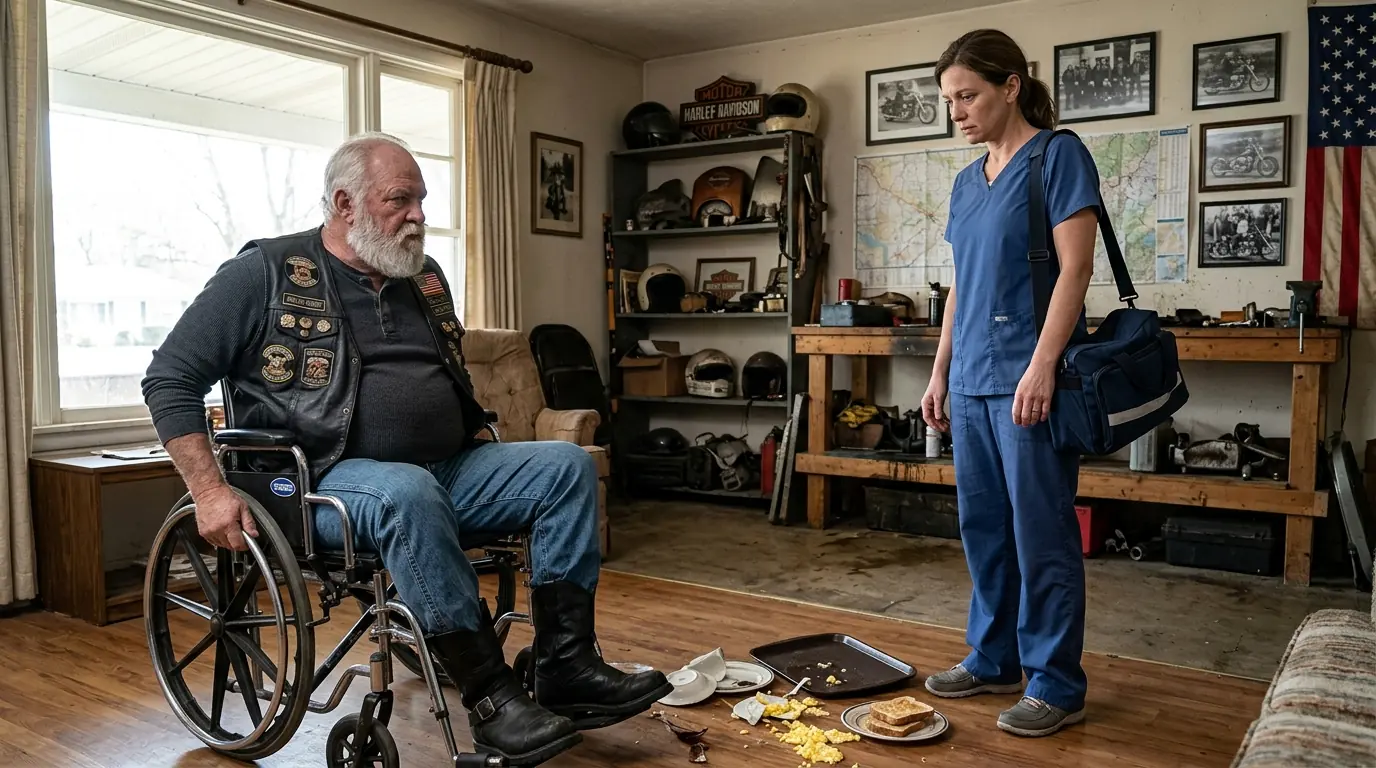
Dana stood still with her nursing bag in one hand and her car keys in the other. She looked at the broken glass, then at the IV line dangling loose from the old man's arm, then at the blood beginning to bead where he had ripped the tape away.
"You missed my head," she said.
For the first time since she had walked in, Sam Callaway blinked.
Dana set her bag down, closed the front door with her heel, and stepped carefully around the mess. "But you hit the wall pretty hard. If that was the wall's breakfast, I'll clean it up after I stop you from bleeding all over your sleeve."
"I said get out."
"I heard you."
"Then you're deaf and stupid."
"Maybe." She pulled on gloves from her bag. "But I'm also the nurse they sent, and unless you can clean that arm yourself with one working hand, we're both going to be here for a few more minutes."
Sam's face tightened. He was seventy-one, broad through the shoulders even after eight months of stroke recovery, with a thick white beard and eyes as hard as gravel. The left side of his body still refused to obey him. His left hand curled uselessly on the armrest. His left foot dragged if he tried to stand. Everything about him seemed built for command, but his own body had stopped listening, and that made him furious enough to burn down the room around him.
Dana knew the look. She had seen it in veterans, retired steelworkers, widowers, men who had spent a lifetime being feared or needed or obeyed. Then one day they could not button their own shirts, and all that pride turned into a weapon.
She did not flinch when he swore at her. She did not answer when he called her a vulture. She cleaned the puncture, taped a fresh dressing over it, and began collecting the broken glass from the floor.
On the hook beside the front door hung a black leather cut.
The vest was old, scarred, and heavy-looking. Its patches had faded at the edges, but the words across the back were unmistakable. Hells Angels. Underneath them was a death head stitched in red and white, cracked with age but still fierce. The vest looked like something that had seen road dust, funeral rain, bar fights, weddings, and blood.
Dana remembered the agency director's rules.
Never touch the leather vest.
Never go into the garage.
Never ask about the photographs in the hallway.
If there is a problem, any problem, call the agency. Do not call the number taped inside the kitchen cabinet.
Document everything.
Dana had read those rules twice in the office that morning while Roberta, the director, avoided eye contact.
"Six nurses quit before me?" Dana had asked.
"Six," Roberta said.
"What happened?"
"The client is difficult."
"Difficult enough for double rate?"
Roberta slid the rules across the desk. "Difficult enough for those."
Dana should have walked away right then. But she had eleven dollars in her checking account, a late rent notice folded in her purse, and an eight-year-old daughter at home whose asthma inhalers cost more than Dana's weekly groceries. Double rate meant Sophie breathed easier. Double rate meant one more month before the lights went off. Double rate meant she did not have the luxury of being offended.
So Dana Ray, nurse number seven, swept the glass from Sam Callaway's living room and stayed.
By the end of the first week, Sam had tried almost everything.
He dumped soup onto the carpet because she had stirred it too slowly. He refused medication until she sat across from him for twenty minutes and ate her own sandwich in silence. He called her girl, vulture, charity case, and once, when he was especially angry, a little rent-a-nurse with a clipboard and no backbone.
Dana wrote all of it down.
Not because she hated him, but because rule five told her to document everything, and Dana had learned long ago that paper could protect you when people would not.
She wrote the meals he refused, the pills he took, the insults he used, the days he slept too much, the times his left hand spasmed, the blood pressure readings, the pain levels, the moments when rage turned suddenly into silence. She documented everything in a spiral notebook she kept in her bag and in the agency app on her phone.
After a few days, she saw the pattern.
Sam was not cruel all the time. He was cruel when he was humiliated. When he needed help transferring to the toilet. When coffee slipped from his weak hand. When he could not get a spoon to his mouth without spilling. When the old power that had once lived in his body betrayed him in front of a stranger.
One morning, after he knocked a pill cup off the table, she said, "My daughter fights her inhaler when she's scared."
Sam glared at her. "I don't care about your kid."
"I know." Dana picked the pills up one by one. "She says she doesn't need it. Then five minutes later, she's wheezing so hard she can't talk. Fear makes stubborn people stupid."
His jaw clenched.
She placed the cup back on the table. "Take the pills or don't. But don't pretend refusing help makes you free. Sometimes it just makes you dead faster."
For a long moment, Sam stared at her like he wanted to hate her more than he had strength for.
Then he held out his good hand.
She gave him the cup.
It was not a victory anyone outside that house would have understood. But in Sam Callaway's living room, it felt like a treaty.
The house itself was full of ghosts.
Framed photographs lined the hallway, though Dana obeyed the rule and did not ask about them. There were pictures of Sam younger and enormous beside lines of motorcycles. Pictures of men in leather standing in the rain. Pictures from toy drives, roadside diners, county fairs, funerals. In several frames, a boy appeared at different ages, grinning beside a half-built motorcycle with greasy hands and Sam's hard eyes softened by pride.
Dana never asked.
On the ninth day, Sam caught her looking.
"Danny," he said from behind her.
Dana turned. "I wasn't asking."
"I know. That's why I'm telling you." He wheeled himself closer, slowly, stubbornly, one push at a time. "My son. His shovelhead's locked in the garage. He was twenty-six when he went down on the interstate. Rain, gravel, a trucker who didn't look twice."
Dana looked back at the photograph. The young man had Sam's jaw and a smile that looked borrowed from someone gentler.
"I'm sorry," she said.
Sam's eyes went flat again. "Everybody is. Doesn't bring him back."
He did not speak about Danny for the rest of the day.
The nephew came every Tuesday.
Kyle Brandt arrived in a white Lexus that seemed embarrassed by the gravel road. He was late thirties, neatly dressed, clean-shaven, soft around the middle, with hands that had never turned a wrench or held a dying man upright. He carried groceries in one arm and a paper bag of vitamins in the other. He called Sam "buddy" in a voice too cheerful for the room.
"How are we doing today, Uncle Sam?"
"Don't call me buddy," Sam muttered.
Kyle laughed as if Sam had told a charming joke. "He's got that famous Callaway temper, doesn't he?"
Dana said nothing.
Before Kyle left that first Tuesday, he stopped her on the porch and handed her a business card.
"If Uncle Sam says anything confused, anything strange, you can text me directly," he said. "Doctors need the full picture, and he gets embarrassed. Won't always admit when his mind slips."
Dana took the card without smiling. "I report through the agency."
"Of course." Kyle's smile remained perfect. "But family appreciates being kept in the loop."
As his Lexus rolled away, something in Dana's stomach tightened.
The fog days started after Tuesdays.
At first she thought it was coincidence. Sam would be sharp on Monday, argumentative, sarcastic, fully present. Kyle would come Tuesday with groceries and vitamins. By Wednesday morning, Sam would be dull-eyed, slow to respond, slurring words, forgetting the date, sometimes forgetting Dana's name.
By Friday he improved.
By Monday he was Sam again.
Dana wrote it all down.
During the third week, she noticed the pills.
Sam's blood pressure medication came in the same bottle with the same label, but the tablets inside looked wrong. Different markings. Different shape. Dana had handled that medication for years. She knew what it should look like.
She photographed the bottle. Photographed the pills beside the old ones from a previous refill. Photographed the lot number. Then she called Roberta at the agency.
"The family manages prescriptions," Roberta said quickly. "Stay in your lane."
"He may be taking the wrong medication."
"Document it."
"I am documenting it. I'm asking for a medication review."
Roberta's voice cooled. "Dana, this case pays double because it requires discretion. Do not create problems where there are none."
The call ended.
Dana looked at Sam asleep in his wheelchair by the window, mouth slightly open, left hand curled, the once-feared president of a motorcycle charter reduced to a silent old man in a sunbeam.
She opened her notebook and wrote every detail.
The first rule Dana broke was the one about the vest.
It happened on a Thursday afternoon. Sam was asleep. Merle Haggard played softly from the record player Dana had repaired after finding it under towels in the spare room. She was dusting near the front door when she saw the seam split at the vest's shoulder. Threads hung loose. The leather sagged under the weight of the patches.
Dana had spent years sewing scrubs, mending Sophie's school clothes, fixing thrift-store coats because new ones were never in the budget. Her hands moved before her fear caught up.
She took the cut down.
At the kitchen table, she threaded a needle with black thread and began closing the seam, tight and clean.
Sam wheeled around the corner twenty minutes later and saw his colors in her lap.
The sound that came out of him was not an insult. It was a roar.
"Nobody touches that."
Dana froze, needle in hand.
"Nobody," he said, voice shaking with fury. "You don't know what that is. You don't know what it cost."
Dana laid the needle down carefully. "You're right. I don't."
"Then why is it in your lap?"
"Because it was ripped."
His face twisted.
She looked him straight in the eyes. "I don't know what it cost. But I know something that important shouldn't hang by the door falling apart."
Sam stared at her.
Then, unbelievably, he laughed.
It was rusty, broken, almost painful, like an engine turning over after years in a shed. Dana did not smile right away. She was too startled.
Sam wheeled closer and ran his good thumb across the seam she had already repaired.
"Tight stitch," he muttered.
"I charge extra for compliments."
The corner of his mouth moved. "Don't push your luck, girl."
After that, something changed.
He still snapped at her. Still cursed when therapy hurt. Still called the walker a surrender pole and refused to use it unless she threatened to tell Sophie he was being dramatic. But he asked about her daughter every Friday.
"How's the kid's lungs?"
"Better this week. Science fair coming up."
"She winning?"