The first soldier laughed before the old man had even finished his sentence.
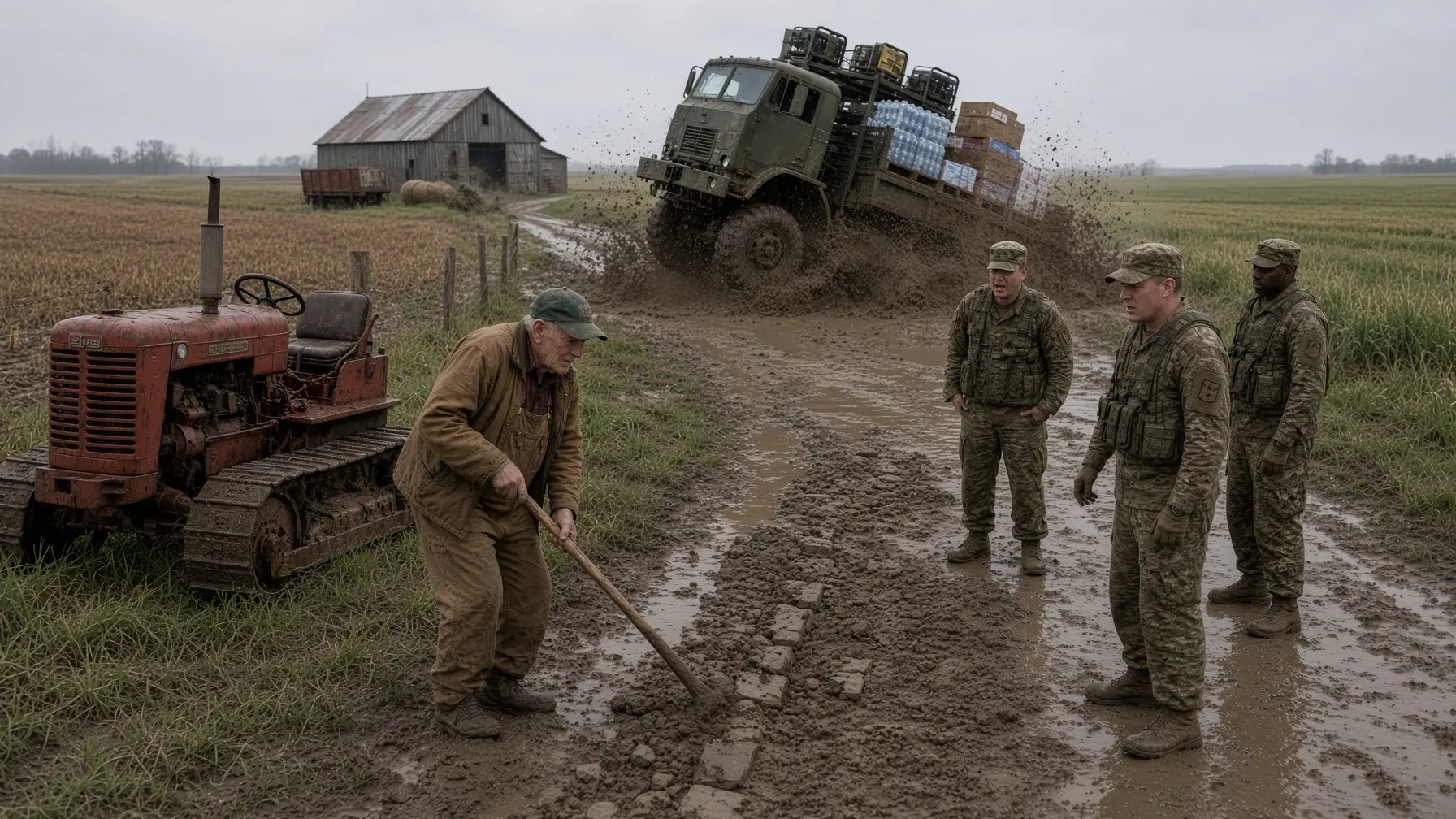
Not a cruel laugh at first. More the involuntary sound of someone who had spent six hours fighting mud, rain, broken roads, and bad decisions, then turned around to find a seventy-eight-year-old farmer standing beside a rust-streaked tractor that looked as if it belonged behind glass in an agricultural museum.
“You’re going to pull that with this?” Specialist Connor Hayes asked.
The old man looked past him toward the stranded Army truck.
“That depends.”
Hayes glanced at the machine behind him.
It was an International Harvester TD-14 crawler tractor from the early 1960s, painted red once, though sun and weather had reduced most of the hood to a faded orange-brown. Its steel tracks were scarred. The seat had been replaced with something that looked suspiciously like it had come from an old pickup. A section of exhaust pipe had been welded twice. There was no cab, no touchscreen, no central tire-inflation system, no automatic traction management, and certainly nothing about it that suggested it should be interfering with a modern military recovery operation.
Hayes grinned at the other soldiers.
“I think Grandpa brought us the cavalry.”
Two men nearby laughed.
The old farmer did not.
Neither did Staff Sergeant Marcus Reed.
Reed stood knee-deep in brown Missouri mud beside an M1083 Family of Medium Tactical Vehicles cargo truck that had sunk almost to the hubs on its right side. The vehicle itself weighed well over ten tons before cargo, and today it carried pallets of bottled water, shelf-stable food, medical supplies, portable lighting, and two small generators intended for a flood-isolated community fourteen miles north.
The truck had not simply become stuck.
It had become trapped in something worse.
Ground that looked solid and was not.
Four days of relentless spring rain had overflowed the Marais Creek system and saturated the low farmland west of Bell County. A county bridge had washed out that morning, forcing a Missouri National Guard relief convoy onto an alternate gravel road running between soybean fields. The route had been approved based on county maps and information available at the emergency operations center.
The map showed a gravel road.
The road existed.
What the map did not show was that thirty yards of its foundation had been repaired after the flood of 1986 using a mixture of local fill and crushed limestone over an older drainage swale.
Water had been moving beneath it for two days.
At 1:46 that afternoon, the loaded military truck found the weak section.
The right wheels broke through first.
The driver stopped immediately.
That saved them from burying the vehicle to its frame.
Then the left rear sank.
By the time Reed arrived with the convoy’s recovery team, the truck had settled at an angle, rear axle deep in saturated clay, front wheels resting slightly higher but still losing ground every time anyone tried to apply torque.
They had already spent ninety minutes trying to free it.
Nothing worked.
The truck’s own all-wheel drive merely polished the mud.
Recovery boards disappeared beneath the tires.
Gravel shoveled into the ruts migrated outward under load.
A second FMTV positioned on the gravel road attempted a straight-line pull using rated recovery equipment.
The stranded truck moved perhaps six inches.
Then stopped.
The recovery vehicle began sliding sideways toward the softened shoulder.
Reed halted the attempt immediately.
A National Guard wrecker was coming from the south, but a flooded intersection had forced it onto another detour.
Estimated arrival: ninety minutes.
Maybe two hours.
The isolated town did not have two hours.
A nursing home there was operating on dwindling bottled water after its municipal system lost pressure. The two generators in Reed’s cargo were intended for a volunteer fire station functioning as the community’s temporary coordination point.
Nobody was going to die in the next ten minutes because the truck was stuck.
But the delay mattered.
Everything during disaster response eventually mattered.
Reed wiped rainwater from his face and looked at the old farmer.
“What’s your name, sir?”
“Samuel Vance.”
“You own this property?”
“Everything from that walnut row to the creek.”
Reed glanced toward the tree line.
“And this road?”
“County road.”
“You know what’s under it?”
Samuel’s eyes shifted toward the sunken truck.
“Better than your map does.”
That ended the laughter for Reed.
Hayes still smiled.
Samuel noticed.
He looked at the young soldier.
“You find something funny?”
Hayes shrugged.
“No disrespect, sir. But we’ve got a ten-wheel-drive Army truck buried past the axle, a recovery vehicle that can’t get traction, and a wrecker on the way. That tractor looks like it fought Korea.”
Samuel turned toward the TD-14.
“Never left Missouri.”
One soldier snorted.
Hayes smiled wider.
Samuel continued.
“And I didn't say it could pull your truck out.”
That quieted them.
Reed stepped closer.
“What did you say?”
“I said I could help.”
Rain pattered against helmets and hoods.
Reed looked toward the tractor.
Then toward the field.
“What are you thinking?”
Samuel did not answer immediately.
Instead he pointed to the stranded truck.
“Why'd you pull straight back?”
“Shortest path to firm road.”
“Firm?”
Reed looked behind him.
The recovery truck had left two deep grooves near the road edge.
“Firm enough.”
Samuel nodded.
“That's your first problem.”
Hayes muttered, “Here we go.”
Reed turned.
“Hayes.”
The smile disappeared.
“Yes, Sergeant.”
Samuel acted as though nothing had happened.
He walked ten yards east, stopped beside a patch of winter wheat, and pushed his walking stick into the ground.
The stick entered four inches.
He moved another ten yards.
Again.
Then farther toward a gentle rise in the field.
This time the stick stopped quickly.
Samuel nodded.
Reed followed.
“What?”
“Rock.”
“You have rock under your field?”
“I have an old farm lane.”
Reed looked around.
There was no lane.
Only wheat.
Samuel pointed toward a line of slightly darker vegetation running diagonally toward an old equipment shed.
“My father built it in 1959. We hauled cattle and grain across this bottom before the county improved the road.”
Hayes said, “I don't see anything.”
Samuel looked at him.
“That's because grass grows.”
Another soldier smiled, but this time it was not at Samuel.
Reed crouched.
He drove the tip of a recovery bar into the soil.
Four inches.
Then metal struck something hard.
He moved over.
Again.
Hard.
Reed scraped away the surface with his boot.
Beneath the mud and roots appeared compacted crushed stone.
“How wide?”
“Ten, maybe twelve feet.”
“How far?”
“Runs from the shed to the old sycamore.”
“Under this?”
“Yes.”
“Still sound?”
Samuel shrugged.
“Sound enough for my tractor last winter.”
“Loaded?”
“Pulling a feed wagon.”
Hayes folded his arms.
“That truck weighs a little more than a feed wagon.”
Samuel looked at him.
“Which is why I wouldn’t put your truck on it.”
Hayes opened his mouth.
Then stopped.
Reed almost smiled.
Samuel pointed toward the military recovery vehicle.
“I'd put that on it.”
Reed’s expression changed.
He looked from the hidden lane to the stuck cargo truck.
The straight pull from the gravel road was failing because the recovery vehicle could not establish enough traction without approaching the compromised shoulder. But if they repositioned on Samuel’s buried farm lane, they could pull from a more favorable angle.
Not directly backward.
Upward and left.
Away from the deepest part of the swale.
Reed began seeing it.
“We'd still have side load.”
Samuel nodded.
“Unless you change the line.”
Reed stared.
“You got an anchor?”
Samuel pointed toward the old crawler.
Hayes laughed again.
This time Reed silenced him with one look.
Samuel walked toward the TD-14.
“You have proper blocks?”
Reed nodded.
“Rated snatch blocks. Shackles. Winch line.”
“Good.”
“You want us to anchor off the tractor?”
“No.”
Reed frowned.
Samuel pointed toward the field.
“Your wrecker truck pulls from the buried lane.”
“Okay.”
“My tractor goes up there.”
He pointed toward a small rise nearly perpendicular to the road.
“Why?”
“Because I can get there.”
Reed followed the path with his eyes.
The ground was covered in wet vegetation, but the slope was gentle and the old crawler’s low ground pressure gave it an advantage over a wheeled vehicle.
Samuel continued.
“You run a secondary line through a block on the Cat’s drawbar. Not your main pull. Just enough to control the rear of that truck so she doesn't walk farther into the swale when your recovery truck takes tension.”
Reed looked at him for several seconds.
“That might work.”
Hayes shook his head.
“You’re seriously considering this?”
Reed turned.
“Yes.”
“With that thing?”
“With a rated rigging plan using that thing as a secondary mobile anchor.”
Hayes pointed toward the crawler.
“Sergeant, we don't know if it can take the load.”
“Then we inspect it.”
Samuel nodded.
“Now you're talking.”
Hayes muttered something Reed did not catch.
Samuel did.
“What was that?”
Hayes looked at the old man.
“I said I hope your museum piece doesn't break in half.”
Samuel considered him.
Then looked toward the military truck.
“I hope yours doesn't sink another foot while you're waiting for something prettier.”