"Get him out of here. Now. Get him out of here. Now."
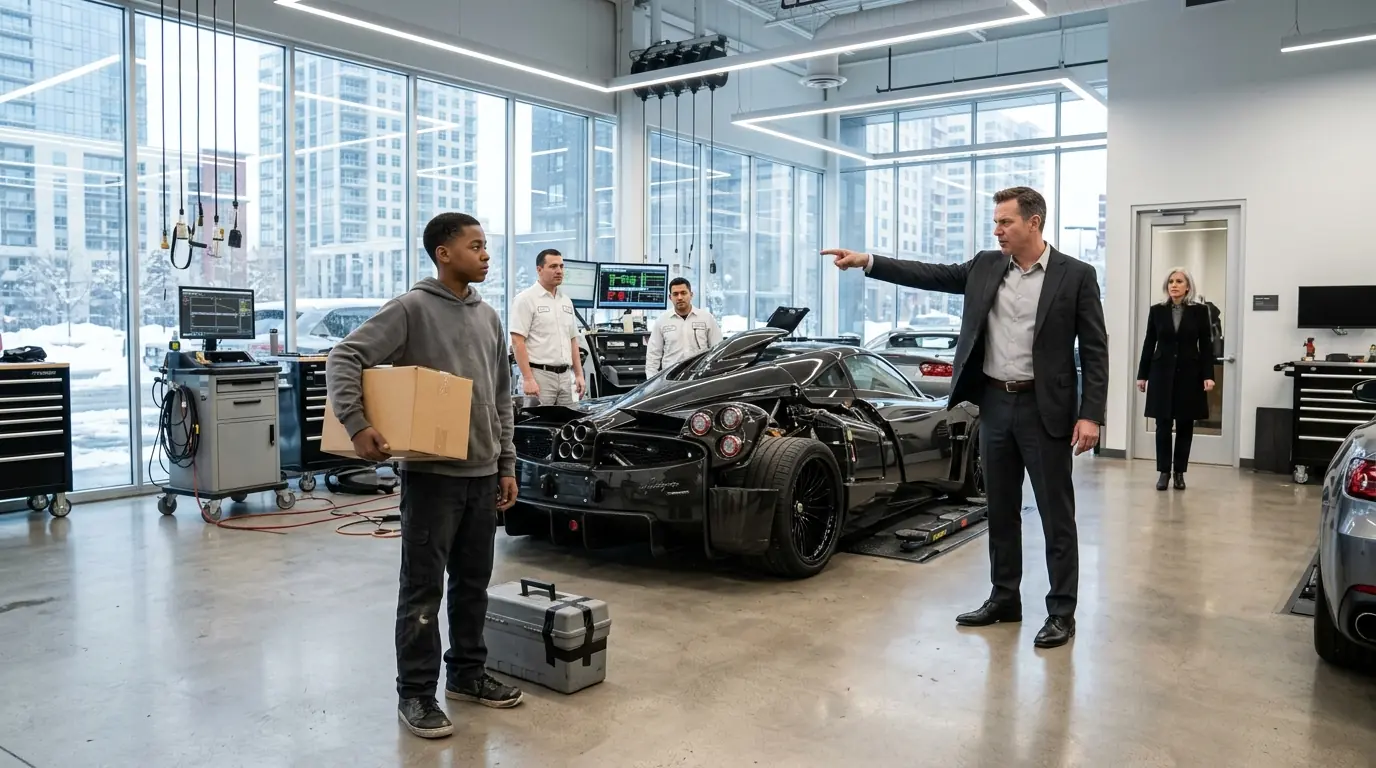
A 19-year-old black kid in a worn hoodie, a cardboard box under his arm, a toolbox held together with electrical tape. That was all Hunter Blake needed to see. 7 days, $600,000, a Bugatti that wouldn't start, and the world's most expensive diagnostic team standing around a car that every machine said was perfectly fine. "Sir, I think I know what's wrong."
"I said get him out." 5 minutes later, a 16-cylinder engine roared back to life, and nobody in that room ever forgot what happened next. The flagship location of Chase Prestige Motors occupied the better part of a city block on the eastern edge of Denver's financial district, floor-to-ceiling glass, polished concrete floors, and enough recessed lighting to make every car parked inside look like it belonged in a museum. Which, for the most part, they did.
But on the seventh consecutive morning that Eleanor Chase walked through the side entrance of her own service bay and found the Bugatti exactly where she'd left it the night before, still silent, unmoved, the building felt less like a showroom and more like a waiting room, one she was very tired of sitting in. She didn't storm in. Eleanor Chase never stormed anywhere. She walked at the same pace she always did, deliberate, unhurried, the kind of calm that made people around her speak carefully.
She was somewhere in her early 50s with close-cropped silver hair she'd stopped coloring years ago, and a way of looking at a room that suggested she was already three steps ahead of whatever was happening in it. She had built this company from a single used car lot on the south side of Denver, and she had done it without apology, without shortcuts, and without tolerance for anyone who wasted her time. The Bugatti Chiron Super Sport sat under a gray protective cover in the center of the service bay, flanked by two rolling carts of diagnostic equipment that had been there since Tuesday. The halogen lights overhead buzzed faintly.
Outside, through the narrow slit of the bay door, the sky was the flat white of a Denver winter morning, 31 degrees and not moving. Hunter Blake was already there, standing with two of his technicians near the rear of the car, a tablet in one hand and a cup of coffee in the other. He was the kind of man who wore dress shoes to a service bay and somehow made it look natural. Tall, lean, the sort of composed that came not from being unflappable, but from years of expensive practice at appearing that way.
His firm, Auto Elite International, had handled crisis diagnostics for collections in Monaco, in Dubai, in Singapore. When Eleanor had called him six days ago, he'd arrived within 18 hours on a charter flight with a team of four and a freight crate of equipment. She had paid for all of it. "Good morning," Hunter said, setting his coffee down on the cart beside him.
Eleanor looked past him at the car. "Show me." He turned the tablet toward her. "Green across the board, battery voltage, ECU response, fuel pressure, hydraulic systems."
Every metric the car could report on it had reported on. Everything was fine, on paper. "We completed the second firmware rollback last night," Hunter said. "Cross-referenced it against the factory build log from Molsheim.
The software is clean. We had the engineers on a call for 3 hours. They've never seen a fault pattern like this, or rather the absence of one." He gestured toward the diagnostic screen.
"The car believes it's operational." "The car," Eleanor said, "has not started in 7 days." "I understand that." "Do you?"
She finally looked at him directly, and Hunter, to his credit, didn't flinch. "Because I've been standing in this bay every morning, and the explanation changes every time. First, it was the battery management module. Then, it was a firmware conflict.
Then, it was trace corrosion on a connector that apparently wasn't there when you opened it up. Now, the car believes it's operational." She let the words sit. "What does that mean for me, exactly?"
Hunter set the tablet down. "It means we've ruled out every common failure point. What I want to propose this morning is a full wiring harness inspection, disassembling the primary loom to check for micro-fractures or intermittent faults that wouldn't register under standard load testing." "How long?"
"Another 5 to 7 days, possibly longer, depending on what we find." "And if you find nothing?" He didn't answer that right away, and his answer lived in that space for both of them. This was the car.
The one that had taken Eleanor 14 months and a considerable amount of personal capital to acquire, not because she needed a Bugatti, but because this particular Bugatti had been configured to exact specifications in Molsheim, and there were fewer than a dozen like it in the world. It had arrived at the Denver facility on a temperature-controlled transport 6 weeks ago. She had driven it once, a single loop around Washington Park on a cold Saturday morning, just to feel what it felt like. It had felt, she remembered, like controlled physics, like someone had found a way to bottle force and make it obedient.
Then, one Monday morning, she had come in early, before the building's heat had been running long enough to matter, before anyone else was in the bay, and pressed the start button at 7:15. Nothing. No warning lights, no fault codes, no sound. The car sat in the bay and told every machine that touched it that it was perfectly healthy and it refused to start.
"I'll need authorization to proceed," Hunter said. "And an adjustment to the current scope of the contract." Eleanor looked at him for a long moment. The current scope of the contract was already at $600,000, a number she had not flinched at when she signed it because Hunter's reputation was real.
And because she had believed a man with that reputation and that equipment and that network of engineers would have the problem solved in 48 hours. That had been 6 days ago. "You have until tomorrow morning," she said. "That's your window.
Whatever you need to do in that time, do it. But I want a result, not a proposal." She turned and walked back toward the interior entrance. Behind her she heard Hunter say something to his technicians in a lower voice, the kind of low that people use when they think they're out of earshot and aren't.