"Please! Somebody help him! He is not breathing right! Please, somebody!" a woman screamed into the pouring rain. People keep walking.
Nobody stops. But one girl does. Sir. Sir, can you hear me? Here.
Please, eat this. It's still warm. Sixteen years old and soaked to the bone, she was holding the only meal she had bought all day. She did not think twice. She simply gave it away.
"You take it, okay? I am fine. I promise. I am okay." Then she turned and walked home in the cold rain.
Empty hands, empty pockets. She thought that was the end of it. But 3 days later, a long black car stops outside her door. "Are you Olivia Ingram? Mr. Calloway has been searching for your family for thirty-eight years." Because the old man she saved was holding a secret her own grandmother had buried for a lifetime. To understand why one small paper bag matters so much, you have to understand what it cost her to even hold it. Her name is Olivia Ingram. She's 16.
And most kids her age are worrying about homework or who said what at school that day. Olivia worries about whether the lights will still be on when she gets home. She lives in a tiny apartment with her grandmother Pearl. Just the two of them. The wallpaper is peeling in the corners.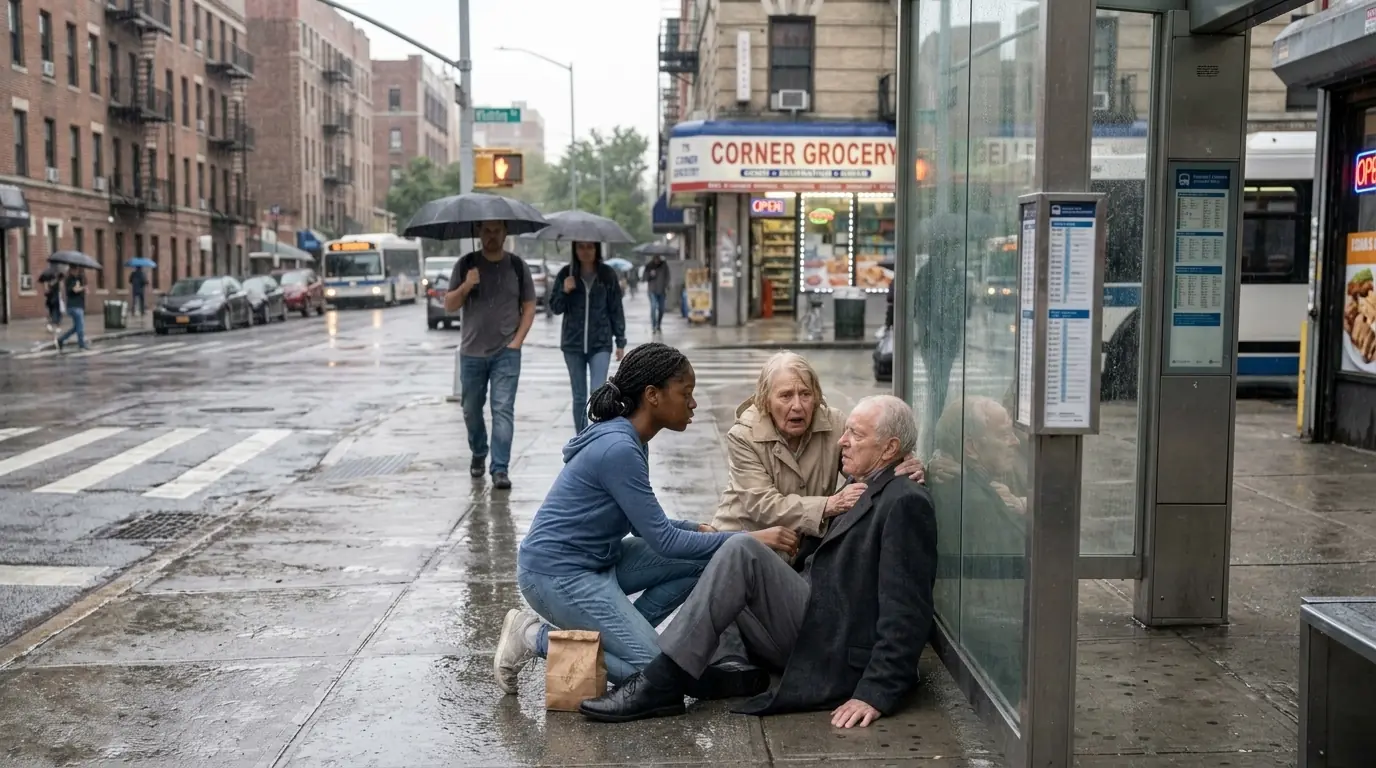
The radiator only works when it feels like it. But Pearl keeps that little place spotless because she says a clean home is a proud home, even when there's nothing in the fridge. Every morning, before the sun is even up, Olivia is awake. She doesn't hit snooze. She can't.
She pulls on her shoes, ties her hair back, and heads out into the dark to her shift at a laundromat down the street. She folds strangers' clothes for a few dollars an hour. Then she goes to school. Then, most evenings, she buses tables at a diner until her feet ache and her eyes burn. And she walks everywhere.
Rain, cold, doesn't matter because every dollar she spent on the bus was a dollar that did not go toward Pearl's medicine. See, Pearl's hands shake now. They didn't used to. And the medicine that helps cost more than they have. So, the bills pile up on the kitchen counter.
Each one stamped with red letters Olivia has learned not to read out loud. But here's the thing about Olivia. She isn't bitter. She isn't angry at the world. She's tired.
Bone tired. But somehow she's still soft, still kind. The kind of kind that actually costs you something. You want to know where she gets it from? From a man she barely remembers.
Because there's a story in her family, a story nobody quite finishes. Pearl said Samuel was a cook once, a real cook. "Your grandfather could make a dollar's worth of food taste like a feast," she would say with a smile. And then she'd say something stranger, that a long time ago Samuel had a handshake with a powerful man, a real partnership, that the two of them built something together, something that was supposed to take care of the whole family. And then nothing.
Whenever Olivia asked what happened, how a man who built something ended up with nothing but an apron, Pearl's face changes. She looks away. She finds something to wipe down, something to fold. "That is old business, baby," she always said quietly. "Let it stay buried." So, Olivia let it stay buried. She figured it was just an old man's story, the kind that grows taller with the years.
She had bigger things to worry about, like the notice on the counter, the one she did read, the one that said if they couldn't pay by the end of the week they'd have to leave the only home she'd ever known. She didn't tell Pearl how scared she was. She didn't want to put that on her. She just worked harder and she smiled and she carried it along. People at the diner liked her.
The regulars learned her name fast. There was something about the way she'd slide an extra napkin across the table or remember that the old man by the window took his coffee black. She gave little pieces of herself away all day long to people who never even noticed. Her boss noticed though. "You are a good kid, Olivia," he told her once, shaking his head.
"Too good for a place like this. You should be in school full-time dreaming big." She just laughed and kept wiping the counter. Dreams were a luxury. Right now she was just trying to keep two people afloat. On the day our story really begins, Olivia had skipped lunch again to save money.
By evening her stomach was a tight hollow knot. So on her walk home she did something she almost never let herself do. She stopped at a little corner store and spent her own few dollars on one warm meal. Rice, a bit of chicken packed in a small paper bag. It wasn't much, but to a girl who hadn't eaten all day it was everything.
She held that warm bag against her chest like a treasure already imagining that first bite. She had no idea she was about to give it away. And here's what she also didn't know, what nobody in that little apartment knew. That buried story Pearl refused to tell, it wasn't a tall tale. Every single word of it was true.
There really was a powerful man. There really was a handshake. And somewhere across that same city that man was still alive. Old now, frail now, and he had spent the last 38 years searching for the family he'd lost. He just never imagined they'd find him first.
In the rain. She told herself she'd walk straight past. She really did. Because by the time Olivia stepped outside the corner store, the sky had opened up. Not a drizzle, a downpour.
The kind of rain that soaks through your jacket in seconds and turns the street lights into blurry smears of orange. She pulled her thin hood up, tucked the warm paper bag under her arm to keep it dry, and started the long walk home. Her plan was simple. Get home, get dry, eat. Just 20 more minutes.
That's when she heard it. A voice cutting through the rain. A woman's voice. High, cracking, terrified. "Walter? Walter, stay with me. Please, stay with me!" Olivia stopped. Across the street, near an empty bus shelter, she saw them. An elderly couple.
The woman was on her knees on the wet pavement, both hands gripping a man's coat. And the man, he was slumped against the shelter, sliding down it. His eyes half closed. His skin a strange shade of gray. "Help!" the woman screamed toward the street. "Somebody, please! My husband needs help!" People were nearby: a man under an umbrella and a young couple hurrying past.
They glanced over at the screaming woman, and then they looked away. They kept walking, heads down. Faster now. Not my problem. Not tonight.
Not in this rain. Olivia felt her stomach twist. Every smart voice in her head told her to keep moving. She was 16. She was soaked and starving.
She had her own crisis waiting at home. A notice on the counter, a grandmother with shaking hands. She didn't have anything left to give anyone. But that old man was sliding down to the ground, and his wife was alone. So she ran.
She didn't decide to. Her feet just moved. She splashed across the street, dropped down beside them, the rain stinging her face. "Ma'am, what happened? What's wrong with him?" The woman looked up, stunned that anyone had stopped.
"He is diabetic," she said, her words tumbling out. "We were waiting for our car. It never came, and he started shaking, and now he will not stay awake. His sugar, it drops. He needs help. Oh God, I do not know what to do." Olivia's heart was pounding.
She didn't know much, but she knew this much. Pale, confused, and slipping out of consciousness, the man needed sugar, and he needed it now. She looked down at her hands, at the warm paper bag she was still holding, her dinner. The only meal she had held all day. The few dollars she could barely spare turned into one small meal that her empty stomach had been screaming for.
There was juice at the corner store. Real sugar, fast, but that took money she didn't have. Money meant for tomorrow's bus, for getting to work, for not falling further behind. For one heartbeat, Olivia hesitated. Just one.
She thought about Pearl. She thought about the empty fridge waiting at home. She thought about how badly her own body needed this food. And then she made a choice that didn't make any sense at all, not for a girl with nothing. She tore open the bag.
"Sir," she said, leaning close, her voice steady even though her hands weren't. "Sir, can you hear me? I need you to eat something, okay? Just a little, right now." The old man's eyes fluttered. He couldn't focus, but as Olivia lifted a bite toward him, his trembling hand reached up, and instead of taking the food, it closed around her wrist.
He gripped it hard, and he stared at her face through the rain, like he was seeing a ghost. "Sam?" he whispered. Olivia froze. "What? No. No, sir. My name's Olivia. Come on, stay with me. Eat this." But the old man kept staring, his cloudy eyes locked on hers, his lips moving around that one strange word.
"Sam." The name seemed to mean something, like it meant everything. She figured it was just a confusion. His sugar was crashing. He didn't know where he was. She gently pulled her wrist free and pressed the food forward.
"Eleanor," the woman said suddenly, pressing a hand to her own chest. "I am Eleanor, and that is my Walter. Thank you. Oh, thank you, sweetheart. I do not—"
"It is okay," Olivia said. "We're going to help him.
But, ma'am, we need more than this. He needs juice, something with real sugar, fast. There's a store right there. And here's what Olivia didn't know. Kneeling in that freezing rain with a dying stranger's hand around her wrist, she didn't know that emptying out the last of everything she had, her food, her bus money, her whole night, wasn't the end of her hardship.
It was the exact moment her real story finally began. The corner store was maybe 50 ft away. Olivia turned to Eleanor and spoke fast. "Stay with him. Keep him talking. I'll be right back." And she ran.
She slammed through the store door, dripping water across the floor. It was the same store and the same cashier from whom she had bought dinner ten minutes earlier. He looked up, surprised to see her back. She didn't explain. She just sprinted to the cooler, grabbed the first bottle of orange juice she saw, and slapped it on the counter.
"Just this," she gasped, "please, hurry." "Two dollars," he said. Olivia's hand was already in her pocket. Her fingers closed around the coins. The bus money. Tomorrow's bus money.
The whole reason she'd walked home in the rain in the first place. She didn't even pause this time. "Here, keep it," she said, slapping the coins on the counter, and she was gone before he could say a word. Back across the street she went, fighting the wind, rain in her eyes, her sneakers full of water, squelching with every step. She dropped to her knees beside Walter, twisted the cap off the bottle, and held it to his lips.
"Sir, drink. Just a little. Come on. Drink for me." "He won't," Eleanor whimpered. "He won't wake up enough to." "He will," Olivia said.
"He has to." "Walter, Walter, drink." His head lolled. Eleanor was crying, holding his face in her hands. "Walter, please. Please, baby." The first sip dribbled down his chin, and Olivia's heart sank. "Come on," she whispered.
"Come on. Come on." The second sip went down. And the third. For a few long seconds, nothing happened. Just the rain hammering the bus shelter roof, Eleanor's broken breathing, Olivia's own pulse roaring in her ears.
She'd seen a customer at the diner go through this once. She remembered the cook saying it takes a minute. You wait. You hold on. You don't panic.
So, she didn't panic. She held the bottle steady and counted in her head. Then, slowly, color started to creep back into Walter's gray face. His eyes, which had been rolling and unfocused, began to settle. To find them.
To find her. "Eleanor?" he murmured. Eleanor let out a sob that was half a laugh. "I'm here. I'm right here." "Oh, thank God. Thank God." "That's it," Olivia breathed.
"That's it, sir. Keep drinking. Slow. You're okay. You're going to be okay." Her own stomach growled, loud enough that she was almost embarrassed.
She ignored it. She'd been hungry before. She could be hungry a little longer. The man in front of her needed her more than her empty stomach did. She didn't stop there.
She peeled off her own jacket. Soaked as it was, it was still something, and draped it over Walter's shoulders to fight the cold. She helped Eleanor prop him up against the shelter so he wasn't lying in the puddle anymore. She kept her voice low and calm, the way you talk to someone you'd known your whole life. "What's your name again, sir?" "Walter," he managed.
"Okay, Walter. You scared your wife real bad tonight. You know that?" A weak, crooked smile tugged at his mouth. "She's used to it." Eleanor laughed and cried at the same time. Then Olivia did the practical thing.
She'd already spent her last coins, but a kind stranger under the store awning had a phone, and Olivia waved him down and asked him to call 911. Within minutes, the distant wail of a siren cut through the rain, getting closer. By the time the ambulance pulled up, Walter was sitting up on his own, talking, breathing easy. The paramedics hopped out, and Olivia stepped back to give them room, telling them everything. Diabetic, sugar crash, how long he'd been out, what she'd given him.
"You did well, kid." One of the paramedics told her, kneeling to check Walter's levels. "Very well. A few more minutes, and this could have gone a very different way. You probably saved his life tonight. Where'd you learn to do that?" Olivia just shrugged, hugging her wet arms.
"I didn't. I just knew he needed sugar. My grandma taught me to pay attention to people." The paramedic gave her a long look, the kind of look adults give a kid when they realize the kid is carrying more than they should. He almost said something. Then he just nodded and turned back to his patient.
And then, here's the part that tells you everything about Olivia Ingram. Once she saw that Walter was safe, that he was in good hands, she just started to leave. No waiting around for thanks, no telling anyone her name twice, no phone number, no address. She had a long walk home in the rain, no jacket now, no food, no bus money, and a grandmother who'd be worried sick. Her teeth were chattering now.
Without the jacket she'd given Walter, the cold cut straight to the bone. But she didn't ask for it back. She just pulled her thin soaked shirt tighter and turned to go. "Wait!" Eleanor called after her, struggling up. "Wait, sweetheart. Your name. At least tell us your name. How can we ever" But the wind tore the words apart.
The siren drowned them out, and Olivia, already half a block into the dark, didn't hear. She just lifted one hand over her shoulder in a small, tired wave, the way you'd wave goodbye to someone you'd never see again, and kept walking, into the rain, toward home, toward the empty fridge and the red stamped notice and the grandmother who'd ask why she was soaked to the skin with no jacket on. What she had no idea about was the old man in the back of that ambulance. Walter was twisting around in his seat, straining against the paramedics hands, his eyes fixed on the girl shrinking into the distance.
And he was whispering one word over and over to a wife who didn't understand it yet. Sam. Sam. That girl. Eleanor.
That girl. 2 days later, a stranger came looking for her and Olivia almost slammed the door in her face. That night, Olivia had made it home soaked and shaking. Pearl took one look at her, no jacket, no dinner, and her face crumpled. "Child, where is your coat? Where's your food money?" "I gave it away, Grandma." Olivia said simply, peeling off her wet shoes.
"Somebody needed it more." Pearl wanted to be angry. She really did. But she looked at her granddaughter standing there, freezing and proud, and instead she just pulled her into a hug. They split a piece of toast for dinner that night, sitting close at the little kitchen table, and called it a feast. Olivia didn't think about the old man again.
She had bills to dodge and shifts to work. Life kept moving. But 2 days later, something happened that didn't fit. Olivia was folding towels at the laundromat when a sleek black car pulled up outside. The kind of car that did not belong on her street.
A woman stepped out. Sharp suit, calm eyes, an umbrella that actually worked. She walked straight in and asked for Olivia by name. "My name is Ruth Bennett," the woman said. "I'm an attorney. I represent Mr. Walter Calloway, the man you helped in the rain." Olivia's stomach tightened.
A lawyer? "Is he is he okay? Did I do something wrong?" "No, no," Ruth almost smiled. "Quite the opposite. Mr. Calloway would like to thank you." She reached into her bag and pulled out a thick envelope.
She set it on the folding table. Olivia could see, even folded over, that it was full of cash. More money than she'd seen in one place in her whole life. Enough to pay the rent. Enough to fix everything, at least for a while.
For one long moment, Olivia just stared at it. And then, she pushed it back across the table. "No, thank you," she said quietly. Ruth blinked. In all her years, people did not push money away.
"I'm sorry?" "I didn't help him for that," Olivia said. "I helped him because he needed help. If I take money for it, then it wasn't really it wasn't really kindness anymore. You understand?" Ruth Bennett, a woman who had spent 30 years watching people lunge for money, stood very still. She studied the 16-year-old in a stained apron like she was looking at something she'd almost stopped believing was real.
Slowly, she put the envelope away. "At least," Ruth said slowly, "let me return this." She held out a small bag. Inside was Olivia's jacket, washed, dried, folded neatly. Olivia took that. That she could accept.
"Thank you," Olivia said. "Tell Mr. Calloway I'm real glad he's okay. Ruth nodded, but before she left, she set one more thing on the table. In case you ever change your mind, she said, her voice soft now, or in case you ever need anything at all. Anything. It was a business card, heavy, cream colored, the kind of paper that costs more than most people's lunch. Olivia barely glanced at it. She was already turning back to her towels, her mind on the next shift, the next bill. Later that night, she slipped the card into the pocket of her grandfather's old apron in the bottom drawer at home and forgot all about it. She didn't read it twice. She was too tired. If she had, if she'd held it up to the light and really looked, she'd have seen a name embossed across the top in elegant gold letters, a company name, two last names side by side, Calloway and Ingram, her own name, printed right there on a rich man's business card. She just didn't look long enough to see it. Meanwhile, across town in a house bigger than Olivia's whole apartment building, an old man couldn't stop shaking, and it had nothing to do with the cold. Walter Calloway was home from the hospital now, propped up in a chair, a blanket over his knees. The doctor said he'd recover fine, but Eleanor had never seen him like this, restless, distant, asking the same question over and over. Tell me again, he said, the girl, what did she look like? Walter, you've asked me four times. Tell me again, Eleanor, please. So she did. Young, black, maybe 16, soaked to the bone, gave away her own dinner, her own bus fare, and walked off without even leaving a name. Walter closed his eyes, and from the pocket of his coat, the coat he'd been wearing that night, he pulled out something old, a folded envelope, soft and yellowed at the creases, like it had been carried for decades. Eleanor frowned. What is that? You've kept that in your coat all this time? 38 years, Walter said quietly. I never stopped carrying it. I always thought if I ever found them, I'd need to be ready. Found who? But Walter wasn't really listening anymore. He was staring at the envelope, his thumb running over a name written on the front in faded ink. Sam's girl, he murmured. Eleanor, I swear to you, that child in the rain, she had his eyes. His exact eyes. After all these years, she finds me. She, of all people. There was a knock and the door opened. A man in his 50s walked in, sharp, tired, protective. Gerald Calloway. Walter's son and the man who ran the company now. Dad, the doctor said you need rest, not He stopped when he saw the envelope. His face hardened. No, absolutely not. We are not dragging that up again. You nearly died two nights ago, and now you want to chase a ghost because some kid handed you a juice box? She wasn't some kid, Walter said. You don't know that. You don't know anything about her. It's a coincidence, Dad. A sad old man seeing what he wants to see. But Walter just shook his head slowly, holding that envelope like it was the most precious thing he owned. I owed her grandfather everything, he said. And I spent my whole life trying to pay it back to a man I couldn't find. To a family that vanished. His voice cracked. I'm not going to lose them twice. Gerald opened his mouth, closed it. He looked at his father, frail, stubborn, certain. And for the first time, a flicker of doubt crossed his own face. What was in that envelope? And who, exactly, was Sam? Because Walter Calloway had been searching for one family for 38 years, and he never, ever imagined they'd be the ones to find him. In the rain, on the worst night of his life, holding out a paper bag. Then, Ruth Bennett came back, and this time she wasn't carrying an envelope of cash. It was a quiet Sunday afternoon when the black car returned to Olivia's street. Pearl was at the stove. Olivia was doing homework at the kitchen table, and then came the knock. Olivia opened the door, and there stood Ruth Bennett. But this time, she wasn't looking at Olivia. She was looking past her at Pearl, frozen by the stove, a wooden spoon halfway to her mouth. "Mrs.
Ingram?" Ruth said gently. "Mrs. Pearl Ingram?" Pearl's hand began to shake harder than usual. "Who's asking?" Ruth stepped inside, slow and careful, like she knew she was walking into something fragile. "I need to ask you one question," she said, "and I need you to think before you answer.
Was your late husband a man named Samuel Ingram? A cook who many years ago went into business with a young man named Walter Calloway?" The wooden spoon clattered to the floor. Pearl didn't move, didn't breathe. The color drained right out of her face. "Grandma?" Olivia stood up. "Grandma, what's wrong?
Who's Walter Calloway?" But Pearl was staring at the lawyer like she'd seen a dead man walk through the door. Her lips trembled. "How?" she whispered. "How do you know that name?" And right then, slowly, with shaking hands, Pearl reached up to her neck and pulled out a locket she'd worn under her collar for as long as Olivia could remember. She never once let Olivia open it, said it was private, said it was old pain. She opened it now. Inside was a tiny cracked photograph. Two young men in cooks' whites standing shoulder to shoulder, grinning like the whole world was theirs. One of them was Olivia's grandfather, Samuel, young, alive, beautiful. And the other man, the crease in the photo had worn his face halfway over the decades, but Ruth Bennett pulled out her phone, and with a steady hand she turned the screen toward them. On it was a photo, an old black and white portrait of Walter Calloway as a young man, the same face, the exact face as the one worn away in the locket, the same crooked grin. Two halves of a single photograph finally placed side by side after 40 years apart. "Oh my god," Olivia breathed. And then it all came pouring out. The story Pearl had buried for almost 40 years. Back in 1968, Samuel Ingram was the best cook anybody had ever tasted, but he was poor and he was black and the world wasn't handing him much. Then he met a young ambitious white man named Walter Calloway who had a little storefront and big dreams but couldn't cook to save his life. The two of them shook hands, a real partnership. Samuel's recipes, Walter's store, equal partners, both names on the door. And they signed a contract that gave Samuel 40% of everything they built together. For a few years it worked. The little shop became a sensation. People lined up around the block for Samuel's cooking. And then came the fire. A warehouse burned down, money got tight, and in the chaos the company's lawyer, a cold man named Vincent Hale, saw an opportunity. He convinced Walter, who was young and panicked and grieving, that Samuel had been careless, that Samuel was a liability, that the only way to save the business was to cut him loose. By the time Walter realized he'd been poisoned with lies, it was too late. Samuel, proud, heartbroken, done being fought over, had already walked away. He didn't take a lawyer. He didn't fight for his 40%. He took one thing on his way out the door, his apron. And then he disappeared. Moved his family across the city, started over with nothing. He was so ashamed, so wounded that he made Pearl promise never to speak that man's name again. He died believing he'd been thrown away. Pearl wept, sinking into a chair. "My Samuel, he died thinking he was a failure, and I never told him the truth because I didn't know it.
I never told any of you. I thought it was buried with him for good." But Ruth Bennett shook her head because here is the twist that none of them saw coming. That little storefront, it didn't fail. It grew and grew. Walter Calloway built it into one of the biggest food companies in the entire country. A brand whose products sat on the shelves of the very corner store where Olivia bought her dinner. Walter built an empire on Samuel's recipes, and he became a very rich and very haunted man because Walter Calloway figured out, too late, that Vincent Hale had lied to him. He spent the next 38 years searching for Samuel Ingram, trying to give back what was stolen. He hired investigators. He never found them because Samuel had hidden his family too well. And the original contract, the signed agreement giving Samuel 40% of the company, Walter never destroyed it. He kept it in an envelope in his coat pocket for 38 years waiting. That was the document in his pocket the night he collapsed in the rain, and the girl who knelt down and gave him her last meal, the girl who asked for nothing in return was Samuel Ingram's granddaughter. She had saved the life of the one man on Earth who'd spent his whole life trying to find her family. And she handed him back his future never knowing he was holding hers. Olivia sank into a chair, the room spinning. "So that card?" she whispered. "The name on the card?" "Yes," Ruth said softly. "It's your name, Olivia.
It was always your name." And now, Walter Calloway had a choice to make. And he wasn't going to make it quietly. He didn't send a thank you note. He didn't send more cash. He asked to make it right in person and on paper. Three days later, that black car came one more time. But this time, it didn't take something away. It brought someone. Walter Calloway, frail but steady with his cane, walked up the steps to Olivia's tiny apartment. Eleanor was on his arm. Behind them came Ruth Bennett with a leather folder, and behind her, arms crossed and jaw tight, came Gerald. Pearl opened the door, and for a long moment, two old people just stared at each other across 40 years of silence. "Pearl," Walter said, his voice broke on the single word. "Pearl, I have looked for you and Samuel for most of my life." Pearl's eyes filled. "He thought you threw him away, Walter." "I know," Walter whispered, "and I will carry that to my grave, but I never stopped trying to make it right.
Please, let me try now." They sat down together in that little kitchen around the same wobbly table where Olivia and Pearl split toast for dinner. The rich man and the poor family, the two halves of an old photograph, finally in the same room after a lifetime apart. Ruth opened the leather folder and laid the old contract on the table. The yellowed pages, Samuel's signature, strong and proud, right beside Walter's. "This document was never voided," Ruth explained. "It was never challenged in court, never legally dissolved.
Mr. Ingram simply walked away, which means in the eyes of the law, his stake in Calloway Foods never disappeared. It had been accruing value for thirty-eight years." Olivia stared at the old pages, at her grandfather's bold signature. "What does that mean in plain words?" Walter leaned forward, both hands on his cane. "It means, child, that your grandfather owned 40% of my company and 40% of everything it became.
That was never mine to keep. It was always his, and now it belongs to the two of you. The kitchen went dead silent. "Walter," Pearl breathed, "we cannot. That is an empire. That is billions." "It's not charity," Walter said firmly.
"Hear me. This is not a gift. This is a debt. Samuel earned every cent of it with his own two hands and his own recipes. I have spent my whole life trying to give it back to him. The only thing I'm guilty of now is being 38 years too late." That's when Gerald stepped forward and the room tensed.
"Dad," he said low, "stop. We don't even know if that contract holds up. We don't know these people." But Ruth Bennett quietly slid a second set of papers across the table. "I had it authenticated, Mr. Calloway. The signatures, the paper, the notary seal from 1968. It is genuine. It would hold up in any court in the country." Gerald's mouth opened, then closed.
He looked at the contract, at the locket on Pearl's chest, at the old apron Pearl had pulled out and set on the table. The very apron from the photograph, the same one Samuel walked out the door with. And something in him cracked. "My whole life," Gerald said slowly, "my father told me about a man named Samuel, a partner he lost. I thought it was an old man's guilt. I thought it was a story." He looked at Olivia and his voice softened.
"I'm sorry. I didn't want to believe it because believing it meant we owed something we could never repay." "You can repay it," Walter said. "We start today." So they laid it all out, page by page. And this is what Walter Calloway offered. First, the 40% honored in full, restructured into a family trust so that Pearl and Olivia would never want for anything again.
The debt finally paid. Second, for Pearl, immediate lifelong medical care, the best doctors, the shaking hands, all of it covered, starting that week. Third, Walter turned to Olivia and his old eyes were wet. And you, Eleanor told me you worked three jobs and walked in the rain to save bus fare, that you gave away your dinner to a stranger. A girl like you should not be folding towels at dawn.
He nodded at Ruth, who slid one more page forward. A full scholarship in your grandfather's name. The Samuel Ingram Scholarship. Tuition, housing, all the way through whatever you want to become. You will never again choose between a meal and a bus.
Olivia looked at the paper. Then she did something that made Walter Calloway smile for the first time in years. She hesitated. I didn't help you for any of this, she said quietly. I want you to know that.
I didn't even know who you were. I know, Walter said gently. That's exactly why you deserve it. You helped me when you thought I was nobody. When there was nothing in it for you.
He reached over and with a trembling hand covered hers. Your grandfather gave me a chance when I was nobody, too. This is just the family finishing what we started. It was always going to be yours, Olivia. You just had to be the one to find me.
Pearl was crying. Eleanor was crying. Even Gerald had to look away. And Olivia, 16 years old, who had walked home in the rain with empty pockets just days before, slowly picked up the pen. She didn't sign for the money.
She signed for her grandfather. For the man in the apron who died thinking he was a failure. For Samuel Ingram, whose name was about to be spoken out loud again with pride after almost 40 years of silence. The papers were signed by Friday. And by Monday, the whole neighborhood would know her grandfather's name.
And here's where one girl's quiet yes turned into something a whole block could feel. Let's rewind just for a second. Remember who Olivia was a week ago? A girl who skipped lunch to save money. A girl who walked home in the rain to dodge a $2 bus fare.
A girl who folded strangers' clothes at dawn, who read red stamp notices she couldn't pay, who split a single piece of toast with her grandmother and called it dinner. That was before. Now, watch what after looked like. The story got out. These stories always do.
A local reporter heard about it and ran a piece. The Lost Founder: How a Teenager's Kindness Uncovered a Thirty-Eight-Year-Old Secret. It exploded. Within days it was national news. People couldn't get enough of it.
The girl who gave away her last meal, the old man who never stopped searching, the cook who was written out of history, finally written back in. And Calloway Foods, they didn't hide from it. They leaned all the way in. The company Samuel Ingram had helped build was renamed Ingram and Calloway. Both names, side by side.
The way they were always supposed to be. The way they were on that little storefront door back in 1968. Samuel's face restored from that cracked locket photo went up on the wall of the company's headquarters, right next to Walter's. Pearl got her doctors. Within a couple of months, her hands were steadier than they'd been in years.
One afternoon, Olivia caught her grandmother humming in the kitchen. Actually humming, cooking one of Samuel's old recipes from memory. And here's the beautiful part. The company put that exact recipe on the label of their flagship product. Samuel's cooking back on the shelves of America, where it belonged.
But Olivia, she didn't buy a mansion. She didn't disappear into a new life and forget where she came from. She remembered exactly where she came from. The first thing she did with that trust was reopen a small shuttered diner on her old block, the same kind of place her grandfather once cooked in. Except this one wasn't just a diner.
It was a community kitchen. Anybody who was hungry could come in and eat. No questions, no money required. Hot food, a warm seat, a kind word. She hired people from the neighborhood.
She put her grandfather's apron, that worn sacred apron, in a frame by the door. So, everyone who walked in would know whose shoulders this was built on. The cashier from the corner store, the one who watched her spend her last coins on juice for a stranger, he became a regular. Came in every week. "I will never forget you that night," he told her once.
"You ran back out into that rain like it was nothing." And the Calloways went further still. Together with Olivia and Pearl, they launched the Samuel Ingram Foundation, a fund that gives scholarships to kids in Olivia's neighborhood. Kids who work three jobs. Kids who skip lunch. Kids who walk home in the rain.
Kids exactly like Olivia used to be. Who never thought anyone was watching. Who never thought their kindness counted for anything. The first round of scholarships went out within the year. Dozens of kids, a whole block of them, suddenly given a shot they never imagined.
And Gerald, the man who crossed his arms and said it's a coincidence, "We don't know these people." Gerald ran that foundation himself. Personally. He'd been so afraid of what his family owed. Now he understood the debt wasn't a burden, it was a gift. A chance to finish something good his father started half a century ago.
One evening, Walter and Eleanor came to the community kitchen for dinner. Walter, slower now, leaned on his cane in the doorway and just looked at it all. The full tables, the laughing kids, his old partner's apron in a frame on the wall. His old partner's granddaughter moving between the tables, refilling cups, remembering everyone's name. He looked at the apron a long time.
"Sam," he said softly to no one. "We did it, old friend. We finally did it." And on the wall behind him hung the restored photograph. The whole thing now. No crease, no worn away face.
Two young men in cooks' whites, black and white, shoulder to shoulder, both faces clear at last, grinning like the whole world was theirs. Because for one block, in one city, for one family, the world finally was. But Olivia did one more thing. One thing nobody asked her to do. And it brought the entire story full circle.
Remember that paper bag in the rain? One year later, almost to the day, the rain came back. The same kind of cold, heavy downpour that had soaked Olivia to the bone the night everything changed. And there she was again, the same bus shelter, the same corner, but everything about her was different now. She wasn't starving anymore.
She wasn't dodging bus fare. She was a full-time student now, doing well with a steady future and food in the fridge at home. She had a warm coat that actually kept the rain out. She just locked up the community kitchen for the night, a takeout container of hot food in her hands, her own dinner to eat on the way home. That's when she saw him.
A man huddled under the bus shelter, soaked through, thin, hungry, watching the warm container in her hands the way only a truly hungry person watches food. Looking away fast, ashamed, the second she noticed. Olivia stopped. And just like that, she was 16 again, kneeling in the rain, holding the only meal she had toward a stranger. She didn't hesitate this time.
She didn't think about herself at all. She just walked over and held out the container. "Here," she said gently, "it's still warm. You take it." The man looked up, stunned. "I can't take your dinner, miss." "You're not taking it," Olivia said, smiling.
"I'm giving it. There's a difference." She crouched down beside him, the rain falling soft around them, and said, "There's a place a few blocks from here, a kitchen, warm food every day, no money needed. You come by tomorrow, okay? You ask for Olivia. We'll take care of you." The man's eyes filled.
"Why?" he whispered. "Why would you do that for me?" Olivia thought about a question like that, about a man in the rain, about a paper bag, about 40% and 40 years and a grandfather she barely got to know. "Because somebody did it for me once," she said. "And it changed everything." Across the street, parked at the curb, a long black car sat with its engine running. In the back seat, an old man watched the whole thing through the rain-streaked window.
Walter. Older now, frailer, but smiling so wide it pushed tears down his cheeks. Eleanor squeezed his hand. And beside them, this time, sat Gerald. There by choice, watching the girl who had changed his family, finally understanding all of it.
Walter pressed a hand to the glass. "Do you see that, Sam?" he whispered to a friend long gone. "It did not stop with us. It never stops." And back home, in a frame by the door of a warm and crowded kitchen, hung an old cook's apron. No longer hidden in a drawer, worn proud, out in the open, right where it always belonged.