You think you know how the world works? The strong eat the weak, the rich ignore the poor, and a patch-wearing biker wouldn't cross the street to spit on a homeless kid? That's the script, right? But sometimes, the script catches fire. When 22 Hells Angels rolled toward an abandoned railyard, they thought they were heading into a standard sit-down.
They didn't know a cartel hit squad was waiting. And they definitely didn't know a 16-year-old girl living in a cardboard box was about to rewrite their history. In the lower industrial district of South City, you don't survive by being brave. You survive by being invisible.
Chloe had mastered the art of nonexistence. At 16, she was a ghost haunting the spaces between chain-link fences and rusted shipping containers. Her wardrobe was a calculated armor of oversized, filth-caked layers, a men's Carhartt jacket that smelled faintly of diesel, three mismatched hoodies, and a pair of combat boots she'd pulled off a corpse two winters ago. She kept her hair chopped close to the scalp with a pocket knife. If you didn't look closely, she was just another pile of trash pushed against the concrete pylons of the interstate overpass, and nobody ever looked closely.
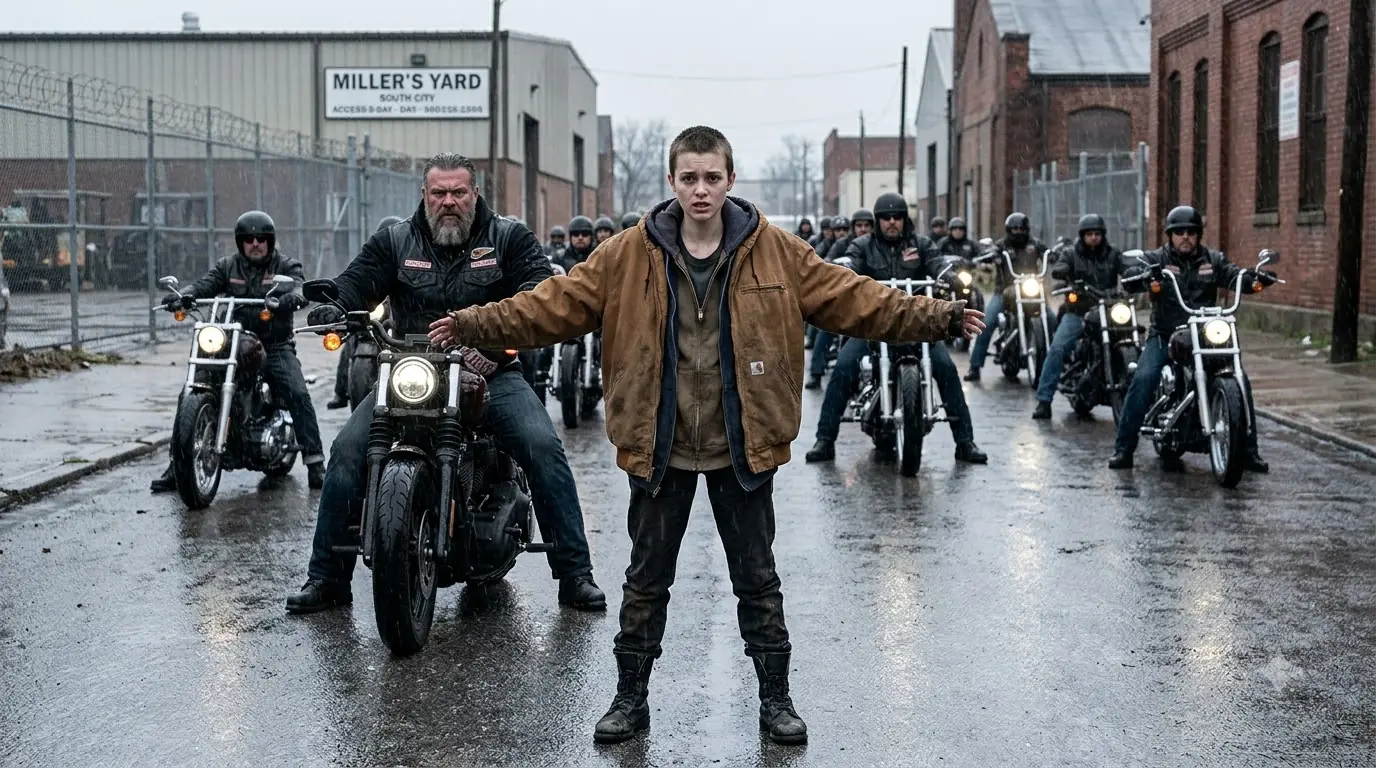
That was the cynical beauty of the streets. People look right through you to avoid the guilt. It was a Tuesday night in November. The kind of cold that doesn't just chill the skin, but aches in the marrow. A steady freezing drizzle slicked the cracked asphalt of Miller's yard, an abandoned expanse of warehouses and dead train tracks where the city shoved the things it wanted to forget.
Chloe was tucked inside a hollowed-out transformer box, her knees pulled to her chest, trying to conserve the heat from a half-eaten sleeve of stale saltines. She had a front-row seat to the main access road of the yard. Usually, her nightly entertainment consisted of watching stray dogs fight over scraps or the occasional squad car rolling past, shining a half-hearted spotlight into the dark before speeding back to civilization. Tonight was different. Around 10:00 p.m., the silence broke.
Not with the rumble of engines, but with the stealthy, deliberate crunch of gravel. Chloe peered through the rusted slats of her hideout. Three matte black panel vans coasted down the access road with their headlights off. They didn't park haphazardly. They arranged themselves in a tight bottleneck formation near the old loading docks, effectively blocking the only exit from the central courtyard.
The doors slid open. Men poured out. These weren't the usual street corner bangers flashing cheap chrome and making noise. These men moved with terrifying, practiced silence. They wore dark, tactical gear.
No insignias. No patches. Chloe watched, her breath catching in her throat as they unloaded heavy canvas bags. One of the men unzipped a bag under the faint, jaundiced glow of a distant sodium lamp. The metallic clack of a bolt sliding home echoed across the wet concrete.
Assault rifles. Long guns. Chloe recognized the silhouettes from the violent movies that used to play on the TV in her last foster home. They were setting up a kill box. Four men climbed the rusted fire escape of the primary warehouse, taking high ground positions on the roof.
Another half dozen dispersed behind a line of rotting steel shipping containers, creating a crossfire angle. The rest stayed near the vans, checking magazines, speaking in hushed, clipped tones that Chloe couldn't quite hear over the sound of the rain. They were waiting for someone. Chloe's instincts screamed at her to crawl out the back of the transformer box and run. Run until her lungs burned.
If they saw her, she was dead. She was a witness to an execution in the making. But the cold had locked her joints and fear had pinned her in place. She squeezed her eyes shut. Don't look.
Don't breathe. Just be trash. Then she felt it. Before the sound reached her ears, the concrete beneath her boots began to vibrate. A low rhythmic thudding that traveled up through the soles of her boots and settled in her chest.
She knew that feeling. Everyone on the south side knew that feeling. It was the steady, synchronized heartbeat of heavy V-twin engines. It wasn't cops. It wasn't a rival street gang.
It was the Hells Angels. They occasionally rode past her spot on Sunday afternoons. Sometimes a massive bearded rider would drop a wrinkled $20 bill onto her lap while stopped at a red light. No words. No pity.
Just a transaction of respect from one outcast to another. Chloe opened her eyes and looked back at the loading dock. The men in the shadows tightened their grips on their weapons. The trap was set. The rumble grew louder, bouncing off the brick walls of the canyon-like street.
They were coming down the main road, straight toward the bottleneck. She had less than 60 seconds. It's not your problem. The cynical voice in her head hissed. You owe them nothing.
You owe the world nothing. Let them die. But as the roar of the approaching motorcycles tore through the freezing rain, Chloe saw the face of the man who had given her that $20 bill. He had looked at her. Really looked at her.
For one split second in this miserable city, she hadn't been invisible. Chloe pushed the rusted door of the transformer box open. The hinges screamed. Bear Sullivan hated the rain. It made the road slick.
It soaked through the heavy leather of his cuts, and it made his arthritis flare up in his clutch hand. But a president rides. Bear sat at the front of the pack, his custom heavy cruiser cutting through the bleak rain-slicked streets of the industrial district. Behind him rode 21 of his brothers. 22 heavy bikes moving in tight, disciplined formation.
The noise was deafening. A roaring mechanical symphony that announced their presence a mile before they arrived. To the civilians in their sedans, they were a nightmare in leather and chrome. A rolling wall of intimidation. But right now, beneath the imposing exterior, Bear was just a tired man with a headache and a bad feeling in his gut.
They were heading to Miller's yard. Three days ago, a dispute had erupted at a bar on the edge of their territory. A local syndicate operating out of the port had roughed up a prospect. It was a matter of respect. In their world, disrespect left unanswered was blood in the water.
The syndicate had reached out through intermediaries. They wanted to sit down, a parley. The terms were old school. Neutral ground, Miller's yard. No heavy weapons.
Just the leadership and enough muscle to keep everyone honest. They were supposed to settle the dispute, draw a hard line on territory, and ride home. You think they'll show? The voice crackled through the comms unit in Bear's helmet. It was Wyatt, his vice president, riding slightly behind and to his right.
Wyatt was younger, prone to hot blood, and always looking for a fight. They'll show. Bear grunted back. They're losing money. Bad business to go to war over a bar tab and a bruised ego.
I don't like it. Wyatt said, "Place is a dead end. Only one way in. That's why we're bringing 22." Bear replied, shifting his weight as they banked into a long curve.
"They make a move, we crush them. We talk, we ride out." Bear maintained a steady 40 miles per hour. The streetlights flickered above them, casting long warped shadows across the wet pavement. The city felt empty here, devoid of life.
He tightened his grip on the handlebars. Wyatt was right, though. Something felt off. The air was too heavy. Bear had survived 30 years in the life.