She stood before the mirror, drowning in 50 yards of heavy Belgian lace she couldn't afford, marrying a man she barely knew.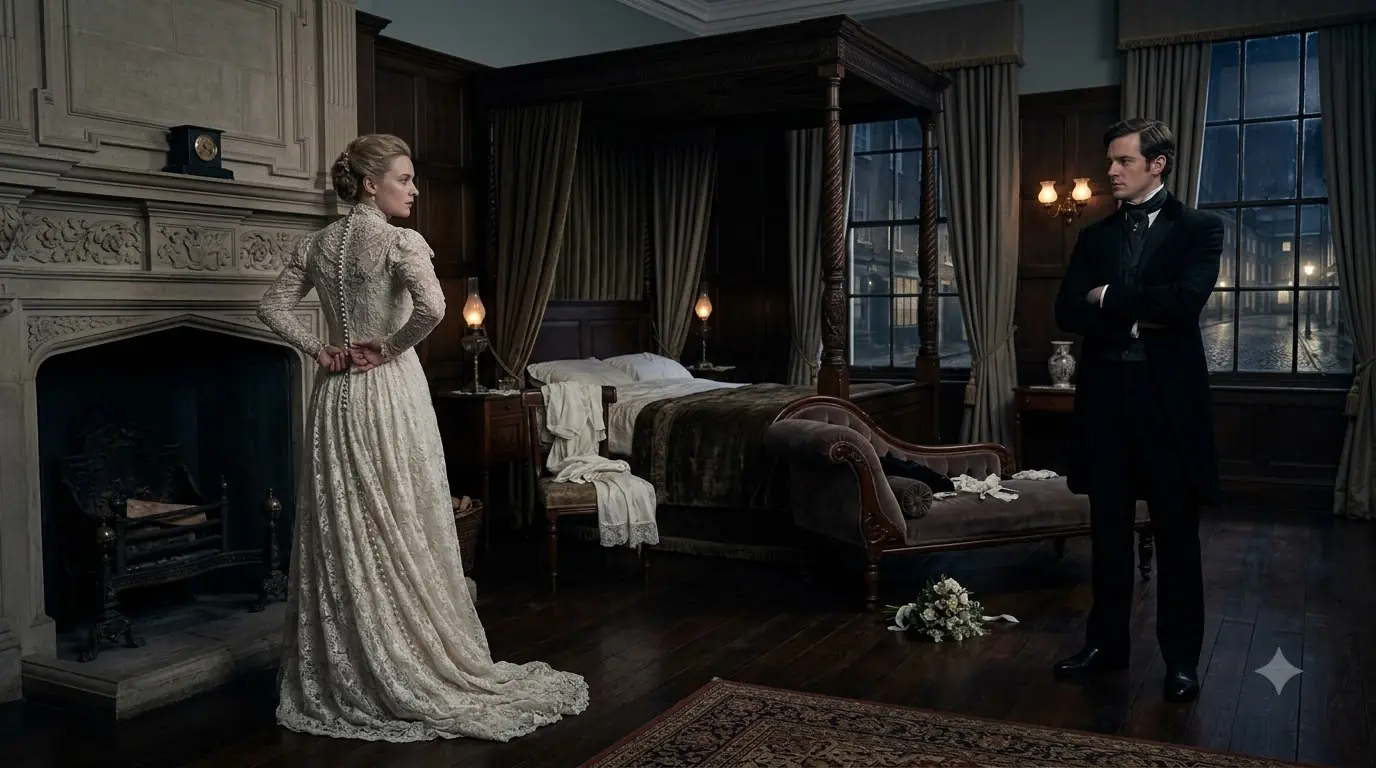
The Duke of Westford didn't want a wife. He wanted a weapon. And as the chapel doors closed, sealing her fate, she learned exactly what kind of weapon she was meant to be.
The ink on the parish register was barely dry when the illusion shattered.
"Take off the wedding dress," he said coldly. "This marriage is just revenge."
The London townhouse was entirely too quiet for a wedding night. No music bled through the floorboards, no staff lingered in the halls with knowing smiles. There was only the sharp, rhythmic click of Arthur's boots against the hardwood, pacing the length of the master suite.
Clara stood near the hearth, though the fire had not been lit. The November chill seeped through the thin silk of her stockings. Her shoulders ached from the sheer weight of the gown—a ridiculous, ostentatious confection of pearls and lace her father had insisted upon, purchased on credit they did not possess.
Arthur stopped pacing. He stood by the window, his back to her, staring out into the gaslit street. He had not removed his tailcoat; he had not so much as loosened his cravat.
"Take off the wedding dress," the Duke said coldly. "This marriage is just revenge."
The words hung in the freezing air, sharp and distinct, dropping like stones into a dry well. Clara did not gasp. She did not clutch her chest or collapse onto the velvet chaise lounge. She was 24, well past the age of romantic delusions, and the daughter of a man who routinely gambled away the family silver.
She simply reached around to the small of her back and began the arduous task of unfastening the 52 tiny pearl buttons.
"I assumed as much," Clara said. Her voice was steady, though her fingers were stiff from the cold. "A man in your position does not pay £80,000 of another man's debt simply because he finds the man's daughter charming."
Arthur turned. His eyes, a pale washed-out gray, narrowed. He seemed genuinely thrown by her lack of hysterics.
"You knew?" he asked, taking a step towards the center of the room.
"I knew my father was facing debtors' prison by Tuesday," she replied, struggling with a particularly stubborn button near her shoulder blades. "I knew you purchased his promissory notes from the bank. And I knew that when you offered for my hand 3 days later, it was not out of charity."
She finally twisted her arm too far, a sharp pain shooting up her shoulder. She let out a small, frustrated breath.
"If you are quite finished being dramatic, Your Grace, I could use some assistance. My maid was dismissed yesterday to save wages."
Arthur stared at her. For a moment, the cold facade cracked, replaced by a profound, irritable confusion. He crossed the room. His hands were large, the knuckles rough for a duke, and when his fingers brushed the bare skin of her back, they were freezing. He worked the buttons with mechanical efficiency.
"Your father destroyed my brother," he said quietly to the back of her neck.
"I am aware of the rumors regarding Lord Henry," Clara said, keeping her gaze fixed on the unlit fireplace.
"They are not rumors. Richard Ashford lured Henry into the Highland mining scheme. He convinced a 20-year-old boy to invest his entire inheritance, and when the veins turned out to be nothing but dirt, your father took his remaining cut and vanished to Paris. Henry shot himself in the study downstairs."
The final button slipped through its loop. The heavy dress suddenly loosened, the bodice going slack against Clara's ribs. She caught the fabric before it could pool at her feet.
"I am sorry for your brother," Clara said. It wasn't an apology for her father—she had stopped making those years ago—but a simple human acknowledgement of grief.
Arthur stepped back, putting distance between them. "I don't want your pity. I wanted Ashford to suffer. When I bought his debt, I could have sent him to the Fleet, but that wouldn't have broken his pride. His pride was you—the untouchable Miss Ashford, the diamond of the season he planned to marry off to a prince to restore his coffers."
Clara let the dress fall. She stood in her plain cotton chemise, shivering slightly, wrapping her arms around her waist. "So you bought me instead? A very expensive insult."
"Exactly," Arthur said, though his voice lacked the triumphant venom he clearly intended. He sounded tired. "You will have a generous allowance. You will have free reign of the country estate when we are not in London. But there will be no warmth here, Clara. There will be no heir. You will wear my name, and your father will have to watch his most prized possession rot in a loveless cage of his own making."
Clara looked at him. He was a handsome man, but bitterness had carved deep, harsh lines around his mouth. He was carrying a ghost, and he had tied her to it.
"Very well," she said. She walked over to the armoire, pulling out a heavy woolen shawl and wrapping it around her shoulders. "But if I am to rot, I request that you have the staff light a fire in the mornings. I refuse to catch pneumonia just to satisfy your vengeance."
Arthur blinked. The silence stretched, heavy and awkward.
"I will sleep in the adjoining room," he finally muttered, turning on his heel. He grabbed the handle of the connecting door.
"Arthur!" she called out.
He paused, looking back over his shoulder.
"My father does not love me," Clara said plainly. "He loves my market value. You have punished him by taking away his payday, yes, but do not flatter yourself into thinking you have broken his heart by ruining my life. He does not have one."
Arthur looked at her for a long time. The harshness in his eyes flickered, replaced by something uncomfortable and dark. He didn't say a word. He just walked through the door and shut it firmly behind him.
Morning came with the metallic clatter of the street sweepers outside the window. Clara woke in a bed too large for one person. The sheets were crisp, smelling of lavender and starch, completely devoid of the human warmth she had briefly craved in the middle of the night.