Weston Hale only drove to the Monroe estate that morning to pick up his daughter and collect a few boxes left behind after the divorce.
When his 1972 Chevy C10 rumbled to a stop at the iron gates, Cassidy Monroe looked at the truck the way she now looked at everything Weston represented: with thin, practiced contempt. Her father stood on the porch. Preston Tate lingered at his shoulder. The housekeeper watched from the doorway.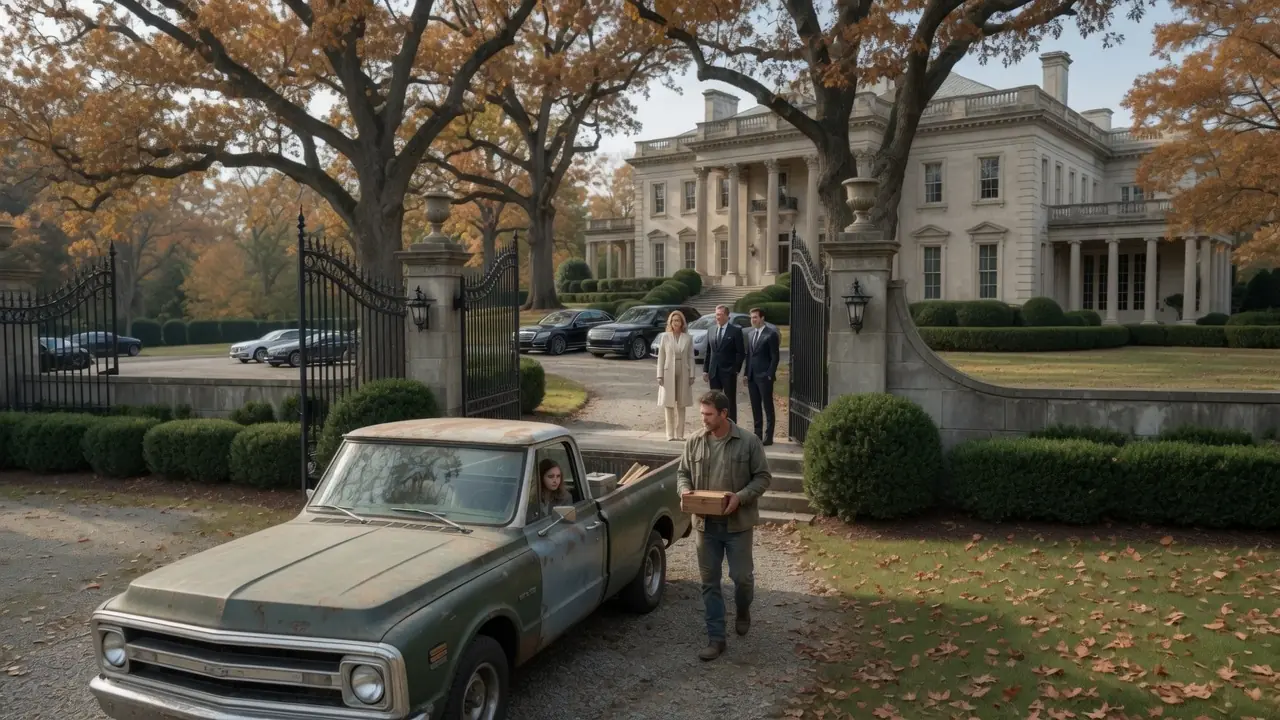
In front of all of them, Cassidy Monroe said the words: “Take your rusty car and leave.” Maddie sat in the back seat and heard every syllable. Weston said nothing.
He simply pulled away into the morning. Thirty days later, the entire Monroe family was standing outside his garage, desperate, hollow-eyed, asking him to come back because the car they called scrap metal was the only thing standing between the Monroes and complete ruin.
The house Weston Hale rented after the divorce sat on a flat quarter-acre lot just beyond the edge of Clarkfield’s older industrial district, close enough to the grain elevator that the whole block smelled faintly of iron and dry wheat on warm mornings.
The garage was attached, a two-bay structure with a roll-up door that groaned whenever the humidity climbed, and the driveway was perpetually freckled with oil stains that nothing short of rain could move.
Weston had set it up exactly the way he liked it, a pegboard wall organized with the precision of a man who understood that the difference between a good diagnosis and a wrong one was often which tool you reached for first.
He worked on other people’s vehicles for income. But the 1972 Chevy C10 parked against the far wall was his.
And everyone who visited quickly understood that the truck was not a project, not a money problem, and not a conversation starter about depreciation.
It was something else entirely.
Maddie Hale was nine years old and thought her father’s truck was the best thing that had ever been built.
Steadier somehow, like the truck was thinking instead of just running.
The seats were cracked in a way that had stopped bothering her somewhere around age six, and the passenger window had a tendency to fog even on mild days, which she had decided was its personality rather than a defect.
When she asked her father once why he didn’t sell it and buy something newer, Weston had glanced at her with the slightly unfocused look he wore when a question landed somewhere real.
“Some things look old to people who don’t know what they’re looking at,” he said. “This truck has been carrying our lives for a long time. That’s not nothing.”
What neither Maddie nor almost anyone outside Weston’s professional history knew was that the truck was not sentimental in the simple way sentiment usually works.
The 1972 Chevy C10 had been rebuilt from its frame outward, but the body was almost beside the point.
Mounted discreetly in the reinforced cargo section behind the cab, bolted to a custom-fabricated rack and sealed inside a weatherproof housing, was the original control module for a system Weston had spent nearly six years developing before his marriage collapsed and his career inside Monroe Freight Systems ended.
He called it the Hale Hybrid Drive.
It was a torque and thermal management architecture designed for heavy-load diesel applications, built specifically to solve the efficiency problems that long-haul operators had been throwing money at since the early 2000s.
The control module was the brain.
The handwritten notebooks stacked beside it were the complete technical record, and the data logged inside that housing represented a decade of real-world test conditions recorded every time the truck moved.
Rhett Callaway had been Weston’s partner through most of that development.
Rhett was sixty-one, had the forearms of a man who had grown up turning wrenches, and possessed the specific kind of institutional memory that comes from forty years of working on things other people had already given up on.
He stopped by the garage two or three times a week, usually with coffee, sometimes with parts, and occasionally with observations about the state of the world that Weston found useful precisely because Rhett had no patience for flattery of any kind.
They had built the prototype together inside the Monroe Freight Research Bay before the divorce, before the politics had turned toxic, before the man who would eventually take Weston’s place had decided that credit was a finite resource best kept for oneself.
Weston woke Maddie at 6:30 every weekday, made eggs and toast, packed her lunch with a note folded inside, and drove her to school in the truck.
He never felt sorry for himself when he did this, which was remarkable given how far the horizon had dropped from what it once looked like.
He was thirty-nine years old, living in a rental near a grain elevator, doing diagnostics on other men’s engines.
By any exterior measure, the arc of his life had bent sharply downward.
But Weston had always been more interested in what things actually were than in what they looked like from a distance, which may have been both his greatest professional strength and the reason his marriage had struggled from its third year forward.
The Monroe estate sat seven miles northwest of the rental house on a ridge that gave Von Monroe a clear sight line to the highway interchange where his freight company’s regional terminal occupied twelve acres of flat, well-drained land.
Vaughn was fifty-eight, built thickly through the chest, and operated with the unexamined confidence of a man who had inherited a functional business and then spent thirty years convincing himself he had built it.
Monroe Freight Systems ran a fleet of 240 trucks across fourteen states, serving agricultural and industrial shippers who needed reliability above all else.
The company had been profitable through most of its history, but the last four years had introduced a new category of pressure: emissions standards, fuel cost escalation, and a competitor landscape that had modernized faster than Vaughn was prepared to acknowledge.
The result was a balance sheet that still showed positive numbers but no longer showed margin.
Cassidy Monroe was thirty-five and lived in the east wing of her father’s house while her own place was being renovated.
A project that had been underway for eleven months and which most people close to the family understood was not really about the renovation.
She had taken her father’s side in the divorce without ever explicitly announcing that she had taken anyone’s side, which is the quietest and most effective way to take a side.
She was not without self-awareness.
She knew something had gone wrong in her marriage that she bore some responsibility for.
There were evenings when a specific memory would surface without warning, and she would have to set her glass down.
But she lived inside her family’s atmosphere the way people live inside weather.
It surrounded her so completely that she had largely stopped noticing its pressure.
Preston Tate had arrived at Monroe Freight fourteen months prior as the new chief financial officer, recommended through a network connection of Vaughn’s, and had made himself useful in the particular way that people who understand power structures make themselves useful.
He was forty-one, polished in the way certain professional men are polished, smooth on every surface, no visible grain.
He had attached himself to Vaughn’s confidence and Cassidy’s proximity with the same efficiency he applied to budget restructuring.
The Monroe family had found him pleasant, capable, and entirely in agreement with their prior assumptions about the world.
His opinion of Weston Hale had been formed before he ever met the man, assembled entirely from the portrait that Vaughn had painted over the preceding years.
And it had all the accuracy you would expect from a portrait painted by someone with reasons to make the subject look small.
The business problem that Preston had been managing, or more precisely, not quite managing, concerned the company’s new efficiency retrofit program.
Monroe Freight had been awarded a preliminary agreement with Mercer Logistics, a regional consolidator whose CEO Celeste Mercer had built her reputation on operational precision and who was now looking to bring her entire carrier network under a single technology standard.
The contract, if finalized, was worth enough to restructure Monroe’s debt position entirely.
The condition for finalization was a successful independent certification of Monroe’s fuel efficiency system.
A certification scheduled for thirty days out based on a drivetrain architecture that the company’s internal engineering team had been struggling to perfect for nearly eight months.
What Preston had not told Vaughn, and what Cassidy did not know, was that the architecture was failing certification benchmarks internally.
The fuel savings were inconsistent across load conditions.
The thermal management system was running hot under sustained grade and load.
The load distribution algorithm was producing errors that the engineering team could not trace to their own code because the code had not originated with them.
It had been adapted carefully and without attribution from a set of technical documents that had once belonged to a man who drove a rusted truck and dropped his daughter at school every morning before eight.
Weston had texted Cassidy two days ahead to confirm pickup time, and she had replied with a single word.
Fine.
The arrangement was civil in the way arrangements become civil after enough time has passed for the initial injury to calcify into logistics.
He arrived at ten on a Saturday.
The Chevy’s engine settled to an idle at the base of the driveway while he waited for the gate to open.
Vaughn Monroe appeared on the front porch before the gate was fully ajar.
Hands in the pockets of his slacks, watching the truck the way you watch something that is confirming a suspicion you have been cultivating for years.
Weston climbed out and closed the door.
He had dressed plainly.
Jeans, a canvas work shirt, boots he had owned long enough that the creases were entirely his own.
He was there to get Maddie and retrieve two boxes from the storage room off the kitchen.
He intended to be back in the truck within twenty minutes.
Vaughn said something about the truck belonging in a junkyard that Weston did not fully register because he was watching Maddie, who had gone still at his side the way children go still when they understand something is happening that involves them without being for them.
Preston said something under his breath that made Vaughn exhale in amusement.
And then Cassidy, whether out of exhaustion or embarrassment, or the accumulated weight of her family’s atmosphere pressing down on that particular morning, said it.
Her voice was not raised.
It was almost flat.
“Take your rusty car and leave.”
Weston did not move for a moment.
He looked at Cassidy the way you look at something that has just permanently changed shape.
Not with anger exactly, but with the specific sorrow of recognition, the understanding that a thing has finally shown you exactly what it is.
He looked at Maddie.
The girl was staring at the ground, her jaw set in a way that was exactly like her father’s.
He put his hand on her shoulder and said quietly, “Let’s get your bag in the truck.”
They walked back down the driveway.
He opened the passenger door for her.
She climbed in without speaking.
Before he put it in gear, he sat for a moment with his hands on the wheel.
The engine idled with its characteristic steadiness, the sound of something running exactly as designed.
He thought about the boxes in the storage room and decided they were not worth going back for.
He thought about Maddie, who was looking out the window at nothing, her small hands flat on her thighs.
He said, “Your mother’s not wrong that the truck is old.”
She said nothing.
“But it carried this family a long time.”
He looked ahead.
“That counts for something, even if she forgot.”
He pulled out of the driveway and did not look back.