Pamela Cross picked up her pen, tapped it twice on the judges desk, and leaned into the microphone with the kind of smile that had survived 20 years of live television. Oh, sweetheart. She tilted her head. Is this the part where the little black girl from Baltimore tells us she's the next Whitney Houston? 400 people laughed.
Pamela set the pen down slowly, folded her hands, and watched Zara Daniels standing alone at the microphone in a hand-pressed dress, 11 years old. Not one note sung yet, and added almost gently, because baby Whitney could speak in full sentences. The laughter got louder. Derek Vance leaned back in his chair, smirked at the ceiling, and said into his mic, without even looking at her, Somebody check the back door. I think the special ed class left one behind.
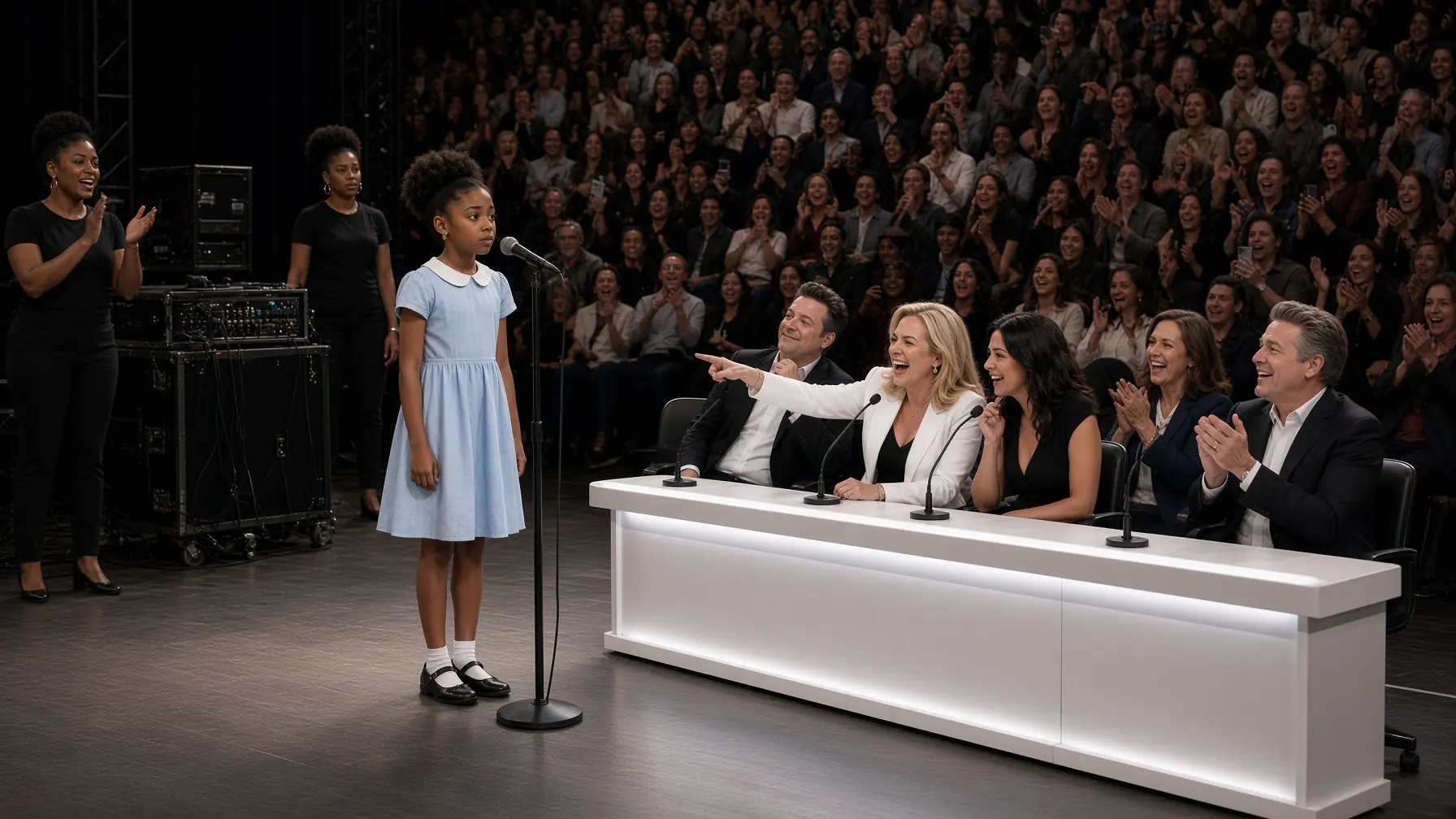
The booth laughed. The floor laughed. Someone in the third row had their phone out already. Then Brooke Ellison, almost as an afterthought, cupped her hand over her mic and stage whispered to Pamela, loud enough for the front six rows to hear every word, Who let her think she was ready for this? 400 people laughing at one 11-year-old child who had not sung a single note.
Zara Daniels did not step back, did not look down, did not make a sound. What happened in the next 4 minutes would be replayed in classrooms, church halls, and congressional briefings across America. Nobody in that room knew that yet. The city of Baltimore holds its stories the way old buildings hold water, quietly in the walls, until the weight gets to be too much. Zara Daniels lived on the second floor of a narrow row house on Brentwood Avenue in East Baltimore, in an apartment that smelled like cedarwood and frying onions and the particular kind of clean that comes not from money but from discipline.
The carpets were worn to the thread in two places, the path from the front door to the kitchen and the path from this kitchen to Loretta's bedroom because those were the only two routes that mattered in that apartment. Everything else was decoration. Everything else was extra. Loretta Daniels was 68 years old and had been raising Zara since the child was six. That was the year Kezia Daniels, Loretta's only daughter, was killed by an uninsured driver on a Tuesday afternoon on East Fayette Street.
Kezia had been walking home from the pharmacy. She had been carrying a bag of groceries in one hand and a birthday card for Zara in the other. The card was still sealed when the paramedics found it. Loretta had kept it in the top drawer of her dresser ever since, still sealed, because opening it felt like finishing something that wasn't supposed to be finished. There was no settlement.
The driver had no insurance, no assets, and disappeared from the court docket 18 months after the accident. Loretta hired a paralegal with $800 she borrowed from her church. The paralegal did what she could. It wasn't enough. Loretta went back to cleaning houses five days a week and raised Zara on $1,140 a month in social security and whatever was left after the electric bill.
She had been the choir director at Greater Calvary Baptist Church for 11 years before her knees gave out. She still hummed while she cooked. She still knew every hymn in the book from memory. And she believed with the quiet certainty of a woman who has survived more than she was ever supposed to, that God put a voice in a person for a reason, and that the worst thing you could do in this life was let somebody else talk you out of using it. Zara's stutter came on at age seven.
It did not come from birth. It came from grief. The year after her mother died, Zara stopped speaking in full sentences at school. Not because she couldn't form the words, she could in her head fast and clear and complete, but because something between the thought and the sound kept seizing up like a key turning in a lock that had swollen in the rain. The school counselor called it a grief response.
The pediatric speech clinic on North Charles Street quoted $3,600 for a 12-week intervention program. Loretta folded that paper twice and put it in the drawer with the electric bills. The stutter stayed, so did the cruelty. In second grade, a substitute teacher asked the class to read aloud from a social studies textbook one paragraph each going down the rows. When it was Zara's turn, she got through the first sentence and the second sentence and stopped at the third on the word between.
The B wouldn't release. She held it for four full seconds while 22 other children watched. The substitute finally said, not unkindly, which almost made it worse. That's okay, sweetheart. We'll just skip ahead.
The class did not laugh, but three of them looked at her with the kind of careful, deliberate pity that a 7-year-old remembers longer than laughter. In fourth grade, a boy named Tyler Briggs started calling her the broken radio on the playground. It caught on the way, mean things catch on fast and without anyone deciding to let it. By the end of the month, half the class used it. By the end of the year, even some of the kids who liked her used it without thinking the way you use a word so many times it stops feeling like a choice.
What nobody at school knew, what nobody anywhere knew except Loretta, was that when Zara sang, the stutter disappeared completely. Not improved. Not reduced. Gone. It had started in the bathroom of the Brentwood Avenue apartment when Zara was 8 years old.
She had been standing at the sink running the tap so Loretta couldn't hear her cry, and she had started humming one of the hymns from her grandmother's old church book without meaning to. And then the humming became words. And the words came out clean and whole and unbroken. Every consonant sitting exactly where it was supposed to sit. Every syllable landing without seizure or pause.
She stood there for a long moment, water running, listening to her own voice like it belonged to someone else. She didn't tell anyone. Not even Loretta. Not for a long time. Instead, she started singing every night after Loretta went to sleep.
Quietly in the bathroom with the tap running. And then in her bedroom with a pillow held over her mouth. And then, when she finally trusted it enough, out loud in the kitchen at 6:00 in the morning while Loretta slept. And the apartment was still. And the only audience was the pale light coming through the window over the sink.
Under her bed, in a spiral notebook with a cracked cover, she kept her songs. Seventeen of them written in pencil and erased and rewritten so many times that some pages had worn thin in the middle. She had never performed any of them for anyone. She had never intended to. Then, Mrs.
Patricia Webb happened. Zara's fifth-grade music teacher had stayed late one Thursday afternoon in October grading sight-reading worksheets at her desk when she heard something from the hallway outside her classroom. She set down her pen and walked to the door and opened it 2 in. Zara Daniels was standing alone in the empty corridor backpack on waiting for the late bus singing softly to herself. A melody Mrs.