A quiet girl, an arrogant teacher, and a piano stood at the center of a moment no one at Willow Ridge Academy would ever forget. What began as a cruel attempt to humiliate her became a performance that silenced an entire classroom and shattered several proud egos. Alyssa Carter did not turn the tables with an argument, a threat, or a dramatic speech. She did it with music. By the time the final note faded, everyone who had dismissed her was forced to see her differently.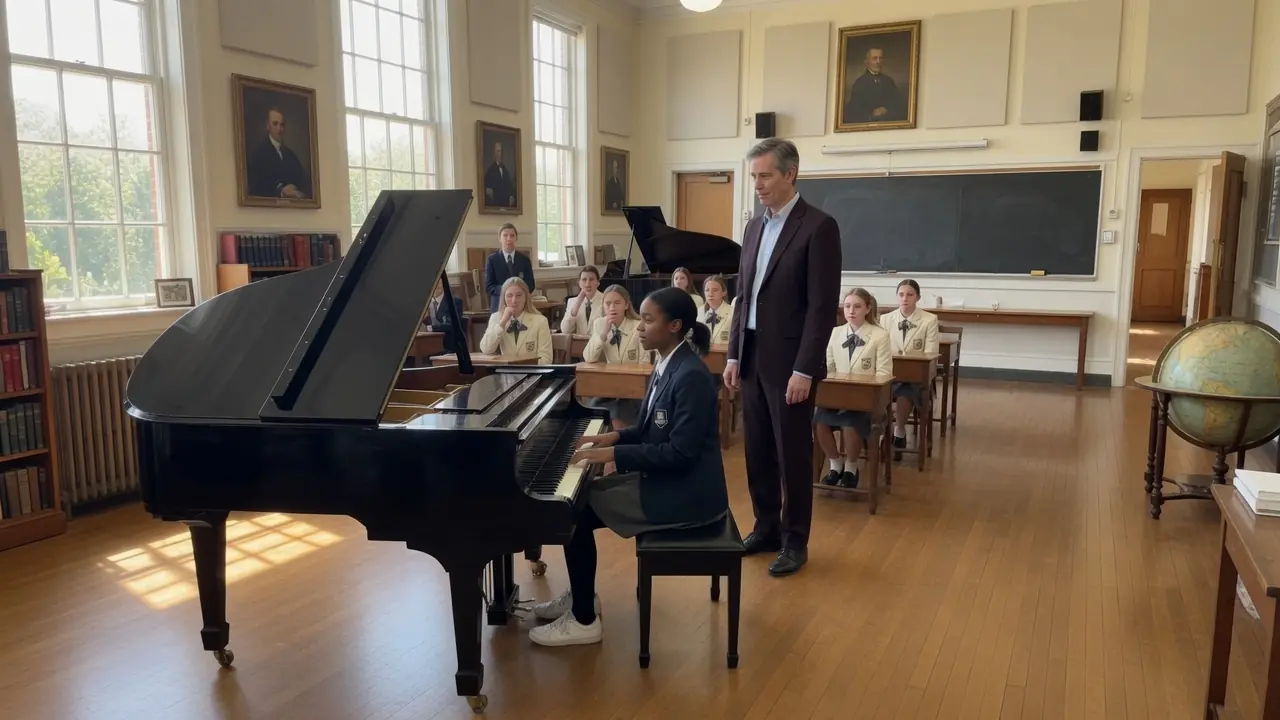
The gates of Willow Ridge Academy opened wide beneath the morning sun, revealing one of Virginia’s most prestigious high schools. Expensive cars rolled into the parking lot while students stepped out in stylish clothes, carrying designer bags and moving with effortless confidence. Laughter echoed across the marble-paved courtyard, where privilege seemed as natural as breathing. A little farther away, Alyssa quietly stepped off an old school bus, her slightly worn sneakers touching the sidewalk. No one turned to greet her, and no one made space for her.
At Willow Ridge, Alyssa was not a name that attracted attention for the right reasons. She did not have her own car, expensive clothes, perfectly styled hair, or the kind of family connections that impressed teachers and parents. She moved quickly past groups of friends, tightening the straps of her backpack and hoping to remain unnoticed. Staying invisible was difficult because Madison Harrington always found a way to mention her in the worst possible way. To Madison, Alyssa was a stain on the polished image of the school.
Madison had silky blonde hair, sharp blue eyes, and the carefully maintained appearance of someone who had always been told she was exceptional. She was not only beautiful but also the daughter of a powerful family with influence in politics and finance. Madison had grown up believing that money could buy power, fame, opportunity, and even control over other people. Teachers praised her, parents admired her, and students followed her lead. She carried herself as though every room already belonged to her.
“Look, it’s the scholarship girl,” Madison called as Alyssa crossed the courtyard. One of her friends laughed and asked, “I wonder if she has enough money for breakfast today.” Another added, “I bet she doesn’t, but maybe she’ll beg for food at the church like she always does.” Alyssa bit her lip and kept walking because she had heard versions of the same cruelty many times before. At Willow Ridge, everything revolved around money, and those without it were either ignored or targeted.
After each long day at school, Alyssa did not return to a mansion or eat dinner in an expensive restaurant like many of her classmates. She went home to a small apartment where her mother, Monica Carter, often arrived late after another exhausting hospital shift. The apartment was not large, but it was warm, clean, and filled with the quiet evidence of Monica’s sacrifices. Even when her eyes were dark from lack of sleep, Monica tried to smile and spend time with her daughter. Alyssa understood how much her mother had given up to keep them safe and fed.
“How was school today, sweetheart?” Monica asked one evening, forcing a smile through her exhaustion. “Same as usual, Mom,” Alyssa replied, hiding the frustration of another day spent being looked down upon. She did not tell her mother every insult because she knew Monica already carried enough burdens. She also did not want her mother to feel guilty for circumstances neither of them had chosen.
Still, there was one part of Alyssa’s life that Madison and people like her could never take away from her: music. Alyssa had loved the sound of the piano since she was a little girl. While other children played with dolls or watched cartoons, she spent hours at the old piano in the local church, letting her small fingers move across its worn keys. Some of the keys were chipped, and the instrument was far from perfect, but to Alyssa it was more beautiful than any grand piano she had ever seen. She had no private teacher and no collection of new music books.
None of that stopped her from learning. She listened to Debussy, Beethoven, and Chopin on her old phone, then tried to reproduce what she heard with her own hands. She borrowed sheet music from the library, studied every note, and practiced with all her heart whenever the church was empty. Alyssa did not simply play the piano; she lived inside the music. The instrument became her companion during lonely afternoons and difficult nights.
Every melody gave her a place where money, status, and ridicule could not reach her. At Willow Ridge, however, piano was treated as a subject for elite students. Girls like Madison had private instructors hired by wealthy parents, expensive grand pianos in their homes, and years of carefully arranged performances. Alyssa could only practice quietly in the corner of the church when no one else was around. She had never dared to play in front of a large group because she feared that one mistake would confirm everything people assumed about her.
That fear was about to be tested in a single class. Richard Grayson, the school’s music teacher, announced that every student would be required to perform an impromptu piano piece. “I want to see you express emotion through music, not merely repeat something you have memorized,” he told the class in his dry, stern voice. Madison immediately looked pleased because she had played since she was three and had already performed at major school events. She expected to become the center of attention once again.
Alyssa hoped Mr. Grayson would simply overlook her. He did not overlook her. “Alyssa Carter, would you like to give it a try, or are you only used to listening to music through headphones?” he asked. The class gasped and then erupted in laughter, while Madison folded her arms and gave Alyssa a challenging stare. Alyssa felt a chill move down her spine because she understood exactly what the teacher was doing.
Mr. Grayson wanted to humiliate her, and Madison wanted to watch her fail. Alyssa could have refused, shaken her head, and allowed the moment to pass as so many others had. Part of her wanted to remain seated and disappear into the back row. Another part of her remembered the long nights of silent practice and the dreams she had never dared to speak aloud. If she refused, the laughter and scornful looks would become proof in everyone’s mind that she was nothing special.
At the center of it all, Richard Grayson watched with a smile full of implication. Grayson was a thin man in his fifties whose gestures carried the authority of someone accustomed to being obeyed. He had taught at Willow Ridge Academy for more than two decades and rarely needed to raise his voice. The wealthy parents liked him because he knew how to polish students who already had private training, family support, and expensive instruments. He organized lavish performances and internal competitions in which the chosen faces shone beneath bright lights.
Students who failed to meet his standards remained silent spectators in the back rows. To Grayson, Alyssa did not belong on the stage or beside the grand piano. He had never taken much interest in students without family backing, formal training, or private tutors guiding every note. In his mind, she was only a faint name on the class roster, a student whose grades were good enough to keep her enrolled but not good enough to deserve his attention. When he saw her sitting silently amid Madison’s giggles, an idea had formed in his mind.
He would teach her a lesson about knowing her place. He believed that students without formal instruction should remain observers rather than performers. In his view, money and training were proof of seriousness, while Alyssa’s silence was proof that she had nothing to offer. He never asked how many hours she practiced or what music meant to her. He never considered that discipline could exist outside expensive studios.
His certainty came from years of rewarding privilege and mistaking it for talent. Grayson walked to the center of the room, his leather shoes clicking against the wooden floor. “Alyssa Carter, perhaps you would like to try, unless you are more comfortable listening through headphones,” he repeated in a drawn-out tone. His words were not loud, but they were sharp enough to cut, and the class laughed again. He was not merely asking a student to perform; he was calling forward someone he believed had no chance of succeeding.
He intended to undermine her confidence and prove that certain doors were never meant to open for people like her. Alyssa knew that he could not physically force her to play. She could claim that she was unprepared, admit that she had never taken lessons, or simply say that she did not want to participate. Yet refusing would allow Madison, Grayson, and the rest of the class to define her before she had ever shown them what she could do. She clenched her fist and looked directly into the teacher’s eyes.
Instead of admitting that she was afraid, she took a deep breath and accepted the challenge. The room seemed to shrink as the fifteen-year-old girl crossed it one heavy step at a time. The students continued watching, but beneath the mockery there was now a trace of curiosity. Madison narrowed her eyes as though she could not believe Alyssa had dared to stand. Grayson raised one eyebrow, briefly surprised, before hiding the reaction behind a small smile.
Alyssa reached the piano, sat on the wooden chair, and placed her hands above the keys. The laughter stopped, but the expectation of failure still hung in the air. Alyssa knew that if she played clumsily or showed the slightest hesitation, no one would ever let her forget it. Grayson crossed his arms and nodded toward the keyboard. “Go ahead, Carter,” he said, his expression still challenging.
“We are all waiting.” Alyssa closed her eyes, drew in a careful breath, and opened them again. Her fingers moved, producing one soft note and then another, gentle as a breeze passing over dry ground. The first sound spread through the room like a drop of water falling into a still pond. Before it could fully settle, a muffled giggle broke from somewhere in the classroom.
The fragile atmosphere she was trying to create seemed to crack around her. Alyssa felt every nerve in her body tighten at once. The laughter was quiet, but it carried the weight of every insult she had endured since arriving at Willow Ridge. Some students whispered to one another, while others leaned back with amused expressions. They were waiting for an awkward pause, a wrong note, or a frightened retreat.
Their expectation of failure was almost louder than the piano itself. A heavy pressure tightened across Alyssa’s chest as dozens of eyes remained fixed on her. Madison tossed back her hair, crossed her legs with practiced elegance, and gave her friends a scornful smile. “Well, that sounds promising,” one girl said, her voice laced with laughter. “She probably has not even touched a real piano before,” another whispered loudly enough for Alyssa to hear.
Every glance felt like a blade waiting for her to make the mistake they had already decided she would make. At the center of the room, Grayson watched with an expression of controlled indifference. He did not laugh, but the slight tilt of his head revealed that he expected the same ending as everyone else. To him, this was not a music exercise but a trial whose verdict had already been decided. He had seen outsiders and dreamers crushed by reality before, and he assumed Alyssa would be another one.
His confidence in her failure was almost calmer than Madison’s open cruelty. Alyssa blinked as old memories surged into her mind. She remembered the first time she touched the church piano, with its worn and chipped keys that seemed more beautiful to her than any expensive instrument. She remembered the nights when Monica returned from the hospital exhausted but still tried to smile. Her mother had worked tirelessly, not to buy a grand piano or a fashionable dress, but to keep food on the table and a roof over their heads.
Those sacrifices had taught Alyssa that value was not measured by what someone could purchase. She remembered all the evenings when Monica came home too tired to eat but still asked about her daughter’s day. She remembered the bills stacked on the kitchen table and the careful way her mother stretched every dollar. No one at Willow Ridge saw those nights or understood the courage required to keep going without comfort. They saw only old shoes, a scholarship, and a girl who stayed quiet.
Alyssa knew there was an entire life behind her silence that none of them had bothered to imagine. She also remembered the scholarships she had applied for and never received. She remembered teachers advising her to choose something more practical instead of chasing a distant dream like music. Their words had sometimes made her want to give up, and on another day she might have lowered her head and returned to her seat. She might have allowed Madison and Grayson to have the humiliation they wanted.
On this day, however, something inside her had changed. The change was not sudden confidence or the disappearance of fear. She was still afraid, and her hands still felt cold against the keys. What changed was her willingness to let fear make the decision for her. For years, she had protected herself by becoming smaller whenever someone powerful challenged her.
At the piano, she decided that shrinking would no longer keep her safe. Alyssa took another breath and steadied her hands. She could still stand, admit that she did not know how to play, and let the teacher move on to someone else. She could take the easy path and protect herself from the risk of public failure. Yet she no longer wanted to run from the dream she had nurtured through years of lonely practice.
She needed to prove to herself that she was not as small as they wanted her to believe. Her shoulders relaxed, and her fingers settled more naturally over the keys. When she began again, the opening notes of “Clair de Lune” spread gently through the classroom. The mocking laughter weakened and then disappeared as the melody gathered shape. Grayson’s folded arms remained in place, but his eyes narrowed because he could not believe what he was hearing.
Madison sat straighter, her confident posture changing before she could hide it. The students who had expected wrong notes, trembling hands, and an embarrassing spectacle became completely silent. Instead of awkwardness, they heard a performance filled with control, emotion, and a sensitivity none of them had expected from Alyssa. She did not look at anyone because she was no longer playing for their approval. Her eyes closed, and she allowed the music to guide her through the fear.
For the first time, she let the room hear the person she had always been in private. The opening phrases floated through the classroom with a softness that demanded attention rather than asking for it. Each note connected naturally to the next, revealing control built through patient repetition. The piece did not sound memorized in the empty, mechanical way Grayson had criticized. It sounded lived in, as though Alyssa had carried the melody through years of loneliness.
The more she played, the less the room resembled a classroom and the more it resembled the quiet church where she had learned. The sound began as lightly as a breath, but each note seemed to cut through the heavy air. Alyssa felt the precise moment when no one dared to laugh or whisper. Even then, a final wave of fear moved through her, urging her to stand and escape before she made a mistake. It seemed as though an invisible force was pulling her away from the piano and from the judgment surrounding her.
Then her mother’s voice returned to her memory. For a second, Alyssa imagined standing up and hearing the laughter rush back into the space. She imagined Grayson nodding as though her retreat confirmed his judgment. She imagined Madison repeating the story for weeks, turning a single frightened moment into a permanent label. That possibility hurt more than the fear of making a mistake.
Alyssa understood that leaving would not erase the humiliation; it would hand control of the story to the people who wanted to diminish her. “You do not need to prove anything, but never let anyone look down on you,” Monica had once told her. Those words became a small light in the darkness of Alyssa’s fear. She opened her eyes and chose not to leave. Madison still leaned with arrogant confidence, her raised eyebrow silently daring Alyssa to fail.
The other students waited, some with folded arms and others with their mouths slightly open. A few had already stopped looking toward Madison for permission to react. Others seemed uncomfortable because the performance challenged the easy assumptions they had accepted about Alyssa. The girl they considered invisible was creating the strongest moment anyone had produced in class that year. Their silence gradually changed from cruel anticipation into genuine attention.
Without saying a word, Alyssa had forced them to reconsider the person sitting at the piano. Grayson was no longer smiling, though his face remained difficult to read. His expression resembled that of a hunter calmly observing prey because he still believed he knew what would happen next. Alyssa’s heart raced, not only from fear, but because she understood that she had reached a crossroads. If she surrendered now, their mockery would follow her and become the story everyone repeated.
If she continued, she would step beyond the place they had assigned to her. Her fingers moved again, and the melody deepened. The classroom seemed to become a separate world containing no whispers, no laughter, and no sound except the piano. “Clair de Lune” flowed softly yet powerfully, weaving a shimmering image through a room that had felt cold only moments earlier. Madison’s teasing excitement vanished as her eyes widened.
Grayson’s brow tightened with a confusion he could no longer completely conceal. They had all expected Alyssa to tremble, strike a wrong note, or stop in embarrassment. What they received was a performance so precise and emotional that it left them speechless. Alyssa kept her eyes closed and allowed the music to carry her farther from their judgment. She no longer felt the weight of their scrutiny because, for the first time in her life, she did not feel small.
She had chosen to remain at the piano, and no one could pull her down from that moment. The melody filled the room like a gentle wave strong enough to sweep away every scornful glance. Alyssa’s hands gained confidence as though the music had always lived inside her and had merely waited for this chance to emerge. At first, she listened carefully to the familiar rhythm she had taught herself during long and quiet days. Soon she stopped thinking about each key and surrendered completely to the piece.
Madison, Grayson, and the rest of the class disappeared from her awareness. Several students straightened in their seats, no longer willing to appear indifferent. Madison leaned forward with her elbows on the desk, watching every movement of Alyssa’s hands. Her friends, who usually laughed after anything Madison said, had fallen silent as well. Their silence came not only from surprise but from being drawn into music they could neither ignore nor belittle.
The performance had taken control of the room more completely than any teacher’s command. The most significant change appeared in Grayson. He had begun with folded arms, patient confidence, and the certainty that he could identify which students possessed potential. After only a few passages, the smugness left his eyes. He stared at Alyssa with growing confusion because the performance contradicted everything he had assumed about her.
In that moment, he understood that his judgment had been wrong. The realization did not arrive as humility but as discomfort. Grayson had built his reputation on claiming that he could recognize ability almost immediately. Alyssa’s performance exposed how often his decisions depended on family names, expensive lessons, and polished appearances. He could not explain her skill within the categories he trusted.
The longer she played, the more clearly his professional confidence gave way to personal embarrassment. Grayson had been certain that Alyssa could not perform a complex piece with precision. Instead, he heard music refined enough to silence even the proudest listener. Alyssa was not merely pressing the correct keys; she was playing with her entire soul and with every struggle she had endured. Years without a private tutor or formal lessons had not prevented her from developing remarkable control.
Endless nights of practice had become part of every phrase she played. She had learned without someone correcting her posture, counting her rhythm, or selecting pieces suited to her level. When a passage confused her, she listened repeatedly, studied borrowed pages, and worked until her hands understood it. She had no recital schedule forcing her to improve and no parent paying for progress. Her discipline came entirely from love and necessity.
That private persistence now sounded through the grand piano with a maturity that formal training alone could not guarantee. The piano had been Alyssa’s companion through the loneliest days of her life. In empty rooms and quiet church corners, she had taught herself to hear, interpret, and express each melody. Now all those hours appeared in the movement of her fingers and the emotion beneath the notes. She did not need to look toward the class or ask anyone to approve of her.
Sitting at that piano, she knew she was no longer simply a shy girl with a private dream; she was a pianist. Alyssa continued, and each phrase wrapped the room more tightly in its embrace. Madison gripped the edge of her desk and glanced toward her friends, searching for the familiar support of their shared mockery. No one looked back because they had forgotten that only moments earlier they had laughed at the girl performing. The notes painted the air with light, sadness, hope, and quiet strength.
Alyssa played because music was the one thing she knew she had been born to do. With every passage, she felt years of pain and pressure release through the keys. The performance became more than a piece of music; it became her strongest declaration. No one in the room could deny her or reduce her to a scholarship student with worn shoes. Grayson’s arms gradually dropped to his sides, and his face lost its usual calm authority.
He did not want to admit it, but the performance was changing the way he saw her. The class also felt the emotional weight beneath the technique. Alyssa’s playing carried the exhaustion of her mother’s long shifts, the humiliation of the courtyard, and the hope she guarded in the church. None of those experiences appeared as spoken explanation, yet they shaped the character of the music. The performance felt personal without becoming uncontrolled.
By expressing everything she had held back, Alyssa transformed pressure into something beautiful and impossible to dismiss. Alyssa had not failed as he expected. She had stepped out of the shadow that he, Madison, and the school’s social hierarchy had placed over her. When the final note sounded, it lingered like the surface of a calm lake after a breeze. The room remained completely still because no one was ready to break what had just happened.
Alyssa opened her eyes and looked down at the keys, breathing a little faster but no longer from fear. A long moment passed after the sound had faded. Alyssa kept one hand resting lightly on the piano while a powerful realization rose inside her. She had done something no one in that room believed possible, and she had made their entire world go silent. The students who had laughed now sat motionless, trying to understand what they had heard.
Their mocking faces had been replaced by confusion, astonishment, and reluctant respect. Some students remained in a daze, as though they were still hearing the last phrase inside their minds. A few looked at one another for confirmation that the performance had truly happened. No one knew who should speak first because any casual comment would have felt inadequate. The silence was no longer a weapon directed at Alyssa.
It had become evidence of how completely she had changed the atmosphere. Alyssa slowly lifted her gaze and looked directly at Madison Harrington. The girl who always appeared perfectly composed now sat with wide-open eyes and no trace of her mocking smile. Madison had expected a clumsy performance, an embarrassed retreat, and another opportunity to humiliate Alyssa. Instead, she had been forced to witness something magnificent.
For several seconds, she could not decide how to react. What disturbed Madison most was not simply the surprise. It was the truth that Alyssa was not the weak, insignificant girl she had always imagined. Designer clothes, a prestigious family, and expensive training had not given Madison ownership of talent. Alyssa possessed something that money could not purchase or command.
Madison’s confusion slowly hardened into anger, but she knew that any insult spoken now would sound empty. She tightened her fingers around the edge of the desk and searched for a way to regain control. Usually, one sharp remark from Madison was enough to restore the social order around her. This time, even her closest friends remained absorbed in what they had heard. If she mocked Alyssa now, the cruelty would expose insecurity rather than superiority.
Madison stayed silent because the truth had left her without a convincing performance of her own. Grayson was also losing the confidence with which he had begun the exercise. He remained standing, but his expression no longer carried smug indifference. He stared at Alyssa as though seeing her clearly for the first time. Years of teaching had made him too comfortable classifying students as gifted, ordinary, or unworthy of serious attention.
Her performance had overturned that entire system of judgment in less than a few minutes. Alyssa Carter was not an insignificant student who happened to know a few notes. She possessed not only skill but also a musical soul that no formal résumé could measure. Her fingers still trembled slightly after the piece, but the trembling came from the force of what she had expressed rather than from fear. She had forced the class to see her in a way they had refused to see her before.
A single clap finally broke the silence from the back of the room. Another clap followed, then another, until applause filled the classroom. Several students stood because they could no longer contain their excitement. Others remained seated in shock but slowly joined the growing response. Alyssa looked around at the same people who had mocked her and saw that they were not clapping from pity or guilt.
They were clapping because her performance had left them no honest alternative. Grayson did not clap. Doing so would have required him to admit publicly that his judgment had been completely wrong. He inhaled slowly and continued staring at Alyssa as though reassessing everything he thought he knew about her. Madison turned away, bit her lip, and clenched her fists beneath her coat.
For the first time in her life, she was the one being pushed to the side while someone else occupied the center of attention. Alyssa rose from the piano with her heartbeat still echoing in her chest. It was no longer the heartbeat of anxiety but the rhythm of a victory no one had handed to her. The final notes seemed to remain in the room even after she stepped away from the keys. She did not need to seek anyone’s gaze or demand praise.
She had allowed the music to speak, and she knew the class would never look at her in the same way again. The atmosphere remained thick as every student waited for Grayson to respond. He stood on the platform with his lips pressed together and his hands making a small, uncertain movement. Around him were students he had always believed he understood, divided into those with potential and those who belonged on the edges. Now his assumptions had been exposed in front of all of them.
No one laughed at Alyssa, and no one whispered with disdain. Grayson drew in a breath as though swallowing something difficult. “I did not expect this,” he finally said. After another pause, he added, “You did well.” The words were an acknowledgment, but they carried none of the generosity of genuine praise.
Everyone could hear that he was admitting only what the evidence in front of him made impossible to deny. His praise lacked warmth because it had not grown from respect. It sounded like the smallest concession he could make while protecting his authority. The students noticed the difference between recognizing a result and acknowledging the person who achieved it. Alyssa noticed it as well, and the old instinct to accept any approval from a teacher briefly returned.
Then she remembered that his opinion had never measured the hours she spent learning alone. A few students exchanged glances because they expected him to say more. He did not continue, and Alyssa immediately understood the emptiness behind his reluctant compliment. She had not performed for his approval, and she did not need hollow words from someone who had tried to shame her. Slowly, she turned and looked directly into his eyes.
Her posture was steady, and she did not lower her head. “Everyone has talent,” Alyssa said clearly. “What matters is whether you have the eyes to see it.” The room seemed to tremble, not because she raised her voice, but because every word carried the weight of what had just occurred. Madison stared at her in disbelief, and even the students who usually followed Madison remained silent.
Alyssa’s statement was aimed not only at Grayson but at everyone who had judged her worth by her clothes, background, and lack of money. Another round of applause rose, this time for her words rather than for the music. Some students nodded as though they had suddenly recognized something they had ignored for years. A boy near the back quietly said, “She is right.” One of Madison’s usual followers also nodded, her expression thoughtful instead of mocking.
The change in the room was not dramatic enough to erase every prejudice, but it was real. Several students who had treated Alyssa as an outsider now seemed ashamed of how easily they had joined Madison’s laughter. Others were simply impressed and had not yet examined their own behavior. The applause did not transform them into close friends or guarantee that school would become easy. It did, however, break the certainty that Alyssa could be dismissed without consequence.
From that moment, they knew she possessed a voice strong enough to command their attention. Students began looking at Alyssa with curiosity, admiration, and genuine respect rather than pity. They also looked at Grayson differently, no longer accepting his judgment as unquestionably correct. Most importantly, Alyssa no longer felt that she needed their permission to belong. She had changed something inside herself even if the rest of the school changed only a little.
That internal change mattered more than any applause. Grayson stared at her for a long moment and seemed to struggle with his thoughts. In the end, he offered no argument because there was nothing he could honestly say. Alyssa had first let her music speak and then had found the courage to speak for herself. Whether he welcomed it or not, she had reclaimed her place in the room.
The social order that Madison and Grayson took for granted had been disrupted in only a few minutes. Just as the classroom hovered between praise and confusion, the door opened. Mrs. Collins, one of Willow Ridge Academy’s longtime teachers, stepped inside. Her graying hair was tied neatly at the back of her neck, and her posture carried the quiet authority of a true educator. Students respected her, and the faculty valued both her judgment and her seriousness.
From the moment she entered, her attention remained fixed on Alyssa. Mrs. Collins carried herself differently from Grayson because her authority did not depend on humiliation. She watched students closely and believed teaching required discovering what had not yet been given a chance to grow. The music from the hallway had been enough to make her stop outside the door. She listened until the final note, then remained still through the applause and confrontation.
By the time she entered, she had already formed a serious judgment about Alyssa’s potential. Mrs. Collins had heard the performance from outside the room. Unlike the students, she did not appear shocked; instead, her eyes held the certainty of someone who had found what she had been seeking. She ignored the curious faces, Grayson’s awkward expression, and Madison’s simmering anger. Her gaze remained warm but focused.
“Have you ever thought about applying for a music scholarship?” she asked Alyssa. The entire room froze once again. Alyssa’s eyes widened because she was not sure she had heard the question correctly. A music scholarship was something she had never allowed herself to imagine seriously. She had spent her childhood alone at an old church piano, exploring the keys without anyone guiding her.
No matter how deeply she loved music, the path toward professional training had always seemed out of reach. The other music students at Willow Ridge lived in a different world. Their parents spent tens of thousands of dollars on private teachers, instruments, master classes, and prestigious performances. Grand pianos stood in the middle of their homes, and many of them had appeared on large stages since childhood. Alyssa possessed only passion, discipline, borrowed music, and access to a worn church piano.
She had always feared that passion alone would never be enough to compete with privilege. Every comparison seemed to place her years behind before she had even begun. Other students knew the language of auditions, conservatories, competitions, and professional coaching. Alyssa knew library due dates, hospital schedules, and the hours when the church remained unlocked. Their advantages were real, and she did not pretend otherwise.
What she had never considered was that her unusual path had also developed patience, independence, and emotional depth. Mrs. Collins did not remove her eyes from Alyssa. There was no pity, hesitation, or charitable softness in her expression. She was serious because she had recognized something real in Alyssa’s playing. The offer was not being made to comfort a poor student or create a pleasant story for the school.
It was being made because Alyssa’s talent deserved an opportunity. Beside her, Madison clenched one fist until her nails pressed into her palm. She had always been the class’s shining star, the student praised by teachers and supported by expensive private tutors. Her family had ensured that she received the best opportunities and performed at prestigious events. She had spent her life protecting the belief that no one in the room could surpass her.
Now a scholarship opportunity was being offered to Alyssa Carter instead of her. Madison’s anger flared, but she could not challenge Mrs. Collins without contradicting everything the class had just heard. She could not claim that Alyssa lacked talent because the performance had proven otherwise. That helplessness frustrated her more than the applause itself. Alyssa, meanwhile, remained too stunned to answer immediately.
She looked around at classmates whose expressions now contained admiration rather than ridicule. Alyssa glanced toward Grayson and saw him avoiding Mrs. Collins’s eyes. He understood that if Alyssa earned the scholarship, his entire way of measuring talent would be exposed as shallow and incomplete. She looked down at her hands, still feeling the echo of the piece she had just played. Perhaps the dream was not as distant as she had always believed.
Perhaps a door was genuinely opening in front of her. “I...” Alyssa began, pausing because the words felt almost impossible to say. She took a breath and met Mrs. Collins’s unwavering gaze. “I want to try,” she said.
Mrs. Collins smiled with quiet satisfaction, as though she had expected that answer. At the back of the room, Madison felt the world she understood beginning to collapse. Alyssa left the classroom in a strange silence, walking lightly even though her emotions swirled like a storm. She did not know how long the class’s changed attitude would last, but she knew she was no longer the same girl who had entered that morning. In the hallway, students glanced at her with curiosity, acknowledgment, and even admiration.
The looks were unfamiliar because they contained none of the usual contempt. For once, she did not feel the need to lower her eyes. When Alyssa passed through the iron gates of Willow Ridge Academy, a gentle breeze moved through her hair. Only then did she realize how fiercely her heart was still pounding. The performance, the applause, Madison’s stunned face, Grayson’s discomfort, and Mrs. Collins’s offer all felt dreamlike.
Yet the dream was no longer vague or unreachable. Something real had happened, and Alyssa wanted to tell her mother immediately. She began to run, not from fear, but from excitement. Her old shoes struck the pavement as she passed familiar grocery stores and streets she had walked every day. Those streets had once seemed like the boundary of a life from which she could never escape.
Now she felt as though they were carrying her toward a future she had finally touched. Tears of hope gathered in her eyes when the apartment building came into view. Monica opened the door still wearing her nurse’s uniform, proof that she had only recently finished her shift. Her tired eyes immediately filled with concern when she saw Alyssa’s red face and ragged breathing. “Alyssa, what happened, sweetheart?” she asked.
Alyssa could not hold back any longer and threw herself into her mother’s arms. The familiar warmth of Monica’s embrace surrounded her completely. For several seconds, Alyssa could only hold on and breathe. The apartment, with its modest furniture and quiet hallway, felt safer than any place she had been all day. Monica did not know whether her daughter had been hurt, punished, or frightened, but she waited without forcing an explanation.
Alyssa felt the contrast between the classroom’s judgment and her mother’s unconditional love. That contrast made the tears come faster, even though they were tears of relief. In that embrace, Alyssa understood that she had broken through an invisible wall that had imprisoned her for years. She had proved to the class, and more importantly to herself, that she was worthy of being heard. Pulling back slightly, she struggled to speak through her tears.
“Mom, I played,” she said, her voice trembling. “And they listened to me.” Monica placed both hands gently against her daughter’s cheeks. “Tell me, sweetheart,” she said. “What happened?”
Alyssa took a breath and began describing the entire day, from Grayson’s mockery to the expectant faces waiting for her to fail. She explained how she had nearly refused but remembered her mother’s words and chose to sit at the piano. She told Monica how the class fell silent, how Madison’s smug expression disappeared, and how Grayson could no longer deny what he heard. She described the applause, the confrontation, and the words she had spoken about seeing talent. Finally, she told her about Mrs. Collins and the possibility of a music scholarship.
Monica listened without interrupting and held Alyssa’s hand throughout the story. Every sentence seemed to warm a place in her heart that years of exhaustion had never touched. When Alyssa finished, the last tears on her face were no longer tears of sorrow. Monica stroked her hair and spoke in a soft but steady voice. “You have always been enough, sweetheart,” she said.
“You only needed to believe it.” Alyssa stood still because words she had heard before suddenly carried an entirely new meaning. In the past, Alyssa assumed her mother praised her only to provide comfort. She thought Monica encouraged the dream because mothers were supposed to protect their children from disappointment. Now she understood that Monica had never doubted her talent or considered her dream a childish fantasy.
The person who had doubted Alyssa most deeply had been Alyssa herself. That realization loosened an invisible knot she had carried for years. Alyssa smiled without hesitation or fear. She believed that she was worthy, that she could improve, and that her dream no longer existed beyond her reach. A few mornings later, sunlight entered her small bedroom through the curtains and fell across her old laptop.
On the screen waited the Willow Ridge music scholarship application. Alyssa rested her hands above the keyboard and allowed herself to understand the importance of the moment. Only a week earlier, she had been the quiet girl in the back row trying to avoid Madison’s gaze. Now her breathing was deeper, and her eyes held a determination she had never recognized in herself. She knew that talent would not make the road easy or guarantee that every opportunity would come to her.
The scholarship process would demand courage, practice, and patience. Even so, the dream was no longer distant because she had begun reaching toward it. Alyssa still carried reasonable fears about the competition ahead. Most students pursuing music at Willow Ridge had studied for years with private instructors and performed on expensive instruments before important audiences. She had learned by listening, borrowing old sheet music, and practicing alone in a church.
The old piano had often seemed like the only thing that understood her. She wondered how she could compete against students whose preparation had begun with advantages she had never possessed. The question did not disappear simply because one classroom had applauded her. A scholarship application meant being examined by people who would compare technique, experience, and formal achievements. Alyssa had no list of competitions, no celebrated instructor, and no expensive recordings.
She worried that the courage of one performance might not be enough on paper. Still, she knew refusing to apply would guarantee the outcome she feared. Then she remembered the classroom and the silence that followed “Clair de Lune.” She remembered Madison’s astonished expression and the moment Grayson could not refute the truth in front of him. Alyssa had already accomplished something everyone considered impossible.
She was not merely good enough; she had exceeded their expectations. If she could do that once, she could face the next challenge as well. She began filling out the form carefully. Under her full name, she typed “Alyssa Carter,” and under her field of expertise, she entered “Classical Piano.” Even those simple words felt unfamiliar because she had always imagined formal music applications belonged to wealthy students.
Now she was placing her own name among them, not because anyone pitied her, but because she deserved to be considered. She continued through each section with growing confidence. The application asked why she had chosen music, how she began playing, and what the piano had given her. Alyssa answered honestly, remembering the church, the worn keys, and the lonely hours that shaped her. The final section requested a short essay explaining why she deserved the scholarship.
Her fingers hovered above the keyboard while she searched for the answer. Then she realized that the answer had been inside her from the first day she touched a piano. She did not need to invent a dramatic reason or imitate the language of wealthy applicants. Her strongest argument was the truth of how she had learned and why she continued. Music had given her a place to survive disappointment without becoming bitter.
It had taught her to listen closely, repeat difficult work, and remain patient when progress was invisible. The essay became another form of performance, except this time the keyboard held words instead of notes. “I was not born with perfect conditions for pursuing music,” she wrote. “I never had a teacher to guide me, never owned an expensive piano, and never had the chance to perform on a large stage. What I have is something nothing can replace: a love for music and the perseverance to keep working for it.
I played every day, not because anyone ordered me to practice, but because I could not imagine my life without music. When I placed my hands on the keys, I did not merely create sound; I told my own story.” “I am not applying because I want to be treated differently,” the essay continued. “I am applying because I believe I have something meaningful to offer, because my music deserves to be heard, and because I will not waste this opportunity. I may not have started from a perfect place, but I know that a starting point does not determine where someone can go.
Given the chance, I can step onto a stage and make people listen. I am ready to work for that chance.” Alyssa read every word and felt as though each sentence held a piece of her life. There was no fear in the essay and no attempt to ask for sympathy. She had written about her circumstances without allowing them to define her limitations.
With one steady movement, she clicked the submit button. The screen displayed the message, “Your application has been successfully submitted.” Alyssa stared at the confirmation and felt a door opening inside her. She had taken the first formal step toward the future she once considered impossible. Later, she entered the quiet room where the old piano waited and closed the door behind her.
A soft yellow light from the ceiling cast a warm glow over the familiar space. She sat on the wooden chair and rested her hands beside the worn keys. This room held countless nights of solitary practice, dreams, doubts, and private victories. It was where Alyssa had often wondered whether she was truly good enough to pursue music. Today, however, everything felt different.
She was no longer only the shy student in the corner of the classroom or the invisible target Madison could easily trample. She was the girl who had sat at a grand piano, silenced the class, and broken through the barriers placed around her. The scholarship opportunity from Mrs. Collins was not a miracle or an act of charity. It had come because Alyssa’s performance revealed ability that deserved to be developed. She knew the road ahead would still contain obstacles, including Madison’s resentment and competitors with far more experience.
Some students would continue to have better teachers, better instruments, and years of advantage. Alyssa no longer considered those facts a reason to surrender. She pressed one old key, and an imperfect note sounded in the small room. It was not as rich as the grand piano at Willow Ridge, but it carried a deeper meaning for her. The note was her voice, shaped by every struggle she had survived.
A clear thought passed through her mind: “Do not let anyone define your worth.” People like Madison and Grayson had believed they could decide who deserved opportunity, but they had been wrong. Their judgments had once seemed permanent because Alyssa had never challenged them publicly. Now she understood that authority could be confident and still be mistaken. A teacher’s opinion, a classmate’s wealth, or a school’s social hierarchy could influence opportunity without defining ability.
This did not mean those obstacles vanished. It meant Alyssa no longer accepted them as the final truth about who she could become. Worth did not come from fame, family background, designer clothes, or the opinions of powerful people. It came from the courage, discipline, and truth within a person.
Alyssa drew a deep breath and began to play. The melody moved slowly but steadily, filling the room like a declaration that she would never allow anyone to extinguish her dream again. “If you have talent, let it speak for itself,” she thought as her hands crossed the keys. Alyssa closed her eyes and allowed the music to carry her beyond the room.
She was no longer afraid of the people who had laughed, the teacher who had judged her, or the opportunities that once seemed reserved for others. She had not been born into perfect circumstances, and no paved path had been prepared for her. Even so, she chose to keep moving forward and to use music as her voice. Her talent did not belong to a social class; it belonged to the person persistent and brave enough to pursue it.