"Shut your mouth, Tate. You don't get to speak in my class."
"Yes, ma'am."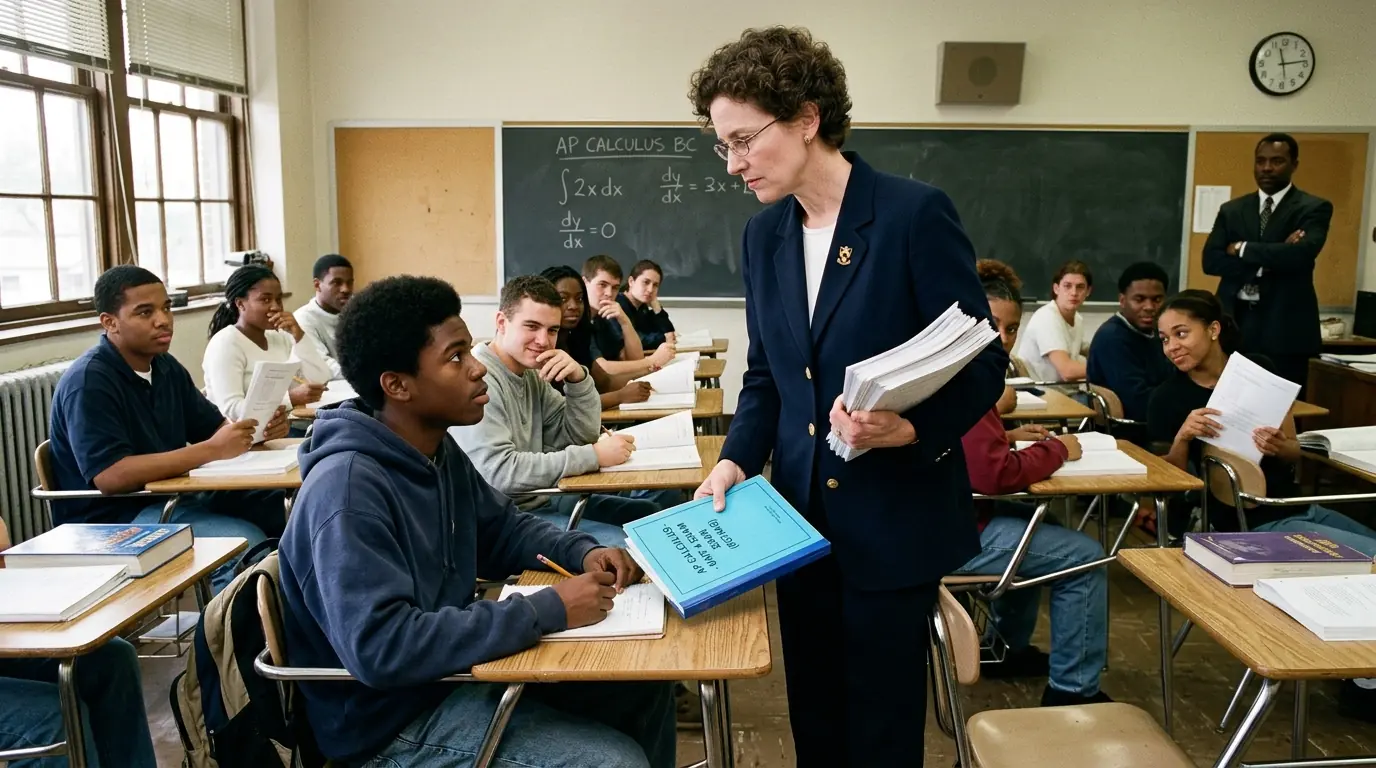
"Look at you. Filthy hoodie. Dirty hands, walking in like you belong."
"I'm sorry, ma'am."
"Sorry? Sorry doesn't fix what's wrong with your head. You think a brain like yours can run AP Math? This is your exam. Garbage. The others got the real test. You're getting one for your kind. Princeton freshman level. Choke on it."
"Ma'am, this isn't—"
"Did I say speak? Read. Fail. So everyone in here can finally see what you really are."
Wesley's thumb pressed the dent on his pencil. But what no one in that room knew yet was that she had just made the biggest mistake of her career.
Lincoln High School sits at the corner of Pratt Avenue, three blocks from the steel mill that used to feed half of Birmingham. The bricks are red and old. The windows still rattle when a train passes. The hallway lockers have been painted over so many times the numbers are starting to swell. Out of 900 students, more than 700 are Black. Most of them are the children of nurses, truck drivers, line cooks, and second-shift welders. The AP Calculus BC roster has 15 names. Two of them are Black. One of those two is Wesley.
Wesley Tate walked those halls every morning at 7:15: hoodie zipped halfway, backpack slung off one shoulder, a blue notebook inside with a cover so worn it looked almost gray. That notebook had belonged to his father. Joseph Tate finished two years of math at Howard before money ran out, and he came home to lay brick. Wesley was eight when his father died. The notebook was the only thing the boy asked for at the funeral. By 16, Wesley had filled half of it himself: equations in pencil, proofs in ballpoint, a few notes in red marker his father had left behind. He didn't show it to anyone—not the teachers, not his mother. He kept it in the inside pocket of his backpack next to the pencil with the dent his father had carved.
Naomi Tate worked 12-hour nights at Cooper Green Hospital. She came home most mornings as Wesley laced his shoes. They overlapped for 10 minutes by the kitchen.
"You eat?"
"Yes, ma'am."
"You sleep?"
"Yes, ma'am."
"You ready for that test today?"
"Yes, ma'am."
She kissed the top of his head and dropped onto the couch, still in scrubs. By the time he closed the front door, she was already asleep.
There was no scholarship money in their account—not yet. But there was an envelope on the fridge: Princeton early application. And Wesley looked at it every morning before he left.
Then there was Miss Vivien Caldwell. She came to Lincoln High in August. Before that, a private prep school in Connecticut; before that, a teaching assistantship at Princeton. She wore narrow glasses, a blazer, and a small gold pin shaped like the Princeton crest. She made sure everyone could see it.
In the teachers' lounge, she had said it more than once: "These kids don't belong in BC level. Putting them in advanced placement is setting them up to fail. It's cruel, really. It's not about race. It's about preparation." Mr. Bennett, the old physics teacher, would just lift his coffee and stare at her.
By October, she had already moved three students out of her class—all of them Black, all of them quiet. She would call them up after the bell, smile gently, and tell them she had found a better fit. None of them had time to fight back. Two of them dropped AP entirely. One of them stopped speaking in class altogether.
Wesley was supposed to be the fourth, but Wesley's name kept showing up at the top of her grade column quiz after quiz: 89, 92, 94. Perfect score on the midterm. Caldwell graded his answers twice each time, looking for the trick. She never found one.
Two weeks before the final, Caldwell put a tricky integration problem on the board to stump the class. Wesley raised his hand.
"Yes, Mr. Tate."
"Substitution, ma'am. Let $u = x^2 + 1$."
The room went still. He was right, and everyone could see it. Caldwell stared at him for a long second. Then she turned to the board, wrote the substitution, and worked the problem herself.
"That's one approach," she said when she finished. She didn't look at Wesley again that period.
That night, she went home and called Dean Holloway. "Someone is doing his homework for him," she said. "There's no other explanation. You don't get a kid like that scoring like this in my class."
Holloway adjusted his tie on the other end. "What do you want to do?"
"Catch him publicly. The final exam is 40% of his grade. If he can't perform under pressure, then we have our answer. He goes back to general math. We move on."
Holloway nodded slowly into the phone. He liked clean answers. The head of the math department, Dr. Eleanor Brooks, would have asked questions. She always did. But Brooks was at a district meeting that Friday morning, and Caldwell had checked her calendar twice. And the exam already locked in her drawer that morning wasn't a high school test at all.
Friday morning, 8:15. The bell had not yet rung, but every seat in room 214 was filled. Miss Caldwell stood at her desk holding a stack of standard white exam booklets in one hand. In her other hand, on top of the white stack, sat a single blue-bound packet. She walked the rows like a tax collector.