"Fake! This check is fake!"
Todd Henderson slammed the check down on the counter. The sound was like a slap tearing through the hall.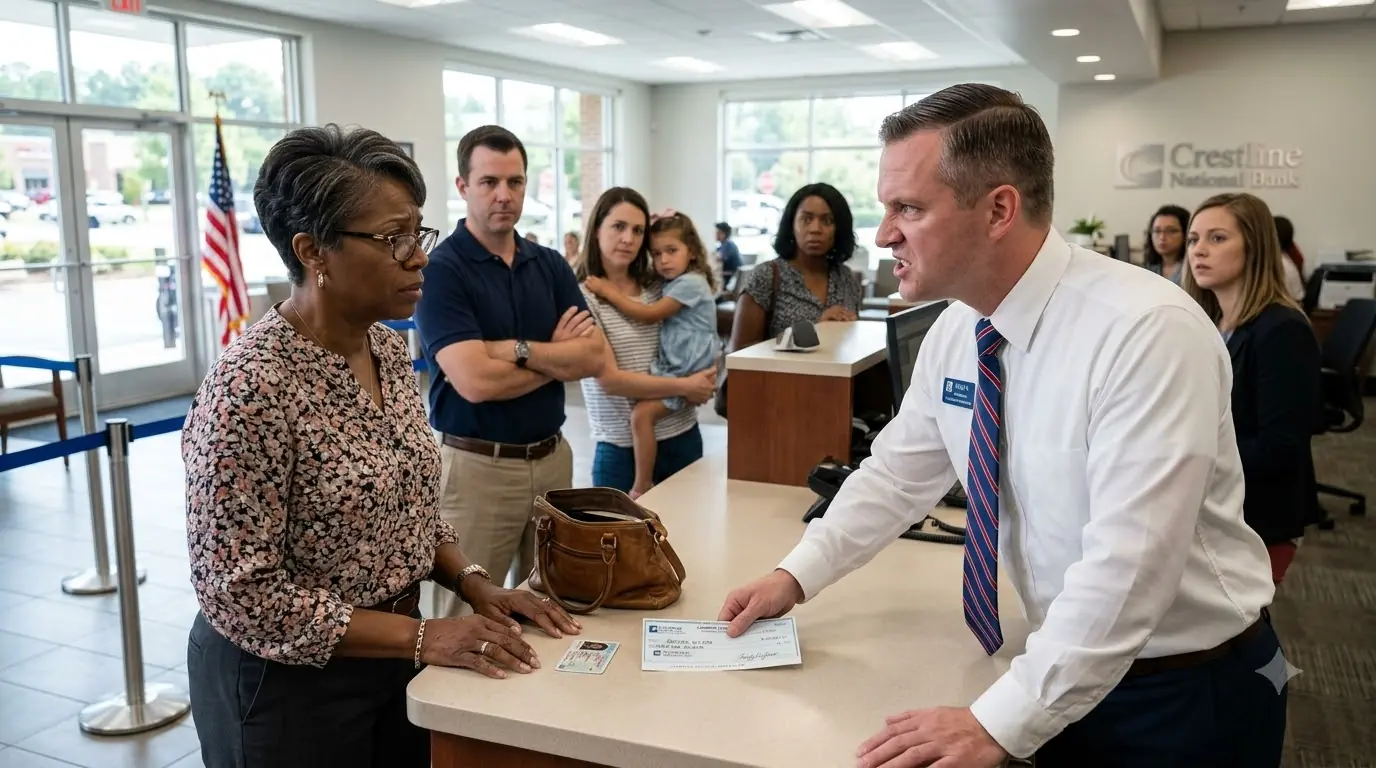
Brenda Wilson flinched. "Sir, please. This is a bank check. My son—"
"Your son?" Todd's lips curled. "Little girl, the only thing your son sends you is trouble." He pushed the check toward her as if it were rubbish. "I can smell the rubbish the moment you walk through this door."
Everyone in the hall turned to look. No one moved. No one spoke.
Brenda's fingers trembled, but her voice remained steady. "I've been a customer here for 15 years."
Todd bent down, gritting his teeth. "Then you've been a fraud for 15 years. Get out! Out! Out!"
She didn't move. The teller had no idea her son was about to ruin his own career.
But before we get there, let me take you back about 3 hours before that moment at the counter.
6:15 in the morning. Orchard Hills, Georgia. A quiet suburb about 40 minutes south of Atlanta, where the lawns are cut on Saturdays and the neighbors still wave from their porches.
Brenda Wilson was already up. She stood on her front porch in a pair of worn slippers, watering can in one hand, coffee in the other. Steam curled off the mug, a faded ceramic thing that read "Number One Teacher" in chipped gold letters. Her students gave it to her almost 20 years ago. She never stopped using it.
The morning air smelled like wet soil and jasmine. Sprinklers hissed softly two houses down. A school bus rumbled past at the end of the block, and Brenda watched it go the way she always did: with a little smile, like she still missed the classroom.
She taught third grade for 28 years. 28 years of spelling tests, parent-teacher nights, messy art projects, and lunch hour meltdowns. She loved every second of it. She retired two years ago. Not because she wanted to, but because her knees couldn't take the stairs anymore.
Life hadn't been easy on Brenda. Her husband, James, was a firefighter. Good man. Strong hands. Quiet laugh. He died in the line of duty when their son Caleb was 9 years old—a warehouse collapse on the south side of Atlanta. They gave her a folded flag and a pension check that barely covered the mortgage.
She raised Caleb alone after that. No family nearby. No safety net. Just a teacher's salary, a prayer before bed, and a stubbornness that could outlast concrete.
And Caleb, that boy turned out just fine. There's a photo in Brenda's hallway that tells you everything: Caleb in a black cap and gown, arms wrapped around his mother, grinning so wide you'd think his face might split. Harvard Law, Class of 2016. Brenda had saved for that frame longer than she'd saved for the plane ticket to get there.
Now, if you asked Brenda what her son did for a living, she'd say something like, "Oh, he's got a big job at some bank downtown. Something with contracts and legal papers. I don't understand all of it, but he works hard."
What she wouldn't tell you, because she honestly didn't fully grasp the weight of it, was that 6 weeks ago Caleb Wilson was appointed General Counsel of Crestline National Bank. That's the top legal officer—the person who oversees compliance, ethics, and every contract the bank signs. 85 branches across the Southeast reported up to his office. His appointment went out in an internal corporate memo. Most branch-level employees never saw it, and they definitely never saw his face.
Remember that. It matters.
Now, let's talk about the bank.
The Orchard Hills branch of Crestline National Bank sat on the corner of Maple and 4th, right next to a dry cleaner and a frozen yogurt shop. Clean glass windows, a little American flag by the door—the kind of branch that looked friendly from the outside.
Inside, the staff was entirely white. The clientele was mostly white, too, though a handful of black and Latino families had moved into the neighborhood over the past decade. They were welcomed, politely, but not warmly.
And then there was Todd Henderson. Late 30s, senior teller. Been at that branch for almost 6 years. Todd was the kind of guy who smiled wide at certain customers, and barely grunted at others. You could predict which ones got which treatment just by looking at them. He'd lean against the counter, cracking jokes with his coworker, laughing a little too loud. But the second a black customer stepped to his window, something shifted. His posture stiffened. His smile disappeared. His questions got sharper.
Three complaints had been filed against Todd in the past 2 years, all from black or Latino customers. All sent to the branch manager, Gail Prescott. And all three were marked "resolved internally." No investigation, no write-up, no discipline. Gail called it keeping the peace; everyone else called it looking the other way.
That was the bank Brenda Wilson walked into that Tuesday morning.
She parked her aging sedan in the side lot, tucked the cashier's check into her purse, and stepped through the front door with a polite smile. She took a ticket, number 34. She sat down, folded her hands, and waited her turn. She had no idea what was coming.
"Number 34?"
Brenda stood up, smoothed her blouse, and walked to the counter. Todd Henderson was already seated behind the glass, leaning back in his swivel chair with a coffee cup in one hand and half a smirk on his face. He just finished laughing at something his co-worker said. He didn't greet her.
Brenda set her purse on the ledge and smiled. "Good morning. I'd like to deposit this check, please."
She slid the cashier's check through the slot. $8,500 printed on official Crestline National Bank paper. Clean, crisp, watermarked, issued by the bank's own corporate office and made out to Brenda Elaine Wilson.
Todd picked it up with two fingers, like it was dirty. He glanced at the check, then he looked at Brenda—slow, deliberate. His eyes moved from her reading glasses to her floral blouse, to her worn leather purse. It wasn't a look of curiosity; it was an inspection. The kind of look a store clerk gives someone they're already planning to follow down the aisle.
He flipped the check over, held it up toward the fluorescent light above his head, tilting it left and right like a jeweler examining a suspect diamond.
"Hmm," he said. Nothing else. Just, "Hmm."
Brenda waited. Her hands rested on the counter, calm and still.
Todd set the check down and tapped it with his index finger. "This doesn't look right."