"That ring isn't real, sir."
The boy's voice was so small that for a moment Nathaniel Carrington thought the words had come from inside his own head.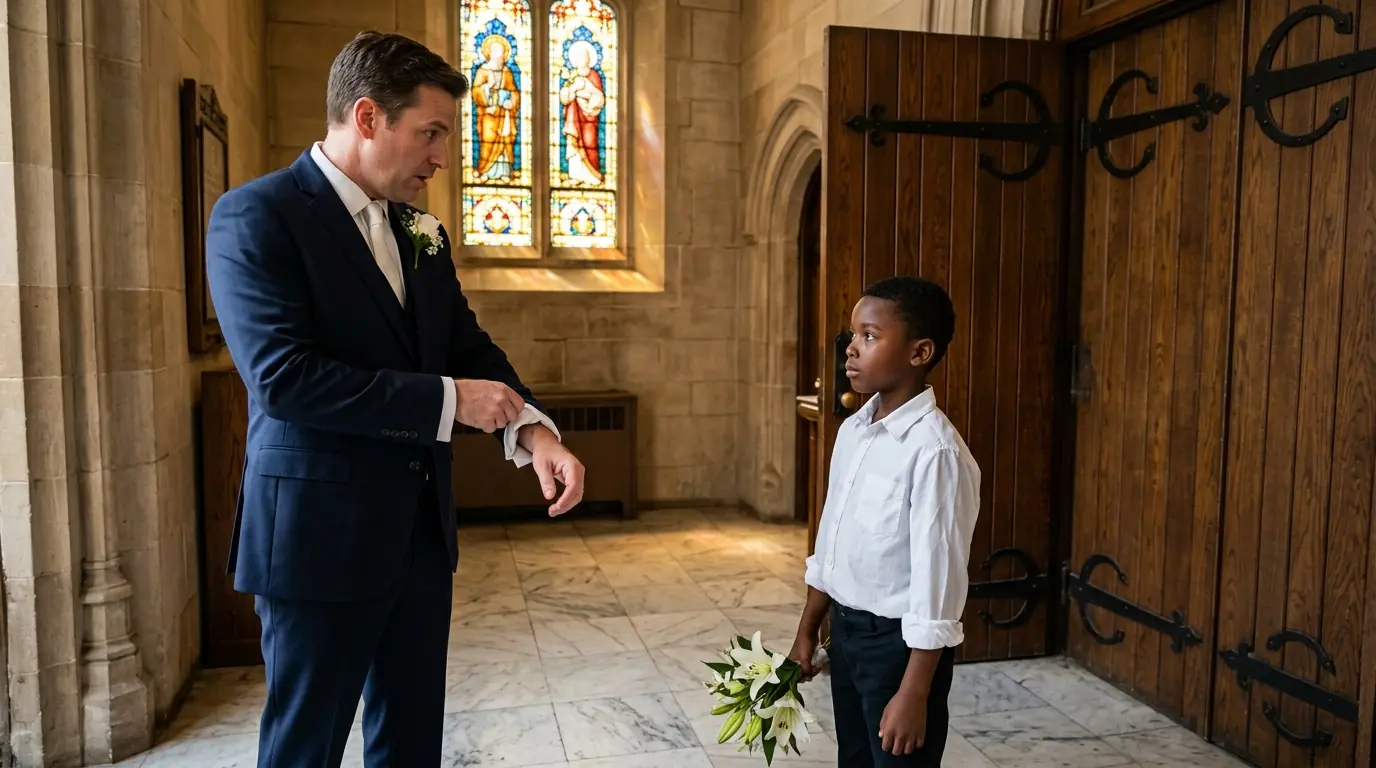
He was standing at the back of St. Augustine's Cathedral in the narrow vestibule where the groom waits before the doors open, adjusting the cuff of his shirt for the third time in 5 minutes.
The cathedral organ was already playing softly somewhere beyond the heavy oak doors, and he could hear the muffled hum of 300 guests on the other side—the same 300 guests whose names he had memorized from a seating chart his fiancée had handed him 2 weeks earlier.
Everything was exactly as it should be. The boutonniere was pinned straight. The rings were in the velvet box his best man had been carrying since morning. The light through the stained glass behind him made a small pattern of red and gold across the marble floor at his feet. And somewhere in the upstairs gallery, a violinist was warming up with a phrase Nathaniel half recognized from his mother's old records.
And yet the boy was still standing there in the side doorway near the sacristy, holding a small bunch of white lilies that was meant for the flower girl, watching him with a kind of steady patience that did not belong on a child.
"What did you say?" Nathaniel asked.
He recognized the boy, or thought he did: the son of the florist, maybe 9 years old, maybe 10. He had seen him an hour earlier setting candles along the aisle with his mother, the two of them working quickly and quietly, the way people work when they have been told to be finished before the guests arrive. The boy had looked up once when Nathaniel walked past, and Nathaniel had given him the small, polite nod he gave to people whose names he did not know, and the boy had nodded back.
"The ring on her finger, sir," the boy said, a little louder this time. "The one she has been wearing—it isn't real."
Nathaniel lowered his hand slowly from his cuff. He was a man who had built a life on not reacting to surprises. He was 43 years old. He was the chief executive of Carrington Maritime, a shipping company his grandfather had founded in 1947, and which had been written about in the financial pages of newspapers in six countries.
He did not change his wedding because a child appeared in a doorway. He did not change anything because of a feeling. He looked at the boy and tried to keep his voice steady.
"Son," he said quietly, "what is your name?"
The boy hesitated. Then he said, "Elijah."
"Elijah," Nathaniel repeated, the way a man repeats a name when he wants to fix it inside his head before he decides what to do with it. "Elijah, I think you should explain that to me, and I think you should do it quickly, because in about 4 minutes those doors are going to open, and I'm going to walk down that aisle. Whatever you have to say to me, you should say now."
The boy did not rush. He shifted the small bunch of lilies to his left hand and stepped fully into the vestibule, and then he reached up and pulled the side door closed behind him with both hands, careful not to let it slam.
Up close, Nathaniel could see that the boy's shirt was a borrowed white dress shirt with sleeves rolled twice at the cuffs to make them fit, and his black trousers were a little too short at the ankle. He smelled faintly of the eucalyptus the florists had been arranging at the altar all morning. His eyes were steady, the way the eyes of a child are steady when the child has decided, somewhere inside himself, that he is going to tell the truth even if no one believes him.
"I work with my mom on weekends," Elijah said. "We did the flowers for your engagement party back in May. We did the flowers for the rehearsal dinner last night, and we did the flowers for today. I have seen the lady you are marrying three different times in the last two months. Each time she has been wearing the ring you gave her, and each time, sir, the ring has been a little different."
Nathaniel did not move. He felt his own heartbeat in a place he was not used to feeling it, somewhere low under the bone of his chest. The cuff of his shirt was still half-buttoned. The organ outside the doors had moved into a quieter passage, the kind that comes just before a piece begins in earnest, and a small part of his mind noted the timing with a strange clinical calm, the way a man notes the time on a clock he is not yet ready to obey.
"Different how?" he said.
The boy took a small breath. His shoulders trembled once and then settled, the way a small bird settles on a branch after a long flight.
"At the engagement party," Elijah said, "she was wearing a ring with a big square stone, very clear, with two smaller stones on the sides. I noticed it because my mom said it was the most beautiful ring she had ever seen up close, and she let me look at it from a few feet away when the lady was talking to someone else. The stone caught the light in a way that made small rainbows on the wall behind her. My mom said that was because of how diamonds bend the light."
Nathaniel nodded slowly. He remembered the ring. He had spent four months choosing it. He had flown to a jeweler in Antwerp twice. The center stone was three and a half carats, cut to specifications his grandmother had recommended before she died, and the two side stones had come from a brooch that had belonged to his mother. He had given the ring to Vivian Ashford on a Sunday afternoon in March in the small garden behind his apartment on the river, and she had cried.
"Go on," he said quietly.
"At the rehearsal dinner last night," Elijah continued, "she was wearing a ring. It looked almost the same—the big stone in the middle and the two smaller ones on the sides—but the stone in the middle was different. It did not catch the light the same way. When she walked past the candles, the stone got bright for a second and then went dull. A real diamond does not do that, sir. My mom taught me. A real diamond keeps the light. A fake one shows it and then loses it. I watched her for almost 10 minutes from the corner where I was helping with the centerpieces. The ring did not behave like the ring from May."
Nathaniel felt the small marble floor under his shoes become very specific beneath his weight. He felt the weight of every guest on the other side of the doors. He felt the heavy oak of the doors themselves, in the 4 minutes that were now closer to 3.
"And today?" he said.
"Today," the boy said, "she came in through the side entrance about 40 minutes ago, the one near the sacristy. She was already in her dress. She walked past where my mom and I were finishing the altar arrangements. She was holding her hand a little strangely, almost closed, the way a person holds a hand when they don't want anyone to see what is on it. I saw her ring for only a second, but it was a different ring again, sir. The center stone was smaller. The setting was thinner. The two side stones were not the same size as each other. It was a ring that looked like the first one if you were not paying attention, but it was not the first one."