The boy's voice did not carry far, but it carried far enough. "That's not your driver, sir." Harlan Whitfield, who had been three steps away from the open rear door of the black sedan idling in front of Whitfield Tower, stopped without turning his head. He was holding a leather portfolio in one hand and a paper cup of coffee in the other, and for a moment the only thing that moved was the small line of steam rising from the lid. The morning was bright and clean, and the street smelled of rain that had ended an hour earlier. Forty floors above him, the windows of the building that bore his name caught the light in long sheets of gold.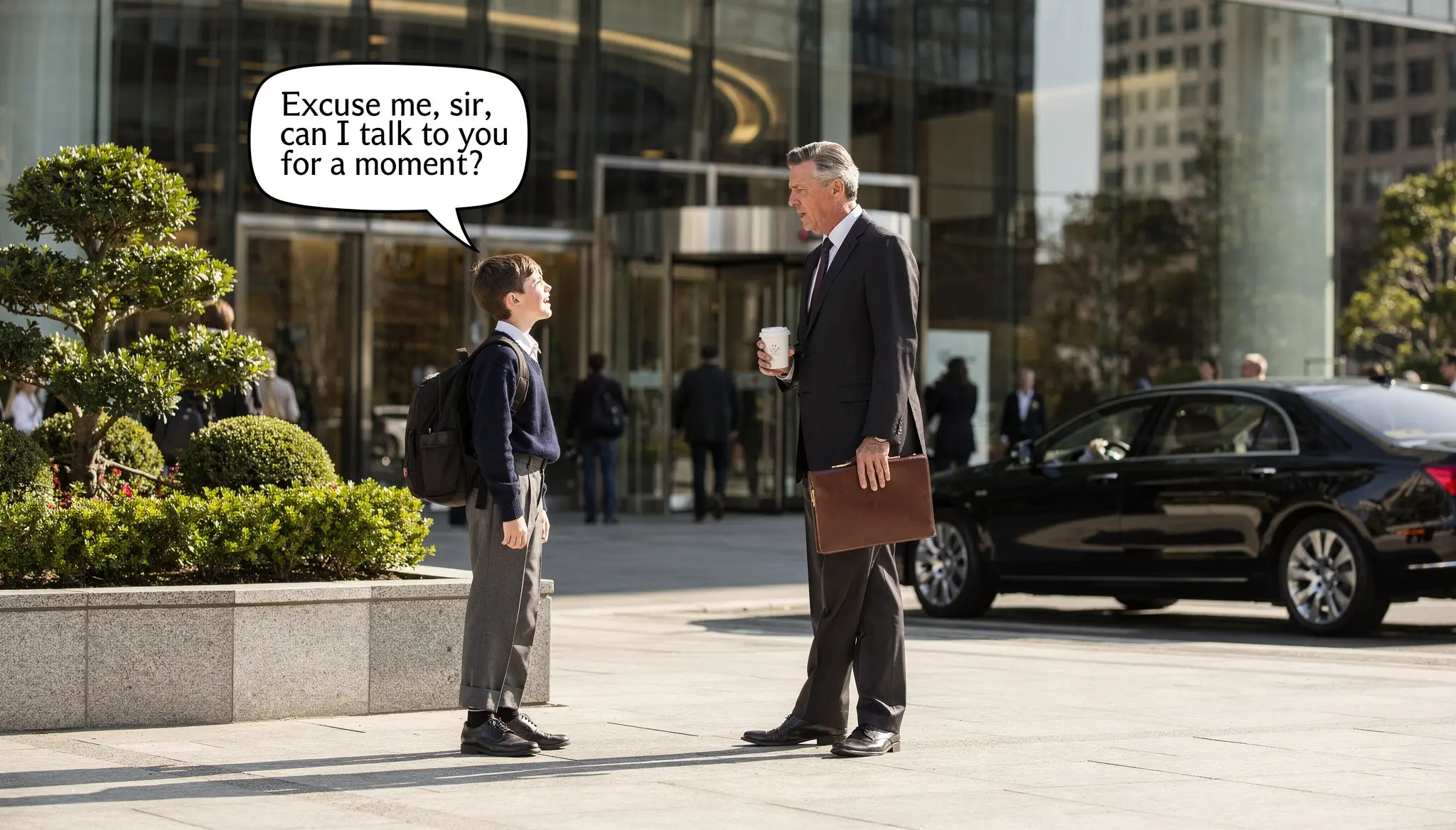
He turned his head slowly. The boy was standing on the wide stone planter that bordered the entrance, the way children sometimes stood when they wanted to be seen by a particular adult and no one else. He was thin and small for his age, perhaps ten or eleven, wearing a navy school sweater and gray pants that had been carefully pressed but were slightly too short at the ankles. His backpack hung from one shoulder, and his other hand gripped the strap as though he had been holding it that way for a long time before deciding to speak. "Excuse me?" Harlan said. "That's not your driver," the boy repeated. He did not point. He kept his hands where they were. "Your driver is the man with the gray hair and the limp, the one who always opens the door first and puts your bag in second. That man in the car is not him."
Harlan glanced toward the sedan. The driver sat behind the wheel with his face turned slightly away, one elbow resting on the door and the other hand near the gearshift. He wore a dark jacket and a chauffeur's cap pulled low. From this angle, in this light, and in the three short seconds Harlan had to look, the man could have been anyone. The car was right. The plate was right. The hour was right. Harlan had walked toward that car at exactly this time, on exactly this corner, on roughly two hundred mornings of his life, and not once had he looked carefully at the man behind the wheel. He looked now.
The driver did not turn his head. He should have. By now, a driver who had been waiting almost three minutes while his passenger stood on the sidewalk speaking to a child should have at least glanced in the side mirror. This driver was looking straight ahead at the empty street, very still, with the kind of stillness a person adopted when listening hard and trying not to be seen listening. Harlan brought his eyes back to the boy. "What's your name, son?" "Isaiah Brooks, sir." "Isaiah," Harlan repeated slowly, buying himself a few seconds. "How do you know my driver?"
"He picks me up sometimes, too, sir, from the back of the building, by the loading dock where my mom works. She cleans the offices on the thirty-eighth floor. Mr. Coleman drives her home on Tuesdays and Thursdays when her shift ends late because the bus stops running. He's been doing it for two years. He never charges. He says my mom reminds him of his sister." Isaiah paused, then said the next part more quietly. "He texted my mom this morning. He said his car wouldn't start and that a different company driver was coming for you. He said the new driver's name was Tomas. He told my mom because if she saw a strange car at the front of the building at eight-thirty, she shouldn't worry." Harlan did not move. He felt the coffee cup growing slightly heavier in his hand.
"And?" he asked. "The man in that car told the doorman his name was Patrick." Harlan Whitfield had spent thirty-one years building a company that moved cargo across four continents. In that time, he had developed a particular kind of stillness for moments when something important was about to happen. He used it in negotiations. He used it when a junior associate brought him bad news. He used it now.
He smiled at Isaiah the way a man smiled at a child who had just shown him a drawing, set his coffee cup gently on the stone planter beside the boy, and lifted his portfolio as if merely adjusting his grip. "Isaiah," he said quietly, "I want you to do something for me. Walk back through the front doors as if you're going to find your mother. Don't look at the car. Don't hurry. Wave to the doorman the way you always do. Once you're inside the lobby, stand near the security desk and wait for me. Can you do that?" The boy's eyes did not waver. "Yes, sir." "Good. Go now."
He did not wait for an answer from the driver. He turned and walked unhurriedly back through the revolving doors. Behind him, very faintly, he heard the soft click of a car door being unlocked from the inside. He did not turn around to confirm it. Inside the lobby, the polished floor and high ceiling made everything feel a degree cooler than the street. Isaiah stood exactly where Harlan had told him to stand, beside the long marble security desk, his hands still gripping the strap of his backpack. Garrett remained at his post by the door. Behind the desk, two members of the morning security shift looked up as Harlan approached. They had been with the company a long time. They knew his face. They also knew that he did not walk toward the security desk on an ordinary morning.
"Frank," Harlan said quietly to the older guard, "I need you to do three things in the next sixty seconds, and I need you to do them without raising your voice. Are you with me?" Frank Delaney straightened in his chair. "Yes, sir." "First, put the building on a soft lockdown. No alarm and no announcement. Close the side exits and place a man at the loading dock. Second, call the police, not the front desk and not the precinct line. Call Lieutenant Marsha Vance directly. Her number is in the emergency book. Tell her I am asking for her personally and that there is a man in a sedan in front of my building impersonating my driver." Frank reached for the telephone.
"Third," Harlan continued, "find Walter Coleman. He works for Hadley Car Service. I want to know where he is, and I want confirmation that he is safe. Do not allow anyone to leave the building who is not already in this lobby. Do you understand?" "Yes, sir." Frank picked up the phone. The other guard, a younger man named Pell, was already moving toward the side corridor. Harlan exhaled once, slowly, and turned to Isaiah. The boy watched him with the same steady eyes. Harlan knelt on one knee so that they were level and set the leather portfolio on the floor beside him. He did not care what it cost or what was inside it.
"Isaiah," he said quietly, "tell me everything you remember from the beginning, from the first thing that made you notice." The boy nodded once. He took a small breath, the kind a child took when he had been waiting to be asked a question and had rehearsed his answer in case he ever was. "My mom got a text this morning before the sun was up," he said. "It was on her phone on the kitchen counter, and I saw it while I was getting cereal. It was from Mr. Coleman. He said his car wouldn't start and he was sorry, but he had asked the company to send Tomas instead. He said Tomas was a friend and that you would be in good hands. He said he would call my mom later to check in."
Isaiah paused. "But twenty minutes later, my mom's phone buzzed again. I saw her read it. She got very quiet. She put the phone in her pocket and didn't tell me what it said. She only said we had to leave for the bus early. She walked me all the way to the building instead of letting me ride alone, which she never does on Wednesdays because she has to be on the thirty-eighth floor by seven." Harlan listened without interrupting. "When we got to the corner," Isaiah continued, "my mom looked at the front of the building for a long time before crossing the street. She kept her hand on my shoulder. She told me to go inside through the side entrance and find her later. Then I saw the car, and I saw the man in it. I knew right away it wasn't Mr. Coleman because Mr. Coleman is not a young man, and the man in the car was young."
The boy swallowed. "When I asked the doorman, he said the driver introduced himself as Patrick from Hadley. I thought that wasn't right either, because the text said the driver's name was Tomas." Harlan felt something tighten slowly behind his ribs. "Where is your mother now, Isaiah?" "I don't know, sir. She said she would meet me in the lobby, but she hasn't come down. I waited fifteen minutes by the elevators. Then I went outside because I saw your car pull up. I thought if my mom wasn't here, somebody had to tell you."
Harlan looked toward the long bank of elevators at the back of the lobby. Two were on the upper floors. The third was descending. He turned back to the boy. "What is your mother's name?" "Vanessa Brooks, sir." "Frank," Harlan said without turning his head, "do you have eyes on Vanessa Brooks from the cleaning service? She works on the thirty-eighth floor."
Frank was already speaking into a handset. He listened, asked a question in a low voice, and listened again. Then he looked up at Harlan. "She clocked in at six fifty-two, sir. She has not clocked out, but the supervisor says she stepped away from her cart about twenty minutes ago to take a phone call and has not returned." Harlan's mouth went dry in a way it had not for many years. "Pull the cameras," he said quietly. "Thirty-eighth floor. Every angle. Now."
Frank nodded and turned to a second monitor. Harlan looked down at Isaiah. The boy had not moved. He stood very still, his hands locked around the strap of his backpack, his face composed in the way small faces sometimes composed themselves when there was more fear inside than the face could comfortably hold. "Isaiah," Harlan said gently, "your mother is going to be all right. I am going to make sure of it. But I need you to stay here with Frank until I come back. Will you do that?" The boy nodded. Harlan stood, picked up his portfolio, and walked behind the security desk. Frank had brought up four camera feeds. The thirty-eighth floor was divided into a long central corridor, two glass-walled office suites, a small break room, and a service hallway behind the elevators leading toward a freight lift used by the cleaning staff.
The corridor was empty. The offices were empty. The break room was empty. The service hallway was empty. "Roll it back twenty-five minutes," Harlan said. Frank's fingers moved across the keyboard. The timestamps spun backward. Figures appeared, walked in reverse, and disappeared. At twenty-three minutes back, a woman came into view in the service hallway, pushing a tall cleaning cart. She stopped, took her phone from her pocket, looked at the screen, and raised it to her ear. She listened for perhaps thirty seconds. Then her free hand rose slowly to cover her mouth.
"That's her," Frank said quietly. "Keep going." Vanessa lowered her hand, looked once toward the elevators, then turned and walked quickly in the opposite direction, away from the cameras and toward the freight lift. She left her cart where it stood. The cart remained visible on two screens for the next nineteen minutes, motionless, with the small lamp on its handle still glowing. "Where does the freight lift go?" Harlan asked.
"Down to the loading dock or up to the roof, sir. Service access only. It doesn't stop in the lobby." "Pull the loading dock cameras." The loading dock appeared on the largest monitor. Two delivery vans were parked along the far wall. A maintenance worker checked a clipboard near the bay doors. There was no sign of Vanessa Brooks. "Roof cameras."
The roof access door was closed. The landing in front of it was empty. The camera above the door showed gray gravel and an HVAC unit humming in the morning light. "She didn't come out at either end," Frank said. "Then she is still inside the lift or got off on a floor between," Harlan replied. He turned toward Pell, who had returned from the side corridor. "Take two men. Start at the bottom of the freight shaft and work your way up. Open every service door. Do not treat her as a suspect. She is a frightened woman. Find her and bring her somewhere secure." Pell nodded and disappeared toward the service stairs.
Harlan turned toward the front of the lobby. Through the tall glass doors, the sedan was still idling at the curb. The driver's posture had changed. His head was now angled toward the entrance, and one hand rested on the steering wheel while the other remained out of sight below the dashboard. From this distance, Harlan could not see the man's face clearly, but he could see his attention. It was the attention of someone beginning to understand that the morning was no longer following the plan. "Frank," Harlan said quietly, "where is Lieutenant Vance?" "Six minutes out, sir. She has two units coming in without sirens. She asked you to stay inside the lobby and keep the boy away from the windows."
"Tell her I am going to keep the driver where he is. I do not want him deciding to leave before she arrives." Frank looked up. "Sir—" "Get Garrett on the radio." Garrett's voice came through a moment later, steady as it had been for nineteen years.
"Mr. Whitfield." "Garrett, I want you to walk out to the car at your normal pace. Tell the driver I have been delayed by a phone call. Apologize for the inconvenience and offer him a bottle of water. Do not let him see that anything is wrong." "Understood, sir." "And Garrett, keep your hands where he can see them."
Through the tall glass doors, Harlan watched Garrett step onto the sidewalk with the unhurried dignity of a man who had spent most of his working life standing in one place and being underestimated for it. He walked to the sedan at the same measured pace he had always used, raised one gloved hand in a small wave, and bent slightly to speak through the lowered driver's window. Harlan could not hear the words, but he could read the shape of the exchange. Garrett pointed toward the lobby as if explaining where Harlan had gone, then mimed the universal shape of a telephone call. The driver leaned back, nodded once, and said something brief. Garrett straightened, gave a polite wave, and returned to the building at the same unhurried pace. When he came through the revolving door, his expression was composed, but his eyes were not.
"He's nervous, sir," Garrett said quietly as he passed Harlan. "He kept looking at the side mirror. He has a phone facedown on the passenger seat. The screen lit twice while I was standing there, but he didn't pick it up." "Did he say anything?" "He said his name was Patrick. He also said the car belonged to Hadley, but the company decal on the dashboard is wrong. Hadley uses a blue circle with a white H. The decal in that car is a green diamond. I've been opening doors for Hadley drivers for nineteen years, sir. I know the right mark." Harlan nodded slowly. "Stay at your post. Do not look at the car again unless he gets out."
"Yes, sir." Harlan returned to the security desk. Isaiah stood exactly where he had been told to stand. He had not moved and had not looked toward the windows. He watched Harlan with patient attention that many adults might have mistaken for shyness, but Harlan was beginning to understand was something else entirely. "Frank, anything from Pell?" "He has cleared the bottom four service levels. He is working upward. Nothing yet. Hadley is also checking on Mr. Coleman. His wife answered on the third ring. She said Walter left for work at five-forty as usual. He told her he was picking up a regular client at six. She has not heard from him since."
Harlan closed his eyes for one brief moment. He pictured Walter Coleman, a quiet man with gray hair, a limp, and a small silver pin on the lapel of his jacket from a service tour completed before Harlan was born. Walter always opened the rear door with a small nod that was not quite a bow and not quite a greeting, yet somehow both. He also pictured Vanessa Brooks somewhere inside the building's service levels after receiving a call that frightened her enough to abandon her cart and hide. "Frank, send a wellness team to Walter Coleman's home address immediately. Use our private security contractor if necessary. I do not want to wait on a precinct line." "Yes, sir."
"And pull the street camera feed outside this building going back two hours. I want to know how long that sedan has been parked there and whether anyone got out before Walter was supposed to arrive." Frank's hands moved across the keyboard. The image of the sedan sharpened, then began to roll backward. Morning unwound in reverse. The light dimmed, a street sweeper backed away, a man with a dog walked backward down the sidewalk, and a delivery cyclist vanished around the corner. The sedan remained. At 6:09, it reversed into motion, then rolled backward down the street and disappeared. Frank stopped and replayed the segment forward. The sedan entered from the south end of the block, parked at the curb, and sat.
The driver did not get out. He did not check his phone. He did not adjust the mirrors. He sat behind the wheel with his hands in his lap and his face turned toward the building entrance. He stayed that way for two hours and twenty-one minutes. "Two hours, sir," Frank said quietly. "He's been there since just after six." "Walter Coleman was supposed to pick me up at eight twenty-five," Harlan said. "Hadley always sends him early because Walter would rather wait at the curb than be one minute late. Whoever sent that message from Walter's phone knew exactly when he would be on his way."
He studied the frozen image of the driver. The man looked to be in his early thirties, lean and clean-shaven, with the kind of carefully ordinary face that resisted memory. Harlan was almost certain he had never seen him before. "Run his face," Harlan said. "Through what, sir?" "Start with the building's visitor logs for the past six months. Vendors, contractors, delivery people, anyone who signed in at the front desk. Then use whatever public databases our security contractor can legally access. I want a name."
Frank began the search. Faces appeared in columns on the monitor, matched for seconds, and fell away. A small wheel turned in one corner. Then Pell's voice came through the radio, low and urgent. "Sir, I have her. Twenty-seventh-floor service corridor. She is inside the cleaning supply room. The door was locked from the inside. She opened it when I said your name." "Is she hurt?"
"No, sir. She's shaking, but she is not hurt. She keeps asking about her son." "Tell her Isaiah is with me and is safe. Bring her down through the back stairs, not the elevator. Take her to the small conference room on three and stay with her until I arrive." "Yes, sir." Harlan turned to Isaiah. He had not realized how tightly he had been gripping the edge of the security desk until he released it. He knelt again.
"Your mother is safe, Isaiah. She is upstairs. Pell is with her, and he is bringing her down through the back of the building. I will take you to her in a few minutes. I need you to be patient with me a little longer. Can you do that?" The boy nodded. His shoulders dropped by a fraction of an inch. It was the first time since speaking on the sidewalk that he had allowed any part of himself to ease. "Sir," Frank said. His voice was tight. "I have a match." Harlan stood and moved around the desk. Two photographs appeared side by side. On the left was the driver sitting at the curb that morning, captured in three-quarter profile through the windshield. On the right was an older, grainier photograph of the same man in a different jacket and with shorter hair, standing outside a courthouse.
Below the image was a name. "Lukas Petrov," Frank read. "Where is that from?" "A court appearance in Newark eighteen months ago. He was a witness, not a defendant. The case involved a kidnapping for ransom."
Harlan looked at the photograph for a long moment. Petrov had the unremarkable face of someone who had learned early that being remembered could be dangerous. "What was the case?" Frank opened the docket. "Three men abducted the adult son of a real estate developer in Bergen County. They held him in a warehouse for eleven days while demanding payment. The victim was returned alive. The defendants were convicted. Petrov testified for the prosecution in exchange for immunity. The file describes him as a low-level participant who cooperated when federal charges were filed." "Where has he been since?"
"There is nothing in the public record after the trial. No employment, no address, no court appearances. He went quiet." "He did not go quiet," Harlan said. "He went professional." He turned toward the front of the lobby. The sedan was still there, and Lukas Petrov was still inside it. Through the glass, Harlan could see the man's posture had shifted again. His shoulders leaned forward, and his head angled toward the phone on the passenger seat. He was waiting for an instruction that was not arriving on schedule. "Frank, how far out is Lieutenant Vance?"
"Two minutes." "Tell her not to come down this street. One unit at the north corner and one at the south. I do not want him seeing police vehicles and running before they can contain the block. When she is in position, she should call me." "Yes, sir." Harlan stepped away from the desk and rested one hand briefly on Isaiah's shoulder.
"I am taking you to your mother in a moment. There is one last thing I need to do. Stay with Frank." "Yes, sir." Harlan walked toward the revolving doors. Garrett straightened as he approached. "Sir?"
"I am going to speak to the driver. I will not get in the car. I will stand beside the rear door and keep him talking until Lieutenant Vance is in position. You stay exactly where you are. If he gets out or makes a sudden move, you follow the police instructions and get everyone away from the entrance." Garrett's face tightened. "Sir, let the lieutenant handle him." "She will. I am not going to confront him. I am only going to make certain he remains where he is for two more minutes." Garrett studied him, then nodded once.
Harlan pushed through the revolving door and stepped onto the sidewalk. The morning had warmed slightly. The street was nearly empty. He walked at his ordinary pace, portfolio in one hand, coat unbuttoned, as though approaching one of the hundreds of cars that had waited for him on this curb. When he reached the sedan, he did not open the rear door. He stood beside it and looked through the driver's open window. "Patrick," he said pleasantly. The driver's head turned. The face Harlan had seen on the monitor was now three feet away. The eyes were lighter than the photograph suggested, a pale, steady gray.
"Mr. Whitfield," the man said. His voice was soft and unhurried. "Everything all right, sir?" "Everything is fine." Harlan rested one hand lightly on the window frame. "I apologize for the delay. A compliance officer needs a signature before I leave. I said five minutes, but it may be closer to ten." "Of course, sir."
"Have you eaten breakfast, Patrick?" The driver hesitated for only a beat. "I have, sir. Thank you." "Good. Garrett may bring you a coffee anyway. He gets bored when there are no doors to open. Indulge him." Harlan smiled with the expression he had perfected in thirty years of boardrooms. It did not reach the corners of his eyes, but few people ever noticed that.
"How long have you been with Hadley?" "Three months, sir." "What did you do before?" Another hesitation, smaller this time. The driver was finding his rhythm again.
"Private security for a family in Westchester. The contract ended." "Steady work. Why the change?" "They moved overseas, sir." Harlan made himself look thoughtful. "Which family? Westchester can be a small world."
The pale gray eyes shifted briefly toward the building entrance and returned. "The Hendersons, sir." "I don't know them. What does the father do?" "Finance, sir." "Most of them do."
Harlan laughed softly. The driver laughed, too. His laugh did not reach his eyes either. "Walter Coleman has driven me for a long time," Harlan continued. "Did Hadley tell you why he is not here this morning?" "Car trouble, sir. His vehicle wouldn't start." "And he is at home?"
"I believe so." "Good. I will call him later. He worries when his routine changes." Harlan let his hand slide a fraction along the window frame as though preparing to step away, then paused as if remembering something unimportant. "One more thing, Patrick. You said the company decal on your dash is green. Is that a new logo? I thought Hadley used a blue circle."
The driver did not look at the dashboard. His left hand, which had been resting on the wheel, drifted a few inches lower and out of sight. His right hand stayed where it was. Only his eyes moved, briefly, toward Harlan's hand on the window frame. "They rebranded last month, sir." "That is the trouble with rebranding. Half the cars look as though they belong to someone else." A dark SUV turned the north corner at the far end of the block and stopped. A second vehicle appeared from the south ten seconds later. Neither used lights or sirens. Plainclothes officers stepped out and began moving toward the sedan from both directions without hurrying or staring directly at it.
Lieutenant Marsha Vance had positioned her people exactly as requested. The driver's eyes flicked once toward the north, then south. The pale gray went very still. "Patrick," Harlan said softly, "keep both hands where I can see them." The driver looked at him. "Step away from the car, sir. Now."
Harlan did not step away. He kept his voice level. "There are officers around this vehicle. I am asking you not to make a movement that will turn this into something worse. Put both hands on the wheel, slowly. A court should hear who sent you here and what they planned. You can still choose to walk away from this alive and answer questions." The driver did not respond. His chest rose and fell in the controlled rhythm of a man counting breaths to keep his hands steady. From the corner of his eye, Harlan saw the officers close the distance. "Hands on the wheel," he repeated quietly. "Both of them. Slowly."
For a long moment, nothing happened. Then the driver's left hand rose from below the dashboard. Both hands came to rest at the top of the steering wheel. "There," Harlan said. "Thank you." The officers reached the car. Lieutenant Vance came to the driver's window with calm, practiced focus. She gave precise instructions, and Petrov obeyed. The engine went silent, the keys landed on the pavement, and the door opened. He was removed without a struggle and handcuffed beside the sedan. Under the dashboard, officers found a small handgun secured beneath the steering column. It was photographed, made safe, and placed in an evidence bag.
Harlan stepped away from the vehicle. For the first time since setting his coffee on the planter beside Isaiah, he felt the tremor that had been waiting in his right hand. He placed the portfolio on the sidewalk and pressed his palm against his thigh until the shaking passed. Lieutenant Vance walked over. She was a small woman with a face weathered by twenty-four years of work and eyes that seemed weathered by none of it. She looked at Harlan with a mixture of professional gratitude and personal exasperation. "Mr. Whitfield." "Lieutenant."
"That was a foolish thing to do." "It was." Her eyes moved toward the lobby. "Was the boy yours?" "No. He is the son of Vanessa Brooks, one of the cleaning staff on the thirty-eighth floor. She is safe upstairs. I would like to take him to her now."
Vance studied him for a moment. The exasperation in her face softened. "Go," she said. "I will need statements from all three of you, but they can wait twenty minutes." Harlan picked up his portfolio and walked back through the revolving doors. Isaiah was still beside the security desk, one hand on the strap of his backpack. He had not looked toward the windows and had not asked Frank a single question. Harlan crossed the lobby and held out his hand. "Come with me, Isaiah."
The boy took it. It was the first time anyone in that building had ever held Harlan Whitfield's hand and the first time in many years that Harlan had allowed his own hand to be held. They walked together toward the elevators, past the polished floor, the high ceiling, and the long bank of brass mailboxes. As they walked, Harlan understood that something in the architecture of his ordinary morning had been permanently rearranged. Vanessa Brooks was waiting in the small conference room on the third floor. She stood when the door opened, and her hand went to her mouth in the same way it had on the camera footage. Then she dropped to her knees on the carpet and wrapped her son in both arms. For almost a full minute, no one spoke. Pell remained quietly beside the door. Harlan stood by the window while morning light moved across the table, across the woman and the boy, and then across the floor.
When Vanessa finally looked up, her face was wet but her voice was steady. "Walter," she said. "Have you found Walter?" Harlan had expected the question, though he had hoped it would come later. "The security team reached his apartment seven minutes ago," he said gently. "He was unconscious in his kitchen. He is being taken to Mercy General now. He is breathing on his own. The first indication is that someone put something in his coffee, but they believe he will recover."
Vanessa closed her eyes. Isaiah pressed his forehead against her shoulder. "He is a good man," she said quietly. "He picked Isaiah up from school when I had to work overnight. He never asked for anything. He just did it." "I know," Harlan said. "I will make certain he receives whatever care he needs for as long as he needs it. You have my word." Vanessa nodded. She did not say anything more because nothing more was required in that moment.
In the weeks that followed, the case unwound slowly and in pieces. Lukas Petrov eventually gave investigators the names of the people who had paid him in exchange for a reduced sentence. Those names led to a small group of investors who had been quietly losing a great deal of money in a shipping deal with Whitfield Logistics. They had decided, in the way desperate men sometimes did, that the simplest solution to a contract dispute was to remove the man who held the controlling vote. Three were indicted within the month, and a fourth was indicted before the end of the year. None of them ever saw the inside of Harlan's office again.
Walter Coleman recovered and returned to work in the spring. Harlan met him at the curb on his first morning back and helped him into the back seat of his own sedan. Walter argued about the arrangement for three blocks before finally allowing himself to be driven home.
Vanessa Brooks accepted a new position in the building, leaving the cleaning roster for a role in the operations office. The salary allowed her to stop working overnight shifts and gave her more time with Isaiah. Harlan had recognized that her knowledge of the building, her composure under pressure, and her instinct to protect others were worth far more than the title she had carried before.
Isaiah continued at his school and later attended a better one. Harlan paid for every year without once calling it a gift. He understood that the boy had not spoken for praise or reward. Isaiah had spoken because he had noticed something wrong and believed an adult's life depended on someone telling the truth.
A child with steady eyes and a careful voice had saved a powerful man's life on an ordinary Wednesday morning. Harlan spent the rest of his life remembering that the smallest voices were sometimes the only ones telling the truth. He also remembered that Isaiah had recognized danger not through wealth, technology, or authority, but because Walter Coleman had treated a cleaning worker and her son with enough kindness to become known to them.
The car, the plate, and the hour had all appeared correct. The human being behind the wheel had not. Isaiah knew the difference because he knew Walter's gray hair, his limp, the order in which he opened a door and lifted a bag, and the quiet way he helped Vanessa when the buses stopped running. In the end, those small details were what saved Harlan Whitfield.
The powerful man made certain the boy, his mother, and the old driver who had cared for them were never again treated as invisible.