She rode three days through wind and stone to marry a man who took one look at her and laughed. Gideon Mercer stood in the middle of Harrow Creek's main street, surrounded by every soul in that settlement, and told Clara Whitlock she wasn't what he'd pictured. Not good enough. Not pretty enough. Not enough.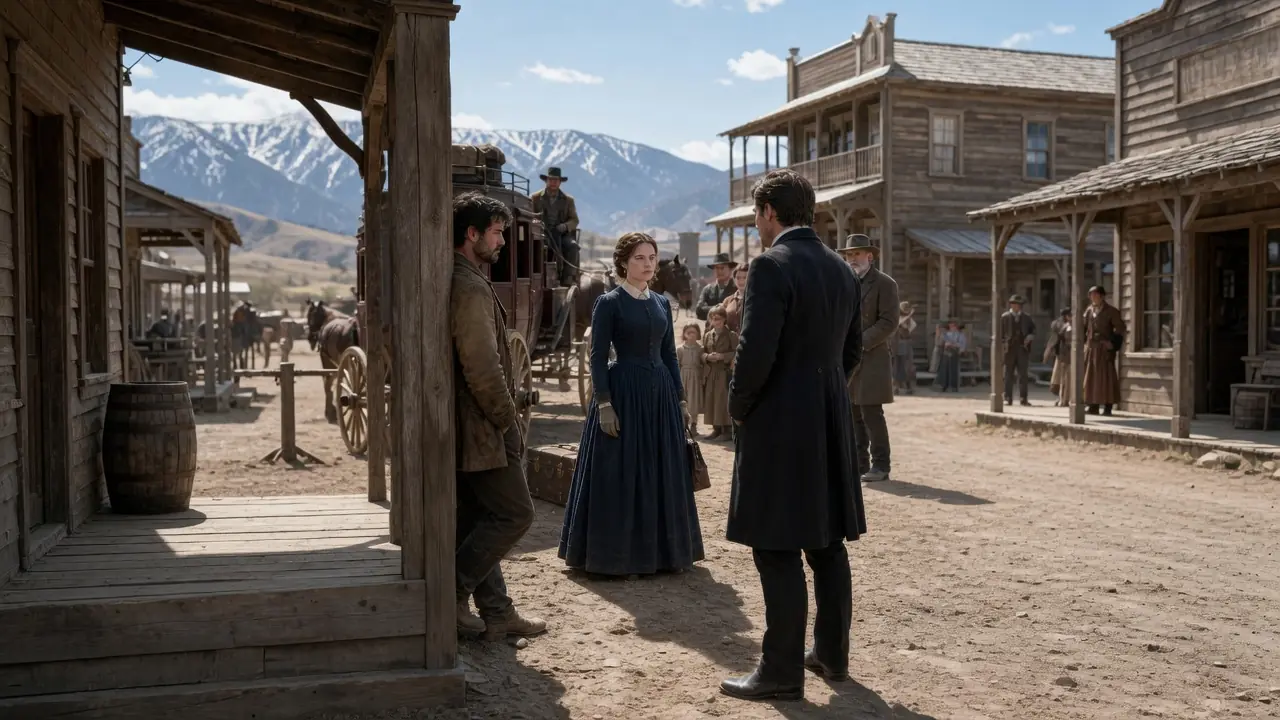
And just like that, she had nothing. No husband, no home, no way back east, and not a single person willing to meet her eyes. But one man stepped forward, a trapper who owed her nothing. A stranger who gave her everything she needed just then. Someone willing to stand between her and the worst moment of her life.
This is her story. The stage lurched hard to the left, and Clara grabbed the leather strap above her head just in time to keep from sliding into the window frame. Outside, the mountain road had gotten narrower somewhere past noon, and the driver, a heavy-set man named Obiee, who smelled like pipe tobacco and old wool, hadn't slowed down once for any of it. She'd been on this coach for three days. Three days of rutted roads and cold nights at relay stations where the blankets were thin and the other passengers were strangers who didn't talk.
Three days of watching the landscape change from rolling prairie to pine dark foothills to these sharp gray mountains that looked like they'd been broken off from something larger and left here to jut against the sky. Clara pressed her forehead against the window glass and watched the valley below come into view. Harrow Creek sat at the bottom of it, a cluster of wooden buildings along a single wide street. A church steeple that tilted slightly to the east, smoke coming from three or four chimneys, a water tower, a livery stable, maybe 200 people if you counted the homesteads spread into the surrounding hills. Smaller than she'd imagined.
She'd imagined it bigger. In her lap sat the letters. She didn't take them out. She'd read them so many times she could recite them without looking. Gideon Mercer had written six letters over the course of four months.
He described himself as a responsible man, a landowner, a man of industry who needed a capable woman beside him to build something lasting in the Colorado mountains. He described Harrow Creek as a growing community with real opportunity. He described himself as lonely. Clara Whitlock was 28 years old. She had worked eight years as a seamstress in a shop in Wichita that belonged to someone else, and she had saved enough money to make a change.
And the change had come in the form of a letter placed in a matrimonial circular by a man named Gideon Mercer. She was not a romantic fool. She knew this arrangement was practical on both sides. She had gone into it with her eyes open, or at least she had told herself that, which was almost the same thing. The coach rolled down the last switchback and into Harrow Creek just past 2:00 in the afternoon.
He was waiting for her. That much he'd promised, and he'd kept that part. Gideon Mercer stood on the boardwalk in front of the general store. He was taller than she'd expected, broad across the shoulders with dark hair and a square jaw that would have been handsome if his expression weren't so flat. He was dressed well, better than most men in a town this size would bother with on a Tuesday afternoon.
His boots were clean. There were other people nearby. Not a crowd exactly, but enough. A woman in a green dress stood outside the milliner's with two children. Three men sat on the bench outside the barber's.
An older man leaned against the post of the land registry office with his arms crossed and his hat low. Clara stepped down from the coach. She was wearing her best dress, blue wool, the color of a cloudy sky, with a white collar she'd pressed carefully at the last relay station the night before. Her brown hair was pinned neatly. She was aware of being looked at.
She was used to that. Walking into rooms full of strangers was something she'd learned to do without flinching. She crossed the street toward him. Gideon Mercer's face did not change as she approached. He looked at her the way a man looks at something he ordered from a catalog and isn't sure he wants to return, but is seriously considering it.
"Miss Whitlock," he said. Not a question. "Mr. Mercer. " She put out her hand. He didn't take it.
That was the first sign and her stomach dropped just slightly. Not all the way, not yet. But enough that her hand dropped back to her side and something behind her eyes went carefully still. "You look different than I pictured," he said. "People generally do.
" He made a small sound that wasn't quite a laugh. "I mean, you're He stopped. Looked her over again in a way that was not kind. "You're older than I expected. Your letter said 26.
" "I'm 28. I wrote that in my second letter. I corrected it. " "Well. " He put his hands in his coat pockets.
"That's a significant difference. " Clara looked at him steadily. Her heart was beating hard enough that she could feel it in her throat, but her face stayed level. She'd learned that a long time ago. Keep your face level.
"Is it? " "For a man in my position looking to start a family. " He said it like she was supposed to agree with him, like she was supposed to understand and graciously withdraw. She was aware of the people watching. The woman in the green dress had gone still.
The men on the bench had stopped talking. The older man by the land registry had straightened up. "I made a three-day journey," Clara said. Her voice was quiet. "On the basis of your letters and your invitation.
" "I'm sorry for that," Gideon said. And he didn't sound sorry at all. He sounded mildly inconvenienced, the way a man sounds when he has to explain something obvious to someone slow. But I think it's better to be honest now than dishonest later. You're not what I was looking for.
I think for both our sakes, we should part ways here. The street was very quiet. Clara stood there for a moment that stretched out long and ugly in every direction. Her trunk was still on top of the coach. She had $42 in an envelope sewn into the lining of her coat.
She knew no one in this town, no one in this state, and the nearest place she'd come from was 3 days away. She did not cry. She wanted to, somewhere down under everything, but she was not going to do that here. "Very well," she said. She turned back toward the coach to figure out what came next.
Her legs felt strange, like they were someone else's. The ground felt uncertain. She was calculating without meaning to. $42, the coach fare back east, whether Obieee had already started unhitching the horses, whether she had enough to stay somewhere tonight while she thought. "That was a poor showing.
" The voice came from her left, low, flat, not directed at her, but clearly about the scene just witnessed. She turned. The man standing there was leaning against the corner post of the building beside her. He was dressed like a working man, heavy canvas jacket, worn boots, dark trousers tucked into them. He was somewhere in his mid-30s with a jaw that needed shaving and dark eyes that were currently fixed on Gideon Mercer with an expression that was not quite contempt.
Something colder than contempt, actually. Something quieter. Gideon looked at him. "Nobody asked you, Calder. Nobody asked you to make a scene on the main street, either," the man said.
"But here we are. " "This is between me and You made it a public matter the second you did it in the street with an audience. Calder pushed off the post and turned to Clara. "Ma'am, do you have somewhere to be tonight? " She looked at him.
She had no idea who this person was. "No. I've got a spare room. " He said it like it was a practical statement, which it was. My place is up in the hills. It's not much, but it's clean and it's private and you'd have it to yourself.
You don't know me, she said. You don't know this town either, he said. And the hotel charges more than it should and the woman who runs it talks. He glanced at Gideon briefly, then back at her. It's your choice.
I'm just offering. She looked at him for a long moment. She was good at reading people. Years of dealing with the public in the shop had sharpened that in her. This man was not performing concern.
He was not trying to impress anyone. He was offering something practical in the same tone he'd probably used to offer a match to someone whose fire had gone out. She looked back at Gideon, who was watching with his jaw tight and something behind his eyes she couldn't name. Thank you, she told the stranger. I'll take the room.
His name was Rhett Calder and he'd been trapping in these mountains for 7 years. She learned that on the ride up to his place, which took almost an hour on a trail that climbed steadily into the pines. He drove a wagon that had seen better decades, pulled by a bay horse named Hector, who clearly had opinions about the steepness of certain grades. Clara sat on the bench beside him with her trunk loaded in the back and her hands in her lap. He didn't talk much.
What he said was direct and without embellishment. I've got the main cabin and a loft room on the north side. The loft's got a window and a door with a latch. Wood stove on the main level keeps it warm enough. How far from town?
Hour, if you move steady. Less if you know the short trail. Do you go to town often? When I need to. She looked at the trees moving past.
Why did you help me? He was quiet for a moment. Mercer's an idiot, he finally said. And the way he did it was worse than the thing itself. There wasn't any call to do it like that.
You could have said nothing. I could have, he agreed. She waited, but he didn't add anything else. She decided that was probably a complete answer. The cabin surprised her.
It was larger than she'd expected. Two solid rooms with the loft above, chinked log walls, a stone fireplace that dominated the main room. The furniture was plain, but made to last. A work table, two chairs, a cast iron stove with a flat top, shelves along one wall stacked with trapping supplies, a few books, canned goods, a hanging rack of tools near the door. It was not dirty, exactly, but it was a place where a man had lived alone for a long time and had let things slide in the ways that didn't bother him.
The grease build-up on the stove top, the layer of dust on the upper shelves, the stack of mending piled in a corner that had probably been there since summer. Rhett carried her trunk up the loft stairs without being asked and left it at the foot of the narrow bed up there. The loft room had a window that looked east toward the valley, and in the late afternoon light she could see all the way down to the flat brown thread of Harrow Creek sitting in the distance below. Blankets in the chest, he said from the doorway. There's water in the pitcher on the shelf.
I'll get the stove going. He left, and she heard him downstairs moving with the efficient quiet of someone who'd lived alone long enough to stop making noise out of habit. Clara sat on the edge of the bed for a moment. She was exhausted, not just from the journey, from the whole day, from the specific particular misery of standing on that street and being looked over and found wanting in front of a town full of strangers, from the way Gideon had said older than I expected, like it was something she'd done to him on purpose. She pressed her palms flat against the quilt.
Then she stood up, went to the window, looked at the valley for a long minute, and made a decision that was less of a decision than a setting of her jaw. She was not going back on the next coach. She had $42, a skill set, and a spare room in a mountain cabin. She would figure out what came next from here. The first week was awkward in the particular way that two strangers sharing a small space is always awkward.
He came back by early evening, quiet and cold from the mountain air, and they'd eat whatever she'd made with whatever was available, and then he'd sit by the fire for an hour with one of his books, and she'd work on the sewing she'd started. Mending his pile first since she'd asked and he hadn't objected. She was not his housekeeper. She wanted to be clear about that in her own head. She helped with the house because she needed to do something with her hands, and the alternative was sitting in the loft staring at the valley, which was not something she intended to do.
She cooked because she'd always been good at it, and because the man's pantry situation, while not disastrous, was unimaginative. She took stock of what he had on the third day. Dried beans, salt pork, corn meal, a sack of flour that was still good, some dried apples, potatoes, a crock of lard, and a collection of spices that told her someone at some point had cared. There was cinnamon and nutmeg and even a half-empty jar of dried thyme. She made a proper soup from the beans and the salt pork with some of the potatoes and the thyme, and served it that evening with cornbread.
Rhett sat down, looked at the bowl for a moment, and ate the entire thing without comment. When he was done, he carried his bowl to the washbasin. "That was better than what I do," he said, not looking at her. "It's not hard," she said. "You had everything you needed.
You just weren't using it right. " He turned around and looked at her for a moment with an expression she couldn't read. Then, "All right," he said, and that seemed to settle something. She went down to town on the fifth day. She needed to send a letter.
One to her sister in Ohio explaining what had happened, and one to the shop in Wichita because she'd left on good terms, and she wanted them to know she wasn't dead. She also needed to know what was available in Harrow Creek in terms of work. Rhett had offered to drive her, but she told him she'd take the short trail. She'd learned it the day before walking it with him when he showed her where the firewood stack was and how to get there and back without getting turned around. The town looked different when she wasn't arriving in it for the first time with her heart in her throat.
It was still small, but it was functional. A post office that also sold hardware, a general store, a schoolhouse at the east end of the street that was clearly newer than the other buildings. A doctor's office with a shingle that swung in the wind. A saloon at the west end that she noted and intended to avoid, not from any particular moral position, but because she'd found that frontier saloons were places where people felt licensed to ask rude questions. She went to the post office first.
The man behind the counter, he introduced himself as Hal Ingram, and she recognized him as one of the men who'd been sitting on the bench outside the barbers. Handed her paper without comment, but his expression was the expression of a man with a great many things he wanted to say and was currently choosing not to. She wrote her letters standing at the tall counter, finished them quickly, paid the postage, and was turning to leave when the woman in the green dress walked in. Up close, she was younger than Clara had thought, maybe 23 with red hair and a direct way of looking at people. She stopped when she saw Clara.
"You're the woman Rhett Calder took in," she said. Not unkind, just the way people in small towns say things when they've already talked about you and aren't going to pretend they haven't. "I'm renting a room," Clara said. "I'm Clara Whitlock. " "Nora Fitch.
My husband's the doctor. " She looked Clara over, but it wasn't the same kind of looking over as Gideon's. It was more like assessment, like someone trying to figure out whether to trust something. "I heard what happened with Mercer. It sounds like everyone did.
" "This town doesn't have anything else to talk about in November. " Nora paused. "For what it's worth, I thought he was rotten about it, the way he handled it. " "It wasn't ideal," Clara agreed, keeping her voice even. Nora seemed to decide something.
"Do you have work? " "Not yet. I'm looking. Ada Greer runs the schoolhouse. She's been managing 32 children by herself since September because her assistant went back east to get married.
It's not a fortune, but it's regular. " Nora glanced out the window at the street. "I'd be glad to introduce you if you want. Tomorrow morning, maybe? " Clara looked at her for a moment.
She was not used to offers from strangers, but she was learning to recognize the genuine ones. "I'd appreciate that," she said. Ada Greer was a small woman in her 50s with iron gray hair, steel-rimmed spectacles, and the kind of efficient manner that suggested she had very little patience for anything that wasted her time, but a great deal of capacity for things that didn't. She looked at Clara the way she probably looked at a new piece of curriculum, with skepticism and careful attention. "You've taught before?
" "I can read, write, and do arithmetic through long division," Clara said. "I haven't taught formally, but I've I learn to work with people quickly. I'm patient and I'm organized and I don't lose my head under pressure. " "32 children will test all three of those things," Ada said. I imagine they will.
Ada took off her spectacles, polished them on her sleeve, put them back on. Three days a week to start? If you're still here by December, I'll add a fourth. She paused. Are you still going to be here?
Yes, Clara said without hesitation. Ada nodded once. Monday, then. she told Rhett that evening while they were eating dinner. Found work at the schoolhouse, she said.
Starting Monday. He looked up from his plate. Ada's school? Yes. A pause.
Ada's particular. I noticed. She doesn't keep people who don't hold up. I know, Clara said. She met his eyes across the table.
I'll hold up. He held her gaze for a moment and then something in his expression shifted. Not quite a smile, more like the easing of a tension she hadn't known he was carrying. All right, he said, and went back to his dinner. The days developed their own rhythm.
Monday, Wednesday, and Friday, she went to the schoolhouse. The rest of the time she was at the cabin. Rhett moved his schedule around the trail conditions and the weather without consulting her, but she noticed, and he probably knew she noticed, that on the days she was home, he made sure the wood box was full before he left in the morning. She learned gradually the geography of his silences. There were the silences that meant he was thinking.
There were the silences that meant he was tired. There were the silences that meant he was uncomfortable with something but not going to say so, which were distinguishable from the other kinds by a slight tension in his shoulders. And there were the silences, which she encountered more and more as November deepened into the cold, that were simply companionable. Where they were both in the same room doing different things, and it didn't feel like absence. That last kind she found she better than she'd expected.
She'd asked him once about 2 weeks in when a conversation about the water situation at the cabin had stretched into a longer discussion about the property, how long he'd been up here alone. "7 years. " he said. "All alone? " "Mostly.
" She looked at him. "Doesn't that" She stopped. Reconsidered. "Doesn't it get very quiet? " He was quiet for a moment in the ironic way then.
"Yes. " he said. "It does. " She didn't push past that. But she thought about it later up in the loft room with the wind off the mountain making the window rattle in its frame.
"7 years alone up here. " That was a long time to let things get quiet enough to settle into every corner of a person. She wondered sometimes what had made him stay. She didn't ask. Some things she'd learned you left alone until the other person was ready to bring them out.
Sometimes they never were. And that was their right. The first real conversation happened on an evening in mid-November when a snowstorm came down off the higher peaks and made the mountain road impassable and they were both stuck inside by the fire with nowhere to go and nothing to do but either talk or sit in separate silences. Rhett had been sharpening his hunting knife for 20 minutes and Clara had been attempting to read one of his books, a history of the Hudson Bay Trading Company which was more interesting than she'd expected. And then the wind hit the cabin like something with a grudge and the fire jumped and they both looked up.
"Good timing. " she said. "Usually comes before December. " he said. "Early this year.
" She looked at the fire. Snow was audible against the window now, a dry hiss. "I was afraid of this kind of weather as a child. " she said. "We lived in a house in Ohio that wasn't well built.
When the wind came, you could feel it inside. " "Ohio. " He looked at her. Long way from Colorado. I know.
She set down the book. I had a plan before I came here. A different kind of plan. I thought this would be simpler. Marriage?
The arrangement. She picked at the cover of the book. I wasn't under any illusions. I knew it was practical on both sides. I wasn't expecting I wasn't expecting to be standing on a street being looked at like a returned parcel.
He was quiet. His hands had stopped moving on the knife. I keep thinking about it, she admitted. I don't want to think about it, but I keep coming back to his face, the way he She stopped. The worst part isn't what he said.
It's that he said it out in the open, like I didn't deserve the basic courtesy of a private conversation. He's the kind of man, Rhett said slowly, who needs an audience. Always has been. When he does something, there have to be witnesses, good or bad. He set the knife down on the table.
He wanted people to see him reject you because he thought it made him look like a man with standards. She looked at him. Did it? To some people, maybe, at first. He picked up the knife again.
Opinions change. She watched the fire for a while. Why do you live up here? she finally asked. She hadn't meant to, but the storm and the hour and the warmth of the fire had loosened something.
He was quiet for long enough that she thought he wasn't going to answer. I was married, he said finally. Before I came here, she died. Fever. Three years into it.
He kept his eyes on the knife. I came out here because I needed to be somewhere that didn't know what I'd lost. Somewhere the quiet didn't remind me of what should have been in it. She didn't say she was sorry. She could tell by his voice that he'd heard that enough times that it had worn smooth and lost its meaning.
Did it work? she asked instead. He thought about that. For a while, they sat in the storm for another long hour, and they talked. Not about heavy things, mostly, but about small ones.
She told him about the seamstress shop and the particular tyranny of the woman who owned it. He told her about a bear he'd tracked for 3 weeks along the northern ridge that had eventually outwitted him entirely, and he'd gone home empty-handed with a grudging respect for the animal. She laughed at that. A real laugh, not polished. And the sound of it seemed to surprise them both.
When she went up to the loft later, she lay in the dark and listened to the storm and felt, for the first time since she'd stepped off that coach, like she was somewhere she might be able to breathe. December came hard. Snow packed into the trail up from town, and the shorter path through the woods was dicey until Rhett spent 2 days clearing it with a hand ax. He didn't say why he did it. She suspected it was because she used that trail to get to the schoolhouse three times a week, and the alternative was the long way around, which added 40 minutes.
She didn't thank him out loud. She'd noticed he got uncomfortable with direct thanks for practical things. He'd deflect or look away. So, instead, she noticed, and she filed it away, and she made a point of doing things back in the same quiet register. She spent an afternoon recaulking the window in the loft, which had been leaking cold air around the frame.
She didn't tell him. He noticed anyway. She heard him tap on the frame the next morning with his knuckle, the small sound of a man checking someone else's work and finding it adequate. She started keeping track of what he ate and what he didn't, the same way she'd learned every customer at the shop and what they'd come back for and what they'd never buy twice. Rhett didn't like anything with too much sweetness.
He ate double portions of anything with salt and fat. He had a specific fondness for fried potatoes that he would never in a hundred years volunteer as information, but she'd figured out from watching. There was something she thought about sometimes, up in the loft with the cold pressing against the chinking and the stars outside her window, that she'd come all this way trying to enter a life that turned its back on her and somehow ended up in one that was quietly making room for her instead. Not dramatically, not with speeches, just room being made day by day without anyone saying so out loud. The children at the schoolhouse were, as advertised, a test of all three of the things she'd claim to be.
32 of them, ages 6 through 14, all in the same room. The youngest ones needed coaxing to speak. The oldest ones needed managing. Two of the boys in the middle range were conducting a private cold war over the ownership of a pocketknife and had been for 3 weeks before Clara figured it out and resolved it by confiscating the knife and telling them both to earn it back through demonstrated responsibility, which was a sufficiently ambiguous challenge to keep them occupied for the foreseeable future. Ada watched all of this from the back of the room with the expression of a woman who has set a trap and is waiting to see what it catches.
At the end of the second week, she waited for Clara after the children left. "You're good at the reading hours," she said, "better than I expected. " "Thank you. " "The arithmetic needs work. " "I know. I'm better with the older ones on that.
The younger ones, I need to think about how to make the numbers make sense for them. " Ada looked at her through the steel-rimmed spectacles. "Have you thought about staying in Harrow Creek? " Clara looked back at her. "I'm thinking about it.
" Ada nodded. "Think faster," she said, not unkindly. "I want a full week by January. " It was a Tuesday evening in late November, just before the bigger snows came and changed everything, that she saw Gideon Mercer in town for the first time since her arrival. She was coming out of Ingram's post office with a letter from her sister.
Her sister was relieved she was alive and furious she was staying, which was exactly what she'd expected. And he was coming out of the saloon across the street. He saw her at the same moment. They stood there for a moment, 30 ft apart, the street between them. Then Gideon crossed toward her and Clara didn't move.
"Miss Whitlock," he said. He looked different than she remembered. Or maybe she was seeing him differently now that she wasn't arriving in hoping. He looked like what he was, a man who'd done something careless and was probably deciding right now how much it bothered him that he'd done it. "Mr. Mercer," she said.
"I" He stopped. "I've been hearing you're working at the schoolhouse. " "I am. " "And you're" "staying with Calder. " Something tightened in his jaw at that.
"I'm renting a room," she said. "Yes. " He looked at her for a moment. She watched his face move through something, pride and calculation working against each other. "I may have been hasty," he said, "when you arrived.
" She kept her voice level. "Is that an apology? " "I'm saying that I" "perhaps judged too quickly. " "Perhaps," she agreed. "I'd be willing to" "talk," he said.
"Start over. " "If you were willing. " She looked at him for a long moment. She could feel the letter from her sister in her hand. She could feel, somewhere in the back of her mind, that strange Tuesday afternoon when she'd stood on this street and the ground had gone uncertain under her feet.
"Thank you," she said. "But, no. " She walked back toward the trail. Behind her, she heard him say nothing, which was the most honest thing he'd done since she'd arrived. That night she told Rhett what had happened, not because she needed to tell him.
She wasn't sure why she told him, exactly. She just found herself doing it while they were finishing dinner and the words came out. He listened. He didn't interrupt. When she was done, he was quiet for a minute.
"Are you all right? " he finally asked. She thought about it. "Yes," she said. "I think I actually am.
" He looked at her for a moment with that expression she'd seen a few times now and still couldn't entirely name. Attentive in the quiet way, the way he looked at things in the forest that he wanted to understand without disturbing. "Good," he said and went back to his coffee. She looked at the fire and thought that good was probably the right word for it. Outside, the mountain was dark and cold and indifferent to all of it, the way mountains are.
And inside the cabin, the fire burned steadily and the coffee was hot and neither of them said anything more for a while and it was fine. It was more than fine. It was the first evening in a long time that felt like the shape of something real. December settled over the mountains like a decision, final, heavy, without apology. The trail from the cabin to Harrow Creek froze solid in the nights and thawed into mud by mid-afternoon, which meant that timing mattered.
Clara learned this the hard way on a Thursday in early December when she'd left for the schoolhouse later than usual and hit the south slope of the trail during the thaw. She arrived with mud up to her ankles and a temper she had to quiet before she walked through Ada's door. Ada looked at her boots and said nothing, but she moved the boot brush from its usual place by the door to a more prominent position, which Clara took as a gesture of solidarity from a woman who didn't make gestures easily. She bought herself a better pair of boots that week from Ingram's General Store, heavier, with a thicker sole and real stitching along the shaft. She spent $4 on them, which she'd budgeted for and didn't regret. When she got back to the cabin that evening, Rhett looked at the boots without saying anything.
Then he went to the small shelf by the door where he kept his oil and saddle soap and set the tin down on the table near her. "Work it in along the seam," he said, "tonight before they dry out fully. Keeps the water from getting in. " She hadn't asked. She did it that night by the fire while he read, working the oil into the leather along the line he'd indicated.
And when she was done, the boots had a darker, denser look that was more honest than the stiff newness they arrived with. Small things. That was how the winter went in the cabin on the hill. An accumulation of small things that didn't announce themselves. She washed her hair on Sunday evenings and spread it over the back of the chair by the fire to dry, and Rhett always found somewhere else to be for an hour.
Not from discomfort, she thought, but from tact. He came back when she'd finished and pinned it up, and he never said anything about it. But there was a quality to his return that told her it was deliberate. She started leaving a cup of coffee on the stove in the mornings before she went upstairs to get ready for the day she had school. She didn't know when he got up, earlier than her, always, but she'd noticed he came in from the barn about an hour after she heard his boots on the stairs.
And there was usually a cold cup sitting on the table that he'd left and forgotten because he got involved in whatever he was doing. So she left a hot one on the stove where it would stay warm longer. He never mentioned it, but the first week she did it, he started leaving the barn chores until after, and she'd hear him come in while she was still upstairs. And by the time she came down, the cup on the stove would be half empty, and he'd be pulling his jacket back on to go out. Nora Fitch came up to the cabin one Saturday in the second week of December, which surprised Clara.
The trail wasn't easy, even in good weather, and Nora was 7 months pregnant, which Clara hadn't known. She arrived on a horse that looked as opinionated as its rider, tied it to the post by the barn, and knocked on the cabin door like someone who had decided something and was going to see it through. "I brought cornmeal," she said when Clara opened the door. "And gossip. You can decide which you want first.
" Clara let her in. Rhett was out on the ridge. They had the cabin to themselves. The gossip came with the coffee. Gideon Mercer had apparently been talking around town.
Nothing direct. "He wasn't," Nora said, "the kind of man who said things directly when he could say them sideways. " But there was a general impression being circulated that Clara's arrangement with Rhett was something other than what it was. That it was perhaps not entirely proper. That a woman living in a man's house unmarried was a subject for a raised eyebrow and a lowered voice.
Clara listened to all of this with her hands around her mug. "How much of the town believes it? " she asked. "Less than Gideon hopes," Nora said. "Ada's made it clear what she thinks of anyone who implies otherwise, which in Ada's case amounts to about three pointed sentences and a very long silence.
" She shifted in her chair. The pregnancy made everything slightly laborious. "But it's still out there. " "These things take on a life once they're loose. " "What would he gain from it?
" "He'd gain your reputation," Nora said simply. "If people stop trusting you, you stop belonging here. " "And then you have nowhere to be and maybe you reconsider his offer. " She paused. "That's how he thinks.
I've known him four years. He doesn't let go of things he thinks belong to him. " "I never belonged to him. " "No. " "But in his mind, you were something he chose and then chose to put down. And now he's changing his mind and he can't understand why the thing won't just pick itself back up.
" Nora looked at her steadily. "The fact that you said no to him on the street last week has not made him more reasonable. " Clara set down her mug. She looked at the fire for a moment, feeling the familiar low-grade irritation she'd been managing since Gideon's name first entered any sentence that had her name in it, too. "He's going to keep doing this," she said.
It wasn't a question. "Until something stops him," Nora agreed. They sat with that for a minute. Outside, the wind moved through the pine boughs in a long, low sound that was almost musical. "Does Rhett know?
" Clara asked. "About what Gideon's saying? " Nora raised her eyebrows slightly. "What do you think? " Clara thought about it.
"He knows," she said. "He's known for a week, probably. He just hasn't said anything because you hadn't said anything, and he was waiting to see how you wanted to handle it. " Nora picked up her mug. "He's not a man who takes over other people's problems unless they ask him to, which can be infuriating, actually, but in this case, it's probably respectful.
" Clara thought about that in the days after Nora left. She thought about it on Monday at the schoolhouse, watching a 7-year-old named Pete struggle with the letter G in a way that suggested the letter She thought about it on the walk home. The mountain trail under a sky that had gone the color of old pewter and smelled like snow coming. She thought about it that evening across the dinner table. "Nora came up Saturday," she said. "I know.
Saw the horse tied up when I came back in. " Rhett didn't look up from his plate. "She told me what Gideon's been saying around town. " A pause. He set down his fork.
"""I was going to mention it. " "" "Were you waiting for me to bring it up? " He looked at her. "Yes. " She held his gaze.
"Why? " "Because it's about your life here," he said. "And how you want to handle it is your business. I'm not going to tell you how to manage something that's yours to manage. " She thought about pushing back on that, on the part where it was also about his household and his name and his standing in a community he'd lived in for 7 years, but she could see, looking at him, that he'd already thought about all of that and had still landed in the same place.
"What do you think I should do? " she asked. "I think you should keep doing exactly what you're doing. " he said. "Go to the school, do good work.
Let people see who you actually are. " He picked his fork back up. "Gossip has a half-life. It runs out of energy if there's nothing to feed it. " "And if it doesn't run out?
" He looked at her again and there was something in his expression that was quieter and more certain than anything he usually showed her. "Then we deal with it. " he said, "together. " "If that's all right with you. " She looked at him for a moment longer than she probably needed to.
"That's all right with me. " she said. The word together sat in the room for the rest of the evening without either of them picking it back up, but it was there and they both knew it. The snow came for real that Thursday, not a dusting, the serious kind, the kind that came off the high peaks loaded with intention and reset the entire landscape overnight. Clara woke in the loft to a silence so complete it pressed against her ears and she knew before she looked out the window what she'd find.
8 inches, maybe more, with the drifts against the north side of the cabin piled to the window sill. She came downstairs to find Rhett already had the stove going and there was a smell of coffee and he was standing at the front window with his cup looking out at the whiteness with the expression of a man who has seen this many times and is still not entirely indifferent to it. "You're not going to town today. " he said without turning around. "I know.
" "Trail will be passable by tomorrow if nothing else comes down tonight. " She poured herself a cup and came to stand at the window beside him. Outside the valley below was completely obscured but there was just white and the dark lines of the pine trees and the gray sky that was already thinking about delivering another round. "It's very quiet. " she said.
"Yes. " She looked at the white world outside for a moment. "I don't hate it," she said, which surprised her slightly as she said it. "I thought I would. This kind of being stuck.
But I don't. " He glanced at her sideways. "No? " "No. " She wrapped both hands around her mug. "In Wichita, the shop was always full of people and noise and someone always wanting something.
The quiet here feels earned, I suppose. Like the mountain makes you work for it and then gives it to you. " He was quiet for a moment, then "That's a fair description. " They stood at the window drinking their coffee for a while in the snow-quiet morning, two people who had not known each other 6 weeks ago and were now standing in the same private silence. And it didn't feel strange at all.
That was perhaps the strangest thing about it. She taught herself to use the snowshoes she found hanging on the north wall of the barn. Rhett had a pair of the wide, flat-framed kind woven with raw hide and he showed her the basic mechanics on a Saturday morning when the snow had compacted enough to support them. She fell twice in the first 10 minutes. He didn't say anything about that, just waited for her to get back up, adjusted the binding on her left foot without making a production of it, and they walked the near ridge for an hour.
She got the hang of it, not gracefully. It took a particular rolling gait that felt absurd and probably looked it, but she got there. "I look ridiculous," she said about 40 minutes in. "Everybody does at first," he said. "Do I still look ridiculous?
" He considered this with what seemed like genuine thought. "Less," he said. She laughed. He almost smiled. She could see it working at the corner of his mouth, the effort of keeping it back, and decided she liked that.
The almost smile, like something real working its way to the surface. She learned the rhythm of the mountain winter the way she'd learned the rhythm of the shop by watching what happened and calibrating. The mornings were for indoor work when the temperature was at its lowest. Midday, when it climbed, was for outdoor things. Late afternoon, the cold returned fast and mean, and you wanted to be back inside before it arrived.
Rhett never explained this to her in so many words. She just watched him and figured it out. She started spending mornings reorganizing his supply shelves with a logic he'd never applied, grouping things by category and frequency of use, putting the most used items at arm height, the rarely touched ones up high. She found three items he'd forgotten he had, including a jar of good molasses that had been sitting behind a box of boot tacks for probably a full season. She made a molasses cake with it.
An actual cake in the Dutch oven, which required managing the temperature carefully and checking it more than she'd have liked, and still came out slightly darker on one side than was ideal. She cut two pieces and set them on the table and didn't say anything about the slightly dark side. Rhett took a bite and sat with it for a moment. "Where'd you find molasses? " he said.
"Behind the boot tacks. " He looked at the shelf, back at the cake, back at her. "It's good," he said. "It's a little dark on the left. " "I know. It's still good.
" Something about the directness of that, not it's fine or I don't mind, but simply it's still good, landed differently than she expected, like honesty in small matters was its own form of respect. "I reorganized the shelves," she said. "I noticed. " "Is that all right? " He gave her a look that said the question was almost insultingly cautious.
"Yes," he said. "It's better. " Christmas came quietly. There was no church service. The minister came through Harrow Creek every 6 weeks or so and had last visited in November, which meant December was an unscheduled gap.
People managed. There was a gathering at the schoolhouse on Christmas Eve, informal. Pine boughs on the windowsills, a fiddle player named Dell Grady, who knew eight songs and played all of them at least twice. A table of food that the women of Harrow Creek had contributed to with a competitive generosity that produced slightly too much of everything. Clara brought a dried apple pie in a tin.
She'd made it the day before with the dried apples from Rhett's shelf and extra lard and a careful hand with the cinnamon, and she'd carried it down the trail in the cold and it had survived intact. She set it on the table and stepped back and Ada appeared at her elbow like a sensory phenomenon. Dried apple? Ada said, lifting the cloth edge. Yes.
Ada replaced the cloth. Good, she said. Nora brought three pies and they're all rhubarb, which nobody wants in December. Clara bit down on a smile. It's the thought.
The thought and the rhubarb are both here whether I want them or not, Ada said. She picked up a cup of cider from the table and moved on. Rhett came to the gathering. She hadn't expected that. He didn't seem like a man who went to town gatherings by choice, but he arrived about an hour in, hat in his hands, and stood near the back of the room with the contained quality he always had in crowds.
Not hostile, just present in a way that didn't expand to fill the space the way some people's presence did. He didn't hover near her, but she was aware of knowing where he was in the room at all times, the same way you're aware of something steady, a fixed point you don't have to look at to know is there. Gideon Mercer was there, too. She'd known he would be. A town this size, one gathering, the mathematics were unavoidable.
She'd accepted it the way you accept incoming weather, noted, prepared for, not catastrophized. He didn't approach her. He watched her from across the room with an expression she'd gotten better at reading in the weeks since she'd arrived. A man who has lost something he's now decided he actually wanted, working through the stages of that realization in real time. There was no more condescension in his look.
What was there instead was closer to hunger or calculation, and she found that worse, actually. The condescension had been easier. The condescension meant he didn't want her. What he was showing her now meant he'd changed his mind, and she knew, with a certainty that sat low and solid in her chest, that his changed mind wasn't about her at all. It was about the fact that she'd settled in here and earned herself a place and hadn't left. And all of that offended him in some way she couldn't quite articulate, but could feel clearly.
Delgrady played the fiddle. Clara talked to Nora and to the wife of the man who ran the water mill, a woman named June, who had a dry humor and a very good molasses cookie that she admitted took three failed attempts to get right. She talked to two of her students who were here with their parents and who seemed slightly startled to see her outside the to exist between Friday afternoon and Monday morning. She danced once with a rancher named Will Prater, who asked her politely and danced adequately and spoke about his cattle operation with a focused enthusiasm that was actually charming in its narrowness. When she turned after that dance, she found Rhett had moved from the back of the room to the side closer to her and was talking to the water mill man, or listening, rather, with the patient expression of someone who knows how to let another person feel heard without actually contributing much.
He glanced at her when she stepped near. Something passed between them, not a look, exactly, more of an acknowledgement. She was all right, and he'd stayed close because he was aware of Gideon in the room, and neither of them said any of this. On the walk back up the trail, the moon was up, and the snow reflected enough light to see clearly. She said, "You didn't have to come.
" He was walking a half step behind her on the narrow part, which she'd noticed was habitual. He positioned himself to catch a fall without making it obvious that was what he was doing. "I know," he said. "Did you want to? " He considered this.
"Not particularly. It's loud. " "Then why? " He didn't answer immediately. The snow crunched under their feet.
The pines were black against the pale sky. "Mercer's been watching you in this town," he said. "I don't trust what he's watching for. " She thought about that. "That's not a reason you had to come.
You're not my I'm not your responsibility. " "No," he said. "You're not. " He said it without apology, the way he said most things. "But I wanted to be there anyway.
That's a different thing. " She turned that over in her mind for the rest of the walk. The cold was clean and sharp, and her breath made little clouds. The mountain rose above them into a dark that was so complete and full of stars, it almost looked like something that could be touched. By the time they reached the cabin and she went upstairs to the loft, she'd decided she understood what he'd meant.
The difference between responsibility and wanting, between duty and choice. It was the same difference, she thought, as between a life you'd fallen into and one you'd chosen. Between a door that opened for you and one you'd opened yourself. She pulled the blanket up and listened to the fire settle downstairs and the wind in the eaves and the absolute mountain silence underneath all of it. And she thought that this place, this unlikely, freezing, pine, dark, difficult place had begun, quietly and without ceremony, to feel like somewhere she belonged.
January in the mountains was a different animal than December. December had been cold and dramatic, the first real snows, the novelty of the white buried landscape, the Christmas gathering with its fiddle music and pine boughs. January was colder and not dramatic at all. January was just relentless. The temperature dropped to places it didn't come back from for days at a stretch, and the sky had a flat gray look to it that meant business.
And the trail between the cabin and Harrow Creek became a negotiation rather than a walk. Clara went to the schoolhouse 4 days a week now as Ada had wanted, Monday through Thursday. She took Friday for the cabin, for the mending that stacked up, the cooking that required more time when she was doing it right, the general maintenance of a household that two people were now actually using instead of one person tolerating. She didn't think of it as her household. Not exactly.
But she'd stopped thinking of it as his household that she was borrowing. It had become something in between, some third thing that didn't have a word for it, and she'd found that was all right. The children at the schoolhouse had stopped being 32 separate small emergencies and had become people to her. Pete, who still had a grudge against the letter G, but had made unexpected peace with multiplication. A girl named Harriet, who was 11 years old and read at a level that embarrassed most adults, and had a quality of contained loneliness that Clara recognized from the inside and watched carefully.
Two brothers, Sam and Eli Greer, um no relation to Ada, who were six and eight and had apparently decided Clara was trustworthy based on some private criteria she'd never been told. Harriet was the one she thought about most. The girl was too smart for the schoolroom in its current state, which meant she finished her work early and then had nothing to do. And a very intelligent child with nothing to do is an interesting problem. Clara started leaving harder problems on Harriet's desk, longer reading passages, arithmetic that required thinking rather than just remembering.
Harriet never said thank you. She just did the work and left it and came back the next day waiting for more. Clara mentioned it to Ada one afternoon after the children had gone. "She needs something beyond what we have. " Clara said.
"She's outpaced everything on the shelf. " Ada looked at her over the spectacles. "I know that. " "What did you do before? " "Before, I hoped she'd move on to something that challenged her naturally.
" Ada started stacking papers with the efficiency of someone who has stacked a great many papers. "She's 12 years old and she lives on a cattle ranch 9 miles from the nearest library. There aren't many natural options. " "I could loan her books from" Clara stopped. She'd been about to say from the cabin, from Rhett's shelf.
She hadn't asked him. "From? " Ada said looking at her. "I have access to some books. I'd need to ask first.
" Ada put the papers down. "Clara, ask. " She asked him that evening sitting at the table while he was cleaning a piece of tack by the fire. She explained about Harriet in the direct way she'd learned he preferred. No preamble, just the facts and the request.
He listened without looking up from the leather. When she was done, he was quiet for a moment. "The history books on the middle shelf," he said, "the blue one and the green one, the natural science one on the end, take those. " He paused. "There's a collected poetry in the corner that was my mother's.
I'd rather that one stayed here. " "Of course," she said, "but take the others. If she's that kind of reader, she'll use them right. " Clara looked at him across the room. He still hadn't looked up from the tack, but there was a quality to the set of his jaw that was not quite self-consciousness and not quite satisfaction and was something she didn't have a word for.
"Thank you. " she said. "The books aren't doing anything sitting there. " he said. She took them down to Harriet on Monday, set them on the girl's desk before school started without ceremony.
Harriet looked at the stack for a long moment, then at Clara. "Are these yours? " Harriet said. "On loan," Clara said. "Take your time with them.
Be careful with the spines. " Harriet ran one finger along the edge of the blue history book. "I will," she said in the tone of someone making a genuine promise rather than just answering politely. Clara went to the front of the room and started the day's lessons and felt something she hadn't felt in a long time. The specific quiet satisfaction of having done something that was going to matter to someone.
The gossip didn't die the way Rhett had predicted it might. It didn't exactly grow, either. It settled into a low persistent hum, the kind that a small town produces about anything it hasn't resolved. Clara heard it in the shape of silences that stopped when she walked into Ingram's, in the way certain women from the outer homesteads looked at her at the schoolhouse door when they came to collect their children, and the careful politeness of people who were trying to be fair but hadn't fully decided what being fair required of them. Nora told her, on a Tuesday in late January, when she came down for supplies and stopped at the Fitch house for coffee.
Nora's baby was 3 weeks old and she was managing on 2 hours of sleep and looked both exhausted and fiercely alive. That Gideon had been talking to the members of the town council. About what exactly no one was certain, but he had the ear of Aldous Crane, who was the closest thing Harrow Creek had to a civic authority. And Aldous Crane was a man who had opinions about propriety that he enjoyed expressing in a civic context. "Crane's not going to do anything official," Nora said, shifting the baby from one arm to the other without looking away from Clara.
"He doesn't have the authority and he knows it. But he can make noise, and noise in a town this size has weight. " "What kind of noise? " "The kind that questions whether it's appropriate for the schoolhouse to employ a woman of uncertain standing. " Nora's voice was flat with contempt.
"His words, apparently uncertain standing, Clara put her cup down carefully. "I have a room I rent in a private home. I have a job. I have been nothing but respectable in every interaction I've had in this town. " "I know that.
" "Does Crane know that? " "Crane knows what Gideon tells him, and Gideon frames things to his advantage. " Nora looked at her steadily. "This is what I was telling you in December. Gideon doesn't do anything direct.
He pushes from the side and waits to see what falls. " Clara was quiet for a moment. The baby made a small sound, and Nora shifted it automatically, still watching her. "Ada won't fire me over this," Clara said, more a statement than a question. "Ada would set Aldous Crane on fire before she let him interfere with her school," Nora said.
"But Ada isn't the whole town. And you care about being here. I can see that you care about it. So, you should know what's being done to make it harder. " She walked back up the trail that afternoon with the cold sitting on her shoulders like something physical.
Not frightened, not exactly, but aware in a way she hadn't let herself be aware that her position here was not as settled as it had started to feel. That belonging somewhere and being allowed to belong somewhere were two different things, and she'd been confusing them. She told Rhett that evening. He let her talk it through without interrupting. When she was done, he was quiet for a long moment, looking at the fire.
"Crane's been in Gideon's pocket for 2 years," he said, "before you came here. Land dispute between two homesteaders east of town. Crane ruled in the way Gideon wanted, and the other man lost 6 acres he'd cleared himself. " He paused. "It wasn't the first time.
" "You knew this and didn't mention it. " "I didn't think it would come around to you," he said. He looked at her then, and there was something in his face that was the closest she'd seen to guilt. "I underestimated how much Mercer was going to push. She held his gaze.
What do we do about it? He didn't look away. What do you want to do about it? I want to not be run out of a place I've earned a right to be in. Then we don't let that happen.
He said it simply. Not a performance of confidence, just a fact he was stating. You keep doing your work. I'll deal with Crane. How?
I know things about this valley, he said. I've been here 7 years. I know where people stand and what they owe each other. Crane has debts he'd rather not have called in publicly. He picked up his cup.
I'm not going to threaten the man. I'm just going to have a conversation. She studied him. When? Tomorrow.
He went to town the next morning before she left for the schoolhouse. She didn't ask for details and he didn't offer them. When she came back down the trail at dusk, he was already back, splitting wood in the yard with the economical violence that was his version of working off whatever a day had given him. She stopped beside the woodpile. How did it go?
He split a piece without looking up. Fine. Rhett. He stopped, set the axe down, looked at her. Crane's going to find something else to have opinions about, he said.
That's all I'll say about it. She looked at him for a moment. There was wood shaving on his sleeve and his jaw was still tight from the effort of the afternoon. Not the wood splitting, she thought, but the conversation that had come before it. He was not a man who liked to apply pressure to people.
She could see the cost of it in how he was holding himself. Thank you, she said. Don't thank me, he said. Just keep teaching. She went inside and started the stove and didn't say anything more about it.
But something had shifted again in the way she understood him. The way a quiet man's actions carry weight precisely because they're not accompanied by speeches. He'd gone down that hill for her. Not because she'd asked. Because something in him had decided it was necessary, and he'd done it without making her feel like she owed him for it.
February came in mean and stayed that way. There were 3 days in the second week when the temperature outside was genuinely dangerous, and Clara didn't leave the cabin, and Rhett didn't go far from it, either. They were together in the same space for stretches of time longer than they'd managed before, and she'd half expected that to be difficult. That forced proximity would find the edges between them and press. It didn't.
They worked alongside each other. She took over the small table by the east window for a project Ada had given her, writing out a clean set of reading exercises on good paper, since the ones in the schoolhouse were worn down to illegibility. Rhett worked on his equipment at the main table, repairing snowshoe frames, recalibrating a trap spring that had been giving him trouble. They talked when there was something to say and didn't when there wasn't, and the hours passed without friction. On the second day, she looked up from her writing at some point in the afternoon and found him watching her, not in a way that was uncomfortable, just just watching, the way he watched things in the forest, like he was learning the pattern of her.
She looked back at him. What? Nothing, he said, and went back to the trap spring. She went back to her writing, but the warmth in her face took a few minutes to settle. She thought about it later, when she was supposed to be sleeping and wasn't, about the fact that she'd been in this cabin for two and a half months, about the fact that somewhere in those months, without any ceremony or announcement, she'd stopped being a person in a difficult situation and had become a person living a life, her life.
In this specific place, with this specific person, and the mountains outside the window, and 32 children 3 days a week, and Ada's iron standards and Nora's coffee and news, and the particular silence of a Colorado winter that she had, against all early expectations, come to love. She thought about this woman who'd stepped off that coach in November. The pressed white collar, the blue wool dress, the $42 sewn into her coat lining. That woman had been braced for whatever came next. She'd had the posture of someone expecting impact.
She didn't feel like that woman anymore. Not entirely. What she felt instead was harder to name. Something that had to do with standing on solid ground. Something that had to do with knowing that when she walked through a town, she knew the names of the buildings and the people in them.
Something that had to do with the specific gravity of being known somewhere. Not perfectly known. Not without complication. But known. The way you can only be known by a place once you've stayed in it through the hard season and it hasn't thrown you out.
She was still thinking about all of that when she heard Rhett downstairs go to the door, open it briefly, checking the weather, which he did before he banked the fire for the night, and then close it again. The sound of the bolt sliding home. The fire settling. His boots on the stairs as he went to his own room. She listened to those familiar sounds and felt the particular peace of a life that had found its shape.
It didn't last through the week. Thursday afternoon, coming back from the schoolhouse, she saw a horse outside the general store she recognized. A big gray with a blaze mark. And felt the specific drop in her stomach that was becoming the particular feeling she associated with Gideon Mercer. She kept walking.
She had her books under her arm and her scarf pulled up against the wind and she intended to reach the trail and go home. Miss Whitlock. She stopped, turned. He was coming out of the general store. He looked different again.
She kept noticing this. How different he looked each time she encountered him. Like he couldn't settle on who he was. Today he was wearing his good coat and his expression was something she hadn't seen from him before. Something that sat somewhere between rehearsed sincerity and genuine discomfort.
The look of a man who has prepared a speech and is hoping the other person will respond the way the speech requires. "Mr. Mercer," she said. The street was not empty. It was never empty. There were two women outside the milliner's and Hal Ingram visible through the store window, and a man across the street pretending to be very interested in a hitching post.
"I'd like to speak with you," Gideon said. "We're speaking. " He came down the store steps and stopped in front of her. Too close. Not threatening, but calibrated to feel significant.
"I've been thinking," he said. "Since you arrived, about what I did, about the way I handled it. " She waited. "I was wrong," he said. The words looked like they cost him something.
"What I said and how I said it, I was wrong. " She kept her expression neutral. "All right. I'm asking for another chance. " He said it quickly, like he'd timed the pause and this was the line that came next.
"I've watched you these past months, what you've built here, your work at the school, the way people talk about you. I was a fool for what I did and I know it. " The street was quiet in the particular way of a small town pretending not to listen. Clara looked at him. She thought about November, the pressed collar, the blue dress, the way the ground had gone uncertain.
She thought about $42 and nowhere to go and a stranger stepping out from the side of a building to offer her a room. She thought about everything that had happened since. "I appreciate you saying so," she said. Her voice was even. Not cold, not warm, just level.
The voice of a woman who knows what she thinks and doesn't need to perform it. "The apology is accepted. " Something moved across his face, the beginning of relief. "But the answer's no. " she said.
"It was no in November, and it's no now. " He stared at her. The beginning of relief curdled. "Clara. " "Miss Whitlock.
" she said quietly. "You can't. " He stopped. Looked around at the not quite not watching street. His jaw tightened.
"After everything I've after the time I've put into He caught himself. "After the time you've put in. " she repeated. Calm. Not unkind, actually.
She genuinely wasn't angry anymore, which surprised her. What she felt was something cooler and cleaner. "You put time into undercutting me to Aldous Crane and to spreading talk around this town about my arrangement with Mr. Calder. That's where your effort went. " She shifted the books under her arm.
"I'm not the woman who stepped off that coach. I'm not waiting for someone to rescue me or change their mind about me. I have work I'm proud of and a place I've earned in this community. And I didn't get either of those things by waiting on your opinion of me to improve. " He had nothing.
She could see it. The speech had run out, and he hadn't prepared past this point because he hadn't believed he'd need to. "Good afternoon, Mr. Mercer. " she said. She walked to the trail and didn't look back.
Her hands were shaking slightly, she noticed, about 200 yards up the path. Not from fear, something else. The particular tremor that comes after you've done something you weren't certain you could do, and it turns out you could. She stopped for a moment and pressed her palms flat against the cold bark of a pine tree and breathed the sharp winter air until the shaking passed. Then she picked up her books and kept walking.
Behind her, Harrow Creek sat in the late afternoon light, small and certain and full of people who had just watched something happen on their main street. She didn't know what they'd do with it. She didn't know whose side the math came out on in a town like this when a woman refused a man like Gideon Mercer in front of everyone who knew them both. She thought she might know though. When she got back to the cabin, Rhett was at the stove moving a cast iron pot with the careful competence of a man who had finally stopped pretending he didn't know how to cook.
He looked up when she came in. Something in her face must have told him something because he set the pot down and turned fully toward her. "Mercer. " She said. Not a question.
"On the main street. " She said. "In front of everyone. " He waited. "He apologized.
" She said. "Properly or close to it. And asked for another chance. " Rhett's expression was careful and still. "I told him no.
" She said. A silence. "You all right? " He asked. She thought about it honestly.
"Yes. " She said. "I think I actually am more than I expected to be. " He nodded, turned back to the pot. Moved it back over the heat with the same economy of motion he did everything with.
"Dinner in about 20 minutes. " He said. She took off her coat and her boots and hung her scarf on the hook by the door and sat down at the table with the particular bone deep tiredness of a long day that had asked more of her than most. The fire was going strong. The cabin was warm.
It smelled like whatever he was cooking. Something with the salt pork and the last of the root vegetables by the smell of it. She sat in all of that and felt the weight of the afternoon begin slowly to lift. "Rhett. " She said. ""Mhm.
" "Thank you for the fire. " He glanced at her. "It needed doing. " "I know. " She said.
"Still. " He turned back to the pot and didn't say anything, but the tension went out of his shoulders in the small barely visible way it did when something had been said that he'd needed to hear and didn't know how to acknowledge. She'd learned to read that. She'd learned a lot of things about him that he'd never told her in words. Outside the window, the last light was going off the mountain in long cold streaks of orange and gray.
Somewhere up the ridge, a wind was moving through the high pines with a sound like distant water. She watched the light go and thought about what the town had seen today. Not just what she'd said, but what it meant. A woman who had arrived with nothing and been publicly discarded standing in the same street 3 months later and turning the same man away without hesitation. That was the kind of thing a small community held on to.
The kind of thing that changed how a person fit into a place. She didn't know yet what Gideon would do next. Men like him didn't fold quietly. She'd known that from the moment she'd seen the calculation in his eyes replace the hurt. But for the first time since she'd stepped off that coach into the cold November air of Harrow Creek, she found she wasn't particularly afraid of finding out.
She had been right about one thing. Gideon Mercer did not fold quietly. The day after the street confrontation, Harrow Creek had the specific electric quality of a place that had witnessed something and hadn't finished deciding what to make of it. Clara felt it when she went down for supplies on Friday morning. In the way Hal Ingram was slightly more forthcoming than usual.
In the way two women from the outer homesteads who'd previously offered her only cautious nods actually stopped to speak with her. Something had shifted in the town's collective posture toward her. Not dramatically, not all at once. But the weight of opinion she could feel had moved. She bought her flour and her salt and her thread and was almost to the trail when she heard two men talking outside the barbers.
She didn't catch every word. She wasn't trying to, but she caught enough. Mercer's name. And then her own. And then the phrase she stood her ground said in the tone people use when they mean something broader than the literal words.
She kept walking. What she didn't know, and what Nora told her on Saturday morning with the particular precision of someone who had made it their business to know, was that Gideon had spent Thursday evening at the saloon and had not been quiet about what had happened on the street. He'd reframed it the way he reframed everything. Made himself the wronged party. The man who had genuinely repented and been treated without grace.
He'd said things about Clara's situation in the cabin that were not accusations exactly, but were shaped to sit in the mind and suggest things. He'd said things about Rhett Calder that were not quite insults, but were aimed at the seams. "He's rattled. " Nora said. Her baby was asleep in the next room, and she was drinking her coffee with the focus of a woman conserving every quiet moment.
"When Gideon gets rattled, he talks. And when he talks, he says more than he should. Three people told me this morning what he said last night, and at least two of them were angry on your behalf. " "That's something. " Clara said.
"It's more than something. He's losing the room, Clara. He's been in this town four years, and people know him well enough to know when he's crying wrong. " Nora set down her cup. "But he's also going to do something.
He doesn't sit still when things don't go his way. I don't know what it'll be, but it'll be something. " Clara had been thinking the same thing since Thursday afternoon. She'd been turning it over at the back of her mind the way you turn over a stone you know is hiding something. Not certain you want to see what's underneath, but aware it's better to look than not.
She went home and told Rhett what Nora had said. He was at the workbench on the north wall working on a trap mechanism with the focused patience he brought to anything mechanical. He listened without stopping what he was doing, which she'd stopped finding impolite and now recognized as simply how he processed. His hands busy so his mind could be still. "He's going to go after the land.
" Rhett said when she finished. She hadn't expected that. What land? Mine. He set down the trap.
Turned to face her. There's a piece of the lower ridge. The 40 acres where I run my lines. It sits on the edge of where Mercer wants to expand his grazing. He's been eyeing it since before I came here.
He put in a claim last fall that didn't go anywhere because my title was clean. He paused. He's going to try again. Now that he has a reason to want me out of the way. She looked at him.
Can he do that? He can try. The land office in Denver has final authority, but locally Crane handles the paperwork. And Crane is in his pocket, she finished. Was, Rhett said.
I thought I'd fix that in January, but if Gideon pushes hard enough and offers the right thing, Crane could reopen it. Clara sat down at the table. Why didn't you tell me about this before? He was quiet for a moment. Because it was my problem before any of this.
I didn't think you needed to carry it, too. I live here, she said. The words came out with more force than she'd planned, and she saw him register that. I live in this house on this land. Whatever happens to it happens to me, too.
You understand that? He held her gaze. Yes, he said. You're right. I should have told you.
Yes, she said. You should have. They sat with that for a moment. Not fighting, exactly, but finding the edge of something that needed to be said and had now been said. Clara pressed her palms flat on the table, an old habit when she needed to think clearly.
What do we do? She said. I need to get to Denver, he said. Talk to the land office directly. If I file an affidavit establishing continuous use and improvement on the property, it strengthens the title in a way that makes a local challenge much harder to push through.
How far is Denver? Four days ride in good weather. In February. He looked at the window. The sky outside had the flat loaded look that had preceded every major snowfall this winter.
Maybe five. Maybe six. And if you go, you stay here. He said it without question in his voice, which was itself a kind of question. He was waiting to see if she'd object.
She didn't. For how long? A week, maybe 10 days if the weather turns. She thought about that. 10 days alone in the cabin on the mountain, winter in full stride, Gideon Mercer somewhere below in the valley having conversations she couldn't hear.
It wasn't a comfortable picture. All right, she said. He looked at her. You sure? No, she said honestly.
But it's what needs doing, so yes. He left on Monday morning before light. She woke to the sound of him moving downstairs. Quieter than usual, the deliberate quiet of someone trying not to disturb. She lay in the loft and listened to the sounds she'd cataloged over months.
The scrape of the stove door, the pour of water, his boots, the creak of the front door, and then silence. She lay there for another few minutes in the dark and then got up. He'd left the stove banked and the wood box full. On the table was a piece of paper, which was unusual enough that she picked it up immediately. It wasn't a letter.
Rhett didn't write letters. It was a list. The practical information she'd need. Where the spare axe was if she split any wood herself. Which of the three horses in the barn was the most reliable if she needed to ride down in an emergency.
A name in Harrow Creek, Will Prater, the rancher she danced with at Christmas, who she should find if something happened she couldn't manage alone. At the bottom of the list, after all the practical things, were four words in his straight plain handwriting, back before you know. She folded the paper and put it in her coat pocket and went to feed the horses. The days alone had a different texture than any she'd experienced in her life. She'd lived alone before in a rented room in Wichita for 2 years, but that was solitude in a city.
The presence of other people was always audible through the walls or visible on the street below. This was something else. This was the mountain winter in its complete version with no buffer. She was not afraid exactly, but she was sharply aware. Aware of sounds she'd previously filtered out.
The creak of the cabin settling in the cold, the sound of something moving through the snow on the north side of the barn that turned out to be a deer. Aware of how much she'd come to rely without realizing it on the simple fact of another person in the same space. She went to the schoolhouse Monday through Thursday. Came home before the light failed. Kept the stove going.
Fed the horses. Did her work. On Wednesday the snow came back. Not as bad as the February storms, but enough to make the trail genuinely unpleasant. She went anyway and came home with wet boots and a temper and made herself a dinner that was better than it needed to be because cooking carefully was one of the ways she managed herself when things were difficult.
And she'd long since stopped being embarrassed about that. Harriet stopped her after school on Thursday. "Miss Whitlock. " The girl had one of Rhett's books tucked under her arm. The natural science one.
She'd had it for 2 weeks and had clearly read it cover to cover at least once based on the questions she'd been asking. Are you all right? Clara looked at her. 11 years old, contained and careful, and too perceptive for anyone's comfort. I'm fine, Harriet.
Why? You look tired, the girl said plainly without cruelty. And you're doing that thing where you're very focused but actually thinking about something else. Clara regarded her. That's an observant thing to notice.
I notice things, Harriet said with the matter-of-fact quality of someone stating a known fact about themselves. Is it Mr. Calder? Someone said he went to Denver. He did, Clara said. He'll be back.
Harriet seemed to turn this over. My father went to Denver once. He was gone 11 days. She shifted the book under her arm. It's strange when someone who's usually there isn't.
Yes, Clara said. It is. She walked home in the cold and thought about what Harriet had said. Someone who's usually there. 6 months ago, there had been nobody who was usually there.
Nobody whose absence left a particular shape in a room. She thought about that shape. The specific chair at the main table. The sound of his boots. The banked fire every night.
The full wood box every morning. The half-empty coffee cup on the stove. She was thinking about this. Sitting at the table on Friday evening with the wind working at the eaves and her sister's latest letter open in front of her. Full of continued concern and continued demands that she come home, which she continued to have no intention of doing, when she heard the horses in the barn.
Not restless movement. Alert movement. The particular sound of animals that have detected something coming. She stood up. Went to the window.
It was dark enough outside that she couldn't see much, but the moon was up and reflecting off the snow. And after a moment, she saw a figure coming up the trail. Her first instinct was Rhett, but the figure was moving wrong. Moving too cautiously, too deliberate. Someone who didn't know the trail well.
She took the rifle down from its place by the door. Rhett had shown her how to use it in December with the same matter-of-fact instruction he brought to anything practical. She checked it the way he'd shown her, not pointing it at anything, just making sure she knew its state. She went to the door and opened it. Gideon Mercer stopped 10 feet from the porch.
He was alone. She'd looked behind him and into the tree line, alone. His horse must have been left at the bottom of the trail. He was breathing hard from the climb and his face was cold reddened and his expression was something she'd never seen from him. Not calculation, not performance, desperation maybe or something close to it.
"I need to talk to you. " He said. She stood in the doorway with the rifle in her hands, not raised, just present. "No. " She said. "You need to go back down the mountain.
" "I will not tell you twice. " She said. Her voice was even. She was surprised in a distant way at how even it was. "You came to a man's property uninvited in the dark.
That's not something I need to accommodate. " He took one step forward and stopped when she shifted her weight. "I'm not here to I just need you to hear me out. That's that's all. " "I've heard you out twice on public streets.
" She said. "The answer was no both times. Coming up this mountain at night doesn't change the answer. " "I love you. " He said.
He said it like a card he was playing, the last one in his hand, the one he'd been saving. "I know I handled everything wrong. I know that. But I do. I fell for you through those letters and I panicked when I saw you because you were you were real and I panicked and I've been trying to fix it ever since and I don't know how else to do this.
" She looked at him standing in the moonlit snow. She thought about those letters. She kept them. They were in a box in the loft. She hadn't looked at them since October. She remembered what she'd felt reading them the first time, the cautious hope, the decision to try.
"That may be true. " She said. "Some version of it. And I'm sorry that you're in pain. I mean that.
" She held his eyes. "But love isn't a claim. It doesn't mean you're owed anything. You don't get to come up this mountain in the dark because you have feelings. That's not how this works.
" He stood there in the snow. The desperation on his face shifted into something raw, something she thought might actually be grief underneath all the strategies and calculations. That almost made her feel something, but grief about losing something didn't mean you'd ever actually had it. "Go home, Gideon," she said quietly, not unkindly in the end. "I'm asking you to please go home.
" He stood for a long moment in the cold. Then, without another word, he turned and went back down the trail. She watched him go until she couldn't see him anymore. Then she went inside and locked the door and set the rifle back in its place and stood in the middle of the room for a full minute with her hands at her sides and her heart beating louder than she wanted it to. She was all right.
She'd handled it. Nothing bad had happened. She made herself tea and sat by the fire and waited for her hands to stop being ridiculous. Rhett came back on day nine. She heard Hector on the trail.
She'd been waiting for the sound and was at the door before he'd reached the yard. He came in looking like nine days of hard winter riding, which is to say that he looked exhausted and trail rough and his jaw was solid with days of unshaved growth and his coat had a new tear along the left shoulder that hadn't been there when he left. He stopped when he saw her face. "What happened? " he said immediately. She told him about Gideon, all of it, the night visit, the rifle, what had been said.
She told it plain and straight without dramatizing. When she was done, he stood very still in the middle of the room with an expression she'd never seen from him. "He came up here," Rhett said, "to this house at night while I was gone? " "Yes. " "Are you" He stopped.
"Are you all right? " "I'm fine," she said. "I handled it. " "I know you did. " He moved to the table and put down the saddlebag he was still carrying.
His hands were doing something at the buckle, but she could tell he wasn't actually focused on the buckle. I shouldn't have gone. You had to go. I should have told someone to watch out for you. I didn't need watching, she said.
The edge in her voice was small, but real. I handled a man who came to the door. I wasn't in danger. I was just She stopped. Reconsidered.
I was frightened, she said, which was harder to admit than she'd expected. I wasn't in danger, but I was frightened, and I'm angry at him for making me be in my own house. She caught herself on my own house and felt the truth of it. When had she started calling it that? In this house, she corrected.
He looked at her for a moment. It is your house, he said. Just like that, flat and definite. She didn't know what to say to that. The Denver trip, he said, moving on because he could see she needed him to.
The affidavit's filed. They stamped and recorded it. Crane can't touch the title now without going through federal process, and Mercer doesn't have the resources or the patience for federal process. He pulled off his coat and hung it. It's done.
He won't try again? On the land? No. He looked at her. On you? I don't know.
But I think last night was him running out of moves. She thought about Gideon's face in the moonlight, the desperation, the grief underneath the strategies. I think so, too, she said. Rhett went to the stove and poured himself a coffee. There was a pot she'd left warm anticipating, and sat down at the table.
He looked around the cabin with the look of a man reacquainting himself with a place he'd been away from and is relieved to find still standing. The horse is all right? He said. Fine. Bessie got into the feed bin on day four, but I caught it early.
He nodded. The east window? Still holding. I checked the caulking. A pause.
You managed everything. I told you I would. He looked at her across the table. The fire was going well and the cabin was warm and outside the mountain was doing what it always did, cold, dark, indifferent. And in here it was none of those things and she was aware of that contrast in a way she hadn't been before he left. Absence had clarified something she'd been choosing not to look at directly.
Rhett, she said. "Mhm. " She turned her coffee cup in her hands. She was not going to be clumsy about this. She was going to say the thing she'd decided to say and say it plainly.
I've been thinking while you were gone about what this is, what we are to each other. He was very still across the table. I'm not asking for anything, she said quickly. I'm not I'm not making demands or issuing ultimatums. I just I think I need to be honest with you because I found that's the thing I'm worst at when it matters most and I'm trying to be better at it.
She looked at him. I don't want to leave. I don't want to go back east and I don't want to move into town and I don't want the arrangement to end when spring comes and the road's clear. I want to stay here. Not because I have nowhere else to go.
I could manage somewhere else if I had to, but because I want to be here, specifically this house, this mountain, this She stopped. He was watching her with that attentive learning quality she knew well by now, not pulling back, not deflecting. I'm aware, she said carefully, that wanting something doesn't mean it's mutual and if it's not, I'd rather know now. I'm not fragile about it. The fire shifted.
The wind moved over the roof. Clara, he said. Yes. I came back in nine days, he said. Trail was passable in seven.
I pushed for two extra days because I was in a hurry. He held her eyes. That tells you something. She felt the thing in her chest that she'd been trying to be sensible about for weeks and that she was apparently done being sensible about. "It tells me something.
" she agreed. He reached across the table and put his hand over hers. Not dramatically, not with a speech, just his hand warm and rough from the trail settling over her fingers with the quiet certainty of someone who has decided something and is done waiting to say so. "I don't want the arrangement to end either. " he said.
"I haven't for a while. I just He paused and she could see him working for the words the way he worked for things that didn't come easily. I've been careful about it. About not about not making you feel like this was conditional. Like the room came with expectations.
"I know. " she said. "I know that's what you were doing. I wasn't always sure you did. " She turned her hand under his so they were holding properly which seemed to settle something in him.
"I know you better than you think. " she said. He looked at their hands. Something moved across his face. The almost smile she'd learned in December.
The one that was more honest than a full smile would have been because it cost him something to produce it. "I know. " he said. "That's been a little terrifying honestly. " She laughed.
A real one surprised out of her. He smiled then, fully, and it changed his whole face in a way she'd only seen a handful of times. And she thought that this moment, firelight, cold coffee, trail worn and honest, was more like the real thing than anything she'd imagined when she'd read Gideon Mercer's careful, composed letters. This was not composed. It was just true.
They sat at the table for a long time that night. The fire burned down and they fed it. The coffee went cold and she made more. They talked the way they'd gotten good at. Some things significant, some things not.
The significant ones carrying more weight because they sat alongside the ordinary ones. At some point near midnight, he looked at the dark window and said, "It's late. " "It is," she said. Neither of them moved immediately. "Clara," he said.
"Yes. " He looked at her with the same directness he'd had the day he offered her a room from a stranger's distance, except that nothing between them was strange anymore. "Stay," he said. "Permanently. Not the room arrangement.
Just stay. " It was a simple word and it held everything in it. She looked at him across the table that had become as familiar to her as anything she'd ever known. In the cabin on the mountain that had started as somewhere to sleep and had become something else entirely without her noticing exactly when. "Yes," she said.
Outside the mountain was dark and enormous and completely unimpressed with the both of them, the way mountains are. And inside, by the fire they'd kept going together, that was enough. The word yes didn't change everything overnight. That was the thing about real life. The significant moments didn't come with music or transformation.
The morning after, the stove still needed feeding and the horses still needed water and the trail down to Harrow Creek still had ice on the north-facing stretch that had been there since December and showed no intention of leaving. But something had settled. The way a house settles after years of standing. Not broken, not collapsed, just finding the position it was always going to end up in. The kind of settling that makes a structure more solid, not less.
They didn't announce anything. That wasn't their way. And both of them knew it without having to say so. Clara went to the schoolhouse on Monday. Rhett went back to his lines on the ridge.
They came home to the same fire and the same table and the same ordinary evening, except that now there was a quality to the ordinary that hadn't been there before. The quality of something chosen rather than fallen into. Spring came in March, reluctant and argumentative, still throwing cold nights at the valley after warm afternoons, still leaving patches of snow in the shadows of the north-facing slopes well into April. But it came. The trail mud returned and the creek below the cabin ran fast and loud with snowmelt, and the horses got restless in the barn, the way horses do when they can smell the season changing.
Clara had a full schedule at the schoolhouse by March. Five days a week now, which Ada had proposed in February with the casual authority of someone who assumes the answer will be yes, but is waiting for confirmation. The answer was yes. There were 37 children now. Three new families had come in over the winter, homesteaders pushing further into the valley.
And the schoolroom was legitimately crowded and legitimately loud, and Clara had developed the specific teacher skill of tracking six things simultaneously without letting any of them know she was watching. Harriet had finished both history books and the natural science one, and had started on a collection of geography essays that Rhett had located in a box of his father's books stored in the barn loft. He'd brought them in without comment and left them on the table for Clara to take down, and she'd pass them to Harriet on a Tuesday, and the girl had received them with the same contained intensity she brought to everything. It was Harriet, in the end, who said the thing Clara had been thinking. They were after school on a Thursday in late March, just the two of them in the emptied schoolroom, Harriet returning the geography essays and Clara stacking the day's papers. The light through the schoolhouse windows had the particular quality of late March light, still pale, but with something new in it, a warmth that wasn't there even 3 weeks before.
"Miss Whitlock," Harriet said. "Mhm? " "Are you going to stay? " Clara stopped stacking, looked at her. "What do you mean?
" "Here in Harrow Creek. " The girl held the books against her chest. "Some of the other children's parents say you'll leave when spring comes, that you only stayed because you had nowhere to go in winter. " Clara set the papers down fully and turned to face her. "Do they?
" "Some of them. " Harriet's expression was careful. "I don't think that's why. " "Why do you think I stayed? " Harriet considered this with the seriousness she applied to everything.
"Because you decided to," she said. "Not because you had to, because it became yours. " She paused. "That's what it looks like, anyway. " Clara looked at the 12-year-old girl who was too smart for her own context and too perceptive for anyone else's comfort and felt something move in her that was more than fondness.
"I'm staying," she said. "I'm not going anywhere. " Harriet nodded. Just once. The nod of a person who had believed this but needed to hear it confirmed.
She set the books on the desk and picked up her coat. "I thought so," she said, and left. Clara stood in the empty schoolroom for a moment and looked at the March light coming through the windows and thought about what the girl had said. "Because it became yours. " She'd never put it in those words, but that was precisely it. The becoming.
Not a decision made on one night or in one moment, but a slow accumulation of mornings and meals and cold trails and children's names and a man's careful silences. The valley had become hers the way things become yours when you stay in them long enough and work in them hard enough and choose them again and again in the small daily ways that don't feel like choosing but are. She walked home up the mountain trail that was finally beginning to dry at the edges and the air smelled like pine and cold water and turned earth and she did not feel like a woman who had arrived somewhere. She felt like a woman who was on her way home. There's a difference.
And once you know it, you can't mistake one for the other. Gideon Mercer left Harrow Creek in the first week of April. Nora told her on a Wednesday without preamble across the kitchen table. He's gone. Sold the grazing rights to Prater and took the stage east 2 days ago.
Clara absorbed this. Do you know where? Kansas, someone said. He has a cousin in Abilene who runs a lumber concern. Nora poured more coffee.
He didn't say goodbye to anyone as far as I've heard. Just went. Clara sat with that for a moment. She'd expected something, relief or satisfaction, or at least a clean sense of resolution. What she felt instead was something quieter and harder to name.
Not quite sadness, but something in that neighborhood. The specific feeling of a conflict that ends not with confrontation, but with absence. Like a storm that finally blows itself out and leaves the land changed, but still. She thought about the man who had written her those letters. Some version of him had meant them.
She still believed that, in the way you believe complicated things about complicated people. He'd wanted something and hadn't known how to want it without making it about control. That wasn't rare. That wasn't even unusual. It was just human, and it had hurt her, and now it was over.
"I hope he finds something that works for him," she said and meant it, which was the thing that surprised her most. Nora gave her a look that was full of the particular affection of a woman who has watched another woman come through something hard and emerge with her generosity intact. "You're a better person than I am," she said. "I doubt that," Clara said. "I'm just done spending energy on it.
" Nora raised her coffee cup. Clara raised hers. They didn't say anything more about Gideon Mercer, and after that morning, she rarely thought about him again. The wedding was in May when the mountain wildflowers had started coming up on the lower slopes and the days were finally longer than the nights. They'd discussed it, practically, the way they discussed most things in early April.
Not a romantic conversation, more of a logistics conversation that kept having feelings in it despite both of them trying to keep it practical. "We should do it properly. " Rhett had said one evening. "If that's what you want. " "What do you want?
" she'd asked. "I want it done. " he said, with the directness she'd stopped finding abrupt and now found straightforwardly honest. "I want the piece of paper and I want people to know. And I want" He stopped.
Looked at the fire. "I don't want there to be any question about who you are in this house, in this valley. " She understood what that meant and what had made him say it. The months of Gideon's low-grade campaign, the gossip, the uncertain standing. He wanted that settled permanently in the way that a man like Rhett Calder settled things, quietly, completely, without remainder.
"All right. " she said. "May. " "May. " he agreed.
It was not a large wedding. It was in fact the smallest wedding Harrow Creek had seen in recent memory, which several people seemed mildly offended by and which Clara found she didn't care about at all. The minister came through on his regular circuit on the 14th of May and they had the ceremony in the morning at the land registry office, which was available and clean and had a window that let in the spring light with Nora and her husband as witnesses and Ada and Will Prater and Hal Ingram who showed up without being invited but seemed so genuinely pleased to be there that no one could object. Harriet came, too. She didn't say anything about it, didn't make a fuss, just appeared standing at the back of the room in her good dress with her hands folded, watching with the serious careful attention she brought to everything.
When it was done, she was the first to shake Clara's hand very formally and say, "Congratulations, Mrs. Calder. " And then walk out before she had to deal with anyone else's feelings about the moment. Clara watched her go and thought that she would fight for that girl's future in this valley with everything she had for as long as she was here to do it. It was not a dramatic thought. It was just the truth.
The reception, if you could call it that, was at the Fitch house because Nora had decided so and nobody argued with Nora when she decided things. There was food and there was music. Del Grady and his eight songs played with slightly more ceremony than at Christmas. And there was a warmth in the room that Clara recognized finally as belonging to a community that had made a decision about who she was and was now simply celebrating the formalization of what they'd already determined. It was not a room full of people doing her a favor.
It was a room full of her neighbors. Ada cornered her near the food table at one point holding a plate and looking at her over the spectacle frames with an expression that, for Ada, was practically effusive. "You're not going to run the school forever," Ada said. Clara blinked. ""Good afternoon to you, too, Ada.
" "I mean, you'll want to start a family eventually and that changes things. " Ada ate a piece of cornbread. "What I'm asking is whether you want to build something more permanent at the school before that happens. A proper library, a second classroom. We've got the numbers to justify it.
" Clara stared at her. "You're asking me to help expand the school. " "I'm telling you I want to expand the school and that I'll need help and that you're the person I want for it. " Ada's version of warmth was never entirely warm, but it was genuine, which was better. "Well?
" "Yes," Clara said. "Absolutely, yes. " Ada nodded once, finished her cornbread, and moved on to the next thing. Clara stood by the food table feeling something that was entirely too large for a single conversation and was, she decided, appropriate anyway. Rhett found her a few minutes later.
He'd been talking to Prater in the corner. He always found the corner at gatherings, the position with the most wall and the least crowd. And he came across the room with the particular walk she knew, the walk of a man who has decided to be somewhere and is going there. He stopped beside her. Ada looked like she was interrogating you.
She offered to let me help build a library. He looked at her. Did you say yes? Immediately. The almost smile.
She had married the almost smile and she was not even slightly sorry. Good, he said. They stood side by side at the food table for a moment, not talking, watching the room around them. Nora was sitting with her baby on her knee, laughing at something her husband had said. Harriet was in the corner doing something that looked like it might be a conversation with the Greer boys, which was remarkable.
Hal Ingram was eating his third piece of pie. Del Grady was talking earnestly to someone about his fiddle. "Rhett," she said. "Mm. " "Are you glad?
" About all of it? She wasn't sure exactly what she meant by the question when she asked it. All of it was a large thing. All of it was November through May, a woman on a stagecoach and a man with a spare room and seven years of mountain quiet and two people learning the shape of each other in the middle of a Colorado winter. He was quiet for a moment in the way that meant he was actually thinking, not deflecting.
Yes, he said. Every part of it. He paused. Even the hard parts? Especially the hard parts?
Maybe, he said. The hard parts are what tell you what something is actually made of. She thought about that for the rest of the afternoon. Summer came up the mountain slowly, the way summer comes to high places, tentative at first, then all at once. The cabin changed in the warmth.
The dark, close feeling of the winter months opened out. The windows could be left open in the evenings and the sound of the creek came up through them on the night air. And the horses were out of the barn more than in. And the garden that Clara had started in the south-facing patch beside the cabin was doing better than either of them had expected. It was not a smooth summer.
No summer on a working mountain property was smooth. There was a month where Rhett's trapping lines in the eastern valley were interfered with by someone she never did get a satisfactory account of. And there were 3 weeks in July when the well ran troubled and they were hauling water from the creek until Rhett found and fixed the underground seep that had been muddying it. There was an incident with the gray horse, Soldier, and a piece of fence that left Clara with a bruised shoulder and a permanently updated opinion of that animal's intelligence. There was a week when she and Rhett didn't speak properly.
Not a fight, exactly. More of a misalignment. The kind where two people are both right about different things and both too stubborn to say so first. Until finally on a Tuesday evening she'd said, "This is stupid. We're both being stupid.
" And he'd said, "Yes. " And it was over. That was how their arguments went. Not dramatically. Not with cruelty.
Just two people occasionally wrong and eventually reasonable. She thought once, in the early weeks, that a man who is quiet must be a man who is easy. She'd been completely wrong about that. Rhett had strong opinions that he held firmly and that required genuine engagement to shift. He was inflexible about certain things, about honesty, about the property, about how people ought to treat each other in ways that could frustrate and also, she'd come to understand, that she depended on. A man without edges isn't a man you can actually lean against.
She'd learned that the hard way in the specific shape of Gideon Mercer's performed certainty that had turned out to be nothing underneath. In September a letter arrived from her sister. Mira had been writing every month since November. The tone shifting gradually from alarmed to concern to in this most recent letter something that was almost if you read it carefully approaching acceptance. She was coming west in October she said.
She wanted to see this place her sister had decided to stay in. She wanted to meet Rhett. Clara read the letter at the table and felt something open up in her chest. Some tension she'd been carrying since November. The guilt of having left the only family she had and settled somewhere too far for easy reaching.
She hadn't known she was still holding it until the letter gave her permission to set it down. She wrote back the same evening. Come in October she wrote. The Aspens are gold and the air is clean and there is a room for you. Rhett wants to meet you too.
She paused then added. I am happy here. I know you worried. I need you to know that it is genuine. Not brave facing, not managing.
I am genuinely actually happy and I wanted you to hear it from me directly. She read it back and decided it was true. Which was the only criterion she applied to things she said to her sister and sent it. October came and Mira came with it. She arrived on the stage the same way Clara had arrived almost a year before.
The same coach, probably the same driver, definitely the same road. Clara was waiting at the bottom of the trail. Not on the main street. She decided she didn't want the echoes of last November on this particular day. Mira was younger than Clara by four years and looked like what she was.
A woman from Ohio who had not previously spent significant time west of Indiana. She stepped off the coach and looked at the mountains with an expression of someone revising their assumptions in real time. It's very she said. Big Clara said. I was going to say gray.
It's October. Come on. They walked up the trail together. Clara pointing out the ice patches and the shortcuts and Mira asking questions in the rapid fire way that meant she was nervous, which meant she cared, which was what Clara had needed to know. At the top, Rhett was in the yard bringing in wood, and he stopped when he saw them and set the wood down and waited.
Mira looked at him for a moment, then she looked at Clara. "All right," she said quietly, just to Clara. The tone of someone who has been worried and is now, reluctantly, less worried. "All right. " Rhett stepped forward and put out his hand.
"Mira," he said, "you made it. " "I did," she said, and shook his hand, and followed them both inside to where the fire was already going and the coffee was hot and the cabin smelled like the bread Clara had made that morning. Mira stayed 2 weeks. She slept in the loft room, Clara's old room, and spent her days learning the geography of the valley and asking questions about everything and getting her shoes muddy and complaining about it and coming back the next day to do it again. She went down to the schoolhouse and watched Clara teach for a full morning and came home at noon with an expression Clara had never seen on her sister's face before, something like awe mixed with the reluctant recognition that she'd been wrong about something she'd been certain about.
On the last evening, they sat on the porch in the cold because Mira had decided she needed to see the stars, and Clara had decided to keep her company. Rhett was inside, but they could hear him. The sound of something being moved and then, faintly, music. Mira went still. "What is that?
" "A fiddle," Clara said, "his father's. " The music came through the cabin door in fragments. An old melody, simple and plain, the kind of tune that sounds like it's been around long enough to have its own weather. Clara knew it by now. She'd heard him play it on winter evenings, always when he thought she was busy with something else, always with the self-consciousness of a man who considers the thing private but hasn't been able to stop himself from doing it.
She never told him she could hear it. She'd kept that particular piece of knowledge to herself, the way you keep something that's too good to risk by naming it. Mira looked at the stars for a moment and then looked at her sister. "You really are happy. " She said, less like an observation and more like she was saying it aloud to finish believing it.
"I told you. " "I know, but you've told me you were fine before when you weren't. " Mira pulled her coat tighter. "You were always the one who pretended the hard things were less hard than they were. " Clara thought about that.
About the woman in the blue dress with the white collar, standing on the main street of Harrow Creek in November with her hands steady and her face level and the ground uncertain under her feet. About all the ways she'd managed herself through that year, through the humiliation and the cold and the gossip and the night on the porch with the rifle and the month of misalignment in the summer that they'd both been too stubborn about. "I'm not pretending. " She said, "I'm not even smoothing it over. It's been hard.
It still gets hard. The winter is very long up here and the work is heavy and Rhett and I don't always agree and there are days when I miss the sound of a city and days when the mountain feels like it's pressing down. " She paused. "But I chose it. I keep choosing it.
And there's a difference between a hard life and an unhappy one that I didn't understand before I came here. " Mira was quiet for a moment. The music inside had shifted to something slower, Rhett moving through the melody at his own pace, unhurried, unconcerned with anyone's opinion of the tempo. "You were always braver than me. " Mira said.
"I wasn't brave. " Clara said, "I was desperate. There's a difference and I didn't know that either. " Mira laughed, a real one, the kind that had been in short supply in their conversation until now. Clara laughed with her and the sound went out into the cold mountain night and dispersed into the dark and.
After Mira left, the valley settled into the rhythm of its second winter with Clara in it. The first winter had been about surviving. The second one was about living. There's a difference there, too, and it shows up in the small things. In the fact that she started a proper kitchen garden planning for spring before the ground froze, because she knew now exactly where the sun hit longest.
In the way she walked the trail to Harrow Creek, knowing every slope and every ice patch and every place where the view opened up between the trees. In the way the children at the schoolhouse looked at her, not as a new thing to be evaluated, but simply as Miss Whitlock, Mrs. Calder now, the teacher who was there and would continue to be. She and Ada broke ground on the library addition in the spring. Not the following May, but the May after that. Because these things take planning and fundraising and the particular patience of women who have decided something will happen and are simply working out the sequence.
When the addition finally went up in a burst of community effort over 2 weeks in May, it had shelves that Rhett built from pine he'd milled himself and a window facing east that Clara had specified because the morning light came in clean that direction. The first book on the first shelf was the collected poetry that Rhett had kept on his own shelf in the cabin. His mother's. He brought it down one morning without announcing it and Clara found it on Ada's desk when she arrived for school. And there was a small piece of paper tucked inside the cover in his plain handwriting that said only for the shelf.
She kept that piece of paper. She had a small box now, not the one she'd brought from Wichita, a different one. One she'd found at Ingram's and bought for this purpose. In it was the list he'd left on the table when he went to Denver. A pressed wildflower from the first spring, blue and small.
A note from Ada that said, "You'll do, witch. " From Ada was practically a medal. A letter from Harriet, who had been sponsored by a cattle rancher's fund to attend a school in Denver at age 14 and who wrote back twice a year with the fierce particular intelligence of a person finding out what they're actually capable of. Harriet's letters were Clara's favorite thing that arrived by post. Years passed the way years do in a place that changes slowly and deeply.
The valley grew by degrees. A new family, a new building, a new road cut through the eastern pass that made access easier and brought more people and changed the texture of the place the way growth always changes things. Some better and some not. Clara watched it all with the particular attention of a woman who has staked herself to a piece of land and takes the responsibility of that seriously. She and Rhett had children, two of them eventually, with the usual difficulty and terror and wonder that attaches to that particular undertaking.
A son first, James, who had Rhett's quiet and her persistence and in combination that Ada described as either promising or alarming depending on the day. A daughter 3 years later, Ruth, who was loud where her brother was silent and relentless where he was patient and who Rhett watched with an expression of baffled love that Clara found privately hilarious. They were not a perfect family. They were a real one. They argued and made up and had bad winters and good springs and disagreed about money and the fence line and what to do about the gray horse who continued to be difficult but whom Clara had developed a complicated affection for.
There were seasons when the trapping was poor and the money was tight and they lived carefully for months stretching everything. There were seasons when everything worked and the cabin was warm and the children were healthy and the world outside the window was the specific gold of a Colorado autumn and she'd look at all of it and feel almost frightened by how much she had to lose. That fear was not a bad thing. She'd come to understand that. The fear of losing something is just the weight of caring about it.
You can't love a life you're not willing to be afraid for. On an evening in late October, James was eight, Ruth was five. Both of them inside by the fire with the chaos and noise the children produce and that you learn to hear as music once it belongs to you. Clara came out to the porch with two cups of coffee and found Rhett already there, sitting on the bench that had been there since before she came and that he'd repaired twice and that she'd put a cushion on two winters ago that had become permanent. He was holding his father's fiddle.
Not playing, just holding it the way you hold something that connects you to something else. She sat beside him and gave him his cup. The valley was all the way down there below them. The lights of Harrow Creek visible as small certain points of warmth in the cold dark. The sky was full of stars in the way that skies are full at altitude.
Not just visible, but present, dimensional, like the dark between them has depth. "Play something. " She said. He looked at her. "You've been holding it for 5 minutes.
" She said. "Play. " The almost smile. Full now. She'd won that from him so many times over the years that he'd mostly stopped fighting it.
He settled the fiddle and drew the bow across and found the old melody. His father's tune. The one she'd heard through the cabin door on the evening Mira was there and had been too good to risk naming. It was simple music. Not technically impressive.
Just honest. The kind of melody that doesn't try to be more than what it is. That carries whatever feeling you bring to it without adding embellishment. She sat beside him on the bench with her coffee and listened and looked at the valley. The valley that had seen her arrive with nothing.
That had watched her be discarded and helped up and tested and settled. That had given her work she was proud of and a community she'd earned and a man who had loved her in the exact specific way she'd most needed. Without fanfare, without performance, in the steady daily language of a person who shows up. She thought about the woman in the blue dress on the main street in November. She thought about $42 sewn into a coat lining and nowhere to go.
She thought about what it had cost her to walk up that trail the first time, not knowing what she was walking toward, only knowing she had to go somewhere. That woman had been brave. She hadn't known she was brave. She thought she was just desperate. But the desperation had asked her to do a brave thing and she'd done it.
She'd walked into the uncertainty and stayed in it long enough for it to become something else. That was all it had been. No grand gesture, no dramatic turning point, just the daily choice to stay, made over and over and over until staying became who she was. The fiddle played on, the stars held. The valley below was warm with its small lights.
Rhett, she said. "Mhm. " "Thank you. She didn't say for what. She didn't need to.
He played the last few measures of the melody and let it finish naturally, the bow coming to rest. And then he set the fiddle on his knee and picked up his coffee and looked out at the same valley she was looking at. Thank you, he said back, simple and direct, the way he said everything that mattered. They sat on the porch in the cold for a long time, two imperfect people who had built something real from uncertain materials, listening to the mountain silence and the small sounds of their children inside and the far-off sound of the creek that ran all year, even under ice, even in the hardest winter.
Because that's what water does. It keeps moving. It finds its way. It doesn't stop just because the surface above it has gone hard.
That is what courage does, too, if you let it. It keeps moving underneath. It finds its way. And one day you look up and the surface above you has changed and the life you are living is the life you chose and there is nothing in the world like that feeling, not perfect, not finished, not without its costs, but yours, entirely and completely yours.