"That boy just threw away a month's wages on a pile of rust."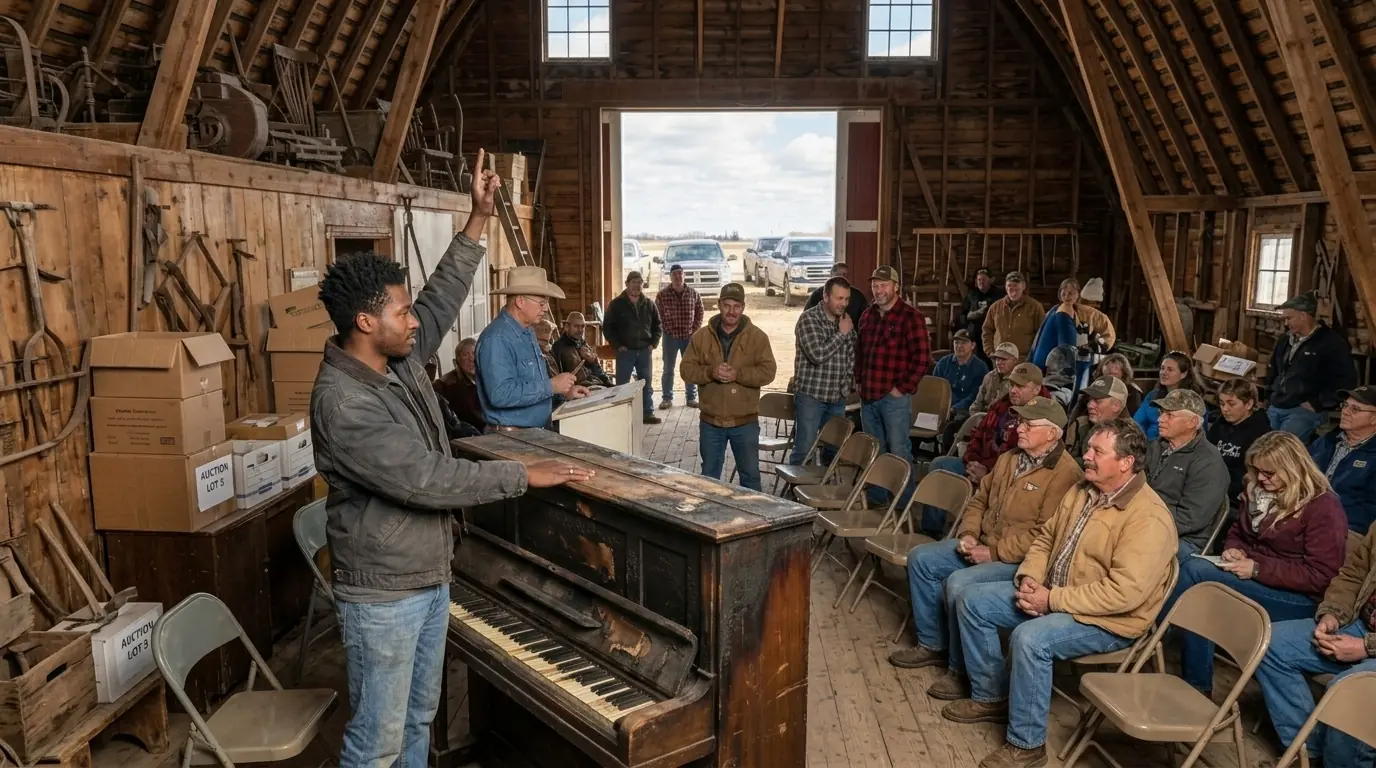
Garrett Fen's voice carried across the whole of the Dunore estate sale like he wanted it to—which was to say, like a man who has never once in his life said a thing quietly when an audience was available. The crowd in the old auction barn laughed the way crowds do when someone else is the joke: easy, and a little too loud.
Elliot Ash did not look up. His eyes remained fixed on the piano.
It was an ugly thing, and there was no arguing that. The lid had warped away from its hinges on one side, and the veneer had bubbled off the case in long strips, the way skin peels after a burn. Which, in a way, was exactly what had happened. The Dunore farmhouse had gone through a fire eighteen months back, and most of what had been inside it had gone with it. The piano had survived the way heavy, old things sometimes survive—through sheer stubbornness. Though surviving and coming through intact were two different propositions, and no one looking at this instrument would have confused the two.
Three of the ivory keys were missing entirely. The ones that remained had gone the color of old teeth. The auctioneer, a cheerful man named Stu Bellamy who ran sales out of a barn on the county road between Dunore and Lacombe, had started the bidding at $40 in the tone of a man who expects to give something away.
Nobody had moved.
Then, Elliot Ash raised his hand, and the room found something to look at.
He was twenty-two that spring, the kind of young that still surprises people when they see it doing serious things. He had driven out from Edmonton that morning in a truck that was older than he was. He had been standing near the back of the barn for the better part of an hour, working his way toward this piano the way you work toward something you are trying not to appear too interested in. He had his hands in his jacket pockets, and his face gave nothing away—a skill he had developed early and kept sharp.
He was the only Black man in the room. In a barn outside Lacombe, Alberta, this was not a thing he was surprised by, though it was a thing he was always aware of. He felt the particular, low-grade attention of a room that has already made up its mind about what a person is likely to want, and what they are likely to be able to afford.
"Forty," Bellamy said, pointing at Elliot with his gavel.
Garrett Fen was the kind of man Lacombe County knew well, and the kind it had stopped being surprised by. He ran a property management company out of an office on Main Street and drove a diesel truck that he idled in front of the post office for longer than necessary just because the sound of it pleased him. He was not a man who wanted a broken piano. He was not a man who played piano, or who had ever wanted to. But he was very much a man who understood the sport of watching someone spend money they couldn't spare on something that wasn't worth it. And he had a gift for recognizing that situation the moment it appeared.
"Fifty," Fen said.
The room stirred.
Elliot had $230 in his account. He had driven two hours to be here. He had a particular reason for wanting this specific piano that had nothing to do with its condition and everything to do with who had owned it. He was not going to explain that reason to anyone in this barn, which meant he was going to have to want it in front of all of them without saying why.
"Sixty," Elliot said. His voice came out even. He was glad of that.
"Seventy." Fen had turned back to his neighbor now, performing indifference, which was its own kind of attention.
The crowd was following the exchange the way a crowd follows anything that has a clear winner and a clear loser. Everyone in the room had already decided which role belonged to the young man with his hand up.
"Eighty."
"Ninety."
"You know," Fen announced to the room at large, his thumbs hooking into his belt. "I've bought a lot of things at auction in this county. Never once paid good money for firewood." He gestured at the piano with the casual authority of a man pointing out the obvious. "That's what that is. Firewood with keys on it."
He grinned at the men beside him, and the men obliged him with a laugh.
"One hundred," Elliot said.
The number landed in the room, and Fen looked at him then. He *really* looked, the way he had not quite bothered to before. Something shifted in his expression. It wasn't respect. It was something more like the recalibration a man does when a game becomes less predictable than he anticipated.
"One twenty," Fen said. His voice had lost its lightness.
"One forty."
The barn had gone the particular quiet of people who have stopped talking to watch. Bellamy was looking back and forth between them with the practiced expression of a man who has seen this specific play before, knowing his only job is to keep the numbers moving.
"One sixty."
"One eighty."
Elliot was doing the math that the room was also doing, which was that he was running out of runway fast. Garrett Fen had a diesel truck and a property management company and could go another $600 without feeling it.
"Two hundred," Elliot said.
It was not quite all he had, but it was close enough that the distinction was academic.
Fen let the silence stretch. He looked at Elliot the way a man looks at something small he is deciding whether to bother with. Then, he spread his hands and laughed.
"All right." He waved the whole thing off like a man dispersing smoke. "All right, son. You want the thing that badly? Go ahead." He turned back to the room. "I'm not going to take the boy's grocery money over a heap of burnt wood."
His voice was easy and generous, and it landed on Elliot like something wet and heavy.
"Going once," Bellamy said, and there was a smile in it. "Going twice. Sold to the young man for $200."
Elliot walked to the front and counted it out. He did not look at Garrett Fen. He did not look at the crowd. He looked at the piano. And when the counting was done, he put his hand flat on the warped lid for a moment, just briefly, and then he went to bring his truck around.
Nobody helped him load it. He hadn't expected anyone to. It took him the better part of forty minutes and a furniture dolly he borrowed without asking from the corner of the barn. Through all of it, the room found other things to bid on. All except for Garrett Fen, who watched from across the barn with a cup of coffee going cold in his hand, an expression on his face that was harder to read than it had been an hour ago.
***
What the room did not know was that the piano had belonged to Elliot's grandmother.
Her name had been Cecile Ash, and she had come to Alberta from Nova Scotia in 1971 with a husband who didn't last and a stubbornness that did. She had played the piano in the Dunore United Church for twenty-six years before her hands made that impossible.
The Dunore farm had belonged to the family she'd worked for, the Caldwells, who had no children, and who had loved her the way people love someone who has given their home a sound it didn't have before. When Eleanor Caldwell died four years ago, she had left the farm and everything on it to a niece in Calgary who had no idea what any of it was worth, or what any of it meant. The niece had held an estate sale, because that was the practical thing to do.
Elliot's grandmother had died the winter before. She had gone quietly in the night the way the best people sometimes do, leaving the people who loved her with the particular bewilderment of a grief that arrived without any warning. She had left him almost nothing in material terms, because she had almost nothing to leave.
What she *had* given him was time, and patience, and the particular gift of her hands. She had pressed them onto his when he was six years old, sat him down at this same piano in the Caldwell house while Eleanor Caldwell brought them tea, and she had said: *"Elliot, you're going to hear the music before you play it. Just listen first."*
He had been trying to do that ever since.
He had a degree in audio engineering from MacEwan University that he was six months into using and twelve months into paying for. He worked out of a studio space he shared with three other people in a warehouse district in Edmonton. He spent his days coaxing sound out of broken and mismatched equipment, because broken and mismatched was what he could afford. And he had learned over those months that broken things still made sound—sometimes, better sound. The imperfections were the character.
He drove back to Edmonton with the piano roped down in the truck bed, his mind going over the thing he had not let himself examine too closely yet. He knew the piano was damaged. He knew it possibly could not be restored to anything resembling its original function. He knew that $200 was money he did not comfortably have.
What he also knew—and this was the thing he had not said out loud to anyone—was that his grandmother had left something inside it.
She had told him so. Not directly, because she had not been the kind of woman who said direct things when an oblique thing would do. But in her last weeks, when he had visited her in the care home, and she had been clear-eyed and certain the way the dying sometimes become, she had taken his hand.
*"Elliot, you know that old piano at the Caldwells'. You remember there's a storage compartment under the bench, and there's a place I put things away under the felt in the top of the case, behind the hammers. Don't let that go without getting it."*
He had meant to go sooner. The estate sale had been announced before he could arrange it. By the time he got there, the bench was already gone—sold separately to a couple from Red Deer who had a use for the storage. The piano was going up in $40 increments with Garrett Fen making sport of the situation. He had paid $200 to find out what his grandmother had put behind the hammers.
***
The studio he worked in had a freight elevator and a loading dock. Two of his co-tenants—a sound designer named Osei and a woman who produced ambient electronic music and went by the name Lark—helped him get the piano off the truck and onto the elevator without anyone putting their back out. Elliot considered this a genuine success given the state of the instrument.
They set it in the corner of his studio space. Osei said, "That is a very sad piano," and Lark said, "I think it's beautiful." Elliot said nothing, because he was already on his knees with a flashlight, looking at the underside of the lid.
The piano was a Lesage upright, and anyone who knew Canadian pianos knew the name. An instrument built in Quebec in the middle of the last century. Solid and deliberate, made to last in houses where winters were long and music was one of the things that made them shorter.
The inside of the case, behind the soundboard and the hammers and the strings, had a narrow shelf of space that the fire had reached only partially. The felt lining had burned away at the edges but held in the middle. When Elliot reached in with careful hands and peeled back what remained of it, his fingers found a flat tin box—the kind that had once held shortbread cookies—sealed shut with the kind of grip that only happens when something has been in the same position for a very long time.
He set it on the floor in front of him and looked at it for a moment. Then, he opened it.
The first thing was a photograph. His grandmother at maybe thirty years old, standing outside a building he didn't recognize, laughing at something off-camera with a laugh he recognized completely, because it was the one she still had sixty years later. Beside her in the photograph was a man he had never seen before: tall and well-dressed, looking at her with an expression that people only have for someone they are certain about.
The second thing was a letter. Three pages in his grandmother's handwriting, addressed to no one and to everyone, which was to say, to whoever finally opened this box.
The third thing was a document, legalized, folded in thirds.
He unfolded it with hands that had stopped being steady and read it once fast, and once slow. The way you read something you need to make sure you are not misunderstanding.
He was not misunderstanding it.
Cecile Ash had come to Alberta in 1971 with a husband who didn't last. What the family had mostly allowed people to believe was that she had come alone. Which was not quite true. She had come with an agreement.
The man in the photograph was named Gordon Caldwell, Eleanor's husband, who had died in 1988, and who had been, it turned out, one of the most quietly principled men in Lacombe County. In 1974, after his company had grown into something genuinely valuable, Gordon Caldwell had drawn up a document with a lawyer in Edmonton whose name was on the letterhead.
In it, he established a trust.
The trust held a share of the original Caldwell Company, now folded into what had become Dunore Agricultural Holdings—a company Elliot had driven past on the county road and not known the name of. The trust was to be administered on behalf of Cecile Ash in recognition of her contribution to the family. The document described it in careful language that made it plain: Gordon Caldwell had understood that the kind of help Cecile had given his household was not the kind that could be compensated in mere wages.
The trust was to pass to her children and grandchildren.
It had never been claimed because Cecile had never told anyone about it. The lawyer's office had sent letters to an old Nova Scotia address that she no longer held. After three unanswered years, the trust had sat in a legal office in Edmonton, unclaimed, compounding quietly for nearly thirty years.
Elliot read his grandmother's letter. It took him two tries, because the first time through he was not reading so much as trying to hold onto the shape of what was happening.
She had not told anyone because she had not wanted anyone to feel they had been *given* something. She had wanted Elliot to find it when he was ready to do something with it—when he was old enough to make it into what it was supposed to be, instead of what fear might make it into. She had not told him the amount because she said she did not know exactly, and she did not trust herself to say a number without him hearing the number instead of the point.
*The point,* she wrote in her clear, steady hand, *is that you were always going to be provided for. I just needed you to find out you could do it yourself first.*
She had written one more thing at the bottom of the last page.
*Gordon put it there for me because he was a man who understood that the quiet work is always the work that lasts. And he wanted the people who came after me to know that someone saw it. Someone always saw it. Don't let anyone tell you that a thing done in good faith and without recognition is a thing done for nothing. The piano heard everything. It just needed the right person to open it.*
Elliot sat on the floor of his studio for a long time. Osei had gone home. Lark had her headphones on at her desk. The freight elevator hummed somewhere below, and the warehouse made the sounds warehouses make at night—a slow ticking and settling.
The piano sat in the corner of the room with its warped lid and its missing keys. He looked at it and let everything he was feeling go through him without trying to organize it. He was not sure what to do with a feeling that was grief and joy and something like vindication, all braided together.
He had spent $200 to drive two hours to be laughed at by a man in a diesel truck. And he had come home with a document that would need a lawyer to interpret, a letter that was still his grandmother's voice, and a photograph of a woman he loved at thirty years old, laughing at something he would never know.
***
The next morning, he called the legal office in Edmonton whose name was on the letterhead. He had to explain the situation twice before the person on the other end understood what he was describing. Then there was a pause on the line that lasted long enough that Elliot thought the call had dropped.
It had not dropped.
What followed over the next four months was not simple. The administration of a thirty-year-old trust is not simple, and a law office staffed by people who were not around when it was created is even less so. Elliot spent a portion of those months learning more about estate law in Alberta than he had ever wanted to know.
But the document was real. The trust was real.
The lawyer who finally took the file—a woman named Priya Johal, who had the focused energy of someone who found injustice annoying on a personal level—told him on their second meeting that the share had compounded significantly. And *significantly* was a word she used carefully.
She named a number. Elliot asked her to say it again. She did.
It was the kind of number that does not change a person's character, but does change the texture of every decision they have to make for the rest of their life.
He did not do what he might have done. He did not move to a larger apartment immediately, or trade the old truck in, or do any of the visible things. He sat with it for three weeks, which felt to him like what his grandmother would have wanted. And then he made a list of what he thought it was for.
The first thing on the list was a recording studio. A *real* one. Not a shared warehouse space, but a proper studio with a good room and proper acoustic treatment and equipment that did not require workarounds. It was going to be in Edmonton because Edmonton was where he was from and where he intended to stay. And it was going to be the kind of studio that could record a church choir or a hip-hop record or a bluegrass fiddle session, because in his experience, those were not as different as people assumed.
The second thing on the list was a program for kids. He had grown up in Edmonton—not poor, but adjacent to it. He knew the specific experience of wanting to make music and not having the equipment to do it, and the specific helplessness of watching that want get smaller every year until some people stopped having it entirely. He wanted to do something about that. Not abstractly, but concretely, with sessions and mentors and instruments that children could actually put their hands on.
The third thing on the list he almost did not write down. But he wrote it down.
***
He went to the Lacombe auction barn on a Saturday, six weeks after the documents were settled. He did not call ahead. He pulled in with the same truck, because he had not yet replaced it, and he walked in during an active sale. He waited until Stu Bellamy called a break, and then he asked for five minutes.
Bellamy was a fair man and a curious one, and he gave him the five minutes.
Elliot stood up in front of whatever crowd was in the barn that day—about forty people—and he told them he had been there six weeks ago and bought a burned piano for $200 and been laughed at for it. He did not say this with anger. He said it the way his grandmother would have said it, which was as a fact that deserved to be on the record.
Then he told them what had been inside it.
He did not tell them the amount. He did not need to. What he told them was that a man named Gordon Caldwell had put something in trust for his grandmother in 1974. That his grandmother had put the documentation inside the piano she had played her whole life. And that the piano had sat in an estate sale and been dismissed as firewood until a young man from Edmonton, who nobody expected to be interested in it, paid $200 and drove two hours because someone he loved had asked him to remember it.
He told them because his grandmother had believed in letting people reckon with true things.
The barn was quiet in the way it had not been quiet on the day he had bought the piano. He looked at Garrett Fen, who was standing against the far wall with his arms crossed, a face that had gone still in the way that faces go still when a story has landed somewhere uncomfortable.
Elliot held his gaze for a moment, not with cruelty, and not without purpose. And then he looked back at Bellamy, thanked him for the time, and drove back to Edmonton.
Garrett Fen said nothing that day. He drove home in his diesel truck and told the story to his wife in the kitchen that night. She said what any person with sense says when they hear that story, which was, "Lord, Garrett." And that was the beginning and the end of the sympathy he received on the matter—which was perhaps as much as he was owed.
***
The studio opened fourteen months later. Elliot named it after his grandmother, which was not a surprise to anyone who had known them both: *Cecile's*, with the accent on the first syllable, the way she had always insisted on.
He put a photograph of her in the lobby. The one from the tin box, the one where she was thirty years old and laughing at something just off-camera. People who came to record there asked about it, and he told them. Most of them understood immediately what they were looking at: a woman who had done the quiet work and trusted someone else to carry it forward.
The piano was there, too.
He had not repaired it and had not tried to. The missing keys were still missing, the lid still sat crooked on its hinges, and the veneer was still lifted away from the case in the pattern the fire had left it in. It stood in the corner of the lobby where the afternoon light came in, and it was the first thing you saw when you walked through the door.
Some things are worth more open than restored. The piano had held a secret for thirty years. Now it stood in a room full of music and held nothing back, and that seemed to Elliot like the right ending for a thing that had been waiting a very long time to be found.
There is a question at the end of a story like this one that is worth sitting with. It is not about Garrett Fen, who is simply a mirror in this story—a reflection of every voice that has ever assigned a value to a person or a thing before looking twice.
The question is about the piano. About all the burned and warped and missing-key things that get rolled out on a hand truck and priced for scrap because no one in the room has the particular reason to look closer. Cecile Ash played piano in a church for twenty-six years, kept a promise for thirty, and trusted her grandson to be the person who would know what to do.
She did not get to see him do it. That is the part of quiet faithfulness that costs the most. And it is also the part that tends to last.